HOSA Complete
 Call Kai
 Learn
Learn Practice Test
 Spaced Repetition
 Match
Match Flashcards
 Knowt Play
1/310

There's no tags or description
Looks like no tags are added yet.
Name | Mastery | Learn | Test | Matching | Spaced | Call with Kai |
|---|
No analytics yet
Send a link to your students to track their progress
311 Terms
Schizophrenia affects what % of people worldwide?
1% → 5x more likely in those of lower socioeconomic class
Bipolar disorder affects what % of Americans?
2.6% of adults
Depression affects what % of Americans?
7% of adult population
Anxiety affects what % of Americans?
30%
PTSD affects what % of Americans?
3-4% of adults
Insight Therapy
Historical approach which improves symptoms by building someone’s understanding of their own situation. Includes psychoanalysis
Talk, They Hear You Campaign
Reduce drinking in youth under 21, provide parent/caregiver resources
Interagency Coordinating Committee On the Prevention of Underage Drinking (ICCPUD)
Coordinate 15 federal agencies to develop a comprehensive plan to prevent underage drinking
STOP Underage Drinking
ICCPUD research website, federal/state resources, funding opportunities
National Prevention Week
Occurs in may. Promotes community involvement, resource distribution, and partnerships to increase community awareness
Communities Talk to Prevent Alcohol and Other Drug Misuse
National initiative, provides resources and stipends for community organizations, educational institutions, and state-wide initiatives. Organize activities for those aged 12-25 about the consequences of alcohol misuse.
National Children’s Mental Health Awareness Day
Increase public awareness and share initiatives that promote development, recovery, and resilience
Federal Commission on School Safety
Recommend policy and best practices for school violence prevention.
National Child Traumatic Stress Initiative (NCTSI)
Raise awareness about impacts of trauma on children/adolescents, develop and implement evidence-based interventions to reduce mental health impacts of trauma.
Electroconvulsive Therapy
Used in severe cases of depression that do not respond to other treatment. General seizures are induced while patient is anaesthetized (+muscle relaxant), caused by electrodes in the head.
Brain Stimulation
Electrical stimulation applied through surgically implanted electrodes to treat certain mood/anxiety disorders.
Neurofeedback
Used to treat ADHD and seizures, teaching client to keep measures of brain activity within a certain range.
Treating ADHD
Most common medications: Ritalin (methylphenidate), Adderal (amphetamine salts), and Dextrine (dextroamphetamine)
→increase dopamine and norepinephrine activity
Treating Schizophrenia
Phenothiazines reduce psychosis, but nearly a quarter of schizophrenic patients do not respond to it.
Tardive Dyskinesia
Syndrome that results from the use of phenothiazines by some patients, causing involuntary movements and tremors in the face and tongue.
Treating Bipolar Disorder
Most common medication is lithium carbonate. This has no effect on people w/o bipolar. Side effects include nausea, vomiting, muscular tremors, seizures, and comas. Regular blood tests are needed to monitor lithium levels.
Treating Major Depressive Disorder
Most common drug: Selective seratonin reuptake inhibitors (SSRIs) such as Zoloft and Prozac
CBT is the most popular psychotherapy approach
Treating Anxiety
Combinations of CBT and medications to increase GABA activity (GABA inhibits brain activity, combating the increased brain activity caused by anxiety). Antidepressants are more effective than GABA drugs due to potential underlying causes.
Treating OCD
Mix of CBT and medications, CBT for OCD involves anticipating a compulsion and then engaging in a competing behaviour.
Treating BPD
No specific BPD drug, but some common ones include antidepressants, antipsychotics, mood stabilizers (ex. lithium), anti-anxiety meds, and anti-convulsants
CBT focuses on forming relationships, and DBT (dialetical) focuses on reducing suicidal thoughts, and behaviours that interfere with therapy, and finally behvaiours interfering with daily life.
Four Dimensions of Recovery
Health, home, purpose, community
What federal law provides funding specifically for youth suicide prevention programs?
Garrett Lee Smith Memorial Act
Among those with serious mental illness, what % of deaths were caused by medical conditions such as cardiovascular disease, cancer, and pulmonary diseases?
95.4%
Heavy Drinking is defined as…
5+ alcoholic drinks on one occasion, on five or more days in the past month
Depressed people usually show unusually high activity in the…
right prefrontal cortex
Cyclothymia
Minor form of bipolar → 2+ years (or 1 for youth) of hypomania and depressive symptoms that don’t fit bipolar criteria
Bipolar 1 vs Bipolar 2
Bipolar 1: one severe manic episode
Bipolar 2: periods of hypomania, more often in the depressive stage
Individuals with OCD have lower than normal levels of ___ activity
serotonin
An estimated ___ americans 12+ were diagnosed with a substance abuse disorder in 2014
21.5 million
What percentage of adults experiencing a major depressive episode did not seek help?
33%
In 2024, what % of adults had co-occuring mental and substance use disorders?
34.5%
According to SAMHSA, addressing the impacts of substance use disorder costs how much yearly?
$600 billion
Every year, over ___ people report having a major depressive episode
15 million
What does short term residential rehab for substance use disorders focus on?
Detoxification
NAMI program for parents/family of children/teens with mental illness:
NAMI Basics
On average, smokers die ___ years earlier than non-smokers
13-14
NAMI support group for those with mental illnesses
NAMI Connection
NAMI program for the family members/SOs/friends of mentally ill individuals
NAMI Family Support Group
NAMI Basics on Demand is…
Free, online program for families of mentally ill youth to learn how to support their loved one.
NAMI resource for military and veterans
NAMI Homefront
NAMI In Our Own Voice is…
A presentation done by those who have experienced mental illness to share their personal perspective.
A NAMI educational program for adults with mental health struggles who want to better understand themselves is…
NAMI Peer-to-Peer
Black adults are ___ more likely to report psychological disturbance than white adults
20%
Only ___ of black adults that need mental health treatment receive it
1/3
NAMI Sharing Hope
Initiative created by black/brown people to support mental wellbeing in their own communities
Community Health Equity Alliance
Initiative prioritizing community-informed solutions → brings together leaders from state and local organizations for mental health advocacy, faith, civic and healthcare professional services for Black/African adults
What percentage of US psychiatrists identify as Black/African?
2%
What percentage of US adults with mental illness receive no treatment?
57%
___American adults experience serious mental health conditions
1/20
Within the mentally ill community, more than ___ deaths caused by chronic illness can be prevented
7/10
People with depression have a ___ higher chance of developing cardiovascular disease
40%
NAMI Hearts+Minds
Wellness program which blends physical and mental wellbeing together
Anosognosia
The inability to perceive one’s own illness, commonly seen in Dementia, Bipolar, and Schizophrenia (due to damage to frontal lobe causing distorted self image)
More than ___ US adults experience mental illness each year. In 2024, this amounted to ___ of the population.
1/5, 61.5 million (23.4%)
What percentage of US adults experienced an anxiety disorder in 2024?
19.1%
The average delay between onset of symptoms and treatment is…
11 years
What percentage of homeless people in 2024 had a serious mental illness?
18.1%
The suicide rate is nearly ___ higher among males than females in the U.S.
4x
What is the 2nd leading cause of death in the US for the 10-15 and 16-24 age groups?
Suicide
Stress
Unpleasant emotional state resulting from perceived danger, positive in the short term and negative in the long term.
Stress Response
Can be initiated by extreme cold, emotional experiences, and lack of oxygen.
Heart rate, blood pressure, and respiration increase, while nonessential functions (ex. digestion) decrease
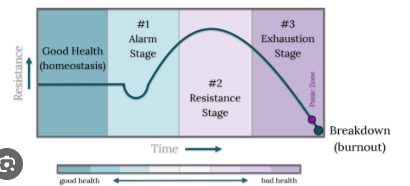
General Adaptation Syndrome
3-stage pattern of behaviour in response to stressors
How does Amygdala Affect Stress?
Participates in ‘fear circuit’ which provides rapid assessment of a stimulus as potentially dangerous. Once it is identified as dangerous, the amygdala communicates with the hypothalamus, which commands the AutonomicNS (fight/flight system)
Stress and the Immune System
In the short term, stress provides a temporary boost in immunity. In the long term, it kills/suppresses lymphocytes activity
3 Types of Coping
Problem-focused: aims to address the problem
Emotion-focused: aims to deal with negative emotions
Relationship-focused: aims to uphold and protect relationships during the stressor
Psychiatrists need what kind of education?
MD, 5 years residency, fellowship for subspecialty
Clinical psychologists need what kind of education?
PhD/PsyD, 5 years practice to register with the College of Psychologists
Counsellors need what kind of education?
Master’s degree, CCPA certification
Hypnotherapists need what kind of education?
Master’s degree, NBCCH (National Board Certified Clinical Hypnotherapist) or ACH certification
What are the Fundamentals of Recovery?
Self-determination and self-direction
Stress can cause high levels of circulating hormones. This can cause…
Death of neurons and inhibition of neurogenesis
Central Nervous System
Brain and spinal cord
Peripheral Nervous System
Nerves exiting CNS, carry sensory/motor information to the rest of the body
Somatic Nervous System
Division of PNS, brings sensory information to the CNS and transmits commands to muscles
Autonomic Nervous System
Division of PNS, directs activity of glands, organs, and smooth muscle
Sympathetic Nervous System
Division of Autonomic NS, coordinates fight/flight (arousal and stress)
Parasympathetic Nervous System
Division of Autonomic NS, coordinates rest/digest (repair and energy storage)
Enteric Nervous System
Division of Autonomic NS, consists of nerve cells embedded in GI tract
Spinal Reflex
Reflexes initiated by the spinal cord without assistance from brain
Sensory Neuron
Carry external information back to the CNS
Motor Neurons
Carry commands from CNS to the rest of the body
Interneurons
Have no sensory/motor function, connect others together
The brainstem contains…
The medulla, pons, and midbrain
Medulla
Controls vital functions such as breathing and heart rate. Contains nerve bundles travelling to/from higher brain levels
Pons
Relay center between medulla and midbrain. Aids in controlling arousal, facial expressions, and sleep
Cerebellum
Participates in skilled movements (balance and coordination) and, in humans, complex cognitive processing
Midbrain
Between Pons and Cerebral Hemispheres, involved in sensory reflexes, movement, and pain
Reticular Formation
Collection of structures along the midline of the brainstem, participates in mood, arousal, and sleep
Subcortical Structures
Lies under the Cerebral Cortex
Thalamus
Involved in processing sensory information, states of arousal, learning, and memory
Basal Ganglia
Collection of structures that participate in voluntary movement
Hypothalamus
Involved in motivation and homeostasis through hunger / thirst / arousal / aggression
Hippocampus
Essential for forming long-term memories
Cingulate Cortex
Anterior segment aids in decision making and emotion, posterior segment aids in memory and visual processing - located above corpus callosum

