Animal Physiology Exam 1 Part 2
 Studied by 0 people
 Call with Kai
 Learn
Learn Practice Test
 Spaced Repetition
 Match
Match Flashcards
 Knowt Play
1/94

There's no tags or description
Looks like no tags are added yet.
Name | Mastery | Learn | Test | Matching | Spaced | Call with Kai |
|---|
No study sessions yet.
95 Terms
what is homeostasis?
maintenance of a constant internal environment regardless of external conditions
what is the difference between osmoregulators and osmoconformers
osmoregulators keep a constant internal osmotic pressure while osmoconformers change internal osmostic pressure based on environment
what is the difference between ionic regulators and ionic conformers
ionic regulators maintain specific ion concentrations at all times while ionic conformers change ion concentrations based on environment
t or f: an organism can be an isoregulator and osmoconformer and the two parameters are not mutually exclusive
t
List an advantage and a disadvantage of regulation
advantage that cells bathed in constant environment but disadvantage that it costs energy (active transport)
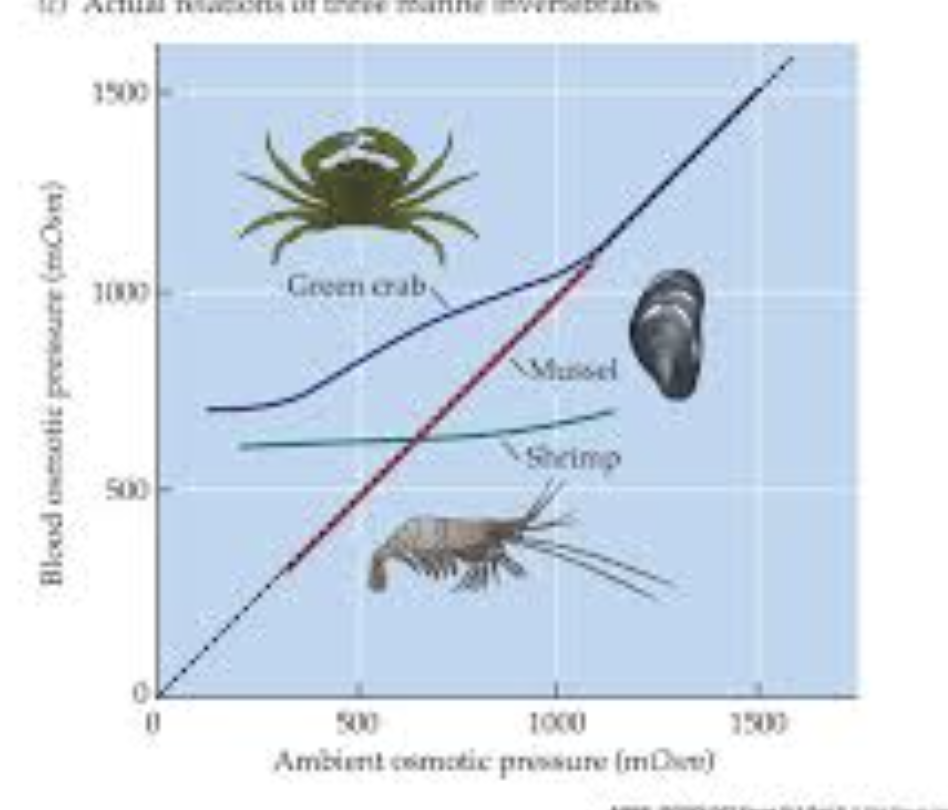
are these animals regulators or conformers?
green crab both / mussel conformer / shrimp regulator
List an advantage and a disadvantage of conformity
list an advantage and disadvantage of conformity
advantage is saves energy and disadvantage is cells must adjust to changing environment occasionally
many marine invertebrates are (__) and are therefore (__) with seawater
osmoconformers / isosmotic
what is interesting about marine teleost fish? is it osmoconformer or osmoregulator? will this fish gain or lose water via osmosis if its 1000 mOsm in the ocean and 400 mOsm in the fish? what about ions?
descended from freshwater ancestors / osmoregulator / lose / gain
explain the process of initial water and ion movement in marine teleost fish as they take in seawater and it travels to the intestine.
due to osmolality differences, fish lose water (osmosis) and gain ions (diffusion). They drink 10-20% of their weight to replace that lost water. Water moves into the lumen (osmosis) and ions diffuse into plasma. In the intestine, ions are actively transported into blood plasma and water moves back into the plasma (osmosis) through aquaporins.
what does the marine teleost fish could use and then actually uses to get rid of excess ions
secrete some magnesium and sulfate from urine but its isosmotic to plasma so instead uses chloride (mitochrondria-rich) cells
explain how chloride cells work
sodium potassium ATPase pumps sodium out of cell into blood and potassium into cell, creating a gradient. Sodium enters the cell through a co-transporter with potassium and chloride. Chlorine then diffuses to the water, creating a negative charge that attracts sodium ions
how do marine birds get rid of excess ions
nasal salt glands
What do you think the difference in diet is between groups of marine birds with high concentrations of sodium in the nasal secretion vs. lower.
the higher concentration secretion birds eat saltier prey, likely osmoconformers like marine invertebrates (squid)
do you think freshwater teleosts drink water (300 mOsm in fish and 3 mOsm in water)
no
do you think the urine produced by freshwater fish is more dilute or more concentrated then blood plasma (300 mOsm in fish and 3 mOsm in water)
dilute
t or f: chloride cells are present in freshwater fish
t
how do chloride cells work in freshwater fish
move Na+ and Cl- into fish blood (opposite of marine fish)
t or f: freshwater invertebrates are isosmotic
f
compared with saltwater relatives, what osmotic are freshwater invertebrates
hyposmotic (lower ion concentrations)
What are 3 physiological differences between freshwater and saltwater fish related to them acclimated in different osmolalities
chloride pumped in for freshwater and out for saltwater, saltwater fish drink water but freshwater don’t, and saltwater fish have isosmotic urine while freshwater fish have hyposmotic urine
what are fish that are born freshwater and then go to ocean
anadromous
what are fish that are born in the ocean and then live in freshwater
catadromous
If the osmolality of a shark’s blood plasma is higher than that of seawater, in what direction will water move? solutes? What are the levels of Na+ and Cl- like? are sharks regulators or conformers? To counter the levels of Na+ and Cl-, what do sharks do and then what counters this
into shark / out of shark / low / conformers / high urea concentration / high TMAO to prevent harm from urea
what do sharks have that secretes NaCl
rectal gland
why is chloride cell activity higher in marine fish than freshwater fish?
they need to get rid of the excess salts gained from drinking salty water (hypertonic solution)
evaporative water loss depends on?
humidity/vapor pressure (the amount of water in the air), permeability of body surface, and thickness of body surface
evaporation occurs faster in what conditions
dry environment and low vapor pressure
certain tissues can resist water diffusion, referred to as (__), which (__) at higher temperatures
permeability / increases
rate of evaporation from a surface is based on
Fick’s law of diffusion
what is fick’s law of diffusion
J = K (WVPS - WVPa) / X (net rate of evaporation = permeability (vapor pressure of surface - vapor pressure of air) / distance or membrane thickness)
what is vapor pressure and how is it related to absolute humidity
amount of water vapor in air / as vapor pressure increases, humidity increases until air reaches saturation and then it condenses
at saturation, does warm or cold air hold more water
warm
humidity is often expressed as (__), which is what?
relative humidity / amount of water in air relative to what it can hold at saturation
If the relative humidity is 50% and the air can hold 30.4 mg H2O/L at 30 degrees Celcius, how much water is in the air
15.2 mg H2O/L
water content in the air is expressed as (__) and in units of what
vapor pressure / mm Hg or kPa
at 30 degrees Celcius and 50% relative humidity, what is the vapor pressure if the saturation water vapor pressure is 31.8 mm Hg
15.9 mm Hg
the vapor pressure of pure water is dependent what two things? It corresponds with the (___) of air at the (__) temp. based on (__) properties
temperature and solute concentration / saturation vapor pressure / same / colligative
greater osmolality = (__) vapor pressure
lower
what would happen to the vapor pressure of the air and water in aqueuous solution in a closed container and why
become the same pressure/reach equilibrium / aqueuous solutions interact with air in terms of vapor pressure
If you are in a desert with low vapor pressure, will you evaporate sweat rapidly or slowly? Use Fick’s Law to justify
rapidly because there is a large difference between vapor pressure on surface of skin and ambient vapor pressure
After sweating for a long period of time, what will happen to the rate at which your sweat evaporates?
osmolality around skin increases due to salt, so vapor pressure of skin decreases, so rate of sweating will decrease since there is a small difference in vapor pressures
sweat evaporation is less efficient when you’re staying still, rather than moving. how does the idea of a boundary layer explain this
when not moving, the sweat accumulates and forms a thicker boundary layer. this creates a smaller difference in vapor pressures at the surface of your skin and increases the distance the sweat must travel to evaporate, thus slowing down sweat evaporation
what is cutaneous water loss
passive loss of water vapor through the integument
t or f: cutaneous water loss (CWL) and sweating are the same
f
t or f: all organisms do CWL
t
cutaneous water loss is determined by…
animal’s resistance to water loss through the integument
what is the relationship between resistance and permeability
inverse
what resistance and permeability levels do amphibians have? what about birds and mammals?
low resistance and high permeability / high resistance and low permeability
what provides resistance to CWL and where are these found in animals?
lipids / skin surface
terrestrial insects secrete primarily what on skin
alkanes and other hydrocarbons
what do some terrestrial frogs do with lipids they secrete
wipe it across their skin
in many terrestrial vertebrates, lipids are found where? List the layers from inner to outer
Stratum Corneum / dermis, epidermis, SC
how does water move through lipid layers
moves through intercellular lipids (living part) around the corneocyte cells
Does water move more easily through ordered or disordered lipids and why?
disordered because they’re not packed as tightly
When are lipids more disordered?
greater proportion of nonpolar groups so less hydrophilic, short hydrocarbons chains, unsaturated hydrocarbons with kinks, abundance of bulky structures
how do birds from the desert of Saudi Arabia compare to birds from temperate Ohio in regards to rates of CWL? What about their lipid compositions? Hydrocarbon chain lengths?
SA birds have lower CWL than OH birds / SA birds had more polar lipids while OH birds had more nonpolar free fatty acids / SA birds had greater hydrocarbon chain length than OH birds
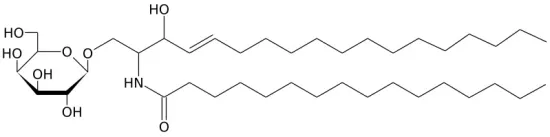
Mice and humans who have Gaucher disease have abnormally high concentrations of cerebrosides in their stratum corneum. Do you expect cutaneous water loss to be higher or lower in these individuals? Make an argument for both and then state what actually happens
due to the bulky head, it could cause higher water loss. due to the polarity of the hydroxide groups that could hydrogen bond with water, it could cause lower water loss / Gaucher disease makes skin very permeable and they have higher CWL
in humans and mice, an increase in cerebrosides increases or decreases CWL?
in birds, an increase in cerebrosides increases or decreases CWL?
increases / decreases
is CWL rate higher or lower in summer caught compared to winter caught house sparrows and why
higher in summer because CWL allows them to cool down
what machine is used to measure molecular interactions
infrared spectroscopy
how does water content change as you move deeper into the layers of the stratum corneum of summer birds? What about hydrogen bonding in summer vs. winter birds? What does this mean about level of cerebrosides in deep layers vs. superficial layers.
increases / strong H-bonding in winter birds but no pattern in summer birds / winter birds should have more cerebrosides in deeper layers and summer birds should have no gradient
why don’t cerebrosides work the same way in mammals as they do in birds
mammals have high amounts of cholesterol in stratum corneum (25% vs. 2%) that could be too much bulky molecules
What is interesting about the cerebroside levels in bats? What purpose do they maybe survive? What prediction would you make about cholesterol levels compared with other mammals?
arid bats have more cerebrosides / hydrate skin to making it stronger for flight / lower cholesterol
where are the most cerebrosides found in bat wings and why is this significant
uropatagium / area where bat wing experiences most stress
do alligators have cerebrosides? cholesterol?
yes / yes
what do cerebrosides in alligators tell us?
birds and alligators share a common ancestor, dinosaurs likely had cerebrosides, and cerebrosides are a preadaptation for light and minimizing water loss in arid environments
How are the lipids in alligator hands different from the rest of the body and why?
more polar lipids with cerebrosides that hydrate the skin and help to strengthen it for movement
how can cutaneous water loss change on an acute time scale
increasing temperature increases K in Fick’s Law / more CWL during summer than during winter
lipids that increase in temperature, reach a (__) and become more (__) to water.
melting point / permeable
tight lipid structure
orthorhombic
lipid structure with small gaps
hexagonal
loose lipid structure
liquid
explain the process of respiratory water loss
cool air enters nasal passages and warms up and nasal turbinates cool down. the air becomes saturated with water vapor
warm, saturated air comes out of lungs and back through nasal turbinates, which are still cool
as air exits, turbinates are warmed and air is cooled. water condenses and is not exhaled
does mouth or nose breathing cause more water loss and why
mouth breathing because mouth lacks nasal turbines and thus must use more water to warm the air and then that air is not recycled when exhale.
thin, scroll-like bones in nasal passages that help conserve respiratory water
nasal turbinates
When comparing turbinates of animals, B is more intricate than A. which of these two carnivores inhabit a drier environment?
B because it has more surface area to warm and moisten the air
t or f: kidneys vary in morphology but have similarities in structure and function
t
what similarities to kidneys of different animals share
all consist of tubular elements that discharge to outside world
all produce and eliminate aqueous solutions derived from blood plasma or other bodily fluids
regulate composition and volume of blood plasma through excretion of solutes and water
excrete nitrogenous waste and maintain blood pH
explain how kidneys regulate homeostasis by explaining the difference between a deydrated and overhydrated person
dehydrated person has very concentrated urine to conserve water while an overhydrated person has very dilute urine to get rid of water
what percent of blood is plasma
55%
functional unit of kidneys
nephron
explain the process of blood/urine in the nephron of the kidney
At the Bowman’s/Glomerular Capsule, blood enters the afferent arteriole
It is ultrafiltered
Blood exits the efferent arteriole
Nephron interacts with blood, forming primary urine at the Bowman’s Capsule.
Definitive urine is excreted from the nephron/final product to leave kidney
What is the difference in size between the afferent and efferent arterioles and why does that matter?
afferent arteriole where blood enters is larger, which creates a positive blood pressure in the glomerulus to allow the blood to be filtered as it moves
how is blood filtered in the glomerulus
capillaries in glomerulus contain fenestrations (pores) and podocytes covering the fenestrations have slits
how fast is all body water filtered
30 minutes
What type of pressure is in the blood that allows it to move from plasma into nephron? What two forces oppose this movement?
positive hydrostatic pressure in capillaries / hydrostatic pressure of capsular space and colloid osmotic pressure of glomerular capillaries
why is there hydrostatic pressure in capsular space of glomerular capsule?
as blood moves into the glomerular capsule from blood, it exerts pressure back on glomerular capillaries
why is there colloid osmotic pressure of glomerular capillaries?
albumin in blood can’t fit through the fenestrations, so osmotic pressure is raised
If the hydrostatic pressure in the capillaries is 55 mmHg, hydrostatic pressure of capsular space is 15 mmHg, and colloid osmotic pressure of glomerular capillaries is 30 mmHg, what is the Net Filtration Pressure (toward nephron positive)
10 mmHg
the 3 forces that interact to determine filtration pressure, determines what
glomerular filtration rate (GFR)
People with nephrotic syndrome excrete large amounts of albumin in their urine.
What has likely happened to the size of the fenestrations in the glomeruli in these individuals?
These individuals also suffer from edema, as water from the blood plasma flows into the tissues of their arms and legs. Why do we see this symptom?
larger / loss of albumin leads to less pressure for water to enter blood and thus accumulates in tissues
chronically high glomerular (blood) pressure results in
damage to glomerulus
effect of high blood pressure on kidneys
damages podocytes and concentration of nephrin protein increases in urine. GFR becomes nonfunctional and results in chronic kidney disease (CKD)
 Note
Note  Flashcards (20)