CHE217 LECTURE 1-5
 Call Kai
 Learn
Learn Practice Test
 Spaced Repetition
 Match
Match Flashcards
 Knowt Play
1/38

Earn XP
Name | Mastery | Learn | Test | Matching | Spaced | Call with Kai |
|---|
No analytics yet
Send a link to your students to track their progress
39 Terms
LEVEL OF STRUCTURAL ANALYSIS
Atomic Structure (Sub-nanometer scale)
Microstructure (Nanometer to Millimeter scale)
Macrostructure (Millimeter to Meter scale)
ATOMIC STRUCTURE
Deals with the atom, atom bonding, and atom arrangement. This level dictates the fundamental, intrinsic properties of a material
BONDING
The type of bond (metallic, covalent, or ionic) determines the melting temperature, thermal conductivity, and electrical conductivity.
ARRANGEMENT
The type of bond (metallic, covalent, or ionic) determines the melting temperature, thermal conductivity, and electrical conductivity.
MICROSTRUCTURE
Refers to the structure seen with the aid of a microscope. It includes grains, grain boundaries, phases, and phase boundaries. This is the level most actively manipulated by engineers to change a material's behavior.
MECHANICAL PROPERTIES
Microstructure heavily controls yield strength, hardness, and toughness.
GRAIN SIZE EFFECT
According to the Hall-Petch relationship, materials with smaller, more numerous grains are generally stronger because the high number of grain boundaries restricts the movement of defects (dislocations). Heat treatments and varied cooling times during solidification are specifically designed to alter this level.
MACROSTRUCTURE
The structure visible to the naked eye. Involves volume defects (like pores and cracks) and macrograins. This level is critical for overall structural integrity and failure analysis.
SOLIDIFICATION DEFECTS
During the casting and solidification of metals, issues like shrinkage (as the metal cools and contracts) or gas porosity (trapped bubbles) manifest at this scale. These volume defects act as stress concentrators and are frequent starting points for fractures or part failures.
SOLIDIFICATION
process where a liquid metal transforms into a solid upon cooling.
FREEZING POINT
solidification starts when a liquid is cooled below its ____
CRYSTAL STRUCTURE AND ALLOY COMPOSITION
what are decided in the solidification process?
MAIN BRANCH W/ MANY APPENDAGES
solidification of crystals follow a pattern consisting of a ___
SINGLE CRYSTALS
Individual crystals are called grains
POLYCRYSTALLINE
Most materials are ___ meaning they are composed of many crystals.
OVERARCHING PROCESS OF SOLIDIFICATION
Nucleation - Growth - Grains
NUCLEATION
Formation of “seed” from which a new phase will grow.
Involves the appearance of very small particles, or nuclei of the new phase (consisting of a few hundred atoms), which are capable of growing.
CRITICAL MASS
Minimum amount of material required to form a stable seed
TYPES OF NUCLEATION
Homogeneous Nucleation
Heterogeneous Nucleation
HOMOGENEOUS NUCLEATION
Nucleation in the parent phase (unaided).
Prominent in pure metals.
Nuclei of the solid phase form in the interior of the liquid as atoms cluster together
HETERGENEOUS NUCLEATION
It is easier for nucleation to occur at surfaces and interfaces than at other sites
Nucleation occurs with the help of impurities or chemical inhomogeneities
The presence of artificial seeds or inoculants speeds up nucleation by assuming a portion of the critical mass.
Artificial seeds include: surface or boundaries, dislocations, grain boundaries, and inclusions
GROWTH
Process of seed enlargement.
Growth is diffusion based.
As temperature increases, diffusion increases, leading to increased growth.
DIFFUSION
Atom movement from a region of high concentration to a region of low concentration.
Diffusion is vital for processes like nucleation, growth, recrystallization, and phase transformations.
APPLICATIONS OF DIFFUSION
Carburizing
Nitriding
CARBURIZING
A technique of case hardening steel by increasing carbon content at the surface through heat treatment.
NITRIDING
A heat-treating process that diffuses nitrogen into the surface of a metal to create a case-hardened surface.
TYPES OF DIFFUSION
Self-DIffusion
Interdiffusion or Impurity Diffusion
SELF-DIFFUSION
Atoms of same material moving within lattice
INTERDIFFUSION OR IMPURITY DIFFUSION
Atoms of different material moving within lattice
PREREQUISITE OF DIFFUSION
There must be an empty adjacent site
The atoms must have sufficient energy to break bonds with its neighbor and then cause lattice distortion during displacement
VACANCY DIFFUSION
Occurs at high temperature since more vacancies are formed.
INTERSTITIAL DIFFUSION
Involves interdiffusion of impurities such as H, C, N, or O.
FACTORS AFFECTING DIFFUSION
1. TEMPERATURE
2. SIZE OF DIFFUSING SPECIES
3. ATOMIC PACKING FACTOR
4. BONDS OF STRUCTURE
5. PRESENCE OF OTHER DIFFUSION PATHS
TEMPERATURE
Increasing temperature increases diffusion rates
DIFFUSION RATE FORMULA
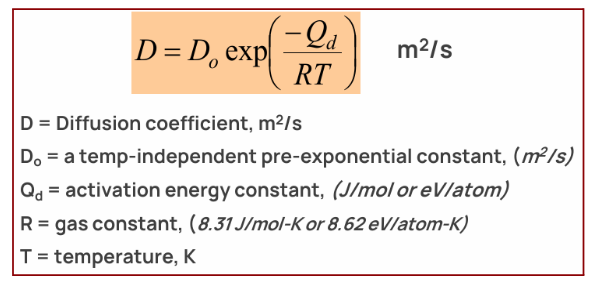
SIZE OF DIFFUSING SPECIES
The smaller the diffusing atom, the faster diffusion is.
ATOMIC PACKING FACTOR
The lower the APF, the faster the diffusion is.
BONDS OF STRUCTURE
The weaker the bond, the faster diffusion is.
PRESENCE OF OTHER DIFFUSION PATHS
Dislocations and grain boundaries hastens diffusion

