WSU CVA bio 324 2026 Exam 2
 Call Kai
 Learn
Learn Practice Test
 Spaced Repetition
 Match
Match Flashcards
 Knowt Play
1/59

There's no tags or description
Looks like no tags are added yet.
Name | Mastery | Learn | Test | Matching | Spaced | Call with Kai |
|---|
No analytics yet
Send a link to your students to track their progress
60 Terms
Aerial Locomotion Types (5)
Jumping, parachuting, gliding- evolved in all classes of vertebrates
Jumping- fish, mammals, reptiles, amphibians
short distances, escape predators
Parachuting- flying squirrels, flying frog, pygmy opossum, fish, mammals, reptiles, amphibians
trap air, soften impact
Gliding- fish, mammals, reptiles, amphibians
Deflect the line of fall
Flailing
Increases distance, steering
Powered flight- birds, bats, pterosaurs, 3 independent lineages
New lifestyle
Gliding/Parachuting
ex- pygmy opossum-parachuting marsupial
loose flap of skin is called a patagium, extends to wrist and catches air to slow
tail is used as a rudder
ex-Colugo-flying lemurs, largest patagium and best gliders, patagum from tips of tail to tips of digits
ex- flying frog-webbed toes trap air
ex-flying lizard, flares out ribs and loose flaps of skin
ex- flying snake, flattens ribs and body
ex- flying fish, enlarged pectoral fins, extended to deflect air
Powered flight
ex- bats
long digits make up the wing and patagium
thin, elongated scapula along body axis, 1 free digit (thumb)
ex- pterosaurs
elongated 5th digit akes leading edge of wing and digits 2,3,4 are used as hooks and 1 is in the patagium and similar to the bat
some winged dinos had spans of 20ft
ex-birds
most efficient fliers, thousands of miles, 100mph+, flight first originated in dinos but only one of the lineages became the birds
gave rise to the lineage of flightless birds (ostrich, penguins, elephant bird
Modern birds have flight feathers and reduction of digits
Archaeopteryx looked like a dino for everything else (had two traits above)
Origin of flight (3 hypotheses)
Arboreal- tree down
Ground up- cursorial
Insect-net
climbing
Ground up- cursorial
Cursorial/Insect-net theory
Running with short hops
Wings used to catch insects or small prey
Climbing theory
Wing assisted incline running (WAIR)
Aerodynamics- Bernoulli’s principle
Bernoulli’s principle
As fluid velocity increases, pressure in the fluid decreases
Airfoil shape
cambered wing with airflow over the top forms lower pressure on the top of the wing and higher pressure on the bottom which provides lift
cambered wing/airfoils-asymmetical wing that is curved slightly at the top
Angle of Attack
Lift -airflow going over bird, must overcome m*g or weight
Drag-
Thrust- must overcome drag
Weight- mass*gravity
Birds can change angle of attack with muscles to alter lift and drag
pilots change AOA with whole plane, risk is that it can stall with no lift and fall out of the sky
Flight feathers
Primary-attach to manus/wrist
Secondary-attach to forearm, radius+ulna
Soaring vs Thrust Bone formation
Hummingbird-short upperarm and forearm with long manus for primary feathers (thrust), rapid flapping, can’t soar, will drop
Albatross-medium upper arm and long forearm for secondary feathers (lift) and short manus, soaring for days, endurance
Shape of wings
Elongated- lift (shearwater
Short, robust- maneuverable (pheasant)
Streamline- fast (swallow)
Intermediate- (rough legged hawk)
Bone Tradeoffs for flight
light bones need less energy and thrust and lift
Penguins- thick bones for swimming against water
Auk- sea bird that dives for fish but still has to fly
Sea gull- soaring
Aerodynamic adaptations
Sclerotic ring- prevents deformation of eye while flying
Feathers- streamlining, contour feathers (body) to reduce drag
Rigid synsacrum and axial skeleton to resist aerodynamic forces, dont need as many axial muscles to lighten body, metabolically good, fusion of bones means resisting twisting forces is easier
Tubular/hollow bones- lighten skeleton, trabeculae are strings of bone tissue and theres no marrow
Why flight?
Travel great distances (thousands of miles) and migration, energy efficient
Catch prey or escape predators
Better access to food resources or others
Cranial Skeleton
Splanchnocranium
Dermatocranium
Chondrocranium
Modern vertebrate skull made of 3 components
Old skull theories (wrong)
Source of skull is the continuation of vertebrae
no fossil evidence of ancestor with vertebrae in head
Composite skull structure
Multiple components and they come together to form the skull
Remodeling from three evolutionary sources
Splanchocranium- (digestive prefix) branchial support structures of pharynx of protochordates, cartilage or bone
Chondrocranium- brain support in early fishes
Dermatocranium- dermal bone or armor of ostracoderms/placoderms (early fish)
Splanchnocranium
Jaws of early gnathosomes, linker bones for jaws, hyoid support for base of skull and gills and or respiratory muscles, inner most part of skull
Chondrocranium
Supports and protects brain, sensory capsule, top part of inside skull
mesenchyme to cartilage, spenoids and ethmoids are the only endochonral bone, rest are dermal
cartilage to bone, except chondrichythes
Dermatocranium
Protection of the head, entire casing of fish skull basically, came from dermal bone plate ontop and it wrapped around
Derived from Dermal armor
Embryological Change
Function-protect the brain!
Embryology +catilage
Condensations of cartilage
Grow into plates
Ossify
General Functions of Chondrocranium
Adult braincase (chondrichythes)
Support and protect brain
Scaffold (most vertebrates)
Centers for ossification
Neurocranium- if ossified
General Functions of the Splanchnocranium (visceral cranium)
Support respiration (fish, amphibian larvae)
support feeding apparatus (tongue, hyoid apparatus)
Jaws and jaw connectors (later)
Derived from anterior branchial arches (mandibular arch/1st branchial arch)
Evidence: embryology, supply of blood vessels, nerves, musculature
FISHY jaws
Agnathans-jawless
Gnathostomes- jawed
General Functions of Jaws
Prey Traps
Crushing/Tearing food
Without jaws- options are filter feeding, parasitic, and suspension feeding
ex-lamprey (jawless) can latch and suck blood
Hypothetical Ancestor- Agnathan
Jawless
Origin of jaws are from front branchail arches
Also gave rise to connective bones that attach to jaws
Shark Embryo Skull
Serial vs Composite hypotheses
Mandibular arch=first branchial arch
Alfred Romer- (serial)
Arch 1 became jaws, and arch 2 became hyoid arch
Erik Jarvik- (composite)
Other pieces of cartilage join up,not just first mandibular arch 1
Jaw Suspension Types (3)
Hyostyly-primary hymandibula (sharks, fish)
Amphistyly two primary articulations, hyomandibula and directly to skull via ligament, more primative (placoderms)
Autostyly-without hyomandibula ex-quadrate to articular (reptiles)
Lineages
Mammals, primitive mammals, therapsids (premammals, limbs rotated forward, jaw attachment changed, mammal like reptiles), pelycosaurs (synapsids, sail back), CENTRAL DIVERGENCE cotylosaurs, amphibians
Changes in synapsid jaw articulation
Reduction in articular and increase in dentary
3 bones turned into middle ear ossicles for sound amplification
transmit vibrations through middle ear into inner ear
act as a lever system amplified between each bone, amplifies about 40x
quadrate→incus
articular→malleus
hyomandibula→stapes
Cuvier dilemma
Animals function as wholes and parts fit/work together, so if you remove/ change one part, others will fail. How to change jaw articulations without jaw system failing?
ancestreal=articulat to quadrate
Probainognathus-early synapsid
Had two jaw articulations and could lose the quadrate/articular without problems
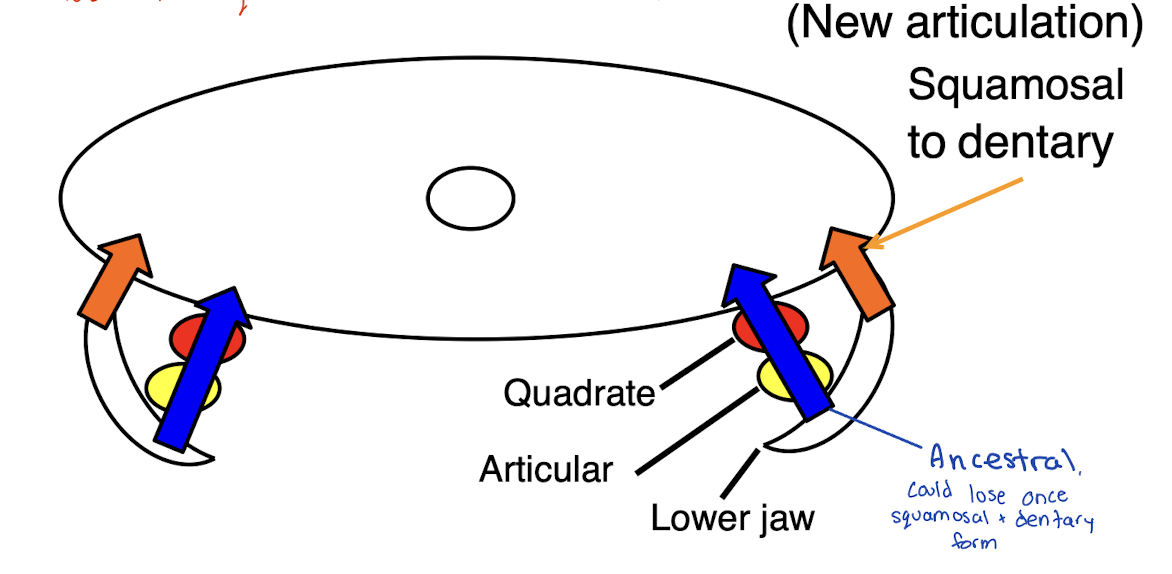
Skull Fenestrae
cons- Weaken Skull
Lighten skull
Increase surface area for muscle/connective fissue
Space allows for bulging of muscles when it contracts
Anapsid-0
Synapsid-1
Diapsid-2
Skull Functions
Primary
Protection
Feeding
Prey traps
Swallowing, respiration
Secondary
Heat exchange- airflow would cool boood circulating to nasal cavity if overheating
sound resonance- sound transmitted through nasal cavity (changes when you are sick)
Skull Function Feeding Methods (aquatic and land)
Filter feeders (A)
Suspension feeders (A)
Suction feeders (A)
Prehension- grab with jaws
(A) is aquatic only
Filter Feeders (aquatic)
Benthic- feed at or near bottom
Small sized particles- not efficient for larger vertebrates
Tight coupling of feeding/respiration
Early Agnathans:ostracoderms raised and lowered pharynx to bring water into oral cavity, not efficient
-not effcienent for large vertebrates (excludes blue whales- only eats krill/suspension feeders)
Suction feeders (aquatic)
Gape ‘n suck
Ingest larger food
More efficient
Use the inertia of water- pulls water in and inertia also bring the food in
Coupled to respiration
Facial muscles contract and move one bone which push/move others via flexible joints, sides of skull flare outwards and creates negative pressure (Cranial Kinesis)
Prehension
Use jaws to grab, bite, tear
Mandibular arch rides forward on its suspension via hyomandibula which increases the gape
Skull Function Feeding (air)
Lingual Feeding
Using tongue (sticky mucus, ex-salamanders and lizards)
Jaws (prehension)
Grab with jaws
Lingual Feeding
Mucus covered sticky tongue, muscles at base of tongue and it is used first to bring food into the mouth
Hyoid bone (with long lingual process and tongue muscles
Glossohyal (retractor muscle), tendon, lingual process, accelerator muscle using the method of a hand squeezing a bar of soap
Prehension (air)
Adaption is a jaw joint
Bone articulations/muscles to open and close
Quadrate and mandible allow wider gape
Skull Function-Swallowing
suspension, filters
ex-baleen whales filter water from krill
whole, often with a gizzard
snake, lizard, bird pebbles in crop grind
mastication, chewing
ex-mammals
Mastication (chewing)
Primary palate- top of nasal cavity (early synapsid)
Secondary palate- allows continual chewing while breathing, top of oral cavity
Mammals have two cavities, Separate nasal and oral cavities, more efficient
If there is no secondary palate then reptiles must top eating to breathe and cows can rechew because they have a secondary palate
Mastication (teeth)
Precise occlusion of teeth (alignment)
Specialized teeth (piercing, tearing, grinding)
Diphyodont (two sets of teeth-mammals-baby and permanent) and polyphyodont (constant replacement-sharks)
Akinetic: no relative motion of skull bones across joints allows precise alignment of specalized teeth
Cranial Kinesis
Not fused tightly to allow for movement
Not good for chewing or crushing
Allows for
rapid change in size and configuration of buccal cavity
feeding methods
alter tooth position
Skull can flex bones and therefore teeth for better grip on prey
appying even force on top and bottom prevents prey from shooting out like a bar of soap
ex-fish, snakes, lizards, birds
Akinetic- amphibians, turtles, crocs, mammals
Snake Kinetic Skull
Ex- Snakes Can swallow prey larger than their head,very flexible jaw 90 degrees, unfused mandible in the front with stretchy ligament
Rattlensake strike
raise.rotate whole maxilla to raise.erect fangs and strike
use muscles of head to move skull bones
MUSCLESSSSS (3, and their subs+ 1 bonus)
Skeletal
Supply power for moving skeletal system
Restrain/restrict movement
Heat production/shivering
Smooth
Walls of hollow organs/tubes
Digestive tract (mixing, peristalsis)
Blood vessels (regulate diameter)
Cardiac
Wall of heart (pumping blood)
Specalized
Electric organs
Electric Organs
blocks of specialized skeletal muscle
Round disc shaped cells, stack (skeletal muscle is normally rod shaped)
contraction will produce a small charge
more rows and stacks will add current
some use low surrounding voltage for navigation and feeling changes
higher voltage for stunning prey or defense
AKA torpedo organs because first found in the torpedo ray
Skeletal muscle/connective tissue
Muscle organ (encased by epimysium)
Perimysium are around the fassicles
Fassicles are the bundles of muscle cells
Endomysium encases the muscle cell (chunks of myofybril)
Epimysium, perimysium, endomysium are all conective tissue
Tendons
Attach muscle to bone, continuous with connective tissue covering of bone and distribute force of muscles over long distances
Function
reduce blood supply
metabolically cheap
lighten distal limb
force generation without weight, not much vascularization or require blood/o2
Support Structures of muscles
Retinaculum- wrap around tendons for support
Bursae- fluid filled pouches to reduce friction

