MB381 FINAL EXAM
5.0(1)
 Studied by 1 person
 Call Kai
 Learn
Learn Practice Test
 Spaced Repetition
 Match
Match Flashcards
 Knowt Play
Card Sorting
1/136

Earn XP
Last updated 10:20 PM on 3/5/23
Name | Mastery | Learn | Test | Matching | Spaced | Call with Kai |
|---|
No analytics yet
Send a link to your students to track their progress
137 Terms
1
New cards
Project
A **temporary** endeavor undertaken to create a unique product, service, or result
2
New cards
Characteristics of a project
•Has an established objective
•Has a defined life span with a beginning and an end
•Involves several departments and professionals
•Involves doing something never been done before
•Has specific time, cost, and performance requirements
•Has a defined life span with a beginning and an end
•Involves several departments and professionals
•Involves doing something never been done before
•Has specific time, cost, and performance requirements
3
New cards
Program
A group of related projects designed to accomplish a common goal over an extended period
4
New cards
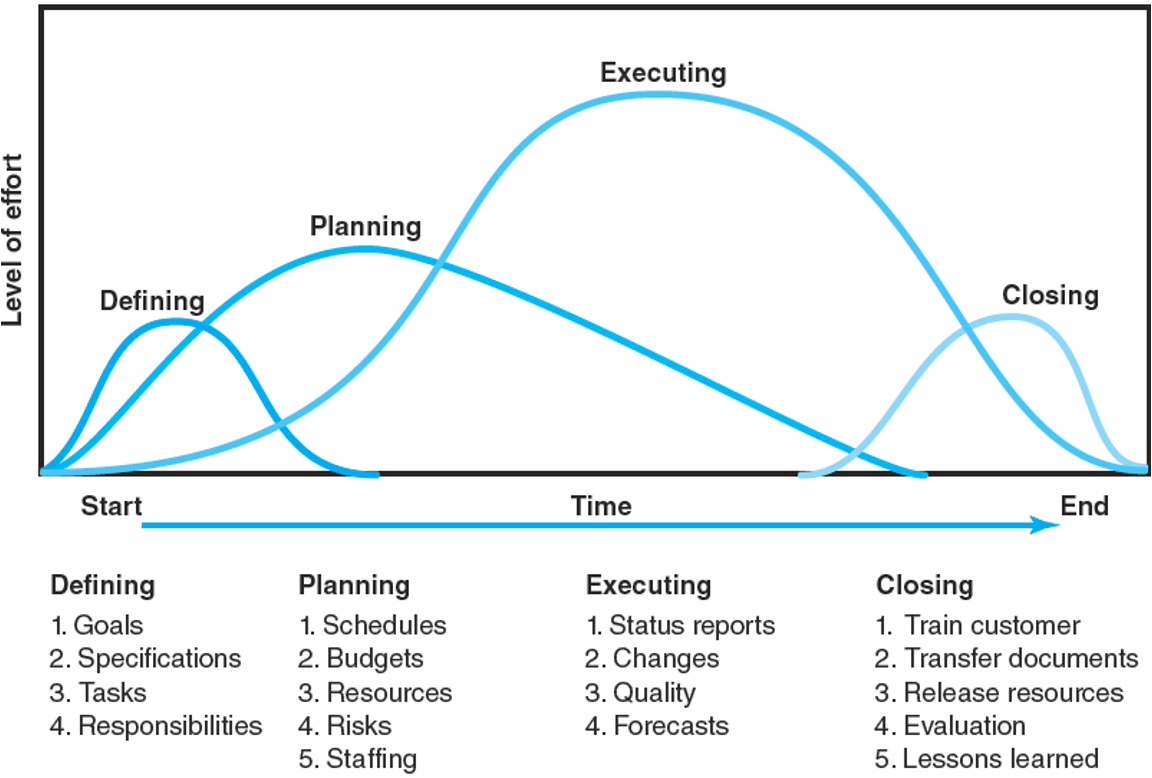
Project Life Cycle
recognizes the lifespan of a project and the changes in level of effort and focus that occur throughout the cycle
5
New cards
Challenges of Project Manager
•Manages temporary, non-repetitive activities and frequently acts independently of the formal organization.
•Organizes resources for the project.
•Is the direct link to the customer.
•Works with a diverse troupe of characters.
•Provides direction, coordination, and integration to the project team.
•Is responsible for performance and success of the project.
•Organizes resources for the project.
•Is the direct link to the customer.
•Works with a diverse troupe of characters.
•Provides direction, coordination, and integration to the project team.
•Is responsible for performance and success of the project.
6
New cards
Sociotechnical Approach: Technical Dimension
The “Science”: Consists of the formal, disciplined, purely logical parts of the process; Includes planning, scheduling, and controlling projects.
7
New cards
Sociotechnical Approach: Sociocultural Dimension
The “Art”: Involves the contradictory and paradoxical world of implementation; Centers on creating a temporary social system within a larger organizational environment that combines the talents of everyone to complete the project.
8
New cards
Agile Project Management
Methodology emerged out of frustration with using traditional project management processes to develop **software,** also referred to as “rolling wave” approach; used across industries in defining phase to manage projects with high levels of uncertainty, and combines active collaboration within small teams to complete project
9
New cards
Rolling Wave Development
Iterations typically last from one to four weeks, and focus on making tangible processes; once one iteration ends, it is reviewed and edited before a new iteration begins
10
New cards
Strategy
Deciding how the organization will compete
11
New cards
Strategic Management
Is the process of assessing “**what we are**” and deciding and implementing “**what we intend to be and how we are going to get there.**”
12
New cards
Four Activities of the Strategic Management Process
1. Review and define the organizational mission
2. Analyze and formulate strategies
3. Set objectives to achieve strategies
4. Implement strategies through projects
13
New cards
SMART Characteristics of Objectives
Specific, Measurable, Assignable, Realistic, Time related
14
New cards
Implementation Gap
The lack of understanding and consensus of organization strategy among top and middle-level managers
15
New cards
Organization Politics
Project selection may be based not so much on facts and sound reasoning as on the persuasiveness and power of people advocating projects; The term *sacred cow* is often used to denote a project that a powerful, high-ranking official is advocating
16
New cards
Resource Conflicts and Multitasking
A multi-project environment creates the problems of project interdependency and the need to share resources. Resource sharing leads to multitasking—involves starting and stopping work on one task to go and work on another project, then returning to the work on the original task.
17
New cards
Types of Selection Criteria
Financial Criteria, Non-Financial Criteria, Multi-Criteria Selection Models
18
New cards
Payback Model
Type of financial criteria that measures the time the project will take to recover the project investment; simplest and most widely used, and emphasizes cash flows.
19
New cards
Payback Model Formula
Payback period (yrs)= (Estimated project cost)/(Annual Savings)
20
New cards
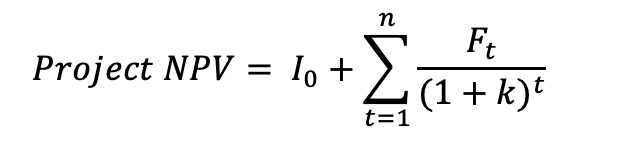
Net Present Value (NPV)
Uses management’s minimum desired rate of return (discount rate) to compute the present value of all net cash inflows; is more realistic because it considers the time value of money, cash flows, and profitability
21
New cards
Net Present Value Formula
\
22
New cards
Non-Financial Criteria
Strategic Objectives:
* To capture larger market share.
* To make it difficult for competitors to enter the market.
* To develop an enabler product, which by its introduction will increase sales in more profitable products.
* To develop core technology that will be used in next-generation products.
* To reduce dependency on unreliable suppliers.
* To prevent government intervention and regulation.
* To capture larger market share.
* To make it difficult for competitors to enter the market.
* To develop an enabler product, which by its introduction will increase sales in more profitable products.
* To develop core technology that will be used in next-generation products.
* To reduce dependency on unreliable suppliers.
* To prevent government intervention and regulation.
23
New cards
Multi-Criteria Selection: Checklist Models
* Use a **list of questions** to review potential projects and to determine their acceptance or rejection.
* Allow greater **flexibility in selecting** among many different types of projects and are easily **used across different divisions** and locations.
* **Fail to answer the relative importance** or value of a potential project to the organization and **does not allow for comparison** with other potential projects.
* Allow greater **flexibility in selecting** among many different types of projects and are easily **used across different divisions** and locations.
* **Fail to answer the relative importance** or value of a potential project to the organization and **does not allow for comparison** with other potential projects.
24
New cards
Multi-Criteria Selection: Multi-Weighted Scoring Models
* Use **several weighted selection criteria** to evaluate project proposals
* Include **qualitative and/or quantitative** criteria
* **Allow for comparison** with other potential projects
* Include **qualitative and/or quantitative** criteria
* **Allow for comparison** with other potential projects
25
New cards
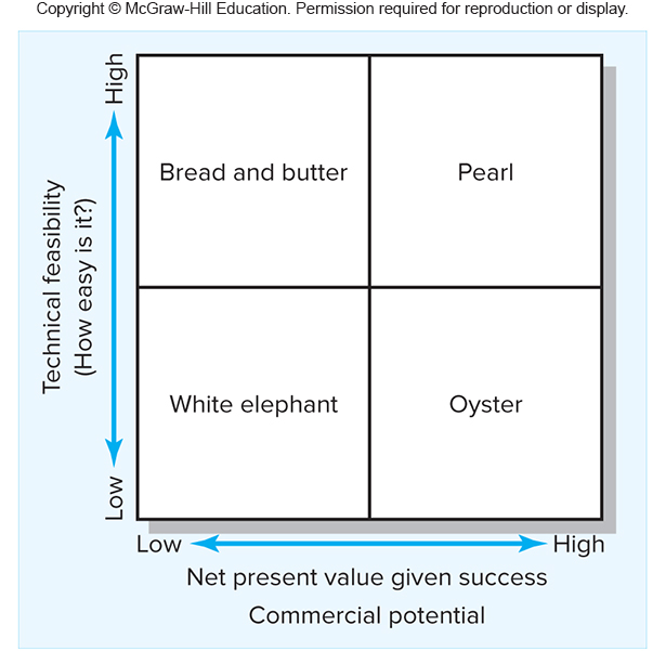
Project Portfolio Matrix
26
New cards
Bread-and-butter Projects
projects involve evolutionary improvements to current products and services.
27
New cards
Oyster Projects
involve technological breakthroughs with tremendous commercial potential.
28
New cards
White elephant Projects
showed promise at one time but are no longer viable.
29
New cards
Pearl Projects
represent revolutionary commercial advances using proven technology.
30
New cards
Defining the Project Stages
1. Defining project scope
2. establishing project priorities
3. creating the work breakdown structure
4. integrating the WBS with the organization
5. coding the WBS for information system
31
New cards
Project Scope
Is a definition of the **end result** or mission of your project—a product or service for your client/customer; Defines the results to be achieved in **specific**, **tangible**, and **measurable** terms.
32
New cards
Establishing Project Priorities
* **Project management trade-offs**
* Three major criteria (trade-offs) that a project manager has to manage are:
* **Cost** (budget)
* **Time** (schedule)
* **Performance** (scope)
* Three major criteria (trade-offs) that a project manager has to manage are:
* **Cost** (budget)
* **Time** (schedule)
* **Performance** (scope)
33
New cards
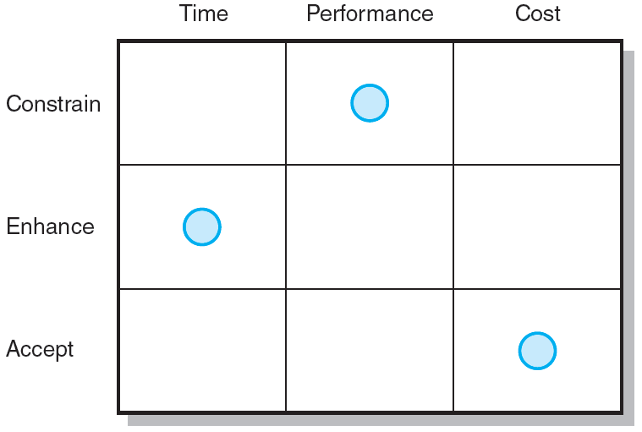
Project Priority Matrix
* A project manager can manage the project trade-offs by completing a priority matrix for the project and identifying which criterion is:
* **Constrain**—original parameter is fixed.
* **Enhance**—a criterion should be optimized.
* **Accept**—a criterion is tolerable not to meet the original parameter.
* **Constrain**—original parameter is fixed.
* **Enhance**—a criterion should be optimized.
* **Accept**—a criterion is tolerable not to meet the original parameter.
34
New cards
Work Breakdown Structure (WBS)
* Is a hierarchical **outline** of the project with different levels of **detail**.
* Identifies the products and work elements involved in a project.
* Defines the **relationship** of the final deliverable (the project) to its sub-deliverables, and, in turn, their relationships to work packages.
* Serves as a framework for **tracking** cost and work performance.
* Is best suited for design and build projects that have tangible outcomes rather than process-oriented projects.
* Identifies the products and work elements involved in a project.
* Defines the **relationship** of the final deliverable (the project) to its sub-deliverables, and, in turn, their relationships to work packages.
* Serves as a framework for **tracking** cost and work performance.
* Is best suited for design and build projects that have tangible outcomes rather than process-oriented projects.
35
New cards
Work Package
Lowest level of the WBS:
* Defines **work** (what).
* Identifies **time** to complete a work package (how long).
* Identifies a time-phased **budget** to complete a work package (cost).
* Identifies **resources** needed to complete a work package (how much).
* Identifies a **single person** responsible for units of work (who).
* Identifies **monitoring points** for measuring progress (how well).
* Defines **work** (what).
* Identifies **time** to complete a work package (how long).
* Identifies a time-phased **budget** to complete a work package (cost).
* Identifies **resources** needed to complete a work package (how much).
* Identifies a **single person** responsible for units of work (who).
* Identifies **monitoring points** for measuring progress (how well).
36
New cards
Organization Breakdown Structure (OBS)
* Depicts how the firm has organized to discharge work responsibility.
* Provides a framework to summarize organization unit work performance.
* Identifies the organization units responsible for work packages.
* Ties the organizational unit to cost control accounts.
* Provides a framework to summarize organization unit work performance.
* Identifies the organization units responsible for work packages.
* Ties the organizational unit to cost control accounts.
37
New cards
WBS Coding System
Defines:
* Levels and elements in the WBS
* Organization elements
* Work packages
* Budget and cost information
* Allows reports to be consolidated at any level in the structure
* Levels and elements in the WBS
* Organization elements
* Work packages
* Budget and cost information
* Allows reports to be consolidated at any level in the structure
38
New cards
Process Breakdown Structure (PBS)
* Is used for **process-oriented** projects.
* Is often referred to as the “waterfall method” in the software industry.
* Is often referred to as the “waterfall method” in the software industry.
39
New cards
Process-oriented Project
* Is a project that the final outcome is a product of a series of steps and phases.
* Is a project that evolves over time with each phase affecting the next phase.
* Is a project that is driven by performance requirements, not by plans/blueprints.
* Is a project that evolves over time with each phase affecting the next phase.
* Is a project that is driven by performance requirements, not by plans/blueprints.
40
New cards
Responsibility Matrix
* Is also called a linear responsibility chart.
* Summarizes the tasks to be accomplished and who is responsible for what on the project.
* Lists all the project activities and the participants responsible for each activity.
* Clarifies interfaces between units and individuals that require coordination.
* Provides a mean for all participants in a project to view their responsibilities and agree on their assignments.
* Clarifies the extent or type of authority exercised by each participant.
* Summarizes the tasks to be accomplished and who is responsible for what on the project.
* Lists all the project activities and the participants responsible for each activity.
* Clarifies interfaces between units and individuals that require coordination.
* Provides a mean for all participants in a project to view their responsibilities and agree on their assignments.
* Clarifies the extent or type of authority exercised by each participant.
41
New cards
Project Communication Plan
Answers the “Who, What, When, Where, Why, How” of the project
42
New cards
Stakeholder Communications
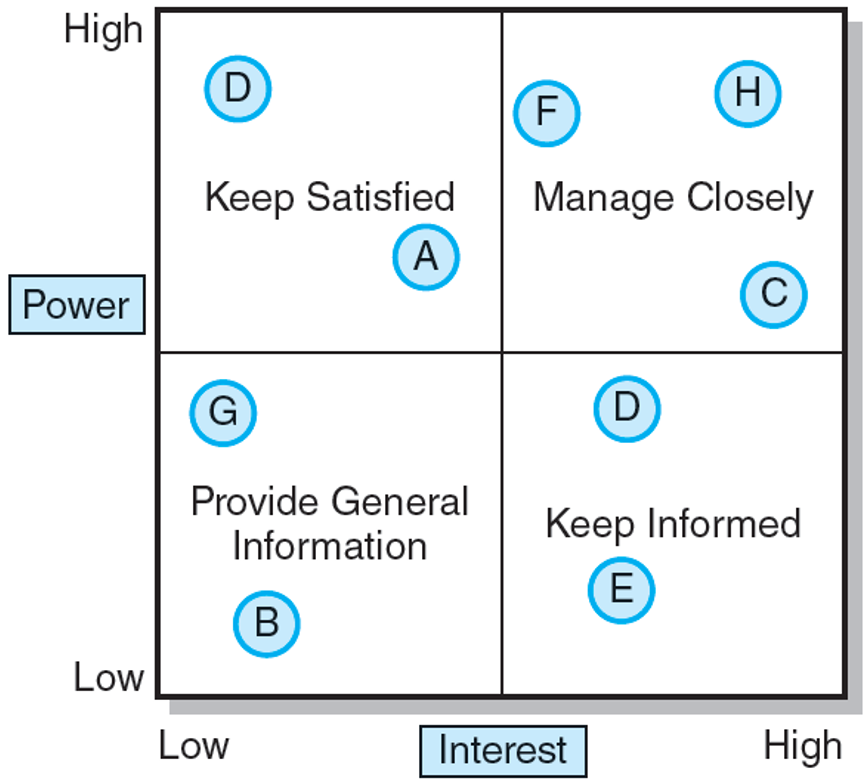
43
New cards
Steps for Developing a Communication Plan
1. **Stakeholder** **analysis**—identify the target groups.
2. **Information** **needs**—project status reports, deliverable issues, changes in scope, team status meetings, gating decisions, accepted request changes, action items, milestone reports, etc.
3. **Sources of information**—where does the information reside?
4. **Dissemination modes**—hardcopy, e-mail, teleconferencing, SharePoint, and a variety of database sharing programs.
5. **Responsibility and timing**—determine who will send out the information and when.
44
New cards
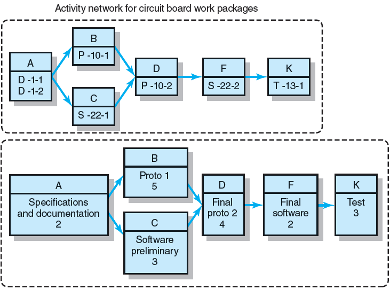
Project Network
* Provides the basis for **scheduling** labor and equipment.
* Enhances **communication** among project stakeholders.
* Provides an estimate of **project duration**.
* Provides the basis for **budgeting** the cash flow.
* Identifies which activities are “**critical**” and should not be delayed.
* Highlights which activities to consider for **compressing** the project duration.
* Helps managers get and stay on the **project plan**.
* Enhances **communication** among project stakeholders.
* Provides an estimate of **project duration**.
* Provides the basis for **budgeting** the cash flow.
* Identifies which activities are “**critical**” and should not be delayed.
* Highlights which activities to consider for **compressing** the project duration.
* Helps managers get and stay on the **project plan**.
45
New cards
Project Network Critical Path
The path with the longest duration through the network:
* The longest path through the activity network that allows for the completion of all project-related activities
* The shortest expected time in which the entire project can be completed.
* Delays on the critical path will delay completion of the entire project.
* The longest path through the activity network that allows for the completion of all project-related activities
* The shortest expected time in which the entire project can be completed.
* Delays on the critical path will delay completion of the entire project.
46
New cards
Project Network Early Start (ES)
Indicates how soon the activity can start; calculated by adding the Durations together
47
New cards
Project Network Early Finish (EF)
Indicates how early the activity can finish; calculated by adding the Early Start and Duration together
48
New cards
Project Network Late Finish (LF)
Indicates how late the activity can finish; the late finish on the last activity is the same as its early finish
49
New cards
Project Network Late Start (LS)
Indicates how late the activity can start; calculated by subtracting the Duration from the Late Finish
50
New cards
Project Network Slack
Tells the amount of time an activity can be delayed and not delayed the project; Calculated by either doing LS-ES or LF-EF
51
New cards
Network Sensitivity
The **likelihood the original critical path(s) will change** once the project is initiated; A network schedule that has only one critical path and noncritical activities that enjoy significant slack would be labeled ‘insensitive’.
52
New cards
Finish-to-Finish Relationship
Type of relationship where two or more activities can only be considered completed when both are completed.
53
New cards
Finish-to-Start Relationship
Type of relationship where one activity—the predecessor—must be fully complete before any following—successor—activities may begin.
54
New cards
Combination Relationship
Type of Relationship where multiple types of relationships are used at the same time, i.e. start-to-start and finish-to-finish.
55
New cards
Project Schedule Management
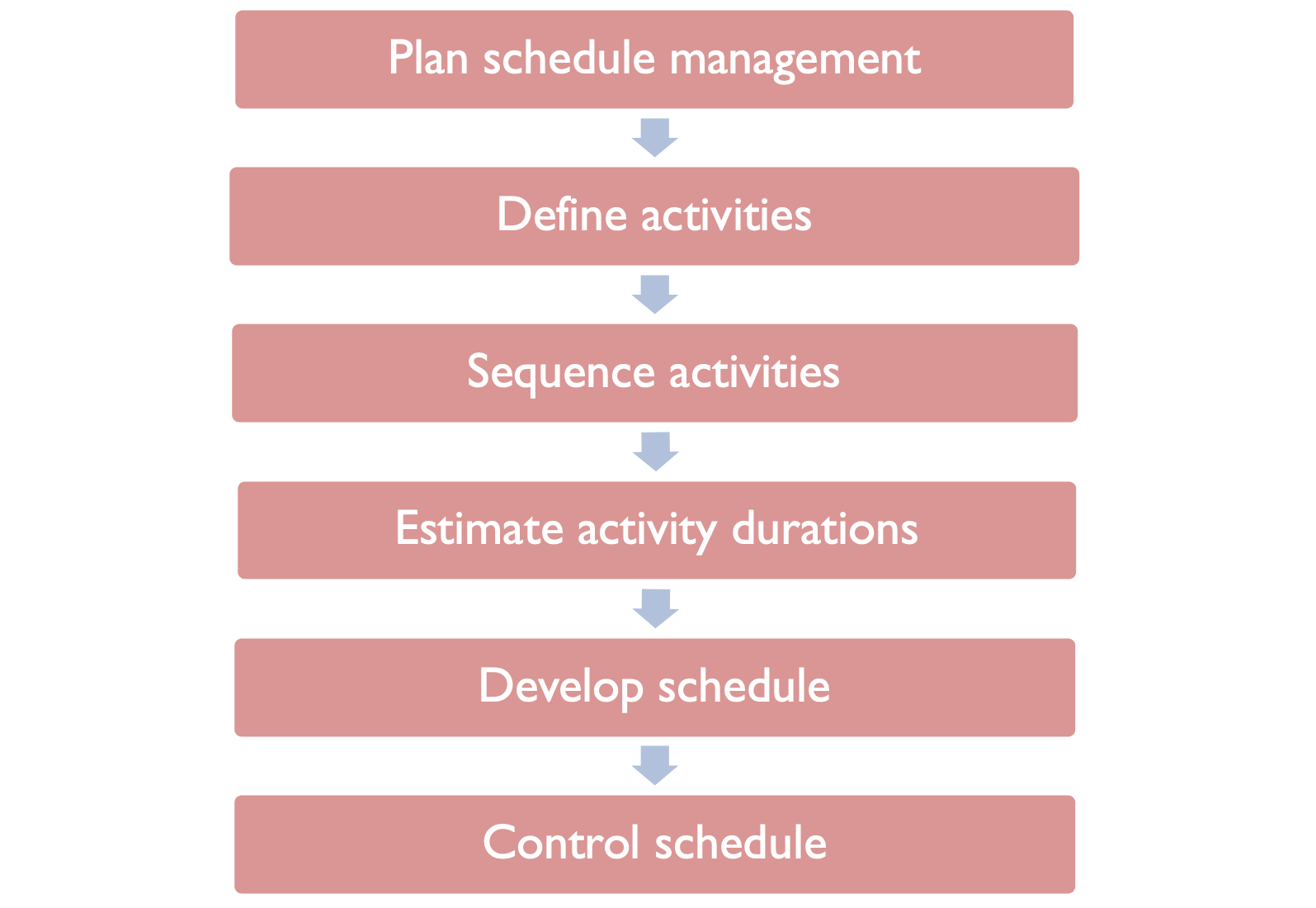
56
New cards
Types of Project Resources
* People
* Materials
* Equipment
* Facilities
* Time
* Money
* Materials
* Equipment
* Facilities
* Time
* Money
57
New cards
Types of Project Constraints
* Technical
* Logical
* Resource
* Skills
* Time
* Logical
* Resource
* Skills
* Time
58
New cards
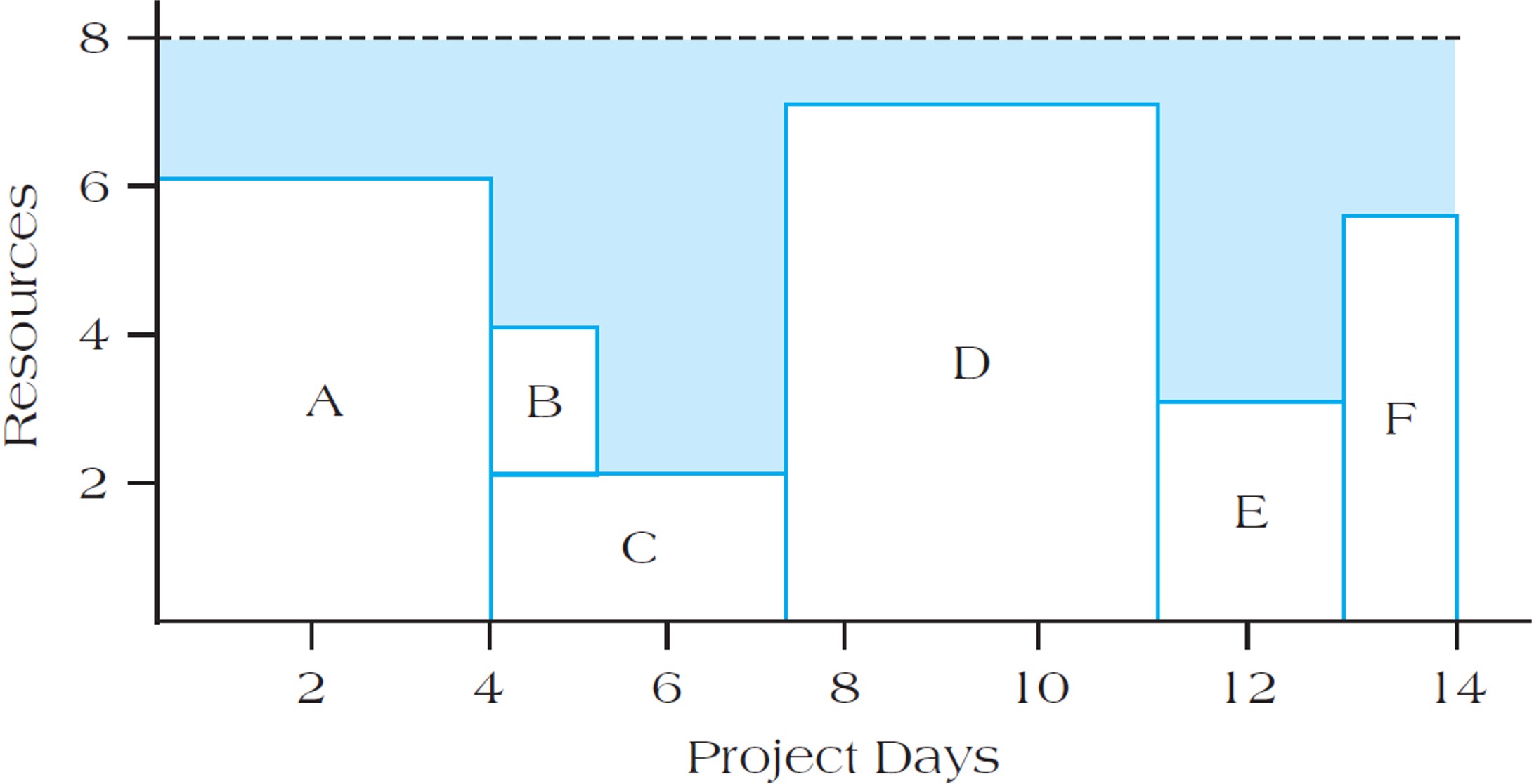
Resource Smoothing (Resource Loading)
Attempts to even out varying demands on resources by delaying non-critical activities (using slack).
__Objectives:__
* To **lower peak resource demand** and, thus, increase resource utilization when resources are adequate over the life of the project
* To determine the resource requirements so that they will be available **at the right time**
* To allow each activity to be scheduled with the **smoothest possible transition** across resource usage levels
__Objectives:__
* To **lower peak resource demand** and, thus, increase resource utilization when resources are adequate over the life of the project
* To determine the resource requirements so that they will be available **at the right time**
* To allow each activity to be scheduled with the **smoothest possible transition** across resource usage levels
59
New cards
Resource Constrained Scheduling
Occurs when resources are not adequate to meet peak demands.
__Consequences:__
* The late start of some activities must be delayed, and the duration of the project may be increased.
__Consequences:__
* The late start of some activities must be delayed, and the duration of the project may be increased.
60
New cards
Splitting Tasks Technique
* Is a scheduling technique used to get a better project schedule and/or to increase resource utilization.
* Involves interrupting the work and sending the resource to another activity for a period of time and then having the resource resume work on the original activity.
* Can be useful if the work involved does not include large start-up or shut-down costs.
* Is considered a major reason why projects fail to meet schedule.
* Involves interrupting the work and sending the resource to another activity for a period of time and then having the resource resume work on the original activity.
* Can be useful if the work involved does not include large start-up or shut-down costs.
* Is considered a major reason why projects fail to meet schedule.
61
New cards
Common Sources of Project Cost
* Labor
* Materials
* Equipment and facilities
* Subcontractors
* Travel
* Materials
* Equipment and facilities
* Subcontractors
* Travel
62
New cards
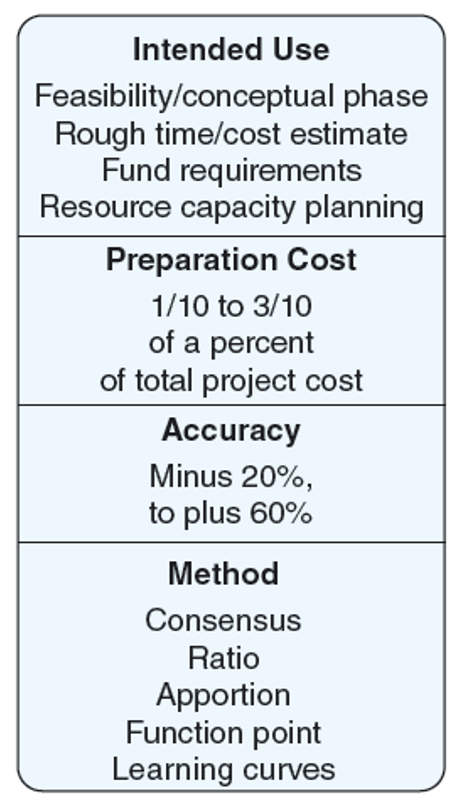
Top-Down Estimates
* Are usually derived from someone who uses **experience and/or information** to determine the project duration and total cost.
* Are sometimes made by **top managers** who have very little knowledge of the component activities used to complete the project.
* Are sometimes made by **top managers** who have very little knowledge of the component activities used to complete the project.
63
New cards
Bottom-Up Estimates
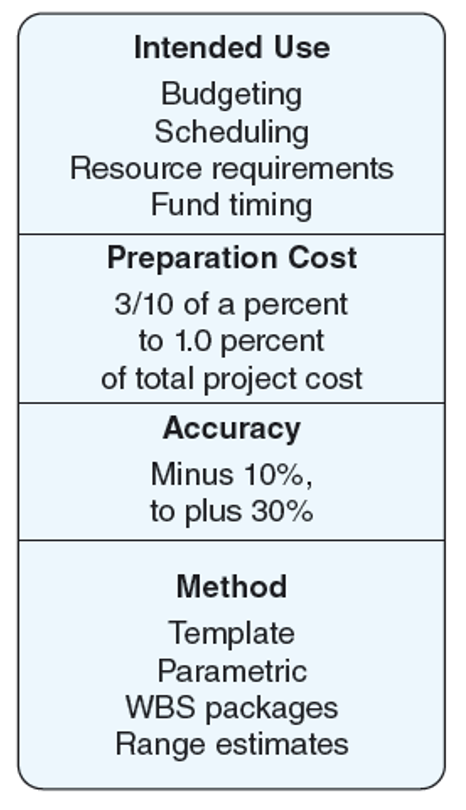
* Can take place after the project has been defined in detail.
* Comes from the **people** **most knowledgeable** about the estimate.
* Can serve as a **check on cost elements** in the WBS by rolling up the work packages and associated cost accounts to major deliverables.
* Comes from the **people** **most knowledgeable** about the estimate.
* Can serve as a **check on cost elements** in the WBS by rolling up the work packages and associated cost accounts to major deliverables.
64
New cards
Conditions for Top-Down Estimates
* Strategic Decision Making
* High Uncertainty
* Internal, small project
* Unstable Scope
* High Uncertainty
* Internal, small project
* Unstable Scope
65
New cards
Conditions for Bottom-Up Estimates
* Cost and Time Important
* Fixed-price Contract
* Customer wants details
* Fixed-price Contract
* Customer wants details
66
New cards
Methods for Estimating Top-Down Time and Costs
* Consensus Method
* Ratio Method
* Apportion Method
* Function Point Methods for Software and System Projects
* Learning Curves
* Ratio Method
* Apportion Method
* Function Point Methods for Software and System Projects
* Learning Curves
67
New cards
Methods for Estimating Bottom-Up Time and Costs
* Template Method
* Parametric Procedures Applied to Specific Tasks
* Range Estimating
* Parametric Procedures Applied to Specific Tasks
* Range Estimating
68
New cards
Consensus Method
(Top-Down) Uses **pooled experience of senior and/or middle managers** to estimate the total project duration and cost; Typically used during the conceptual stage of the project
69
New cards
Ratio Method
(Top-Down) Uses ratios to estimate project times or costs; Used in the conceptual phase to get an **initial duration and cost estimate**
70
New cards
Apportion Method
(Top-Down) Used when projects **closely follow past projects** in features and costs; Common in projects that are **relatively standard** but have some small variation or customization
71
New cards
Function Point Method
(Top-Down) Used for software and system projects; Assumes adequate historical data by type of software using function points
72
New cards
Function Point
Major parameters such as number of inputs, number of outputs, number of inquiries, number of data files, and number of interfaces
73
New cards
Learning Curves
Each time the output quantity doubles, the unit labor hours are reduced at a constant rate
74
New cards
Template Method
(Bottom-Up) Used when projects are similar to past projects; Differences in the new project can be noted and past times and costs adjusted to reflect these differences; Ready in a very short time span
75
New cards
Parametric Procedures Applied to Specific Tasks
(Bottom-Up) Parametric techniques are applied to **specific tasks**
76
New cards
Range Estimating
(Bottom-Up) Works best when work packages have **significant uncertainty** associated with the time or cost to complete; **Group estimation** to determine the low, average, and high cost or duration
77
New cards
Phase Estimating
Hybrid Approach:
* Begins with a top-down estimate for the project and then refines estimates for phases of the project as it is implemented.
* A **detailed estimate** is developed for the immediate phase and a **macro estimate** is made for the remaining phases of the project.
* Used for projects where the final product is **not known**, and the **uncertainty** is very large
* Begins with a top-down estimate for the project and then refines estimates for phases of the project as it is implemented.
* A **detailed estimate** is developed for the immediate phase and a **macro estimate** is made for the remaining phases of the project.
* Used for projects where the final product is **not known**, and the **uncertainty** is very large
78
New cards
Factors Influencing the Quality of Estimates
* Planning Horizon
* Project Complexity
* People
* Project Structure and Organization
* Padding Estimates
* Organizational Culture
* Other Factors
* Project Complexity
* People
* Project Structure and Organization
* Padding Estimates
* Organizational Culture
* Other Factors
79
New cards
Estimating Guidelines for Time, Costs and Resources
* Responsibility
* The use of several people to estimate
* Normal Conditions
* Time Units
* Independence
* Contingencies
* Risk assessment added to avoid surprises to stakeholders
* The use of several people to estimate
* Normal Conditions
* Time Units
* Independence
* Contingencies
* Risk assessment added to avoid surprises to stakeholders
80
New cards
Level of Detail for WBS
Varies with:
* The complexity of the project
* The need for control
* The project size, cost, and duration
* Other factors
* The complexity of the project
* The need for control
* The project size, cost, and duration
* Other factors
81
New cards
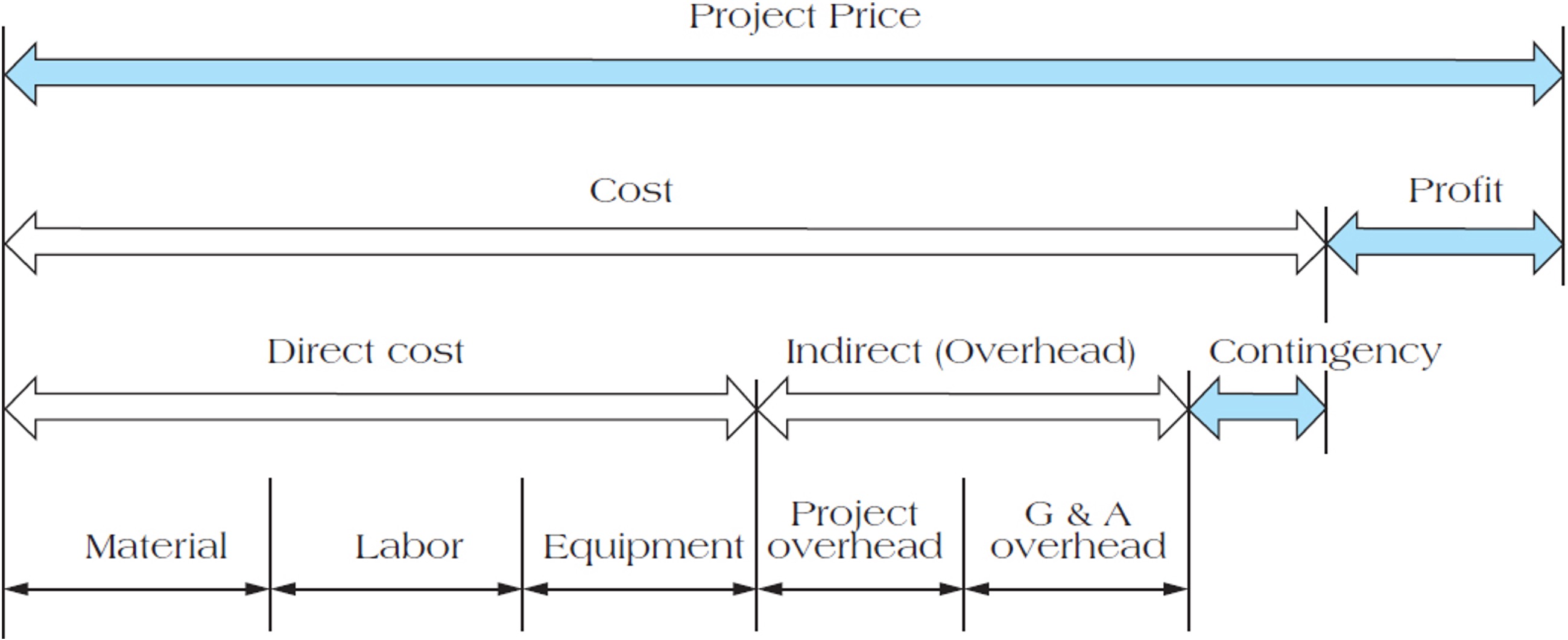
Types of Costs
Direct Costs
Project Overhead Costs
General and Administrative (G&A) Overhead Costs
Project Overhead Costs
General and Administrative (G&A) Overhead Costs
82
New cards
Direct Costs
Are clearly chargeable to a specific work package, ex. Labor, materials, equipment, etc.
83
New cards
Project Overhead Costs
Identifies which organization resources are being used in the project; Can be tied to project deliverables or work packages, Ex: Salary of the project manager, temporary rental space for the project team, supplies, specialized machinery
84
New cards
General and Administrative (G&A) Overhead Costs
Are not directly linked to a specific project; Usually allocate as a percentage of the total direct costs, Ex: Advertising, accounting, salary of senior management above the project level
85
New cards
Project Price Breakdown
86
New cards
Other Types of Costs
* **Recurring costs**, such as __labor and materials__, are repeatedly incurred throughout the project life cycle.
* **Nonrecurring costs**, on the other hand, are one-time costs that are typically incurred at the beginning or at the end of the project, such as __market research and labor training.__
* **Fixed costs** do not vary with usage. For example, costs incurred in the __purchase of capital equipment__ remain fixed, regardless of the extent of equipment use.
* **Variable costs** vary directly with usage. They are typically associated with __labor and materials__.
* **Normal costs** are incurred when project tasks are completed according to the original planned duration.
* **Expedited costs** or **crash costs** are unplanned costs incurred as a result of steps taken to accelerate project completion.
* **Nonrecurring costs**, on the other hand, are one-time costs that are typically incurred at the beginning or at the end of the project, such as __market research and labor training.__
* **Fixed costs** do not vary with usage. For example, costs incurred in the __purchase of capital equipment__ remain fixed, regardless of the extent of equipment use.
* **Variable costs** vary directly with usage. They are typically associated with __labor and materials__.
* **Normal costs** are incurred when project tasks are completed according to the original planned duration.
* **Expedited costs** or **crash costs** are unplanned costs incurred as a result of steps taken to accelerate project completion.
87
New cards
Reasons for Adjusting Estimates
* Interaction costs are hidden in estimates.
* Normal conditions do not apply.
* Things go wrong on projects.
* Project scope and plans change.
* People are overly optimistic.
* People engage in strategic misrepresentation.
* Normal conditions do not apply.
* Things go wrong on projects.
* Project scope and plans change.
* People are overly optimistic.
* People engage in strategic misrepresentation.
88
New cards
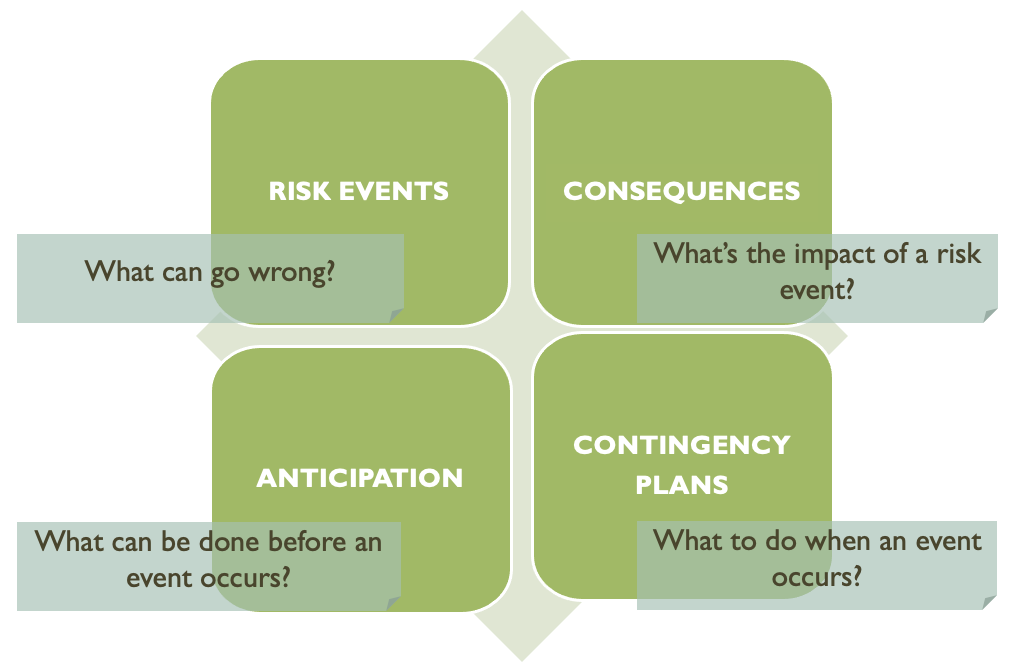
Risk
An **uncertain event** or condition that if it occurs, has a positive or negative effect on project objectives, such as scope, schedule, or cost
89
New cards
Risk Management
The art and science of identifying, analyzing, and responding to risk factors throughout the life of a project and in the best interest of its objectives.
90
New cards
Risk Management Process
91
New cards
Risk Event Graph
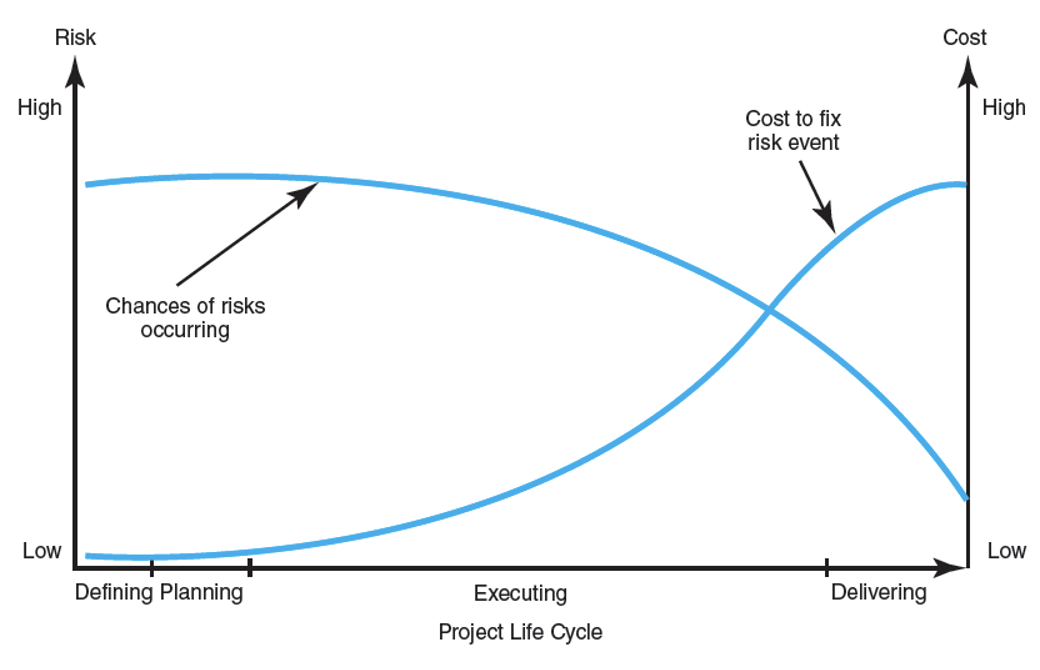
92
New cards
Benefits of Risk Management
* A **proactive** rather than reactive approach
* **Reduces surprises** and negative consequences
* Prepares the project manager to take **appropriate action**
* Provides **better control** over the future
* Improves chances of **reaching project objectives** on time, within budget, and of meeting required performance.
* **Reduces surprises** and negative consequences
* Prepares the project manager to take **appropriate action**
* Provides **better control** over the future
* Improves chances of **reaching project objectives** on time, within budget, and of meeting required performance.
93
New cards
Risk Identification
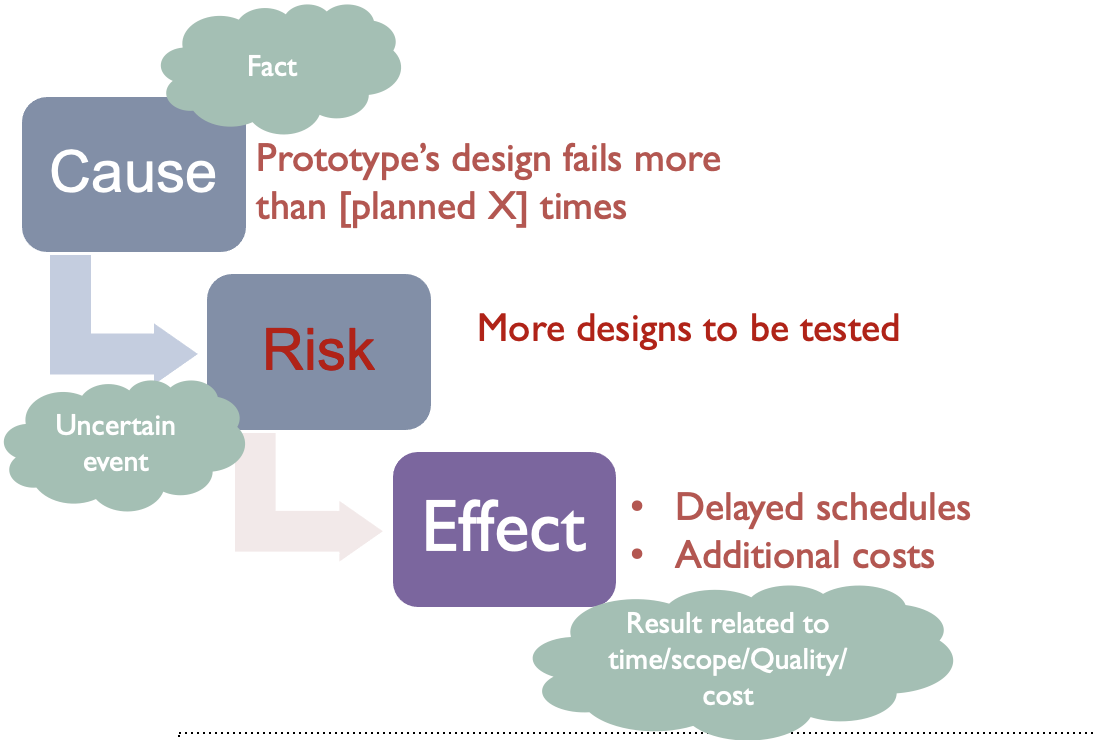
94
New cards
Risk Breakdown Structure (RBS)
Used in conjunction with work breakdown structure that helps to identify the risks and analyze them.
95
New cards
Scenario Analysis
Risk Assessment; assesses the significance of each risk event in terms of **probability** and **impact**.
96
New cards
Risk Assessment Form
Risk Assessment; evaluates the severity, probability of risk events and its detection difficulty.
97
New cards
Risk Severity Matrix
Prioritizes which risks to address; **Failure Mode and Effects Analysis (FMEA)** extends the risk severity matrix by including ease of detection in the equation:
Risk Value = Impact x Probability x Detection
Risk Value = Impact x Probability x Detection
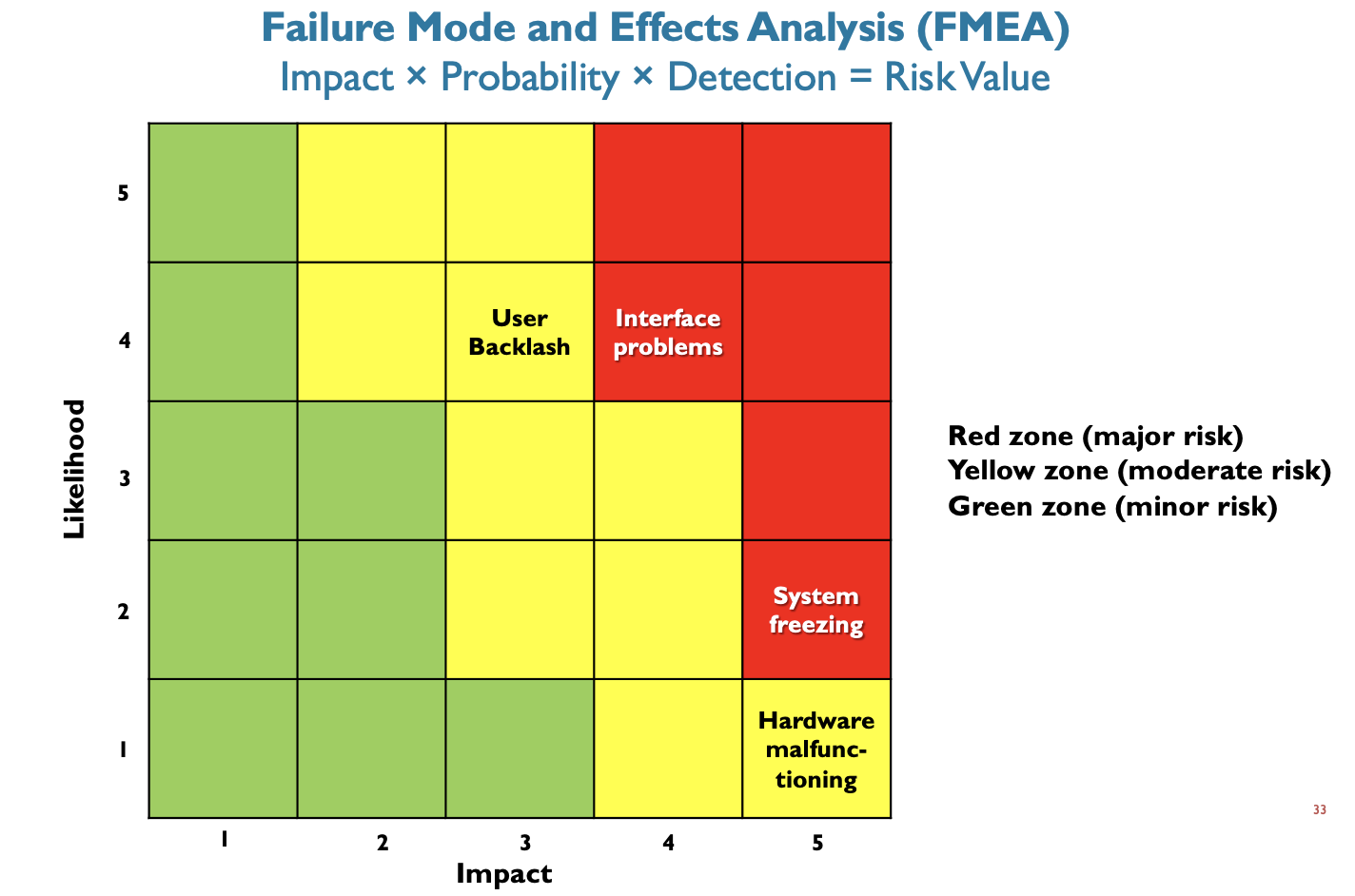
98
New cards
Risk Response Development
* Mitigating Risk: Reducing Likelihood and Impact
* Avoiding Risk: Changing project plan
* Transferring Risk: Passing risk to another party
* Escalating Risk: Notifying appropriate people
* Retaining Risk: Making conscious decision to accept risk
* Avoiding Risk: Changing project plan
* Transferring Risk: Passing risk to another party
* Escalating Risk: Notifying appropriate people
* Retaining Risk: Making conscious decision to accept risk
99
New cards
Contingency Plan
An alternative plan that will be used if a possible foreseen risk event becomes a reality; A plan of action that will reduce or mitigate the negative impact of the risk event.
100
New cards
Risk Response Matrix
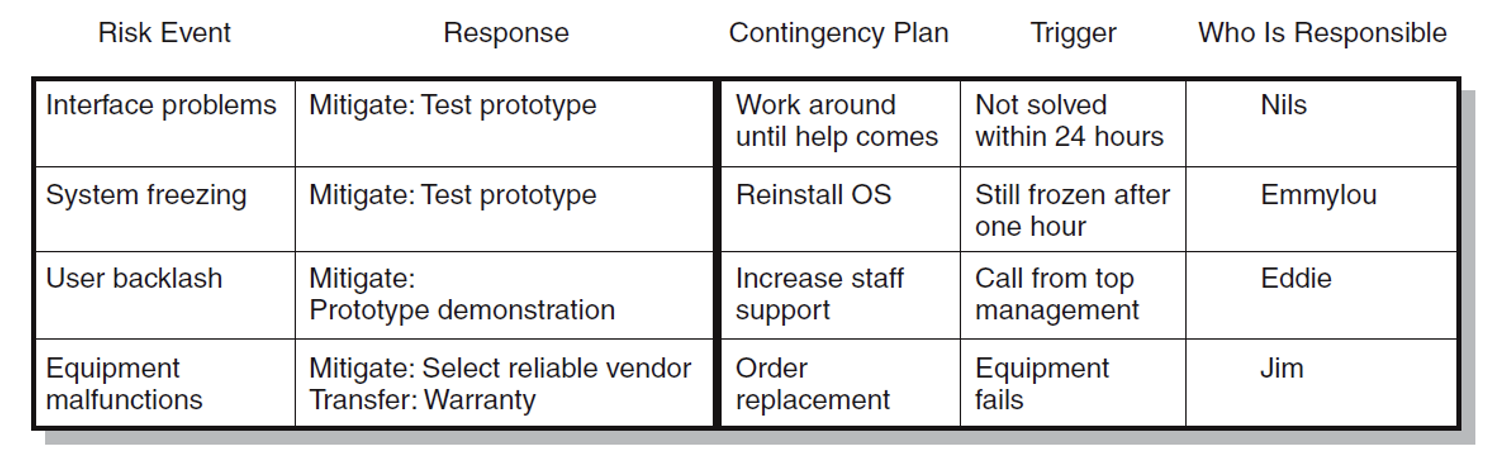
 Note
Note  Flashcards (100)