Bony Fish
 Call Kai
 Learn
Learn Practice Test
 Spaced Repetition
 Match
Match Flashcards
 Knowt Play
1/60

There's no tags or description
Looks like no tags are added yet.
Name | Mastery | Learn | Test | Matching | Spaced | Call with Kai |
|---|
No analytics yet
Send a link to your students to track their progress
61 Terms
Phylum Craniata Split into
Subphylum: Hyprotreti
Subphylum: Vertebrata
Subphylum Vertebrata split into
Class: Hyperoartia
Infraphylum: Gnathostomata
Infraphylum Gnathostomata split into
Class: Chondrichthyes
Superclass: Osteichthyes
Superclass Osteichthyes split into
Class: Actinopterygii
Class: Sarcopterygii
Class: Actinopterygii split into
Subclass: Condrostei
Subclass: Neopterygii
Subclass Condrostei split into
Order: Acipenseriformes
Order: Polypteriformes
Subclass Neopterygii split into
Infraclass: Teleostei
Class: Sarcopterygii split into
Order: Dipnoi
Order: Coelacanthiformes
Most common bony fish today
teleosts
most successful vertebrate on the planet
Acanthodians
spiny forms
small, minnow size
marine and freshwater
prominent notochord
reduced dermal bone from scales and armor in head
characteristics of chondrichthyes and osteichthyes
gill flaps
gill flaps
brachiostegal rays
cover the gills
Osteichtyes
most living vertebrates today
ossified bony skeletons
swim bladders
a few regressed back to cartilaginous skeletons
examples: sturgeon, paddlefish, and lungfish
2 main classes: Sarcopterygii and Actinopterygii
Lepidotrichia
bony rays
strengthen and elaborate fins
suite of characters bony fish share
swim bladder
ossified endoskeleton
dermal bone in primitive groups, replaced with dermal scales in derived groups
3 types of scales
ganoid
cycloid
ctenoid
Ganoid scales
primitive
found in Gar
thin scale
line up next to each othe
Cycloid Scales
derived
round or circular
found in herring. minnow, and trout
overlap
ctenoid scales
derived
comb-like, toothed, or spiny edge
found in the perch family
overlap
Actinoptergii
lepidotrichia
muscles controling fins are in body walls
supraorders: Palaeonisciformes and Neopterygii
Palaeonisciformes
extinct forms were the earliest bony fishes
small in size
dominant notochord
fusiform shape
ganoid scales
heads similar to acanthodians
Surviving Primitive bony fish
Acipenseriformes
Polypteruformes
Acipenseriformes
paddlefish and sturgeon
large plates in the head region
Sturgeon are the largest freshwater fish
show reversing skeleton with cartilaginous skeletons
some sturgeon are marine, some freshwater
Sturgeon eat fish and invertebrates and are bottom dwellers
Sturgeon can live to be 100
Paddlefish are open water filter feeders
Polypteriformes
Bichirs
ganoid scales
paired swim bladders
found in African swamps
Neopterygii
derived bony fish
most successful vertebrate taxa today
aka Teleosts
high evolved jaw
scales are rounder, thinner, and lighter
ossified vertebrate and bone
swim baldders
homocercal tails
familiar taxa: herring, eel, salmon, trout, pike, smelt, perch, bass, seahorses, minnows, carp, catfish
Sarcopterygii
not diverse (7 species)
gave rise to tetrapods
fleshy fins help move in shallow water
bottom dwellers in deep water
prominent internal choanae
divided into: Dipnoans and Crossopterygians
Dipnoans
lungfish
have lungs
allows fish to gulp air to extract O2 in low environments
Obligatory Air Breathers
early ones were marine but today are all freshwater
Obligatory Air Breathers
have to gulp air or will drown
estivation
A period of reduced activity that some animals experience
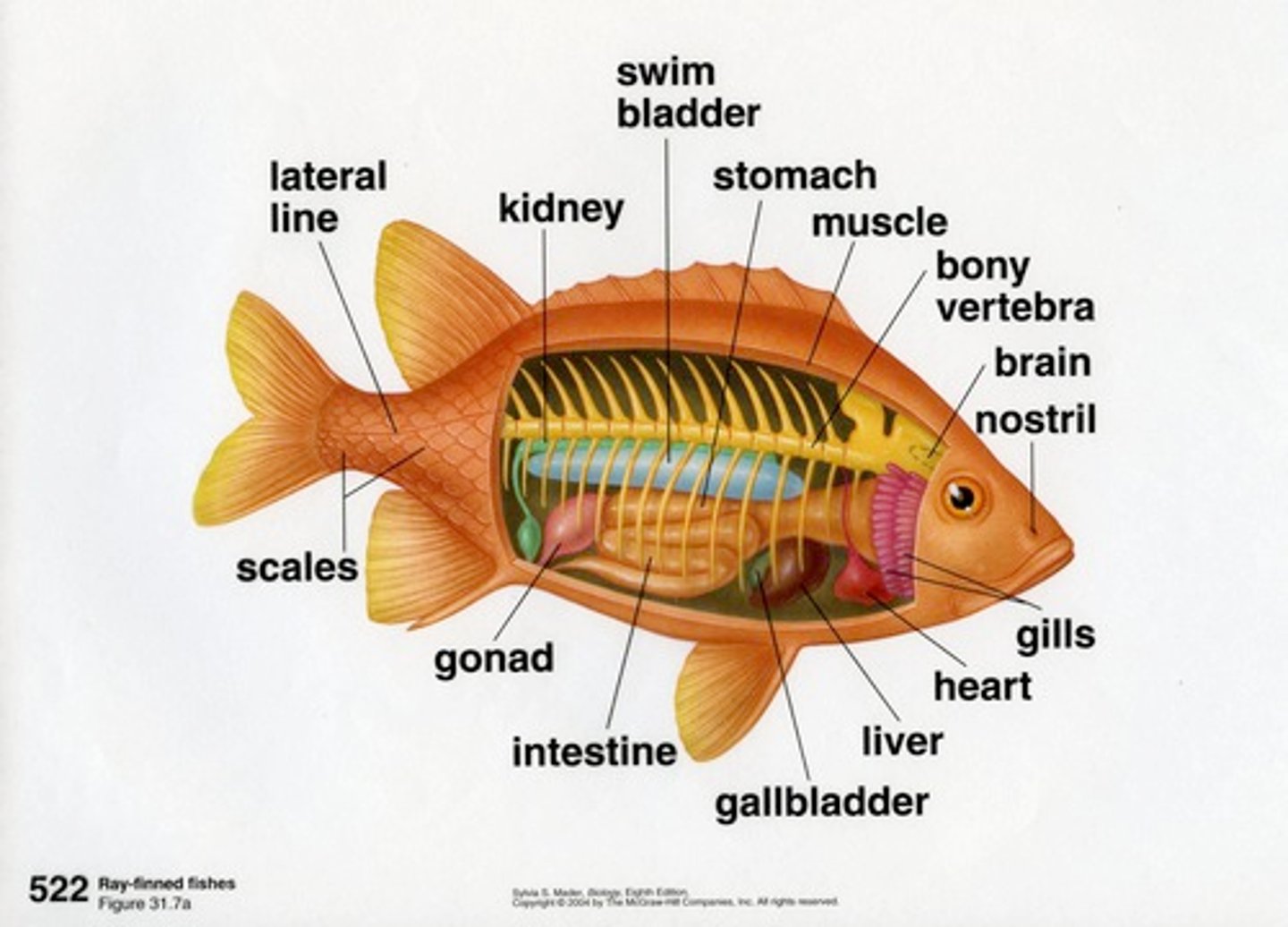
swim bladder
allows fish to adjust the gas amount within the bladder
allows them to maintain depth called neutral buoyancy
2 types: Primitive teleost and Derived Teleosts
Primitive teleost
bladder is connected to gut
gas enters bladder via blood vessels
to off gas pneumatic duct opens to allow gas to enter gut and be burped up
in herring, eel, minnows, salmon, and goldfish
Derived Teleosts
lack of connection to the gut
have a gas gland to deliver air to gut via blood vessels
have a muscular sac called ovale
to off gas constrictor muscle opens bladder to ovale which is surrounded by blood vessels and gas moves to blood from ovale
Coelacanths
thought to have gone extinct
living forms caught in 1930s
highly endangered and little is known about them
very primitive
small vertebrae with prominent notocord
heterocercal tail
pectoral fins
muscles on fins to walk on bottom
labyrinthodonts
earliest fossils
show characteristics of tetrapods and fish
named because of the complicated folds in the teeth
labyrinthodonts characteristic
gills
lateral line systems
notochord with vertebrae
radial fins
girdles, skulls, and limbs like tetrapods
stapes
Early forms of Tetrapod groups
Eusthenopteron
Panderichthys
Ichthyostega
Ichthyostega
same body as salamanders
mostly aquatic
limbs supported body weight
gills and lungs had a lateral line system
Stegocephalians
early tetrapods
same bone structure and organization, fleshy fins
stronger pelvic and pectoral girdle
Chiridium
strong muscular limbs
Pentadactyl chiridium
modern tetrapods
have 5 digits at the end of limbs
Polydactyl chiridium
early tetrapods
limbs with 6 or 7 digits
Hearing in tetrapods
sound in air bounces off bodies
modified hyomandibula bone to the stapes
stapes connects outer ear to inner ear allowing sound conduction
Feeding in tetrapods
develop ability to grab food with tongue and jaws
hyoid bone supports tongue muscles
salamanders switch between suction feeding and tongue feeding
what groups gave rise to modern amphibians
temnospondyls
lepospondyls
modern amphibians
frogs, salamanders, caecilians
called Lissamphibians
over 4,000 living species
tropical and temperate regions
eggs lack extraembryonic membranes
Scales are lost except in caecilians
skin used as a respiratory organ
bony exoskeleton
mucus and poison glands
pedicellate teeth
auricular operculum
Sound conducting apparatus parts
operculum
stapes (ossicles) high frequency
Operculum
low frequency
muscle connection to scapula
helps transmit sound efficiently to operculum and then to inner ear
low vibrations go through front legs
Stapes
High frequency
found in frogs
more important for complex behavior in breeding
shut off apparatus to focus on calls during breeding season
green rods
amphibians have extra rods to expand vision
helps hunting at night
absent from caecilians
levator bulbi muscle
muscle found under eye
attaches to its surface
allows amphibians to raise eyes during swallowing
helps cover the eye with translucent lower eyelid in water
Cutaneous respiration/buccal pump
rely on mouth and throat to push air in and out of lungs
swallow air and release air by moving throat up and down
extending off the throat and sides of head in males
Unique characteristics or Lissamphibia
Sound conducting apparatus
green rods
Levator bulbi muscle
cutaneouns respiration/buccal pump
Urodela
salamander and newts
paired limbs
long tails
terrestrial salamanders protrude tongues t ofeed
aquatic forms suck water to capture prey
external reproduction and internal reprduction with spermatorphore
paedomorphism
spermatophore
form of internal fertilization
packages of sperm
Salientia
frogs and toads
larger and longer hindlegs
external fertilizaion
some carry tadpoles on back
larvae eat algae and detritus
rapid metamorphosis
protrude tongues to capture prey
tympanum or ear drum
toads have warty skin and parotid glands
parotid glands
behind eyes of toads
produce poison
Gymnophiona
Caecilians
no limbs
damp tropical habitats
burrows
skull is solid and compact
internal fertilization
aquatic larvae
produce live miniature adults
Bolitoglossine feeding
longest tongue of salamanders
extend tongue to more than half is body length
projects tongue and hyoid apparatus
Salamander feeding muscles
subarcualis rectus I muscle
rectus cervicus profundus
Subarcualis rectus I muscle
protractor muscle
coiled around epibranchial cartilage
contracts and squeezes epibranchials together
launches the hyobranchial apparatus tongue out of mouth
tip of tongue is sticky with mucous glands
rectus cervicus profundus
anchored to pelvis and reels tongue back in
has slack so it takes time to pull tongue in
both muscles contract at the same time
Reproduction in Amphibians
frogs have external fertilization
salamanders have internal fertilization
both call to attract females
practice parental care
most go trough tadpole stages
species are ovoviviparous, oviparous, viviparous

