Sub-aerial processes (weathering and mass movement)
 Studied by 0 people
 Call Kai
 Learn
Learn Practice Test
 Spaced Repetition
 Match
Match Flashcards
 Knowt Play
1/20

Earn XP
Description and Tags
Name | Mastery | Learn | Test | Matching | Spaced |
|---|
No study sessions yet.
21 Terms
What are sub-aerial processes?
Include weathering and mass movement these processes operate on the cliff face to weaken it and provide material for coastal erosion
What is weathering?
Weathering is the breakdown of rocks at the earths surface by the action of rainwater, extremes of temperature and biological activity
IT DOES NOT INVOLVE THE REMOVAL OF ROCK MATERIAL
What are the 3 types of weathering?
Mechanical (physical)
Biological
Chemical
What is mechanical weathering?
It involves the breakdown of rocks without any chemical changes taking place
Freeze thaw
Salt crystalisation
Wetting and drying
Exfoliation
What happens in freeze thaw weathering?
Also known as frost shattering
Water gets into a crack and freezes
The water expands by around 10%
This puts pressure on the rock forcing the crack to widen
Eventually the rock breaks away and collects at the base of the rock as scree
What happens in salt crystalisation?
Salt water evaporates and leaves salt crystals behind
Overtime the crystals build up and exert pressure causing it to break up
If there is traces of iron the rock can be corroded
What happens in wetting and drying?
Rocks rich in clay ( e.g shale) expand when wet and contract when dry this causes the rocks to crack and eventually breakup
What happens in exfoliation?
Mostly happens in hot areas where there is a large diurnal ( difference between day and night) temperature range
There is a constant expansion and contraction of the outer layer of rocks therefore 'shedding’ their outer layer
What is biological weathering?
The breakdown of rocks by organic activity
What are different types of biological weathering?
Thin plant roots grow into small cracks on a cliff these cracks widen as the roots grow breaking up the rock
Water running through decaying vegetation becomes acidic which leads to increased chemical weathering
Birds like puffins and sand martins and animals like rabbits dig burrows into Cliffs
Marine organisms are also capable of burrowing into rocks like piddocks (similar to clams) or of secreting acids like limpets
What is chemical weathering?
It involves a chemical reaction where salts may be dissolved or a clay like deposit may result which is easily eroded
Carbonation
Oxidation
Solution
What happens in carbonation?
Rainwater absorbs carbon dioxide from the air to form a weak carbonic acid
Carbonic acid reacts with calcium carbonate in rocks such as limestone and chalk to form bicarbonate which is easily dissolved
The cooler the temperature of the rainwater the more carbon dioxide is absorbed so carbonation is more effective in the winter
What happens in oxidation?
Reaction of rock minerals with oxygen
For example iron forms a rusty red powder leaving rocks more vulnerable to weathering
What happens in solution?
The dissolving ofrock minerals such as halite (rock salt)
What is soliflution?
Mass movement
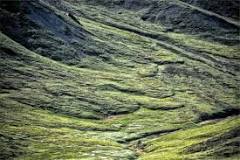
Saturated soil flows down a steep slope because permafrost is impermeable to water so soil overlaying it becomes saturated and gravity brings it down
Characteristically forms features called solifluction lobes
What is soil creep?
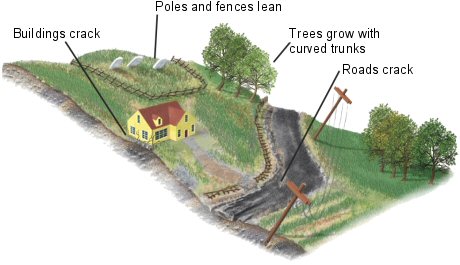
Extremely slow form of movement of individual soil particles downhill it often involves particles rising towards the ground surface due to wetting or freezing and then returning vertically to the surface in response to gravity as the soil dries or thaws
Can be suggested through the formation of shallow terracettes one build up of sat on the upslope side of walls and the bending of tree trunks
What is mud flow?
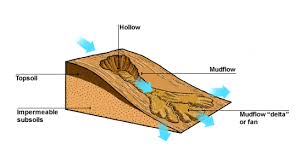
Involves earth and mud flowing down hill usually over unconsolidated or weak bedrock such as clay often after heavy rainfall
Water gets trapped within the rock increasing pore water pressure which forces the rocks apart and leads to slope failure
Often sudden and fast flowing
Can represent a significant natural hazard
What is a landslide?
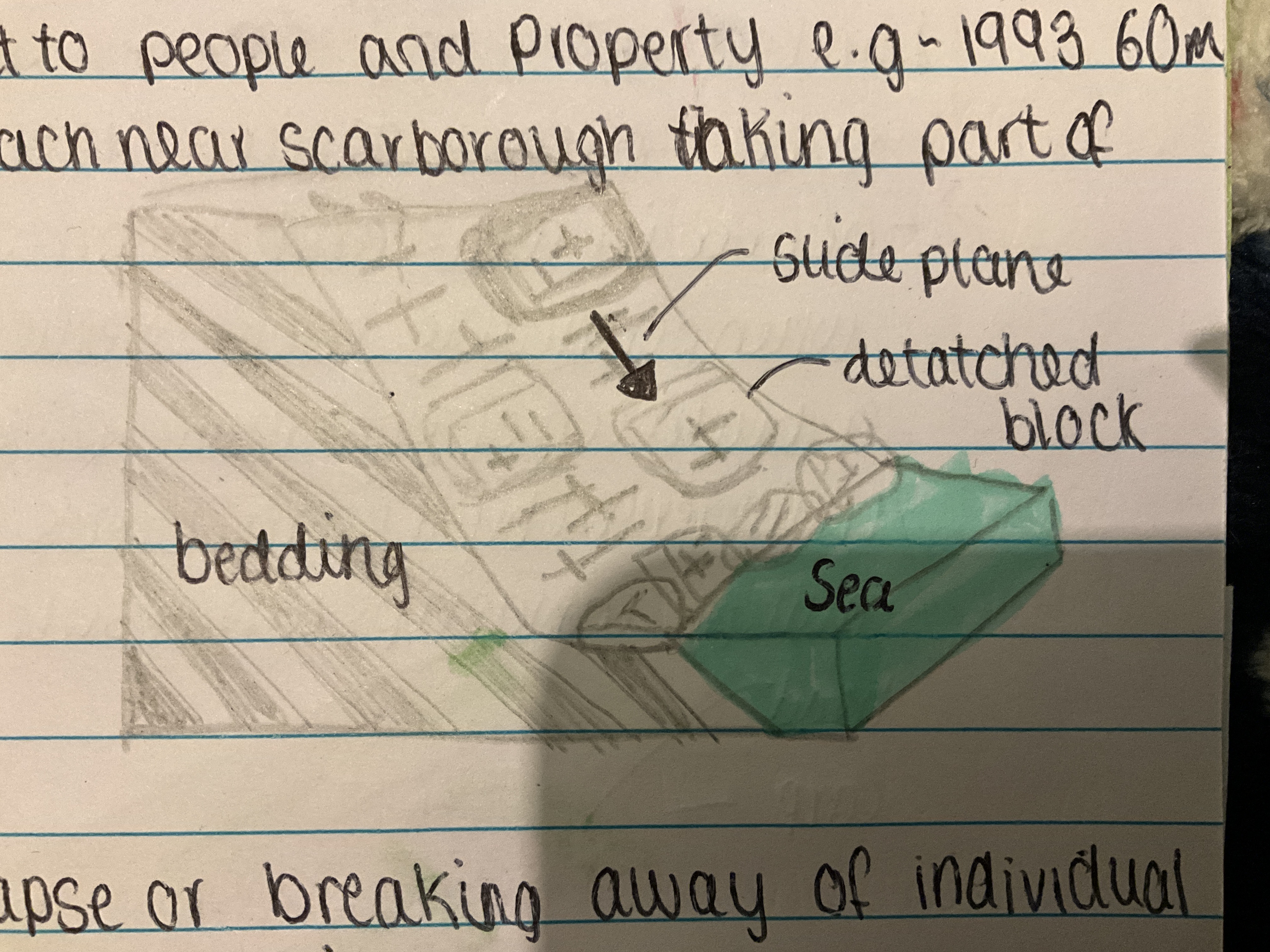
A block of moving rock moving rapidly downhill along a planar surface (slide plane), often a bedding plane that is roughly parallel to the ground surface
Moving block of material remains largely intact
Triggered by earthquakes or heavy rainfall - when the surface becomes lubricated and friction is reduced
Pose significant risk to people a property
What is rock fall?
Is the sudden collapse or breaking away of individual rock fragments at a Cliff face
Commonly associated with steep or vertical cliffs in heavily jointed and quite often resistant rock
Often triggered by mechanical weathering ( particularly freeze thaw) or an earthquake
Once broken away from the source rocks fall/ bounce down the slope to form scree or talus at the foot of the slope
Scree forms a temporary store within the coastal system then the material is gradually transported elsewhere by the sea - scree forms input into a sediment cell

What is runoff?
When overland flow occurs down a slope small particles are moved downslope to enter the littoral zone potentially forming an input into a sediment cell
Can be considered a type of flow that transfers both water and sediment from one store (the rock face) to another (beach/sea)
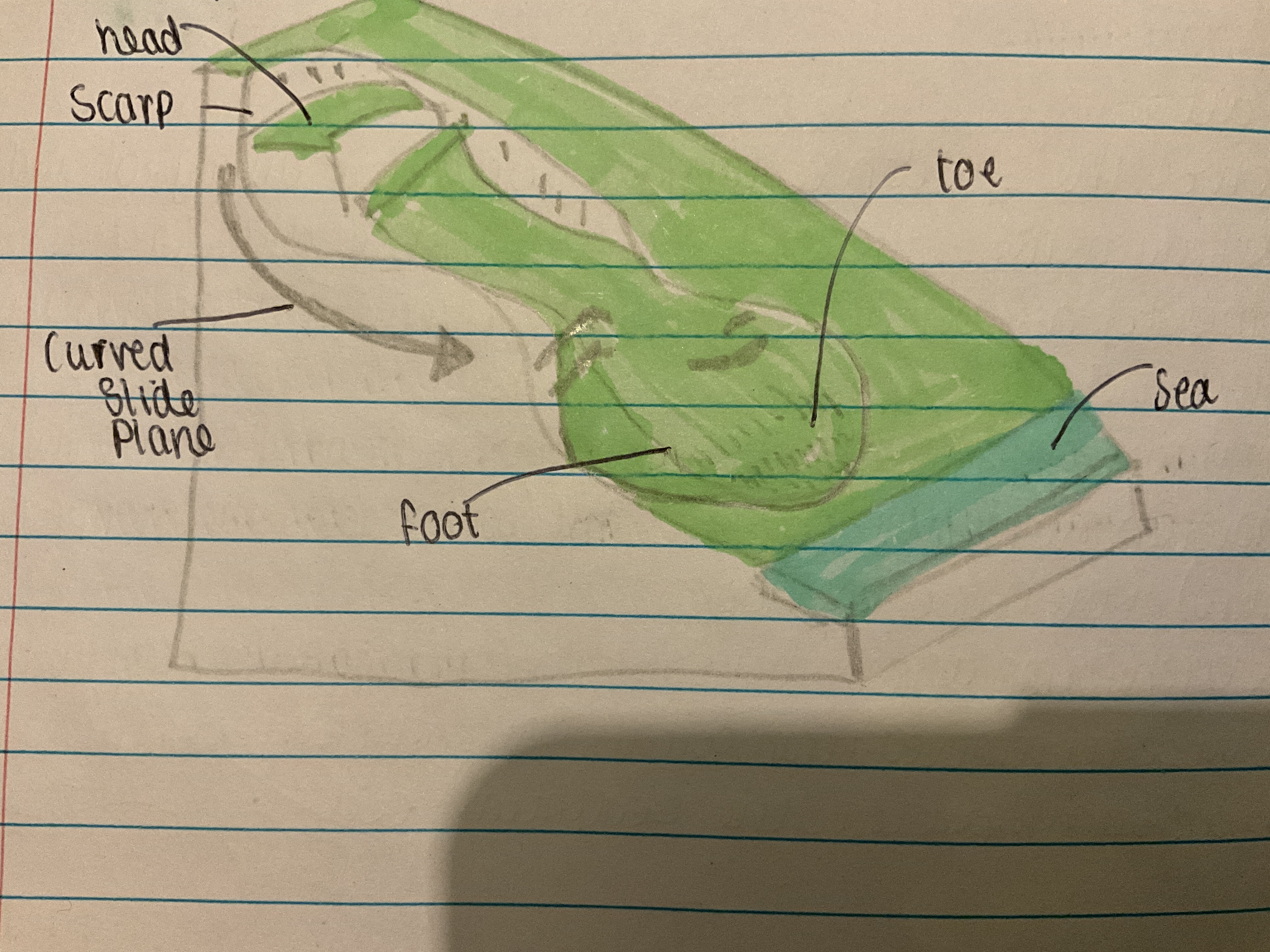
What is a landslip or slump?
Occur in weak and unconsolidated clays and sands often when permeable rock overlies impermeable rock which causes a builds up of pore water pressure
Characterised by a sharp break of slope and the formation of a scar
The slide surface is curved rather than flat
Multiple landslips can result in a terraced appearance on a cliff face
 Note
Note  Flashcards (52)