Cons Bio Exam 2
 Call Kai
 Learn
Learn Practice Test
 Spaced Repetition
 Match
Match Flashcards
 Knowt Play
1/46

Earn XP
Description and Tags
these are low quality; check your notes!
Name | Mastery | Learn | Test | Matching | Spaced | Call with Kai |
|---|
No analytics yet
Send a link to your students to track their progress
47 Terms
When did contemporary diversity begin to decline?
After the Anthropocene era
In North America, at what number did species peak near the end of the Anthropocene era?
30,000
For what two main reasons do Islands continue to increase in number of extinctions?
few, small spp. populations
low habitat diversity
How does extinction rate tend to work on islands?
the most sensitive species die first (quickly), and then the rest of species die (slowly)
What is extinction debt?
The predicted eventual loss of species following damage to their environment
What is the theory of island biogeography?
the number of species on an island depends on a balance between immigration and extinction rates
based on species-area relationship
Immigration rate = 0 when all potential species immigrate to an area
Immigration rate is higher when distance to disperse is shorter
Smaller islands have more extinctions
What is species-area relationship?
larger areas have higher species richness than smaller areas
Why do smaller islands tend to have more extinctions?
Fewer habitat types = less resources = more competition
more constrained population = more vulnerability
Two main figures related to the theory of island biogeography?
E.O. Wilson
Rob MacArthur
What did Dan Simberloff do to test the Idea that dispersal rate is tied to island’s distance from mainland?
Fumigated mangrove “islands” and observed the returning species
islands closer to shore accumulated spp. faster and had more spp.
What are the seven major threats to biodiversity?
Habitat destruction
Habitat fragmentation
Habitat degradation (pollution)
Introduction of invasive spp.
Overexploitation
Increased spread of disease
What is the leading cause of biodiversity loss?
habitat destruction and degradation
What are the three major ways humans dominate the global ecosystem?
fossil fuel use (~70%)
deforestation (~30%)
Control/influence of the nitrogen cycle
What is the formula for the impact humans have on the environment?
I = P*A*T
I = environmental impact
P = num. of people in a region
A = annual income of those people
T = technology level of those people
Lower I = Better
What is ecological footprint?
the spatial impact of a person or group of people on the environment
What is the most important means to preserving biodiversity?
Habitat preservation
What biomes are currently growing?
Temperate forests
What two major biomes are currently shrinking, and why?
Tropical forests
Logging followed by slash and burn agriculture which decimates soil nutrition
Old-growth forests
human exploitation
How does agroforestry benefit tropical rainforests?
Allows for habitat restoration and economic opportunity without degrading soil like slash and burn ag does
What percentage of agriculture-viable land is already in use globally?
98%
What is habitat fragmentation?
reduction of area and division of a habitat into two or more fragments
What three major differences do fragmented habitats have compared to non-fragmented habitats?
Greater amount of edge per unit area
center of fragments is closer to the edge
fragmented habitats are non continuous (divided from eachother)
What is matrix?
areas of non-habitat that surround habitat fragments
What two ways do habitat isolation and division affect populations?
cause inbreeding depression
cause genetic drift
What 6 species types are particularly vulnerable to fragmentation?
Species with wide ranges
species with migratory seasons
non-vagile (non-moving) species
species that prefer core habitat
low-fecundity species
human-exploited species
What is the edge effect?
Altered physical and biological conditions at the edge of fragmented habitats
light
temp
humidity
predation
wind
competition
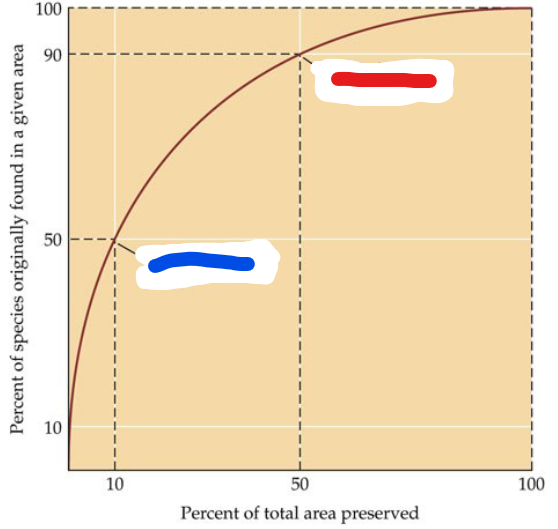
What does this graph suggest?
Blue: if only 10% of habitat is preserved (90% lost), 50% of spp. will be lost
Red: if only 50% of habitat is preserved (50% lost), 10% of spp. will be lost
What is habitat shredding?
fragmentation in a way that results in a habitat being almost entirely edge (little to no core habitat)
What does it mean that habitat fragmentation is “non-random”?
most fragmentation occurs in valleys, where human activity most commonly occurs due to terrain
How does loss of terrapins cause a trophic cascade?
terrapins eat the predators of cordgrass; no terrapins = overabundance of cordgrass
How have terrapins been exploited historically?
consumed by natives
overexploted by euros
continued decimation by americans into the 1900s
What two unsuccessful attempts were made in terrapin recovery?
coastal facilities
not economically viable due to long reproductive time
introduction to san fran bay
waters too cold
What lead to terrapin population rebound?
various events in the mid 1900s lead to a lack of demand → pop reboundf
What four modern threats do terrapins face?
blue crab bycatch
automobile accidents
nest predation
turtle food market
What are the five steps of invasive species?
transport
introduction
establishment
spread
impact
What are the two forms of invasive introduction?
Accidental
vehicle, cargo, etc contamination
intentional
exotic pet release, tourist collection, failed biocontrol projects, etc.
What are the 7 examples of agricultural invasives?
Kudzu
fast-growing vine that smothers plants
pink bollworm
eats crops from inside out
screwworms
Eat cattle flesh
feral hogs
crop eaters & tramplers
nutria
wetland destroyers
zebra mussels
sharp shells
nilgai
out-compete native deer
How does tree of heaven affect other plants?
release ailanthone that inhibits nearby plant growth
SLF eat this, making them undesirable to predators
What is honeydew?
secretion from SLF that inhibits plants and allows for fungi to grow (destroys crops)
What is the greenhouse effect?
high-energy light from the sun hits earth → bounces off in degraded form → degraded light bounces off atmospheric gas → back to earth
What is the main driving force behind the increase in greenhouse effect?
human fossil fuel use
What are the 4 main components of a carbon cycle?
Pool
place where gases are stored:
Source = pool that gives more than it recieves
sink = pool that recieves more than it gives
Flux
zone of movement between pools
What are the 5 influences climate change has on organisms?
direct effect on physiological processes
indirect effect on resource avaliability
influence of species range and movement
phenology
species interaction
what is phenology?
the timing of seasonal biological events
What is phenological mismatch?
change in phenology of a species having drastic effects on another species
What are extreme climate events?
extreme conditions that can cause widespread mortality quickly
frequency and magnitude has been increasing over time
What are trophic cascades?
influence of activity at one trophic level having drastic impacts on the rest
Explore top notes

