International Marketing Session 2
 Studied by 0 people
 Call Kai
 Learn
Learn Practice Test
 Spaced Repetition
 Match
Match Flashcards
 Knowt Play
1/21

There's no tags or description
Looks like no tags are added yet.
Name | Mastery | Learn | Test | Matching | Spaced |
|---|
No study sessions yet.
22 Terms
What Is Targeting
Targeting – process of identifying customers for whom the company will optimize its offering
One-for-all-strategy vs One-for-each strategy
and
Is "One-for-Each" Always a Good Idea?
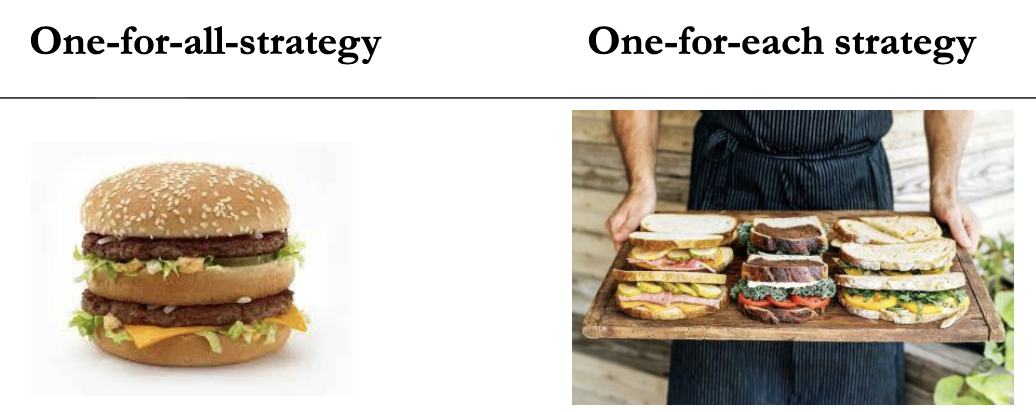
Based on the "International Marketing: Session 2" lecture slides, here is an explanation of the two strategies and the critique of the "One-for-Each" approach.
1. One-for-All vs. One-for-Each Strategy
These concepts refer to different approaches to Targeting, which is the process of identifying customers for whom the company will optimize its offering.
One-for-All Strategy: This implies a mass marketing approach where a company offers a single product or service to the entire market, treating all customers as if they have the same needs.
One-for-Each Strategy: This is the opposite extreme, often called hyper-customization or one-to-one marketing. Here, the company creates a unique, optimized offering for every single individual customer.
2. Is "One-for-Each" Always a Good Idea?
The short answer is No.
While a "One-for-Each" strategy might sound perfect because every customer gets exactly what they want, the lecture highlights that it often fails to create an Optimal Value Proposition because it creates conflict between the three value stakeholders (Customer, Company, Collaborator).
Why is it not always a good idea:
High Costs for the Company (Company Value): Creating a unique product for every person creates massive operational complexity. The slides specifically ask to consider the "possible sources of additional costs for the company". These often include:
High manufacturing costs (no economies of scale).
Complex logistics and distribution.
Expensive marketing to communicate with each person individually.
Diminishing Returns: Not all differences between customers matter. Focusing on every tiny individual preference (e.g., a customer wanting a slightly different shade of blue) might not lead to enough extra profit to justify the cost.
The Solution: Segmentation
Because "One-for-All" is too generic and "One-for-Each" is too expensive, the middle ground is
Segmentation.
The lecture defines segmentation as the grouping of customers with similar needs. It works by:
Focusing on differences that are relevant for targeting (e.g., price sensitivity, status seeking).
Ignoring differences that are irrelevant (e.g., slight variations in taste that don't change purchasing behavior).
This allows a company to be specific enough to satisfy customers without the crushing costs of serving everyone individually.
What Is Segmentation?
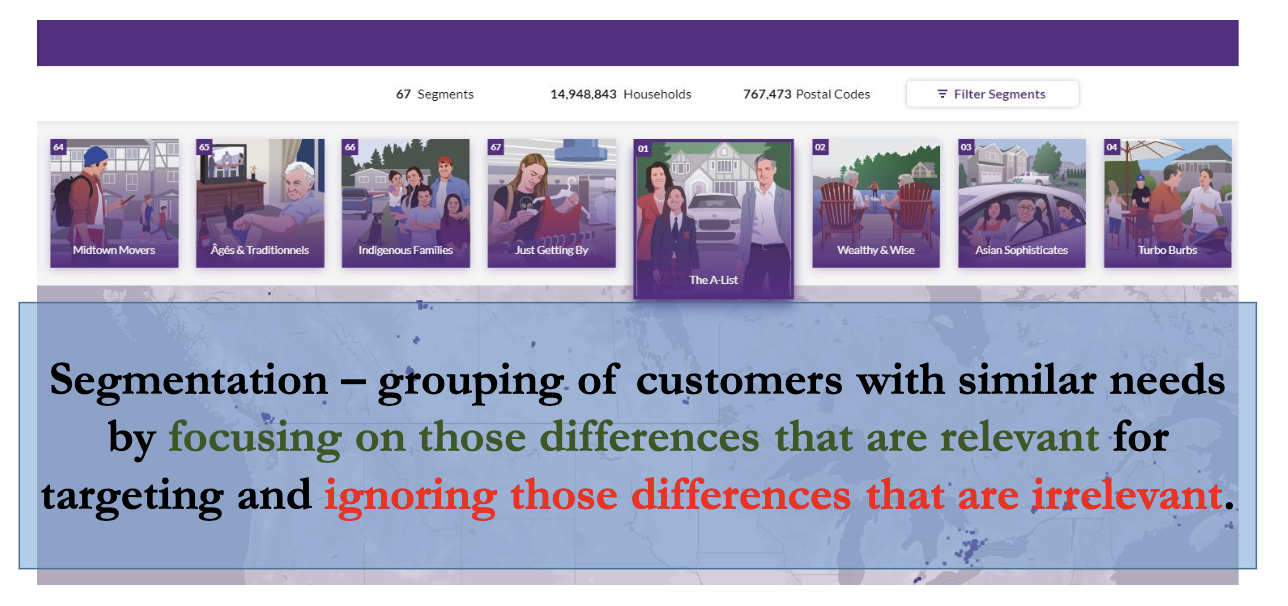
The lecture defines segmentation as the grouping of customers with similar needs. It works by:
Focusing on differences that are relevant for targeting (e.g., price sensitivity, status seeking).
Ignoring differences that are irrelevant (e.g., slight variations in taste that don't change purchasing behavior).
This allows a company to be specific enough to satisfy customers without the crushing costs of serving everyone individually.
TARGETING AND SEGMENTATION:
Strategic vs Tactical
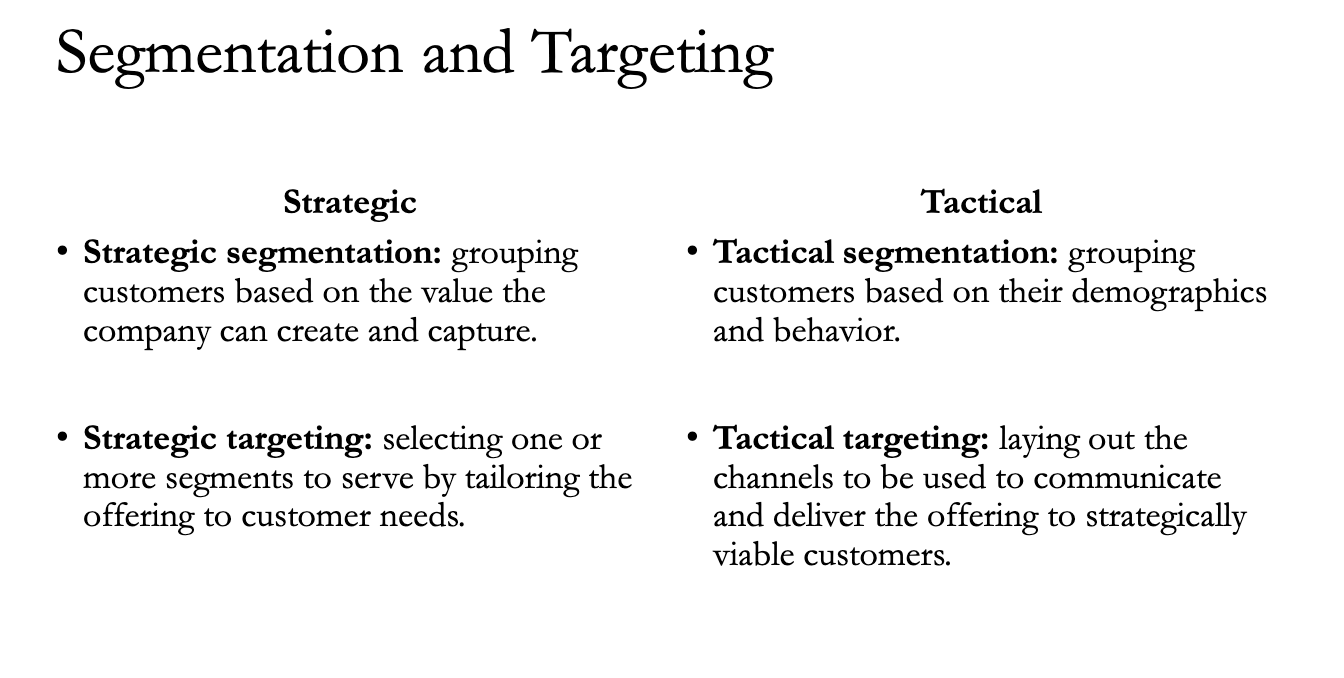
Strategic (The "Why" and "What") and Tactical (The "Who" and "How").
TARGETING AND SEGMENATION: HOW TO?
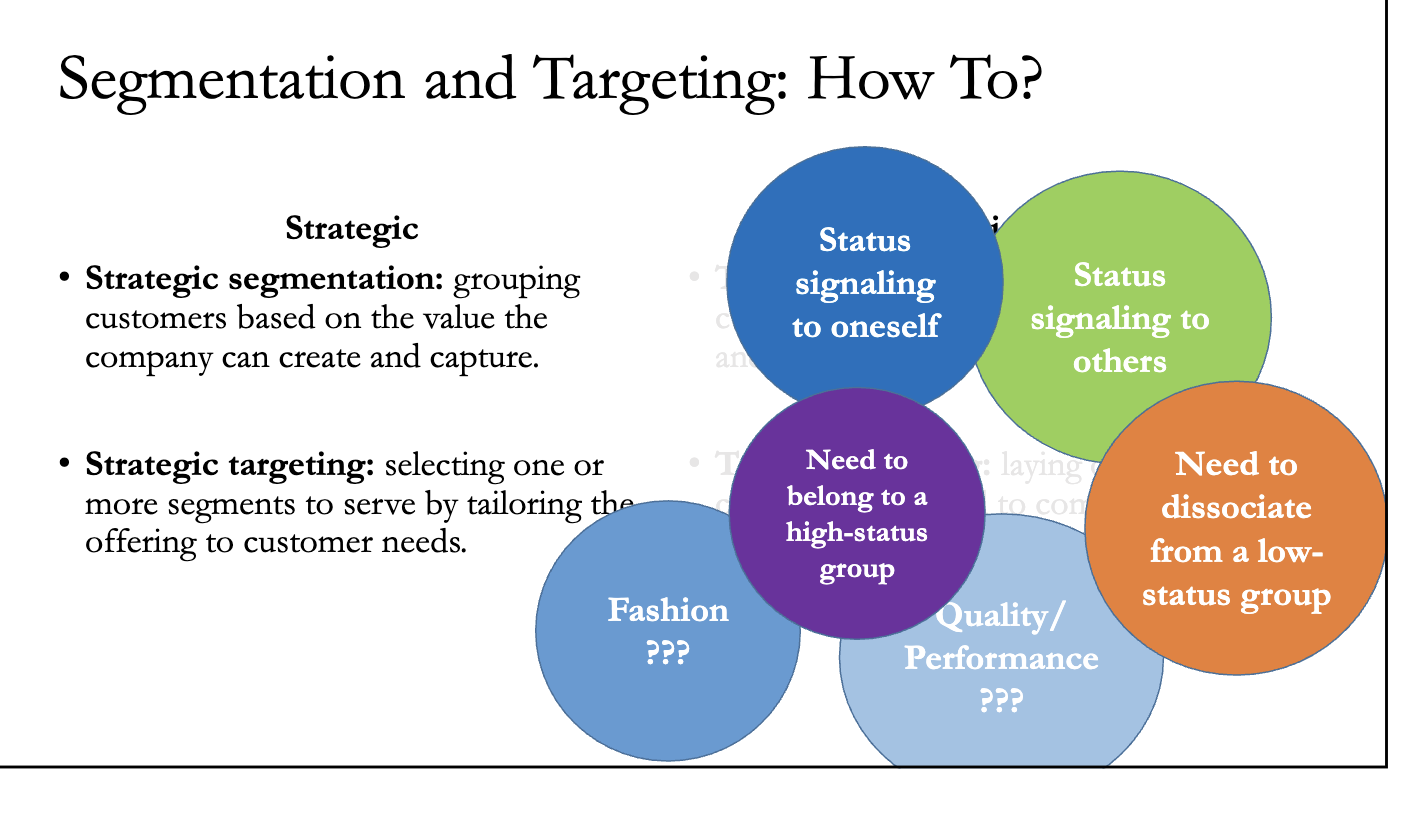
Based on the "International Marketing: Session 2" lecture slides, here is an explanation of the Targeting and Segmentation: How To? section.
The lecture divides the process into two distinct levels: Strategic (The "Why" and "What") and Tactical (The "Who" and "How").
1. Strategic vs. Tactical: What's the difference?
To do segmentation effectively, you must separate the value you create from the profile of the customer.
Strategic Segmentation (The "Why"): You group customers based on value. Why do they want the product? What specific benefit are they looking for?.
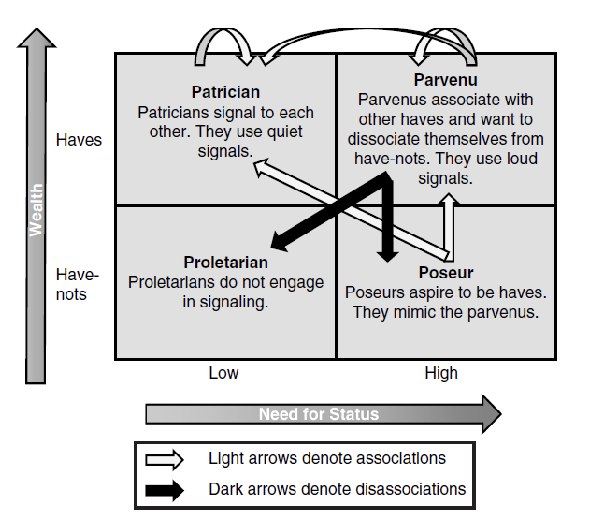
Example: Some people buy a bag to show off wealth ("loud signals"), while others buy it for quality and subtle status ("quiet signals") .
Tactical Segmentation (The "Who"): You group customers based on demographics and behavior. How can we reach them? How old are they? Where do they live?.
Example: "Women aged 25-40, earning $50k+, living in cities."
Strategic Segmentation Principles (The 4 Rules)
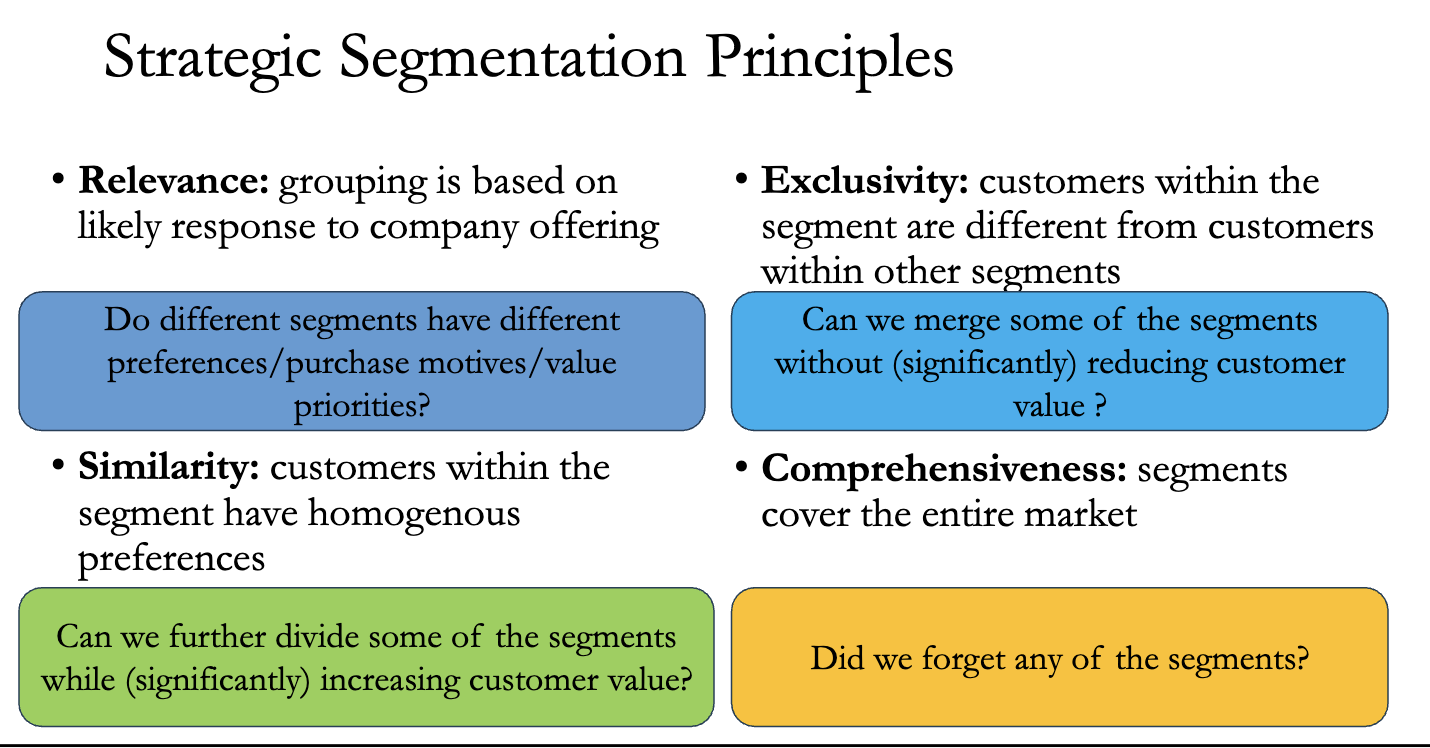
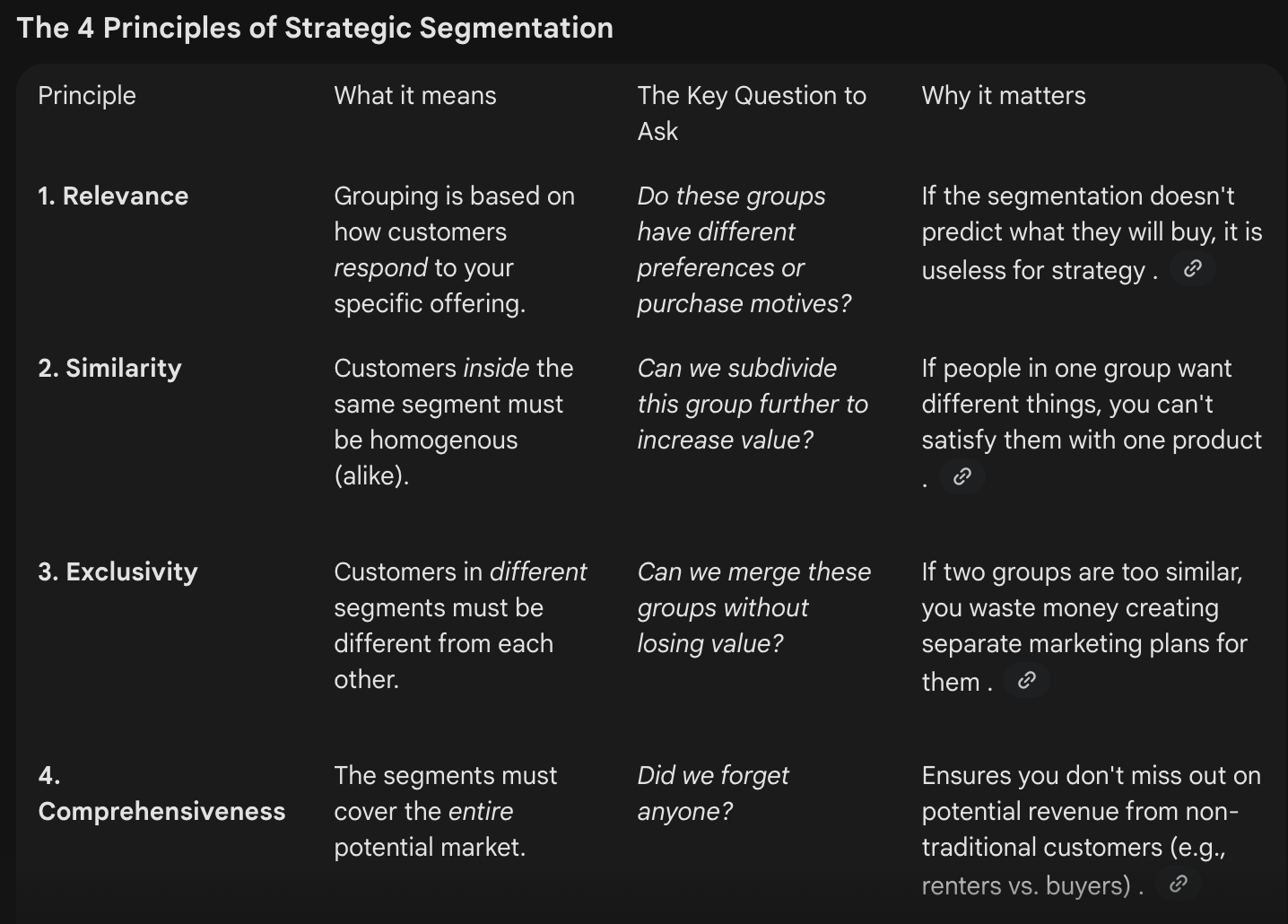
Strategic Segmentation Principles (The 4 Rules)
When you are creating your value-based groups (Strategic Segmentation), you must check your work against four principles. The lecture uses a Luxury Goods Case (Handbags) to explain this.
A. Relevance
Does the segmentation actually predict what they will buy? The groups must have different preferences.
The Test: If "Segment A" and "Segment B" both like the exact same "loud" handbag with a big logo, your segmentation isn't relevant. You need groups that react differently to your product.
Luxury Case: The study found that "Patricians" (wealthy, low need for status) prefer quiet bags, while "Parvenus" (wealthy, high need for status) prefer loud bags. This is a relevant segmentation because their choices differ.
B. Similarity
Are the people inside one segment actually alike? They must have homogenous preferences.
The Mistake: If you just group everyone by "Wealth" (The Haves vs. The Have-Nots), you violate this principle. Why? Because the "Haves" includes both people who want loud bags and people who want quiet bags. They are not similar enough to be one group .
C. Exclusivity
Are the segments different enough from each other?
The Test: If two segments (e.g., Segment 1a and Segment 1b) require the exact same marketing plan and product, you are wasting money. You should merge them.
D. Comprehensiveness
Did you miss anyone? Your segments should cover the entire potential market.
The Test: Are there customers who don't fit into your current boxes but could still pay you?
Luxury Case: The slides highlight "Rent the Runway." This service targets people who don't want to buy a dress (maybe they can't afford it or only need it once) but still want to wear it. If you only segment by "Buyers," you miss this entire "Renters" market
in a way isnt Relevance, Similarity and Exclusivity saying the same thing?
It is easy to see why they feel similar: they are all "quality checks" for your groups. If you mess one up, the others often fall apart too.
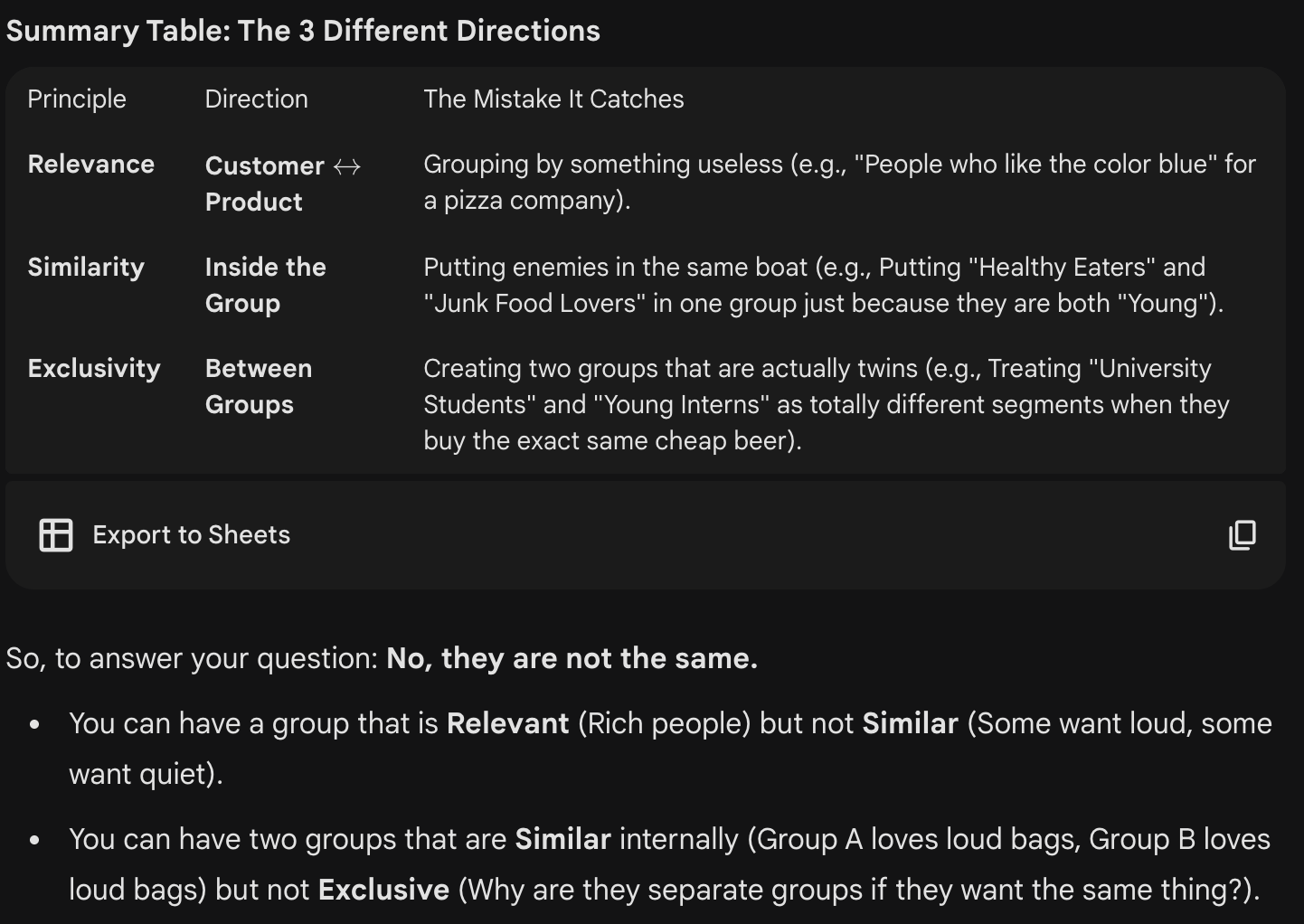
However, in marketing strategy, they test three different directions:
Relevance tests the connection between the customer and the product.
Similarity tests the inside of the box (consistency).
Exclusivity tests the outside of the box (distinctiveness).
Here is a breakdown of why they are not saying the same thing, using the Luxury Handbag Case from your slides to prove it.
The "Luxury Handbag" Proof
Imagine we segment the market based on "Income Level" (High vs. Low).
1. Is it Relevant? (The "Does it matter?" Test)
Definition: Does this trait predict what they buy?
Verdict: YES. High income is relevant because you need money to buy luxury bags.
Result: Relevance is passed.
2. Is it Similar? (The "Internal Purity" Test)
Definition: Do all high-income people want the same bag?
Verdict: NO. As the slides show, the "High Income" group contains both Patricians (who want quiet, subtle bags) and Parvenus (who want loud, flashy bags).
Result: Similarity FAILED. The group is "Relevant" (they all have money), but not "Similar" (they want opposite things).
3. Is it Exclusive? (The "Are they unique?" Test)
Definition: Is this group truly different from the others?
Verdict: NO. If we look at the Parvenus (wealthy show-offs) and Poseurs (less wealthy show-offs), they both want the exact same thing: Loud bags. In terms of product preference, these two groups are not exclusive; they overlap significantly in what they crave .
Result: Exclusivity FAILED.
Strategic Targeting: Picking Your Battles
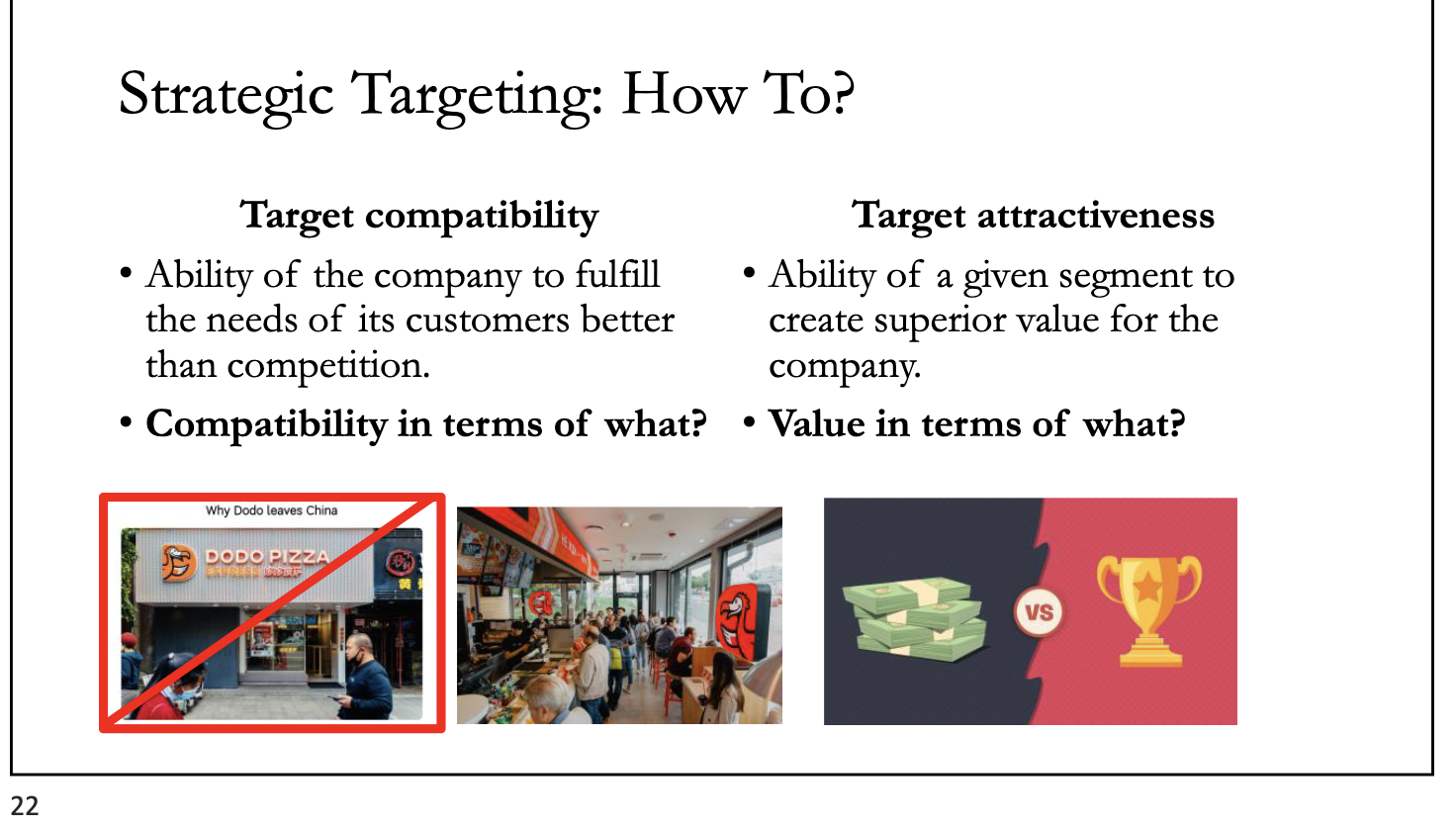
Strategic Targeting: Picking Your Battles
Once you have your segments, how do you choose which ones to target? You evaluate two things:
Target Compatibility: Can we make them happy?
Do we have the ability to fulfill their needs better than the competition? (e.g., Do we have the right engineers? The right brand image?) .
Target Attractiveness: Can they make us happy?
Will this segment create value for the company? Are they profitable? Is the segment growing?.
Tactical Segmentation and Targeting
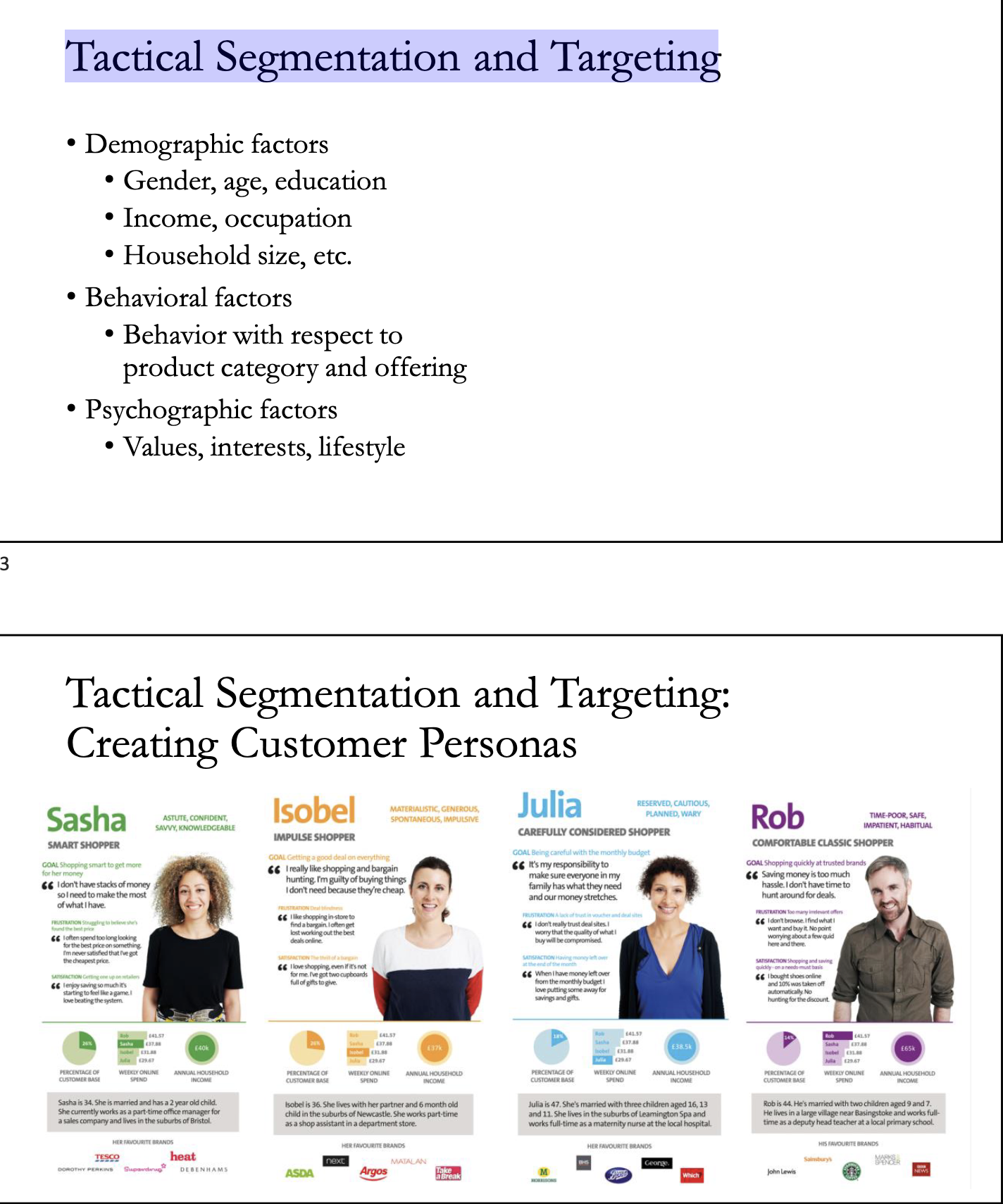
While strategic segmentation asks "Why do they buy?" (Value), tactical segmentation asks "Who are they and how do we reach them?" (Profile). This step turns abstract strategy into concrete action by defining the specific characteristics of the customers you want to target.
Tactile Segmentation
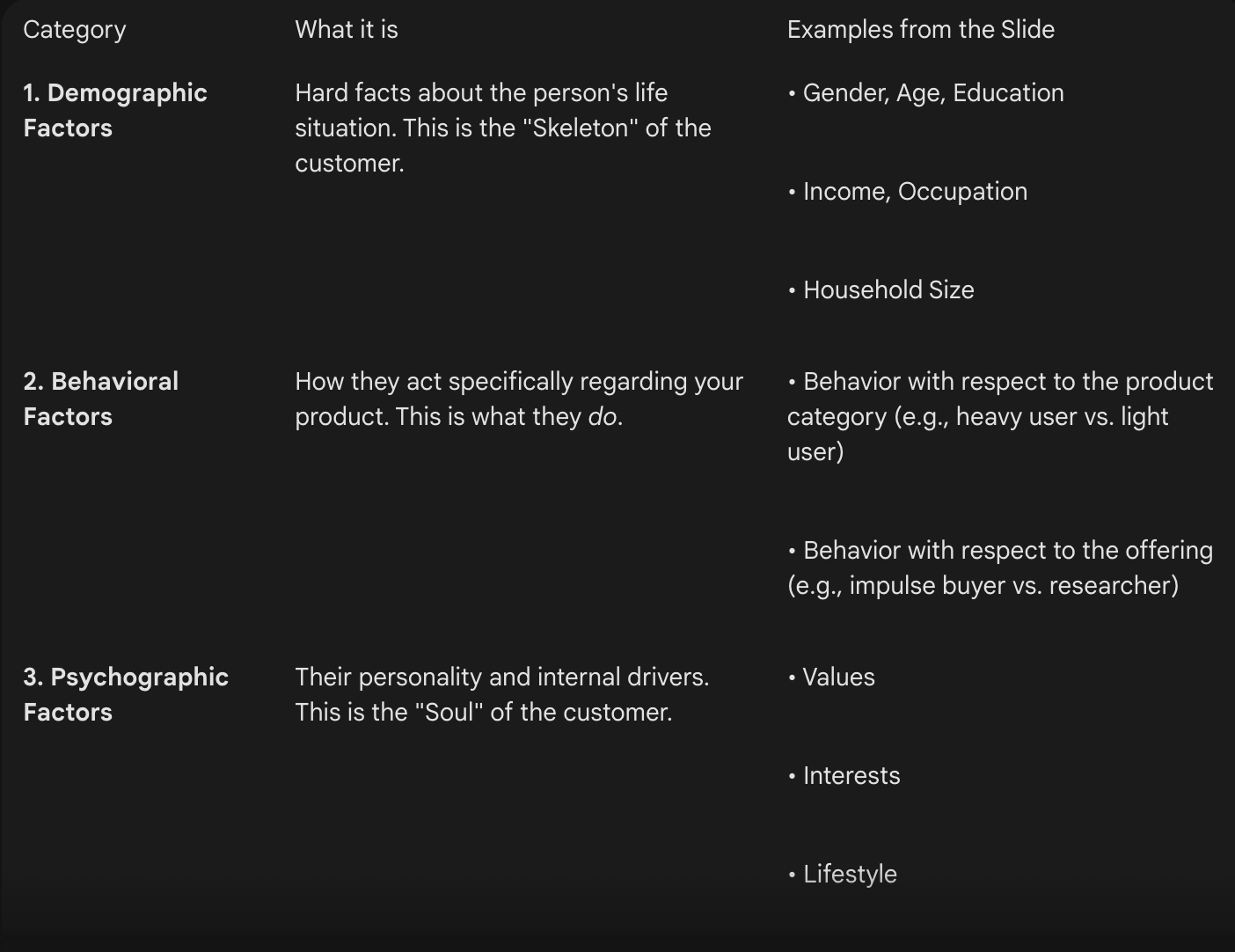
The 3 Pillars of Tactical Segmentation
To identify and reach your customer segments, you look at three main categories of data 🇦
Putting it into Practice: Creating Customer Personas
Slide 23 (Page 12) shows how these three factors come together to create
***Customer Personas: A persona is a fictional character that represents a segment.***
The slide provides four distinct examples of how tactical data creates a clear picture of a buyer :
1. Sasha: "The Smart Shopper"
Demographic: 34 years old, married, 2-year-old child, part-time office manager.
Psychographic: Savvy, confident, knowledgeable.
Behavior: "I don't have stacks of money... I treat shopping like a game." She actively hunts for the best value.
2. Isobel: "The Impulse Shopper"
Demographic: 36 years old, lives with partner & child, works part-time as a shop assistant.
Psychographic: Enthusiastic, carefree, spontaneous.
Behavior: "Guilty of buying things I don't need because they're cheap."
3. Julia: "The Carefully Considered Shopper"
Demographic: 47 years old, married with three teenage children (16, 13, 11), works full-time as a nurse.
Psychographic: Reserved, cautious, family-oriented ("It's my responsibility to make sure everyone... has what they need").
Behavior: Doesn't trust deal sites; worries about quality compromise.
4. Rob: "The Comfortable Classic Shopper"
Demographic: 44 years old, married with two young kids (7 & ?), deputy head teacher.
Psychographic: "Time poor," safe, impatient, habitual.
Behavior: "Saving money is too much hassle." He doesn't hunt for deals; he values convenience and trusted family brands.
Why do we do this?
The goal of Tactical Targeting is to use these profiles to decide where and how to communicate.
Example: You wouldn't advertise to Rob using a "Flash Sale" coupon app (he hates the hassle). You would advertise to him using convenient "Subscribe & Save" options on a reliable website. Conversely, Isobel is the perfect target for a "Buy One Get One Free" impulse offer.
Tactile Targeting
The Method: Tactical Segmentation
The actual method involves gathering data on three specific factors to group your customers :
Demographics: (Age, gender, job, family size).
Behavior: (Do they hunt for deals? Do they buy impulsively?).
Psychographics: (Are they cautious? Spontaneous? Time-poor?).
2. The Output: Customer Personas
Sasha, Isobel, Julia, and Rob are Personas. You create these characters to humanize the data so your marketing team understands who they are talking to.
Instead of saying "Target Segment A (Females, 30-40, low income)," you say "Target Sasha."
3. The Application: Tactical Targeting
This is the final step where you use the persona to decide how and where to reach them.
Targeting Sasha: Since she "actively hunts for value" and treats shopping like a game, you would target her with coupons, comparison websites, and loyalty apps.
Targeting Rob: Since he finds saving money "too much hassle" and values safety, you would target him with convenience, subscription services, and ads in trusted newspapers, emphasizing reliability over price.
Summary: The profiles you listed are what you build using the methods (demographics + behavior + psychographics) so that you can perform tactical targeting effectively.
The Tactical Workflow
1. Tactical Segmentation (The Data)
What you do: You collect raw data on "Demographic," "Behavioral," and "Psychographic" factors.
The Input: "We have a group of women, 30-40, working part-time, who like value."
↓
↓
2. Personas (The Model)
What you do: You synthesize that dry data into a "fictional character" to make it relatable for your marketing team.
The Output: "Meet Sasha. She treats shopping like a game and hunts for deals."
↓
↓
3. Tactical Targeting (The Action)
What you do: You decide where to place your ads and how to deliver the product based on what the Persona does3.
The Result: "Since Sasha 'hunts for deals' and is 'savvy, we will place ads on coupon apps and offer a loyalty rewards program."
Summary:
Tactical Segmentation is sorting the pile of people.
Personas are giving the pile a face and a name.
Tactical Targeting is talking to that face.
Case of Luxury Goods: Different Levels of Luxury and its segements
Diaspora Marketing: How to market to people who have moved from their home country to a new "host" country (immigrants)?
Part 1: The Context – Why Market to Immigrants?
Immigrants are a huge, wealthy segment. The question is: How do we group them effectively?.
eg:
The lecture starts by proving that immigrants are a massive, valuable business opportunity, not just a small niche.
The Numbers are Huge:
In the Netherlands, about 25% of the population (4.5 million people) has a migration background.
In the USA, there are 37 million Mexican-Americans.
In Germany, there are 3-4 million people of Turkish descent.
They Have Money (Purchasing Power):
A common myth is that immigrants are poor. The slides show the opposite for many groups.
Example: In the US, the median household income for Indian-Americans is over $90,000, which is much higher than the US average of $50,000.
Chinese and Vietnamese Americans also earn higher than the average US median income
Part 2: Two Ways to Segment Immigrants
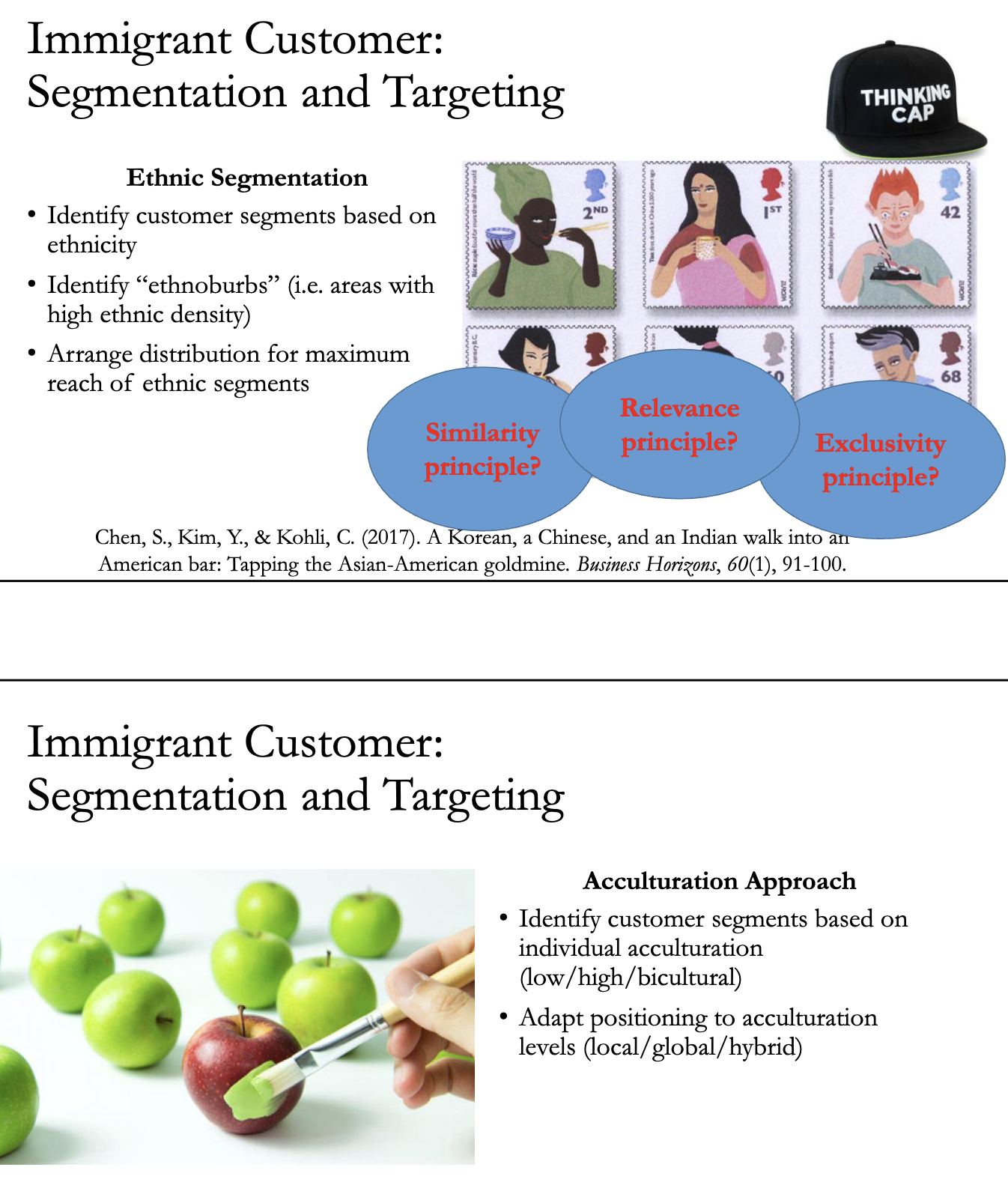
The lecture introduces two specific methods to group these customers:
Method 1: Ethnic Segmentation (The Geographical Approach)
How it works: You group people simply by their ethnicity and where they live.
Key Concept: "Ethnoburbs" (Ethnic Suburbs). These are areas with a high density of a specific ethnic group (like Chinatown or Little Italy).
Strategy: You simply send your products to these specific neighborhoods.
Method 2: Acculturation Approach (The Psychological Approach)
How it works: Instead of just looking at where they live, you look at how they act and feel.
Key Concept: Acculturation. This measures how much they have adapted to the new culture versus keeping their old culture.
Strategy: You adapt your marketing based on their integration level (e.g., are they fully local, fully traditional, or a mix?).
Part 3: Understanding Acculturation
This section dives deep into Method 2 (Acculturation) because it is more complex but often more useful.
What is Acculturation? It is the process of acquiring the traits of the new "host" culture, such as learning the language, making friends outside your ethnic group, and participating in local institutions
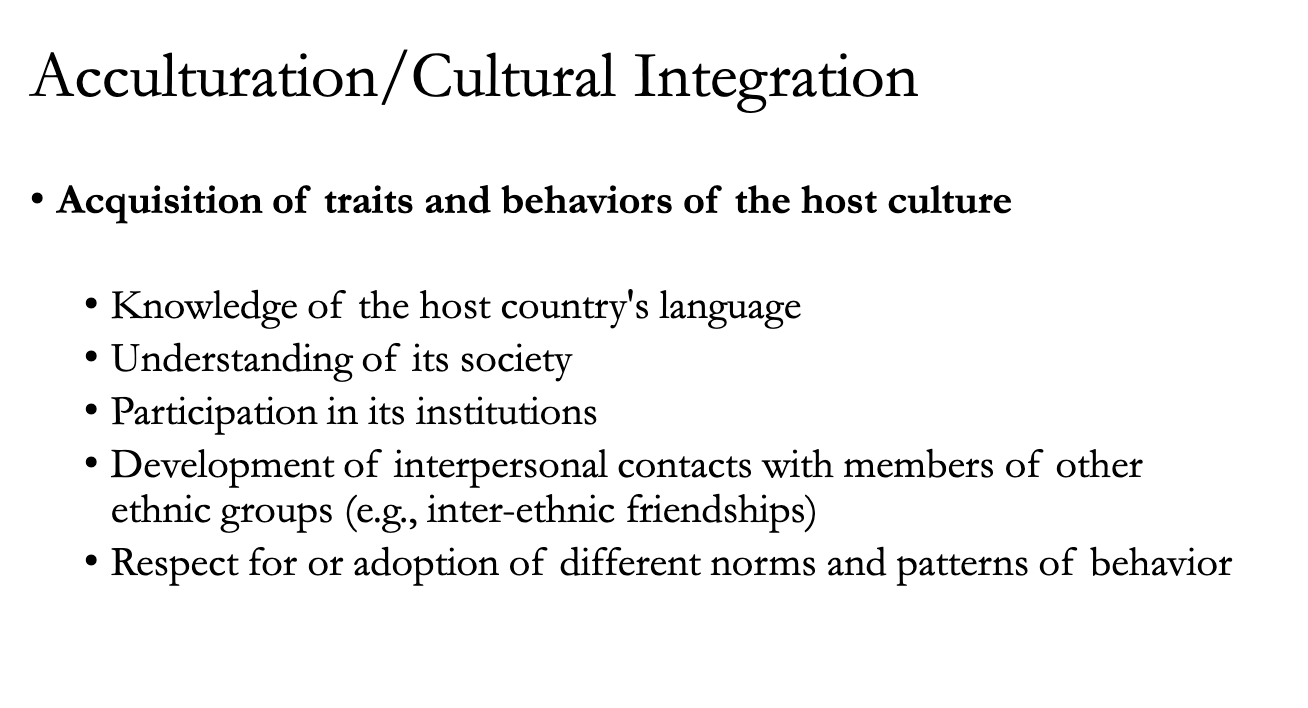
Acculturation : How do we measure it? (The Vancouver Index)
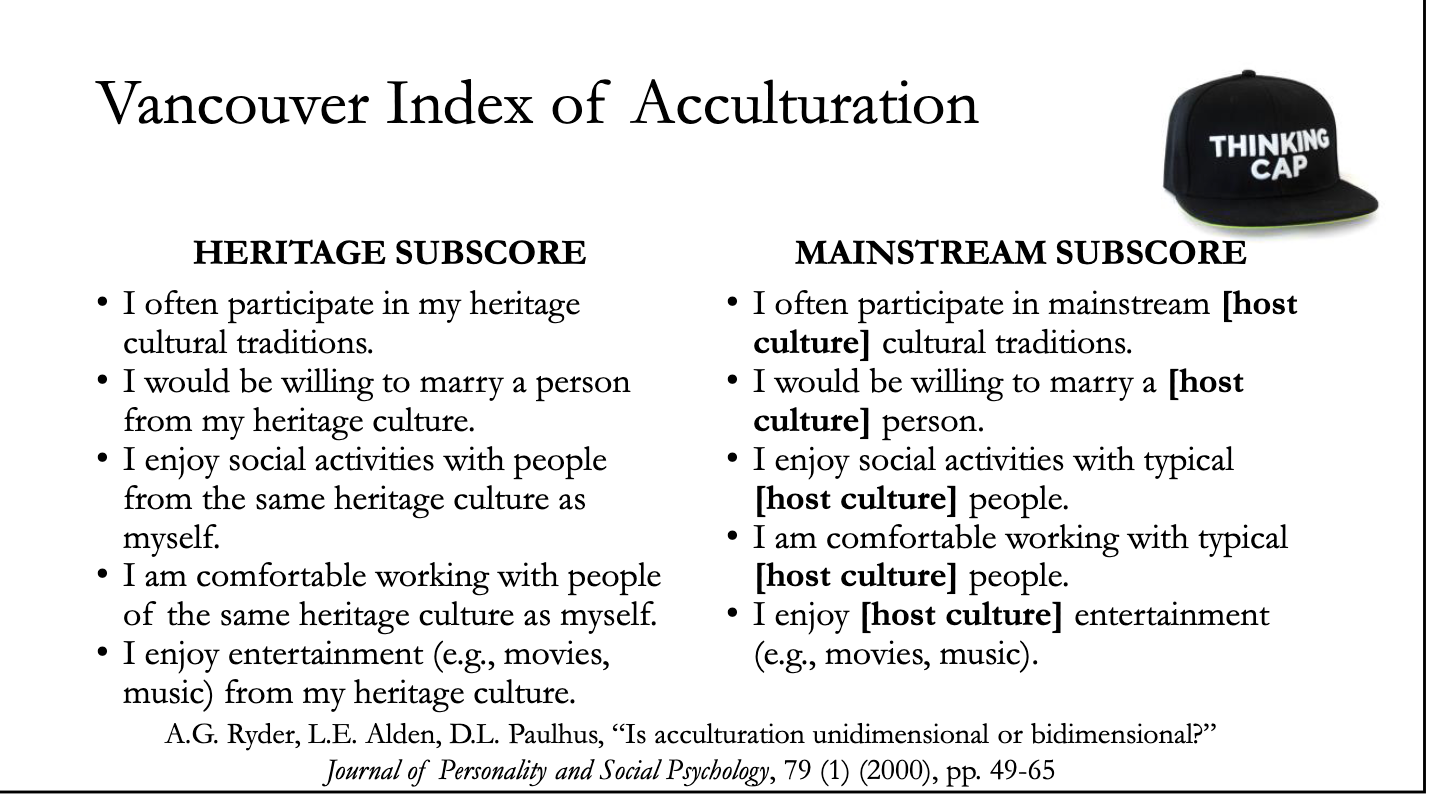
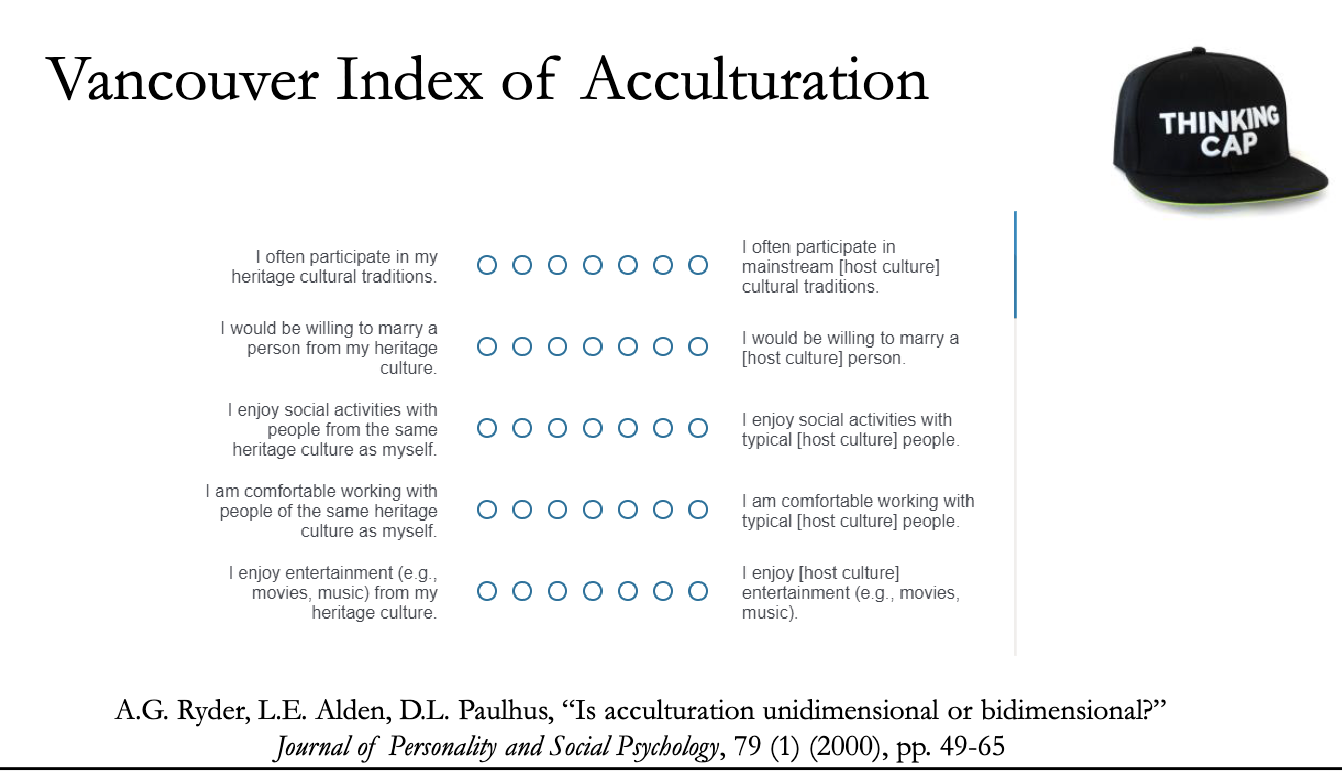
How do we measure it? (The Vancouver Index) The slides introduce a tool called the Vancouver Index of Acculturation. It teaches us that cultural identity is not a straight line where you lose one culture to gain another. Instead, it asks two separate questions :
Heritage Subscore: Do you like your old home culture? (Do you marry within it? Enjoy its music/food?) .
Mainstream Subscore: Do you like the new host culture? (Do you enjoy local entertainment? Have local friends?) .
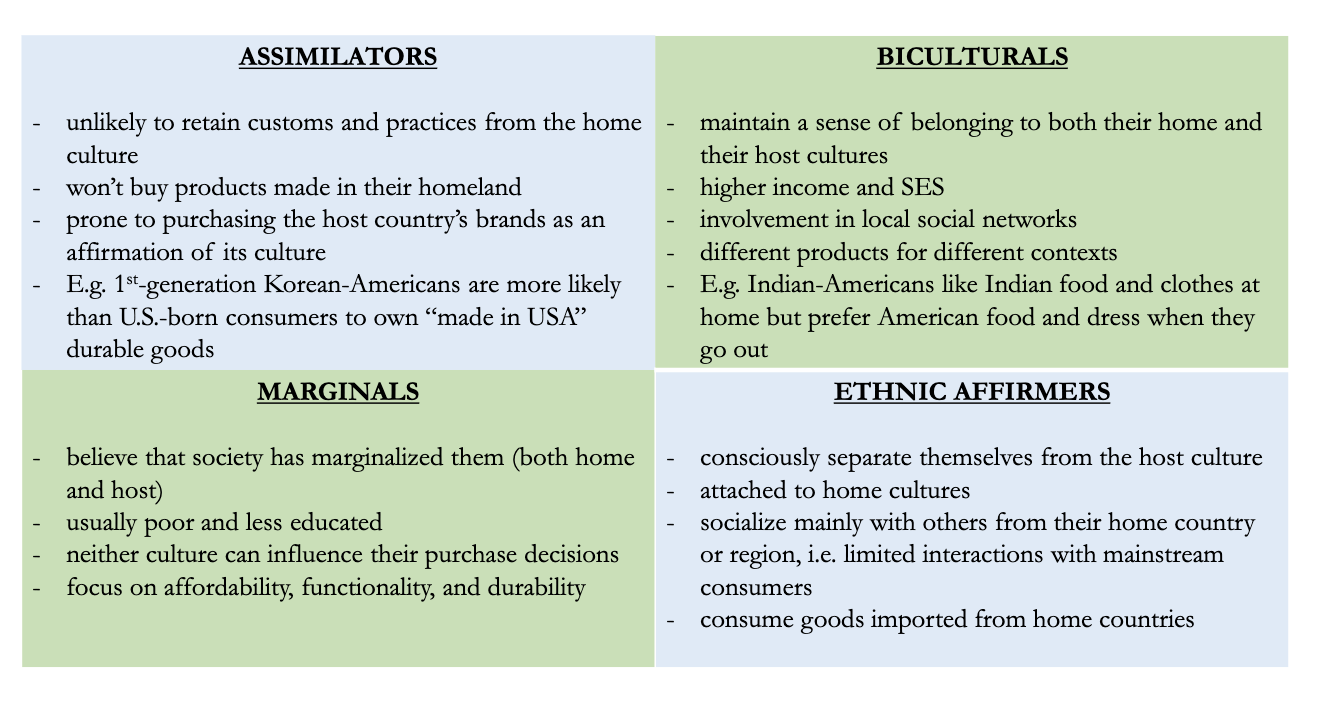
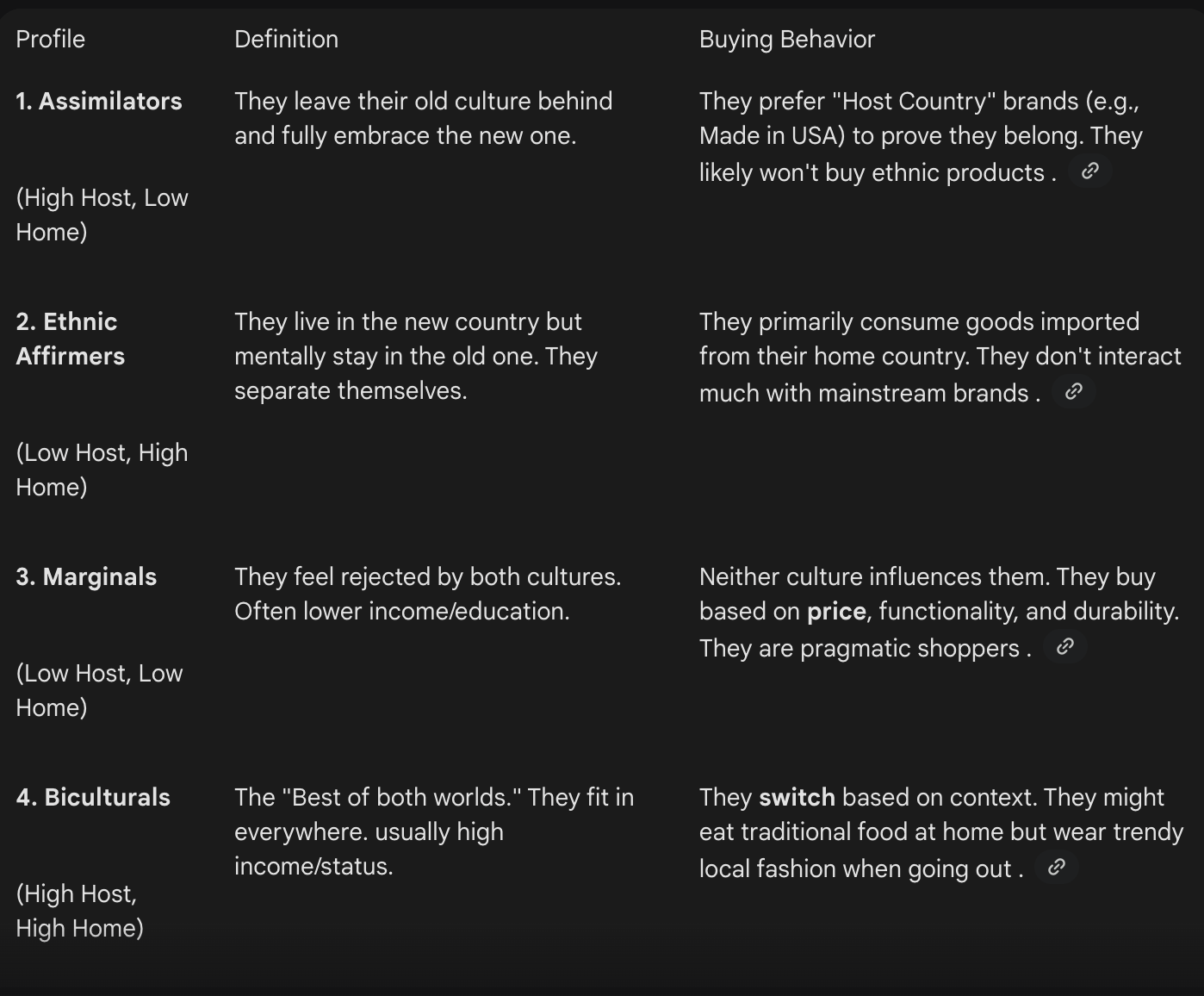
The 4 Immigrant Customer Profiles
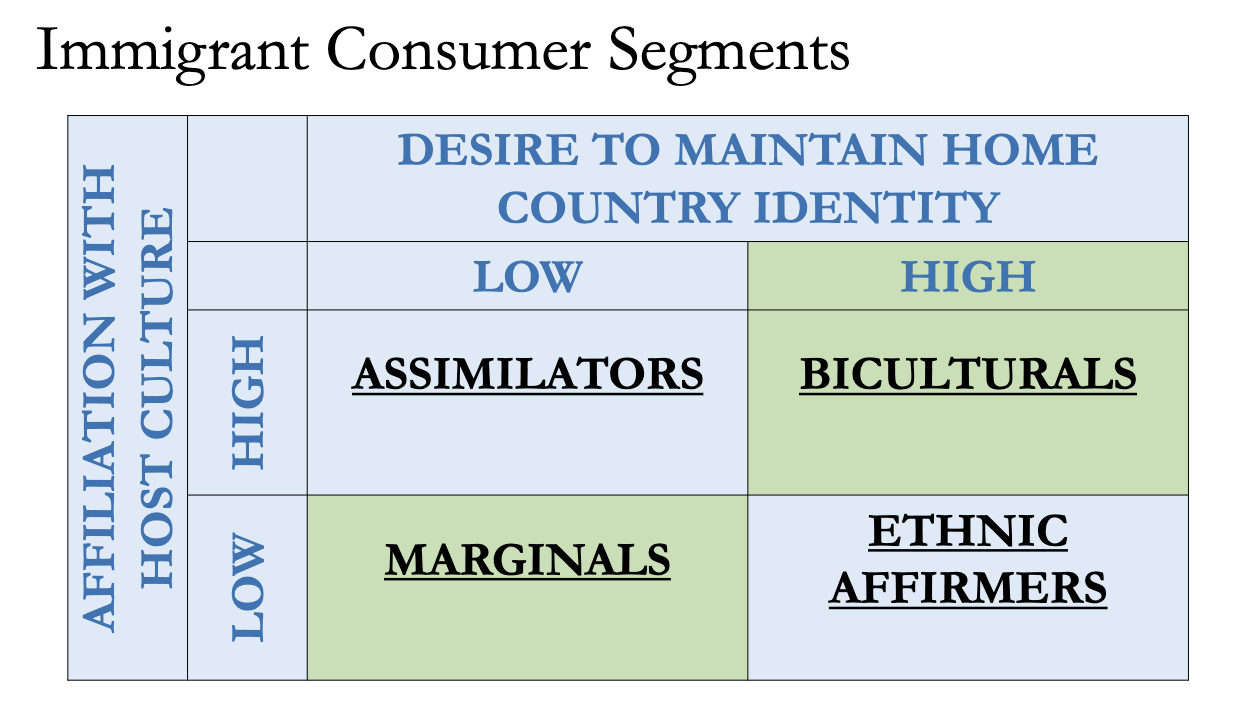
Based on the Vancouver Index (High/Low Heritage vs. High/Low Mainstream), you get 4 distinct types of customers. This is the most critical part of the framework for targeting.
How to Identify the Segments?
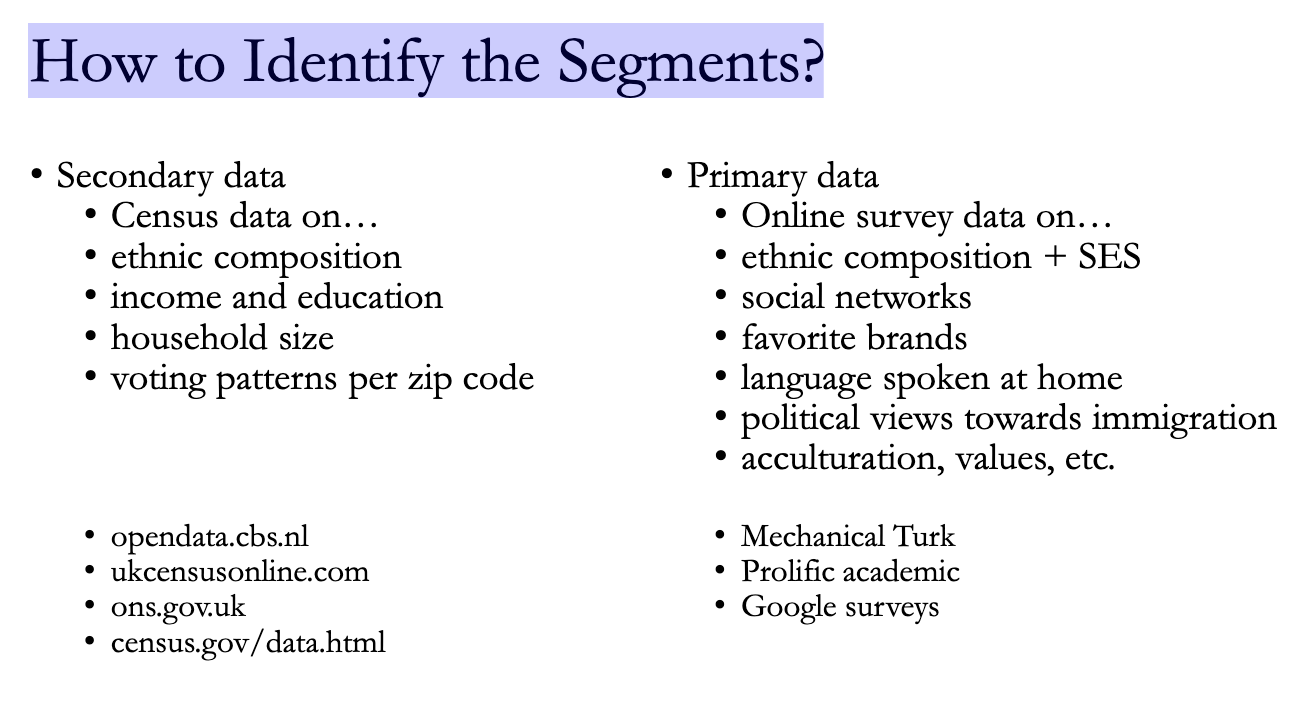
How to Find the Data:
Once you know these segments exist, how do you find them in the real world?
Secondary Data (Easy to find): Look at Census data. This tells you ethnic composition, income, and voting patterns by zip code .
Primary Data (You have to collect it): You must run surveys to ask deeper questions like "What language do you speak at home?" or "What are your political views?" to figure out their acculturation level .
WHICH SEGMENTS TO TARGET?
The section concludes by asking: Which segment should we target?
The slides suggest a specific strategy for Diaspora Marketing:
Market to the Immigrant first: Specifically, those living in the new host culture.
Use them as a "Launchpad": Use the immigrant group to build popularity, then expand to the mainstream consumers .
Visual Examples:
99 Ranch Market: An Asian supermarket chain that started for immigrants but now attracts everyone.
Lebara: A phone company built for immigrants to call home cheaply, which became a major mainstream provider.
The Core Strategy: The "Launchpad" Approach
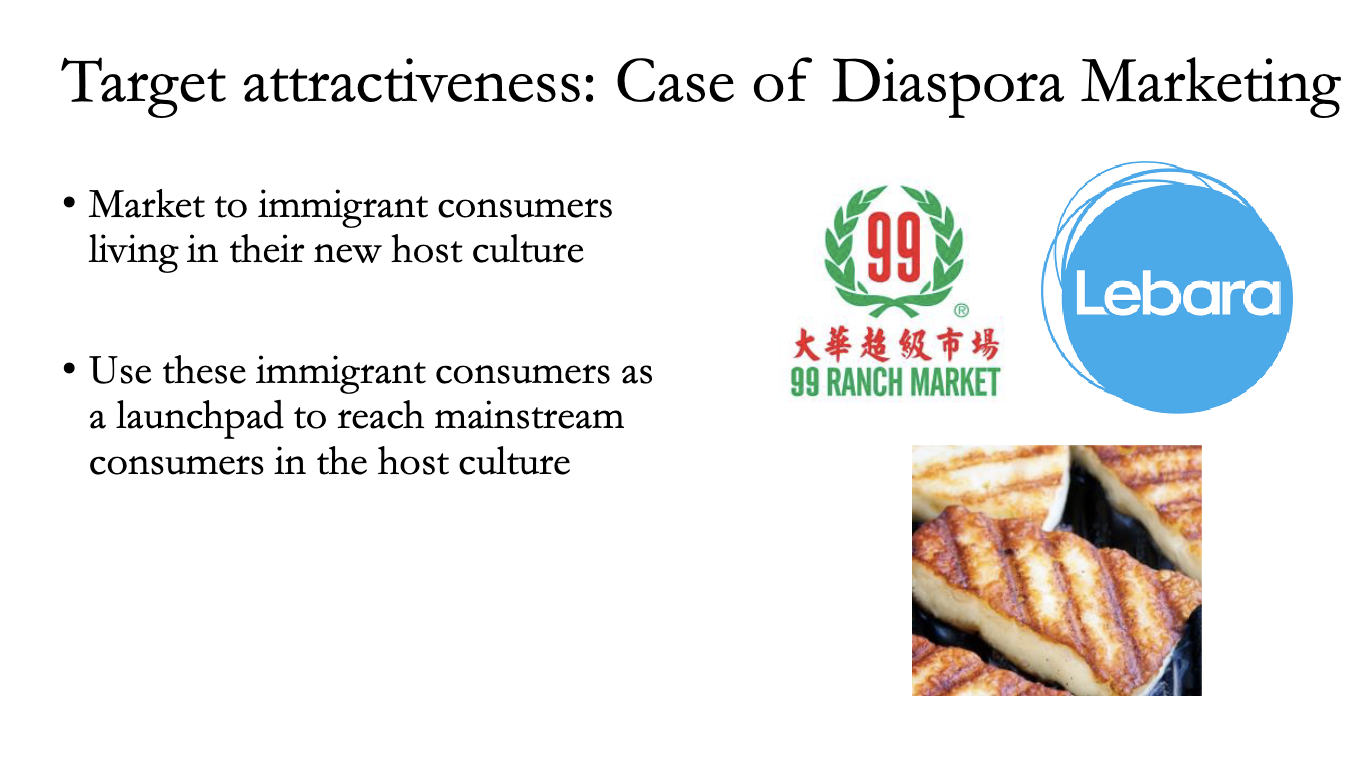
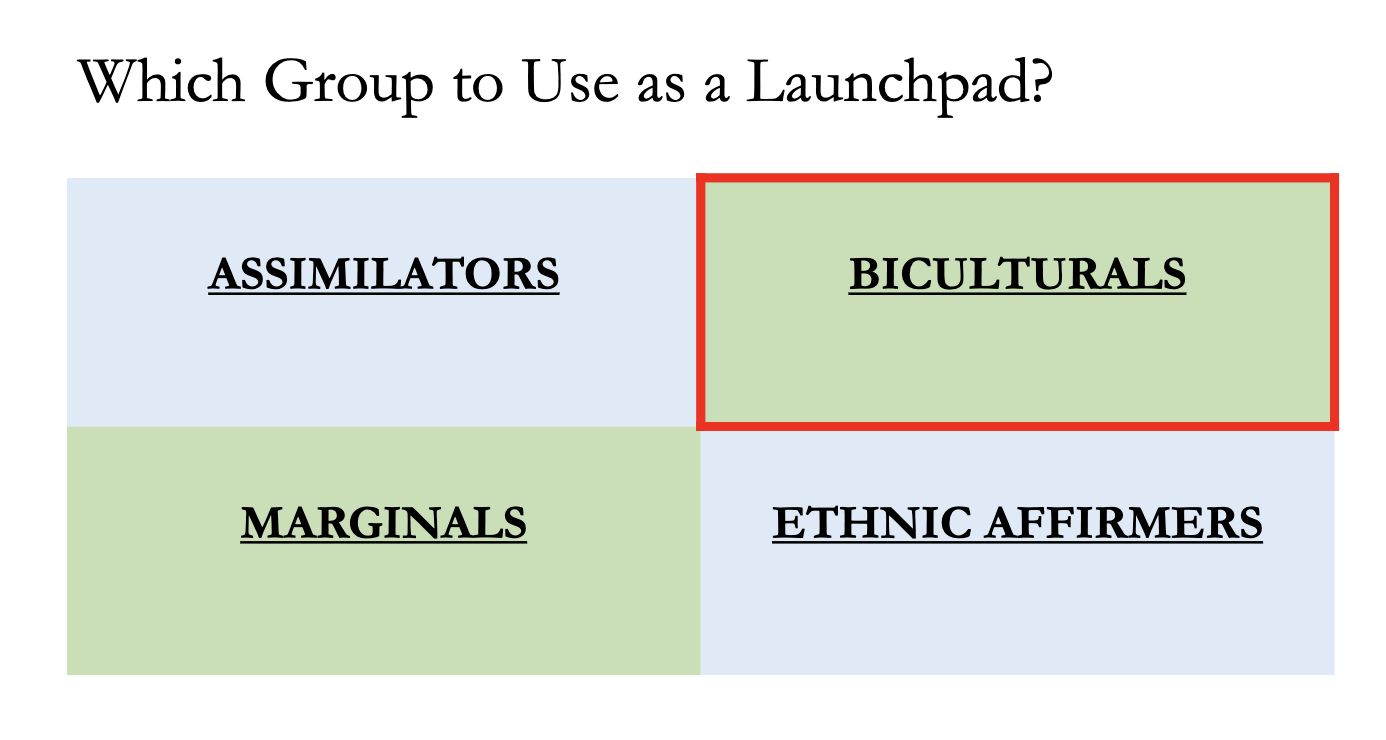
The lecture proposes a specific two-step strategy for companies targeting immigrant groups.
The Goal: Do not just stay in the ethnic niche forever.
The Strategy: Market to immigrant consumers first because they already know/need the product. Then, use them as a "Launchpad" to jump over to the mainstream consumers (the native population).
Real-World Examples:
99 Ranch Market: Started as an Asian grocery store for immigrants, now frequented by everyone for specialty ingredients.
Lebara: Started as cheap SIM cards for migrants to call home; now a major budget carrier for everyone.
Who is the Best "Launchpad"?
You have four segments (Assimilators, Marginals, Ethnic Affirmers, Biculturals). Which one helps you cross over to the mainstream?
The Answer: BICULTURALS (Highlighted in green on the slide).
Why?
Assimilators reject their home culture, so they won't buy your ethnic product.
Ethnic Affirmers isolate themselves, so they won't talk to mainstream locals about your product.
Biculturals are the bridge. They love the ethnic product and have strong social ties with mainstream locals. They are the influencers who say to their local friends, "Hey, you have to try this food/movie."
The Investment Checklist: When should you try this?
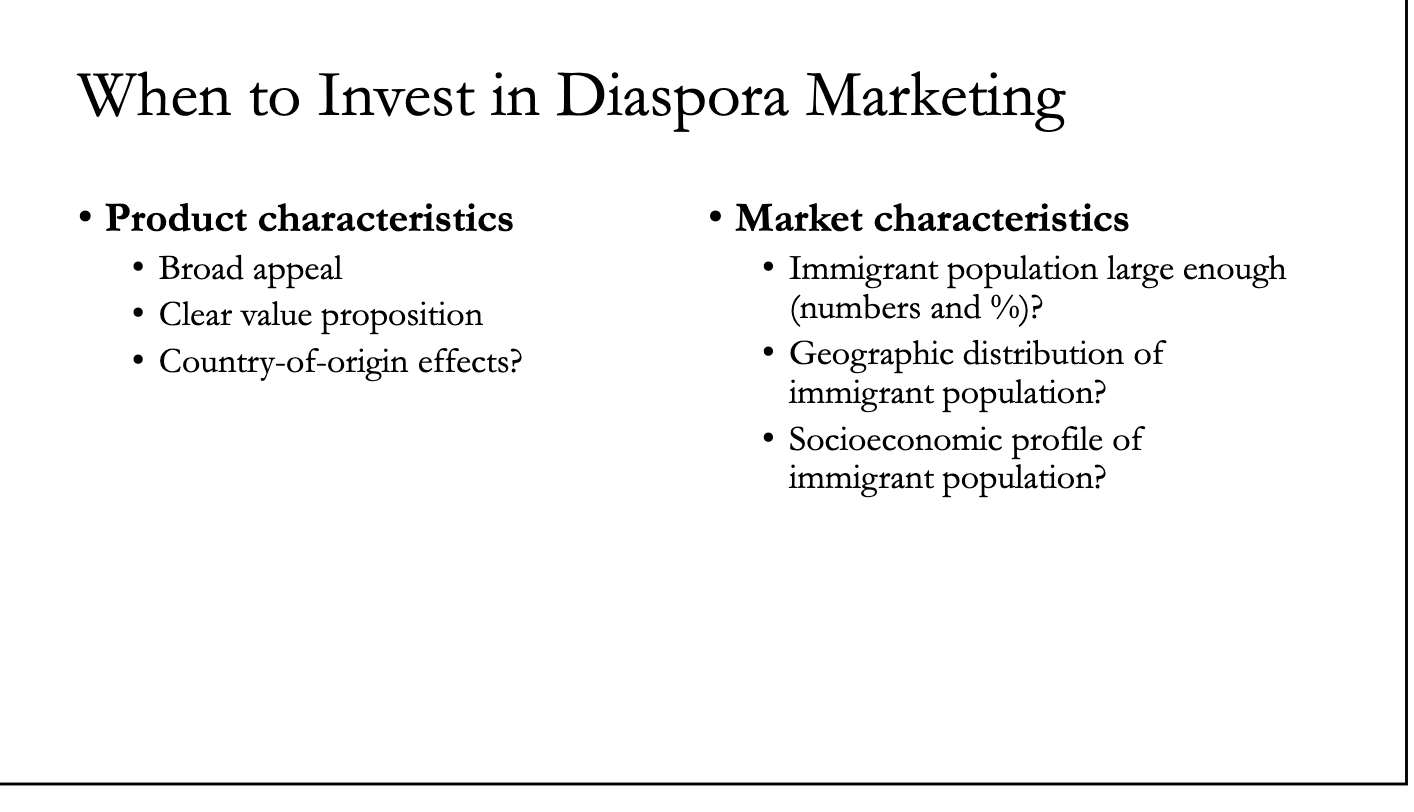
Before investing money, you must check if the Product and the Market are ready.
A. Product Characteristics (Is the product ready?)
Broad Appeal: Does it taste/look/feel good to people outside the culture? (e.g., Pizza has broad appeal; fermented shark meat might not) .
Clear Value Proposition: Is it obvious why it’s good?.
Country-of-origin effects: Does the country have a cool or positive reputation? (e.g., "Swiss Chocolate" vs. chocolate from a country with a bad reputation) .
Examples given: Kusmi Tea (French tea with Russian roots) and Crazy Rich Asians (A specific cultural story with universal themes of love and family).
B. Market Characteristics (Are the people ready?)
Size: Is the immigrant population large enough to support you while you start?.
Geography: Where do they live? (See next section) .
Socioeconomic Profile: Do they have money and status? (See final section) .
Geography: The "Best" Distribution
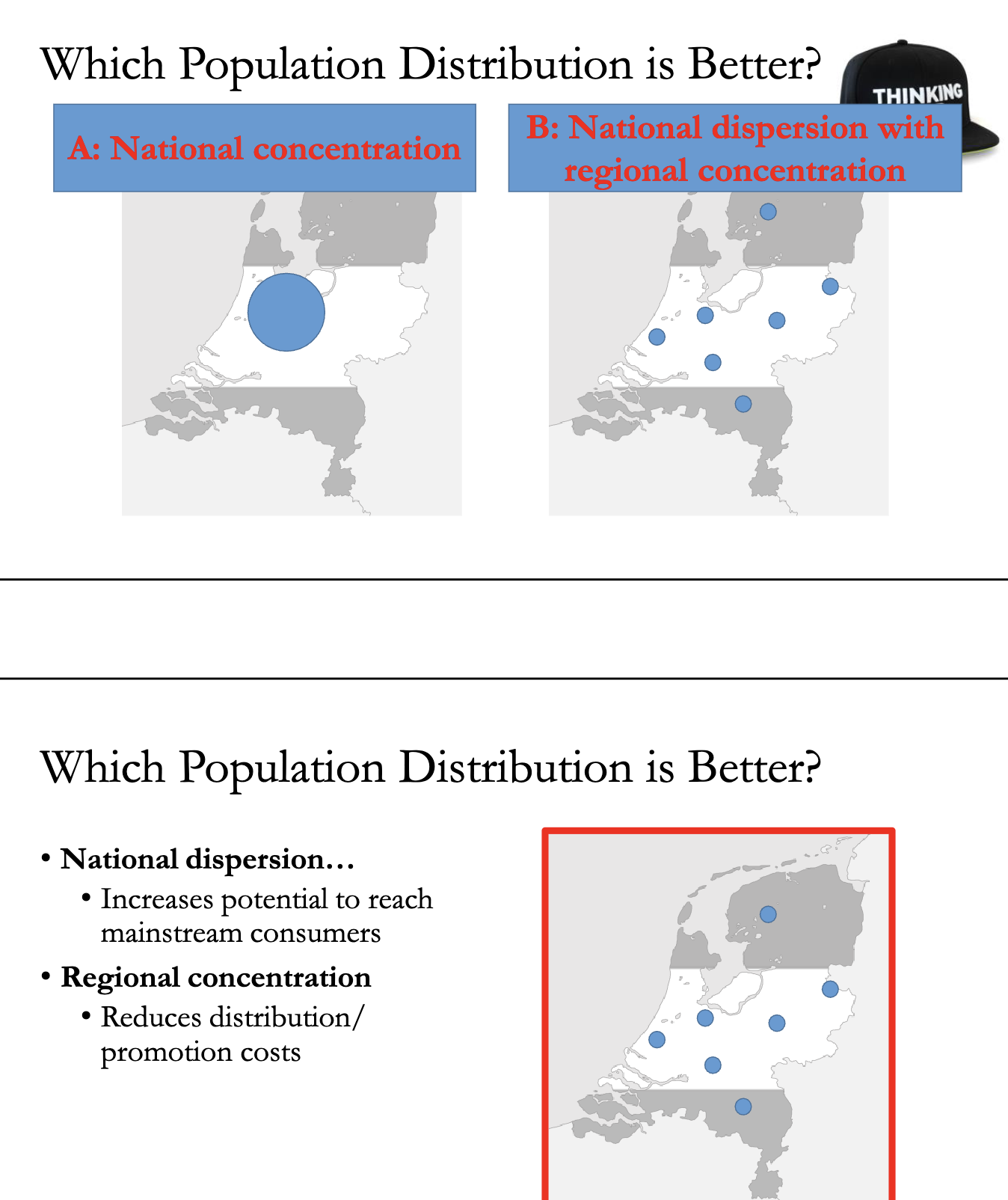
The lecture compares two maps of the Netherlands to see which is better for a "Launchpad" strategy.
Scenario A (National Concentration): All immigrants live in one giant city/blob.
Scenario B (National Dispersion with Regional Concentration): Immigrants are in distinct "clumps" spread all over the country.
The Verdict: Scenario B is better.
Why? It offers the "Best of Both Worlds":
Lower Costs: Because they are clustered in specific neighborhoods (Ethnoburbs), you can deliver products to one spot cheaply (Regional Concentration).
Higher Reach: Because these clusters are spread across the whole country, your product gets exposed to mainstream consumers everywhere (National Dispersion).
Sociology: Will the product actually spread?
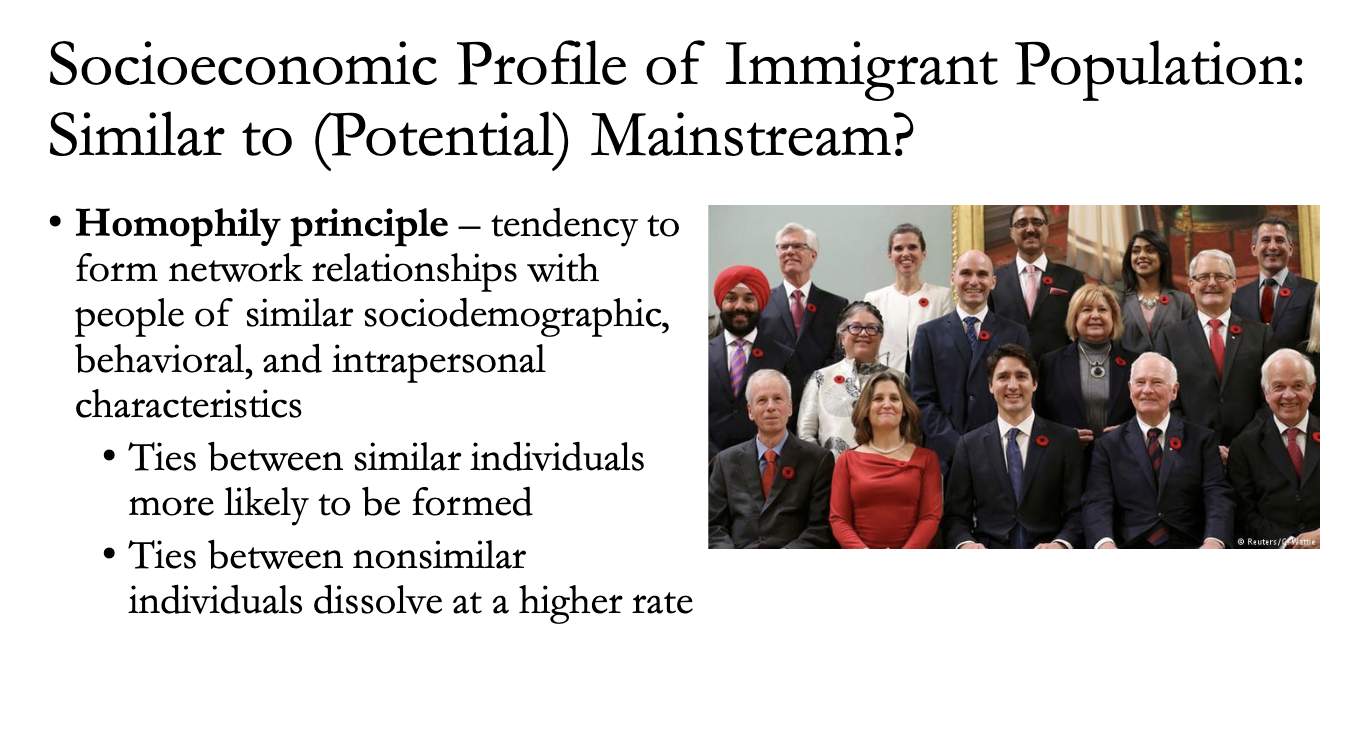
Finally, you check the Socioeconomic Profile. This relies on the Homophily Principle.
The Principle: "Birds of a feather flock together." We tend to form relationships with people who are similar to us (similar jobs, income, education).
The Application:
If your immigrant segment is poor/isolated and the mainstream is wealthy, they will not mix. The "bridge" is broken.
If your immigrant segment has a similar profile (income/education) to the mainstream, they will form ties.
Conclusion: The "Launchpad" strategy works best when the immigrant group is socioeconomically similar to the potential mainstream customer.
Lecture 2: Self-check questions
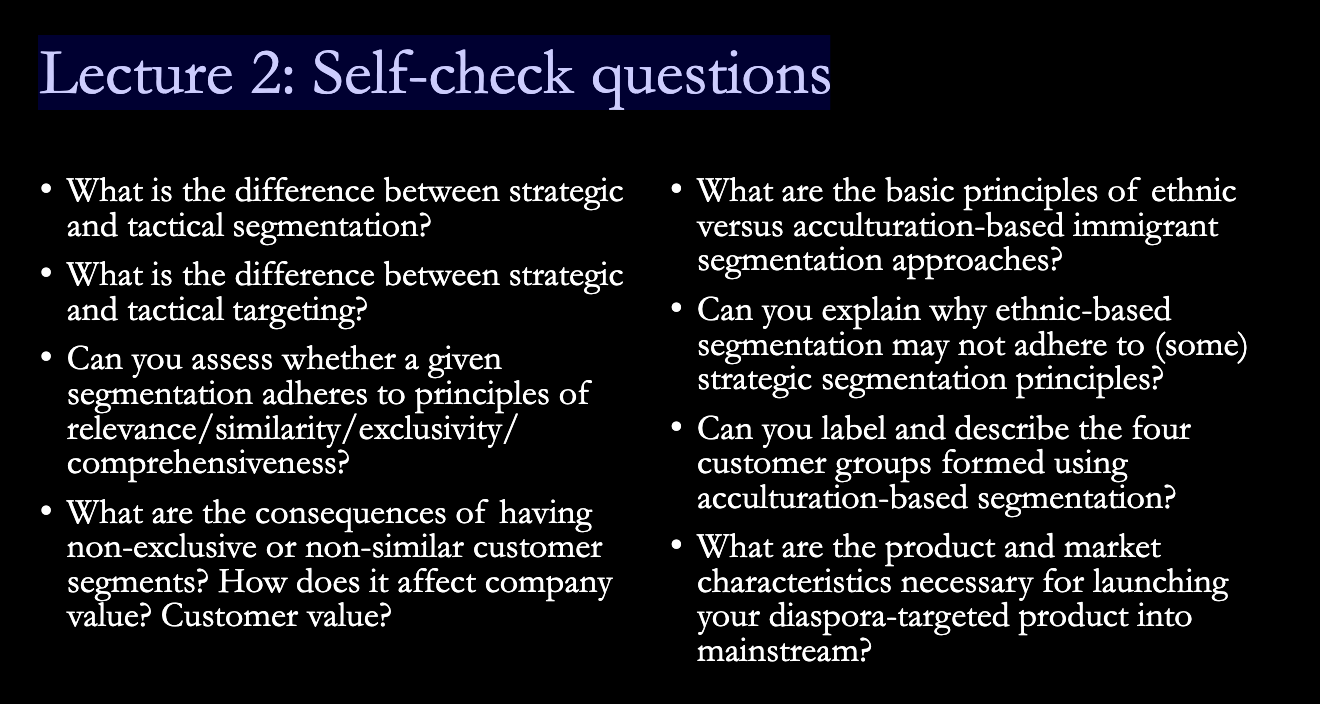
1. What is the difference between strategic and tactical segmentation?
Strategic Segmentation groups customers based on value and needs (the "Why"). It looks at the value the company can create and capture.
Tactical Segmentation groups customers based on demographics and behavior (the "Who"). It focuses on attributes like age, gender, and location to identify how to reach the strategic segments.
.
2. What is the difference between strategic and tactical targeting?
Strategic Targeting is the decision of which segment(s) to serve based on the company's ability to satisfy their needs better than competitors (compatibility) and the segment's profitability (attractiveness) .
Tactical Targeting is the execution of how to reach those customers. It involves selecting the specific channels and media to deliver the offering to the strategically selected customers.
3. Assessing Segmentation Principles (Relevance, Similarity, Exclusivity, Comprehensiveness)
To assess a segmentation, apply these four checks:
Relevance: Do the segments respond differently to the offering? If preferences don't differ between groups, the segmentation isn't relevant.
Similarity: Are customers within the segment homogeneous? If they have different preferences, the segment is too broad.
Exclusivity: Are the segments distinct from one another? If two segments want the exact same thing, they are not exclusive.
Comprehensiveness: Do the segments cover the entire market? Ensure no potential profitable group (e.g., renters vs. buyers) is ignored.
4. Consequences of Non-Exclusive or Non-Similar Segments
Non-Exclusive (Segments are too alike):
Consequence: You waste resources creating separate marketing plans for groups that are actually the same.
Impact: Lowers Company Value due to unnecessary costs.
Non-Similar (Segment is too diverse):
Consequence: You try to serve people with different needs using a single product.
Impact: Lowers Customer Value because the offering doesn't fit anyone's needs perfectly.
5. Principles of Ethnic vs. Acculturation-Based Segmentation
Ethnic Segmentation: Groups customers based on ethnicity and geography (e.g., "ethnoburbs" or areas with high ethnic density) .
Acculturation Segmentation: Groups customers based on their psychological adaptation to the host culture (High/Low Heritage identity vs. High/Low Mainstream identity) .
6. Why Ethnic-Based Segmentation May Fail Strategic Principles
Ethnic-based segmentation often fails the principle of Similarity.
Just because customers share an ethnicity (e.g., "Mexican-American"), it does not mean they have homogeneous preferences. One might be fully assimilated (buying local brands) while another is an ethnic affirmer (buying only imported goods). Grouping them solely by ethnicity ignores these vast behavioral differences .
7. The Four Acculturation-Based Customer Groups
Assimilators (High Host, Low Home): Reject home culture; prefer host country brands to affirm new identity.
Ethnic Affirmers (Low Host, High Home): Keep home culture; prefer goods imported from home country; isolate from mainstream.
Marginals (Low Host, Low Home): Feel alienated by both; focus on price, functionality, and durability .
Biculturals (High Host, High Home): Integrated into both; switch consumption based on context (e.g., ethnic food at home, local fashion outside) .
8. Characteristics for a "Launchpad" Diaspora Strategy
To successfully launch a diaspora product into the mainstream, you need:
Product: Broad appeal (taste/aesthetics), a clear value proposition, and a positive Country-of-Origin effect .
Market: A large enough immigrant population to sustain the start, a distribution that is regionally concentrated (for low cost) but nationally dispersed (for reach), and a socioeconomic profile similar to the mainstream (to facilitate social mixing) .
 Note
Note  Flashcards (53)