C4.1 Populations and Communities
 Call Kai
 Learn
Learn Practice Test
 Spaced Repetition
 Match
Match Flashcards
 Knowt Play
1/24

There's no tags or description
Looks like no tags are added yet.
Name | Mastery | Learn | Test | Matching | Spaced | Call with Kai |
|---|
No analytics yet
Send a link to your students to track their progress
25 Terms
Definitions
Species: A group of organisms that can be interbreed and produce fertile offspring
Population: A group of organisms of the same species who live in the same area at the same time
Community: A group of populations living and interacting with each other in an area
Ecosystem: A community and its abiotic environment
Habitat: The environment in which an organism, species, population or community lives
Habitat can be described by their geographical or physical location and by the type of ecosystem.
Carrying Capacity: maximum population size that the environment can sustain over a set time
Population density: number of individuals per unit area/volume : indication of how closely packed individuals are within a given space
Density dependent factors: Factors that change the size of a population are dependent on population density (e.g. spread of disease)
Endemic species: Species that can only be found in one specific area nowhere else in the world.
Invasive species: Species that have been introduced into a new area from a distant origin
Invasive species population grows well that they start to cause problems for the species that are already living there.Herbivores : an animal that feeds on plants.
Top-down control: Presence/activities of organisms at higher trophic levels influence the abundance or behavior of organisms in lower trophic levels
Bottom-up control: Availability of resources at lower trophic levels influence the abundance and distribution of organisms at higher trophic levels
Estimation of population size by random sampling → sessile organsisms
Random sample for sessile organisms
Quadrats
Capture-mark-release-recapture and the Lincoln Index to estimate population size for motile organisms
Motile organisms: organisms that can move around the habitat.
Method: Capture-mark-release-recapture
Lincoln index: The population size = (n1× n2 ) ÷ n3
n1 is the number of individuals initially caught.
n2 is the total number of individual caught in the second sample.
n3 is the number of marked individuals in the second sample.
(1st sample markerd x 2nd sample caught ) / 2nd sample marked
capture mark release recapture environmental requirement
Must make sure that there is at least 24 hours gap before the second trap was set up.
This is because to allow time for the organisms to randomly distributed in the area again.
When marking the organism, one must make sure the markings are not toxic, not permanent and will not make the organism stand out from its surroundings. (losing its natural camouflage.)
Assumes that the population is closed, with no immigration or emigration.
No death no birth
Assumptions & Limitations of using the Lincoln Index
Assumes that marked individuals are representative of the whole population
Assumes the ratio of marked to unmarked individuals in the second sample accurately reflects the ratio of the population
Assumes there are no births, deaths, immigrations or emigrations during the study period
Increase sample size and conduct multiple trials of sampling to increase accuracy
Carrying Capacity
maximum population size that the environment can sustain over a set time
Influenced by the availability of resource → it varies over space and time.
limiting resources: , Food , Space for breeding , Shelter, Water , Light Soil nitrogen
When these resources become scarce, competition (interspecific and intraspecific) arises for survival; this will reduce the population.
Population density
Population density: number of individuals per unit area/volume
indication of how closely packed individuals are within a given space
Size of a population is influenced by:
1) density-dependent and
2) density-independent limiting factors
Density-dependent factors
Density dependent factors: Factors that change the size of a population are dependent on population density (e.g. spread of disease)
Negative feedback in the form of competition for resources & the spread of disease works
to control the size of population so that cannot go above it carrying capacity.
PANDA
Predators
Availabiltiy of resources
Nutrient supply
Disease / pathogenic spread
Accumulation of wastes
Density-independent factors
Factors are external to the population and can cause sudden and drastic changes to population size. These include:
PAW
Phenomena - natural disaster
Abiotic factor (eg. temperature, O2)
Weather conditions (floods, storms)
Anthropogenic causes (human)
Population growth curves
Exponential growth (J curve)
Reflects population growth under ideal conditions where resources are unlimited and abiotic factors are favourable.
ex. Bacterial populations in lab settings when resources are available.
__
Exponential Phase: Abundant of food, space, light increases reproduction.
Transitional Phase: Competition increase
Plateau Phase: When population reaches carrying capacity (K) there is no longer growth in population size
Populations tend to fluctuate around the carrying capacity and maintained by negative feedback. [density dependent factor]
![<p><span style="background-color: transparent;"><strong>Exponential growth (J curve)</strong></span></p><ul><li><p><span style="background-color: transparent;">Reflects population growth <strong>under ideal conditions</strong> where<strong><u> resources are unlimited and abiotic factors are favourable. </u></strong></span></p></li></ul><p><span style="background-color: transparent;">ex. Bacterial populations in lab settings when resources are available.</span></p><p></p><p><span style="background-color: transparent;">__</span></p><ul><li><p><span style="background-color: transparent;"><strong>Exponential Phase: <u>Abundant</u></strong> of food, space, light increases <strong><u>reproduction</u></strong>.</span></p></li><li><p><span style="background-color: transparent;"><strong>Transitional Phase: </strong>Competition increase</span></p></li><li><p><span style="background-color: transparent;"><strong>Plateau Phase: </strong>When population reaches <strong><u>carrying capacity (K) </u></strong>there is no longer growth in population size</span></p></li></ul><p><span style="background-color: transparent;">Populations tend to fluctuate around the carrying capacity and maintained by <strong><u>negative feedback</u></strong>. [density dependent factor]</span></p>](https://assets.knowt.com/user-attachments/5e00d1c6-b91d-43d8-8e63-b5c203435b89.png)
Population growth curve case study
Eurasian collared doves
Occupy new niche
Reproduction → exponential growth in population
Competition versus cooperation in intraspecific relationships
Intraspecific competition : Members of the same species compete for a limited resource such as food, water or space
→ as they have same ecological niche, density dependent factors
Intraspecific competition: Individuals collaborate to increase their chances of survival and reproduction
Group hunting, defense against predators
Community
Community: A group of populations living and interacting with each other in an area
Many interspecific relationships:
Herbivory
Predation
Interspecific competition
Mutualism
Parasitism
Pathogenicity
interspecific competition , Herbivory, predation, Mutualism, parasitism and pathogenicity as categories of interspecific relationship within communities
Interspecific competition
Definition: two species using the same resources, thus the resources available is reduced by the other species
E.g. Red and Grey squirrel in Britain
Herbivory
Definition: where primary consumers feed on producers
E.g. Giraffes on tree
Herbivory, predation, interspecific competition, mutualism, parasitism and pathogenicity as categories of interspecific relationship within communities
Predation
Definition: A consumers feed on another consumers
E.g. Fox and rabbit
Parasitism
Definition: an organism that lives on or in a host and obtain nutrient from the host, at the expense of the host
E.g. Tapeworm in humans
Herbivory, predation, interspecific competition, mutualism, parasitism and pathogenicity as categories of interspecific relationship within communities
Pathogenicity
Definition: microorganism causing disease to another species.
E.g. HIV in human
Mutualism
Definition: two different species live together in a close relationship, where both species benefits from the relationships.
E.g. Zooxanthellae and coral reef
Mutualism as an interspecific relationship that benefits both species → Root nodules in legume plants and nitrogen-fixing bacteria
Rhizobium Bacteria → nitrogen fixing bacteria → convert nitrogen gas to nitrate ion (into a form that plant can use)
Live in root nodules in legume plant → mutualistic relationship
Receive carbohydrate from legume plants + protection
provide supply of nitrogen compounds
Mutualism as an interspecific relationship that benefits both species → Mycorrhizae between non-photosynthetic orchid and fungus
Mycorrhizae(fungus) forms a symbiotic relationship with roots of orchid
Plant provides carbohydrate from photosynthesis
Fungi absorb and provides nutrient from soil → increase plants ability to acquire nutrient by increasing SA for absorption of water and minerals
aiding in nutrition acquisition
Mutualism as an interspecific relationship that benefits both species → coral polyps and algae zooxanthellae
Coral polyps and algae zooxanthellae
Coral polyps are small animals with tentacles.
Photosynthetic algae zooxanthellae are embedded in the tissue of their tentacles.
Coral polyps give algae Co2, → algae need to photosynthesize and grow
algae provide carbon-based energy molecules → made through photosynthesis
Endemic and invasive species
endemic species : only be found in one specific area and nowhere else
invasive species : introduced in a new area from a distant origin → cause problem to original species
Traits of invasive species
rapid reproduction, fast growing
no natural predators in new area
high tolerance to a wide range of environmental factor
live of a wide range of food type
associate with human
Resource competition between endemic and invasive species
Endemic or native species have evolved and adapted to a specific region over time
Invasive species are introduced to new environments where conditions are favourable for them to rapidly establish and spread
Lead to the rapid decline and even extinction of endemic species
case study
Giant tortoise in galapagos island → endemic species
Over many decades, the populations of giant tortoises decreases
Reasons for the decline of these species 1) Humans eating them 2) Competition with introduced invasive species such as goats
Humans brought goats → some escaped and formed feral populations, which their population eventually grew.
Goats compete with tortoises for grazing space and tend to destroy their habitats.
Goats breed more rapidly than tortoises
To correct the mistake, Culling (reducing population numbers by killing off a certain percentage of the population) have been implemented
Testing for interspecific competition
Aim: To see if there is any indication that the population of one species changes in the presence of another.
Population of the remaining species increases → competition
If the population of the remaining species does not change → no competition
Correlation does not provide competition
Null hypothesis (Ho) = There is no association between the species. They are distributed independently in the area.
Alternative hypothesis (H1) = There is an association between the species. They are not distributed independently in the area (this could be positive or negative - both always present or both always absent)
DF =1
P= 0.05
calculated value > criticla value → reject null, accept alternative
Predator-prey relationships as an example of density-dependent control of animal populations
Density-dependent factor & negative feedback loop
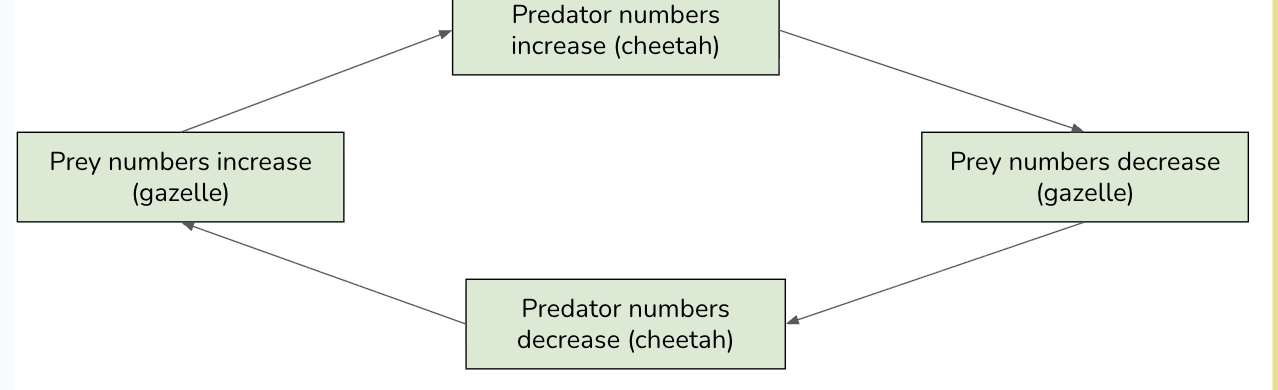
Canada lynx and the snowshoe hare are an example of a predator-prey interaction.
Changes in the numbers of the lynx (predator) population are followed by changes in the numbers of the hare (prey) population.
Limiting factor for lynx population: food availability
Limiting factor for snowshoe hare: number of predator
Top-down and bottom-up control of populations in communities
Types of population control: both possible in a community, but one is more likely dominant
Top Down Control: Presence/activities of organisms at higher trophic levels influence the abundance or behavior of organisms in lower trophic levels
predation
Bottom Up Control: Availability of resources at lower trophic levels influence the abundance and distribution of organisms at higher trophic levels
nutrient availability
Allelopathy and Antibiotic Secretion
Both involve organisms releasing chemical substances into the environment to deter potential competitors.
Allelopathy : release of chemicals by one organism
Allelopathy: Black Walnut tree
Releases a chemical compound into the soil
Inhibitor → suppresses the growth of nearby competing plants
by inhibiting key physiological processes : root development and photosynthesis
Antibiotic Secretion: Penicillin fungus
secrets antibiotic chemical Penicillin
inhibit growth of bacteria near the fungus → reduce competition for resources
Penicillin is used as medicine → inhibit bacterial growth

