History - Civil Rights
 Call Kai
 Learn
Learn Practice Test
 Spaced Repetition
 Match
Match Flashcards
 Knowt Play
1/34

Earn XP
Description and Tags
Section 1: African Americans 1865-1992 Revision notes (1) - 1865-1941 Revision notes (2 - 1941-1963
Name | Mastery | Learn | Test | Matching | Spaced | Call with Kai |
|---|
No analytics yet
Send a link to your students to track their progress
35 Terms
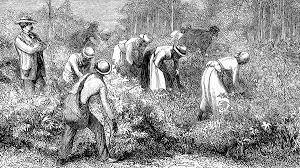
What was the attitude towards slavery in the North up to its abolition in 1865?
In Northern states, the morality of slavery was hotly disputed from the start. A smaller number of African Americans lived here and the majority appeared to be free men and women: they possessed full civil rights of citizenship, including the right to vote for men.
However, rights often remained theoretical, in spite of the support that the abolitionist movement received in the North, a significant proportion of the population was hostile to African-American equality, and some even owned slaves.
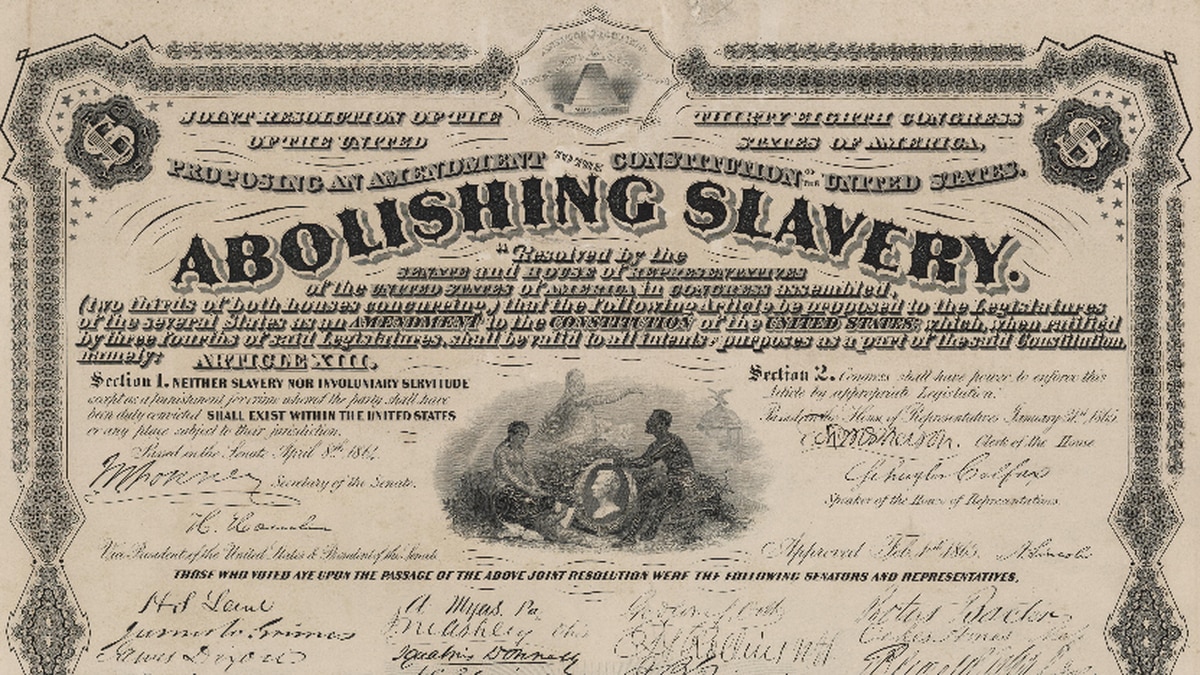
Abolitionist Movement
The earliest movement demanding abolition of slaves dates from 1817, when the American Colonization Society demanded a gradual emancipation of the slaves with compensation for their owners.
Most supporters of the abolition resided in the Northern states.
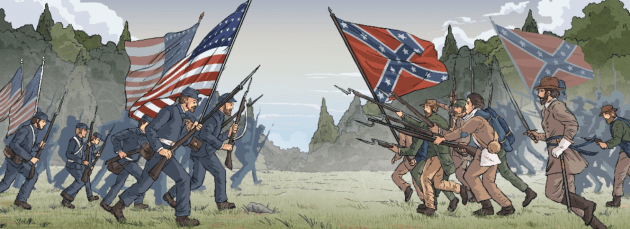
What was the background to the outbreak of civil war?
Abolitionist feelings continued to grow stronger in the north in the mid-nineteenth century but it would require constitutional change to destroy slavery: within the political system, the president did not have the power to do this alone.
The Federal system was still weak and the real power rested with the state governments. However, in 1854 the Republican Party, with its base of support in the North, was formed as a party opposed to slavery. By contrast, the Democrat Party, strong in the South and especially among plantation owners, was split over the question.
What was Emancipation and what was its effects?
Lincoln had insisted at the start of the war that it was the question of secession and not slavery being fought over, but his policy changed during 1862.
He issued the Emancipation Proclamation stating that black people could no longer be owned as property by others and were free to leave their masters. The Proclamation resulted in slaves continuing to leave their plantations in increasing numbers.
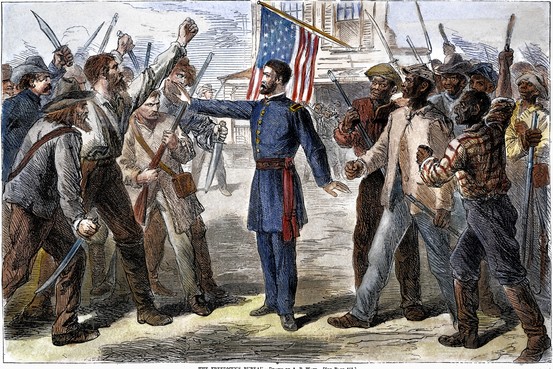
What was the Reconstruction?
The name was given to the period 1865-77, a time reconstructing the infrastructure of the Southern states after the devastation of the Civil War.
During this period the Northern states attempted to impose their wishes regarding the new status of African Americans on white southerners. The white south resented attempts at controlling their society and by 1877 had largely re-established their right to run their states in the way they wanted. Civil rights for blacks frequently remained theoretical.
What amendments and laws were passed to aid civil rights?
The Fourteenth Amendment, ratified in 1868, gave all freed blacks their United States citizenship and equal protection under the law.
How far did black Americans gain political rights?
Over 700,000 black men were now enrolled to vote. These newly liberated people had a major role in electing members to the Conventions that had been set up by Congress.
Black representatives were now in the position of possessing real political power, and sharing it with pro-northern scalawags or actual northern carpetbaggers.
De jure
De facto
In law.
In reality.
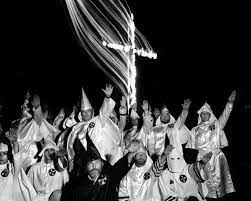
Ku Klux Klan
A terrorist organisation founded by Nathan Forrest and active mainly in the Southern states which advocated white supremacy.
The activities of the KKK reflected the tense inter-racial atmosphere prevalent in the South during the Reconstruction. In Memphis, in May 1866 there were three days of violence after a collision between two horse-drawn carriages with black and white drivers. 46 were killed and 5 women raped. In New Orleans the following July, African-American soldiers travelling to vote were attacked: 34 people were killed and over 100 injured: these were merely the worst examples.
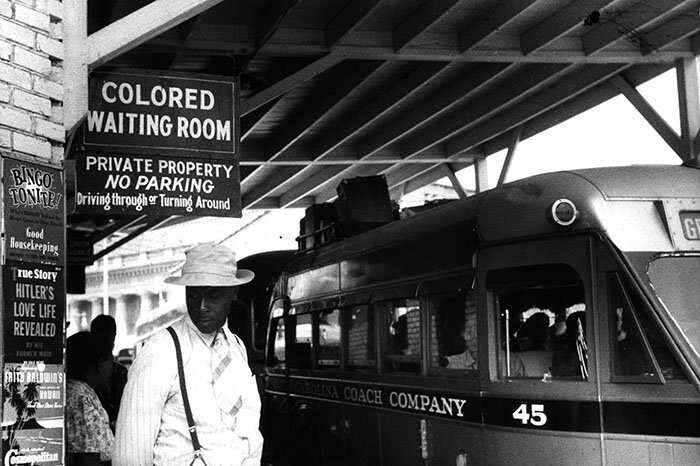
How did the Jim Crow laws develop?
Jim Crow segregation laws developed rapidly between 1887 and 1891, when eight southern states introduced formal segregation of the races on trains, three of them extending this to waiting room facilities.
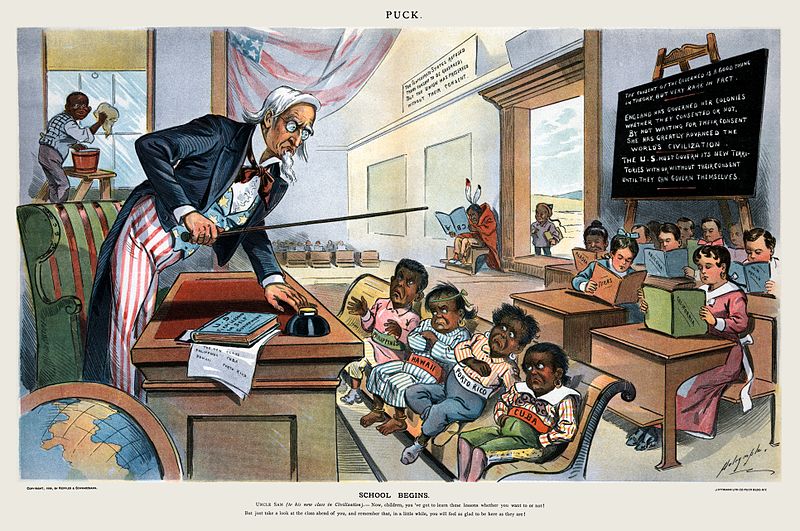
Social Darwinism
The application of Darwin’s biological theory of evolution to sociology by arguing that the survival of the fittest can be applied to the development of races and societies. Human society, it was argued, operated on scientific principles in a similar way to the natural way.
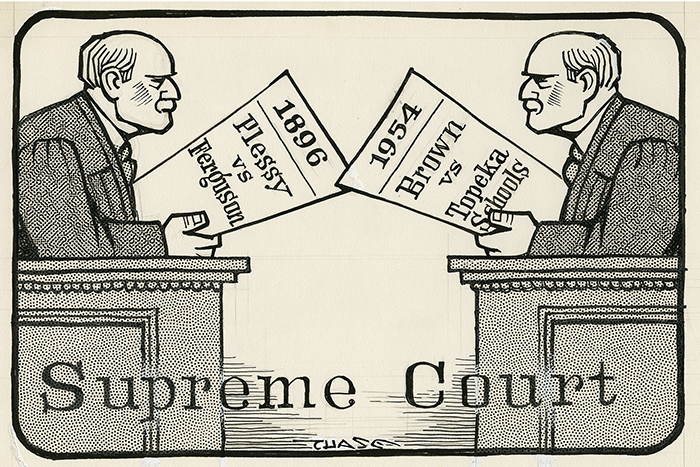
Plessy V. Ferguson 1896
Homer Plessy was a light-skinned mulatto, legally classed as black, who sued after being denied a seat in an all-white railway carriage. The justices decided 8-1 against him that segregation was constitutional.
They ruled that separation in itself did not imply inferior treatment. Only Justice John Harlan dissented. His argument that “Our constitution is color blind and neither knows nor tolerates classes among citizens” was confined to the realms of legal theory. The Plessy case created a situation whereby similar cases would look to this preceding case and its legal guidelines. Thus, in Cumming v. Board of Education in 1899 the separate but equal principle was extended to schools, even though here the greater amount spent on white schools made a mockery of true equality.
What measures were taken to remove black voting rights?
Although the Fifteenth Amendment of 1870 had outlawed voting discrimination on grounds of race, it had not outlawes discrimination because of gender or property ownership.
Poll tax - Before polling, the voer had to make a monetary payment which had to be made well in advance.
Property qualifications - Some states also imposed rules which meant that only those who owned their own home were allowed to vote.
Literacy tests - In Mississippi, literacy tests of 1880 included being able to interpret a section of the Constitution. This process could be arranged so that the questions for uneducated whites were simpler than those for their African-American equivalents.
Grandfather clause - This was an effective measure to eliminate black but not white votes. The franchise was granted to adult males providing their fathers or grandfathers had voted before the Reconstitution, that is before 1867 and the growth in the black franchise.
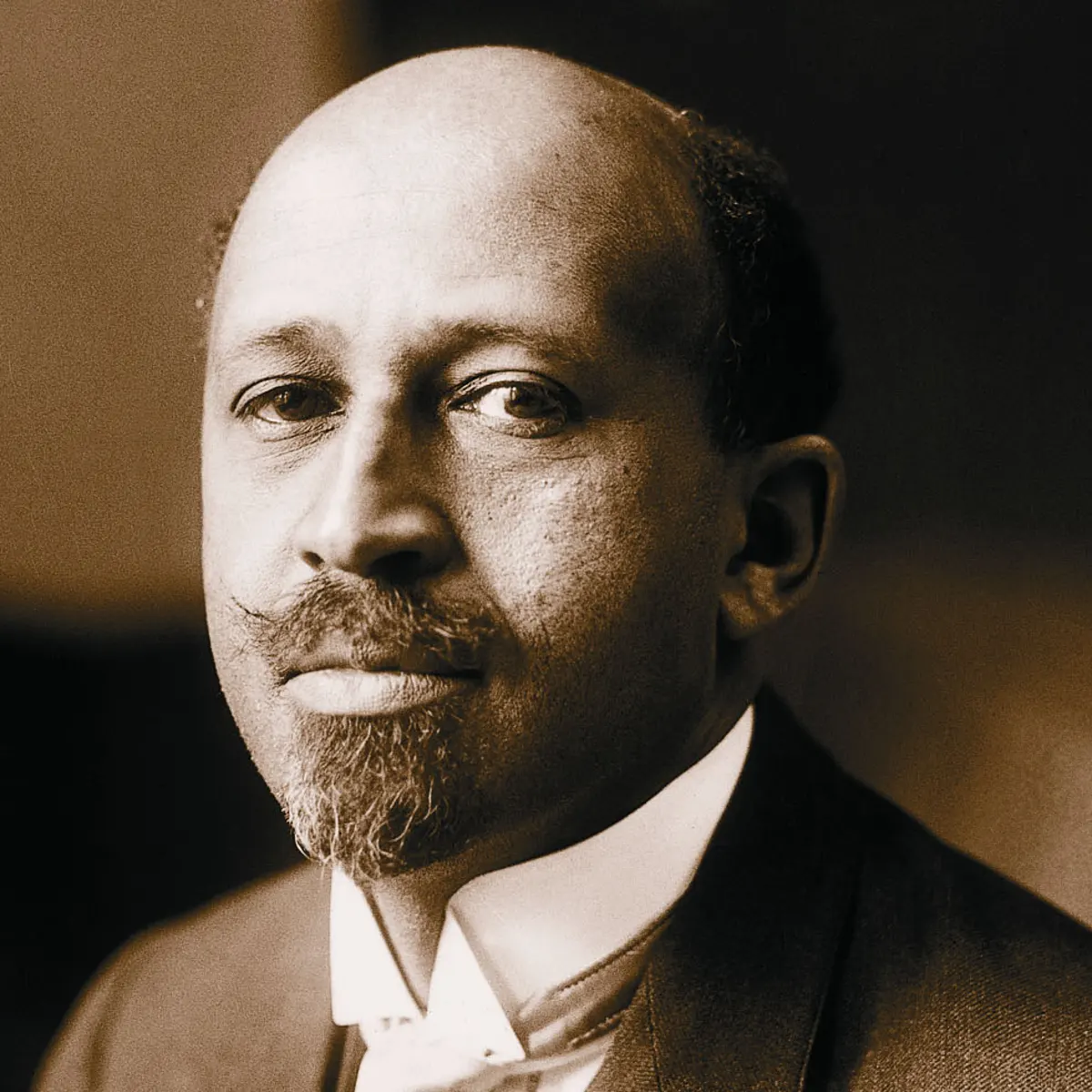
W.E.B. Du Bois
Born in Massachusetts, the son of free black parents, he acquired a PhD from Harvard University, the first African American to do so, in 1895.
A prolific writer on the black condition and an early sociologist, he helped to found the Niagara movement in 1905 and the NAACP. He then moved away from the NAACP’s approach.
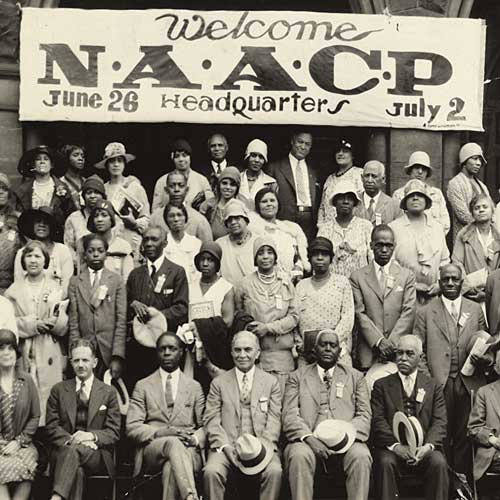
National Association for the Advancement of Coloured People (NAACP)
Founded in 1909 the year after the Springfield riot, it was the first successful, nationwide, civil rights organisation to campaign systematically for black civil rights and gain a large membership of both black and white supporters. It remained a peaceful and Constitutional organisation.
Its successes were rarely spectacular but it played a significant long-term role in the fight for the legal end of segregation.
The aims of the NAACP were to investigate racism, publicise it, suggest positive solutions and take legal action to enforce the law and the Constitution to ensure civil rights in general and equality of oppportunity in particular.
It adopted a constitutional approach to lawsuits believing, that many of the measures taken against African Americans violated the constitutional amendments passed between 1865 and 1870.
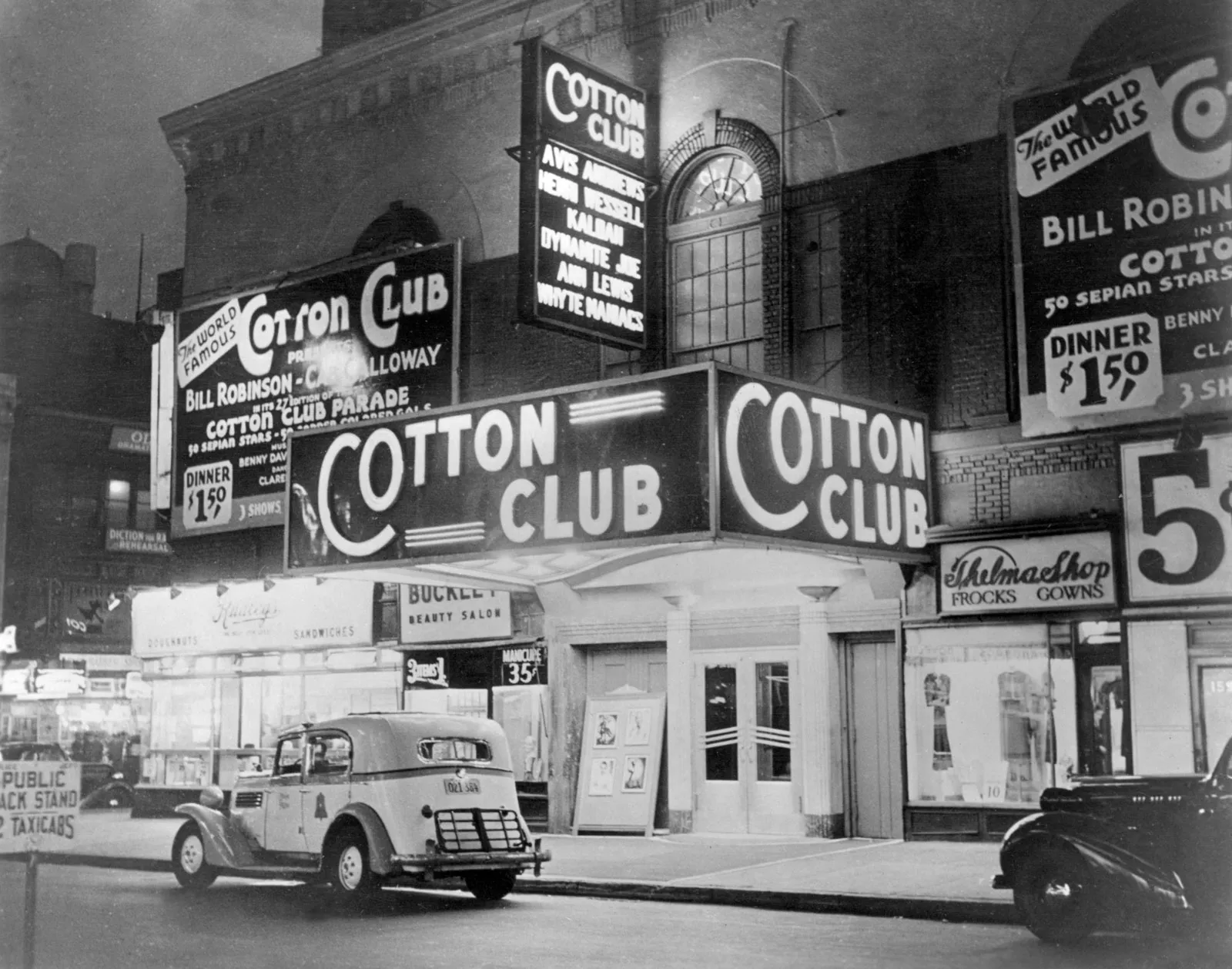
Harlem Renaissance
An out-pouring of artistic talent by blacks in the 1920’s and 1930’s in literature, the visualarts, theatre and music.
African-American artistic performers were now praised by critics and publicly acknowledged. Leading figures included Paul Robeson, Langston Hughes, Louis Armstrong, Bessie Smith, Duke Ellington.
For the first time there were black people singing and writing about thier experiences and desire for equality and freedom.
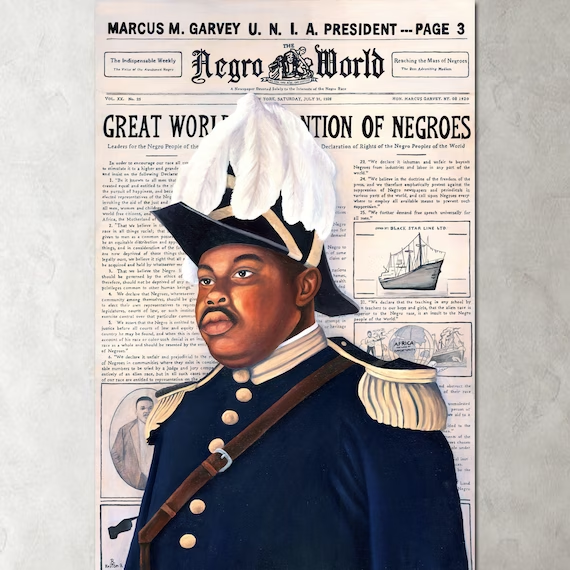
Marcus Garvey
Marcus Garvey was initially inspired by Booker T. Washington’s work at Tuskegee. Garvey’s Universal Negro Improvement Association (UNIA) began in 1914 in his native Jamaica.
Garvey wished to go further than Washington in his approach to improving the lives of blacks including not just economic progress and white acceptance of black equality, but blacks taking control of their own affairs.
Garvey ultimately saw a return to Africa as the only solution but he always remained vague about specific details of a “Back of Africa” move. In the short term Garvey believed that blacks should concentrate on building up their own education and their own businesses. He encouraged them to have pride in themselves and their culture.
His message was well received that Garvey decided to stay and develop UNIA in the US.
What was the importance of the NAACP?
Between the World Wars (particularly after the fall of Marcus Garvey), the organisation that embodied the civil rights campaign most clearly was the NAACP.
It focused on Civil Rights rather than social conditions and its Secretary in the 1920’s, James Welson Johnson, targeted desegration voting rights and education.
The NAACP believed the races should live, work and be educated together. It would take cases to federal courts and the Supreme Court if necessary. Though non-violent NAACP raised money to defend those accused of rioting.
The growth of the NAACP membership was rapid after 1915. By the early 1920’s there were over 900,000 members, reflecting the greater interest in civil rights.
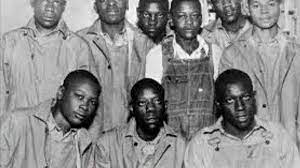
Scottsboro Boys
Two white women claimed that nine young African American boys had raped them on a train. Despite lack of corroborative or medical evidence all were sentenced to death in a hastily organised and farcial trial.
Two were under 14, one was severely disabled and another almost blind - these four were eventually released after over 6 years in jail.
The other five spent many years in prison, one not being released until 1950. The case caused outrage over the whole country and was a sign that attitudes were changing.
The revival of the Ku Klux Klan
In the years prior to the First World War the Ku Klux Klan experienced a revival. This was greatly influenced by the release of a film in 1915, called “The Birth of a Nation”.
In this film African Americans were portrayed as lazy, violent criminals whereas the Klansmen were seen as the ‘heroes’ saving white civilisation.
William J Simmons set up the revived Klan - a patriotic Protestant group. Hiram Evans took over in 1922. The new Klan was not anti-black. It directed its activites against anyone it considered un-Americans.
In 1924, there were said to be 4 million members. The Klan counted many politicians among its members.
What impact did Roosevelt’s New Deal have on the black community?
Blacks praised Roosevelt’s attempts to encourage the raising of wages and cutting of working hours. By 1935, 30 per cent of black families were on relief compared with 10 per cent of whites. This illustrated their greater poverty but also the fair application of the policy towards them.
However, urban black unemployment rate were high. In the south the black sharecroppers were hit hard by the depression , as they were not covered by the Social Security Act or National Labour Relations Act that assisted so many others. This was not merely bad luck. Southern Democrats had refused to vote for a measure that would particularly help blacks.
CORE (Congress of Racial Equality)
This was set up in 1942 to protest against de facto racial segregation in northern cities.
It was revived in 1961 by James Farmer. It was split over support for Black Power in 1966 and Farmer resigned in disgust at the violent tendencies of some members.
He was replaced by Floyd McKissack. After 1968, when Roy Innis took over, it moved back to a more moderate position.
Progress made for Black civil rights in 1945-55
Employment - By 1953, 20 states and 30 cities had adopted Roosevelt’s fair employment regulations.
Education - The NAACP attempted to challenge the ‘separate but equal’ doctrine of Plessy V. Ferguson in education. The NAACP sued on the behalf of black children. Thurgood Marshall impressively argued why the legak system should acknowledge and tackle the lack of equality in the education system.
Brown V. Board
The Supreme Court unanimously ruled that a black girl, Linda Brown, should be allowed to attend her nearest school (an all-white one) and that to bar her from it was unconstitutional.
The equal protection clause of the 14th Amendment was clearly interpreted. It required admission of all children to state schools on equal terms.
Washington DC, Baltimore, St. Louis and other towns and cities now began to integrate schools but progress was not quick. By 1957 less than 12 per cent of the school districts in the south had been integrated.
Emmet Till
Emmet Till was a 14-year-old black youth from Chicago, who was visiting Mississippi where he was said to have made remarks to a white woman and wolf whistled.
He was shot in the head and his body dumped in the river. The case excited great publicity and protest. This showed that these events were becoming rarer and that people’s attitudes were changing. However, the case also showed the continuing lack of justice in the south. Despite clear evidence against the two alleged murderers, an all-white jury found them not guilty.
Little Rock 9
In 1957, Governer Orval Faubus used National Guard troops to bar the entry of 9 black students to the Central High SChool after a federal district court had ruled that the school must be desegregated.
The president sent in paratroopers (federal troops) and announced that the 10,000 troopers of the Arkansas National Guard were to be put under federal control. The same soldiers who had barred the way before, now kept white protesters back and escorted the children back into school.
What happened after Little Rock 9?
This was the only occasion when President Eisenhower used his federal authority to intervene and enforce the Brown legal ruling.
The years immediately following the Brown decision had shown the limitations of the Supreme Court power in terms of acceptance and enforcement and, with the exception of Little Rock, the continuing caution of presidential action in the civil rights field.
The two Civil Rights Acts of 1957 and 1960 were very weak and made hardly any impact. But by this time the movement for civil rights had received a boost from below with a fresh and successful campaign, a new and dynamic leader and the emergence of an organisation to challenge the NAACP in terms of popularity, tactics, and achievements.
The Montgomery Bus Boycott
In the south, separation on public transport was always the most resented form of segregation. Blacks were frequently made to stand, given the poorer seats, thrown off buses for little reason and generally spoken down to or humiliated by white drivers and passengers. The majority of African Americans lived in their own out-of-town areas and needed to travel frequently to employment in town centres.
NAACP activist Rosa Parks was thrown off a bus for refusing to give up her seat for a white person. This seemingly small incident gave birth to a new and important phase in the civil rights movement.
The boycott showed evidence of unity and solidarity. Nearly, all blacks responded to the call to make a stand, they showed they could organise a protest, and co-operate with each other with minimal white participation.
It put financial pressure on the authorities who initially unwisely refused the slightest concessions. The Supreme Court gave another favourable verdict, it ruled segregation on buses to be unconstitutional.
SCLC (Southern Christian Leadership Conference)
Formed in 1957 in Atlanta with King as president. It widened the field of civil rights activity. The SCLC did not take individual members like the NAACP but reacted to events, organising campaigns as seemed appropriate.
Martin Luther King
Born in Atlanta, Georgia. He was brought up in a well-off family but, like all black families, suffered from the inequality and hurt of segregation.
He was forced to go north to Boston to study for a PhD. He was a Baptist Minister in Montgomery 1954-60 after which he returned to Atlanta and, while assisting at his father’s church, became a full-time leader of the civil rights movement.
Sin-ins
A form of non-violent protest where protestors usually seat themselves and remain seated either until their requests are granted or until they are evicted, usually by force.
SNCC (Student Non-Violent Co-ordinating Committee)
Set up as a result of sit-ins, it organised swim-ins, read-ins, watch-ins, and even shoe-ins.
When it began a move towards a Black Power approach, this split and weakened the organisation. It disbanded in 1970.
The importance of Television
In 1949, one million American families had a television set; by 1960, the figure had risen to 45 million.
This proved significant during the 1960s when millions watched the horrific treatment of civil rights protesters by racist police. King and others deliberately courted this favourable publicity.
Birmingham Protest 1963
On 3 April 1963, King and the SCLC arrived in Birmingham, demanding desegregation and an end to racism in employment. Only limited progress was made at first and King was imprisoned, but he then arranged a protest march at the beginning of May which included children from local high schools.
As predicted, Police Chief ‘Bull’ Conner over-reacted and ordered police dogs and water canons to be used on the protesters. The whole world including President Kennedy, was watching the violence as it unfolded on television.
The over-reaction created the publicity the civil rights movement needed.
Two conclusions were reached; the white Birmingham business community decided that a few concessions was less damaging than the continued chaos and the loss of profit caused by successful boycotts; secondly, President Kennedy decided that law and order had broken down in Birmingham and that these scenes would be repeated unless he took federal action on civil rights.
In the end, Kennedy’s decision was more significant for civil rights than the local and limited concessions won in Birmingham.

