PHA 329 - Endocrine System
 Call Kai
 Learn
Learn Practice Test
 Spaced Repetition
 Match
Match Flashcards
 Knowt Play
1/107

There's no tags or description
Looks like no tags are added yet.
Name | Mastery | Learn | Test | Matching | Spaced | Call with Kai |
|---|
No analytics yet
Send a link to your students to track their progress
108 Terms
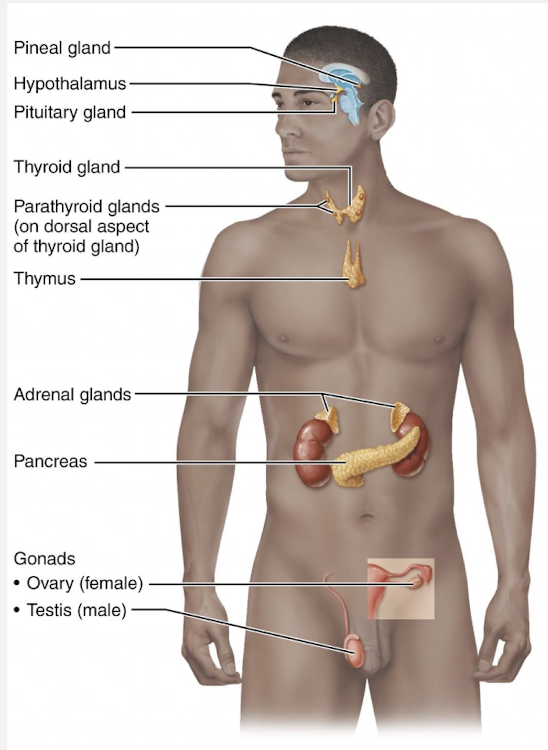
Endocrine system
A system of ductless glands that secrete hormones into the bloodstream to regulate target tissues
Hormone
Chemical messenger released into the blood that binds receptors on target tissues to produce a physiological response
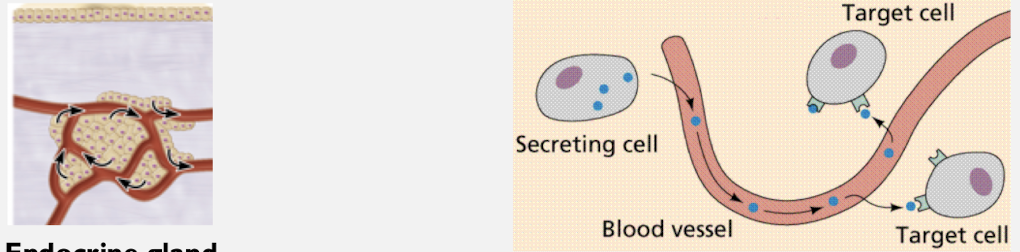
Endocrine gland
Group of epithelial-derived cells that secrete hormones directly into the bloodstream
Target tissue
Tissue that contains specific receptors for a hormone and responds when the hormone binds
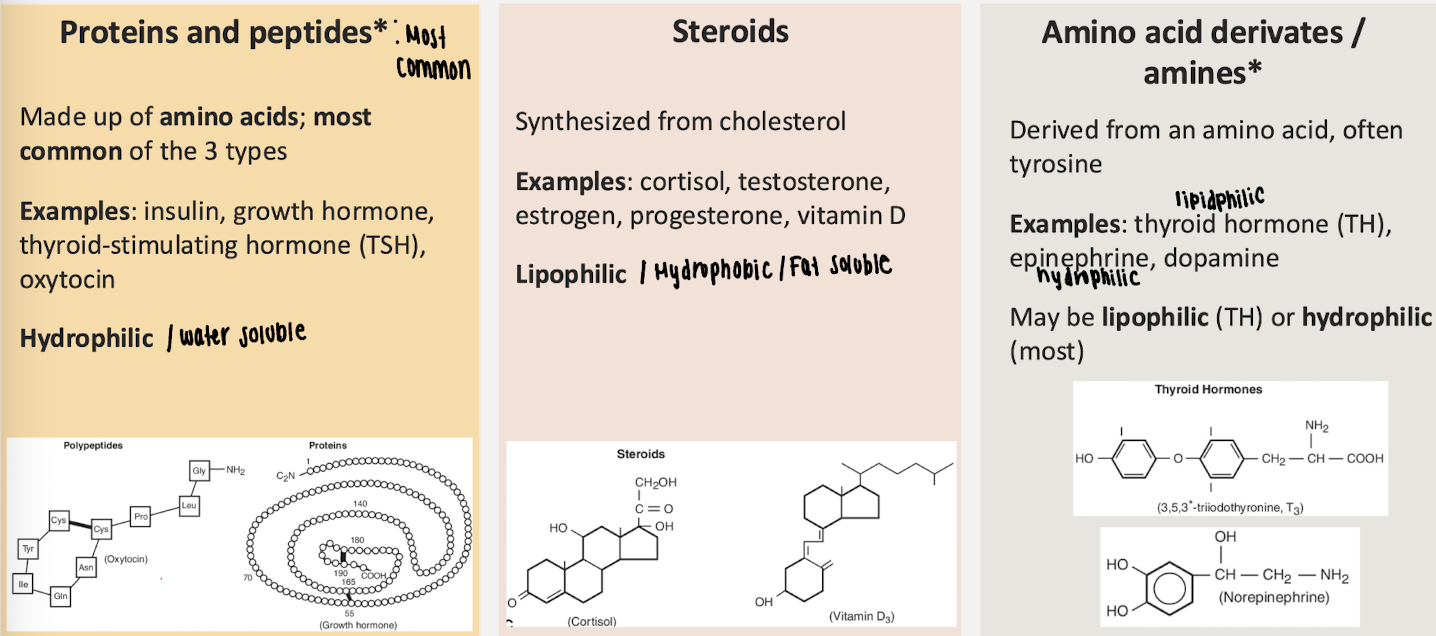
Chemical classes of hormones
Peptide/protein hormones, steroid hormones, and amino acid–derived hormones
Peptide/protein hormones
Hormones made of amino acids; hydrophilic; stored in vesicles and released by exocytosis
Examples of peptide hormones
Insulin, growth hormone, TSH, oxytocin
Steroid hormones
Hormones synthesized from cholesterol; lipophilic; synthesized on demand and diffuse across membranes
Examples of steroid hormones
Cortisol, aldosterone, testosterone, estrogen, progesterone, vitamin D
Amino acid–derived hormones
Hormones derived from amino acids (usually tyrosine); can be hydrophilic or lipophilic
Examples of amino acid–derived hormones
Epinephrine, dopamine, thyroid hormone
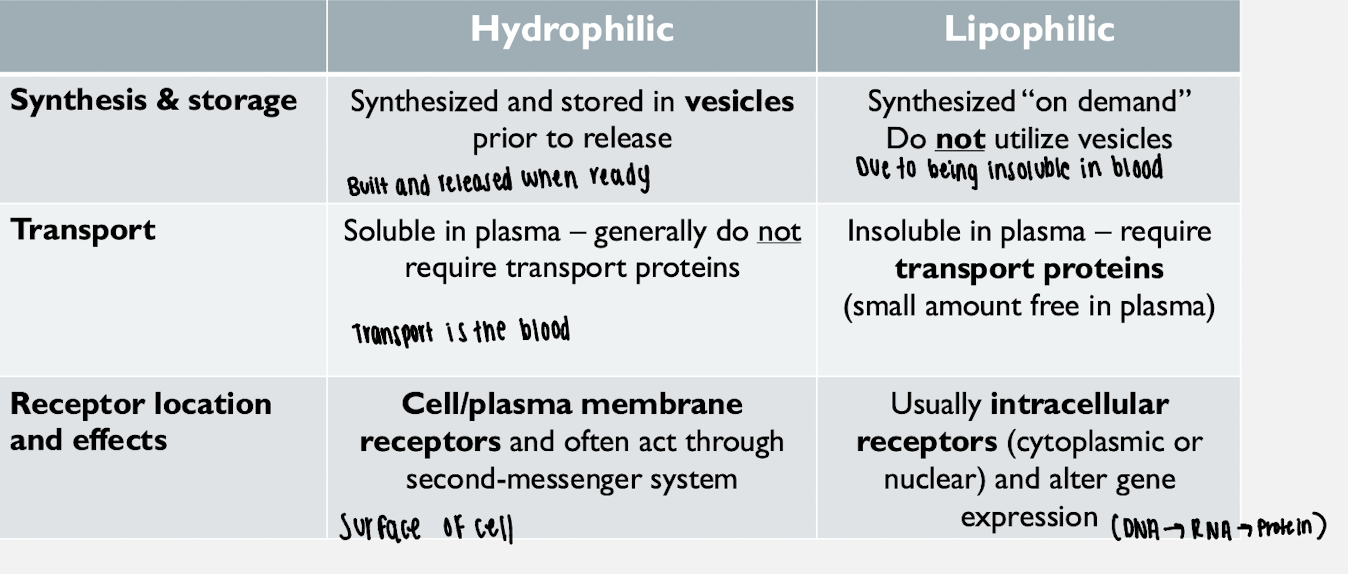
Hydrophilic hormones
Hormones that are water-soluble, circulate freely in plasma, and bind cell membrane receptors
Lipophilic hormones
Hormones that are lipid-soluble, require carrier proteins in blood, and bind intracellular receptors
Protein hormone synthesis
Preprohormone → prohormone → active hormone with storage in secretory vesicles
Steroid hormone synthesis
Synthesized from cholesterol with pregnenolone as the rate-limiting step
On-demand synthesis
Hormone synthesis that occurs as needed rather than being stored, typical of steroid hormones
Hormone release via exocytosis
Method used by peptide and protein hormones to enter the bloodstream
Diffusion across membrane
Method used by lipophilic hormones to leave endocrine cells
Hormone transport
Movement of hormones through the bloodstream to target tissues
Carrier proteins
Plasma proteins that bind lipophilic hormones for transport in blood
Free hormone
Fraction of hormone not bound to carrier protein and biologically active
Cell membrane receptor
Receptor located on the plasma membrane used by hydrophilic hormones
Second messenger system
Intracellular signaling pathway activated by hydrophilic hormones after receptor binding
Intracellular receptor
Cytoplasmic or nuclear receptor used by lipophilic hormones
Gene transcription alteration
Process by which lipophilic hormone–receptor complexes change gene expression
Humoral stimulus
Hormone release triggered by changes in blood levels of ions or nutrients
Neural stimulus
Hormone release triggered by nervous system input
Hormonal stimulus
Hormone release triggered by another hormone (tropic hormone)
Negative feedback loop
Regulatory mechanism where the final hormone inhibits earlier hormone release to maintain homeostasis
Positive feedback loop
Regulatory mechanism where hormones amplify each other to produce a specific event
Homeostasis
Maintenance of a stable internal environment
Example of negative feedback
Thyroid hormone inhibiting TSH release
Example of positive feedback
Estrogen increasing LH and FSH during ovulation
Permissiveness
One hormone must be present for another hormone to exert its full effect
Example of permissiveness
Thyroid hormone required for normal reproductive development
Synergism
Two hormones produce the same effect and their combined effect is greater than additive
Example of synergism
Glucagon and epinephrine increasing blood glucose together
Antagonism
Two hormones have opposite physiological effects
Example of antagonism
Insulin lowers blood glucose while glucagon raises blood glucose
Up-regulation
Increase in number of receptors to enhance hormone signaling
Down-regulation
Decrease in number of receptors to reduce hormone signaling
Receptor desensitization
Decreased receptor responsiveness due to prolonged hormone exposure
Example of desensitization
Insulin resistance in type 2 diabetes
Hypothalamus
Neuroendocrine gland that produces releasing and inhibiting peptide hormones providing hormonal stimulation to the anterior pituitary and neural stimulation to the posterior pituitary
Posterior pituitary
Releases peptide hormones ADH (vasopressin) and oxytocin in response to neural stimulation from hypothalamic neurons
Anterior pituitary
Produces and releases peptide and protein hormones including GH (somatotropin), prolactin, TSH, ACTH, LH, and FSH in response to hormonal stimulation from hypothalamic releasing hormones
Antidiuretic hormone (ADH) / vasopressin
Peptide hormone released from the posterior pituitary via neural stimulation that increases renal water reabsorption, decreases urine output, causes vasoconstriction at high levels, and increases blood pressure
ADH release stimulation
Humoral stimuli including increased blood osmolarity, decreased blood pressure or volume, and hormonal stimulation by angiotensin II
ADH release inhibition
Humoral stimuli including low blood osmolarity, hypervolemia, and alcohol
Low ADH pathology
Diabetes insipidus characterized by excessive urination and dehydration
High ADH pathology
SIADH causing water retention, hyponatremia, and low urine output
Oxytocin
Peptide hormone released from the posterior pituitary via neural stimulation that stimulates uterine contractions during labor and milk ejection during breastfeeding
Oxytocin release stimulation
Neural stimulation from cervical stretch and breastfeeding with positive feedback
Oxytocin release inhibition
Stress
Growth hormone (GH) / somatotropin
Protein hormone released from the anterior pituitary via hormonal stimulation that promotes growth, protein synthesis, lipolysis, and increases blood glucose through IGF mediation
GH release stimulation
Hormonal stimulation by GHRH and humoral stimuli such as hypoglycemia, exercise, and deep sleep
GH release inhibition
Growth hormone inhibiting hormone (GHIH) also called somatostatin and negative feedback from GH and IGFs
Excess GH pathology
Gigantism in children and acromegaly in adults
GH deficiency pathology
Pituitary dwarfism in children
Growth hormone inhibiting hormone (GHIH) / somatostatin
Hypothalamic peptide hormone that inhibits growth hormone release from the anterior pituitary
Prolactin
Protein hormone released from the anterior pituitary that stimulates breast development and milk production and suppresses GnRH
Prolactin release stimulation
Hormonal stimulation by estrogen and neural stimulation from breastfeeding
Prolactin release inhibition
Prolactin inhibiting hormone (PIH) also called dopamine
Hyperprolactinemia
Elevated prolactin causing galactorrhea and infertility
Thyroid gland
Endocrine gland that produces amino acid derivative hormones T3 and T4 in response to hormonal stimulation by TSH
Triiodothyronine (T3)
Amino acid derivative thyroid hormone with three iodine atoms and high receptor affinity; primary physiologically active form
Thyroxine (T4) / tetraiodothyronine
Amino acid derivative thyroid hormone with four iodine atoms that serves as the primary circulating reservoir for conversion to T3
Thyroid peroxidase (TPO)
Enzyme responsible for iodide oxidation, iodination of tyrosine, and coupling reactions in thyroid hormone synthesis
Physiological effects of thyroid hormone
Increased basal metabolic rate, heart rate, respiration, GI motility, CNS activity, growth, and development
HPT axis
Hormonal stimulus pathway where TRH stimulates TSH release which stimulates thyroid hormone secretion with negative feedback
Hyperthyroidism
High thyroid hormone levels with low TSH
Hypothyroidism
Low thyroid hormone levels with high TSH
Adrenal cortex
Produces steroid hormones including mineralocorticoids, glucocorticoids, and adrenal androgens
Aldosterone
Steroid hormone classified as a mineralocorticoid released primarily by humoral stimuli that increases sodium and water reabsorption, potassium excretion, and blood pressure
Aldosterone release stimulation
Humoral stimuli including angiotensin II and hyperkalemia with minor hormonal stimulation by ACTH
Cortisol
Steroid hormone classified as a glucocorticoid released via hormonal stimulation that increases blood glucose, suppresses immune function, and mediates the stress response
HPA axis
Hormonal stimulus pathway where CRH stimulates ACTH release leading to cortisol secretion with negative feedback
Addison disease
Primary adrenal insufficiency characterized by low glucocorticoids and mineralocorticoids
Cushing syndrome
Condition of excess glucocorticoid cortisol causing hyperglycemia, immune suppression, and hypertension
Pancreatic beta cells
Endocrine cells that produce peptide hormones insulin and amylin
Insulin
Peptide hormone released in response to humoral stimulation that decreases blood glucose by increasing cellular glucose uptake and promoting energy storage
Insulin release stimulation
Humoral stimuli including hyperglycemia, amino acids, fatty acids, GLP-1, and acetylcholine
Insulin release inhibition
Epinephrine and norepinephrine
Type 1 diabetes
Autoimmune destruction of beta cells resulting in low insulin
Type 2 diabetes
Insulin resistance with initial hyperinsulinemia progressing to insulin deficiency
Pancreatic alpha cells
Endocrine cells that produce the peptide hormone glucagon
Glucagon
Peptide hormone released in response to humoral stimulation that increases blood glucose through glycogenolysis and gluconeogenesis
Glucagon release stimulation
Humoral stimuli including hypoglycemia, exercise, epinephrine, and norepinephrine
Oxytocin is produced in the and released from the .
Hypothalamus; posterior pituitary
Which of the following are physiological effects of antidiuretic hormone (ADH)? Select all that apply.
Vasoconstriction and renal water reabsorption
Which of the following are TRUE regarding growth hormone? Select all that apply.
Increases blood glucose; deep sleep increases its release
A patient with galactorrhea likely has which of the following hormone alterations?
Elevated prolactin
What is the difference in chemical composition between T3 and T4?
The number of iodine residues
A patient is diagnosed with an autoimmune condition that results in atrophy of the thyroid gland. Which abnormality would be expected?
Low T4 and high TSH
A patient is taking a glucocorticoid medication. Which of the following are expected effects? Select all that apply.
Increased blood glucose and immune suppression
Insulin release is primarily triggered by which of the following?
Increase in blood glucose
Amino acid–derived hormones
Hormones synthesized from amino acids including catecholamines and thyroid hormones
Examples of amino acid–derived hormones
Epinephrine, dopamine, and thyroid hormones (T3 and T4)
Catecholamines
Amino acid–derived hormones including epinephrine and dopamine that are water-soluble and act like peptide hormones
Epinephrine storage
Epinephrine is stored in secretory vesicles and released by exocytosis

