Chapter 6 - Nonhuman Primates
 Studied by 0 people
 Call Kai
 Learn
Learn Practice Test
 Spaced Repetition
 Match
Match Flashcards
 Knowt Play
1/41

There's no tags or description
Looks like no tags are added yet.
Name | Mastery | Learn | Test | Matching | Spaced | Call with Kai |
|---|
No analytics yet
Send a link to your students to track their progress
42 Terms
Primitive mammal traits that primates and humans share
Thermoregulation (warm blooded)
tetrapod/quadrupedal body plan ( four limbs)
different life stages
period of growth and developmental changes
infancy, juvenile and adulthood
Dichromatism (two colour vision)
heterodont dentition (four types of teeth)
taxonomic classification of primates (and traits associated with each taxa)
Kingdom - animalia
phylum - chordata
subphylum - vertebrata
class - mammalia
infraclass - eutheria
superorder - archonta
Order - Primates
traits of Phylum: chordata
notochord provides support and flexibility
bilateral symmetry
traits of subphylum: vertebrata
vertebral column
presence of cranium
traits of class: Mammalia
mammary glands
hair
presence of 3 ear ossicles (bones)
traits of infraclass: Eutheria
greater placental development
live birth (don’t lay eggs)
superorder: Archonta
includes:
Plesiadapiformes (extinct “primate-like” mammals or “stem primates”)
Scadentia (tree shrews)
dermoptera (flying lemurs)
primates
Derived traits shared by all primates
Opposable thumbs
finger nails (not claws) and tactile pads
post-orbital bar (eye socket bone)
stereoscopic (3D) vision
relatively big brains
shared derived traits and primitive traits of Lorises and lemurs
shared derived traits
toothcomb
primitive traits
wet nosed - rhinarium
grooming claw
mostly nocturnal
tapetum lucidum (eyeshine)
Strepsirrhines unique teeth
they have a Dental comb
combined front teeth used for grooming and scraping sap from trees
derived trait of strepsirrhines
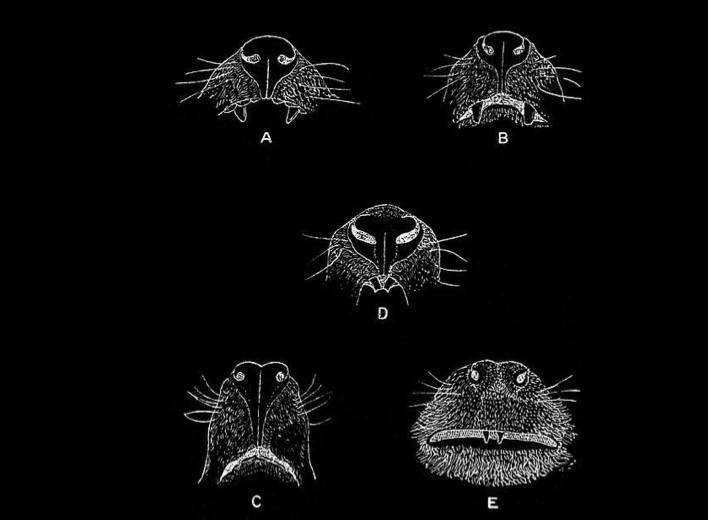
Which of these have a rhinarium and How to tell if an animal has a Rhinarium
A and D - strepsirrhines because they have a rhinarium
no hair
splits upper lip
E - Tarsier (Haplorhin) - no rhinarium present
shared derived traits of haplorhini
shared derived traits
loss of rhinarium - flatter noses
loss of tapetum lucidum - no eyeshine
trchromatism - 3 colour vision
post-orbital enclosure
Primitive and derived Traits of Haplorhini: Tarsiers
Longest evolutionary history
Primitive Traits
nocturnal
retained grooming claw
lack of toothcomb
Derived Traits
Dry nosed (no rhinarium)
no hair on nose
doesn’t split lip
Haplorhini: platyrrhini and their traits
New world (western hemisphere) monkeys
Single clade: Ceboidea
Derived traits:
dry nosed - flat, wide, and turned outward
platy = flat, Rhine = nose
mostly diurnal - polymorphic dichromatic or trichromatic vision
prehensile tail in some (no other primates have this)
Haplorhini: Catarrhini and their traits
characterized by dry, downward-pointing noses and 2-1-2-3 dental formula
split into 2 superfamilies
Cercopithecoidea (Old world monkeys)
Hominoidea (Apes)
How do Apes and Old Wold Monkeys differ (traits)
based on shared derived traits
apes don’t have a tail
apes have a distinct “Y5” molar shape
Sub-groups and siffuxes
Superfamily: -oidea
Family: -idae
Subfamily: -inae
Tribe: -ini
How did monkeys get from Africa to south america
floated and drifted through the ocean through rafts
monkeys living in trees, they break trees into the river, basically creating a raft for them to float on
which is why platyrrhini are represented as a single clade
Clades of Hominoidea
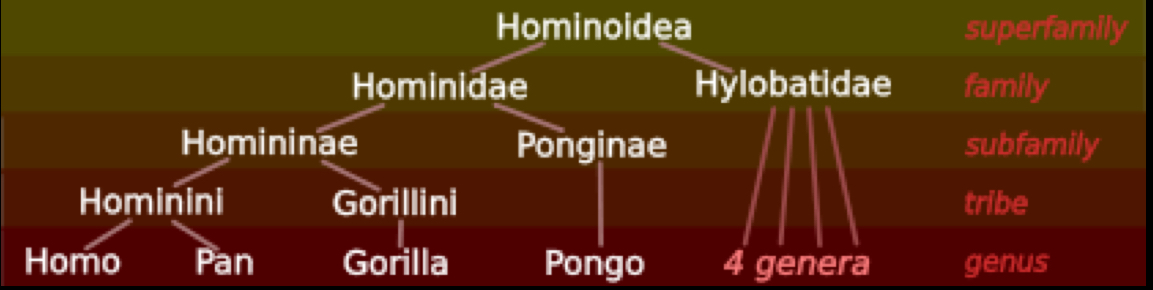
Family Hominidae - “Great” Apes
Family Hylobatidae - “Lesse” Apes
Subfamilies - Homininae (African ape clade), and Ponginae (Orangutans)
Tribes - Hominini (humans and chimps) and gorillini (gorrilas)
subtribe - Hominina (Humans) and panina (chimps and bonobos)
What kind of body plan for primates have
quadrupedal body plan
6 different ways of locomotion of primates
Quadrupedalism (most common) - two types are arboreal and terrestrial
leaping using hind limbs
ex. baboon and howler monkeys
Vertical clinging and leaping - body is propelled from one branch to another using hindlimbs
ex. Tarsier and lemur
slow climbing - only one limb is moved at a time
ex. Orangutan and Lorin
brachiaton - hand-over-hand movement in trees
ex. gibbon, orangutan, and spider monkey
knuckle walking - quadrupedal movement using knucles and sometimes standing up
ex/ chimp and gorilla
bipedalism - upright walking on hindlimbs
ex. humans
Skeletal features of Primates (teeth and snout)
Shortened snout
reduced sense of smell and increased vision
also have reduced number of teeth compared to other animals
Heterodont detition - incisors, canines, premolars, and molars
different types of teeth for eating a variety of foods and process food efficiently
generalizaed mammalian trait
Mammalian Dentition and the 2 types
Mammals have more complex teeth than reptiles or fish
Homodont - all teeth similar in form
sharp and replaced throughout life
ex. sharks, crocodiles, etc.
Heterodont - different types of teeth present
some specialized for chewing
ex. most mammals
Diphyodont dentition - One set of deciduous (baby or milk) teeth that are replaced by adult teeth as mammals mature
4 types of mammalian teeth
Incisors - cutting teeth in the front of the jaw
Canines - long sharp “dog” teeth
for communication and biting prey
Premolars - more flattened teeth
Molars - flat chewing teeth
Number and patterns of teeth are distinctive for different mammals
Eutherian Dental formula
3 incisors, 1 canine, 4 premolars, and 3 molars
per side (double to get total teeth)
Formula
(incisors, canines, premolars, molars) TOP / (incisors, canines, premolars, molars) BOTTOM
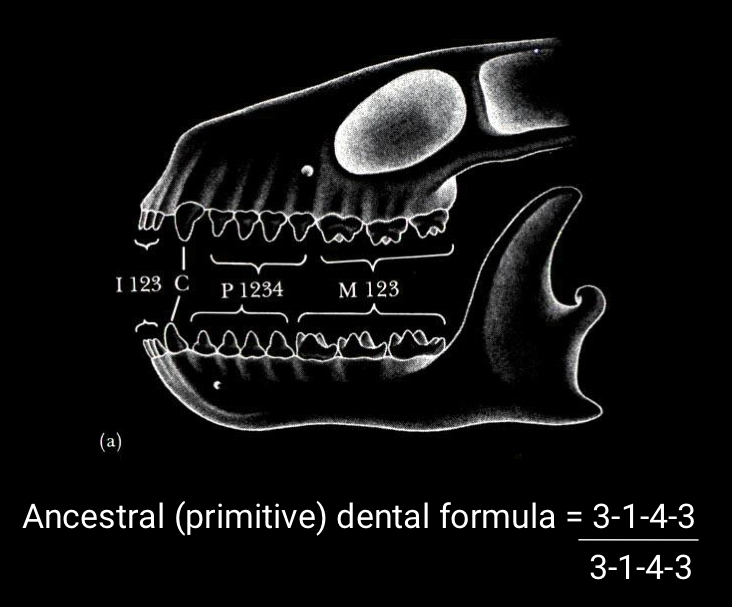
What is the dental formula for humans
2-1-2-3
Specialization in primate teeth
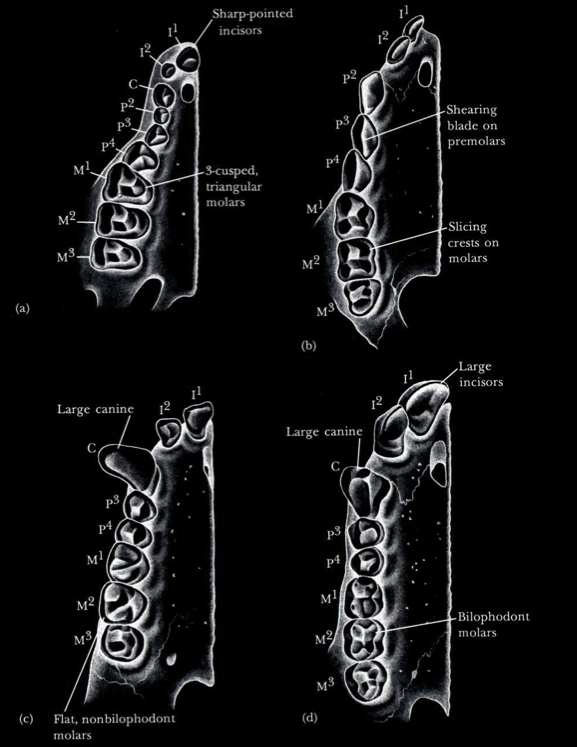
Insect-eating promision
Leaf-eating lemur (Indri) - many crests for mashing up leaves
Fruit and leaf eating ape (Hylobates) - incisors to bite into fruit
Fruit-eating monkey (cercocebus) - incisors and crests
Diet and digestive system of primates
lots of variation between primate species in deit
most primates are generalists - exploit a wide range of foods sources
types of food a primate species exploits depends on size and behaviour
Larger animals will be more likely to eat plants and leaves
because they are more easily resourced
who has the largest brains (for their size) out of fish, mammals, birds, reptiles, and primates
from smallest to largest
Reptiles, Fish, birds, other mammals, and primates
Characteristics relating to brain size of primates
Advanced ability to learn
many examples of primate culture
experimental models of apes learning language
Advanced social structure
long term mother child bonding
ability of small groups to collaborate to gain power within larger group
Two theories of Primate Origins
Arboreal theory
adapting to living trees is what caused the observable traits primates have
stereoscopic vision (less reliance on smell), grasping hands and feet, good eye-hand coordination, and a large brain become advantageous in trees
Visual predation theory
binocular vision, good grasping capabilities, and highly refined eye-hand coordination are adaptations for insect hunting in low branches
behaviour
anything organisms do that involves action in response to internal or external stimuli
response of an individual, group, or species to its environment
responses may not be deliberate (intentional) and aren’t necessarily result of conscious decision making
Behavioural ecology
focuses on the relationship between behaviours, natural environment, and biological traits of the species
behaviours have evolved through the operation of natural selection:
behaviours are influenced by genes and are subject to natural selection the same way physical characteristics are
but individuals also have agency and can talk and decide about behaviour given any situation
evolution of behaviour
behaviour constitutes a phenotype
individuals whose behavioural phenotypes increase reproductive fitness will pass on their genes at a faster rate
genes do not code for specific behaviours (ex. aggression, cooperation, etc.)
species vary in their limits and potentials for learning and behavioural flexibility, set by genetic factors (Nature vs. Nurture)
Natural selection acts on genetic factors shaped by ecological setting of past and present
Is human behaviour different from primate behaviour?
No, human behaviour is primate behaviour
our behaviour is not special from primates
primates are social animals
Primate Social Structure
Primates are among the most social of animals
social behaviour is one of the major topics in primate research
broad subject that includes all aspects of behaviour
Why be social? (group living)
competition
Costs of competition are offset by the benefits of predator protection and resource sharing provided by associating with others
group living evolved as an adaptive response to a number of ecological variables
Primate social groups
Primates often live in social groups with complex social orders
One-male, multi-female groups - one male units, able to join with others if food is plentiful, can form large stable bachelor groups
ex. baboons, gorrilas, howlers
Matrilines - consist of a female, her daughters, and their offspring
ex. macaques
pair bonds
not very permanent
ex. humans and gibbons
multi-male, multi-female groups
ex. bonobos
Domiannce hierarchies (in primate social behaviour)
primate societies that impose order and establish parameters of individual behaviour
higher-ranking animals have greater access to preferred food items and mating partners than lower ranking individuals
sometimes called “pecking orders” that change throughout one’s life and are learned
Factors that influence dominance status
Sex
Age
Aggression
Intelligence
Time in the group
motivation
mother’s social position
Communication (in primate social behaviour)
any act that conveys info to another individual
goal is to stimulate a change in behaviour in the recipient
may be caused by involuntary processes or a secondary consequence of an intentional action
 Note
Note  Flashcards (31)