EASC 210 midterm study
 Call Kai
 Learn
Learn Practice Test
 Spaced Repetition
 Match
Match Flashcards
 Knowt Play
1/196

Earn XP
Description and Tags
Stratigraphic principles, geochronology, sedimentary archives, fossil record, evolution and biological classification, continental drift, plate tectonic theory, hadean eon.
Name | Mastery | Learn | Test | Matching | Spaced | Call with Kai |
|---|
No analytics yet
Send a link to your students to track their progress
197 Terms
Lithosphere
Earth's rigid outer layer including crust and upper mantle
Crust
The thin, outermost layer of Earth.
Mantle
The denser layer directly below the crust.
The Earth formed:
4.56 billion years ago
What is plate tectonics?
A theory describes the movement and interaction of the plates or Earth's lithosphere.
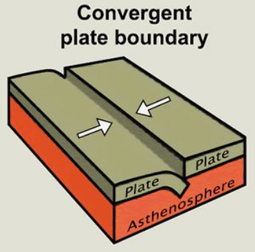
Convergent boundary
A tectonic plate boundary where two plates come together.
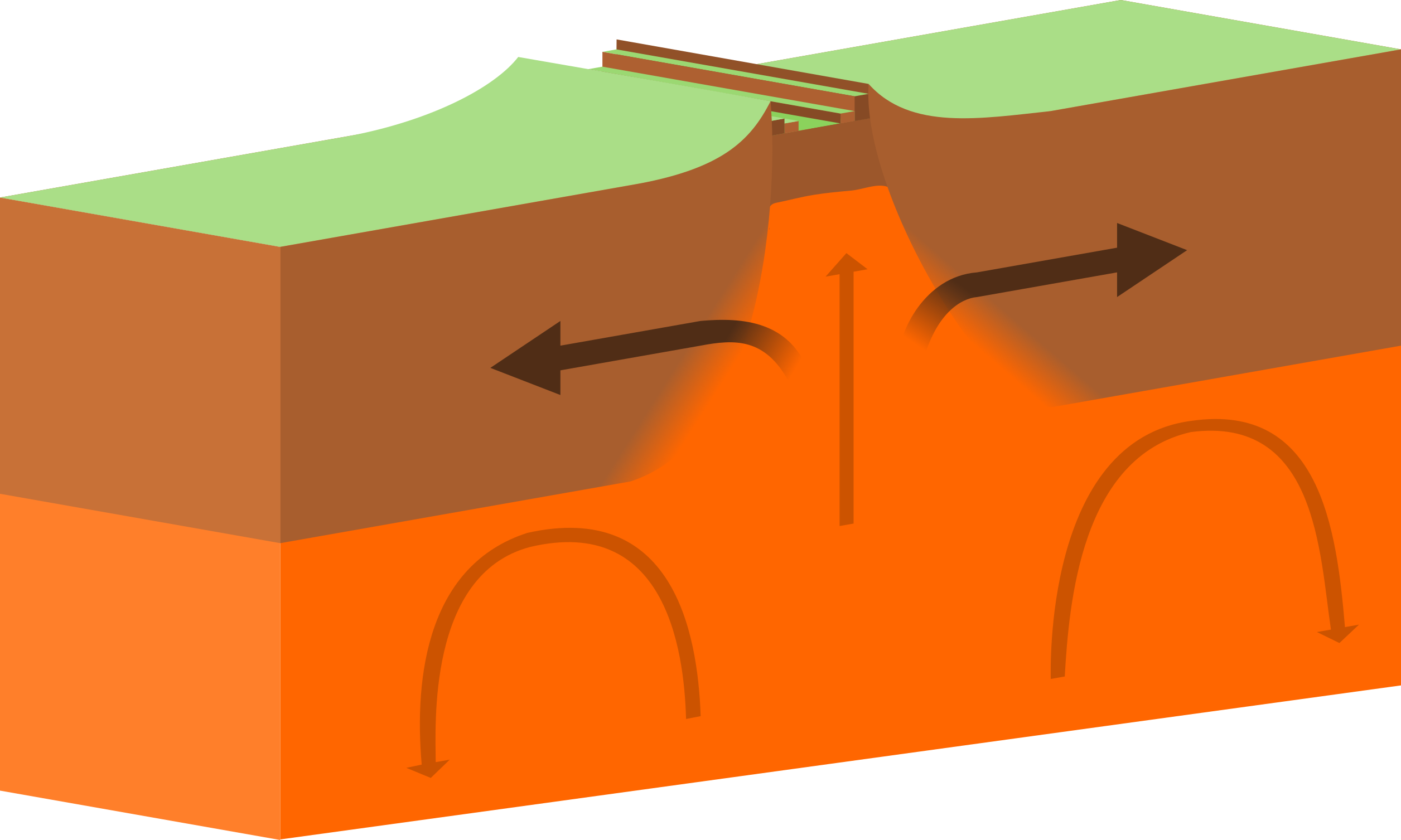
Divergent boundary
A tectonic plate boundary where two plates move away from each other.
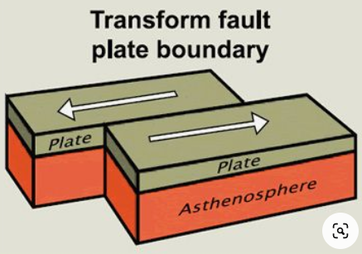
Transform boundary
Two plates slide past each other.
What is the significance of tectonic plates in our lives today?
Plate movements and interactions control major geological events, such as mountain building, volcanism, earthquakes, and the creation of ocean basins and continents
What must happen for a hypothesis to become a theory?
Extensive testing where the hypothesis is proven and the results withstand the test of time.
What is the importance of fossils in historical geology?
Fossils are valuable indicators of the age of rocks. They help geologists place rocks in the appropriate geologic era.
What is the age of the oldest rocks so far?
4.0 GA
What is the oldest rock?
The Acasta Gneiss
Where is the Acasta Gneiss found?
In the Canadian Shield.
Why is it unlikely that geologists will find rocks that are as old as the Earth itself?
During the Hadean eon (4.56 GA - 4.0 GA), there was no solid rock until the Earth cooled off at the beginning of the Archean eon.
Why do we use meteorites to determine the age of Earth?
Meteorites that landed on Earth during the Hadean were not melted down, while all other rock was molten.
Would changes in climate and topography affect the course of evolution?
Yes, these changes cause living organisms to adapt. Example: during the ice age, species evolved to have bigger bodies as way of retaining heat.
What are the 3 great themes of Earth history?
Deep time,
Plate tectonics,
and the evolution of life
How is the absolute age of rocks expressed?
Absolute dating gives you a real age in actual years by measuring radioactive decay.
How do we express relative age?
Relative age is the age of a rock layer compared to other layers. It can be determined by looking at the position of the layers.
What are the goals of historical geology?
Examples:
To address the origin of Earth, and Earth’s evolution through deep time,
To document the evolution of Earth’s continents and oceans,
To document the succession of life through fossils found in strata.
What is deep time?
Geologic time, time beyond human time.
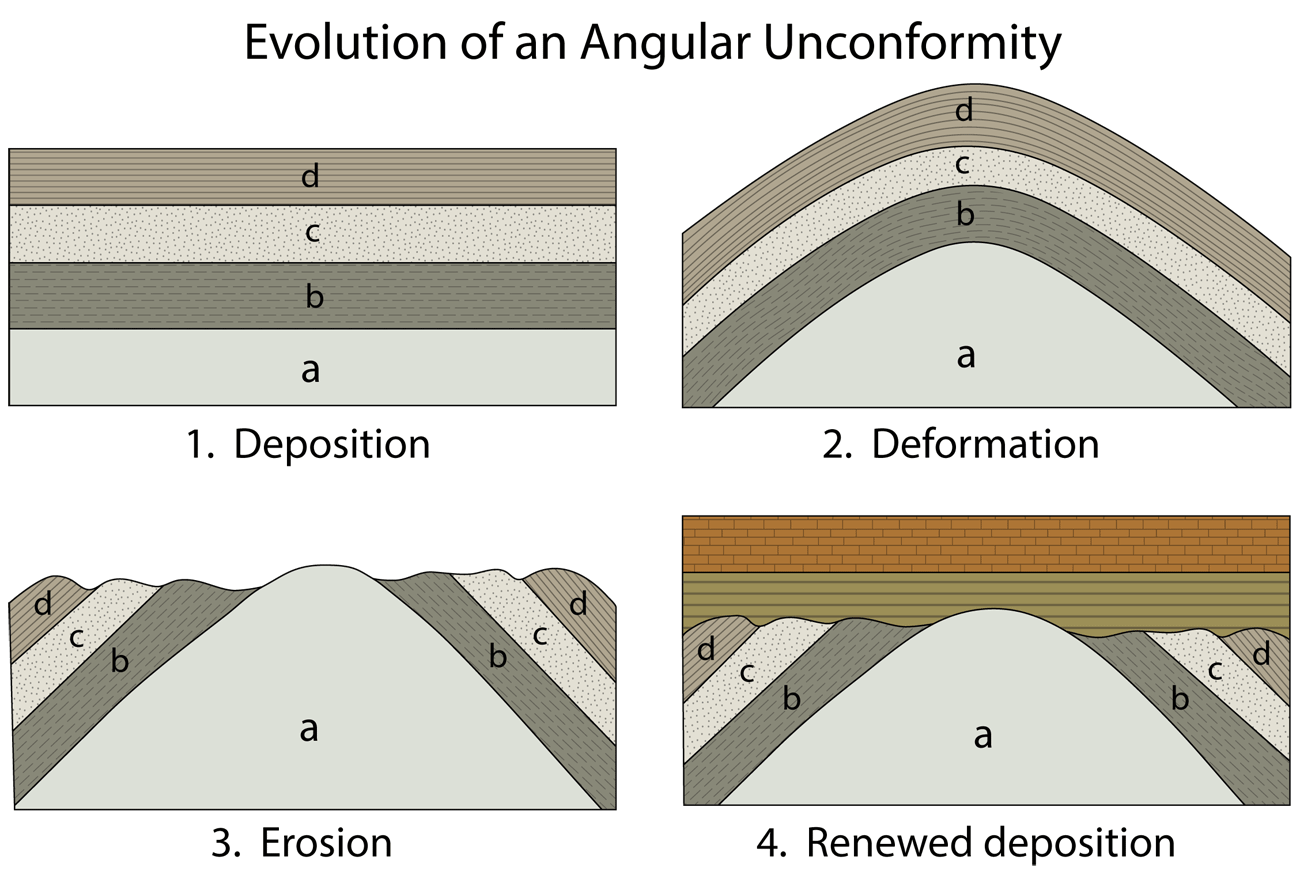
Describe an angular unconformity.
A surface between overlying, younger, flat rocks and underlying, older, tilted rocks. Younger rock is not parallel with older rock.
Describe a disconformity.
Layers above and below the erosion boundary are parallel to each other.
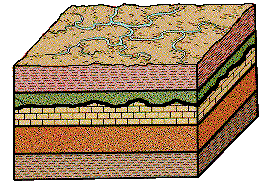
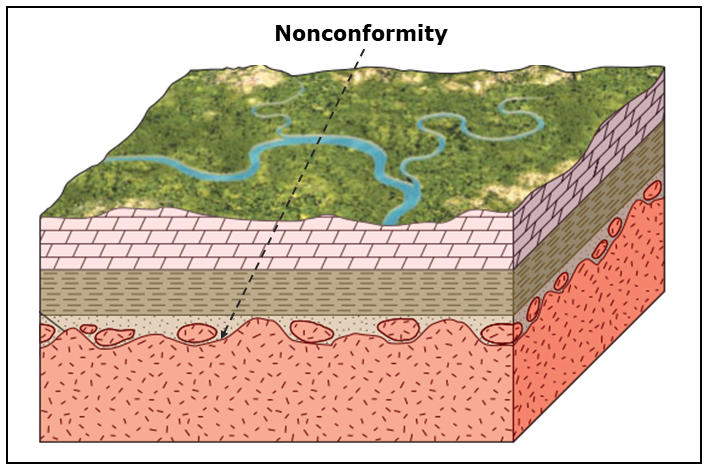
Describe a nonconformity.
Igneous rock is deposited, then sedimentary layers are laid on top.
Outcrop
Exposed layers of rock.
Strata
Layered rock sequences on the Earth’s surface.
Conformable strata
Layers without time gaps in between.
Unconformable strata
Big time gaps between certain layers.
Facies
The characteristics of a rock unit that reflect its origin.
What are Steno’s 3 stratigraphic principles?
Superposition
Original Horizontality
Original Lateral Continuity
Principle of superposition
In a sequence of undisturbed strata, the oldest rock will be on the bottom, and layers get younger as you move toward the top.
Principle of original horizontality
Sediment layers are originally horizontal. If they are deformed, deformation must have occurred after deposition, burial, and lithification.
Principle of original lateral continuity
A rock layer extends continuously in all directions until it thins out, turns into another sediment type, or encounters a barrier.
Principle of fossil succession
Each fossil species reflects a unique period of time in Earth’s history. Once a fossil species goes extinct, it disappears and cannot appear in younger rock.
Principle of cross-cutting relationships
Penetrating rock must be younger than the rock that is being penetrated.
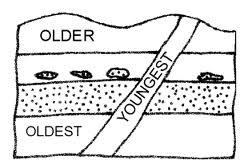
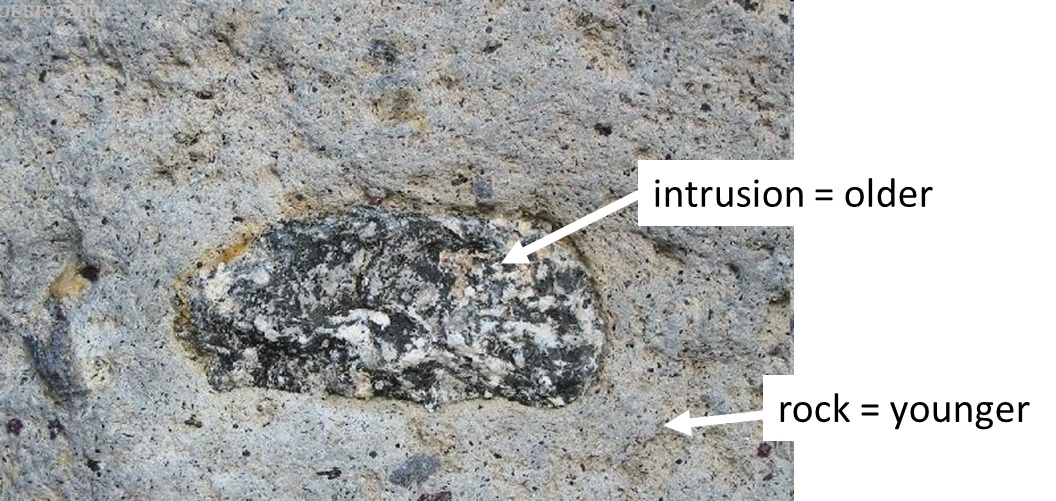
Principle of inclusions
If one rock type includes pieces of another rock type, the included rock must be older
Intrusive contact
Contact between country rock and intrusive magma body.
Fault contact
Rocks come into contact with fault zones
Neptunism
The Neptunists believed that all rocks precipitated from the primordial oceans.
Plutonism
Plutonists believed that fire was key to the origin of rocks.
Catastrophism
Changes in the Earth’s crust were caused by sudden, violent, catastrophic events.
Uniformitarianism
Changes in the Earth’s crust are caused by gradual, continuous processes.
Who came up with the theory of uniformitarianism?
Charles Lyell
Walther’s Law
Any vertical succession of facies, if the sequence has no big gaps, those facies were originally side-by-side . Caused by sea level changes.
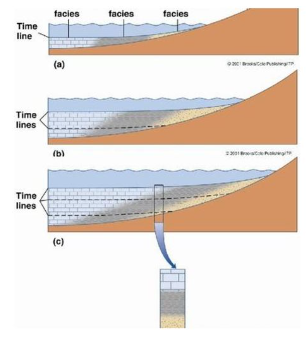
Geopetal indicator definition
A characteristic in a rock that makes it possible to determine which way is up.
Geopetal indicators examples
Trace fossils (burrows, footprints)
Laminations
Ripples
Rain marks
Mud cracks
Examples of changes in the natural environment that would cause facies to move around.
Sea level changes (facies move in, layer 1 would get overlain by layer 2, layer 2 overlain by layer 3, and so on)
Glaciation (ice overlays sediment, after ice melts, land bounces back up)
Geochronology
Provides the framework for Earth history.
Common mistakes in geological time scales
Periods are evenly spaced. This reflects how little knowledge we have of earlier periods.
Units of the time scale
Eon
Era
Period
Epoch
Age
Chron
Time-Rock divisions
Eonothem
Erathem
System
Series
Stage
Zone (chronozone)
What are time boundaries based on?
Time boundaries are based on the origin and extinction of fossils.
Why are the time boundaries for the Precambrian based on arbitrary numbers?
There are no good fossil distinctions.
What are the units of the geological time scale?
Ma = mega-annum
Ga = giga-annum
Chronostratigraphic units
Strata/rocks that were deposited during a certain time interval.
What is the oldest definitive evidence of life on Earth?
Trace fossils of stromatolites that date to 3.5 GA.
When was the first multicellular life?
Late Neoproterozoic
What was the climate like in the late Neoproterozoic?
Glaciation created a snowball Earth.
How many different supercontinents were in the proterozoic?
Two. Nuna in the paleoproterozoic, Rodinia in the Neoproterozoic.
What is the Cambrian explosion?
A time of rapid expansion for life forms on Earth.
The Ordovician and Silurian mark the appearance of the first ______?
Plants
The Devonian period is known as the age of ______?
Fishes
First reptiles appear in the _____________?
Pennsylvanian period
When was the final assembly of Pangea?
The Permian period
What event marks the end of the Paleozoic era?
The largest mass extinction of all time, the Permian extinction.
What type of animal first appears in the Permian?
Mammal-like reptiles
Mesozoic era is known as the age of ________?
Reptiles
What type of animals evolved in the Triassic?
Dinosaurs
mammals
What type of animal evolves in the Jurassic?
Birds
When and how does the Mesozoic era end?
The mesozoic era ends 66 Ma with a mass extinction caused by the impact of an asteroid.
Paleogene period is the age of _______?
Mammals
What type of plant evolves in the Eocene?
Grass
What are the 3 ideas for when the Anthropocene should begin?
At the start of the agricultural revolution (12,000 ya),
At the beginning of the industrial revolution (late 18th century),
Or at 1945 - the date of the Trinity Test.
Why is the Trinity Test considered a possible beginning for the Anthropocene?
Radioactive particles from the nuclear test were found in soil samples worldwide.
Why is the Anthropocene controversial?
Time span would be too short
There’s debate over where the boundary would begin
3 essential parts of atoms
Protons (positively charged)
Neutrons (neutral charge)
Electrons (negatively charged)
Isotope
A variant of an element that has a different atomic weight due to a different # of neutrons.
What happens to an unstable isotope?
The unstable isotope will break down, release energy, and create a daughter product.
Radiogenic
Derived from radioactivity.
What are unstable isotopes called?
Radioisotopes
What is an alpha particle and during what process is it released?
A helium nucleus (2+)
It is released during Alpha Decay
Describe Beta decay?
A neutron splits into a proton and a nuclear electron, and the electron is emitted from the nucleus.
Isotopic clock
Starts the moment when an isotope is locked into a mineral.
When does radioactive decay start?
Once a mineral crystallizes and the radioisotope is locked in.
What are some things we assume when we calculate a rock’s age based on radioactive decay?
There was no daughter product at the beginning,
Both parent and daughter material has not left,
Parents decay into daughters at a uniform rate,
Rock is unaffected by heat, pressure, or chemical changes.
What might cause a rock to lose some of its daughter product?
Melting,
Metamorphism,
If the daughter product is a gas, it will be released if rock is broken.
Why is Zircon so useful for Radioisotopic dating?
Zircon is very hard to break down or melt, so their isotopic clocks tend to not get reset.
What does a mass spectrometer do?
It counts the total # of parent molecules and the total # of daughter molecules.
Half-life
The time it takes for half of the parent radioactive isotope to decay into daughter isotopes.
Why does the effective range start at 10 million years for radioisotopes such as U-238? Hint: U-238 has a very long half-life.
There is a very small amount of daughter product at <10 million years, and it’s hard to detect.
Age dating formula
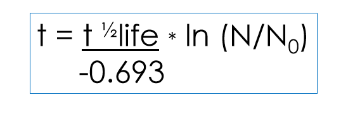
What kind of rocks can be used for dating? What makes them better for dating?
Igneous rocks: the crystallization of magma into rock traps the radioactive isotopes and keeps their daughter products.
Why are sedimentary rocks not as suited to radiometric dating?
Sedimentary rocks are made from other rocks, so there may be some particles in the rock that are older than the layers of sediment themselves.
Why are metamorphic rocks not as suited to radiometric dating?
Metamorphism can cause some of the daughter product to be lost by exposing it to heat and pressure.
Detrital mineral grains in sedimentary rocks can be dated. What can a detrital mineral date tell you?
Detrital mineral age can tell you the maximum depositional date. The sedimentary unit must be younger because the mineral grains existed before the rock formation.
Radiocarbon dating
A method that can determine the age of organic-rich sediments.
Daughter product of C-14 is ____?
N-14
What is a disadvantage of radiocarbon dating?
The age range is relatively short. After 60,000 years, there is very little carbon left to reliably measure.

