Lec 9 Biogeochemical cycles

0.0(0)
Studied by 0 people
call kaiCall Kai
learnLearn
examPractice Test
spaced repetitionSpaced Repetition
heart puzzleMatch
flashcardsFlashcards
GameKnowt Play
Card Sorting

1/53

encourage image

There's no tags or description

Looks like no tags are added yet.

Last updated 4:38 AM on 4/2/26
Name
Mastery
Learn
Test
Matching
Spaced
Call with Kai

No analytics yet

Send a link to your students to track their progress

54 Terms
1
New cards

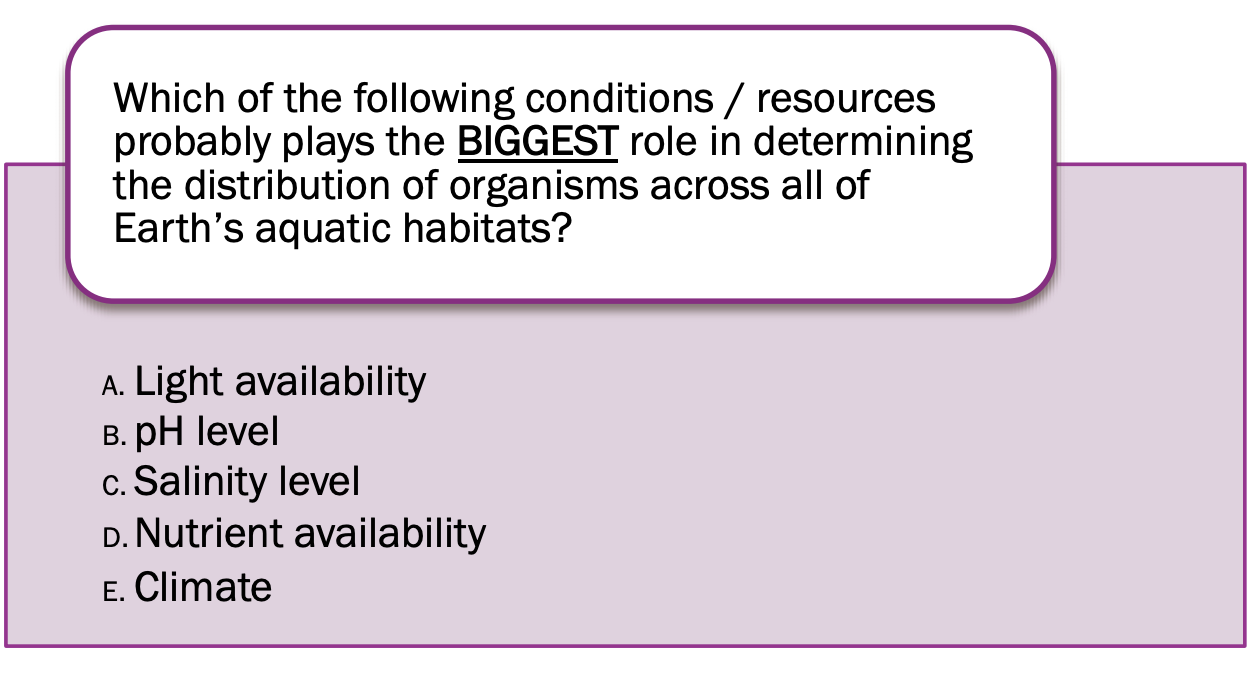
  • A 

    • Most ocean doesn't have sunlight -> no photo -> biggest limiting availability 

    • No mention of photic 

      • Nutrient would be more limiting then 

2
New cards

What are global biogeohemical cycles?

  • linked network of biological and physical processes that moves nutrients through pools within the environment

  • Nitrogen, phosphorus, carbon -> from food sources -> get them from plants 

  • Cycle impacts how available they are to living organism 

3
New cards

What are pools?

  • large reservoir of nutrients (e.g., oceans, atmosphere, soil)

  • Reservoir that is not moving 

  • Not being used by living  

4
New cards

What is flux?

  • movement of nutrients between pools

    • evaporation & precipitation

    • carbon-fixation through photosynthesis & respiration

  • Examples

    • Taken out of atmosphere -> moves into soil 

    • Nitrogen movement 

    • Take atmospheric carbon -> plants make starchs -> moved = flux 

5
New cards

How can nutrients be moved?

  • Nutrients can be carried long distances by winds as gases and particles

  • by waters of streams and oceans as dissolved solutes or as particles

  • Phosphorus in form of Phosphate lost in ground water washed downstream 

6
New cards

What is residence time?

  • Residence time: how long the molecules stays in one pool 

7
New cards

What is the residence time in the hydro cycle?

  • Ice sheet: maybe 20k years frozen 

  • Atm: evaporated -> only in atm for couple of days before being rained out 
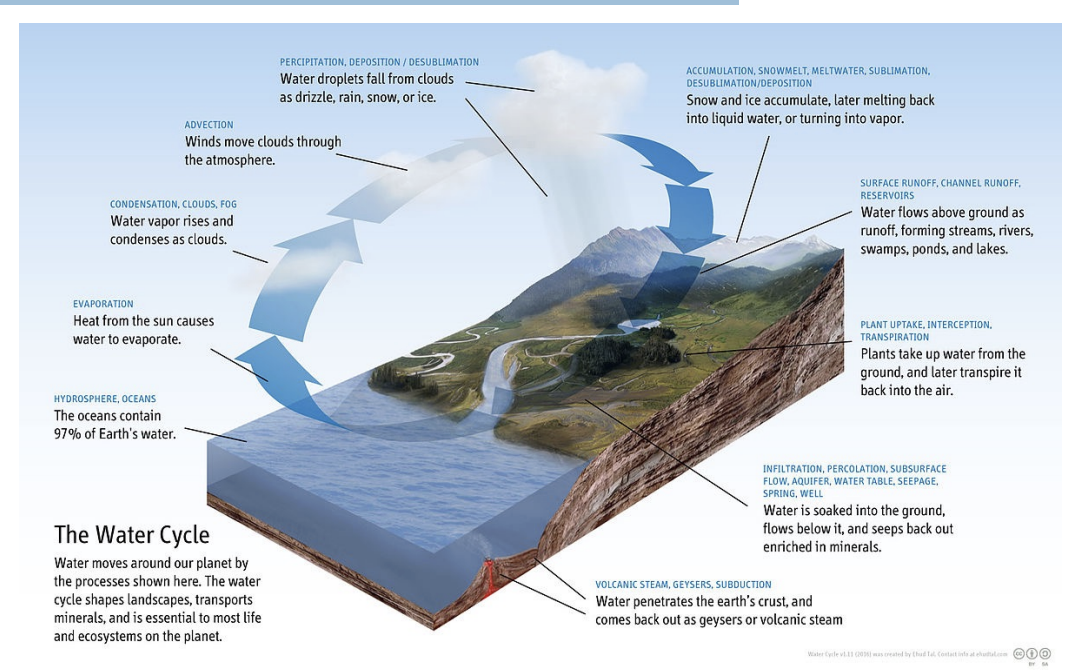
<ul><li><p><span style="background-color: inherit; line-height: 19.55px; color: windowtext;">Ice sheet: maybe 20k years frozen</span><span style="line-height: 19.55px; color: windowtext;">&nbsp;</span></p></li><li><p class="Paragraph SCXO188463403 BCX0" style="text-align: left;"><span style="background-color: inherit; line-height: 19.55px; color: windowtext;">Atm: evaporated -&gt; only in atm for couple of days before being rained out</span><span style="line-height: 19.55px; color: windowtext;">&nbsp;</span></p></li></ul><p></p>
8
New cards

What is the hydrological cycle?

  • Most rain and show made from evap of oceans 

    • Evapotranspiraiotn can also make rain 

  • The biggest pool is the ocean (contains ~97.5% of earth’s water).

  • Only 0.08% of global water is in flux at any given moment.
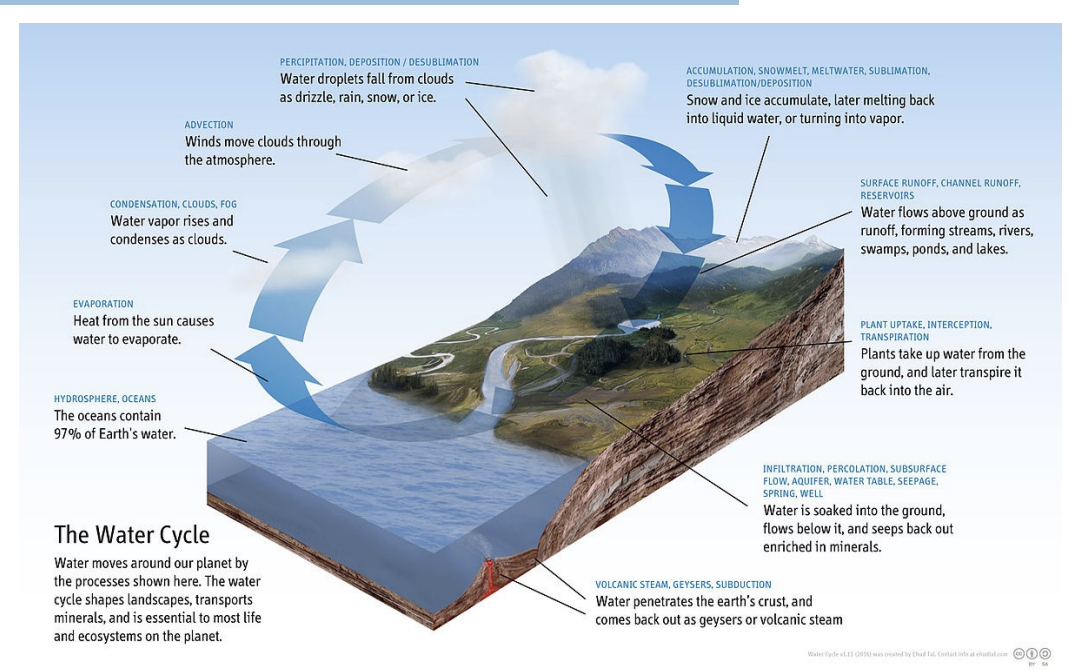
<ul><li><p><span style="background-color: inherit; line-height: 19.55px; color: windowtext;">Most rain and show made from evap of oceans</span><span style="line-height: 19.55px; color: windowtext;">&nbsp;</span></p><ul><li><p class="Paragraph SCXO89579405 BCX0" style="text-align: left;"><span style="background-color: inherit; line-height: 19.55px; color: windowtext;">Evapotranspiraiotn can also make rain</span><span style="line-height: 19.55px; color: windowtext;">&nbsp;</span></p></li></ul></li><li><p>The biggest pool is the ocean (contains ~97.5% of earth’s water).</p></li><li><p>Only 0.08% of global water is in flux at any given moment.</p></li></ul><p></p>
9
New cards

What happens as the Earth gets hotter?

  • Heat Earth -> Ocean hotter -> more evap -> speeds up water cycle -> more powerful hurricanes , cyclones, more frequent -> more flooding 

    • Speed up water cycle -> more water natural disasters 
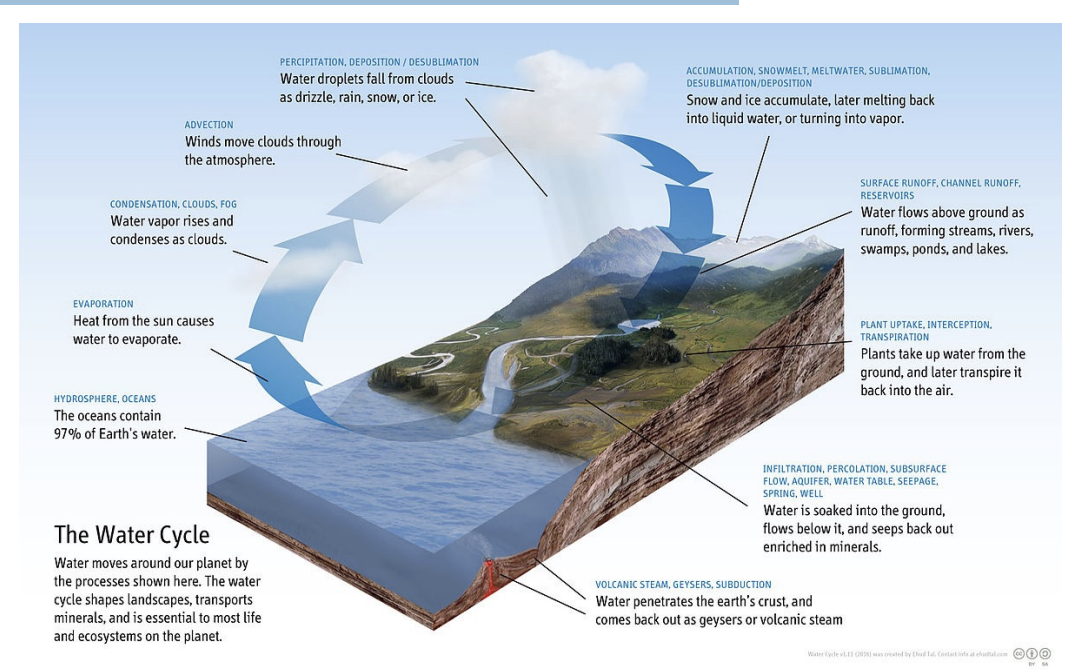
<ul><li><p><span style="background-color: inherit; line-height: 19.55px; color: windowtext;">Heat Earth -&gt; Ocean hotter -&gt; more evap -&gt; speeds up water cycle -&gt; more powerful hurricanes , cyclones, more frequent -&gt; more flooding</span><span style="line-height: 19.55px; color: windowtext;">&nbsp;</span></p><ul><li><p class="Paragraph SCXO261839605 BCX0" style="text-align: left;"><span style="background-color: inherit; line-height: 19.55px; color: windowtext;">Speed up water cycle -&gt; more water natural disasters</span><span style="line-height: 19.55px; color: windowtext;">&nbsp;</span></p></li></ul></li></ul><p></p>
10
New cards

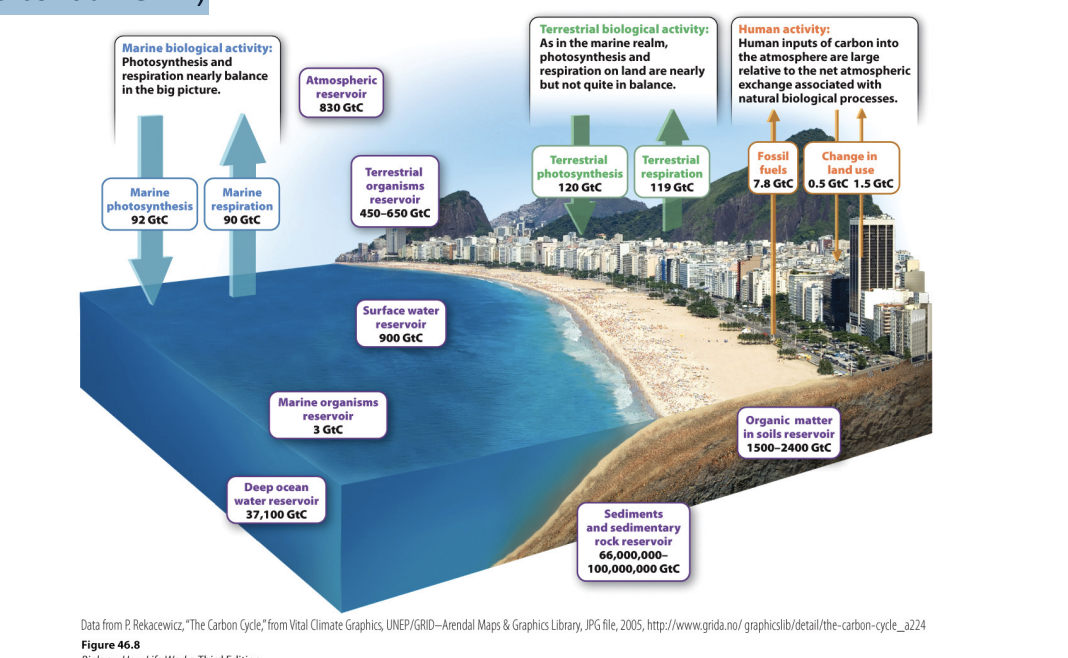
What are the major pools for the global carbon cycle?

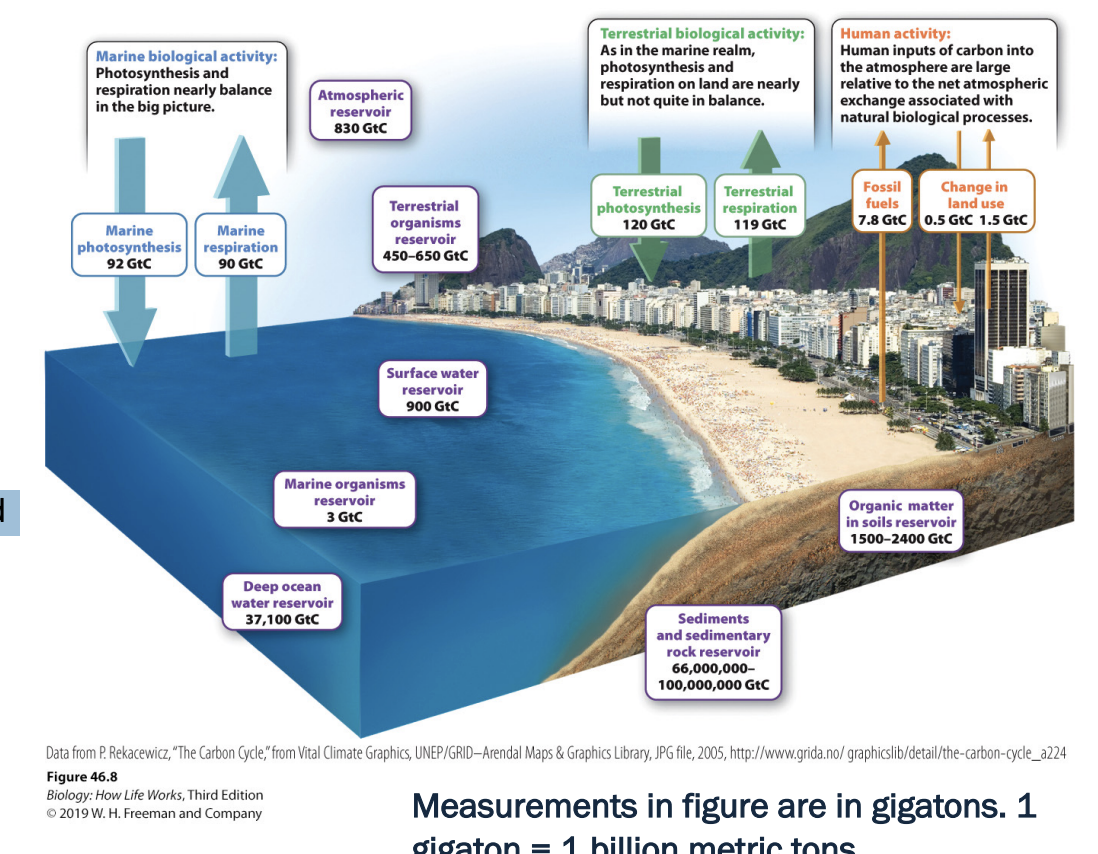
  • Major pools include atmosphere, oceans, land surface (soils and vegetation), sediments and rock

  • Sediments and rock → 99% of global C

    • largest pool, acts as carbon sink

  • Ocean and rock big reservoirs 

    • Most are in the atmosphere (atmospheric cycle – where most fluxes happen where it moves out and in) 

    • Once in pools -> could be there for a long time 
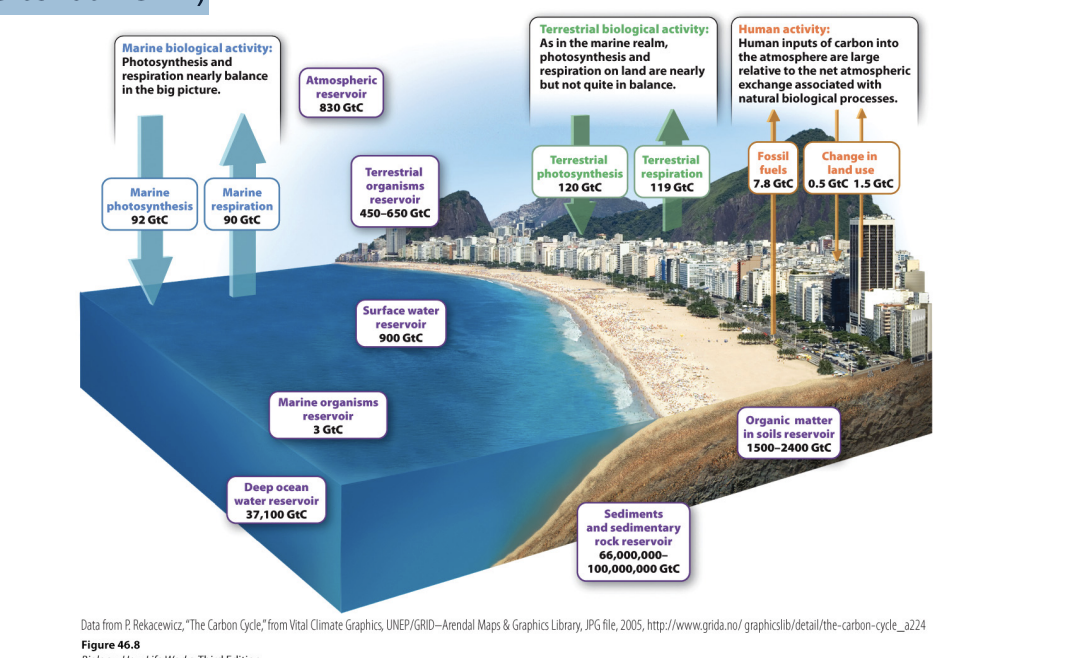
<ul><li><p>Major pools include atmosphere, oceans, land surface (soils and vegetation), sediments and rock</p></li><li><p>Sediments and rock → 99% of global C </p><ul><li><p>largest pool, acts as carbon sink</p></li></ul></li><li><p><span style="background-color: inherit; line-height: 19.55px; color: windowtext;">Ocean and rock big reservoirs</span><span style="line-height: 19.55px; color: windowtext;">&nbsp;</span></p><ul><li><p class="Paragraph SCXO111685323 BCX0" style="text-align: left;"><span style="background-color: inherit; line-height: 19.55px; color: windowtext;">Most are in the atmosphere (atmospheric cycle – where most fluxes happen where it moves out and in)</span><span style="line-height: 19.55px; color: windowtext;">&nbsp;</span></p></li><li><p class="Paragraph SCXO111685323 BCX0" style="text-align: left;"><span style="background-color: inherit; line-height: 19.55px; color: windowtext;">Once in pools -&gt; could be there for a long time</span><span style="line-height: 19.55px; color: windowtext;">&nbsp;</span></p></li></ul></li></ul><p></p>
11
New cards

What is the difference between human fluxes and natural carbon fluxes?

  • Orange: human fluxes and much smaller -> don’t move as much carbon as natural fluxes 

    • Uneven (only .5 out, more in atm) -> actions not in balance 

  • Atmosphere thorough living organism  (green arrow) = photo 

    • Return carbon to atmosphere: cellular resp 

    • 200 Gt moving in and out of atm 

    • Even each other out 

<ul><li><p><span style="background-color: inherit; line-height: 19.55px; color: windowtext;">Orange: human fluxes and much smaller -&gt; don’t move as much carbon as natural fluxes</span><span style="line-height: 19.55px; color: windowtext;">&nbsp;</span></p><ul><li><p class="Paragraph SCXO79881862 BCX0" style="text-align: left;"><span style="background-color: inherit; line-height: 19.55px; color: windowtext;">Uneven (only .5 out, more in atm) -&gt; actions not in balance</span><span style="line-height: 19.55px; color: windowtext;">&nbsp;</span></p></li></ul></li><li><p class="Paragraph SCXO79881862 BCX0" style="text-align: left;"><span style="background-color: inherit; line-height: 19.55px; color: windowtext;">Atmosphere thorough living organism&nbsp; (green arrow) = photo</span><span style="line-height: 19.55px; color: windowtext;">&nbsp;</span></p><ul><li><p class="Paragraph SCXO79881862 BCX0" style="text-align: left;"><span style="background-color: inherit; line-height: 19.55px; color: windowtext;">Return carbon to atmosphere: cellular resp</span><span style="line-height: 19.55px; color: windowtext;">&nbsp;</span></p></li><li><p class="Paragraph SCXO79881862 BCX0" style="text-align: left;"><span style="background-color: inherit; line-height: 19.55px; color: windowtext;">200 Gt moving in and out of atm</span><span style="line-height: 19.55px; color: windowtext;">&nbsp;</span></p></li><li><p class="Paragraph SCXO79881862 BCX0" style="text-align: left;"><span style="background-color: inherit; line-height: 19.55px; color: windowtext;">Even each other out</span><span style="line-height: 19.55px; color: windowtext;">&nbsp;</span></p></li></ul></li></ul><p></p>
12
New cards

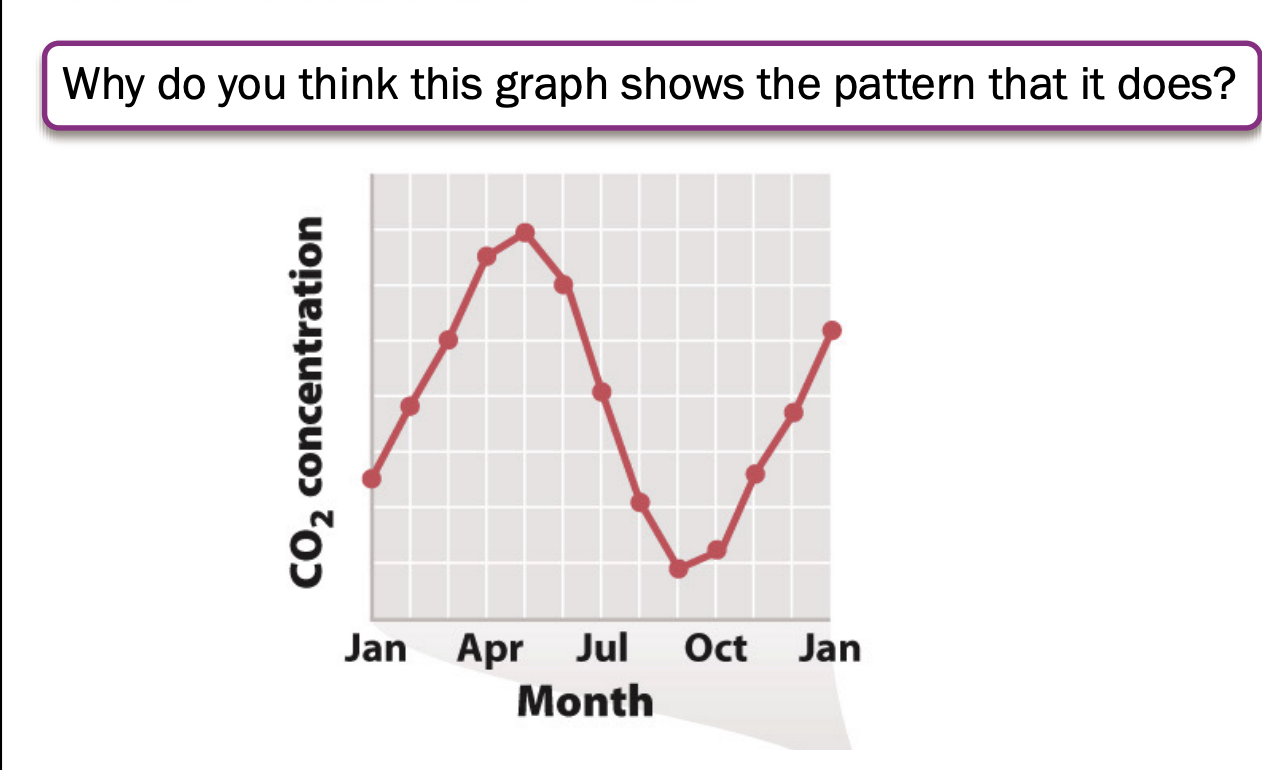
How does the carbon cycle change anually?

  • Record of atmospheric CO2 levels, as measured from Mauna Loa, Hawaii, from 1950s to 2010s

    • Above trees -> not getting atm averages from no local sources (houses etc) 

    • Inc in carbon in atm 

  • Annual pattern with seasonal oscillations

    • highest in early spring

    • lowest in early fall

  • 47 billion metric tons of CO2 enters and leaves atmosphere every year due to this annual pattern
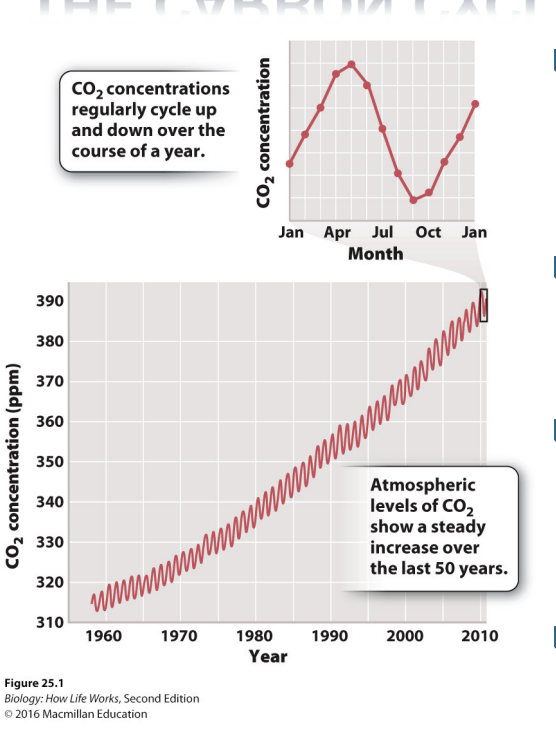
<ul><li><p>Record of atmospheric CO2 levels, as measured from Mauna Loa, Hawaii, from 1950s to 2010s</p><ul><li><p><span style="background-color: inherit; line-height: 19.55px; color: windowtext;">Above trees -&gt; not getting atm averages from no local sources (houses etc)</span><span style="line-height: 19.55px; color: windowtext;">&nbsp;</span></p></li><li><p class="Paragraph SCXO199161676 BCX0" style="text-align: left;"><span style="background-color: inherit; line-height: 19.55px; color: windowtext;">Inc in carbon in atm</span><span style="line-height: 19.55px; color: windowtext;">&nbsp;</span></p></li></ul></li><li><p>Annual pattern with seasonal oscillations</p><ul><li><p>highest in early spring</p></li><li><p>lowest in early fall</p></li></ul></li><li><p>47 billion metric tons of CO2 enters and leaves atmosphere every year due to this annual pattern</p></li></ul><p></p>
13
New cards

  • Respiration fairly constant, photo is not  

  • Atm high in april 

    • No leaves -> carbon increases 

  • Lowest in sept oct 

    • Trees active -> carbon levels decrease 

  • Matches northern hemisphere (where most land is found) -> cycle driven by big land plants 

    • Partly offset by southern hemi, but it has less land 

14
New cards

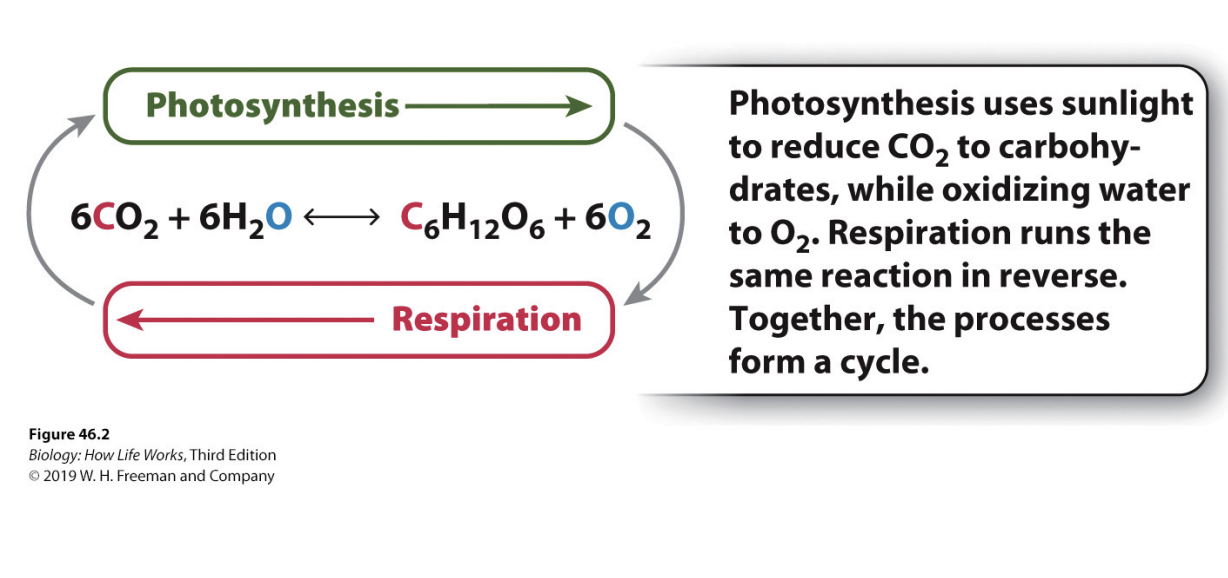
How is Photo and respiration related?

  • Photosynthesis and respiration typically equalize each other across year

    • same amount of CO2 taken out of atmosphere as enters it because of these processes

  • Photo: uses sunlight to reduce CO2 + oxidizing O2

  • Resp: same reaction in reverse

  • form cycle

<ul><li><p>Photosynthesis and respiration typically equalize each other across year </p><ul><li><p>same amount of CO2 taken out of atmosphere as enters it because of these processes</p></li></ul></li><li><p>Photo: uses sunlight to reduce CO2 + oxidizing O2</p></li><li><p>Resp: same reaction in reverse</p></li><li><p>form cycle</p></li></ul><p></p>
15
New cards

Where is more land?

  • There is more land in the north

  • More land in North with more seasonal tropical forests ->  
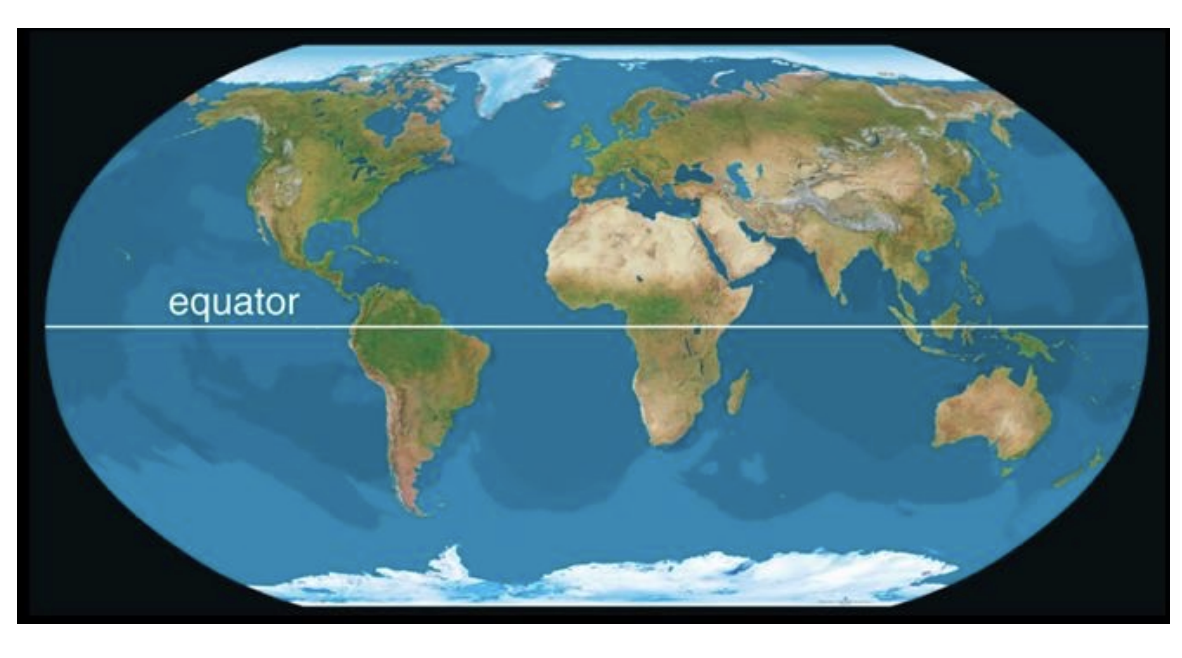
<ul><li><p>There is more land in the north</p></li><li><p><span style="background-color: inherit; line-height: 19.55px; color: windowtext;">More land in North with more seasonal tropical forests -&gt;&nbsp;</span><span style="line-height: 19.55px; color: windowtext;">&nbsp;</span></p></li></ul><p></p>
16
New cards

How has CO2 levels increased?

  • atmospheric CO2 levels increased by more than 30% in 60 yrs

  • If atmospheric CO2 levels have increased, then CO2 entering the atmosphere must exceed CO2 leaving it.
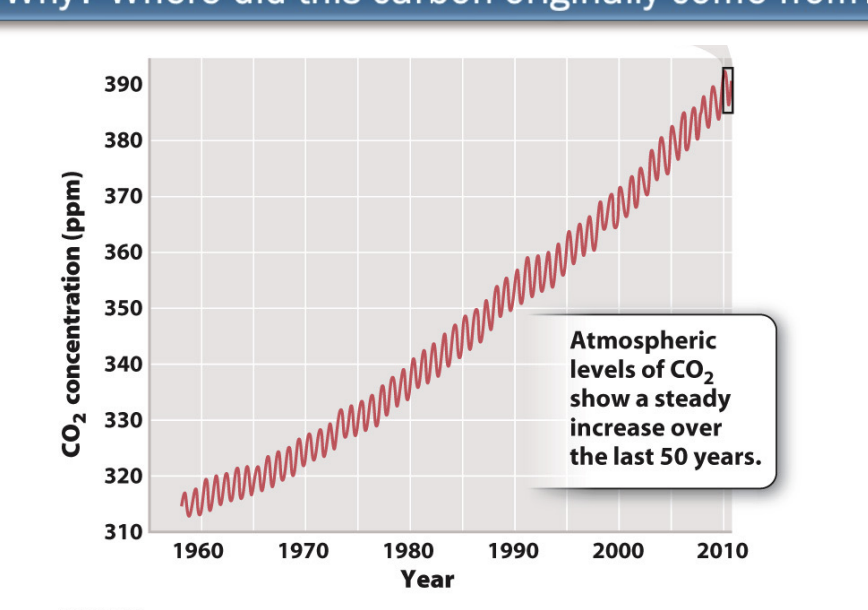
<ul><li><p>atmospheric CO2 levels increased by more than 30% in 60 yrs</p></li><li><p>If atmospheric CO2 levels have increased, then CO2 entering the atmosphere must exceed CO2 leaving it.</p></li></ul><p></p>
17
New cards

How does carbon dioxide enter the atmosphere?

  • Geological inputs (volcanoes, mid-ocean ridges)

    • Volcanic release methane, CO2 

  • MOR: hydrothermal vents 

  • Biological inputs

    • respiration

  • Anthropogenic inputs (burning fossil fuels, deforestation)

    • Burning fossil fuel and deforest 

      • Both contain carbon 

18
New cards

How does carbon dioxide leave the atmosphere?

  • Geological removal

    • chemical weathering → CO2 in rainwater reacts with exposed rocks

  • Biological removal

    • photosynthesis

19
New cards

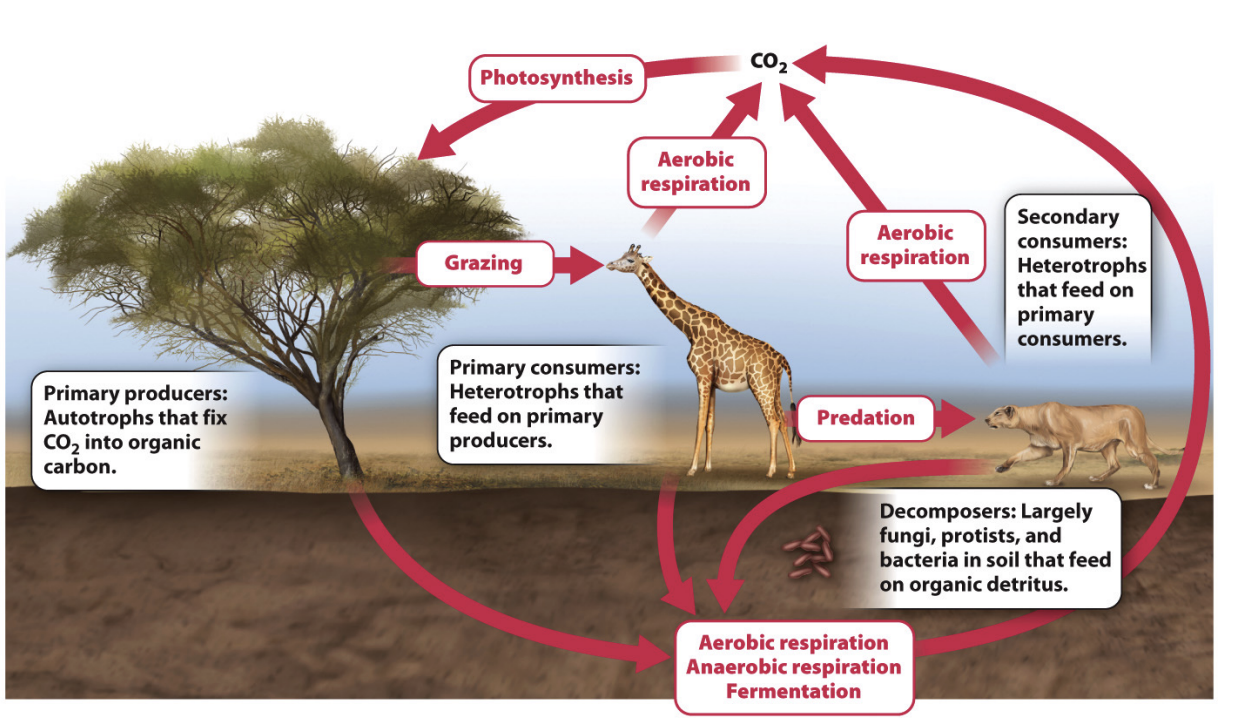
What is BIOLOGICAL INPUT/REMOVAL or the terrestrical carbon cycle?

  • CO2 in atm → photo → primary produces that fix CO2 into organic carbon → primary consumers feed on primary producer → secondary consumer

  • aerobic resp + anarobic resp from decomposers in soil that feed on organic detritus

  • Co2 comes out atm and goes back to atm 

  • Examples

    • Co2 -> plant -> decomp -> release to atm 

    • Co2 -> plant -> eaten -> poop or die -> decomp  

      • Giraffe breath it out 

    • Anything in soil gets decomp -> released back into atm 

    • Sometimes goes to sediments -> can stay for awhile 

    • In food webs release to atm 

<ul><li><p>CO2 in atm → photo → primary produces that fix CO2 into organic carbon → primary consumers feed on primary producer → secondary consumer</p></li><li><p>aerobic resp + anarobic resp from decomposers in soil that feed on organic detritus</p></li><li><p><span style="background-color: inherit; line-height: 19.55px; color: windowtext;">Co2 comes out atm and goes back to atm</span><span style="line-height: 19.55px; color: windowtext;">&nbsp;</span></p></li><li><p class="Paragraph SCXO205689843 BCX0" style="text-align: left;">Examples</p><ul><li><p class="Paragraph SCXO205689843 BCX0" style="text-align: left;"><span style="background-color: inherit; line-height: 19.55px; color: windowtext;">Co2 -&gt; plant -&gt; decomp -&gt; release to atm</span><span style="line-height: 19.55px; color: windowtext;">&nbsp;</span></p></li><li><p class="Paragraph SCXO205689843 BCX0" style="text-align: left;"><span style="background-color: inherit; line-height: 19.55px; color: windowtext;">Co2 -&gt; plant -&gt; eaten -&gt; poop or die -&gt; decomp&nbsp;</span><span style="line-height: 19.55px; color: windowtext;">&nbsp;</span></p><ul><li><p class="Paragraph SCXO205689843 BCX0" style="text-align: left;"><span style="background-color: inherit; line-height: 19.55px; color: windowtext;">Giraffe breath it out</span><span style="line-height: 19.55px; color: windowtext;">&nbsp;</span></p></li></ul></li><li><p class="Paragraph SCXO205689843 BCX0" style="text-align: left;"><span style="background-color: inherit; line-height: 19.55px; color: windowtext;">Anything in soil gets decomp -&gt; released back into atm</span><span style="line-height: 19.55px; color: windowtext;">&nbsp;</span></p></li><li><p class="Paragraph SCXO205689843 BCX0" style="text-align: left;"><span style="background-color: inherit; line-height: 19.55px; color: windowtext;">Sometimes goes to sediments -&gt; can stay for awhile</span><span style="line-height: 19.55px; color: windowtext;">&nbsp;</span></p></li><li><p class="Paragraph SCXO205689843 BCX0" style="text-align: left;"><span style="background-color: inherit; line-height: 19.55px; color: windowtext;">In food webs release to atm</span><span style="line-height: 19.55px; color: windowtext;">&nbsp;</span></p></li></ul></li></ul><p></p>
20
New cards

What is the biological input and removal marine carbon cycle?

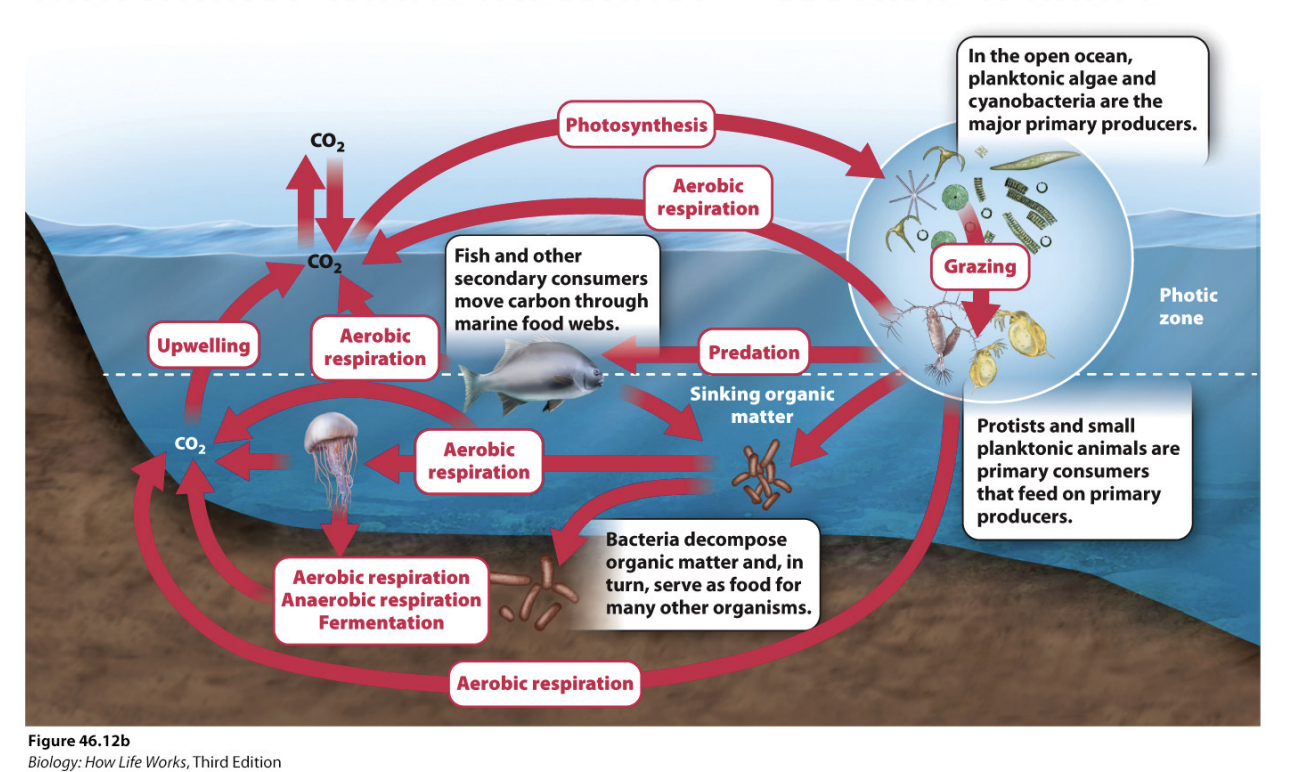
  • Open ocean: planktonic algae and cyanobacteria are major primary producers → protists and small planktonic animals are primary consumers that feed on primary producers → fisher and other secondary consumers more carbon through food webs → bacteria decompose organic matter and →. serves as food for other organisms

  • Lose it to ocean sediments 

    • Deeper oceans where its colder in form of organic matter or methane -> methane can freeze -> stays there 

    • Get into sediments as carbon -> come back through food webs from upwelling -> move btwn water and atm 

      • Carbon stored as acid in water 

<ul><li><p>Open ocean: planktonic algae and cyanobacteria are major primary producers → protists and small planktonic animals are primary consumers that feed on primary producers → fisher and other secondary consumers more carbon through food webs → bacteria decompose organic matter and →. serves as food for other organisms</p></li><li><p><span style="background-color: inherit; line-height: 19.55px; color: windowtext;">Lose it to ocean sediments</span><span style="line-height: 19.55px; color: windowtext;">&nbsp;</span></p><ul><li><p class="Paragraph SCXO70423486 BCX0" style="text-align: left;"><span style="background-color: inherit; line-height: 19.55px; color: windowtext;">Deeper oceans where its colder in form of organic matter or methane -&gt; methane can freeze -&gt; stays there</span><span style="line-height: 19.55px; color: windowtext;">&nbsp;</span></p></li><li><p class="Paragraph SCXO70423486 BCX0" style="text-align: left;"><span style="background-color: inherit; line-height: 19.55px; color: windowtext;">Get into sediments as carbon -&gt; come back through food webs from upwelling -&gt; move btwn water and atm</span><span style="line-height: 19.55px; color: windowtext;">&nbsp;</span></p><ul><li><p class="Paragraph SCXO186007450 BCX0" style="text-align: left;"><span style="background-color: inherit; line-height: 19.55px; color: windowtext;">Carbon stored as acid in water</span><span style="line-height: 19.55px; color: windowtext;">&nbsp;</span></p></li></ul></li></ul></li></ul><p></p>
21
New cards

What can happen with warming temperatures in the ocean?

  • Lose it to ocean sediments 

    • Deeper oceans where its colder in form of organic matter or methane -> methane can freeze -> stays there 

    • Great dying (shut down of gulf): world gets hot -> ocean gets hot -> methane becomes gaseous methane -> greenhouse gas -> even more warming  

      • Worst mass extinction event we know of 

22
New cards

Is the increase in CO2 unusual?

  • Co2 levels change over time 

  • Glacial ice as it forms → traps air bubble → ice can last for thousands of years → examine ice cores to find out what the atmosphere was like in the past.

    • High: greenhouse conditions 

    • Low: ice house (where we are) 

      • Holes that are frozen -> dig in ice caps (ice forms anually and layers) -> look for air pockets -> graph 

  • Graph 

    • Large increase from 1950 

    • Something changes 1700s-1900s: humans started using fossil fuels 
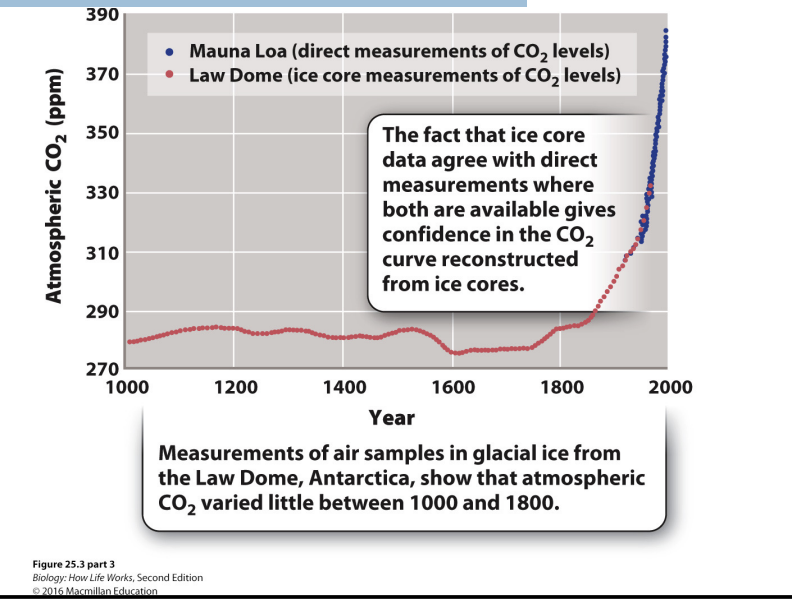
<ul><li><p><span style="background-color: inherit; line-height: 19.55px; color: windowtext;">Co2 levels change over time</span><span style="line-height: 19.55px; color: windowtext;">&nbsp;</span></p></li><li><p>Glacial ice as it forms → traps air bubble →  ice can last for thousands of years → examine ice cores to find out what the atmosphere was like in the past.</p><ul><li><p class="Paragraph SCXO182455815 BCX0" style="text-align: left;"><span style="background-color: inherit; line-height: 19.55px; color: windowtext;">High: greenhouse conditions</span><span style="line-height: 19.55px; color: windowtext;">&nbsp;</span></p></li><li><p class="Paragraph SCXO182455815 BCX0" style="text-align: left;"><span style="background-color: inherit; line-height: 19.55px; color: windowtext;">Low: ice house (where we are)</span><span style="line-height: 19.55px; color: windowtext;">&nbsp;</span></p><ul><li><p class="Paragraph SCXO182455815 BCX0" style="text-align: left;"><span style="background-color: inherit; line-height: 19.55px; color: windowtext;">Holes that are frozen -&gt; dig in ice caps (ice forms anually and layers) -&gt; look for air pockets -&gt; graph</span><span style="line-height: 19.55px; color: windowtext;">&nbsp;</span></p></li></ul></li></ul></li><li><p class="Paragraph SCXO182455815 BCX0" style="text-align: left;"><span style="background-color: inherit; line-height: 19.55px; color: windowtext;">Graph</span><span style="line-height: 19.55px; color: windowtext;">&nbsp;</span></p><ul><li><p class="Paragraph SCXO182455815 BCX0" style="text-align: left;"><span style="background-color: inherit; line-height: 19.55px; color: windowtext;">Large increase from 1950</span><span style="line-height: 19.55px; color: windowtext;">&nbsp;</span></p></li><li><p class="Paragraph SCXO182455815 BCX0" style="text-align: left;"><span style="background-color: inherit; line-height: 19.55px; color: windowtext;">Something changes 1700s-1900s: humans started using fossil fuels</span><span style="line-height: 19.55px; color: windowtext;">&nbsp;</span></p></li></ul></li></ul><p></p>
23
New cards

What are the isotopes of carbon?

  • 12C - 99% of all carbon

  • 13C - ~1% of all carbon atoms

  • 14C - 1 ppt (part per trillion) of all atmospheric C

    • unstable → decays to 14N

24
New cards

Was this increase in CO2 from human activities?

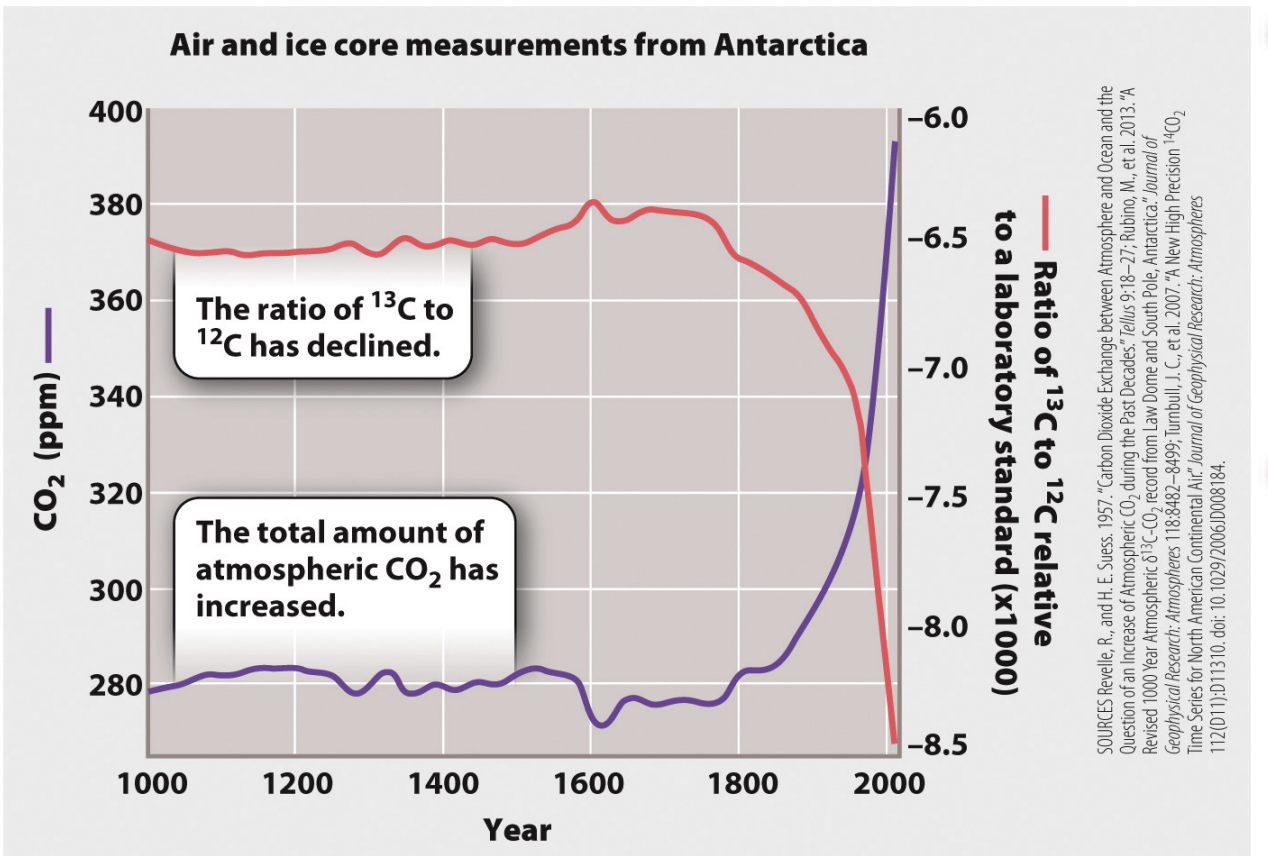
  • Atmospheric carbon levels have increased, but the ratio of 13C to 12C has declined.

  • Source of excess carbon is 13C depleted compared to carbon originally in the atmosphere

  • Match concentration to source 

  • C14 is not stable -> radiodecays (use for carbon dating) 

    • Die -> stop taking in C14 -> decays 

  • Blue line: carbon levels have inc 

  • Red line: source that is 13C depleted 

    • 12/13 ratio has decreased over tie -> doesn't match atm 

  • Summary

    • Atmospheric CO2 increasing, but natural ratio of 13C/12C ratio is declining (can’t use 14C because it decays) is decreasing → CO2 must be coming from another source
<ul><li><p>Atmospheric carbon levels have increased, but the ratio of 13C to 12C has declined.</p></li><li><p>Source of excess carbon is 13C depleted compared to carbon originally in the atmosphere</p></li><li><p><span style="background-color: inherit; line-height: 19.55px; color: windowtext;">Match concentration to source</span><span style="line-height: 19.55px; color: windowtext;">&nbsp;</span></p></li><li><p class="Paragraph SCXO66956590 BCX0" style="text-align: left;"><span style="background-color: inherit; line-height: 19.55px; color: windowtext;">C14 is not stable -&gt; radiodecays (use for carbon dating)</span><span style="line-height: 19.55px; color: windowtext;">&nbsp;</span></p><ul><li><p class="Paragraph SCXO66956590 BCX0" style="text-align: left;"><span style="background-color: inherit; line-height: 19.55px; color: windowtext;">Die -&gt; stop taking in C14 -&gt; decays</span><span style="line-height: 19.55px; color: windowtext;">&nbsp;</span></p></li></ul></li><li><p class="Paragraph SCXO66956590 BCX0" style="text-align: left;"><span style="background-color: inherit; line-height: 19.55px; color: windowtext;">Blue line: carbon levels have inc</span><span style="line-height: 19.55px; color: windowtext;">&nbsp;</span></p></li><li><p class="Paragraph SCXO66956590 BCX0" style="text-align: left;"><span style="background-color: inherit; line-height: 19.55px; color: windowtext;">Red line: source that is 13C depleted</span><span style="line-height: 19.55px; color: windowtext;">&nbsp;</span></p><ul><li><p class="Paragraph SCXO66956590 BCX0" style="text-align: left;"><span style="background-color: inherit; line-height: 19.55px; color: windowtext;">12/13 ratio has decreased over tie -&gt; doesn't match atm</span><span style="line-height: 19.55px; color: windowtext;">&nbsp;</span></p></li></ul></li><li><p class="Paragraph SCXO66956590 BCX0" style="text-align: left;">Summary</p><ul><li><p class="Paragraph SCXO66956590 BCX0" style="text-align: left;">Atmospheric CO2 increasing, but natural ratio of 13C/12C ratio is declining (can’t use 14C because it decays) is decreasing → CO2 must be coming from another source</p></li></ul></li></ul><p></p>
25
New cards

How is carbon used in plants?

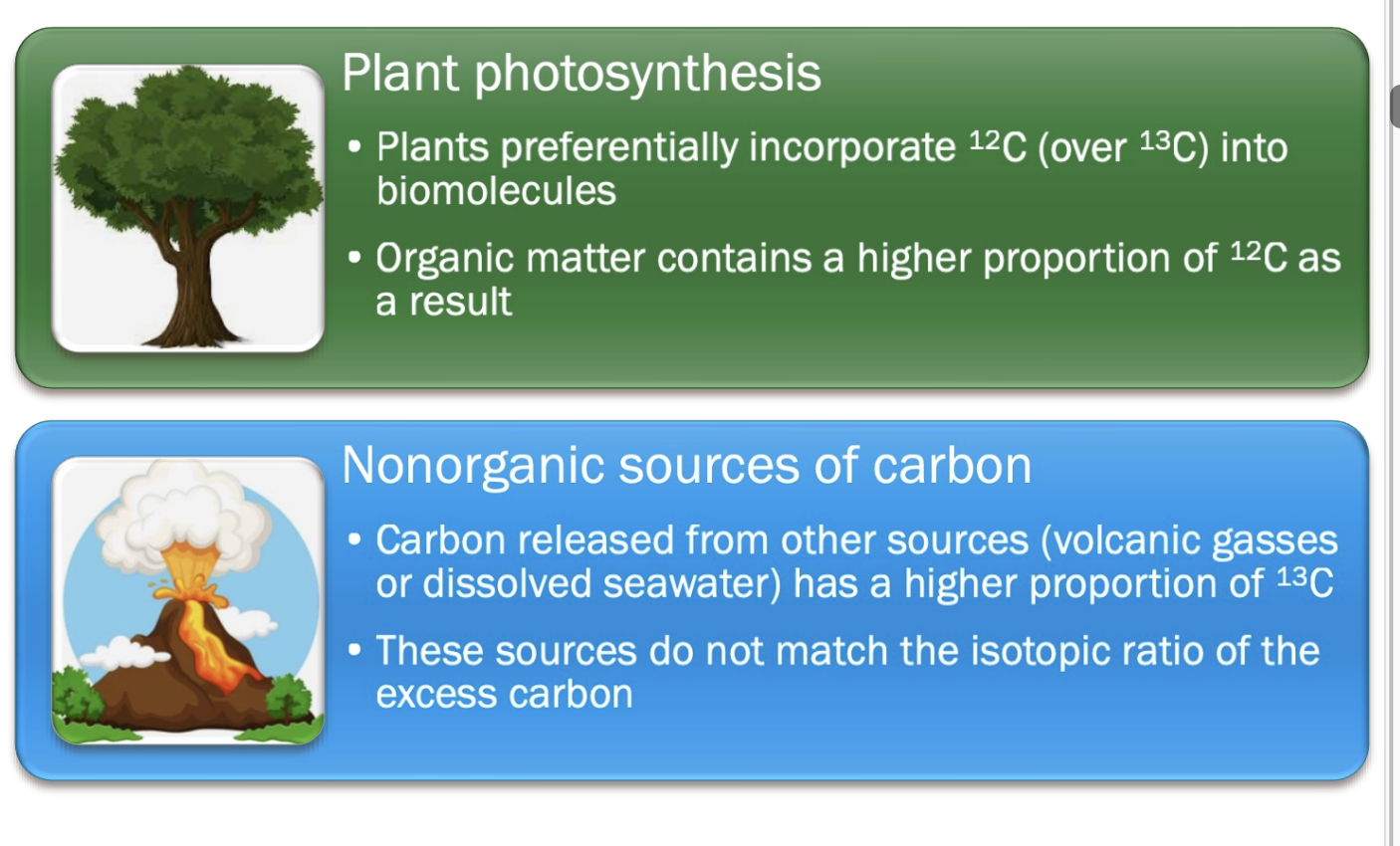
  • plants preferentially incorporate 12C (over 13C) into biomolecules

  • Organic matter contains a higher proportion of 12C as a result

  • Plants 13/12 ratio differ from atm 

    • Less 13 than expected from the ratio in atm 

26
New cards

What kind of carbon is found in nonorganic sources?

  • carbon released from other sources (volcanic gasses or dissolved seawater) has higher proportion of 13C

  • sources do not match the isotopic ratio of excess carbon

    • too little 13 C in atm

<ul><li><p>carbon released from other sources (volcanic gasses or dissolved seawater) has higher proportion of 13C</p></li><li><p>sources do not match the isotopic ratio of excess carbon</p><ul><li><p>too little 13 C in atm</p></li></ul></li></ul><p></p>
27
New cards

What does the mismatch in inorganic carbon sources mean?

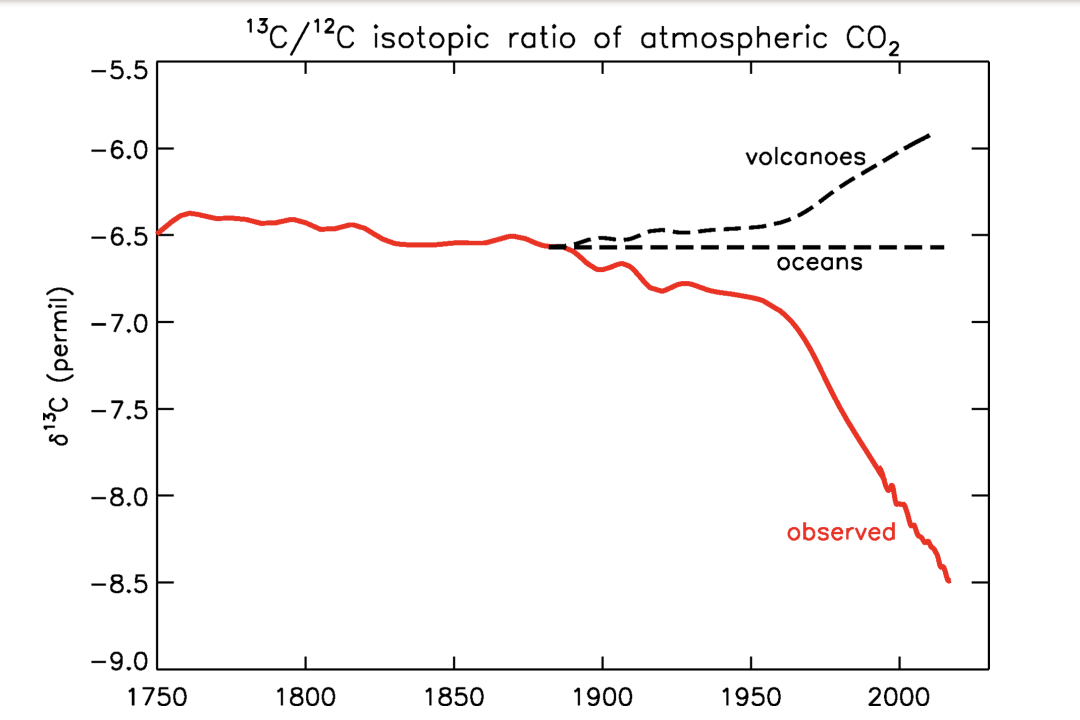
  • neither volcanic gases nor dissolved ocean waters have 13C/12C rations that mach the increase in atm carbon

  • If came from volcanoes or upwelling etc -> 13/12 ratio should inc 

    • More 13 in atm  

    • Doesn't match  

  • Line matches plants 

    • Plants alive today 

    • Plants that died in carboniferous -> fossil fuels 
<ul><li><p>neither volcanic gases nor dissolved ocean waters have 13C/12C rations that mach the increase in atm carbon</p></li><li><p><span style="background-color: inherit; line-height: 19.55px; color: windowtext;">If came from volcanoes or upwelling etc -&gt; 13/12 ratio should inc</span><span style="line-height: 19.55px; color: windowtext;">&nbsp;</span></p><ul><li><p class="Paragraph SCXO28036237 BCX0" style="text-align: left;"><span style="background-color: inherit; line-height: 19.55px; color: windowtext;">More 13 in atm&nbsp;</span><span style="line-height: 19.55px; color: windowtext;">&nbsp;</span></p></li><li><p class="Paragraph SCXO28036237 BCX0" style="text-align: left;"><span style="background-color: inherit; line-height: 19.55px; color: windowtext;">Doesn't match&nbsp;</span><span style="line-height: 19.55px; color: windowtext;">&nbsp;</span></p></li></ul></li><li><p class="Paragraph SCXO28036237 BCX0" style="text-align: left;"><span style="background-color: inherit; line-height: 19.55px; color: windowtext;">Line matches plants</span><span style="line-height: 19.55px; color: windowtext;">&nbsp;</span></p><ul><li><p class="Paragraph SCXO28036237 BCX0" style="text-align: left;"><span style="background-color: inherit; line-height: 19.55px; color: windowtext;">Plants alive today</span><span style="line-height: 19.55px; color: windowtext;">&nbsp;</span></p></li><li><p class="Paragraph SCXO28036237 BCX0" style="text-align: left;"><span style="background-color: inherit; line-height: 19.55px; color: windowtext;">Plants that died in carboniferous -&gt; fossil fuels</span><span style="line-height: 19.55px; color: windowtext;">&nbsp;</span></p></li></ul></li></ul><p></p>
28
New cards

What can 14C be used for?

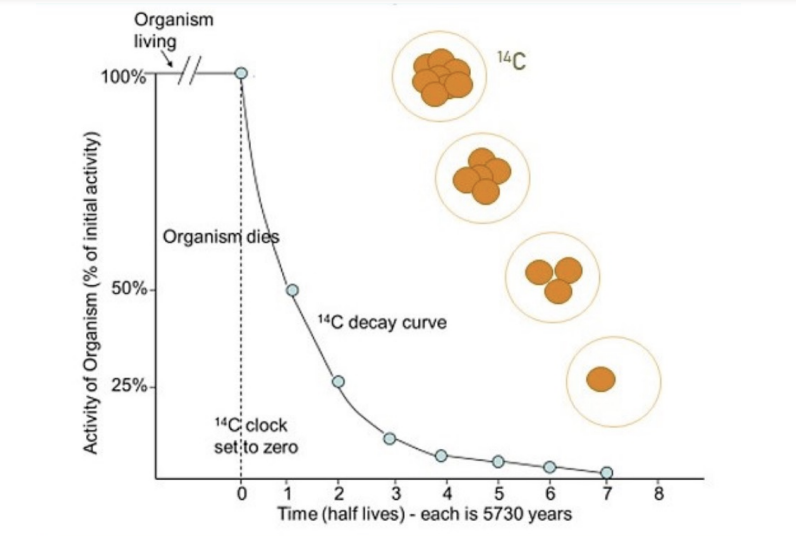
  • living organisms continually incorporate 14C into their bodies throughout life

  • 14C decays to other forms of carbon

  • organism dies → amnt of 14C in body decays over time → radiocarbon date fossils

  • 14C ratio 

  • Comes from source that 14C depleted -> old plants 

    • Land just started to colonize -> fell in hypoxic bogs -> turned into fossil fuels 
<ul><li><p>living organisms continually incorporate 14C into their bodies throughout life</p></li><li><p>14C decays to other forms of carbon </p></li><li><p>organism dies → amnt of 14C in body decays over time → radiocarbon date fossils</p></li><li><p><span style="background-color: inherit; line-height: 19.55px; color: windowtext;">14C ratio</span><span style="line-height: 19.55px; color: windowtext;">&nbsp;</span></p></li><li><p class="Paragraph SCXO213129526 BCX0" style="text-align: left;"><span style="background-color: inherit; line-height: 19.55px; color: windowtext;">Comes from source that 14C depleted -&gt; old plants</span><span style="line-height: 19.55px; color: windowtext;">&nbsp;</span></p><ul><li><p class="Paragraph SCXO213129526 BCX0" style="text-align: left;"><span style="background-color: inherit; line-height: 19.55px; color: windowtext;">Land just started to colonize -&gt; fell in hypoxic bogs -&gt; turned into fossil fuels</span><span style="line-height: 19.55px; color: windowtext;">&nbsp;</span></p></li></ul></li></ul><p></p>
29
New cards

Is this source modern or from fossil fuels?

  • Additional studies showed that carbon entering in the atmosphere was 14C-depleted → modern plant vegetation contains too much 14C to be the source

  • Ancient organic matter (coal, petroleum, natural gasses) → isotopically similar to carbon entering atmosphere

  • Inc in Co2 is b/c of burning of fossil fuels 

    • Also from deforestation, but lesser 

  • Carbon in atm is anthro 

30
New cards

How much carbon pollution do humans create?

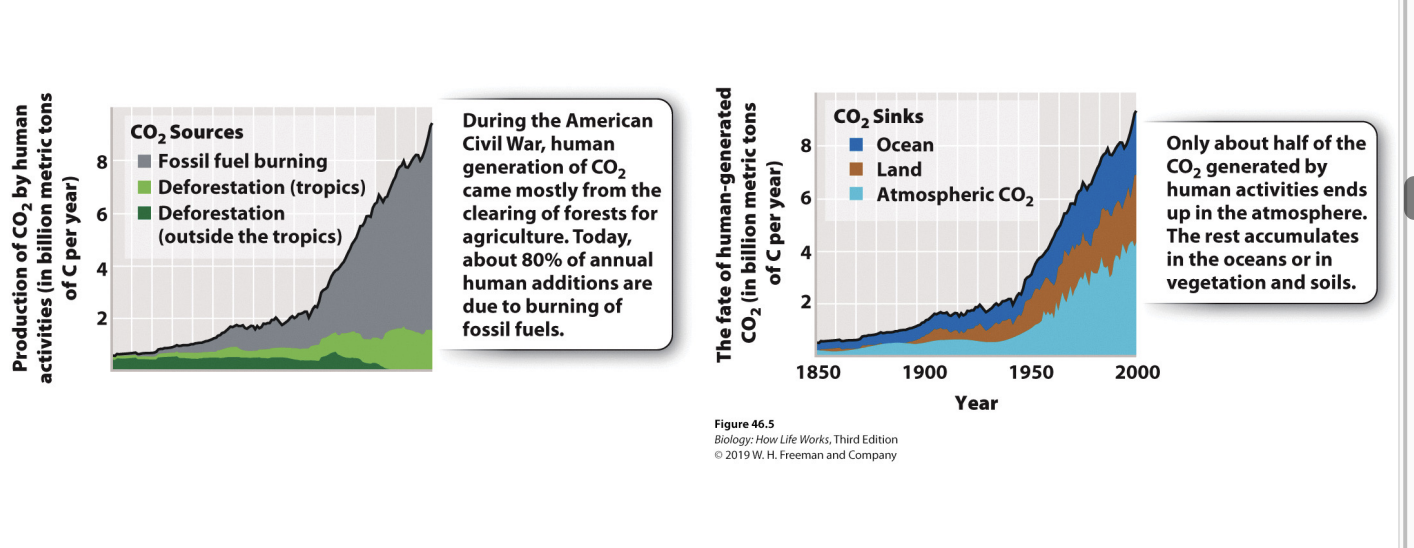
  • HUMANS PRODUCE 9 GIGATONS (1 billion metric tons0 OF CARBON POLLUTION ANNUALLY

  • Photosynthesis and respiration move far more carbon in/out of atmosphere annually than we do

  • However, our flux is largely unidirectional, and photosynthesis and respiration generally offset each other

    • don’t move as much carbon in and out as others -> humans largely unidirectional 

    • Burning fossil fuels in biggest cause 

<ul><li><p>HUMANS PRODUCE 9 GIGATONS (1 billion metric tons0 OF CARBON POLLUTION ANNUALLY</p></li><li><p>Photosynthesis and respiration move far more carbon in/out of atmosphere annually than we do</p></li><li><p>However, our flux is largely unidirectional, and photosynthesis and respiration generally offset each other</p><ul><li><p><span style="background-color: inherit; line-height: 19.55px; color: windowtext;">don’t move as much carbon in and out as others -&gt; humans largely unidirectional</span><span style="line-height: 19.55px; color: windowtext;">&nbsp;</span></p></li><li><p><span style="background-color: inherit; line-height: 19.55px; color: windowtext;">Burning fossil fuels in biggest cause</span><span style="line-height: 19.55px; color: windowtext;">&nbsp;</span></p></li></ul></li></ul><p></p>
31
New cards

What anthro activities that add carbon?

  • ~20% à land use changes (deforestation, agriculture)

  • ~80% à burning fossil fuels

  • Not all ending in atm -> carbon stored in ocean water (deep oceans) -> eventually rise to surface and released into atm 

    • Carbon come out of ocean eventually 

<ul><li><p>~20% à land use changes (deforestation, agriculture) </p></li><li><p>~80% à burning fossil fuels</p></li><li><p><span style="background-color: inherit; line-height: 19.55px; color: windowtext;">Not all ending in atm -&gt; carbon stored in ocean water (deep oceans) -&gt; eventually rise to surface and released into atm</span><span style="line-height: 19.55px; color: windowtext;">&nbsp;</span></p><ul><li><p class="Paragraph SCXO37624524 BCX0" style="text-align: left;"><span style="background-color: inherit; line-height: 19.55px; color: windowtext;">Carbon come out of ocean eventually</span><span style="line-height: 19.55px; color: windowtext;">&nbsp;</span></p></li></ul></li></ul><p></p>
32
New cards

What is the nitrogen cycle related to?

  • This cycle is closely linked to the carbon-cycle because nitrogen is a critical component of amino acids, nucleic acids, membranes

33
New cards

What is the largest N2 pool?

  • The largest nitrogen pool is N2 gas

    • form not usable by most living organisms

      • usable by chemoautotrophs

34
New cards

What is nitrogen fixation?

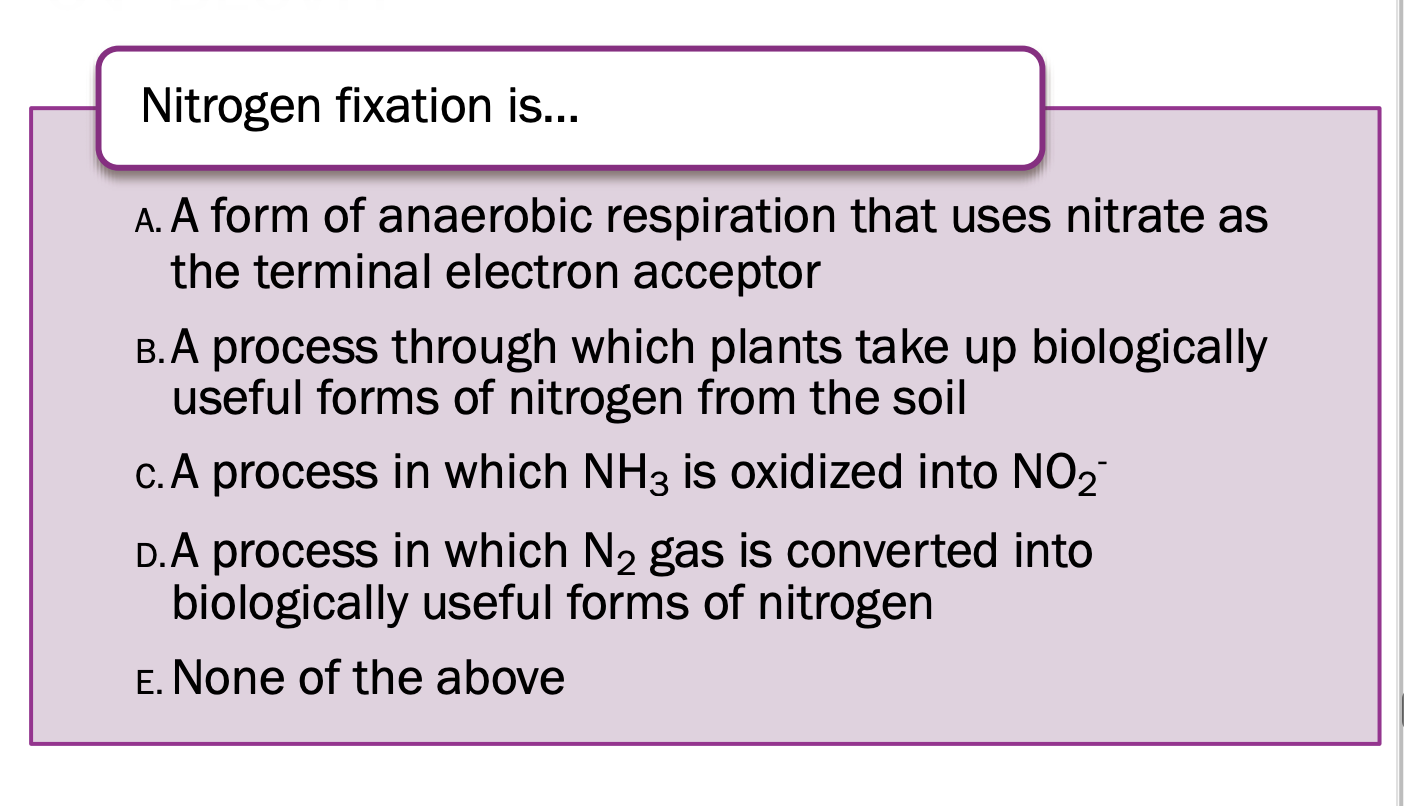
  • process by which some bacteria and archaea reduce N2 gas to biologically useful NH3

    • this is how nitrogen enters food webs

  • N2 taken out of atm into ammonium  

35
New cards

What is assimilation?

  • process by which primary producers obtain biologically useful nitrogen from surroundings (NO3 - or NH3)

  • take useful forms of nitrogen from soil or mutualistic that gets it from soil

36
New cards

What is denitrification?

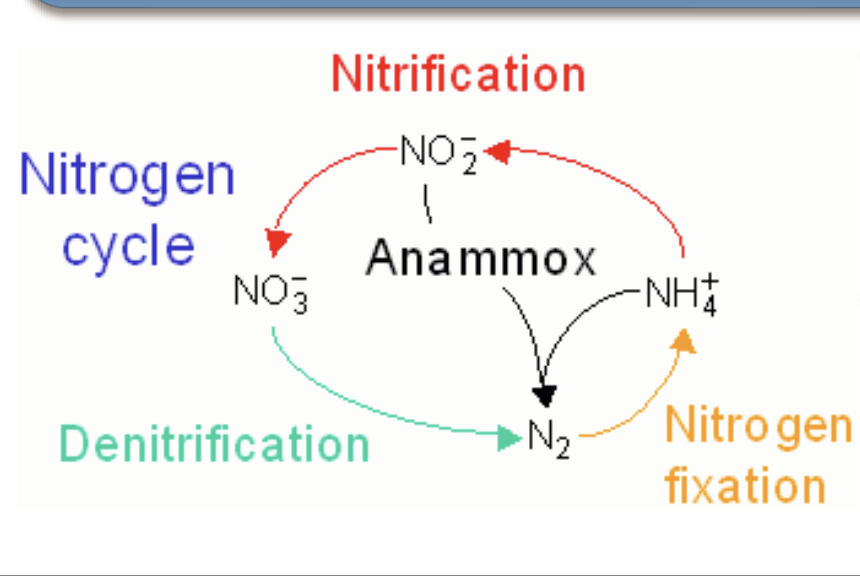
  • a form of anaerobic respiration in which NO3 - is terminal electron acceptor

  • N in form of higher energy to lower energy 
<ul><li><p>a form of anaerobic respiration in which NO3 - is terminal electron acceptor</p></li><li><p><span style="background-color: inherit; line-height: 19.55px; color: windowtext;">N in form of higher energy to lower energy</span><span style="line-height: 19.55px; color: windowtext;">&nbsp;</span></p></li></ul><p></p>
37
New cards

What is nitrification?

  • a process in which NH3 or NO2 - are oxidized to generate energy
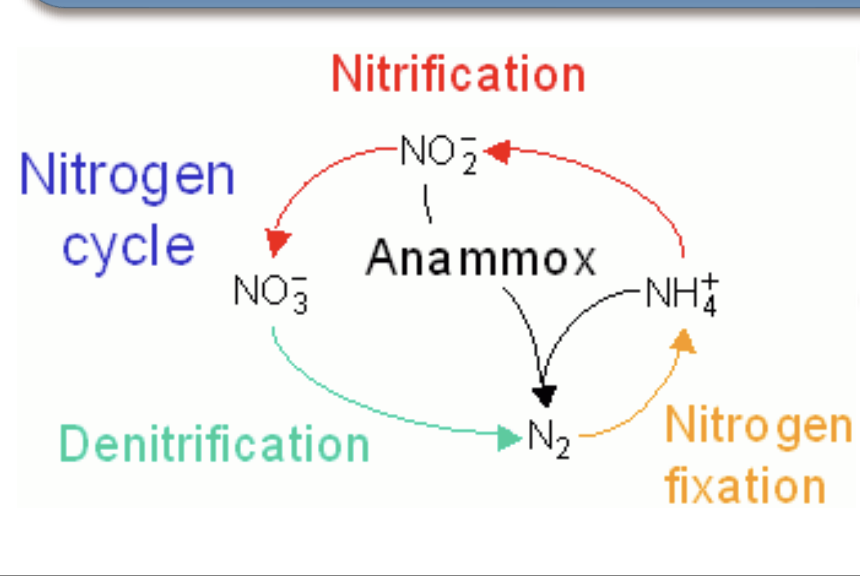
<ul><li><p>a process in which NH3 or NO2 - are oxidized to generate energy</p></li></ul><p></p>
38
New cards

Why does nitrogen need to be fixed?

  • hemoautotrophic bacteria and arachaeons use NO3 - or NH3 to generate energy → releasing N2 gas as biproduct.

  • This causes biologically useful forms of nitrogen to decrease in the soil.

  • To obtain more, nitrogen fixers convert N2 gas into more NO3 - or NH3

  • Essentially, they do it because this is how they generate their own energy.

39
New cards

What is anamox?

  • Driven by chemoautotrophs to generate energy -> take it and go back to N2 gas 

    • Other organisms take before they can get to it 
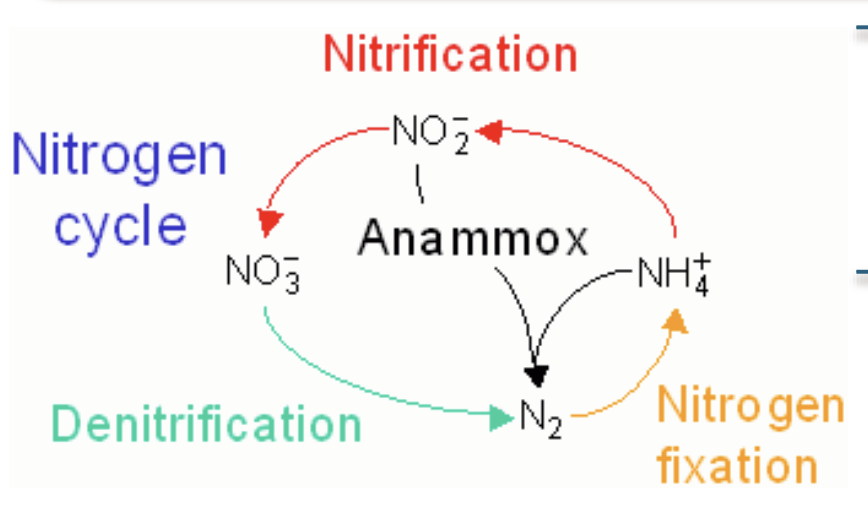
<ul><li><p><span style="background-color: inherit; line-height: 19.55px; color: windowtext;">Driven by chemoautotrophs to generate energy -&gt; take it and go back to N2 gas</span><span style="line-height: 19.55px; color: windowtext;">&nbsp;</span></p><ul><li><p class="Paragraph SCXO236967936 BCX0" style="text-align: left;"><span style="background-color: inherit; line-height: 19.55px; color: windowtext;">Other organisms take before they can get to it</span><span style="line-height: 19.55px; color: windowtext;">&nbsp;</span></p></li></ul></li></ul><p></p>
40
New cards

What is the nitrogen cycle?

  • Plants -> organisms -> back into soil (plants use ammonia) -> return to atm 

  • Nitrogen fixation converts N2 → form that can be used by plants

  • primary producers assimilate biologically usable N from soil or symbiotic N- fixing bacteria

  • consumers obtain N from their food

  • decomposer return N to soil as ammonia

  • in Anoxic envi. some decomposing bacteria use NO3 - in resp → denitficiation (converts biological usable N back to N2)

  • Chemoautotrophic bacteria gain the energy needed to fix carbon by oxidizing NH3 using O2 (nitrificatoin) or NO2- (anammox)
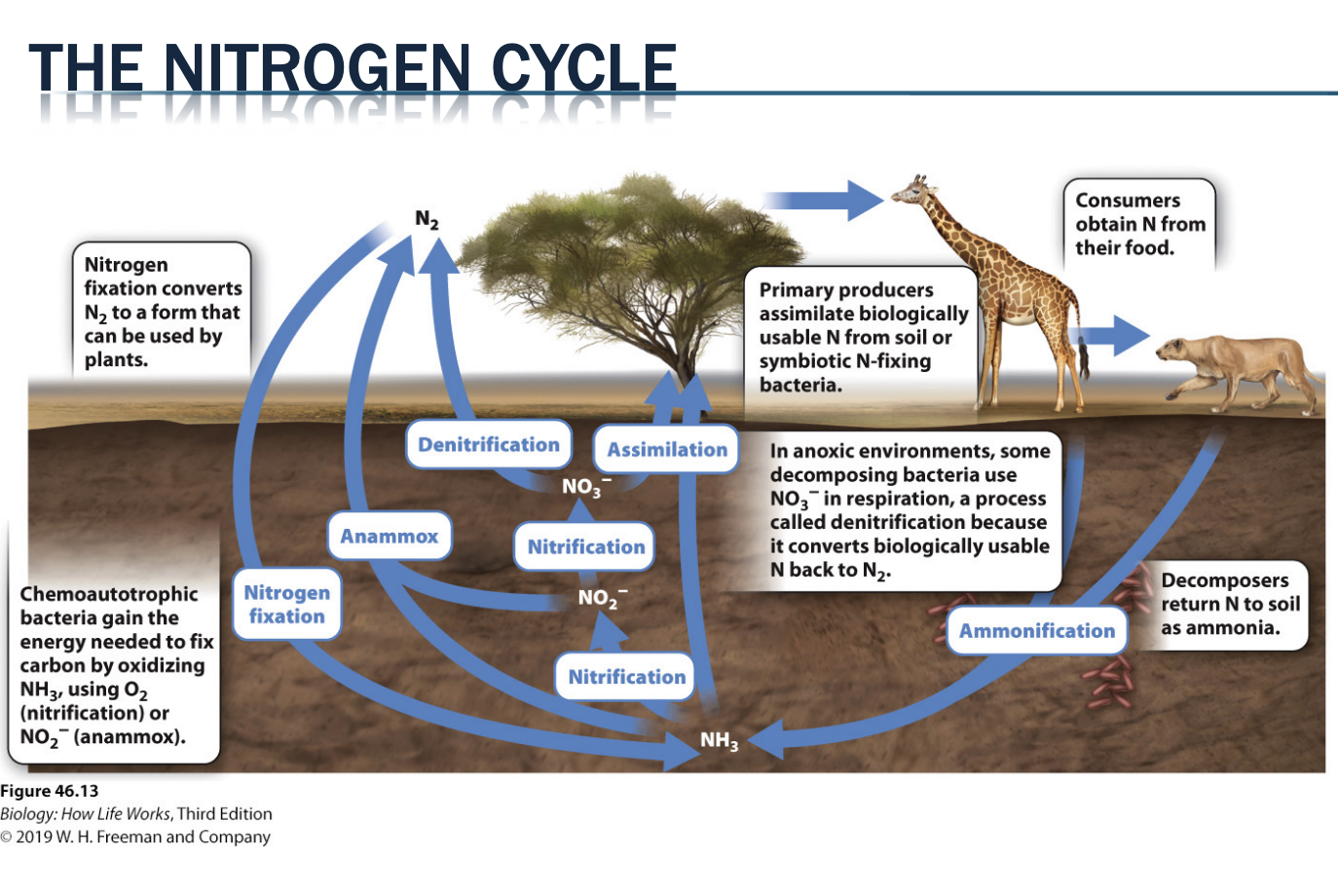
<ul><li><p><span style="background-color: inherit; line-height: 19.55px; color: windowtext;">Plants -&gt; organisms -&gt; back into soil (plants use ammonia) -&gt; return to atm</span><span style="line-height: 19.55px; color: windowtext;">&nbsp;</span></p></li><li><p><span style="line-height: 19.55px; color: windowtext;">Nitrogen fixation converts N2 → form that can be used by plants</span></p></li><li><p><span style="line-height: 19.55px; color: windowtext;">primary producers assimilate biologically usable N from soil or symbiotic N- fixing bacteria</span></p></li><li><p><span style="line-height: 19.55px; color: windowtext;">consumers obtain N from their food</span></p></li><li><p><span style="line-height: 19.55px; color: windowtext;">decomposer return N to soil as ammonia</span></p></li><li><p><span style="line-height: 19.55px; color: windowtext;">in Anoxic envi. some decomposing bacteria use NO3 - in resp → denitficiation (converts biological usable N back to N2)</span></p></li><li><p><span style="line-height: 19.55px; color: windowtext;">Chemoautotrophic bacteria gain the energy needed to fix carbon by oxidizing NH3 using O2 (nitrificatoin) or NO2- (anammox)</span></p></li></ul><p></p>
41
New cards

How do plants get nitrogen?

  • biologically useful forms of N can be in low supply, especially in young soils

  • plants can trade carbs with mutualists to obtain organic forms of the N they require

    • Lots of systems are nitrogen limited because most are in a form only chemotropic organism can use 

      • Very young soils are nitrogen limited b/c they don't have the organisms 

        • Form mutualists with chemoauthropic organisms 

      • Already source of nitrogen -> convince mutualist (fungi) to get it  

        • Soil releases carbohydrates into soil -> fungi hyphae grow towards carbs -> form mutualistic relation 

  • Mutualists: can provide to N plants

    • Rhizobium bacteria

    • Ectomycorrhizae

42
New cards

What is the Rhizosphere?

  • soil layer surrounding actively growing roots, receives carbohydrates from plants to stimulate growth of soil microbial mutualists

43
New cards

What are Rhizobium bacteria?

  • nitrogen-fixers that exchange organically useful forms of N for carbohydrates

44
New cards

What is Ectomycorrhizae?

  • fungi that exchange water and nitrogen (obtained from soil) for carbohydrates

  • already have nitrogen -> fungi move it toward plant 

    • Can protect plant form pathogens 

45
New cards

How does mutualism with rhizobial bacteria work?

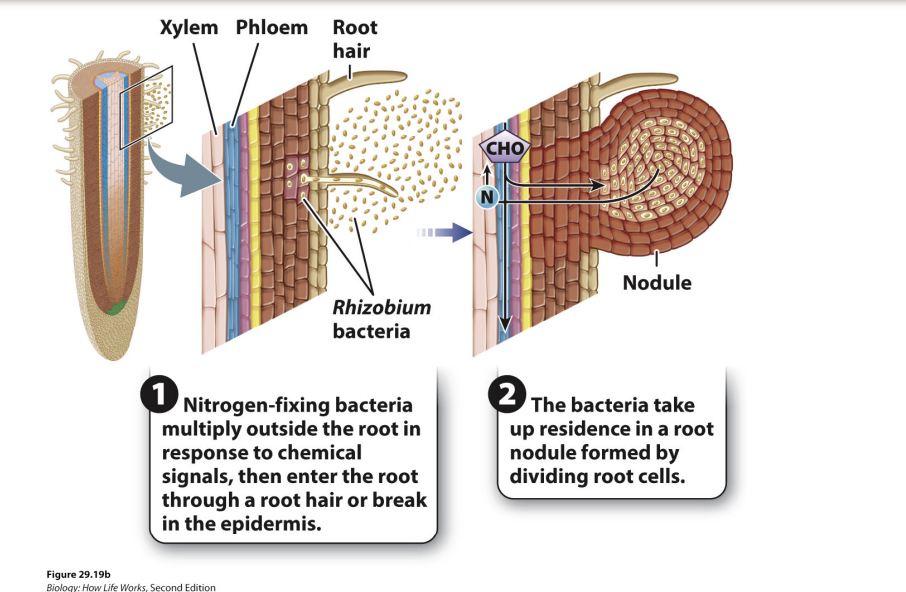
  • Nitrogen fixing bacteria in the soil multiple in the rhizosphere in response to chemical signals from the plant roots

  • plants that form mutualisms with these bacteria are often referred to as nitrogen fixers

    • but, it is the bacteria that are doing the work

  • nitrogen fixing bacteria multiply outside root in response to signals → enter the root through a root hair or break in the epidermis → bacteria take up residence in a root nodule formed by dividing root cells

    • sugars in soil -> bacteria multiply -> plants grows around them and gives them carbs -> bacteria keep fixing nitrogen and give to plants 

    • Rare mutualism  

<ul><li><p>Nitrogen fixing bacteria in the soil multiple in the rhizosphere in response to chemical signals from the plant roots</p></li><li><p>plants that form mutualisms with these bacteria are often referred to as nitrogen fixers</p><ul><li><p>but, it is the bacteria that are doing the work</p></li></ul></li><li><p>nitrogen fixing bacteria multiply outside root in response to signals → enter the root through a root hair or break in the epidermis → bacteria take up residence in a root nodule formed by dividing root cells</p><ul><li><p><span style="background-color: inherit; line-height: 19.55px; color: windowtext;">sugars in soil -&gt; bacteria multiply -&gt; plants grows around them and gives them carbs -&gt; bacteria keep fixing nitrogen and give to plants</span><span style="line-height: 19.55px; color: windowtext;">&nbsp;</span></p></li><li><p class="Paragraph SCXO235224386 BCX0" style="text-align: left;"><span style="background-color: inherit; line-height: 19.55px; color: windowtext;">Rare mutualism&nbsp;</span><span style="line-height: 19.55px; color: windowtext;">&nbsp;</span></p></li></ul></li></ul><p></p>
46
New cards

How does mutualism with ectomycorrhizal fungi work?

  • fungi produce a thick sheath of fungal cells that surround plant root tips and extend into root interior

  • fungal cells produce network of filaments that surround root cells → but do not penetrate them

    • Fungi grow hyphae quickly and move soil easily -> increases volume that plant can extract nutrients 

  • fungi can provide root cells with N (obtained frmo soil) in exchange for carbs

  • In soli with nitrogen already (lots of decomp that releases ammonia and nitrogen fixing bacteria) 
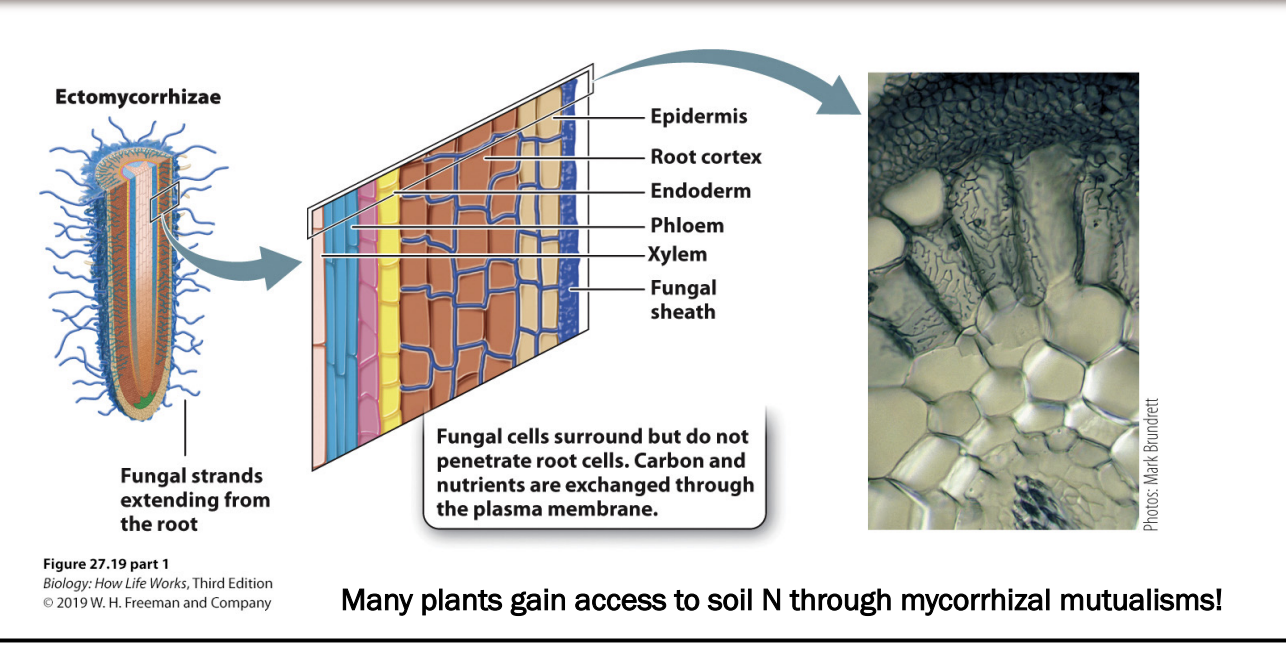
<ul><li><p>fungi produce a thick sheath of fungal cells that surround plant root tips and extend into root interior </p></li><li><p>fungal cells produce network of filaments that surround root cells → but do not penetrate them</p><ul><li><p><span style="background-color: inherit; line-height: 19.55px; color: windowtext;">Fungi grow hyphae quickly and move soil easily -&gt; increases volume that plant can extract nutrients</span><span style="line-height: 19.55px; color: windowtext;">&nbsp;</span></p></li></ul></li><li><p>fungi can provide root cells with N (obtained frmo soil) in exchange for carbs</p></li><li><p><span style="background-color: inherit; line-height: 19.55px; color: windowtext;">In soli with nitrogen already (lots of decomp that releases ammonia and nitrogen fixing bacteria)</span><span style="line-height: 19.55px; color: windowtext;">&nbsp;</span></p></li></ul><p></p>
47
New cards

Why are mutualisms formed with mycorrhizae?

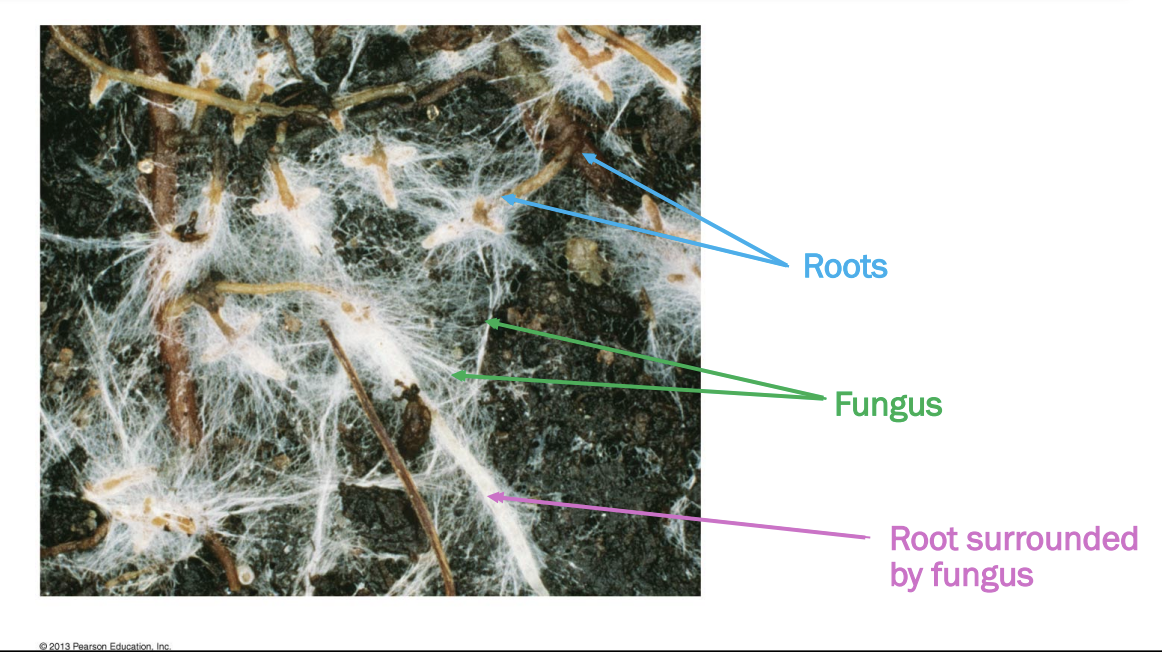
  • fungi can decompose organic matter to obtain nitrogen (good at obtaining other nutrients from soils)

  • hyphae are extensive → increases volume where nutrients are obtained

  • Some fungi form mutualisms with nitrogen-fixing bacteria to obtain N for themselves and their plant mutualists
<ul><li><p>fungi can decompose organic matter to obtain nitrogen (good at obtaining other nutrients from soils)</p></li><li><p>hyphae are extensive → increases volume where nutrients are obtained</p></li><li><p>Some fungi form mutualisms with nitrogen-fixing bacteria to obtain N for themselves and their plant mutualists</p></li></ul><p></p>
48
New cards

Where does mycorrhizae cover?

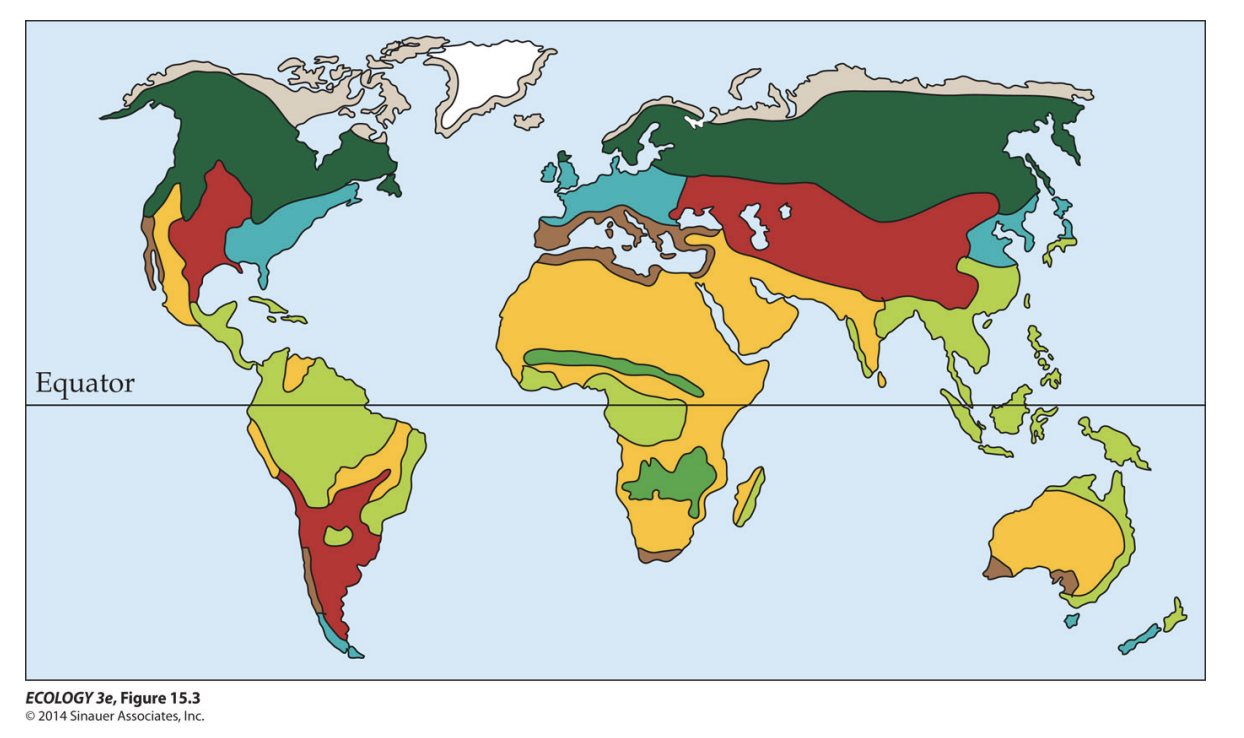
  • Each colour represents a different type of mycorrhizal association

  • Evolved ind multiple times -> covers most of land 
<ul><li><p>Each colour represents a different type of mycorrhizal association</p></li><li><p><span style="background-color: inherit; line-height: 19.55px; color: windowtext;">Evolved ind multiple times -&gt; covers most of land</span><span style="line-height: 19.55px; color: windowtext;">&nbsp;</span></p></li></ul><p></p>
49
New cards

  • D

50
New cards

What is the phosphorus cycle related to?

  • Cycle is closely linked to the carbon-cycle because phosphorous is a key element for growth (nucleic acids and membranes, ATP)

51
New cards

What are the largest pools for phosphorus cycle?

  • Rocks & ocean sediments → largest pools, P atoms leave pools via uplift & chemical weathering

52
New cards

How does the phosphorus cycle work?

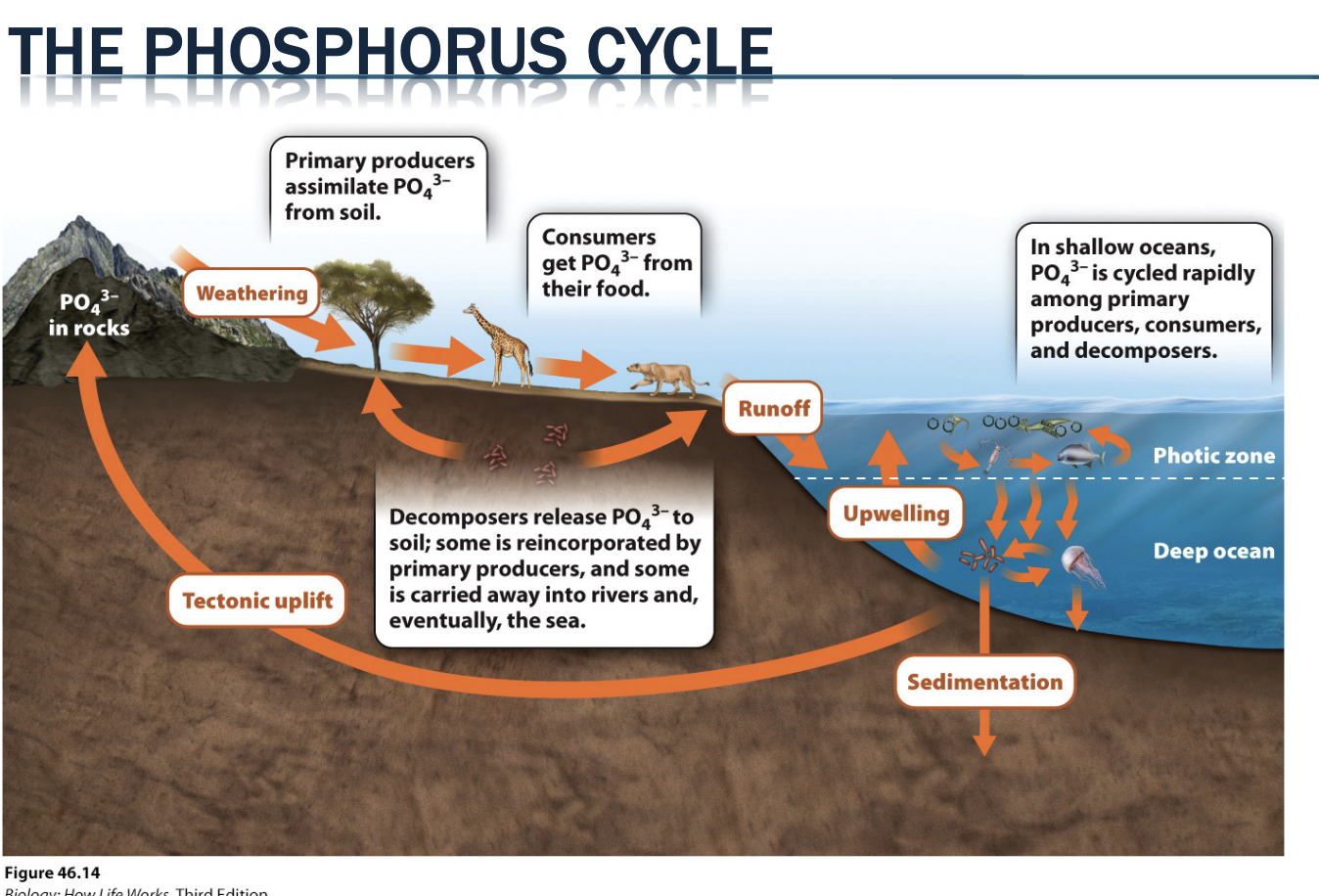
  • P enters food webs as PO4 3- , which is highly immobile in clay soils → hard for plants to obtain without help from mutualistic fungi

    • Enter as phosphate that are hard to move and hard for plants 

      • Mutualisms with fungi 

  • P leaves terrestrial ecosystems through soil erosion, leaching, and groundwater runoff, and marine ecosystems through sedimentation

    • Sedimentary cycle (not a lot in atm) 

      • Phos moves to water -> goes into rocks 

  • Leached from soils into ground water -> down-stream -> ends in ocean sediments -> makes continental drift to make mountain -> moves back into land 

    • Can take over 100 millions years for a P atom to return to food webs once enters ocean sediments → coastal upwellings can considerably shorten this timing

    • Lost quickly  

      • Ocean sediments can return with upwellings 

      • Most time stays in sediments until ocean becomes land through cont drift and mechanically weathered again (and/or enter food web 
<ul><li><p>P enters food webs as PO4 3- , which is highly immobile in clay soils → hard for plants to obtain without help from mutualistic fungi</p><ul><li><p><span style="background-color: inherit; line-height: 19.55px; color: windowtext;">Enter as phosphate that are hard to move and hard for plants</span><span style="line-height: 19.55px; color: windowtext;">&nbsp;</span></p><ul><li><p class="Paragraph SCXO145228139 BCX0" style="text-align: left;"><span style="background-color: inherit; line-height: 19.55px; color: windowtext;">Mutualisms with fungi</span><span style="line-height: 19.55px; color: windowtext;">&nbsp;</span></p></li></ul></li></ul></li><li><p>P leaves terrestrial ecosystems through soil erosion, leaching, and groundwater runoff, and marine ecosystems through sedimentation</p><ul><li><p><span style="background-color: inherit; line-height: 19.55px; color: windowtext;">Sedimentary cycle (not a lot in atm)</span><span style="line-height: 19.55px; color: windowtext;">&nbsp;</span></p><ul><li><p class="Paragraph SCXO89923593 BCX0" style="text-align: left;"><span style="background-color: inherit; line-height: 19.55px; color: windowtext;">Phos moves to water -&gt; goes into rocks</span><span style="line-height: 19.55px; color: windowtext;">&nbsp;</span></p></li></ul></li></ul></li><li><p><span style="background-color: inherit; line-height: 19.55px; color: windowtext;">Leached from soils into ground water -&gt; down-stream -&gt; ends in ocean sediments -&gt; makes continental drift to make mountain -&gt; moves back into land</span><span style="line-height: 19.55px; color: windowtext;">&nbsp;</span></p><ul><li><p>Can take over 100 millions years for a P atom to return to food webs once enters ocean sediments → coastal upwellings can considerably shorten this timing</p></li><li><p><span style="background-color: inherit; line-height: 19.55px; color: windowtext;">Lost quickly&nbsp;</span><span style="line-height: 19.55px; color: windowtext;">&nbsp;</span></p><ul><li><p class="Paragraph SCXO18044479 BCX0" style="text-align: left;"><span style="background-color: inherit; line-height: 19.55px; color: windowtext;">Ocean sediments can return with upwellings</span><span style="line-height: 19.55px; color: windowtext;">&nbsp;</span></p></li><li><p class="Paragraph SCXO18044479 BCX0" style="text-align: left;"><span style="background-color: inherit; line-height: 19.55px; color: windowtext;">Most time stays in sediments until ocean becomes land through cont drift and mechanically weathered again (and/or enter food web</span><span style="line-height: 19.55px; color: windowtext;">&nbsp;</span></p></li></ul></li></ul></li></ul><p></p>
53
New cards

What are endomycorrhizae?

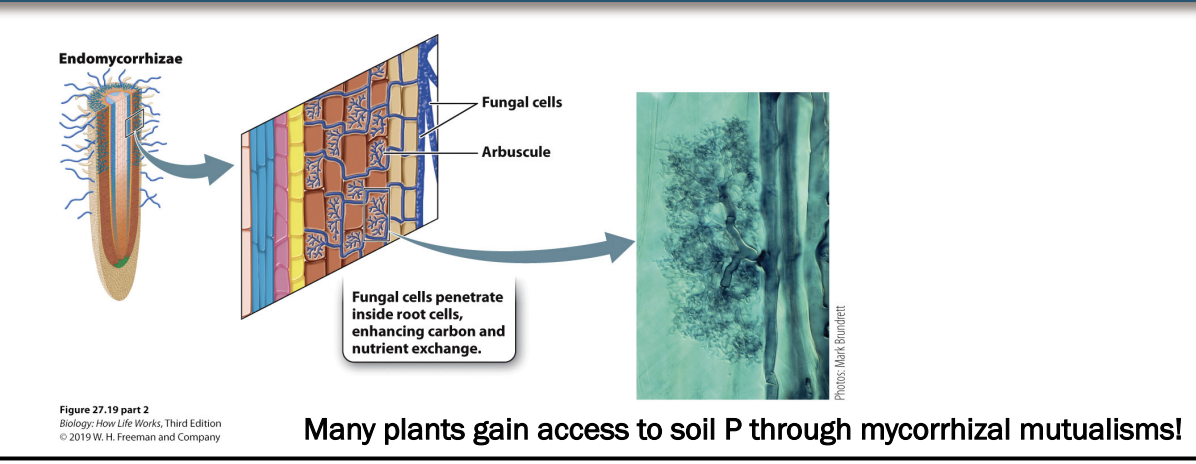
  • fungi that penetrate root cells, but do not form visible structures outside of root cells after this

    • can make them hard to study.

  • Instead, they form highly branched arbuscules that grow inside roots
<ul><li><p>fungi that penetrate root cells, but do not form visible structures outside of root cells after this</p><ul><li><p> can make them hard to study. </p></li></ul></li><li><p>Instead, they form highly branched arbuscules that grow inside roots</p></li></ul><p></p>
54
New cards

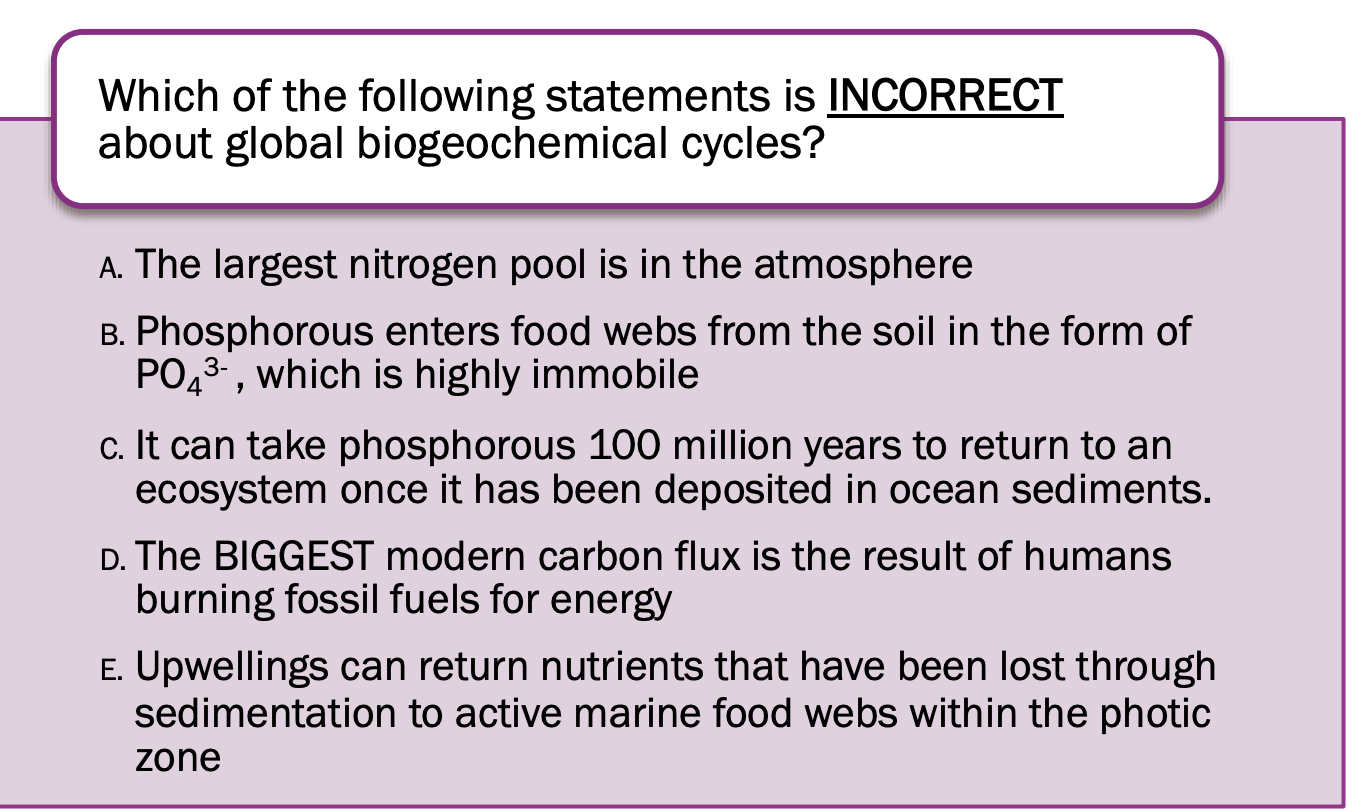
  • D 

    • Phto and respiration are the biggest carbon flux 

    • Humans only 9 

Explore top notes

note
Japanese Animals Vocab
Updated 137d ago
0.0(0)
note
Cells
Updated 1257d ago
0.0(0)
note
Les semi-auxiliares
Updated 304d ago
0.0(0)
note
Leçon 1 D'Accord 3 Vocabulaire
Updated 1284d ago
0.0(0)
note
ECON2105 Chap. 2
Updated 1159d ago
0.0(0)
note
Macromolecules
Updated 1300d ago
0.0(0)
note
3.4: Controversies
Updated 338d ago
0.0(0)
note
Japanese Animals Vocab
Updated 137d ago
0.0(0)
note
Cells
Updated 1257d ago
0.0(0)
note
Les semi-auxiliares
Updated 304d ago
0.0(0)
note
Leçon 1 D'Accord 3 Vocabulaire
Updated 1284d ago
0.0(0)
note
ECON2105 Chap. 2
Updated 1159d ago
0.0(0)
note
Macromolecules
Updated 1300d ago
0.0(0)
note
3.4: Controversies
Updated 338d ago
0.0(0)

Explore top flashcards

flashcards
AP Psych Exam
721
Updated 1070d ago
0.0(0)
flashcards
Evolution/Natural Selection
23
Updated 673d ago
0.0(0)
flashcards
English for everyone Jobs 9.1
28
Updated 676d ago
0.0(0)
flashcards
AP Psych Exam
721
Updated 1070d ago
0.0(0)
flashcards
Evolution/Natural Selection
23
Updated 673d ago
0.0(0)
flashcards
English for everyone Jobs 9.1
28
Updated 676d ago
0.0(0)