International Econ exam 2
 Call Kai
 Learn
Learn Practice Test
 Spaced Repetition
 Match
Match Flashcards
 Knowt Play
1/118

There's no tags or description
Looks like no tags are added yet.
Name | Mastery | Learn | Test | Matching | Spaced | Call with Kai |
|---|
No analytics yet
Send a link to your students to track their progress
119 Terms
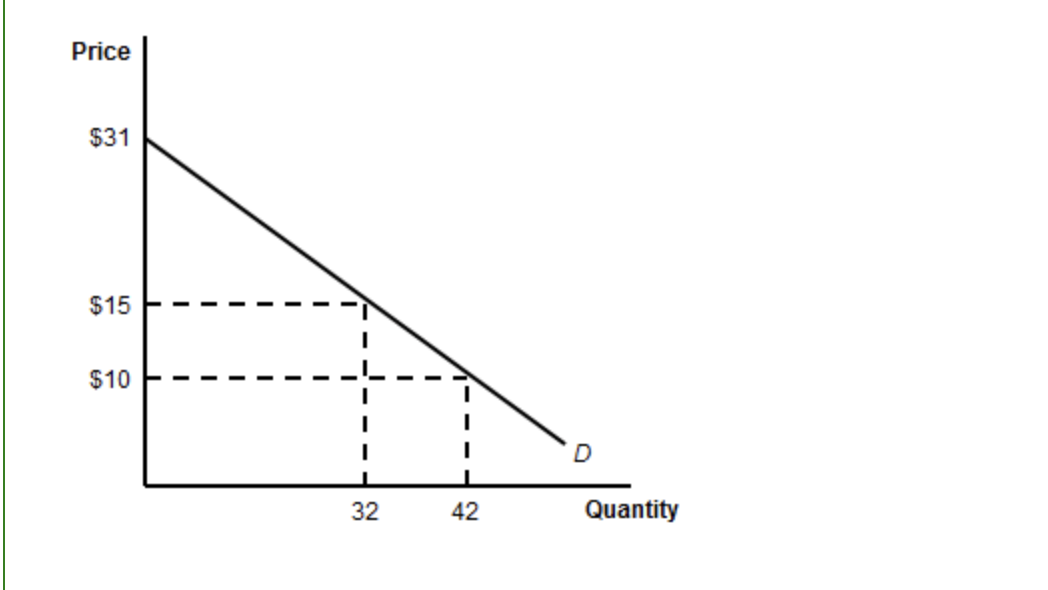
By how much will consumer surplus in the graph below increase if the price falls from $15 to $10?
$185
When firms are able to sell units of a good at a price higher than the marginal cost of production, they are getting:
producer surplus.
Suppose that Norway is a small country and currently produces 100,000 board feet of lumber at $600 per 1,000 board feet. Then it begins to trade at the world price of $500 per 1,000 board feet. As a result of trade, Norway's production falls to 50,000 board feet and its consumption increases to 200,000 board feet. How many board feet of lumber does Norway now import?
150,000 board feet
If S = P represents a country's home supply curve and D = 100 – P represents its home demand curve, then the equilibrium price and quantity in autarky are:
$50 and 50 units.
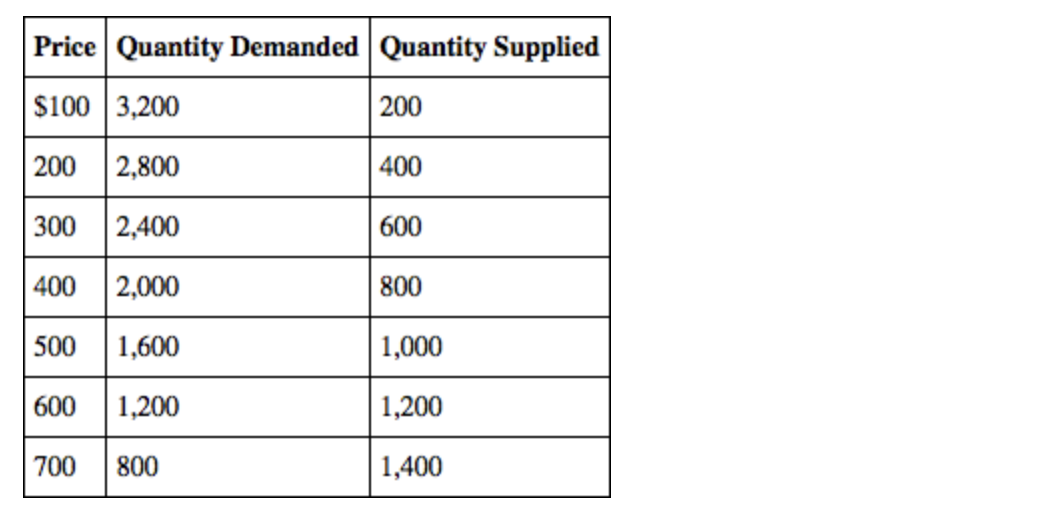
The following table gives the hypothetical supply and demand of television sets in Guatemala. Guatemala is a small country that is unable to affect world prices. The world price (free-trade price) is $300 per TV set. In the absence of trade, what will be the price of TV sets in Guatemala?
$600
How did the WTO react to the U.S. imposition of steel tariffs in 2002?
It allowed other nations to impose tariffs on U.S. exports to retaliate.
If a large country imposes a tariff:
the terms-of-trade effect can never offset deadweight losses on its economy.
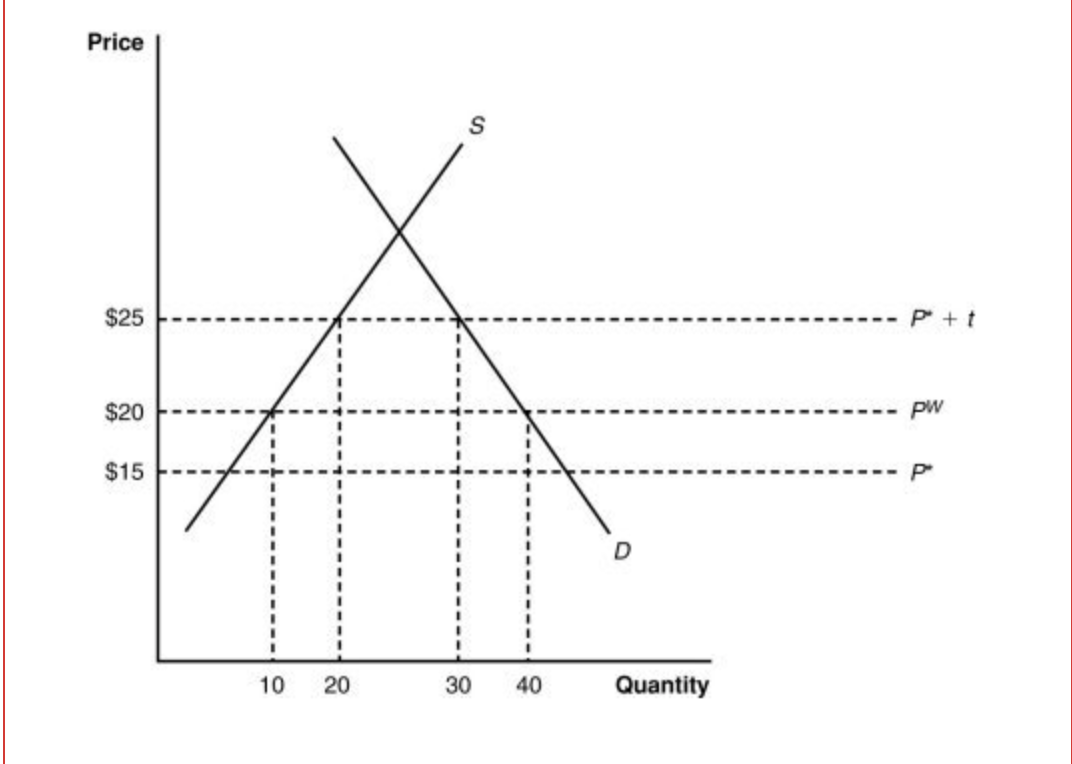
For the large country in the graph, the free-trade price of the product is ______ and the amount imported is _________.
$20; 30
Which organization acts as a forum for countries to come to agreement on trade policies and to resolve trade policy disputes?
the World Trade Organization
During his first term, President Trump tried to minimize the visible impact of his import tariffs on consumers by:
focusing on intermediate inputs that U.S. companies would typically use to produce other final goods for consumers.
According to Feenstra and Taylor’s calculations, the deadweight loss associated with the 2018–19 tariffs enacted under President Trump was:
approximately $79.1 billion annually.
What is a difference between a tariff imposed by a large country and a tariff imposed by a small country?
A tariff imposed by a large country has a terms-of-trade effect.
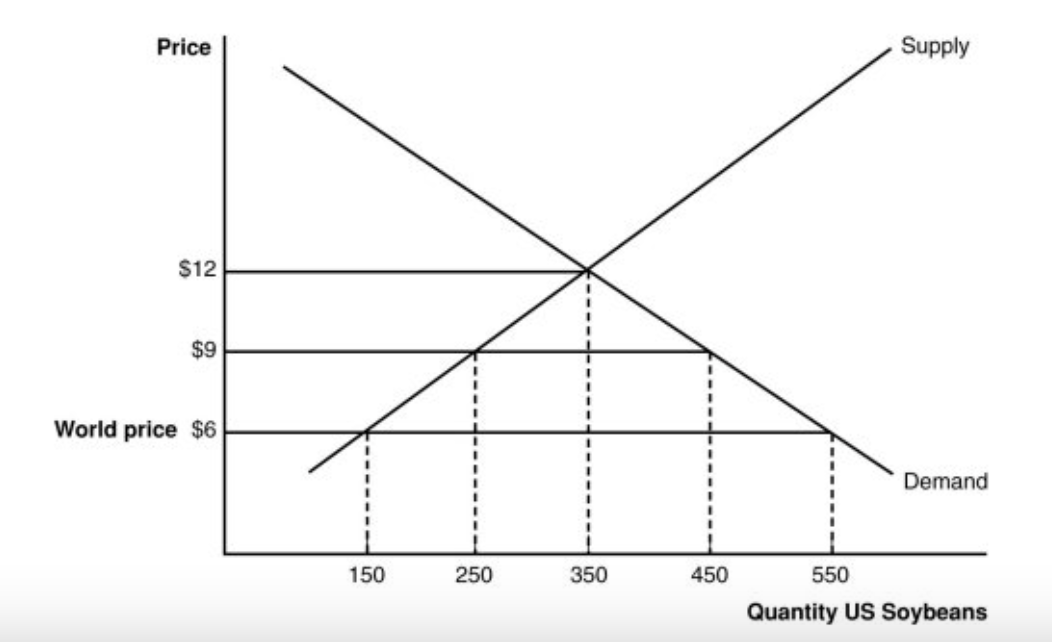
Refer to the graph below. If an import quota of 200 soybeans is imposed, the quota rents will calculate to be
$600
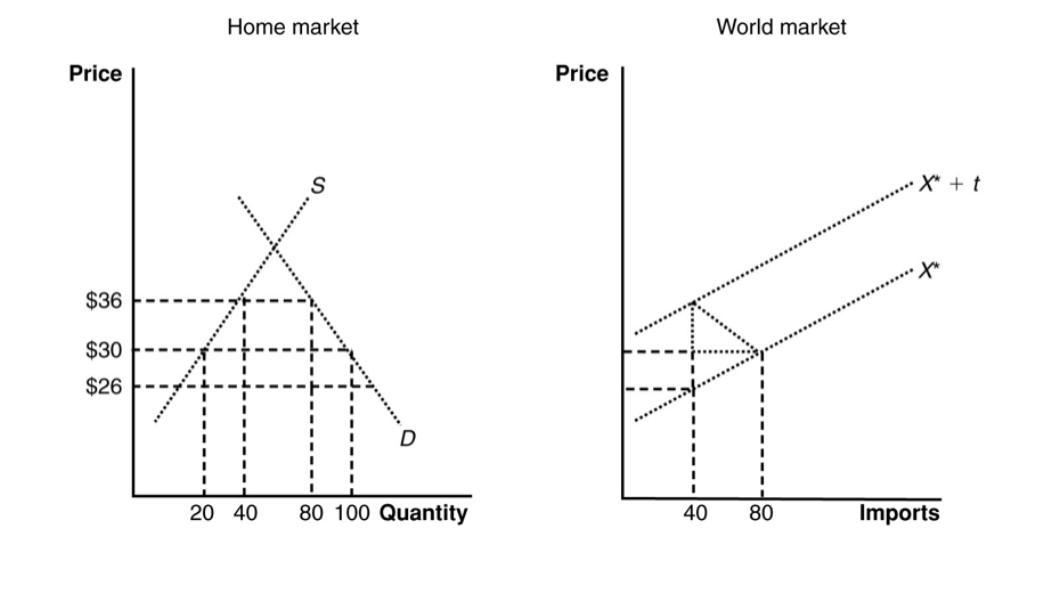
Suppose home country imposes a tariff t on imports as shown in the graph below. The loss of consumer surplus in this country is
$540
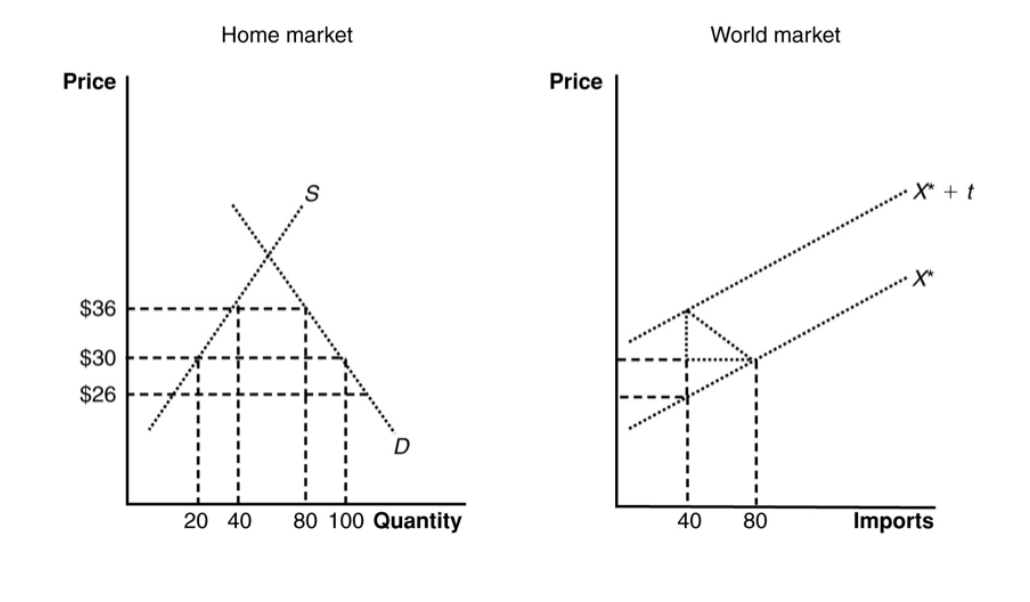
Based on the graphs, the amount imported by the home market under free trade is:
80
With respect to environmental issues, the GATT:
allows countries to adopt environmental laws that are applied uniformly against domestic producers and imports.
A regional trade agreement involves:
several nations, usually trading partners, with a common agenda or geographically linked.
What is the “most favored nation principle” of the WTO?
Every nation must grant the same rights and treatment to other nations in the WTO as it grants to its “most favored nation.”
In a payoff matrix of large countries, a Nash equilibrium will emerge in which each country, seeking to maximize its own gains, will
impose a tariff.
The “phase one” agreement between the United States and China in January 2020 specified that China would commit to the purchase of $200 billion more exports from the United States in 2021 than it did in 2017. This doubling of China’s imports of U.S. products is a form of:
managed trade.
__________ specifies the amount that a country must purchase from another (in a trade agreement).
Managed trade
The U.S.–China trade war of 2018–19 and its temporary resolution in January 2020 illustrate:
the undesirable outcome of a prisoner’s dilemma.
What happens when two countries apply tariffs against each other in an attempt to capture their terms-of-trade gain?
Both countries lose because the terms-of-trade gain for one country is canceled by the tariff in the other country.
Which of the following is an effect of an international trade agreement that provides an incentive for nations not to impose tariffs?
an increase in world welfare and standard of living
The negative effects of trade diversion are reduced when:
trade creation more than offsets trade diversion.
Trade diversion is one reason that some economists:
recommend we change our focus from regional trade agreements to the WTO, a multilateral trade agreement.
The graph illustrates a customs union between the United States and Mexico. The United States does not produce the product shown in the graph. Imports satisfy its domestic demand (designated by MUS). The curves Smex and Sasia describe Mexican and Asian supplies. With a free-trade price of $150, how many units each will the United States import from Mexico and from Asia?
250 from Mexico and 350 from Asia
In 2015, nearly 200 countries adopted a resolution to limit the increase in global temperature. What was that called?
the Paris Accord
The main goal of the Paris Agreement was to:
limit increases in the earth's average temperature to 2 degrees Centigrade.
What is the Kyoto Protocol?
It is based on the 1992 UN climate treaty that set specific air pollution reduction targets for each nation.
When there is no incentive to cut pollution because it will make domestic firms less competitive, world welfare will improve if:
there is an international agreement so that every nation regulates global pollutants and no firms have competitive advantages because of lax pollution laws.
Why do the United States and the European Union governments apply tariffs to solar panel imports, even though solar panels generate positive consumption externalities?
They believe that domestic production of solar panels generates positive production externalities that outweigh the positive consumption externalities of imports.
Which of the following is associated with increased use of solar panels?
positive consumption externalities
The phenomenon known as the tragedy of the commons occurs whenever:
there is no ownership of resources, so they become depleted due to lack of management.
Suppose that there is a negative externality associated with alcohol consumption in the United States (e.g., the costs of publicly funded alcoholism treatment centers). What will happen to the social costs of this externality if the United States eliminates all tariffs on alcohol imports?
The social costs will increase.
Key elements of the international macroeconomy are:
many currencies, financial integration, and economic policy choices made in context.
Which one of the following reasons does not explain why exchange rates are important?
They affect the profits of all domestic producers.
European residents who hold U.S. dollar assets experience a _______ in their value when the dollar exchanges for fewer units of foreign currency.
decline
A nation's current account is:
a record of a nation's income, expenditure, deficit, and surplus during a particular period.
A country's external wealth is equal to:
its foreign assets minus its foreign liabilities.
International lenders want to know the likelihood that a nation will repay its debt. Therefore, they rely on:
international ratings of country risk.
What is the difference between an open economy and a closed economy?
An open economy has very few restrictions on trade or financial flows.
Among the following countries, which one has experienced a severe drop in its currency value during the last couple of decades?
Zimbabwe
Under a floating exchange rate regime, U.S. residents who hold European assets benefit when the dollar _______ in value against the euro.
declines
In general, the percentage of appreciation of one nation's currency is equal to:
the percentage of depreciation of the foreign nation's currency.
Suppose 80% of U.S. trade is with the UK and the rest is with Japan. If the dollar appreciates by 10% against the pound and appreciates by 20% against the yen, what is the percentage change in the effective exchange rate of the United States?
-12%
Which of the following exchange rate systems is in the right order, from most control to least control?
fixed, managed float, floating
When we look at exchange rates between two countries, what is the relationship between the exchange rate expressed in units of the domestic currency and the exchange rate expressed in units of the foreign currency?
One is always the reciprocal of the other.
A dining table costs $3,000 in New York and the same table costs 5,000 euros in Rome. Thus, you expect $1 to be equal to:
1.67 euros.
Which of the following statements is equivalent to an appreciation of the dollar relative to the euro?
The euro buys fewer dollars now.
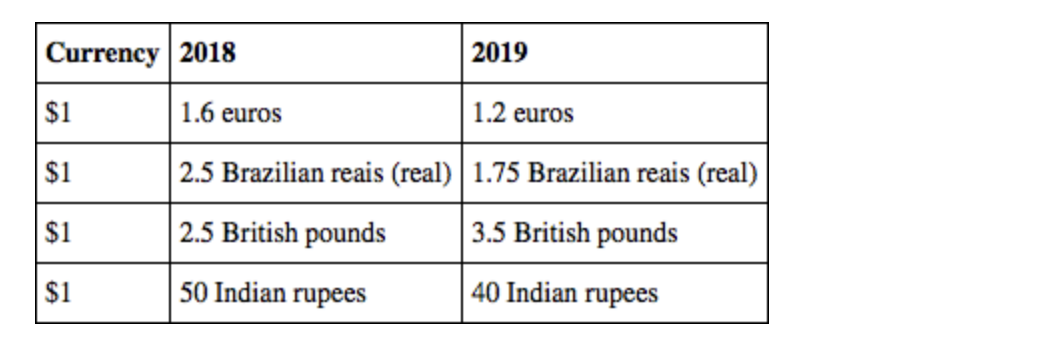
Using the table below, between 2018 and 2019, the U.S. dollar depreciated against:
the euro, the real, and the rupee.
If today €1 exchanges for ¥135, and tomorrow €1 exchanges for ¥150, we say the euro has:
appreciated.
The equation E$/£ = 2 means that:
1 dollar buys ½ a pound.
If, in 2011, $1 = 1.5 euros, and in 2016, $1 = 0.9 euros, which of the following statements would be true?
Americans will import fewer products from Europe.
The spot market for foreign exchange
is the purchases and sales of currencies for immediate delivery.
Spreads in quotations of exchange rates are:
the difference between the price the buyer pays and the price the seller receives.
The difference between the spot contract and a forward contract is that:
the former is a contract to be settled immediately, and the latter is a contract to be settled at a future agreed-upon date.
Capital control is described by all of the following except:
restricting merchandise trade.
Suppose $1 = 10.5 pesos in New York and $1 = 9.6 pesos in Mexico City. If you had $10,000 using arbitrage, your profits would be:
$937.50.
When it is possible to trade two separate currencies for a common third currency, economists refer to profit opportunities as:
triangular arbitrage
A vehicle currency is:
a widely accepted, tradable currency that serves as a currency to use for buying or selling one's own.
There can be an opportunity for covered interest arbitrage if:
the forward/spot rate difference is either larger or smaller in percentage terms than the difference in the interest rates on two currencies.
In equilibrium, if both uncovered and covered interest parity hold, what condition should exist?
The forward rate will equal the expected future spot rate.
The situation in which the difference in interest rates between two currencies is equal to the expected change in the spot rate over the same period is known as:
uncovered interest parity
The liquidity of an asset refers to:
the ease with which it can be sold.
Covered interest parity refers to the situation in which:
the forward rate between the two currencies is equal to the ratio of their returns times the spot rate between the two currencies
Foreign exchange is traded:
continuously all over the world 24 hours a day and seven days a week.
External wealth can increase by all of the following, except:
borrowing from international entities
Dollarization in the narrowest and most literal sense of the term has been adopted by which countries?
Panama and Ecuador
In general, we currently classify nations into three categories, depending on the level of economic advancement. These are
advanced, emerging, and developing.
If a nation is a net creditor internationally, it means that
residents of the nation have more foreign assets than foreign liabilities.
Suppose IBM has entered into a contract with a Dutch supermarket chain in which IBM will manage the Dutch company's internal data network and information technology systems. The contract calls for the Dutch company to pay IBM €9000 per month. Suppose the exchange rate at the beginning of 2025 was €0.94 per dollar and ended the year at €0.90 per dollar. Compared to the start of 2025, IBM's monthly revenue in dollar terms will be ____ by approximately ____ at the end of 2025 due to currency fluctuation impacting this contract.
higher; $426
If in January 2025, $1 = 110 yen, and in July 2025, $1 = 90 yen, then a Harley Davidson motorcycle that cost $8,000 in January would cost _______ in Japan in July.
720,000 yen
A crawling peg refers to
a fixed exchange rate regime in which the currency is adjusted very frequently to reflect market conditions.
Under covered interest parity, if the U.S. interest rate is 4% per year, the U.K. interest rate is 9% per year, and the spot rate is $1.5, then the forward exchange rate will be:
$1.43.
In equilibrium, if both uncovered and covered interest parity hold, what condition should exist?
The forward rate will equal the expected future spot rate.
A US-based company has a contract to provide network outsourcing services to a business customer in Buenos Aires for which it charges 100,000 Argentine pesos a year. At the beginning of the year, the peso was worth $0.10 but suffered depreciation of 10% by the end of the year. The impact of this is:
The US company will see revenues suffer, in dollar terms, by $1000.
To calculate the multilateral effective exchange rate for a nation for each trading partner:
multiply the share of trade by the change in the exchange rate and add the products.
If 1 euro is priced at $1.25 and if 1 euro will also buy 88 Japanese yen (€1 = ¥88), in equilibrium, with no arbitrage opportunities, how much is the cross rate between the yen and the dollar (yen–dollar rate)?
¥70.4/$
If both covered interest parity and uncovered interest parity hold, then the expected future spot rate is equal to the
current forward rate.
If the R$-US$ exchange rate is R$5.15 per US$ and the US$/€ exchange rate is US$1.18/€, then a no-arbitrage outcome is that the R$-€ exchange rate is
6.08 Brazilian reais per euro
If a pound of coffee beans costs 85 pesos in Mexico City and 10 pesos = 35 rupees, then the same pound of coffee should cost ___ rupees in New Delhi, all other things equal.
297.50
What is a currency band?
a fixed rate regime with some small variation allowed, up or down
Suppose $1 = 10.5 pesos in New York and $1 = 9.6 pesos in Mexico City. If you had $10,000 to exploit arbitrage opportunities, your profits would be
$937.50.
Which European Union member has kept its own currency and maintains a fixed value against the euro?
Denmark
With respect to environmental issues, the GATT:
allows countries to adopt environmental laws that are applied uniformly against domestic producers and imports.
A regional trade agreement involves:
several nations, usually trading partners, with a common agenda or geographically linked.
What is the “most favored nation principle” of the WTO?
Every nation must grant the same rights and treatment to other nations in the WTO as it grants to its “most favored nation
In a payoff matrix of large countries, a Nash equilibrium will emerge in which each country, seeking to maximize its own gains, will
impose a tariff.
The “phase one” agreement between the United States and China in January 2020 specified that China would commit to the purchase of $200 billion more exports from the United States in 2021 than it did in 2017. This doubling of China’s imports of U.S. products is a form of
managed trade
__________ specifies the amount that a country must purchase from another (in a trade agreement).
Managed trade
The U.S.–China trade war of 2018–19 and its temporary resolution in January 2020 illustrate:
the undesirable outcome of a prisoner’s dilemma
What happens when two countries apply tariffs against each other in an attempt to capture their terms-of-trade gain?
Both countries lose because the terms-of-trade gain for one country is canceled by the tariff in the other country.
Which of the following is an effect of an international trade agreement that provides an incentive for nations not to impose tariffs?
an increase in world welfare and standard of living
The negative effects of trade diversion are reduced when:
trade creation more than offsets trade diversion.
Trade diversion is one reason that some economists:
recommend we change our focus from regional trade agreements to the WTO, a multilateral trade agreement.
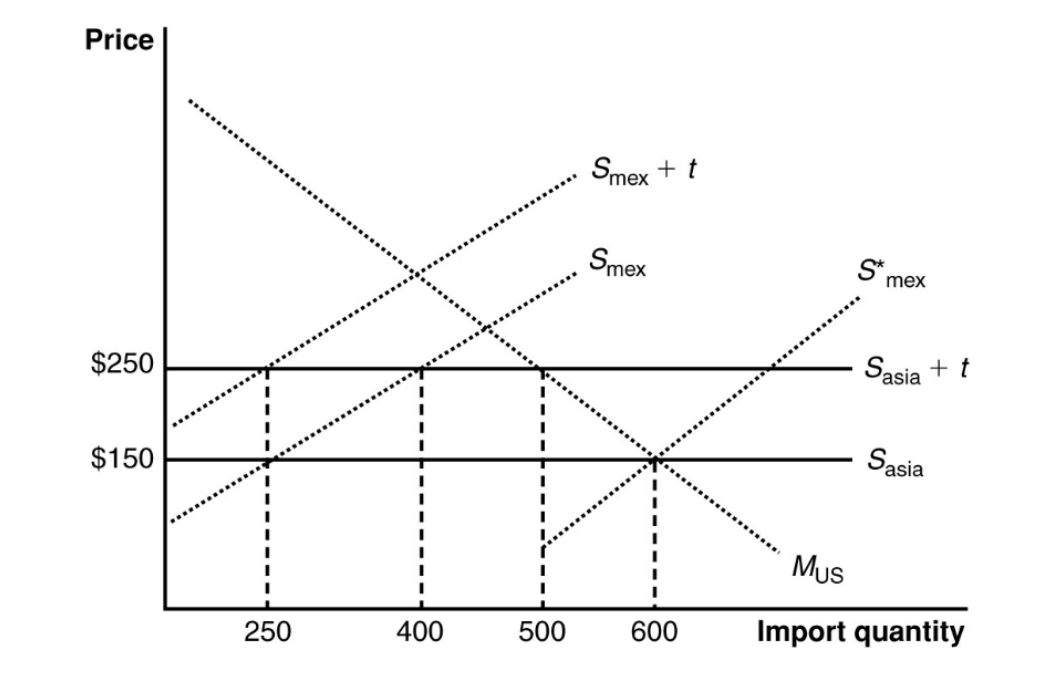
The graph illustrates a customs union between the United States and Mexico. The United States does not produce the product shown in the graph. Imports satisfy its domestic demand (designated by MUS). The curves Smex and Sasia describe Mexican and Asian supplies. With a free-trade price of $150, how many units each will the United States import from Mexico and from Asia?
250 from Mexico and 350 from Asia
While the law of one price relates the prices of individual goods to the exchange rate, the theory of PPP relates:
the relative price level of a basket of goods to the exchange rate.
If a basket of goods costs $100 in the United States and 300 pesos in Mexico, and if the exchange rate is $1 = 5 pesos, then the dollar price of the basket of goods in Mexico is:
$60
Evidence suggests that convergence to PPP occurs:
slowly, as arbitrageurs operate and as production, prices, and exchange rates adjust.

