AP Congress
 Studied by 0 people
 Call with Kai
 Learn
Learn Practice Test
 Spaced Repetition
 Match
Match Flashcards
 Knowt Play
1/48

There's no tags or description
Looks like no tags are added yet.
Name | Mastery | Learn | Test | Matching | Spaced | Call with Kai |
|---|
No study sessions yet.
49 Terms
A term of Congress is ____ years
Two years
A session of Congress is ____ years
One year
Currently the ___ Congress
119th Congress
20th Amendment
Moved the start time of new Congressional terms from March to January.
Why did the Founding Fathers Choose To Model Congress on a Bicameral System? (3)
Based on British Tradition
Great compromise at Constitutional Convention
Created a system of checks and balances within Congress
House of Representatives: Term, Minimum Age, and Residency Requirements
Term: two years
Minimum Age: 25 years old
Residency Requirements: 7 years US citizen
Senate: Term, Minimum Age, and Residency Requirements
Term: six years
Minimum Age: 30 years old
Residency Requirements: 9 years US citizen
____ Senators per state
____ Total Senators
Two senators per state
100 total senators
Originally senators were appointed by the states. This changed in 1913 with the ratification of the 17th amendment; the citizens directly elect them.
17 amendment
Made senators directly elected in.
Number of Reps from each state in the House of Representatives is determined by a state’s ______. Reps used to be elected statewide, but are now elected out of ______________. The total number of Representatives was frozen at ____ in 1929
Population
Single member districts
435
How are changes made to a state’s house districts?
Reappointment
Redistricting
Gerrymandering
Reappointment
Changing the # of reps for each state based on the census (every 10 years)
Redistricting
State legislatures draw the Rep districts to reflect changes
Gerrymandering
When districts are drawn to benefit a party
Incumbent (congress)
Somebody that holds the job currently and wants to be reelected
Reelected in the House: 80%
Incumbent advantages
Name recognition:
Media Attention
Fundraising
Casework:
Members of Congress solve Constituents’ problems
Gerrymandering:
districts are drawn for advantage
Baker v. Carr (1962)
14th amendment’s EQUAL PROTECTION CLAUSE
Establishes the principle of “ONE PERSON, ONE VOTE”
All districts have same # of people
(761,000)
Shaw v. Reno (1993)
14th amendment’s EQUAL PROTECTION CLAUSE
RACE cannot be used as the sole factor in the drawing of the districts
Debate in the House of Reps
Larger size & more members = more heavily regulated (strict time limits)
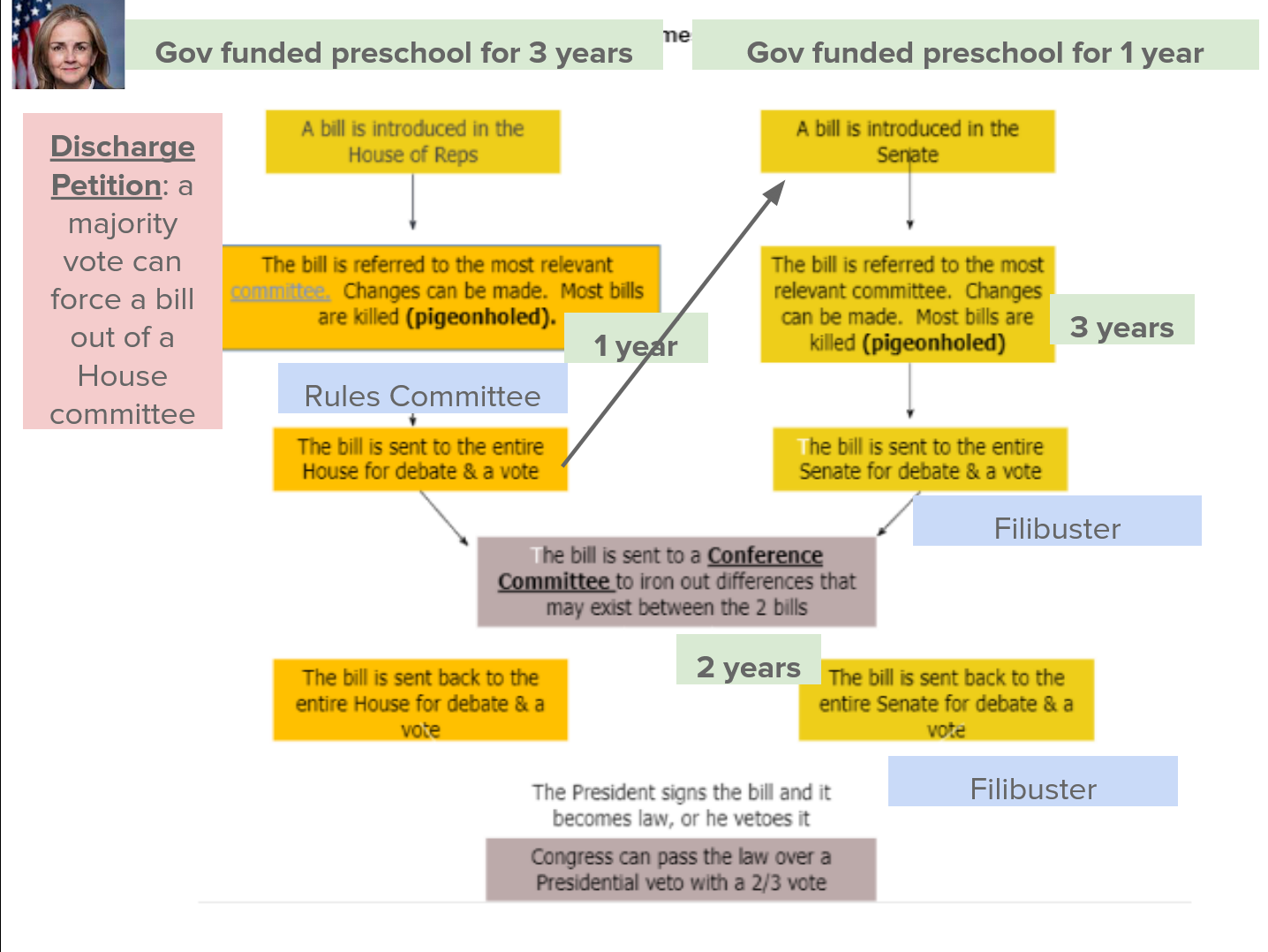
Rules Committee: exists to determine the specific conditions for debate.
Rules Committee
Exists to determine the specific conditions for debate.
A CLOSED rule does not allow changes to a bill once it’s introduced to the floor
An OPEN rule allows changes to be made to a bill
Debate in the Senate
Smaller size & less members = less regulations
FILIBUSTER: just one Senator can prevent a bill from being voted on by giving a long speech (delay tactic)
Filibuster
Just one Senator can prevent a bill from being voted on by giving a long speech (delay tactic)
can only be ended by a CLOTURE vote
requires at least 60 Senators to agree to end it
Silent Filibuster
Delay a bill by simply announcing their intentions
TRUSTEE
What you personally feel is correct
DELEGATE
What your constituents want
PARTISAN
What your party leaders want
POLITICO
A master politician that alternates back and forth between the 3 other models of representation
Economic
Budget-set discretionary spending for each agency.
Pass laws that raise/lower taxes (these bills must begin in the House)
War
Declaration of War needed from a majority of both Houses
War Powers Resolution (1973)
Electoral
The House of Reps votes (majority) when no candidate gets a majority of the electoral vote. Has only happened in 1800 & 1824.
Judicial
House of Reps: Impeachment (majority). Johnson (1864) & Clinton (1998), Trump (2019 & 2021))
Senate: Trial. 2/3 vote needed for conviction
Confirmation
The Senate must approve (majority) Presidential appointments like judges, cabinet members and ambassadors.
Foreign Affairs
The Senate is required to approve all formal treaties (2/3 vote).
Investigation & Oversight
Congress is responsible for overseeing the bureaucratic agencies. Congress possesses subpoena power & individuals must take oath before testifying
Committee System
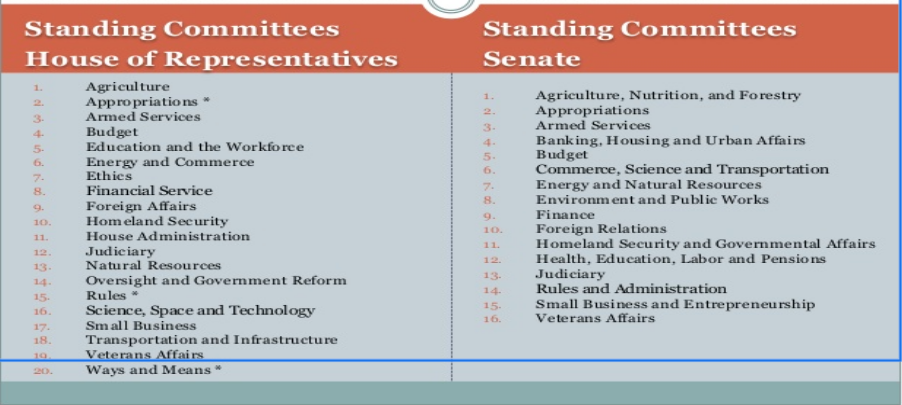
How does it allow Congress to become more efficient
By specializing in an area
How is the composition of each committe determined?
The majority party outnumbers the minority party on every committee and chooses the Chairperson
How Can Committees Benefit Individual Members?
A high profile committee assignment gets your more media attention and make you more attractive to donors
Committee assignment may allow you to add PORK to a bill
Something that may only benefit your constituents
Pork to a bill
Something that may only benefit your constituents
Why is the Ways and Means Committee in the House significant?
The Ways and Means Committee is significant because it is the primary tax-writing body in Congress, holding exclusive constitutional authority to originate all revenue-raising legislation, including taxes, tariffs, Social Security, and Medicare.
Why is the Rules Committee in the House significant?
The Rules Committee is significant because it acts as the "traffic cop" of the House, determining which bills reach the floor for debate and setting the specific parameters—such as time limits and allowable amendments—under which those bills will be considered.
President of Congress
Constitutional Duty of VP
President Pro Tempore
Ceremonial position given to the longest serving member of the majority part. 3rd in line of Presidential succession.
Speaker of Congress
Elected from the Majority party. 2nd in line of Presidential succession. Public spokesperson; assigns majority party members to committees.
Majority Leader
Takes a back seat to the Speaker in the House; in the Senate the Majority leader is a public spokesperson and assigns members of the majority party to committee assignments.
Minority Leader
Public spokesperson; assigns committee assignments to members of the minority party
Majority Whip
Keep regular members in touch with leadership
Pigeonholed
Bill is killed
How a bill becomes a law
 Note
Note  Flashcards (55)