Astronomy Final Unit
 Studied by 0 people
 Call Kai
 Learn
Learn Practice Test
 Spaced Repetition
 Match
Match Flashcards
 Knowt Play
1/44

There's no tags or description
Looks like no tags are added yet.
Name | Mastery | Learn | Test | Matching | Spaced |
|---|
No study sessions yet.
45 Terms
Measuring galactic masses
Within 59 kpc of center—→ use rotation curves
Farther out——> binary galaxy systems’ rotation period and semimajor axis
Wole galaxy clusters—→ ask, “how massive must it be to bind it’s galaxies gravitationally?”
Intracluster gas
Gas found between galaxies in a galaxy cluster, contributing to the overall mass and gravitational binding of the cluster. (as much or more as mass of the visible stars in the cluster)
-emits X-ray radiation
Galaxy collision
e.g. what will happen to Andromeda and Milky Way in a few million years!
rapidly varying gravitational forces compress the gas, resulting in a galaxy wide episode of star formation that lasts millions of years—no effect to individual stars, they just glide past each other
Dark Halos’ role in collision
dark matter (which most galaxies have if not all) extend far beyond the visible edges and bump into each other, making collisions/interactions more common
Galactic cannibalism
cause of some mergers—a much larger galaxy strips dark matter off of the smaller galaxy’s halo, redistributing or disposing of the free matter and causing orbital paths to change and spiral toward each other
Collision between equal mass, unequal size galaxies
result in the smaller galaxy distorting the shape of the larger; causing spiral arms to appear where none were before
Collision between equal size & mass galaxies
destroys a spiral galaxy’s disk, turning it into an elliptical galaxy with an X-ray halo
Black hole-Galaxy relationship
every bright galaxy—active or not—has a supermassive black hole at it’s center, with the most massive galaxies having the most massive black holes
The Quasar Epoch
roughly 11 billion years ago when many supermassive black holes had formed from merging smaller black holes from the edges of developing galaxies, and there was still enough merger-driven fuel to power them
Quasar feedback
a fraction of the quasar’s energy is absorbed by surrounding gas, expressed from the galaxy, and causes the quasar’s fuel supply to shut off and star formation to cease
Superclusters
clusters of galaxy clusters… e.g. the Virgo Supercluster contains Galaxy clusters Virgo, Local Group and others, 40-50 mpc across
Redshift surveys
Used to probe deep into intergalactic space—shows that many clusters and superclusters occur unevenly across the universe, in filamentary clusters like beads on a string with voids between them
The Great Wall
one of the largest known “structures” in the universe—a long sheet of galaxies/clusters (70 × 200 Mpcs)
Techniques used for observational evidence of dark matter
by studying the gravitational lensing of background quasars and galaxies by foreground galaxy clusters
Cosmological principle
the universe as a whole is:
-homogenous (the same everywhere), and
- isotropic/ symmetrical (the same in all directions)
Olber’s paradox
if the universe were infinite and unchanging in time, when you look out and cast any line into space it will run into a star—so, you SHOULD perceive the sky as bright as the surface of a star, but we don’t. So, the universe must be either finite or have evolved in time
Estimated age of the universe
14 billion years
Critical Universe
the density of the universe is equal to 1, or exactly the critical density. This universe would be flat and infinite in extent
Open Universe
this universe’s density < 1, or low-density. It’s shape would be saddle curved
Closed Universe
this universe’s density > 1. Or high density. it would be spherical in the way a baloon’’s surface is spherical
Cosmic Microwave Background
the constant cosmological radio “hiss” discovered by Penzias and Wilson—believed to be a completely redshifted remnant of the primeval fireball’s radiation…aka, creation itself.
Mass of the universe—stages
Early Universe— Radiation dominated
Middle—Matter dominated
Now—Dark energy dominated
Primordial Nucleosynthesis
a large amount of Helium was fused from deuterium (neutron+proton) just seconds after the big bang
Decoupling Epoch
occurred 10s of thousands of years after helium was first fused—electrons and nuclei combine to form Atoms, photons, and dark matter
Cause of the Microwave Background
The universe went from being opaque to radiation (with ionized matter) to being nearly transparent to it (with only H and He able to interact with matter), so all other wavelengths could travel forever without interacting. When the universe expanded and cooled, this radiation remained.
Epoch of Inflation
only a few seconds after the Big Bang, parts of the cosmos (including ours) acquired vacuum energy and expanded and an enormously accelerated rate faster than the speed of light, which cause portions of the universe that had already communicated radiation to each other to be dragged far apart
Inhomeogenities
slight variations in density—how larger structures in the universe eventually formed
Order of structure formation
First, dark matter structures formed—then normal matter was drawn to accumulate at these regions like foam on top of a wave
“Ripples” in microwave background
caused by tiny density fluctuations from dark matter before decoupling, even though dark matter can’t directly interact with radiation, these features were imprinted in it
WIMPs
Weakly Interacting massive particles—typically baryonic or “normal” matter
MACHOs
Massive Compact halo objects—nonbaryonic or made up of subatomic particles, strong candidate for dark matter
Tidal Stream of Stars
created when two galaxies interact and strip stars from one another
Chemical Evolution
complex molecules (and life) could have evolved from natural processes that produced proteins and amino acids
Microspheres
Tiny laboratory-made cells that function similarly to biological ones, multiplying and not dissolving in water
Alternate origin of organic compounds
building blocks of organic cells perhaps formed in interstellar space and arrived on earth in interplanetary dust and meteorite
Sequence of biological evolution
-single celled organisms (algae)
-amoeba
-insects
-reptiles
-mammals
-humans
Jovian moons with water
Jupiter’s Eurpoa & Ganymede
Titan & Enceladus
Planet most likely to have had life
Mars—scientists believe its surface was once warmer and wetter, able to sustain some form of biological life
Extremophiles
life forms that have adapted to survive in extreme environments such as superheated vents or frigid Antarctic glaciers
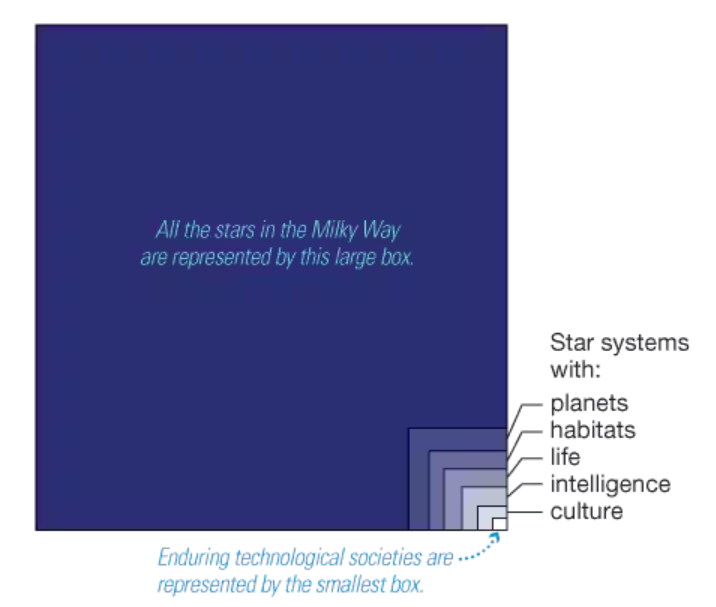
The Drake Equation
number of intelligent civilizations present in the galaxy=
average rate of star formation +
fraction of stars with planets +
average number of habitable planets in those systems+
fraction of those habitable planets on which life arises +
fraction of life bearing planets on which intelligence evolves+
fraction of intelligent life planets that develop a technological society+
average lifetime of a technologically competent civilizaiton
Time likely to travel to nearest intelligent life (Theoretically)
over 1 million years!
The Pioneer and Voyager
interstellar probes launched in the 70s with no destination, just to leave the solar system with hopes any intelligent life would receive it and decipher our presence
Best way to perceive extraterrestrial life
Radio searches, due to their far reach and quick travel
The Water Hole
the radio interval between 18 and 21 cms—likely to be emitted by water and thus more likely to have intelligent life nearby
 Note
Note  Flashcards (69)