Chapter 6 - CHANGES IN ECOSYSTEMS
 Call Kai
 Learn
Learn Practice Test
 Spaced Repetition
 Match
Match Flashcards
 Knowt Play
1/20

There's no tags or description
Looks like no tags are added yet.
Name | Mastery | Learn | Test | Matching | Spaced | Call with Kai |
|---|
No analytics yet
Send a link to your students to track their progress
21 Terms
Communities change
Communities change progressively over time, with one community being replaced by the next in the process of succession. Ecological succession can affect the abiotic and biotic interactions in the community, which in turn can affect the species present and their population size.
primary succession
When succession begins in a virtually lifeless area where soil has not yet formed, the process is called primary succession.
nudation
Catastrophic events, such as volcanic eruptions, cyclones, earthquakes and tsunamis, can cause the development of barren sites with no organisms inhabiting the affected area. This process, called nudation, starts a long-term process of change, generally involving four main stages.
The four stages
1 Pioneer plants colonise. The particular species of pioneer plants depends on the environmental factors in the habitat, such as coastal sand dunes or newly formed islands rising from the sea as a result of volcanic activity. Usually, the first pioneer plants to become established are autotrophs, such as lichens in the harsh, bare surroundings exposed after glacial retreat. Organic acids secreted by the lichens attack the rocky surface in the process of weathering, allowing windblown dust particles to settle in the cracks.
2 Soil formation. As the pioneer plants die and decompose, a thin layer of soil is formed. The shallow soil makes it possible for mosses to become established. When they die, they add nutrients to the soil. Over time, bacteria, fungi and invertebrates are able to establish and assist with the formation of a simple community. When there is enough soil added for grasses, ferns and shrubby herbaceous plants to become established, they grow upwards and outwards, shading the living things below, and their roots speed up the process of weathering the rock.
3 These early colonising plants have characteristics that make them successful: effective seed dispersal, rapid growth and rapid reproduction. They are generally fast growing and typical of r-selected species. These species are often the first to occupy the unused resources and living space. Their numbers increase rapidly but often decline just as rapidly when more competitive species move in.
4 A new community forms. With the establishment of producer organisms (autotrophs), small herbivores such as insects have food and shelter, and they become the next link in the food chains. Gradually, a whole new community forms, colonised by immigrant species from the surrounding areas. Immigrant species survive or stay only if they can obtain the resources that they need for survival.
5 As the succession process slowly continues, biodiversity increases. Succession is a slow process, and dependent on the abiotic conditions. It may take hundreds or even thousands of years. Eventually, if there is no further disruption, a climax community is established.
Secondary succession
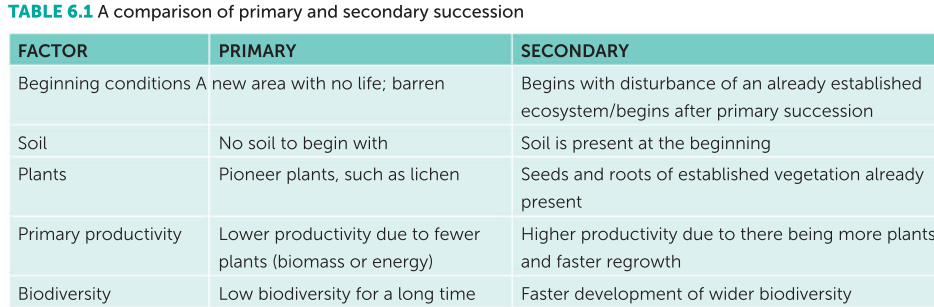
Secondary succession is a process of change in an ecosystem when a previously established community is taken over by a new group of organisms. Through natural disturbance (such as fire or flood) or human intervention (such as logging or land clearing for agriculture), dramatic changes to ecosystems occur. The cycling of matter and the flow of energy are interrupted as components of the ecosystems change. Organisms can recolonise recently disturbed communities via secondary succession, regaining equilibrium, although the number and kinds of organisms present may be different from the original ecosystem. As the soils develop, grasses and small herbaceous plants start to grow More organic matter is added and roots of plants aid break up of rock material Deeper soils hold more water; small shrubs colonise these better soils Nutrient availability increases; more root action Eventually trees establish, leading to the development of a climax community on The process of secondary succession is similar to primary succession, but it begins at step two with soil formation. This is because organisms and some organic matter are present in the soil. Primary succession may take anywhere up to 1000 years to reach a climax community. Secondary succession, however, may only take between 50 and 100 years to become established.
Key concept of secoundary succesion
Secondary succession is a similar process to primary succession, except that it begins at the second step, with a few organisms and some organic matter and soil already present.
The process of secondary succession is summarised as follows.
1 A natural or artificial disturbance occurs.
2 New plants, such as fast-growing pioneer plants, colonise the area. Invertebrates enter the ecosystem.
3 Slower-growing trees begin to grow and stabilise the community. New herbivores, then carnivores and omnivores, arrive and become part of the food web.
4 A new community forms and eventually becomes a climax community. Note that secondary succession always follows primary succession and a disturbance.
A comparison of primary and secondary succession
The end of succession is marked by
a climax community
climax community
A climax community is the stable community present at the final stage in a succession. It is stable as long as environmental factors remain unchanged. Such communities tend to be made up of slow-growing, long-lived K-selected species. These species, living in more stable environments than r-selected species, outcompete the others around them. They are often tall trees such as oaks or large conifers in the northern hemisphere, and trees such as jarrah or mountain ash in Australia.
During photosynthesis, trees
During photosynthesis, trees absorb carbon dioxide from the atmosphere, then they store it in the form of carbohydrates. As the bush burned, carbon dioxide re-entered the atmosphere; it will be a long time before the ecosystems can reabsorb the greenhouse gases that were released. The UN environmental program estimates the 2019–20 bushfires have already emitted 400 megatonnes of carbon dioxide into the atmosphere. This is equivalent to as much as Australia’s average annual carbon dioxide emissions, in just 3 months.
Prescribed burning
Prescribed burning is the process of planning and applying fire to a predetermined area, under specific environmental conditions, to lower fuel loads and to reduce the severity and size of bushfires. The best time to burn is usually between late June and early September, when cooler weather conditions create moisture in the vegetation. This causes the fire to burn cooler and for a shorter period of time. It is also important to have an appropriate wind speed, so the fire doesn’t spread too quickly or too little
The proliferation of new growth
in a post-fire community attracts many mobile species, such as wallabies, birds, small mammals and insects. The new growth sustains animals that may have survived the fire in underground burrows, such as wombats and echidnas.
In prescribed burning
In prescribed burning, fire is used as a management tool. Fire can positively affect a community by removing dominant plants and opening up space for other living things, and returning nutrients from plant biomass to the soil. Also, smoke can promote germination.
Natural disturbances
Natural disturbances such as tsunamis and wildfires are followed by successio
Ecosystem models
Ecosystem models are very useful for simulating and analysing the long-term dynamics and properties of complex ecosystems. They allow the use of information from different disciplines, as well as providing a means to analyse, interpret and understand field observations. Models provide a basis for predictions of the impacts of changes in real ecosystems, and the development of tools for management support and policy advice. Like all models, those designed to demonstrate ecosystem interactions are built using gathered 6.4 ECOSYSTEM MODELS AND PREDICTING THE data and the interpretation of that data. To draw on the most accurate and comprehensive data set would entail examining every part of the ecosystem, such as in a census collection. However, this is highly impractical for most ecosystems. A more practical approach is to examine parts of the ecosystem through random sampling. If all members of the population have an equal chance of being selected, simple random selection ensures that the sample is representative. The reliability of the model is determined by the representativeness of the sampling. One of the most widely used models is that of ecological succession. The concept of secondary succession is applied to restoration ecology projects worldwide in an effort to predict how to restore ecosystems that have suffered natural or human-made disturbances, such as those at a mining site. An understanding of abiotic conditions and the roles of species can be used to predict successional outcomes
Succession
Succession is a process of change in community composition and structure, usually towards the establishment of a stable ecosystem
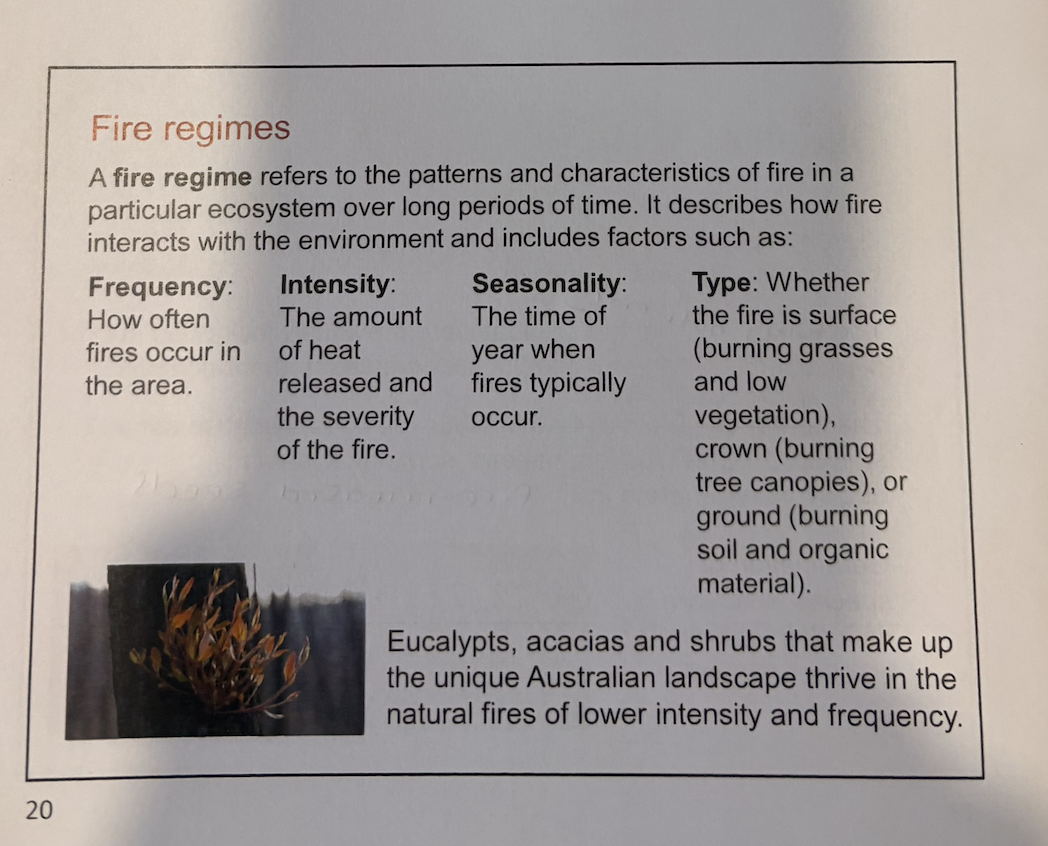
Fire
Fire intensities depend upon weather and fuel load. The rate of spread of a fire is affected by a variety of issues including wind speed, moisture content of the fuel, fuel particle size, vegetation height, fuel bulk density.
benefits of fire
Removes the slow-growing but dominant trees and shrubs thereby opening up space for other living things. (e.g herbaceous, grass-like species)
Returns nutrients to the soil that were previously locked up in plant biomass. Ash produced in fires creates nutrient-rich soil.
The heat of the fire can lead to biotic changes, because some species of bottlebrushes, hakeas, some acacias and eucalypts regenerate from fire-released seeds.
Germination of species which are difficult to germinate
Fire regimes
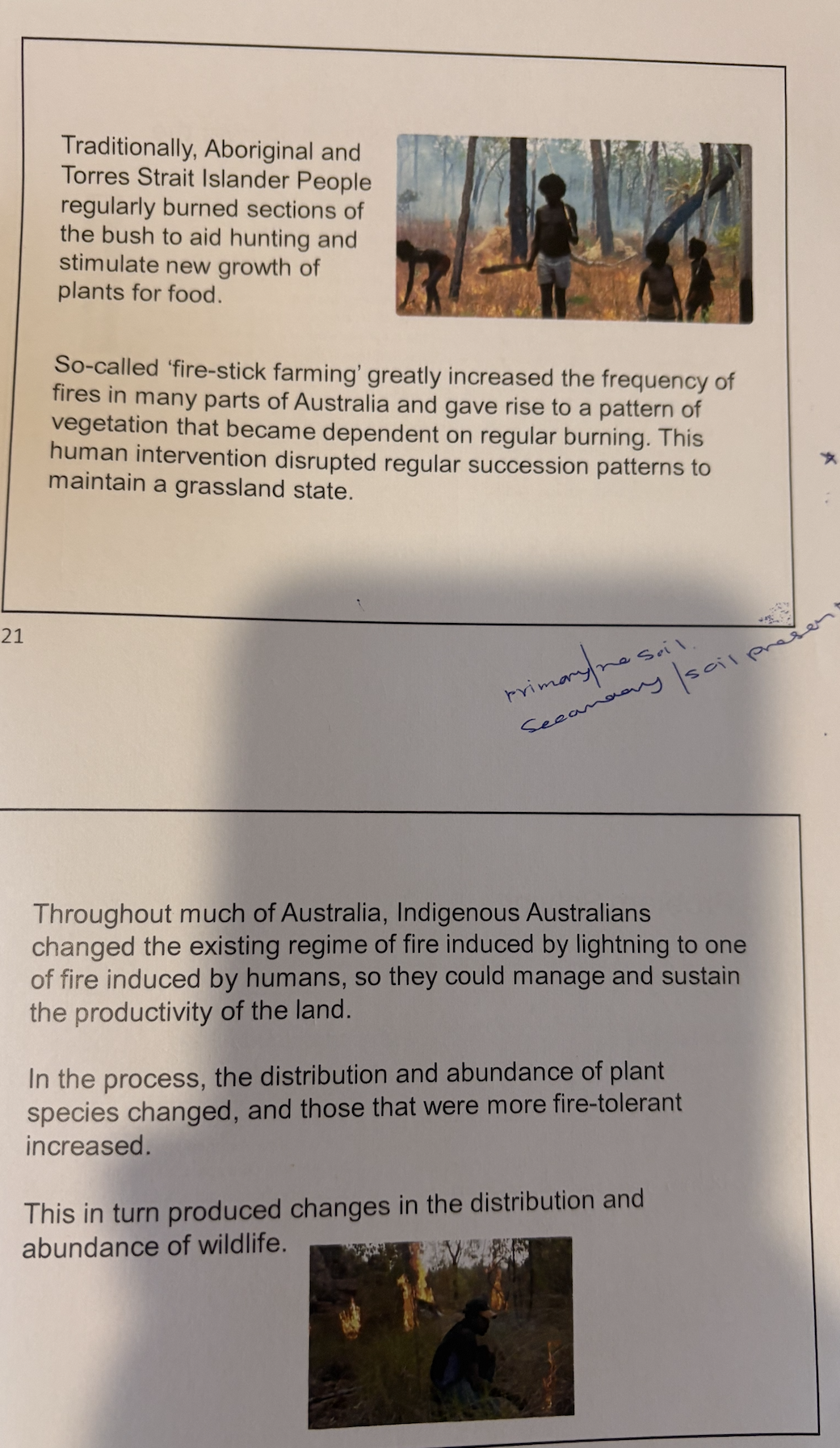
Indigenous Australians