Lecture 15-Viruses
 Call Kai
 Learn
Learn Practice Test
 Spaced Repetition
 Match
Match Flashcards
 Knowt Play
1/53

There's no tags or description
Looks like no tags are added yet.
Name | Mastery | Learn | Test | Matching | Spaced | Call with Kai |
|---|
No analytics yet
Send a link to your students to track their progress
54 Terms
living cells
Viruses must be grown in _________
plaques
Bacteriophages form ________ on a lawn of bacteria
cell culture
Animal and plants viruses may be grown in __________
living animals or in embryonated eggs
Animal viruses may be grown in ___________ or _____________
1.)infect cells and incubate
2.)incubate at 37 degrees
3.)Take sample of the mixture after every hour
4.)separate cells from the liquid(supernatant)
5.)make serial dilutions(water down sample) and do plaque assay
Overview of One Step growth curve -experiment
‘plaque forming units’ (PFU)
______________________ is a common way to measure the amount of virus in solution
Eclipse, Maturation, and Release
Three growth phases from a one-step growth curve
-the virus as entered the cell and is apart of the host cells machinery to begin mass production.
-the phase ends when the first viral parts are assembled into mature virions
Question - what is going on during eclipse - why
no sign of virus?
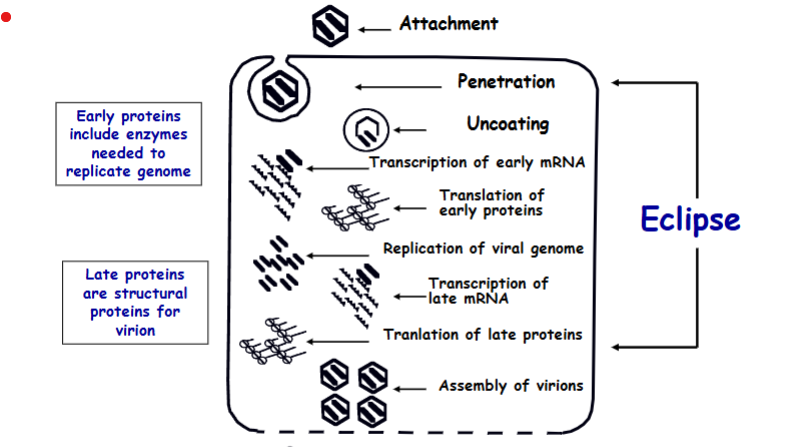
1.)Attachment and Pentration
-uncoating
2.)Transcription of early mRNA
-translation of early proteins
3.)Replication of viral genome
-transcription of late mRNA
4.)Translation of late proteins
-assembly of virions
List steps of the Eclipse in viral replication cycle
enzymes that are needed to replicate genome
For the eclipse phase of Viral replication cycle:
What are the early proteins that are translated?
structural proteins for virion
For the eclipse phase of Viral replication cycle:
What are the late proteins that are translated?
nucleus or cytoplasm
What are the two locations where some of the eclipse phase steps occur?
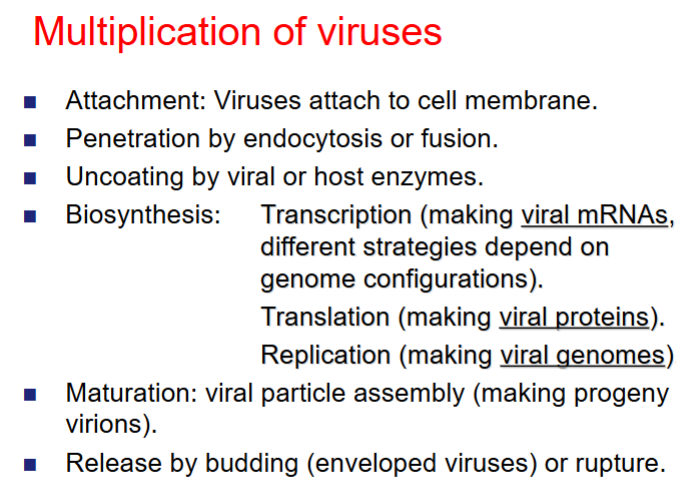
List the steps of Multiplication of viruses
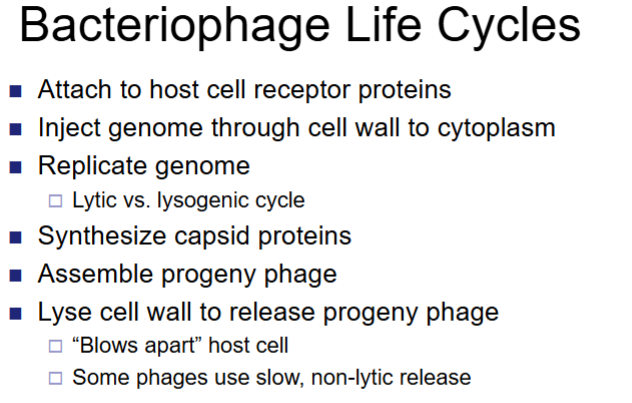
List the steps of Bacteriophage Life Cycle
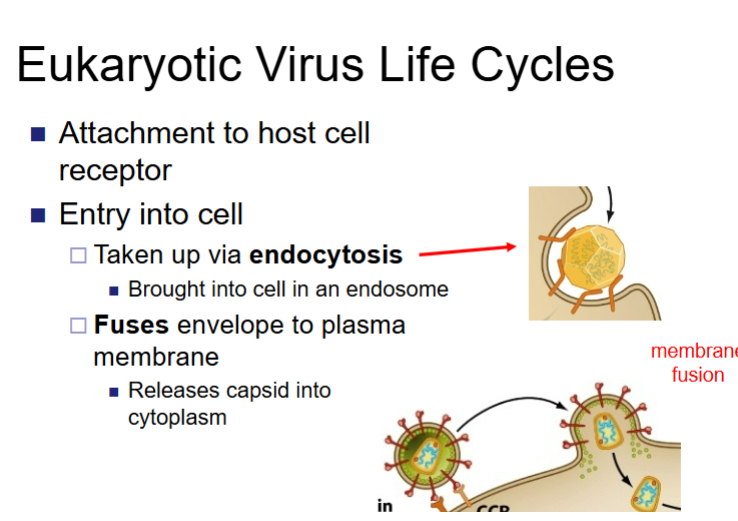
-Attachment to host cell receptor
-Entry into cell via endocytosis(brought into cell in an endosome)
-Fuses envelope to plasma membrane
-releases capsid into cytoplasm
Brief Overview of Attachment of Eukaryotic Virus Attachment
Non-enveloped-binds to capsid
Enveloped-binds viral glycoproteins(receptor binding protein)
Differences in viral receptor on non-enveloped vs enveloped viruses?
-trigger conformation in capsid for entry
-conformational change in glycoprotein for entry
-May send signals to cells
What are the three things that can be triggered from virus binding?
CD4 and CCR5
HIV receptor _____ and coreceptor ______
ACE2
SARS-Cov2 viral receptor
Tropism
the spectrum of tissues and cell types infected by a given virus.
appropriate viral receptor
Tropism is often explained by the presence or absence of the ______________________
Each type of virus binds to one (usually) or more (rarely) receptors to attach to the cell surface, initiating the entry process.
What is the general specificity for viruses to receptors
polymerase
DNA viruses must go to cell nucleus to use host ___________
Poxvirus
Viruses that replicate in cytoplasm with viral polymerase
viral polymerase
RNA viruses must encode a ____________
-Host cells cannot read RNA to make more RNA
+ss RNA
(+/-) ssRNA can be translated as mRNA to make viral
proteins, therefore it can be infectious
-ss RNA
(+/-) ssRNA and retrovirus genomes must be replicated to be able to be translated
small
(small/large) viruses use host cell DNA polymerase
and other enzymes.
large
(large/small) viruses encode many of the enzymes required (e.g. DNA polymerase) and are more “autonomous”
pox- and herpes-
2 examples of large viruses that encode many of their own enzymes and are more autonomous
ribosomes
All viruses make proteins with host __________
cytoplasm
For eukaryotic virus life cycles: Translation occurs in __________
RNA genomes- encode their own RNA-dependent RNA polymerase, which uses a complementary RNA as template (+ -> – or – -> +)
RNA polymerase
RNA genomes from viruses encode their own ______________ which later on uses one strand to code the other(+ → - or - →+)

