Beta Lactams MedChem

0.0(0)
studied byStudied by 4 people
call kaiCall Kai
learnLearn
examPractice Test
spaced repetitionSpaced Repetition
heart puzzleMatch
flashcardsFlashcards
GameKnowt Play
Card Sorting

1/80

encourage image

There's no tags or description

Looks like no tags are added yet.

Last updated 2:11 PM on 12/20/25
Name
Mastery
Learn
Test
Matching
Spaced
Call with Kai

No analytics yet

Send a link to your students to track their progress

81 Terms

1
New cards

What is the characteristic beta lactam ring?

Cyclic amide - 4 membered ring with a N
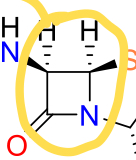
<p>Cyclic amide - 4 membered ring with a N </p>
2
New cards

What are Beta lactams a substrate analogue?

D-Ala-D-Ala

3
New cards

What do B-lactam antibiotics inhibit?

Inhibit crosslinking step of peptidoglycan synthesis 

4
New cards

What are the different type of B-lactam antibiotics?

Penicillins, cephalosporins, carbapenems 

5
New cards

What is a diagram showing the timeline of penicillin discovery?
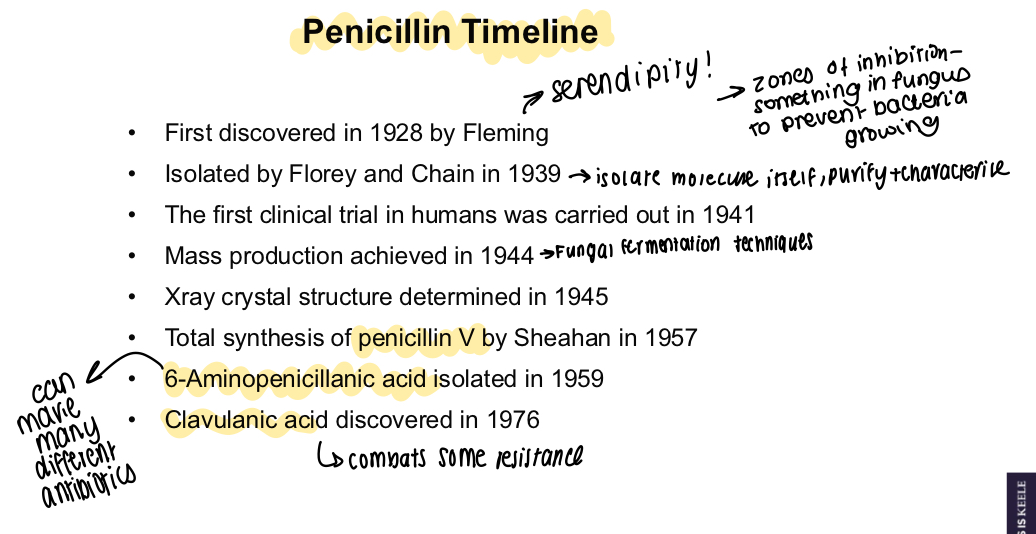
knowt flashcard image
6
New cards

What is the SAR of penicillin?

Amide bond is essential, stereochemistry essential, bicyclic structure, free acid and B-lactam ring all essential to function

7
New cards

What does the SAR mean?

Structure activity relationship - use be retained for activity

8
New cards

What is a thiazolidine ring?

Saturated ring containing sulphur and nitrogen

9
New cards

What is the mode of action of penicillin?

Binds to penicillin binding proteins - the beta lactam ring opens and forms a covalent bond irreversibly by acylating a serine residue within the active site of a PBP

10
New cards

What step does penicillin and analogues of this inhibit in peptidoglycan synthesis?

Transpeptidation 

11
New cards

What are PBPs?

Transpeptidase enzymes that catalyse the crosslinking step in peptidoglycan synthesis

12
New cards

What do better antibiotics bind to in terms of PBPs?

More PBPs binding = better antibiotic

13
New cards

What is the structure of the B-lactam ring?

Not planar - amide bond forces the chain to be bent 

14
New cards

What structure does the fused thiazolidine ring cause the lactam nitrogen to be in for penicillin?

Tetrahedral 

15
New cards

Why is the lactam amide bond in a B-lactam antibiotic more labile than amide bond in a peptide?

More susceptible to attack as the bond is weak - the lone pair of electrons held in nitrogen sp3 hybrid orbital cannot overlap with the carbonyls p orbital

16
New cards

What is the normal action of PBP catalysing release of D-alanine?

Serine residue attacks the amide bond, ester is cleaved off and forms a peptide chain and makes cross-linked peptidoglycan 
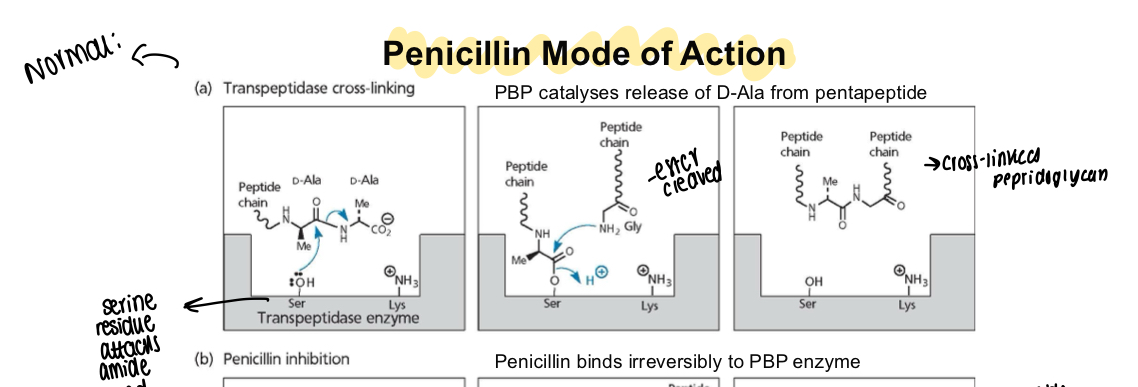
<p>Serine residue attacks the amide bond, ester is cleaved off and forms a peptide chain and makes cross-linked peptidoglycan&nbsp;</p>
17
New cards

What is the action of PBP when penicillin inhibits it?

Amide bond in penicillin is cleaved and OH and NH3 groups interact with serine and lysine in the transpeptidase enzyme, ester bond is then made and an additional ionic interaction is made, the residual portion left of the Abx is the thiazolidine ring, thiazolidine ring blocks hydrolysis of ester
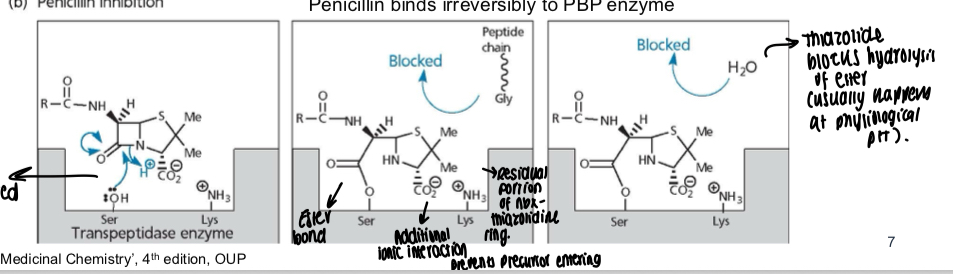
<p>Amide bond in penicillin is cleaved and OH and NH3 groups interact with serine and lysine in the transpeptidase enzyme, ester bond is then made and an additional ionic interaction is made, the residual portion left of the Abx is the thiazolidine ring, thiazolidine ring blocks hydrolysis of ester</p>
18
New cards

What was the first isolated penicillin?

Penicillin G
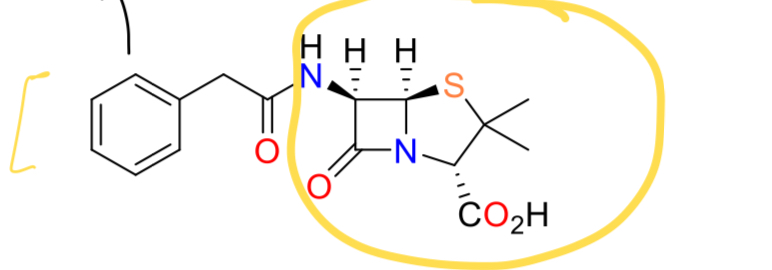
<p>Penicillin G </p>
19
New cards

What are the properties of penicillin G?

Non-toxic, active against gram positive cocci and gram negative bacteria, narrow spectrum

20
New cards

What are the issues with penicillin G?

NOT orally active, acid sensitive and destroyed by B-lactamases

21
New cards

Why is penicillin G acid sensitive?

Has a 4 membered ring which is unstable and labile B-lactam ring is extremely reactive - acid catalysis opens the ring and relieves the strain

22
New cards

How does acid hydrolysis occur in all penicillins?

The pi electrons from the carbonyl group in side chain attack the carbonyl group of the lactam amide bond, oxygen kicks out hydrogen, proton transfer means B-lactam ring opens and won’t reform, 4 membered ring becomes strained and converts to penicilloic acid
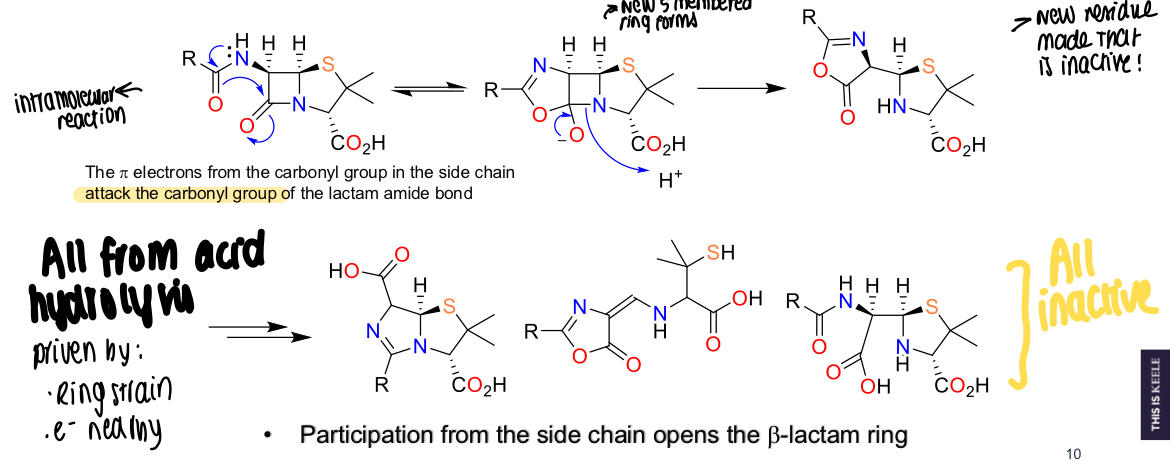
<p>The pi electrons from the carbonyl group in side chain attack the carbonyl group of the lactam amide bond, oxygen kicks out hydrogen, proton transfer means B-lactam ring opens and won’t reform, 4 membered ring becomes strained and converts to penicilloic acid </p>
23
New cards

What type of reaction is acid hydrolysis classified as?

Intramolecular reaction

24
New cards

What is acid hydrolysis driven by in penicillins?

Ring strain and nearby electrons

25
New cards

Why is acid hydrolysis bad for penicilllins?

Makes inactive molecules

26
New cards

What is the main difference between penicillin G and V?

Oxygen added in side chain between beta lactam SAR and benzene ring

27
New cards

What effect does the added oxygen in penicillin V have for activity?

Electronegative oxygen draws electrons towards itself via inductive effect so decreases the ability of electrons in carbonyls to attack the b-lactam

28
New cards

What is a beneficial property of penicillin V?

Acid stable so can be taken orally

29
New cards

What are the drawbacks of penicillin V?

Less potent than penicillin G and also sensitive to B-lactamases

30
New cards

What property must penicillin structures side chain have to have an effect?

Electron withdrawing effects

31
New cards

What are some examples of semi-synthetic penicillins?

Penicillin G, 6-Aminopenicillanic acid

32
New cards

What are the issues with semi-synthetic penicillins?

Unstable so need to access something to give a core structure

<p>Unstable so need to access something to give a core structure </p>
33
New cards

What do gram negative bacteria have in their cell that allows resistance to penicillins?

B-Lactamase in periplasmic space surrounding the cell

34
New cards

How are lactamase-resistant derivatives designed?

Attaching bulky groups to the penicillin that prevent access to the enzyme active site but must prevent the drug from accessing target transpeptidase active site

35
New cards

What type of bacteria do b-lactamase resistant penicillins have little/no activity against?

Gram negative due to steric bulk

36
New cards

What is a positive to methicillin?

Resistant to B-lactamases due to methoxy group that donates into electron ring

37
New cards

What is the key issue with methicillin?

Sensitive to acid hydrolysis so not orally active

38
New cards

What is the activity of methicillin against bacteria?

Weak activity against gram positive, not active against gram negative

39
New cards

What is the term to describe methicillin resistance?

MRSA

40
New cards

What are some examples of penicillins that are stable to acid and B-lactamases?

Oxacillin, flucloxacillin, temocillin

41
New cards

What is flucloxacillin good for for bacteria?

Gram positive bacteria that produces beta lactamases

42
New cards

What is a positive of flucloxacillin?

Higher bioavailability than other analogues

43
New cards

What are the benefits of temocillin?

Good for gram negative bacteria and reserved for resistance to 3rd generation cephalosporins

44
New cards

What are some examples of broad spectrum penicillins?

Ampicillin, amoxicillin

45
New cards

What are the disadvantages of broad spectrum penicillins?

Unstable to penicillinases, widespread resistance

46
New cards

What is co-amoxiclav comprised of?

Amoxicillin and clavulanic acid

47
New cards

What is co-amoxiclav used to treat?

Gram positive and negative bacteria that has resistance strains

48
New cards

What are examples of suicide inhibitors?

Clavulanic acid and tazobactam

49
New cards

How do suicide inhibitors work?

Bond covalently and degrade within the active site of the lactamase enzyme, inactivating it

50
New cards

Is tazobactam active in the body?

No - destroyed by B-lactamases

51
New cards

How many covalent bonds does clavulanic acid form?

2 covalent bonds within the active site

52
New cards

What are examples of antipseudomonal penicillins?

Piperacilin, ticarcillin

53
New cards

What is piperacillin available as?

Only available in combination with tazobactam

54
New cards

What is ticarcillin available as?

Combination with clavulanic acid

55
New cards

What are the properties of antipseudomonal penicillins?

Broad spectrum, available in combination with B-lactamase inhibitor

56
New cards

What are antipseudomonal penicillins active against in terms of bacteria?

Gram negative pseudomonas infections - reserved for treating septicaemia, HAP and complex infections

57
New cards

What is the SAR of cephalosporins?

Essential amide bond, B-lactam essential, stereochemistry essential, bicyclic structure and free acid
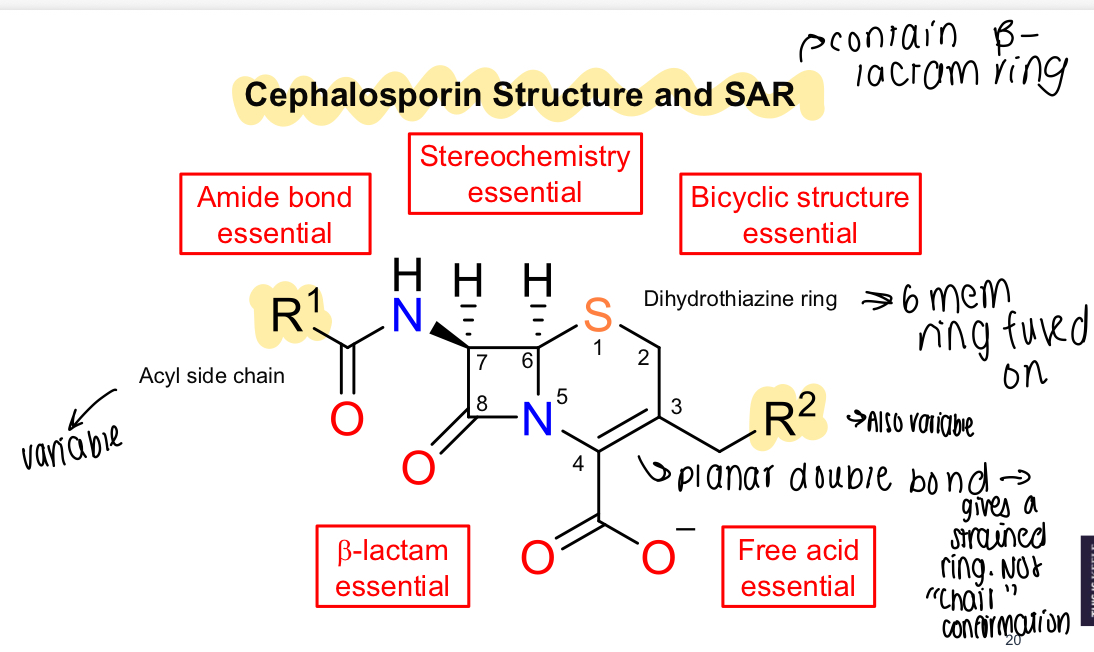
<p>Essential amide bond, B-lactam essential, stereochemistry essential, bicyclic structure and free acid </p>
58
New cards

What does the planar double bond in the cephalosporin SAR mean for the ring?

Strained ring

59
New cards

What is cephalosporin C active against?

Gram positive and negative bacteria

60
New cards

What are the advantages of cephalosporin C?

Stable to acid and B-lactamase

61
New cards

What are the disadvantages of cephalosporin C?

Low potency, not orally active, difficult to isolate and purify

62
New cards

What is the MOA of cephalosporin C?

PBP catalyses release of D-alanine from the pentapeptide - in cephalosporin C, serine cleaves the ring structure and the carboxylate group leaves, bonding the serine to the cephalosporin
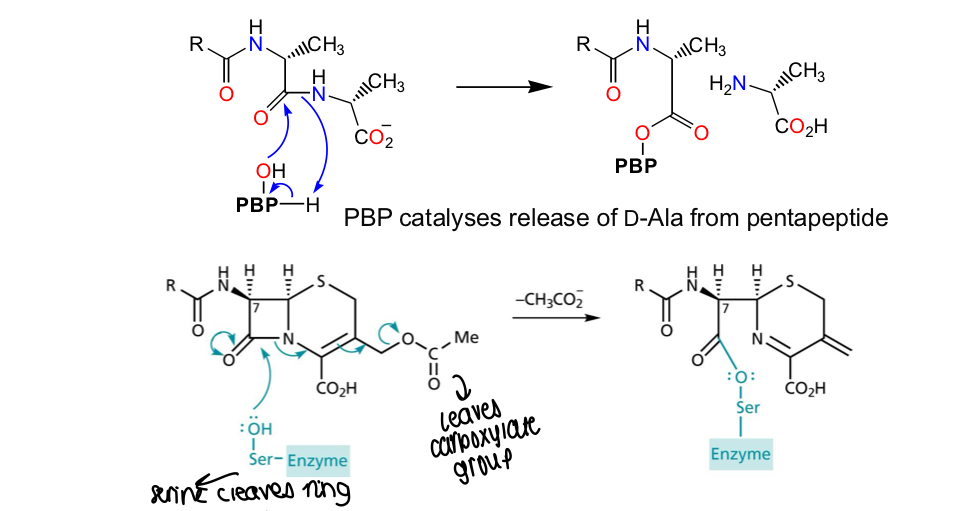
<p>PBP catalyses release of D-alanine from the pentapeptide - in cephalosporin C, serine cleaves the ring structure and the carboxylate group leaves, bonding the serine to the cephalosporin </p>
63
New cards

What are some properties of cephalosporins as a group?

Broader spectrum of activity than the penicillins and effective against many resistant strains of bacteria

64
New cards

What cephalosporin is an analogue of 6-APA?

7-aminocephalosporanic acid

65
New cards

What are the drawbacks of 7-aminocephalosporanic acid?

Not readily available, much more expensive to produce and investigate

66
New cards

How are most cephalosporins administered?

IV as typically poorly absorbed across gut wall

67
New cards

What is an example of a 1st generation cephalosporin?

Cefalexin

68
New cards

What are the positives of Cefalexin?

Orally active, broad spectrum, greater activity against gram positive

69
New cards

What group in Cefalexin compensates for the loss of the ester substituent?

Hydrophilic amino group

70
New cards

What cephalosporin has the same side chain as ampicillin?

Cefalexin

71
New cards

What is an example of a 2nd generation cephalosporin?

Cefuroxime

72
New cards

What is a benefit of Cefuroxime in comparison to 1st generation cephalosporins?

Greater resistance to B-lactamases

73
New cards

What functional group is Cefuroxime is stable to metabolism?

Urethane functional group

74
New cards

What is an example of a 3rd generation cephalosporin?

Ceftriaxone

75
New cards

What are the positives to ceftriaxone?

Broad spectrum, long half life, more active against gram negative bacteria than 2nd generation

76
New cards

What infections if ceftriaxone reserved for?

Serious infections e.g., pneumonia, septicaemia

77
New cards

What is the absorption like of cephalosporins in CNS?

Poorly absorbed unless membranes are inflamed

78
New cards

What is a use of ceftriaxone in relation to the CNS?

Can treat meningitis

79
New cards

What are the advantages of carbapenems?

Broad spectrum, bind to a range of PBPs, resistant to B-lactamases

80
New cards

What are examples of carbapenems?

Imipenem, ertapenem

81
New cards

What are carbapenems reserved for?

HAP and complex infections - resistance is increasing!

Explore top notes

Imperialism Rise in Nationalism • During the French and Industrial Revolution, nationalism continued to inspire nations to increase their political and economic power. • Nationalism became the ideal force in the political, economic, and cultural life in the world, becoming the first universal ideology-organizing all people into a nation state. Nationalism Defined • The strong belief that the interest of a particular nation-state is of primary importance. o Nation-State – a state where the vast majority shares the same culture and is conscious of it. It is an ideal in which cultural boundaries match up with political ones. • As an ideology, it is based on the idea that the individual’s loyalty and devotion to the nation-state surpass other individual/group interests. • Exalting one nation’s belief above all others and placing primary emphasis on promotion of its culture and interests, excluding the interests of others. Changing the World through a Nationalistic Vision • The French Revolution significantly changed the political world and how countries govern. • The Industrial Revolution significantly changed the economic world. • The Age of Imperialism (1870-1914) dramatically changed the political, economic, and social world. What is Imperialism? • Imperialism- The policy of extending the rule of authority of an empire or nation over foreign countries, or of acquiring and holding colonies and dependencies. Power and influence are done through diplomacy or military force. Reasons for Imperialism • There are 5 main motives for empires to seek to expand their rule over other countries or territories: 1. Exploratory • Imperial nations wanted to explore territory unknown to them. • The main purpose for this exploration of new lands was for resource acquisition, medical or scientific research. o Charles Darwin • Other reasons: o Cartography (map making) o Adventure 2. Ethnocentric • Europeans acted on the concept of ethnocentrism o Ethnocentrism- the belief that one race or nation is superior to others. • Ethnocentrism developed out of Charles Darwin’s “survival of the fittest” theory. Philosophers used the theory to explain why there were superior races and inferior races. o This became known as Social Darwinism. • Most imperial nations believed that their cultural values or beliefs were superior to other nations or groups. • Believed imperial conquest would bring successful culture to inferior people. 3. Religious • Imperial expansion promoted a religious movement of people setting out to convert new members of conquered territories. • With the belief that Christianity was superior, missionaries believed it was their duty to spread Christianity to the world. • Christian missionaries established churches, and in doing so, they spread Western culture values as well. • Typically, missionaries spread the imperial nation's language through education and religious interactions. 4. Political • Patriotism and Nationalism helped spur our imperial growth, thus creating competition against other supremacies. • It was a matter of national pride, respect, and security. • Furthermore, European rivalry spurred nations for imperial conquest. Since land equaled power, the more land a country could acquire the more prestige they could wield across the globe. • Empires wanted strategic territory to ensure access for their navies and armies around the world. • The empire believed they must expand, thus they needed to be defended. 5. Economic • With the Industrial Revolution taking place during the same time, governments and private companies contributed to find ways to maximize profits. • Imperialized countries provided European factories and markets with natural resources (old and new) to manufacture products. • Trading posts were strategically placed around imperialized countries to maximize and increase profits. o Such places as the Suez Canal in Egypt which was controlled by the British provided strategic choke hold over many European powers. o Imperial powers competed over the best potential locations for resources, markets, and trade. History of Imperialism • Ancient Imperialism 600 BCE-500 CE o Roman Empire, Ancient China, Greek Empire, Persian Empire, Babylonian Empire. • Middle Age Imperialism (Age of Colonialism-1400-1800s) o Great Britain, Spain, Portugal, France, Netherlands (Dutch), Russia. • Age of Imperialism 1870-1914 o Great Britain, Spain, Portugal, France, Germany, Belgium, Italy, Japan, United States, Ottoman Empire, Russia. • Current Imperialism...? o U.S. Military intervention (i.e. Middle East) o Russia’s Invasion of Ukraine. Imperialism Colonialism • Refers to political or economic control, either legally or illegally. • Refers to where one nation assumes control over the other. • Creating an empire, expanding into neighboring regions and expanding the dominance far outside its borders. • Where a country conquers and rules over other regions for exploiting resources from the conquered country for the conqueror's benefit. • Foreign government controls/governs a territory without significant settlement. • Foreign government controls/governs the territory from within the land being colonized. • Little to no new settlement established on fresh territory. • Movement to settle to fresh territory. Age of Colonialism WHEN? • Started around the late 1400s and ended around the late 1700s/early 1800s. WHY? • Primary Reason: European countries, wished to find a direct trade route to Asia (China & India) and the East Indies. o Quicker and relatively more effective than land routes over Asia. • Secondary Reason: Empire expansion (land power) WHO? • Countries involved: Great Britain, France, Spain, the Dutch & Portugal. • Individuals’ knowns as Mercantilists believed that maintaining imperialized territory and colonizing the region could serve as a source of wealth, while personal motives by rulers, explorers, and missionaries could therefore promote their own agenda. o This agenda being “Glory, God and Gold”. Mercantilism • Mercantilism was a popular and main economic system for many European nations during the 16th to 18th centuries. • The main goal was to increase a nation’s wealth by promoting government rule of a nation’s economy for the purpose of enhancing state power at the expense of rival national power. • It was the economic counterpart of political absolutism. Why did mercantilists want colonies? • Mercantilists believed that a country must have an excess of exports over imports. • By colonizing territory, it provided the nation with indispensable wealth of precious raw materials. • Therefore, the claimed territory served as a market and supplier of raw materials for the mother country. Which, in time, provided an excess of exports for the nation and thus created wealth. o Development of Trading Companies to support this economic system. Hudson Bay Company – (1670). Controlled primarily North America. o Dutch East Indie Trading Company (1682) o East Indian Trading Company (1600) o Royal African Trade Company (1672) WHERE? • European nations begun to colonize the America, India and the East Indies to create a direct trade route. • Great Britain was the leading power in India, Australia and North America, South Africa. • Spain colonized central and South America. • French held Louisiana, coastal land of Africa and French Guinea. • The Dutch built an empire in the East Indies. • The Portuguese was able to take control of present-day Brazil and the southern tip of South America and Japan. Age of Colonialism • As countries started to imperialize these regions, eventually the concept of colonization took hold: • This is what makes the Age of Colonialism extremely different! End of Colonialism • By 1800, colonialism became less popular • Why? o Revolutions (Spain, France & American) o The Napoleonic Wars o Struggle for nationalism and democracy. o Exhausted all money and energy to supervise their colonies. Waiting to wake again • Imperialism would stay quiet for close to 50 years before Great Britain and France’s economies revitalized. • The outbreak of the Industrial Revolution only encouraged and revitalized European nations to begin their conquest for new territory and resources. Age of Imperialism THE SCRAMBLE FOR AFRICA 1870-1914 Conditions Prior to Imperialism of Africa  European interest in exploiting Africa was minimal.  Their economic interests & profit in Africa primarily came through coastal trade that took place during the 1500-1700s.  The slave trade became the main source of European profit.  Furthermore, disease, political instability, lack of transportation and unpredictable climate all discouraged Europeans from seeking territory. Slave Trade & the Trans-Atlantic Slave Voyages  Forced labor was not uncommon during the 13-17th Centuries. Africans and Europeans had been trading goods and people across the Mediteranea for centuries.  This all changed from 1526 to 1867, as a new system of slavery was introduced that became highly “commercialized, racialized and inherited”  By 1690, the America and West Indies saw approximately 30,000 African people shipped from Africa. A century later, that number grew to 85,000 people per year.  By 1867, approximately 12.5 million people (about twice the population of Arizona) left Africa in a slave ship. What Changed? 1. End of the Slave Trade- Left a need for trade between Europe and Africa. 2. Innovation in technology- The steam engine and iron hulled boats allowed Europe 3. Discovery of new raw materials- Explorers located vast raw materials and resources and this only spurred imperialism with Europe in the wake of the Industrial Revolution. 4. Politics- Unification of Germany and Italy left little room to expand in Europe. Germany and Italy both needed raw materials to “catch up” with Britain and France so they looked to Africa. The Scramble for Africa  The scramble started in 1870.  Although some coastal land had previously been acquired before 1870, the need for territory quickly accelerated as European countries looked t get deeper into Africa.  Within 20 years, nearly all continents were placed under imperialistic rule. Who was Involved?  Great Britain  France  Germany  Italy  Portugal  Belgium  Spain (kind) Violent Affairs  Violence broke out multiple times when European nations looked to claim the same territory.  Germ Chancellor. Otto van Bismarck. Attempted to avert the possibility of violence against the European powers.  In 1884, Bismarck organized a conference in Berlin for the European nations. The Berlin Conference (1884-85)  The conference looked to set ground rules for future annexation of African territory by European Nations.  Annexation is the forcible acquisition and assertion of legal title over one state’s territory by another state, usually following military occupation of the territory.  From a distant perspective, it looked like it would reduce tensions among European nations and avert war.  At the heart of the meeting, these European countries negotiated their claims to African territory, made it official and then mapped their regions.  Furthermore, the leaders agreed to allow free trade among imperialized territory and some homework for negotiating future European claims in Africa was established. Further Path  After the conference, european powers continued to expand their claims in Africa so that by 1900. 90% of the African territory had been claimed. A Turn towards Colonization?  Upon the imperialization of African territory, European nations and little interest in African land unless it produced economic wealth.  Therefore, European governments put little effort and expertise into these imperialized regions.  In most cases, this emat a form of indirect rule. Thus, governing the natin without sufficient settlement and government from within the mother country. Some Exceptions  There were some exemptions through in Africa as colonization was a necessary for some regions i n Africa.  Some regions where diamonds and gold were present. Government looked to protectorate the regions and establish rule and settlement in the regions.  Protectorates: A state controlled and protected by another state for defense against aggression and other law violations. Would  Some examples include South Africa, Botswana, Zimbabwe and Congo. Conclusion  Although it may appear that the Berlin Conference averted war amid the African Scramble, imperialism eventually brought the world into worldwide conflict.  With the continued desire to create an empire by European nations. World War 1 would break out which can be linked to this quest at imperialism.
Updated 490d ago
note Note
Imperialism Rise in Nationalism • During the French and Industrial Revolution, nationalism continued to inspire nations to increase their political and economic power. • Nationalism became the ideal force in the political, economic, and cultural life in the world, becoming the first universal ideology-organizing all people into a nation state. Nationalism Defined • The strong belief that the interest of a particular nation-state is of primary importance. o Nation-State – a state where the vast majority shares the same culture and is conscious of it. It is an ideal in which cultural boundaries match up with political ones. • As an ideology, it is based on the idea that the individual’s loyalty and devotion to the nation-state surpass other individual/group interests. • Exalting one nation’s belief above all others and placing primary emphasis on promotion of its culture and interests, excluding the interests of others. Changing the World through a Nationalistic Vision • The French Revolution significantly changed the political world and how countries govern. • The Industrial Revolution significantly changed the economic world. • The Age of Imperialism (1870-1914) dramatically changed the political, economic, and social world. What is Imperialism? • Imperialism- The policy of extending the rule of authority of an empire or nation over foreign countries, or of acquiring and holding colonies and dependencies. Power and influence are done through diplomacy or military force. Reasons for Imperialism • There are 5 main motives for empires to seek to expand their rule over other countries or territories: 1. Exploratory • Imperial nations wanted to explore territory unknown to them. • The main purpose for this exploration of new lands was for resource acquisition, medical or scientific research. o Charles Darwin • Other reasons: o Cartography (map making) o Adventure 2. Ethnocentric • Europeans acted on the concept of ethnocentrism o Ethnocentrism- the belief that one race or nation is superior to others. • Ethnocentrism developed out of Charles Darwin’s “survival of the fittest” theory. Philosophers used the theory to explain why there were superior races and inferior races. o This became known as Social Darwinism. • Most imperial nations believed that their cultural values or beliefs were superior to other nations or groups. • Believed imperial conquest would bring successful culture to inferior people. 3. Religious • Imperial expansion promoted a religious movement of people setting out to convert new members of conquered territories. • With the belief that Christianity was superior, missionaries believed it was their duty to spread Christianity to the world. • Christian missionaries established churches, and in doing so, they spread Western culture values as well. • Typically, missionaries spread the imperial nation's language through education and religious interactions. 4. Political • Patriotism and Nationalism helped spur our imperial growth, thus creating competition against other supremacies. • It was a matter of national pride, respect, and security. • Furthermore, European rivalry spurred nations for imperial conquest. Since land equaled power, the more land a country could acquire the more prestige they could wield across the globe. • Empires wanted strategic territory to ensure access for their navies and armies around the world. • The empire believed they must expand, thus they needed to be defended. 5. Economic • With the Industrial Revolution taking place during the same time, governments and private companies contributed to find ways to maximize profits. • Imperialized countries provided European factories and markets with natural resources (old and new) to manufacture products. • Trading posts were strategically placed around imperialized countries to maximize and increase profits. o Such places as the Suez Canal in Egypt which was controlled by the British provided strategic choke hold over many European powers. o Imperial powers competed over the best potential locations for resources, markets, and trade. History of Imperialism • Ancient Imperialism 600 BCE-500 CE o Roman Empire, Ancient China, Greek Empire, Persian Empire, Babylonian Empire. • Middle Age Imperialism (Age of Colonialism-1400-1800s) o Great Britain, Spain, Portugal, France, Netherlands (Dutch), Russia. • Age of Imperialism 1870-1914 o Great Britain, Spain, Portugal, France, Germany, Belgium, Italy, Japan, United States, Ottoman Empire, Russia. • Current Imperialism...? o U.S. Military intervention (i.e. Middle East) o Russia’s Invasion of Ukraine. Imperialism Colonialism • Refers to political or economic control, either legally or illegally. • Refers to where one nation assumes control over the other. • Creating an empire, expanding into neighboring regions and expanding the dominance far outside its borders. • Where a country conquers and rules over other regions for exploiting resources from the conquered country for the conqueror's benefit. • Foreign government controls/governs a territory without significant settlement. • Foreign government controls/governs the territory from within the land being colonized. • Little to no new settlement established on fresh territory. • Movement to settle to fresh territory. Age of Colonialism WHEN? • Started around the late 1400s and ended around the late 1700s/early 1800s. WHY? • Primary Reason: European countries, wished to find a direct trade route to Asia (China & India) and the East Indies. o Quicker and relatively more effective than land routes over Asia. • Secondary Reason: Empire expansion (land power) WHO? • Countries involved: Great Britain, France, Spain, the Dutch & Portugal. • Individuals’ knowns as Mercantilists believed that maintaining imperialized territory and colonizing the region could serve as a source of wealth, while personal motives by rulers, explorers, and missionaries could therefore promote their own agenda. o This agenda being “Glory, God and Gold”. Mercantilism • Mercantilism was a popular and main economic system for many European nations during the 16th to 18th centuries. • The main goal was to increase a nation’s wealth by promoting government rule of a nation’s economy for the purpose of enhancing state power at the expense of rival national power. • It was the economic counterpart of political absolutism. Why did mercantilists want colonies? • Mercantilists believed that a country must have an excess of exports over imports. • By colonizing territory, it provided the nation with indispensable wealth of precious raw materials. • Therefore, the claimed territory served as a market and supplier of raw materials for the mother country. Which, in time, provided an excess of exports for the nation and thus created wealth. o Development of Trading Companies to support this economic system. Hudson Bay Company – (1670). Controlled primarily North America. o Dutch East Indie Trading Company (1682) o East Indian Trading Company (1600) o Royal African Trade Company (1672) WHERE? • European nations begun to colonize the America, India and the East Indies to create a direct trade route. • Great Britain was the leading power in India, Australia and North America, South Africa. • Spain colonized central and South America. • French held Louisiana, coastal land of Africa and French Guinea. • The Dutch built an empire in the East Indies. • The Portuguese was able to take control of present-day Brazil and the southern tip of South America and Japan. Age of Colonialism • As countries started to imperialize these regions, eventually the concept of colonization took hold: • This is what makes the Age of Colonialism extremely different! End of Colonialism • By 1800, colonialism became less popular • Why? o Revolutions (Spain, France & American) o The Napoleonic Wars o Struggle for nationalism and democracy. o Exhausted all money and energy to supervise their colonies. Waiting to wake again • Imperialism would stay quiet for close to 50 years before Great Britain and France’s economies revitalized. • The outbreak of the Industrial Revolution only encouraged and revitalized European nations to begin their conquest for new territory and resources. Age of Imperialism THE SCRAMBLE FOR AFRICA 1870-1914 Conditions Prior to Imperialism of Africa  European interest in exploiting Africa was minimal.  Their economic interests & profit in Africa primarily came through coastal trade that took place during the 1500-1700s.  The slave trade became the main source of European profit.  Furthermore, disease, political instability, lack of transportation and unpredictable climate all discouraged Europeans from seeking territory. Slave Trade & the Trans-Atlantic Slave Voyages  Forced labor was not uncommon during the 13-17th Centuries. Africans and Europeans had been trading goods and people across the Mediteranea for centuries.  This all changed from 1526 to 1867, as a new system of slavery was introduced that became highly “commercialized, racialized and inherited”  By 1690, the America and West Indies saw approximately 30,000 African people shipped from Africa. A century later, that number grew to 85,000 people per year.  By 1867, approximately 12.5 million people (about twice the population of Arizona) left Africa in a slave ship. What Changed? 1. End of the Slave Trade- Left a need for trade between Europe and Africa. 2. Innovation in technology- The steam engine and iron hulled boats allowed Europe 3. Discovery of new raw materials- Explorers located vast raw materials and resources and this only spurred imperialism with Europe in the wake of the Industrial Revolution. 4. Politics- Unification of Germany and Italy left little room to expand in Europe. Germany and Italy both needed raw materials to “catch up” with Britain and France so they looked to Africa. The Scramble for Africa  The scramble started in 1870.  Although some coastal land had previously been acquired before 1870, the need for territory quickly accelerated as European countries looked t get deeper into Africa.  Within 20 years, nearly all continents were placed under imperialistic rule. Who was Involved?  Great Britain  France  Germany  Italy  Portugal  Belgium  Spain (kind) Violent Affairs  Violence broke out multiple times when European nations looked to claim the same territory.  Germ Chancellor. Otto van Bismarck. Attempted to avert the possibility of violence against the European powers.  In 1884, Bismarck organized a conference in Berlin for the European nations. The Berlin Conference (1884-85)  The conference looked to set ground rules for future annexation of African territory by European Nations.  Annexation is the forcible acquisition and assertion of legal title over one state’s territory by another state, usually following military occupation of the territory.  From a distant perspective, it looked like it would reduce tensions among European nations and avert war.  At the heart of the meeting, these European countries negotiated their claims to African territory, made it official and then mapped their regions.  Furthermore, the leaders agreed to allow free trade among imperialized territory and some homework for negotiating future European claims in Africa was established. Further Path  After the conference, european powers continued to expand their claims in Africa so that by 1900. 90% of the African territory had been claimed. A Turn towards Colonization?  Upon the imperialization of African territory, European nations and little interest in African land unless it produced economic wealth.  Therefore, European governments put little effort and expertise into these imperialized regions.  In most cases, this emat a form of indirect rule. Thus, governing the natin without sufficient settlement and government from within the mother country. Some Exceptions  There were some exemptions through in Africa as colonization was a necessary for some regions i n Africa.  Some regions where diamonds and gold were present. Government looked to protectorate the regions and establish rule and settlement in the regions.  Protectorates: A state controlled and protected by another state for defense against aggression and other law violations. Would  Some examples include South Africa, Botswana, Zimbabwe and Congo. Conclusion  Although it may appear that the Berlin Conference averted war amid the African Scramble, imperialism eventually brought the world into worldwide conflict.  With the continued desire to create an empire by European nations. World War 1 would break out which can be linked to this quest at imperialism.
Updated 490d ago
note Note

Explore top flashcards

Unit 5: Genetics
Updated 375d ago
flashcards Flashcards (29)
La familia
Updated 784d ago
flashcards Flashcards (38)
CMS III Final: EM
Updated 255d ago
flashcards Flashcards (212)
2b: Cell structure
Updated 1171d ago
flashcards Flashcards (30)
deelsteppen
Updated 1065d ago
flashcards Flashcards (87)
PSYC 14
Updated 148d ago
flashcards Flashcards (64)
Unit 5: Genetics
Updated 375d ago
flashcards Flashcards (29)
La familia
Updated 784d ago
flashcards Flashcards (38)
CMS III Final: EM
Updated 255d ago
flashcards Flashcards (212)
2b: Cell structure
Updated 1171d ago
flashcards Flashcards (30)
deelsteppen
Updated 1065d ago
flashcards Flashcards (87)
PSYC 14
Updated 148d ago
flashcards Flashcards (64)