NURS 262- Exam 3 Textbook Questions
 Call Kai
 Learn
Learn Practice Test
 Spaced Repetition
 Match
Match Flashcards
 Knowt Play
1/39

There's no tags or description
Looks like no tags are added yet.
Name | Mastery | Learn | Test | Matching | Spaced | Call with Kai |
|---|
No analytics yet
Send a link to your students to track their progress
40 Terms
The nurse would call the primary care provider immediately for which laboratory result?
Hgb = 16 g/dL for a male client
Hct = 22% for a female client
WBC = 9000/mm3
Platelets = 300,000/μL
Hct = 22% for a female client
Very low (36-44%) and can lead to death; RBCs participate in oxygenation
A 78-year-old male client needs to complete a 24-hour urine specimen. In planning his care, the nurse realizes that which measure is most important?
Instruct the client to empty his bladder and save this voiding to start the collection.
Instruct the client to use sterile individual containers to collect the urine.
Post a sign stating “Save All Urine” in the bathroom.
Keep the urine specimen in the refrigerator
Post a sign stating “save all urine” in the bathroom
Will inform the staff that the client is on 24-hour urine collection
The first voided specimen is to be discarded
The specimen container is meant to be clean, not sterile; only one container is needed for the urine specimen, not multiple
Some 24-hour urine collections do not require refridgeration
The client has a urinary health problem. Which procedure is performed using indirect visualization?
Intravenous pyelography (IVP)
Kidneys, ureter, bladder (KUB)
Retrograde pyelography
Cystoscopy
Kidneys, ureter, bladder (KUB)
A KUB is an x-ray of the kidneys, ureters, and bladder; it does not require direst visualization
Intravenous pyelography is an IVP, which requires the injection of a contrast media
Retrograde pyelography requires the injection of a contrast media
Cystoscopies use a lighted instrument inserted through the urethra, resulting in direct visualization
Which noninvasive procedure provides information about the physiology or function of an organ?
Angiography
Computerized tomography (CT)
Magnetic resonance imaging (MRI)
Positron emission tomography (PET)
Positron emission tomography (PET)
This type of nuclear scan demonstrates the ability of tissues to absorb the chemical to indicate the physiology and function of an organ
Angiographies are invasive procedures focusing on blood flow through an organ
CTs and MRIs provide information about density of tissue to help distinguish between normal and abnormal tissue of an organ
When assisting with a bone marrow biopsy, the nurse should take which action?
Assist the client to a right side-lying position after the procedure.
Observe for signs of dyspnea, pallor, and coughing.
Assess for bleeding and hematoma formation for several days after the procedure.
Stand in front of the client and support the back of the neck and knees.
Assess for bleeding and hematoma formation for several days after the procedure
Bone marrow aspiration includes deep penetration into soft tissue and large bones such as the sternum and iliac crest
This penetration can result in bleeding
Assisting to a right-lying position is an action during a liver biopsy
Observing for dyspnea, pallor, and cough is an action for thoracentesis
Standing in front of the client and supporting the back of the neck/knees is an action for a lumbar puncture
During an assessment, the nurse learns that the client has a history of liver disease. Which diagnostic tests might be indicated for this client? Select all that apply.
Alanine aminotransferase (ALT)
Myoglobin
Cholesterol
Ammonia
Brain natriuretic peptide or B-type natriuretic peptide (BNP)
ALT, ammonia
ALT is an enzyme that contributes to protein and carbohydrate metabolism (increase indicates liver damage)
The liver contributes to the metabolism of protein, which results in the production of ammonia
Myoglobin, cholesterol, and BNP are relevant for heart disease
The nurse practitioner requests a laboratory blood test to determine how well a client has controlled her diabetes during the past 3 months. Which blood test will provide this information?
Fasting blood glucose
Capillary blood specimen
Glycosylated hemoglobin
GGT (gamma-glutamyl transferase)
Glycosylated hemoglobin
Indicates the glucose levels for a period of time
Fasting blood glucose and capillary blood specimen will provide information about the current blood glucose, not past history
GGT is for liver disease assessment
The client is supposed to have a fecal occult blood test done on a stool sample. The nurse is going to use the Hemoccult test. Which of the following indicates that the nurse is using the correct procedure? Select all that apply.
Mixes the reagent with the stool sample before applying to the card.
Collects a sample from two different areas of the stool specimen.
Assesses for a blue color change.
Asks a colleague to verify the pink color results.
Asks the client if he has taken vitamin C in the past few days.
Collect sample from two different areas of the stool specimen
Assess for a blue color change
Ask the client if he has taken Vit C in the past few days
Blue indicates positive result
Ingestion of Vit C is contraindicated for 3 days prior to taking the specimen
Option 1 is incorrect because the reagent is placed on the specimen after it is applied to the testing card
Option 4 is incorrect because a pink color would be considered negative and doesn’t require verification
A primary care provider is going to perform a thoracentesis. The nurse’s role will include which action?
Place the client supine in Trendelenburg’s position.
Position the client in a seated position with elbows on the overbed table.
Instruct the AP to measure vital signs.
Administer an opioid analgesic.
Position the client in a seated position with elbows on the overbed table
Puncture site is usually on the posterior chest; leaning forward allows the ribs to separate for exposure of the site
The nurse needs to collect a sputum specimen to identify the presence of tuberculosis (TB). Which nursing action(s) is/are indicated for this type of specimen? Select all that apply.
Collect the specimen in the evening.
Send the specimen immediately to the laboratory.
Ask the client to spit into the sputum container.
Offer mouth care before and after collection of the sputum specimen.
Collect a specimen for 3 consecutive days.
Send the specimen immediately to the laboratory
Offer mouth care before and after collection of the sputum specimen
Collect a specimen for 3 consecutive days
Sputum is collected in the morning, not evening
Asking the client to “spit” is incorrect as that indicates saliva is being examined; the client needs to cough up or expectorate mucus/sputum
An older nursing home resident has refused to eat or drink for several days and is admitted to the hospital. The nurse should expect which assessment finding?
Elevated blood pressure
Weak, rapid pulse
Moist mucous membranes
Jugular vein distention
Weak, rapid pulse
Elevated BP, moist mucous membranes, and jugular vein distention are indicative of fluid volume excess
A man brings his elderly wife to the emergency department. He states that she has been vomiting and has had diarrhea for the past 2 days. She appears lethargic and is complaining of leg cramps. What should the nurse do first?
Start an IV.
Review the results of serum electrolytes.
Offer the woman foods that are high in sodium and potassium content.
Administer an antiemetic.
Review the results of serum electrolytes
Further assessment is needed to determine appropriate actions (ADPIE)
The rest of the options are interventions
The nurse administers an IV solution of D5 1/2NS to a postoperative client. This is classified as what type of intravenous solution?
Hypertonic
An older client comes to the emergency department experiencing chest pain and shortness of breath. An arterial blood gas is ordered. Which ABG results indicate respiratory acidosis?
pH 7.54; PaCO2 28 mmHg; HCO3 22 mEq/L
pH 7.32; PaCO2 46 mmHg; HCO3 24 mEq/L
pH 7.31; PaCO2 35 mmHg; HCO3 20 mEq/L
pH 7.50; PaCO2 37 mmHg; HCO3 28 mEq/L
pH 7.32; PaCO2 46 mmHg; HCO3 24 mEq/L
Retention of CO2 would cause a decreased pH with varying levels of HCO3 related to hypoventilation
The intake and output (I&O) record of a client with a nasogastric tube who has been attached to suction for 2 days shows greater output than input. Which nursing diagnoses are most applicable? Select all that apply.
Decreased fluid volume
Potential for decreased fluid volume
Dry oral mucous membranes
Altered gas exchange
Inadequate cardiac output
Decreased fluid volume, dry oral mucous membranes, inadequate cardiac output
The data includes an actual problem, excluding the option of “potential for decreased fluid volume”
Altered gas exchange is related more to increased fluid volume
Which client statement indicates a need for further teaching regarding treatment for hypokalemia?
“I will use avocado in my salads.”
“I will be sure to check my heart rate before I take my digoxin.”
“I will take my potassium in the morning after eating breakfast.”
“I will stop using my salt substitute.”
I will stop using my salt substitute
Salt substitutes contain potassium; the client can still use it within reason
An older man is admitted to the medical unit with a diagnosis of dehydration. Which sign or symptom is most indicative of a sodium imbalance?
Hyperreflexia
Mental confusion
Irregular pulse
Muscle weakness
Mental confusion
Sodium contributes to neural tissue function
Hyperreflexia and muscle weakness are related more to calcium imbalances
Irregular pulses are related to potassium and calcium, which contribute to cardiac function
The client’s arterial blood gas results are pH 7.32; PaCO2 58; HCO3 32. The nurse knows that the client is experiencing which acid–base imbalance?
Metabolic acidosis
Respiratory acidosis
Metabolic alkalosis
Respiratory alkalosis
Respiratory acidosis
Because of CO2 retention, the PaCO2 is elevated
Metabolic acidosis involves a loss of bicarbonate, but no retention of CO2
Metabolic acidosis involves a loss of acid or retention of HCO3, but no retention of CO2
Respiratory alkalosis involves a loss of CO2, resulting in increased pH
A client is admitted to the hospital for hypocalcemia. Nursing interventions relating to which system would have the highest priority?
Renal
Cardiac
Gastrointestinal
Neuromuscular
Neuromuscular
Major clinical signs and symptoms of hypocalcemia are due to increased neuromuscular activity, and not the renal, cardiac, or GI systems
The nurse would assess for signs of hypomagnesemia in which of the following clients? Select all that apply.
A client with renal failure
A client with pancreatitis
A client taking magnesium-containing antacids
A client with excessive nasogastric drainage
A client with chronic alcoholism
A client with pancreatitis, excessive nasogastric drainage, chronic alcoholism
Renal failure and magnesium-containing antacids are related to hypermagnesemia
Your client has a Braden scale score of 17. Which is the appropriate nursing action?
Assess the client again in 24 hours; the score is within normal limits.
Implement a turning schedule; the client is at increased risk of skin breakdown.
Apply a transparent wound barrier to major pressure sites; the client is at moderate risk of skin breakdown.
Request an order for a special low-air-loss bed; the client is at very high risk of skin breakdown.
Implement a turning schedule; the client is at increased risk of skin breakdown
Score from 15-18 indicates risk
Transparent barriers would be appropriate for scores 13-14
Option 4 is very high risk, assigned for scores 9 or less
Proper technique for performing a wound culture includes which of the following?
Cleansing the wound prior to obtaining the specimen
Swabbing for the specimen in the area with the largest collection of drainage
Removing crusts or scabs with sterile forceps and then culturing the site beneath
Waiting 8 hours following a dose of antibiotic to obtain the specimen
Cleansing the wound prior to obtaining the specimen
Microbes responsible for infection are more likely to be found in viable tissue
Collected drainage contains old and mixed organisms
An appropriate specimen can be obtained without causing the client the discomfort of debriding
Once systemic antibiotics have begun, the interval following a dose will not significantly affect the concentration of wound organism
A client has a pressure injury with a shallow, partial skin thickness, and eroded area but no necrotic areas. The nurse would treat the area with which dressing?
Alginate
Dry gauze
Hydrocolloid
No dressing is indicated
Hydrocolloid
Hydrocolloid dressings protect shallow injuries and maintain an appropriate healing environment
Alginates (option 1) are used for wounds with significant drainage
Dry gauze (option 2) will stick to new granulation tissue, causing more damage. A dressing is needed to protect the wound and enhance healing.
Thirty (30) minutes after application is initiated, the client requests that the nurse leave the heating pad in place. The nurse explains the following to the client:
Heat application for longer than 30 minutes can actually cause the opposite effect (constriction) of the desired one (dilation).
It will be acceptable to leave the pad in place if the temperature is reduced.
It will be acceptable to leave the pad in place for another 30 minutes if the site appears satisfactory when assessed.
It will be acceptable to leave the pad in place as long as it is moist heat.
Heat application for longer than 30 minutes can actually cause the opposite effect (constriction) of the desired one (dilation)
The heating pad needs to be removed. After 30 minutes of heat application, the blood vessels in the area will begin to exhibit the rebound effect, resulting in vasoconstriction
Lowering the temperature, but still delivering heat—dry or moist—will not prevent the rebound effect. The visual appearance of the site on inspection (option 3) does not indicate if rebound is occurring
Which statement, if made by the client or family member, would indicate the need for further teaching?
“If a skin area gets red but then the red goes away after turning, I should report it to the nurse.”
“Putting foam pads under my heels or other bony areas can help decrease pressure.”
“If my father cannot turn himself in bed, I should help him change position every 4 hours.”
“The skin should be washed with only warm water (not hot) and lotion put on while it is still a little wet.”
If my father cannot turn himself in bed, I should help him change position every 4 hours
Immobile and dependent clients should be repositioned at least every 2 hours, not every 4, so this client or family member requires further teaching
Your client is only comfortable lying on the right or left side (not on the back or stomach). List four potential sites of pressure injuries you must assess.
Potential pressure injury sites for side-lying clients include ankles, knees, trochanters, ilia, shoulders, and ears
The nurse plans to remove the client’s sutures. Which action demonstrates appropriate standard of care? Select all that apply.
Use clean technique.
Grasp the suture at the knot with a pair of forceps.
Place the curved tip of the suture scissors under the suture as close to the skin as possible.
Pull the suture material that is visible beneath the skin during removal.
Remove alternate sutures first.
Use clean technique, grasp the suture at the knot with a pair of forceps, place the curved tip of suture scissors under the suture as close to the skin as possible, remove alternate sutures first
Which of the following are primary risk factors for pressure injuries? Select all that apply.
Low-protein diet
Insomnia
Lengthy surgical procedures
Fever
Sleeping on a waterbed
Low-protein diet, lengthy surgical procedures, fever
Protein is needed for adequate skin health and healing
During surgery, the client is on a hard surface and may not be well protected from pressure on bony prominences
Fever increases skin moisture, which can lead to skin breakdown, plus the stress on the body from the cause of the fever could impair circulation and skin integrity
Fever increases body’s metabolic demands, which are inhibited by the ischemia caused by pressure
Insomnia → restlessness
Waterbeds distribute pressure more evenly and reduce chances of skin breakdown
Which of the following items are used to perform wound irrigation? Select all that apply.
Clean gloves
Mask
Refrigerated irrigating solution
60-mL syringe
Forceps
Clean gloves, mask, 60-mL syringe
To irrigate a wound, the nurse uses clean gloves to remove the old dressing and to hold the basin collecting the irrigating fluid
A mask should be worn when splashing can occur such as when irrigating a wound. A 60-mL syringe is the correct size to hold the volume of irrigating solution plus deliver safe irrigating pressure.
The irrigation fluid should be room or body temperature—certainly not refrigerated
Forceps may be used to remove/apply dressing, but not for irrigation
Which of the following indicates a proper principle of bandaging?
Apply the bandage as tightly as possible without causing pain.
Gauze bandages are used to hold absorbent dressings in place.
Elastic bandages must be sterile when applied.
The bandage should always cover at least one joint of the limb.
Gauze bandages are used to hold absorbent dressings in place
How tight a bandage is applied depends on the purpose
Elastic bandages are generally not sterile because they are used to support a body part and not cover a wound
The bandage may or may not cover at least one joint of the limb
Which nursing diagnosis is most appropriate for a client with a BMI of 35?
Inadequate dietary intake
Obesity
Overweight
Undernutrition
2- Obesity
A BMI of 30-40 indicates moderate to severe obesity. A BMI of less than 18.5 indicates underweight, which may be due to inadequate dietary intake or undernutrition. A BMI of 25-29.9 indicates overweight.
An adult reports usually eating 3 cups dairy, 2 cups fruit, 2 cups vegetables, 5 ounces grains, and 5 ounces meat each day. The nurse would counsel the client to:
Maintain the diet; the servings are adequate
Increase the number of servings of dairy
Decrease the number of servings of vegetables
Increase the number of servings of grains
4- Increase the number of servings of grains
Balanced portion
6-7 oz grains per day
3 cups/week dark green vegetables
2 cups/week orange vegetables
3 cups/week legumes
3 cups/weak starchy vegetables
1.5-2 cups fruit per day
5-6 oz meat and beans per day
3 cups milk, yogurt, and cheese per day
Which items are allowed on a full liquid diet? Select all that apply.
Scrambled eggs
Chocolate pudding
Tomato juice
Hard candy
Mashed potatoes
Cream of wheat cereal
Oatmeal cereal
Fruit “smoothies”
Chocolate pudding, tomato juice, hard candy, cream of wheat cereal, fruit “smoothies”
Full liquid diet: contains only liquids or foods that turn to liquid at body temperature
Scrambled eggs, mashed potatoes, and oatmeal cereal are soft diet
What is the best indication of proper placement of a nasogastric tube in the stomach?
Client is unable to speak
Client gags during insertion
pH of the aspirate is less than 5
Fluid is easily instilled into the tube
3- pH of the aspirate is less than 5
Gastric secretions are acidic, as evidenced by a pH of less than 6.
If the tube were improperly placed in the client’s airway, speaking would usually be impaired.
Gagging during insertion is common and does not indicate that the tube is in the stomach
Ability to easily instill fluid into the tube does not relate to its placement. The lungs would offer no resistance to the flow of liquid.
What is the proper technique with gravity tube feeding?
Hang the feeding bag 1 foot higher than the tube’s insertion point into the client
Administer the next feeding only if there is less than 25 mL of residual volume from the previous feeding
Place client in the left lateral position
Administer feeding directly from the refrigerator
1- Hang the feeding bag 1 foot higher than the tube’s insertion point in the client
Feedings may be administered if there is less than 90-100 mL of residual volume.
To prevent or reduce the risk of aspiration, the client should be placed in Fowler’s position during feeding.
The feeding should be warmed to room temperature before administration to decrease cramping and diarrhea.
A 55-year-old female is about 9 kg (20 lb) over her desired weight. She has been on a “low-calorie” diet with no improvement. Which statement reflects a healthy approach to the desired weight loss?”
Increase my exercise to at least 30 minutes every day
Switch to a low-carbohydrate diet
Keep a list of my forbidden foods on hand at all times
Buy more organic and less processed foods
1- Increase my exercise to at least 30 minutes every day
The Dietary Guidelines recommend 30 minutes of physical activity on most days of the week to achieve optimal weight.
Some individuals benefit from a low-carb diet, but no particular diet is the solution for all individuals.
A reasonable diet emphasizes balance and portion control rather than forbidding or requiring any specific foods.
Fresh and chemical-free foods may be healthier than preserved foods but do not automatically assist with weight loss.
An older Asian client has mild dysphagia from a recent stroke. The nurse plans the client’s meals based on the need to:
Have at least one serving of thick dairy (pudding, ice cream) per meal
Eliminate the beer usually ingested every evening
Include as many of the client’s favorite foods as possible
Increase the calories from lipids to 40%
3- Include as many of the client’s favorite foods as possible
Always inquire into the client’s favorite foods when planning a diet.
Dairy may not be indicated for this client due to the high incidence of lactose intolerance in individuals of Asian heritage.
Beer can be a source of calories, and in moderation, is not harmful, and may maintain the client’s satisfaction with the dietary changes. The nurse will need to assess the ability to swallow beer safely, however.
Calories from lipid sources should be kept below 35% and, when enhanced wound healing is indicated (not so with a stroke), increased protein and carbohydrates are needed rather than fats.
Two months ago a client weighed 195 pounds. THe current weight is 182 pounds. Calculate the client’s percentage of weight loss and determine its significance.
___% weight loss
Not significant
Significant weight loss
Severe weight loss
Unable to determine significance
~6% over the 2 months
If the weight loss was steady during the past 2 months, that would indicate a 3.3% loss per month → 1- Not significant
Significant weight loss- >7.5%
Severe weight loss- >10%
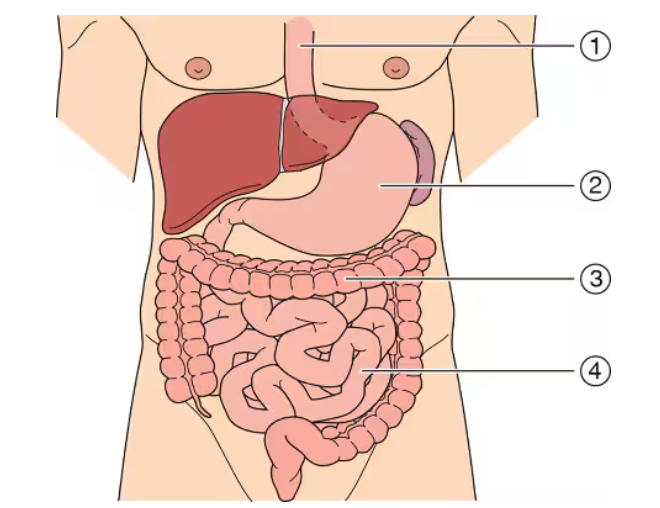
Which of the sites on the diagram below indicates the correct location for the tip of a small-bore nasally placed feeding tube?
2- Stomach
A small-bore nasal feeding tube tip is most commonly placed in the stomach
1 = esophagus
Tube placement there will lead to aspiration
3 = postpyloric duodenum
Small-bore nasal tubes can be advanced to this location if desired, but such placement is less common than gastric placement
4 = jejunum
Feeding tubes can be placed, but usually not from a nasally placed tube
Which meal would the nurse recommend to the client as highest in calcium, iron, and fiber?
3 oz cottage cheese with 1/3 cup raisins and 1 banana
½ cup of broccoli with 3 oz chicken and ½ cup peanuts
½ cup spaghetti with 2 oz ground beef and ½ cup of lima beans plus ½ cup ice cream
3 oz tuna plus 1 oz cheese sandwich on whole-wheat bread plus a pear
4
(too many numbers in the answer but sure)

