Week 9 - More Nervous System

0.0(0)
Studied by 0 people
call kaiCall Kai
learnLearn
examPractice Test
spaced repetitionSpaced Repetition
heart puzzleMatch
flashcardsFlashcards
GameKnowt Play
Card Sorting

1/20

encourage image

There's no tags or description

Looks like no tags are added yet.

Last updated 11:28 AM on 3/26/26
Name
Mastery
Learn
Test
Matching
Spaced
Call with Kai

No analytics yet

Send a link to your students to track their progress

21 Terms

1
New cards

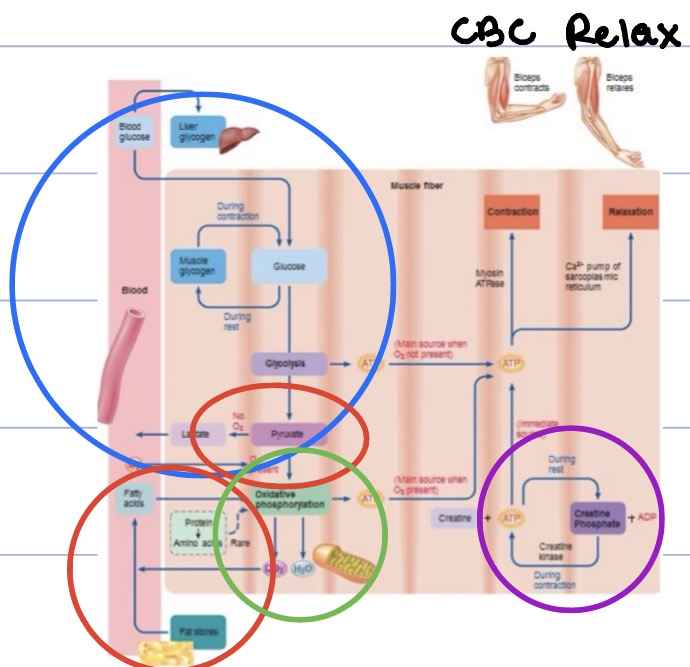
Skeletal muscle - contraction

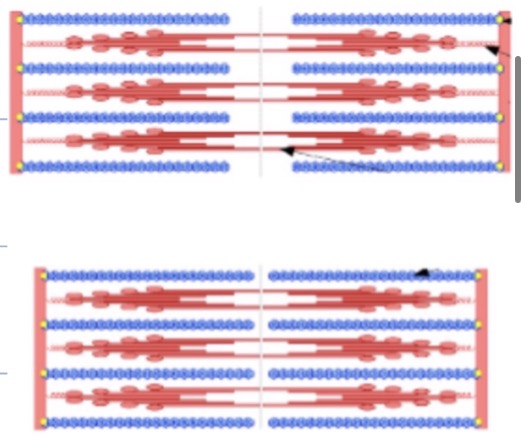
Crossbridge cycling - consequences:

  • Movement = only about 10 micrometers

    • Thick (myosin) pulls thin (actin) toward M line

    • Shortening of:

      • Sarcomere

      • I band

      • H zone

      • NOT A band

<p>Crossbridge cycling - consequences:</p><ul><li><p>Movement = only about 10 micrometers </p><ul><li><p>Thick (myosin) pulls thin (actin) toward M line</p></li><li><p>Shortening of:</p><ul><li><p>Sarcomere</p></li><li><p>I band</p></li><li><p>H zone</p></li><li><p>NOT A band</p></li></ul></li></ul></li></ul><p></p>
2
New cards

Skeletal muscle - relaxation

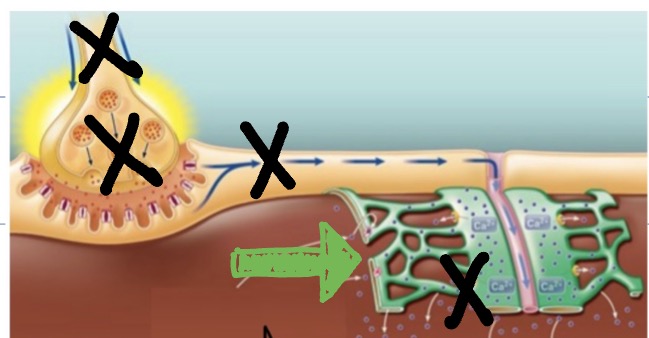
Must stop crossbridge cycling by stopping…

  • Motor neuron action potentials

  • ACh

  • Myofiber action potentials

  • Ca2+ exiting sarcoplasmic reticulum

    • Return Ca2+ to sarcoplasmic reticulum

      • From cytosol

      • Via ATPase pump/transporter

      • Into sacroplasmic reticulum

<p>Must stop crossbridge cycling by stopping…</p><ul><li><p>Motor neuron action potentials</p></li><li><p>ACh</p></li><li><p>Myofiber action potentials</p></li><li><p>Ca<sup>2+</sup> exiting sarcoplasmic reticulum</p><ul><li><p>Return Ca<sup>2+</sup> to sarcoplasmic reticulum</p><ul><li><p>From cytosol</p></li><li><p>Via ATPase pump/transporter</p></li><li><p>Into sacroplasmic reticulum</p></li></ul></li></ul></li></ul><p></p>
3
New cards

Skeletal muscle - twitch

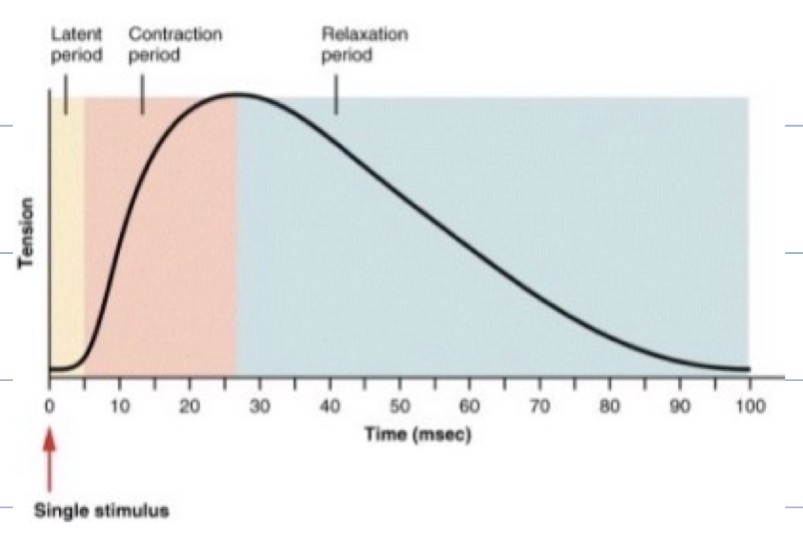
Twitch = the pattern of tension (T) produced by a single action potential

  • T = force generated from crossbridge cycling

  • AP = 1-2 milliseconds (over before any T exists)

  • Delay before any T

    • Latent period (& release of Ca2+)

    • Get crossbridge cycling started

  • Build to peak

  • Delay before there’s no T

    • Remove all Ca2+

<p><strong>Twitch</strong> = the pattern of tension (T) produced by a <u>single action potential</u></p><ul><li><p>T = force generated from crossbridge cycling</p></li><li><p>AP = 1-2 milliseconds (over before any T exists)</p></li><li><p>Delay before any T</p><ul><li><p>Latent period (&amp; release of Ca<sup>2+</sup>)</p></li><li><p>Get crossbridge cycling started</p></li></ul></li><li><p>Build to peak</p></li><li><p>Delay before there’s no T</p><ul><li><p>Remove all Ca<sup>2+</sup></p></li></ul></li></ul><p></p>
4
New cards

Skeletal muscle - ATP

  • Needs (lots)

    • Crossbridge cycling

      • Unbinding myosin from actin

      • Energizing crossbridge for next cycle

    • Relaxation → ATP pumps Ca2+ back into SR to relax the muscle
<ul><li><p>Needs (lots)</p><ul><li><p>Crossbridge cycling</p><ul><li><p>Unbinding myosin from actin</p></li><li><p>Energizing crossbridge for next cycle</p></li></ul></li><li><p>Relaxation → ATP pumps Ca<sup>2+</sup> back into SR to relax the muscle</p></li></ul></li></ul><p></p>
5
New cards

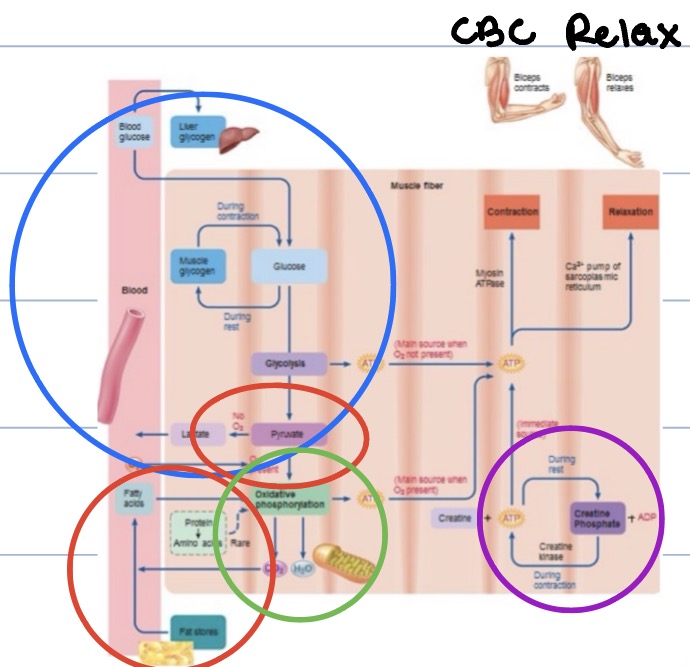
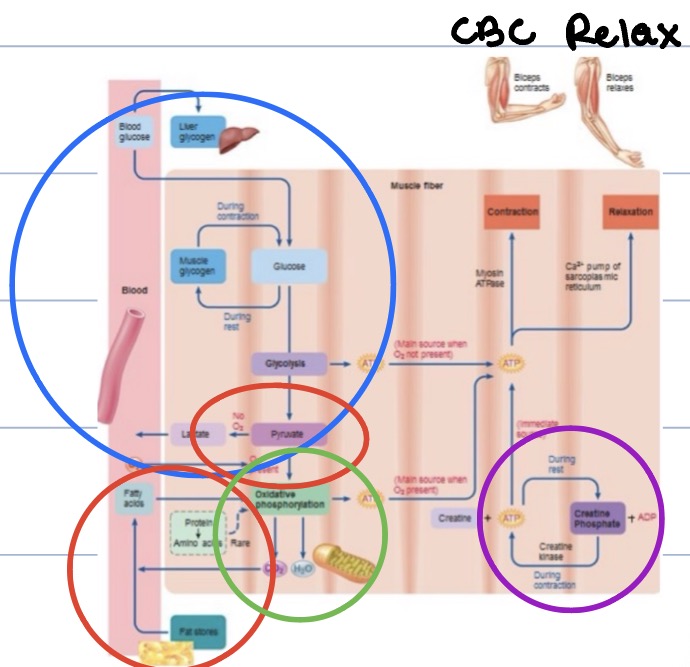
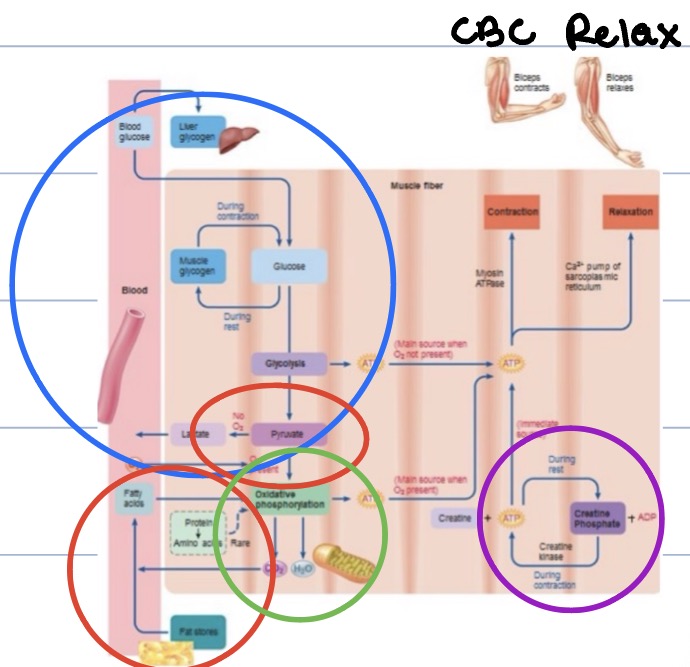
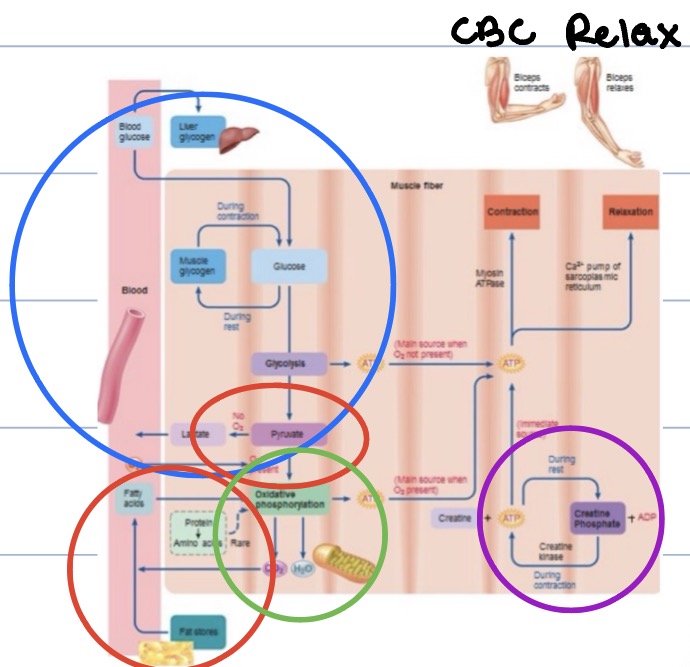
Skeletal muscle - ATP - sources

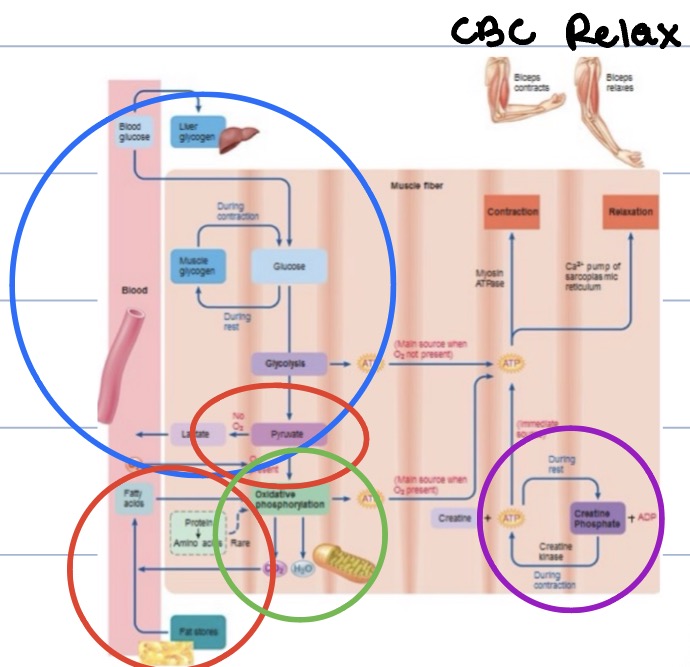
  • 1. Creatine Phosphate

  • 2. Glycolysis

  • 3. Kreb’s Cycle

  • 4. Oxidative Phosphorylation

<ul><li><p><span style="color: rgb(153, 17, 251);">1. Creatine Phosphate</span></p></li><li><p><span style="color: rgb(37, 18, 242);">2. Glycolysis</span></p></li><li><p><span style="color: rgb(250, 14, 14);">3. Kreb’s Cycle</span></p></li><li><p><span style="color: rgb(9, 155, 19);">4. Oxidative Phosphorylation</span></p></li></ul><p></p>
6
New cards
  1. Creatine Phosphate

  • 1 ATP

  • Initial source

  • Anaerobic (can do aerobic)

  • Replenished during relaxation

  • Problems: osmolarity, kidney damage

<ul><li><p>1 ATP</p></li><li><p>Initial source</p></li><li><p><strong>Anaerobic </strong>(can do aerobic)</p></li><li><p>Replenished during relaxation</p></li><li><p>Problems: osmolarity, kidney damage</p></li></ul><p></p>
7
New cards
  1. Glycolysis

  • 2 ATPs

  • Breaks down glucose

    • Blood

    • Oxygen

  • Anaerobic (can do aerobic)

    • Intense (need lots of ATP now)

      • “Sprinting to library as fast as possible”

    • Prolonged

      • “Walking to Cleveland without stopping”

    • Lactate created mainly during intense activity: cleared during rest

      • Producing energy anaerobically: break down glucose (glycolysis), create pyruvate, which turns into lactate to keep producing energy when O2 is limited
<ul><li><p>2 ATPs</p></li><li><p>Breaks down glucose</p><ul><li><p>Blood</p></li><li><p>Oxygen</p></li></ul></li><li><p><strong>Anaerobic</strong> (can do aerobic)</p><ul><li><p><strong>Intense</strong> (need lots of ATP now)</p><ul><li><p>“Sprinting to library as fast as possible”</p></li></ul></li><li><p><strong>Prolonged</strong></p><ul><li><p>“Walking to Cleveland without stopping”</p></li></ul></li><li><p>Lactate created mainly during intense activity: cleared during rest</p><ul><li><p>Producing energy anaerobically: break down glucose (glycolysis), create pyruvate, which turns into lactate to keep producing energy when O<sub>2</sub> is limited</p></li></ul></li></ul></li></ul><p></p>
8
New cards
  1. Kreb’s Cycle

  • 2 ATPs

  • Aerobic only

  • Sources:

    • Glycolysis

    • Fatty acids

    • Amino acids

<ul><li><p>2 ATPs</p></li><li><p><strong>Aerobic only</strong></p></li><li><p>Sources:</p><ul><li><p>Glycolysis </p></li><li><p>Fatty acids</p></li><li><p>Amino acids </p></li></ul></li></ul><p></p>
9
New cards
  1. Oxidative Phosphorylation

  • 28-34 ATPs

  • Aerobic only

  • Sources:

    • Kreb’s Cycle

    • Glycolysis

<ul><li><p>28-34 ATPs</p></li><li><p><strong>Aerobic only</strong></p></li><li><p>Sources:</p><ul><li><p>Kreb’s Cycle</p></li><li><p>Glycolysis</p></li></ul></li></ul><p></p>
10
New cards

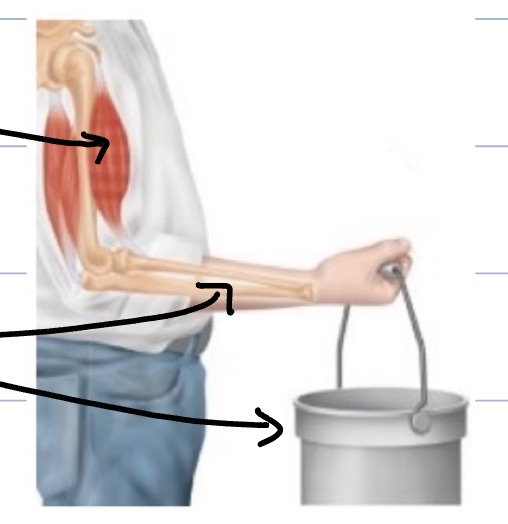
Skeletal muscle - whole muscles - contraction

  • Contraction:

    • Generation of tension

    • Opposed by load (L)

      • Bucket = load, but we’re also the load!

    • Shortening ONLY if tension > load

<p></p><ul><li><p>Contraction:</p><ul><li><p>Generation of tension</p></li><li><p>Opposed by load (L)</p><ul><li><p>Bucket = load, but we’re also the load!</p></li></ul></li><li><p>Shortening ONLY if tension &gt; load</p></li></ul></li></ul><p></p>
11
New cards

Types of contraction

  • Isometric (tension < load)

    • Independent of load; contraction but no change in muscle length

      • Independent = the muscle will still try to contract and generate tension regardless of how heavy the load is

  • Eccentric (tension < load)

    • Dependent of load; contraction & lengthening of muscle as load wins

      • Dependent = how much the muscle lengthens depends on how heavy the load is

  • Isotonic (tension > load)

    • No change in tension (in order to conserve ATP/energy); muscle shortens as tension wins

12
New cards

Isotonic contraction - keys

  • Isometric must come 1st (to build tension)

  • As load increases…

    • Increased latency (b/c we must generate a bigger tension to overcome the load, which takes time → “latent period”)

    • Decreased velocity

    • Decreased response (b/c the initial tension isn’t enough anymore to overcome the increased load)

13
New cards

Summed tension

  • Tension is summed → builds the tension

    • This maintained contraction = tetanus

      • Unfused tetanus: partial relaxation (shown in image)

      • Fused tetanus: no relaxation

        • Done when we need to do it fast → like in dangerous situations or in American Ninja Warriors
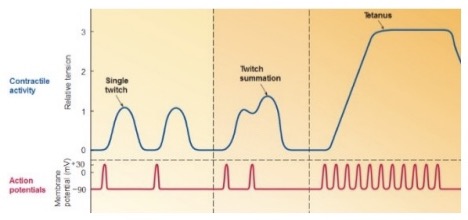
<ul><li><p>Tension is summed → builds the tension</p><ul><li><p>This maintained contraction =<strong> tetanus</strong></p><ul><li><p><strong>Unfused tetanus</strong>: partial relaxation (shown in image)</p></li><li><p><strong>Fused tetanus</strong>: no relaxation</p><ul><li><p>Done when we need to do it fast → like in dangerous situations or in American Ninja Warriors</p></li></ul></li></ul></li></ul></li></ul><p></p>
14
New cards

Difference between myofibers

  1. Speed of contraction

  2. Main ATP source

15
New cards
  1. Speed of contraction

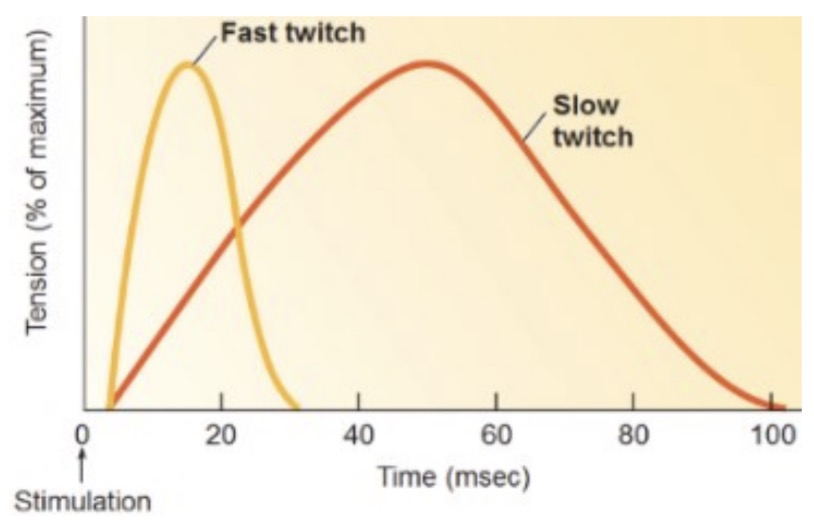
  • Slow vs. fast twitch

    • Fast: gets to tension quickly, but uses up ATP quickly

    • Slow: uses up ATP slowly, but gets to tension slowly

  • ATPase speed in crossbridge cycling

<ul><li><p>Slow vs. fast twitch</p><ul><li><p><strong>Fast</strong>: <span style="color: rgb(7, 183, 23);">gets to tension quickly</span>, <span style="color: rgb(245, 19, 19);">but uses up ATP quickly</span></p></li><li><p><strong>Slow</strong>: <span style="color: rgb(9, 167, 19);">uses up ATP slowly</span>, <span style="color: rgb(246, 15, 15);">but gets to tension slowly</span></p></li></ul></li><li><p>ATPase speed in crossbridge cycling</p></li></ul><p></p>
16
New cards
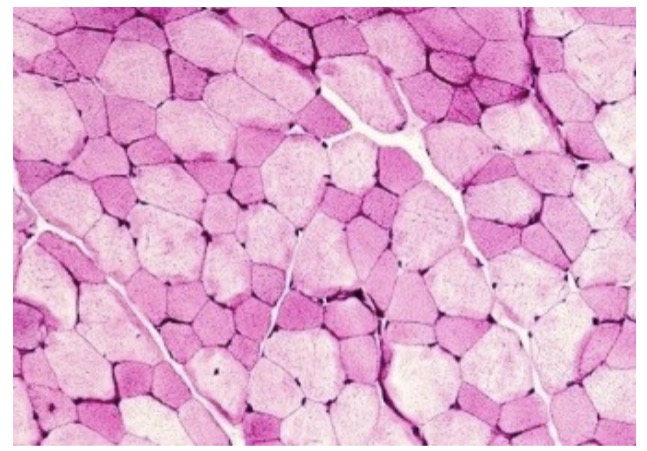
  1. Main ATP source

  • Glycolytic (anaerobic)

    • Few mitochondria

    • Lots of glycogen

  • Oxidative (aerobic)

    • Many mitochondria

    • Highly vascularized (more vessels)

    • Lots of myoglobin → allows us to store O2 b/c O2 can’t be stored in myofibers

17
New cards

Skeletal muscle - whole muscles - myofiber types

  1. Slow-oxidative

  2. Fast-oxidative (aka fast-oxidative-glycolytic)

  3. Fast-glycolytic

<ol><li><p>Slow-oxidative </p></li><li><p>Fast-oxidative (aka fast-oxidative-glycolytic)</p></li><li><p>Fast-glycolytic</p></li></ol><p></p>
18
New cards

Myofiber types - characteristics chart
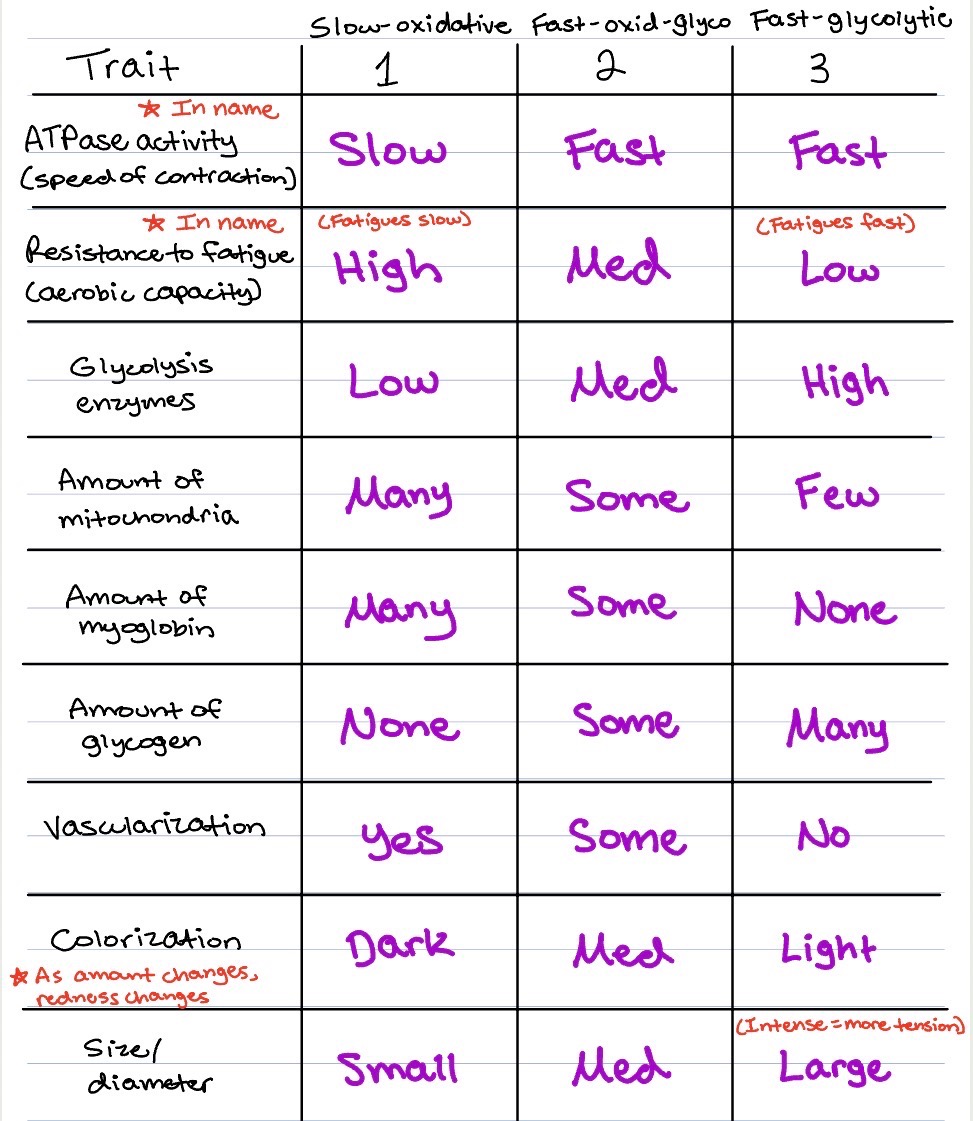
knowt flashcard image
19
New cards

Most muscles are a mix of all 3 types

  • Genetic basis → based on what the muscle has always done

  • Slight modification is possible (you can improve how a muscle fiber functions, but you can’t completely change its type)

    • Change in structure (ex. adding/subtracting mitochondria)

    • Change in function (ex. focusing more on glycolysis than on using mitochondria)

20
New cards

Source of muscle type modification

  • Disuse & some diseases = atrophy

  • Use, especially exercise = hypertrophy

    • Aerobic = increased vascularization, increased number of mitochondria, decreased fatigue (shouldn’t be intense or prolonged)

    • Anaerobic = increased myofiber diameter (by adding more sarcomeres), increased glycolytic enzymes (b/c more intense & prolonged)

21
New cards

Extra Credit

  • Working hard to relax

  • “Clean-up principle” → easy to make a mess, but harder to clean it up

  • Creatine gives body builders bigger/swollen muscles

  • Anaerobic - intense = sprinting to library as fast as possible

  • Anaerobic - prolonged = walking to Cleveland without stopping

  • Physics

  • She-hulk

  • $25

  • Increased latency: Olympics → pause before weight lift to build tension against load

  • Bad tetanus lasts a decade

  • American Ninja Warrior

  • Speed skating

  • Usane Bolt

  • Sprinter vs. Marathoner

Explore top notes

note
Key Stuff - All Ideologies
Updated 1017d ago
0.0(0)
note
Aniline differentiation
Updated 351d ago
0.0(0)
note
Chapter 27 - The Cold War
Updated 1441d ago
0.0(0)
note
CGO casus 4
Updated 434d ago
0.0(0)
note
Key Stuff - All Ideologies
Updated 1017d ago
0.0(0)
note
Aniline differentiation
Updated 351d ago
0.0(0)
note
Chapter 27 - The Cold War
Updated 1441d ago
0.0(0)
note
CGO casus 4
Updated 434d ago
0.0(0)

Explore top flashcards

flashcards
Unit 6 Gradesavers Kaji
47
Updated 1102d ago
0.0(0)
flashcards
patho chapter 5
31
Updated 1136d ago
0.0(0)
flashcards
Vocabulary Power Unit 3
42
Updated 414d ago
0.0(0)
flashcards
APUSH Unit 5
111
Updated 1176d ago
0.0(0)
flashcards
english final
53
Updated 104d ago
0.0(0)
flashcards
TUTTO PARZIALE 2
169
Updated 464d ago
0.0(0)
flashcards
troika chapter 4
68
Updated 1119d ago
0.0(0)
flashcards
Unit 6 Gradesavers Kaji
47
Updated 1102d ago
0.0(0)
flashcards
patho chapter 5
31
Updated 1136d ago
0.0(0)
flashcards
Vocabulary Power Unit 3
42
Updated 414d ago
0.0(0)
flashcards
APUSH Unit 5
111
Updated 1176d ago
0.0(0)
flashcards
english final
53
Updated 104d ago
0.0(0)
flashcards
TUTTO PARZIALE 2
169
Updated 464d ago
0.0(0)
flashcards
troika chapter 4
68
Updated 1119d ago
0.0(0)