CLASS MATERIALS
 Call Kai
 Learn
Learn Practice Test
 Spaced Repetition
 Match
Match Flashcards
 Knowt Play
1/18

There's no tags or description
Looks like no tags are added yet.
Name | Mastery | Learn | Test | Matching | Spaced | Call with Kai |
|---|
No analytics yet
Send a link to your students to track their progress
19 Terms
What are the differences between types of probability and nonprobability samples?
Probability sampling has randomization as every element has an equal chance to be selected into the sample for generalizability, and is used with a sampling frame
Non-probability sampling has no randomization, is common in social sciences, and is used when no population list exists.
Probability sampling
has randomization as every element has an equal chance to be selected into the sample for generalizability, and is used with a sampling frame
Non-probability sampling
has no randomization, is common in social sciences, and is used when no population list exists
Simple random sampling (Pros & Cons)
Pros:
Controls selection/systematic bias
Sample is comparable to population
Cons:
Less efficient
Weak sampling frame
Cluster sampling (Pros & Cons)
Pros:
Useful when a sampling frame is not available
Cons:
Quota Sampling (Pros & Cons)
Pros:
Cons:
Does not involve randomization
Benefits of a pilot study
pre- and posttests
testing out the study to refine it?
Issues present with quasi-experimental designs
No random assignment
Selection bias
Selection-maturation
Threats to internal validity (CHEST MIST)
CHEST
Contamination
History
Experimental Mortality
Selection bias
Testing
MIST
Maturation
Instrumentation
Statistical regression
Treatment misidentification
Contamination
Awareness of group differences; demoralization
History
Events that happen outside the experiment; uncommon
EX: The Great Depression may have influenced productivity level identified by researchers of the Hawthorne studies; civil rights movement
Experimental Mortality (Attrition)
Participants who drop out are systematically different from those who remain
Selection bias
When participants are chosen in a way that leads to a non-representative sample, either by voluntary participation, their inherent characteristics, or method of data
Strive for a diverse and representative sample, ensure random sampling, and consider participant eligibility.
Testing
Performance is influenced by prior exposure to the same or similar tests due to familiarity
Maturation
Natural changes can occur independent of any intervention; pronounced in longitudinal studies
EX: long-term studies on drug rehabilitation; police reform
Instrumentation
Changes in measurement tools (questions, scales, collection method)
Statistical regression
Outliers
Treatment misidentification
Treatment/ intervention studies is incorrectly defined, applied, or identified
EX: Stanford prison experiment: Guards exaggerated their behaviors, with Zimbardo too involved; Hawthorne effect; Clever Hans, drug dogs
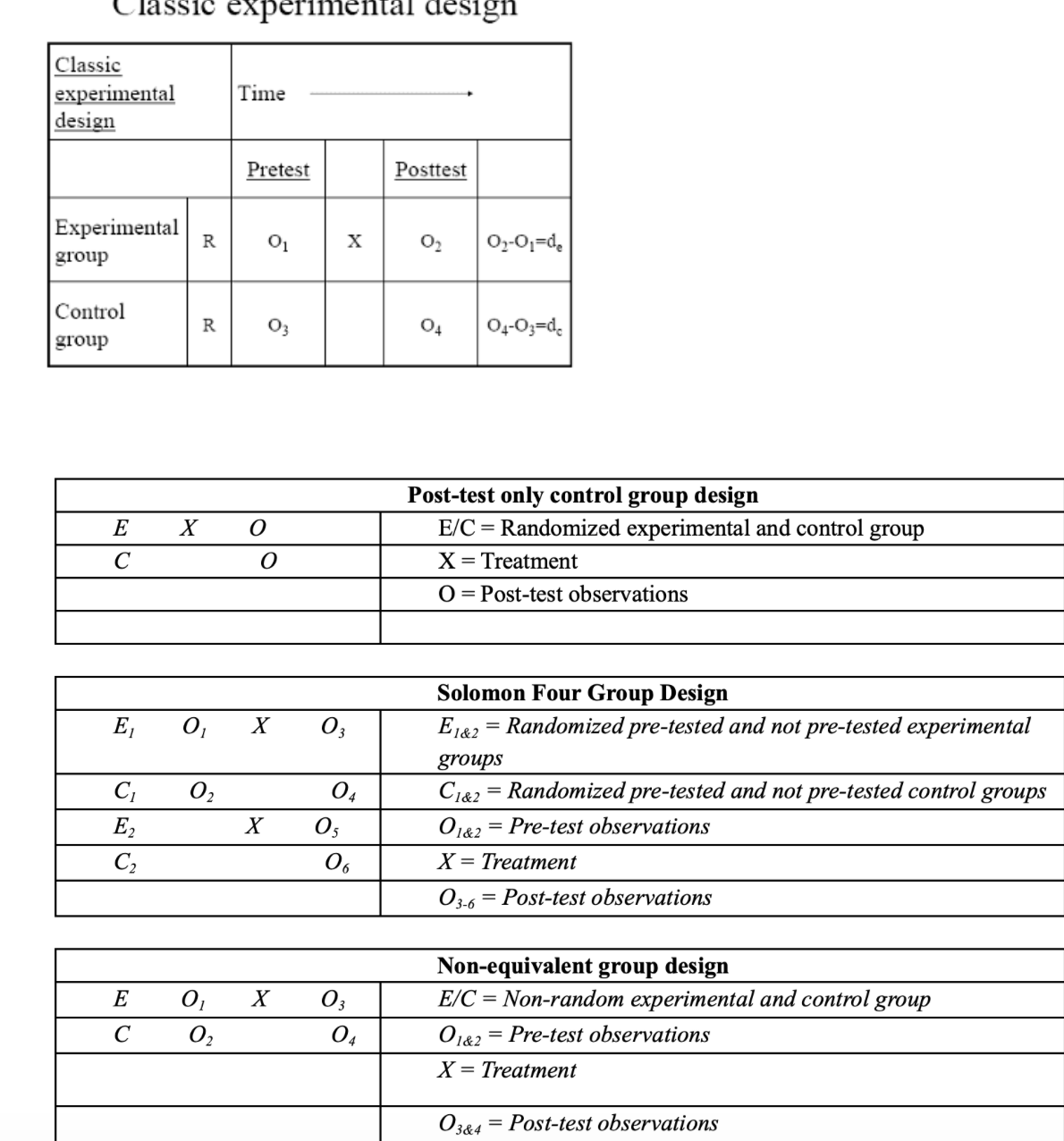
Know the placement of the pre- and post-test and treatment (X)