geo set problem 3
 Studied by 0 people
 Call Kai
 Learn
Learn Practice Test
 Spaced Repetition
 Match
Match Flashcards
 Knowt Play
1/6

There's no tags or description
Looks like no tags are added yet.
Name | Mastery | Learn | Test | Matching | Spaced | Call with Kai |
|---|
No analytics yet
Send a link to your students to track their progress
7 Terms

existence postulate: doesn’t hold because there is only one point
incidence postulate: satisfied vacuously because there is no pair of points
ruler postulate: satisfied vacuously because there is no line
plane separation postulate: satisfied vacuously because there is no line
protractor postulate: satisfied vacuously because there is no line, so no ray, and so no angle
SAS: satisfied vacuously because there is no triangle
all 3 parallel postulates are satisfied vacuously because there is no line
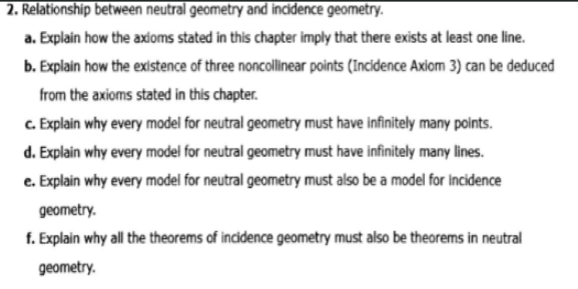
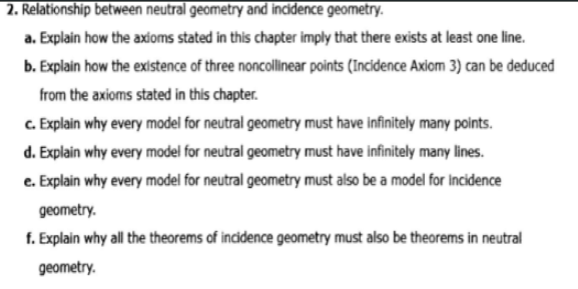
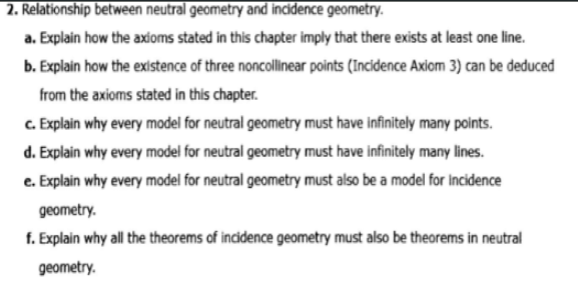
part a
we know there are two points because of the existence postulate, and the incidence postulate tells us that two points make a line
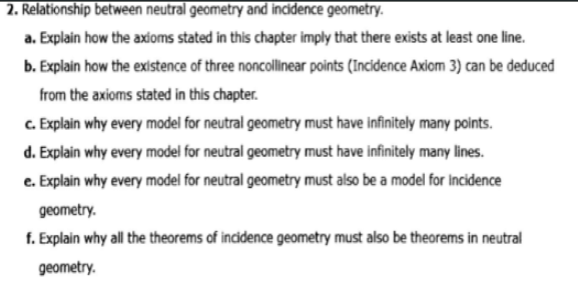
part b
by part a, we know line l exists. we know there is infinitely many number of points on l because of the ruler postulate. also, the set of points not on l is nonempty according to the plane separation postulate. so, by the ruler and plane separation postulates, we can choose two points that lie on l and a third point that does not lie on l. therefore, we get 3 noncollinear points
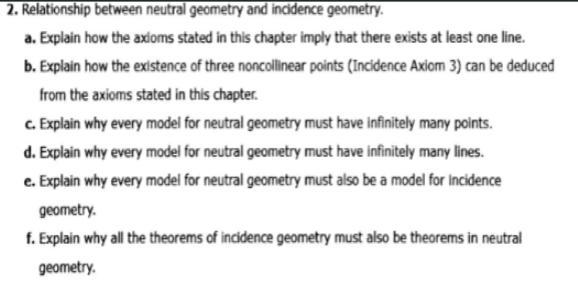
part c
by part a, there is at least one line. the ruler postulate tells us there is a 1-1 correspondence between points on a line and the real numbers. so, there are infinitely many points in the lines as well as in the model
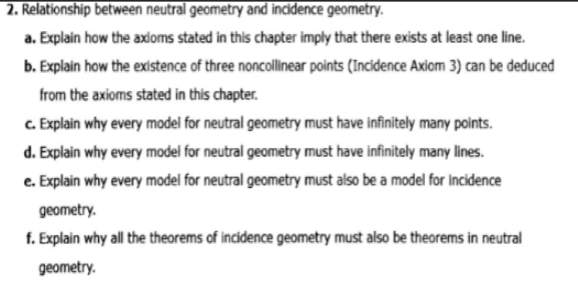
part d
by part a, there is a line l and there is a point p that does not lie on l by plane separation postulate. for each point Q on l, ∃ line PQ s.t. line PQ ≠ l because P ∉ l. by ruler postulate, there are infinitely many different points on l. 2 different points Q1 and Q2 on l determine different lines through P because ∃ only one line that contains both Q1 and Q2 which is l. since each other points of l yields a different line and there are infinitely many points, there are infinitely many lines
part e
IA1 is implied by the Incidence Axiom of neutral geometry. IA2 is implied by the ruler postulate. IA3 was verified in part b, thus the axioms of neutral geometry imply the axioms of incidence geometry. the axioms of neutral geometry are true in any model of neutral geometry, so the axioms of incidence geometry are true statements in that model as well. thus, any model for neutral geometry also serves as a model for incidence geometry.
part f
by part e, the axioms of incidence geometry are true statements in any model for neutral geometry. the theorems of incidence geometry are logical consequences of these axioms, so they must be true statements as well
 Note
Note  Flashcards (169)