A/P CH 1: Intro to Human Anatomy & Physiology
 Studied by 1 person
 Call Kai
 Learn
Learn Practice Test
 Spaced Repetition
 Match
Match Flashcards
 Knowt Play
1/150

Earn XP
Description and Tags
All of the definitions from textbook and lab manual and learning videos thru chapter 1.
Name | Mastery | Learn | Test | Matching | Spaced | Call with Kai |
|---|
No analytics yet
Send a link to your students to track their progress
151 Terms
Anatomy
The branch of science that deals with the structure (morphology) of body parts- their forms and how they are organized
Physiology
The functions of body parts- what they do and how they do it
Atom
Simplest unit of matter
Molecule
Particle composed of two or more atoms
Macromolecule
Very large molecule (ex. protein or nucleic acid)
Organelle
A structure in a cell that has a specialized function
Cell
The structural and functional unit of an organism
Tissue
Group of similar cells that performs a specialized function
Organ
Structure consisting of a group of tissues with a specialized function
Organ System
Group of organs coordinated to carry on a specialized function
Organism
An individual living thing
Metabolism
All of the chemical reactions in a cell
Homeostasis
Dynamic state in which the body’s internal environment is maintained in the normal range.
Internal environment
Conditions and elements that make up the inside of the body, surrounding the cells
Receptor
Specialized cell that provides information about the environment.
Set Point
Target value of a physiological condition maintained in the body by homeostasis
Effector
A muscle or gland that effects change in the body
Negative Feedback
A mechanism that restores the level of a biochemical or other balance in the internal environment
Positive Feedback
Process by which changes cause additional similar changes, producing unstable conditions
Gross Anatomy
Also known as “Macroscopic Anatomy”, this type of anatomy examines large visible structures
Microscopic Anatomy
Examines cells or molecules
Cytology
Study of cells
Histology
Study of tissues (collections of cells)
Cell Physiology
Functions of cells
Organ Physiology
Functions of specific organs
Systemic Physiology
Functions of organ systems
Pathological Physiology
Effects of diseases on organs or systems
Integumentary System
Hair, Skin, Nails
Skeletal System
bones, cartilage, ligaments, bone marrow
Muscular System
Skeletal muscles, tendons
Nervous System
Brain, Spinal Cord, Nerves, Sense organs
Endocrine System
Pituitary gland, thyroid gland, pancreas, adrenal glands, gonads, hormone tissues
Cardiovascular System
heart, blood, blood vessels
Lymphatic System
Spleen, thymus, lymphatic vessels, lymph nodes, tonsils
Respiratory System
Nasal cavities, sinuses, larynx, trachea, bronchi, lungs, alveoli
digestive system
teeth, tongue, pharynx, esophagus, stomach, small intestine, large intestine, liver, gallbladder, pancreas
urinary system
kidneys, ureters, urinary bladder, urethra
male reproductive system
testes, epididymides, ductus deferentia, seminal vesicle, prostate, penis, scrotum
female reproductive system
ovaries, uterine tubes, uterus, vagina, labia, clitoris, mammary glands
surface anatomy
locating structures on or near the bodys surface
Anatomical Position
Hands at sides, palms forward
Supine
Lying down, face up
Prone
lying down, face down
superior
above, towards the head
Inferior
Below, towards the feet
Medial
toward the midline
Lateral
away from the midline
proximal
toward the point of attachment of a limb to the trunk
distal
away from the point of attachment of a limb to the trunk
superficial
close to the body’s surface
deep
toward the interior of the body, far from the surface
cranial
towards the head
caudal
towards the tail (tailbone)
anterior/ventral
the front surface
posterior/dorsal
the back surface
Frontal (coronal) plane
Vertical plane that divides the body into anterior and posterior portions
Saggital Plane
Vertical plane dividing body into L/R portions
Midsaggital
a cut right in the middle of the midline
parasaggital
a cut in the body that is offset from the middle (body planes)
Transverse Plane
divides body into superior and inferior portions
Axial
Pertaining to the head, neck and trunk
Appendicular
Pertaining to the upper or lower limbs
Cranial Cavity
Houses the brain
Vertebral Canal
Contains the spinal cord within the sections of the backbone (vertebrae)
thoracic cavity
Hollow space inside the chest containing the thoracic organs
Abdominopelvic Cavity
Space between the diaphragm and the pelvic outlet that contains the abdominal and pelvic viscera
Viscera
Organs in a body cavity
Mediastinum
Tissues and organs of the thoracic cavity that form a septum between the lungs
Abdominal Cavity
space between the diaphragm and the pelvic outlet that contains the abdominal viscera
Pelvic Cavity
Hollow place within the ring formed by the sacrum and the hip bones that encloses the terminal part of the large intestine, the urinary bladder, and the internal reproductive organs
Oral cavity
Mouth Cavity
Nasal cavity
space in the nose
orbital cavities
containing the eyes and associated skeletal muscles and nerves
Middle Ear cavities
containing the middle ear bones
Parietal
Pertaining to the wall of a cavity
Visceral
refers to a membrane that is deeper toward the interior and covers an internal organ such as a lung
Pleural Membranes
serous membrane that encloses the lungs and lines the chest wall
Peritoneal Membrane
Membranes in the abdominopelvic cavity
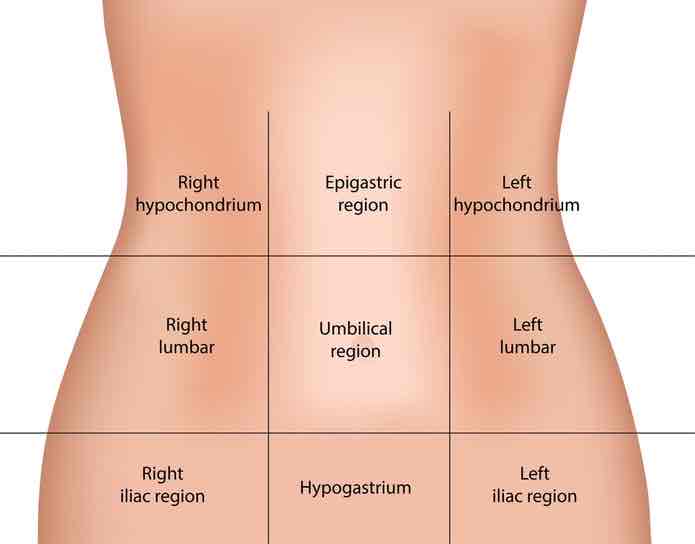
9 abdominal regions
abdominal
region between thorax and pelvis
acromial
point of the shoulder
antebrachial
the forearm
antecubital
space in front of elbow
axillary
the armpit
brachial
arm
buccal
the cheek
calcaneal
heel
carpal
wrist
celiac
abdomen
cephalic
the head
cervical
neck
costal
ribs
coxal
hip
crural
leg
cubital
elbow
digital
finger or toe
dorsal
back
femoral
thigh
frontal
forehead
genital
reproductive organs

