AP Government and Politics Unit 3 Review
 AP Practice
 Call Kai
1/84

Earn XP
Name | Mastery | Learn | Test | Matching | Spaced | Call with Kai | Chat |
|---|
No analytics yet
Send a link to your students to track their progress
85 Terms
Civil Liberties
Fundamental freedoms guaranteed to individuals by the Constitution. Protections from government abuse laid out in the Constitution. Restricts government action.
Civil Rights
Legal rights that protect individuals from discrimination and ensure equal opportunities and treatment under the law. Protections by government to ensure your equality. Empowers government action.
Bill of Rights
First 10 amendments; protect fundamental civil liberties
Incorporation
Applying Bill of Rights protections to the states.
Selective Incorporation
Supreme Court process of applying specific rights to states via the 14th Amendment.
Due Process Clause
Government must follow fair legal procedures (5th & 14th Amendment).
Equal Protection Clause
States must treat individuals equally under the law (14th Amendment)
Establishment Clause
Government may not establish or favor a religion (separation of church and state)
Free Exercise Clause
Government may not interfere with religious practice
Under what conditions does it make the Free Exercise Clause not absolute?
If a religious practices violates public safety or other laws, it can be restricted (ex. human sacrifice, polygamy)
Prior Restraint
Government censorship before publication; usually unconstitutional
Obscenity
Speech not protected by the 1st Amendment
Libel
Written false statements tat damage a person’s reputation.
Slander
Spoken false statements that damage a person’s reputation.
Search Warrant
Court order allowing police to conduct a search.
Probable Cause
Reasonable belief a crime has occurred; required for warrants.
Self-Incrimination
Protection against being forced to testify against oneself (5th Amendment).
Affirmative Action
Policies that consider race/gender to address past discrimination.
Discriminatory Impact
Policy has unequal effects, even without intent.
Discriminatory Intent
Policy deliberately targets a specific group.
Double Jeopardy
Cannot be tried twice for the same crime (5th Amendment).
Eminent Domain
Government power to take private property for public use with just compensation.
Clarence Gideon
Defendant whose case led to the right to an attorney (Gideon v. Wainright)
Thurgood Marshall
NAACP lawyer in Brown; first African American Supreme Court justice.
Earl Warren
Chief Justice who expanded civil rights and liberties. Central figure in Brown v. Board
Martin Luther King Jr.
Civil rights leader advocating nonviolent protest.
Lyndon b. Johnson
President who signed major civil rights legislation.
Linda Brown
Plaintiff in Brown v. Board of Educaiton
Ratification of the Bill of Rights (1791)
Established constitutional protections for individual liberties.
Civil Rights Act (1964)
Banned discrimination in public accommodations and employment
Voting Rights Act (1965)
Prohibited racial discrimination in voting.
Incorporation via the 14th Amendment
Supreme Court applied most Bill of Rights protection to the states.
Question raised in Wisconsin v. Yoder (1972)
Can the state require Amish children to attend school past 8th grade, even if it conflicts with their religious beliefs?
Decision & Majority Opinion in Wisconsin v. Yoder (1972)
Unanimous 7-0 for Yoder. Court ruled that the compulsory school attendance laws violated the 1st Amendment’s free exercise clause when applied to the Amish.
Question raised in Tinker v. Des Moines (1969)
Do students have the right to wear armbands in school to protest the Vietnam War?
Decision & Majority Opinion in Tinker v. Des Moines (1969)
7-2 for Tinker. Students do not lose 1st Amendment rights at school unless their actions cause substantial disruption.
Question raised in Schenck v. United States (1919)
Are anti-draft pamphlets protected under free speech during wartime?
Decision & Majority Opinion in Schenck v. United States (1919)
9-0 for the U.S. Speech that presents a “clear and present danger” is not protected under the 1st Amendment
Question raised in New York Times v. United States (1971)
Can the government prevent the NYT from publishing classified documents about the Vietnam War?
Decision & Majority Opinion in New York Times v. United States (1971)
6-3 for NYT. Prior restraint (censorship) was unconstitutional because the government did not show sufficient justification.
Question raised in Gideon v. Wainwright (1963)
Does the 6th Amendment’s right to counsel apply to state courts for defendants who cannot afford a lawyer?
Decision & Majority Opinion in Gideon v. Wainwright (1963)
9-0 for Gideon. Court ruled that the 6th Amendment requires states to provide attorneys in criminal cases to those who cannot afford one.
Question raised in Brown v. Board of Education (1954)
Is racial segregation in public schools constituted under “separate but equal’?
Decision & Majority Opinion in Brown v. Board of Education (1954)
9-0 for Brown. “Separate but equal” is inherently unequal and violates the Equal Protection Clause.
Question raised in Roe v. Wade (1973)
Does the Constitution protect a woman’s right to choose an abortion?
Decision & Majority Opinion in Roe v. Wade (1973)
7-2 for Roe. A woman’s right to privacy under the Due Process Clause of the 14th Amendment included the right to terminate a pregnancy.
Question raised in Engel v. Vitale (1962)
Can schools require students to voluntary recite a state-written prayer?
Decision & Majority Opinion in Engel v. Vitale (1962)
6-1 for Engel. School-sponsored prayer violates the Establishment Clause of the 1st Amendment, even if participation is voluntary.
Question raised in McDonald v. Chicago (2010)
Does the 2nd Amendment right to bear arms apply to state and local governments?
Decision & Majority Opinion in McDonald v. Chicago (2010)
5-4 for McDonald. The 2nd Amendment applies to states through the 14th Amendment’s Due Process Clause.
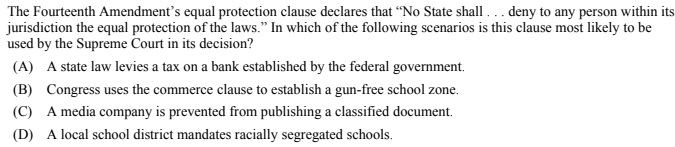
D
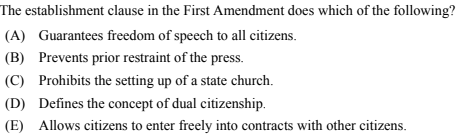
C

C
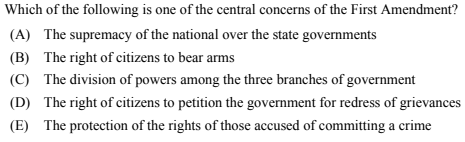
D
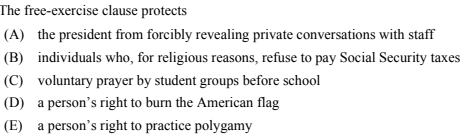
C
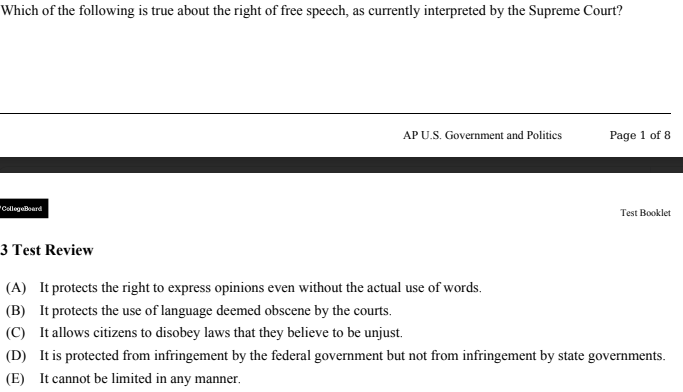
A
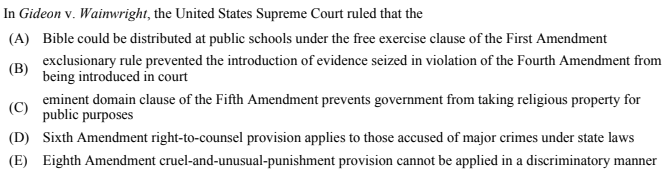
D
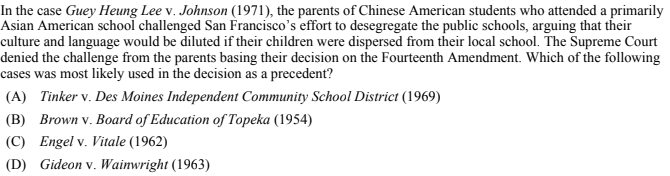
B
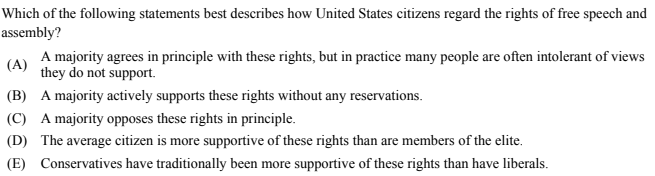
A

E

C
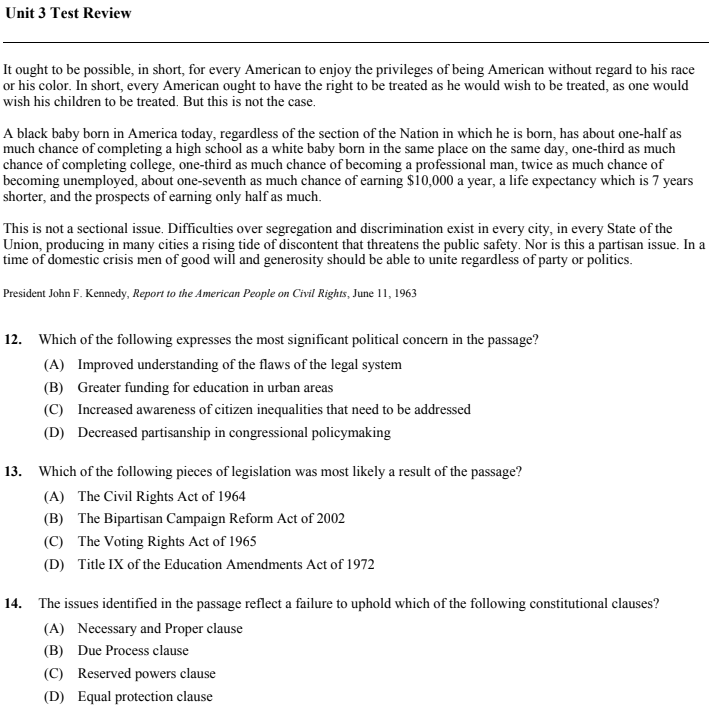
C, A, D
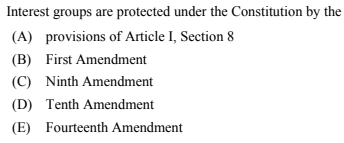
B
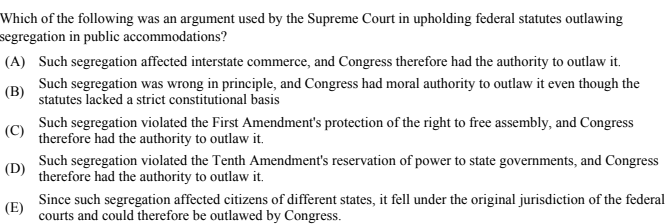
A
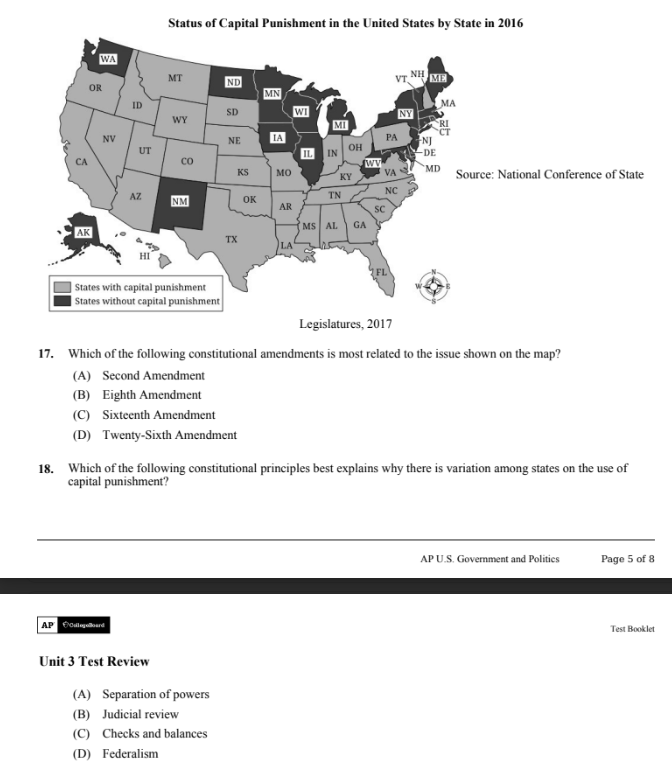
B, D
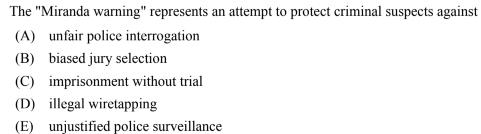
A
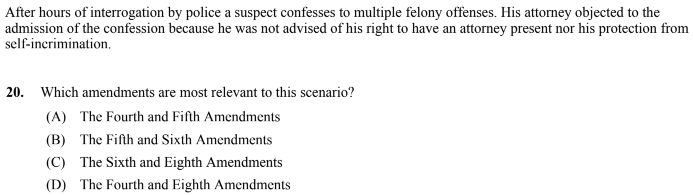
B
1st Amendment
Protects freedom of religion, speech, press, assembly, and the right to petition the government.
2nd Amendment
Protects the right of people to keep and bear arms.
3rd Amendment
Prevents the government from forcing citizens to house soldiers in their homes.
4th Amendment
Protects against unreasonable searches and seizures; requires warrants with probable cause.
5th Amendment
Grantees due process, protects against self-incrimination and double jeopardy, and requires fair compensation for taken property.
6th Amendment
Ensures a speedy and public trial, an impartial jury, legal counsel, and the right to be informed of charges.
7th Amendment
Guarantees the right to a jury trial in certain civil cases.
8th Amendment
Prohibits excessive bail and fines, and cruel or unusual punishment.
9th Amendment
States that people have rights beyond those listed in the Constitution.
10th Amendment
Reserves powers not given to the federal government to the states or the people.
Important Clauses in the 1st Amendment
Establishment Clause and Free Exercise Clause
Important Clauses in the 5th Amendment
Due Process Clause (regarding the Federal government)
Important Clauses in the 14th Amendment
Due Process Clause (applies to states; selective incorporation) and Equal Protection Clause.
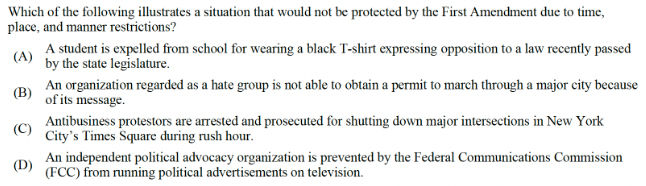
C
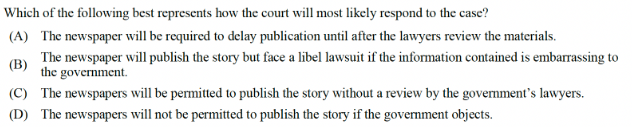
C
Privacy in the Constitution
freedom of association (1), no quartering (3), search and seizure (4), self-incrimination (5), enumerated rights (9), due process and liberty (14)
How has the Supreme Court expanded or limited civil liberties?
Expanded by protecting speech, the right to counsel, and desegregation. Limited by allowing restrictions for public safety or national security.