AQA A-Level Economics : Microeconomics
 Studied by 0 people
 Call with Kai
 Learn
Learn Practice Test
 Spaced Repetition
 Match
Match Flashcards
 Knowt Play
1/355

Earn XP
Description and Tags
Name | Mastery | Learn | Test | Matching | Spaced | Call with Kai |
|---|
No analytics yet
Send a link to your students to track their progress
356 Terms
Short-Termism
the tendency for government to focus excessively on short-term performance objectives at the expense of longer-term strategic objectives e.g. lowering income tax
Scarcity
a situation in which unlimited wants exceed the finite resources available to fulfill those wants
Ceteris Paribus
'all other things being equal'
Positive Statement
objective statements that can be proved e.g. homelessness is currently at 5% in Cambridge
Normative Statements
opinions that contain value judgments
Value Judgments
judgments about society that cannot be quantified and tested e.g. homelessness is too high in Cambridge
Main Purpose of Economic Activity
to produce goods and services to satisfy consumers' wants and needs
The Economic Problem
involves working out how to allocate limited resources as effectively as possible to satisfy people's unlimited wants and needs
Factors of Production - Land
all natural resources that are used to produce goods and services e.g. materials, water
Factors of Production - Labour
a combination of human capital (the value of workers' labour) and the labour force (the working population)
Factors of Production - Enterprise
entrepreneurial actions (e.g. establishing businesses and taking risks) that individuals take to try and make a profit
Factors of Production - Capital
equipment used to generate goods and services within the production process e.g. machinery
Three Main Economic Agents
- individuals : people/firms that produce goods or supply services
- consumers : people/firms who purchase the goods/services
- governments : establishes rules for economies
Opportunity Cost (Tradeoffs)
the benefit lost by not choosing next best alternative to a decision
Issues with Opportunity Cost (2)
- imperfect information may prevent consumers from picking the alternative
- barriers between switching to alternative
Production Possibility Frontier
illustrates the trade-offs facing an economy that produces only two goods. It shows the maximum quantity of one good that can be produced for any given quantity produced of the other
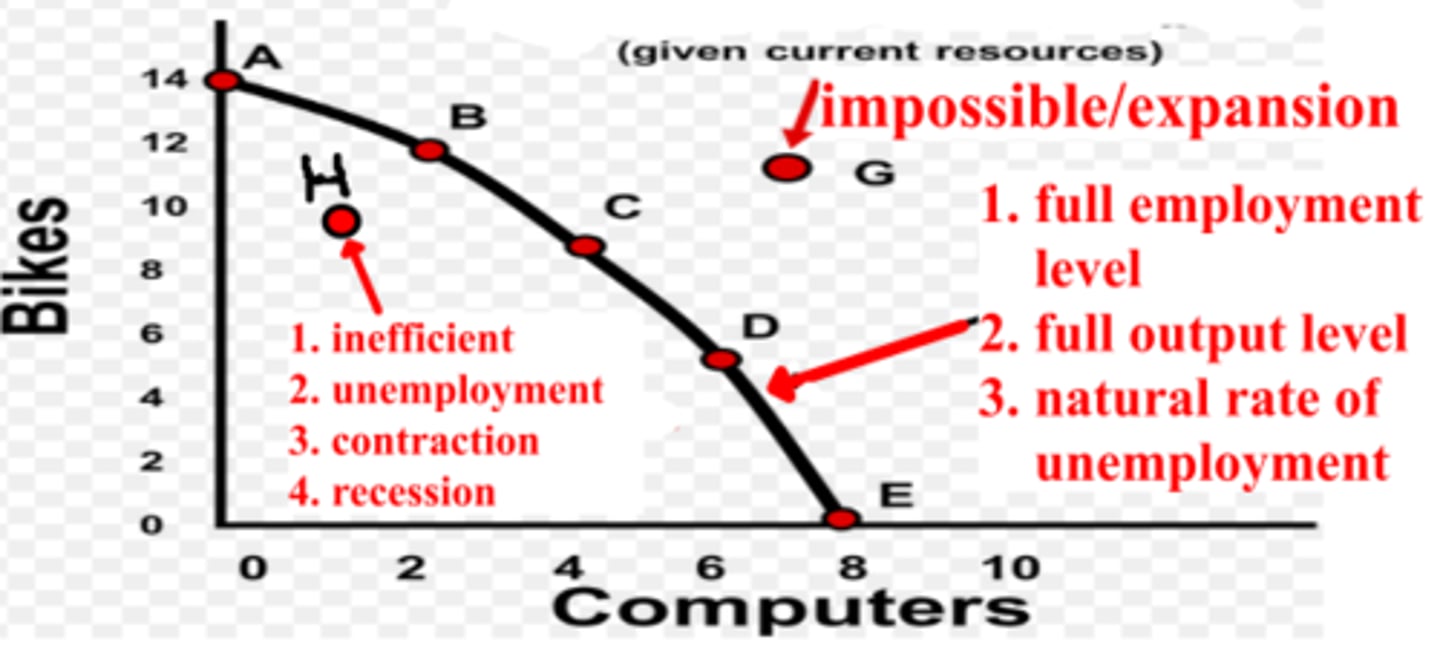
Why is the PPF Curved?
as the costs of production are not constant, and therefore the tradeoffs between producing product A and product B differ at different quantities
Efficiency
using resources in such a way as to maximize the production of goods and services
Static Efficiency
when productive and allocative efficiency are both achieved at a particular point in time
Productive Efficiency
when it is impossible to produce more of one product without decreasing the quantity produced of another product
Allocative Efficiency
a state of the economy in which production is able to meet consumer demand entirely (marginal benefit = marginal cost)
Factors which Shift the PPF Outwards (3)
- reallocation of fixed resources
- improvements in technology
- increase in the supply of labour
Command Economy
an economic system in which the government controls a country's economy
Marginal Product
the amount of extra output produced by an extra unit of input
Marginal Product of Labour
the amount of extra output produced by one more worker
Marginal Product of Capital
the amount of extra output produced by an extra unit of capital
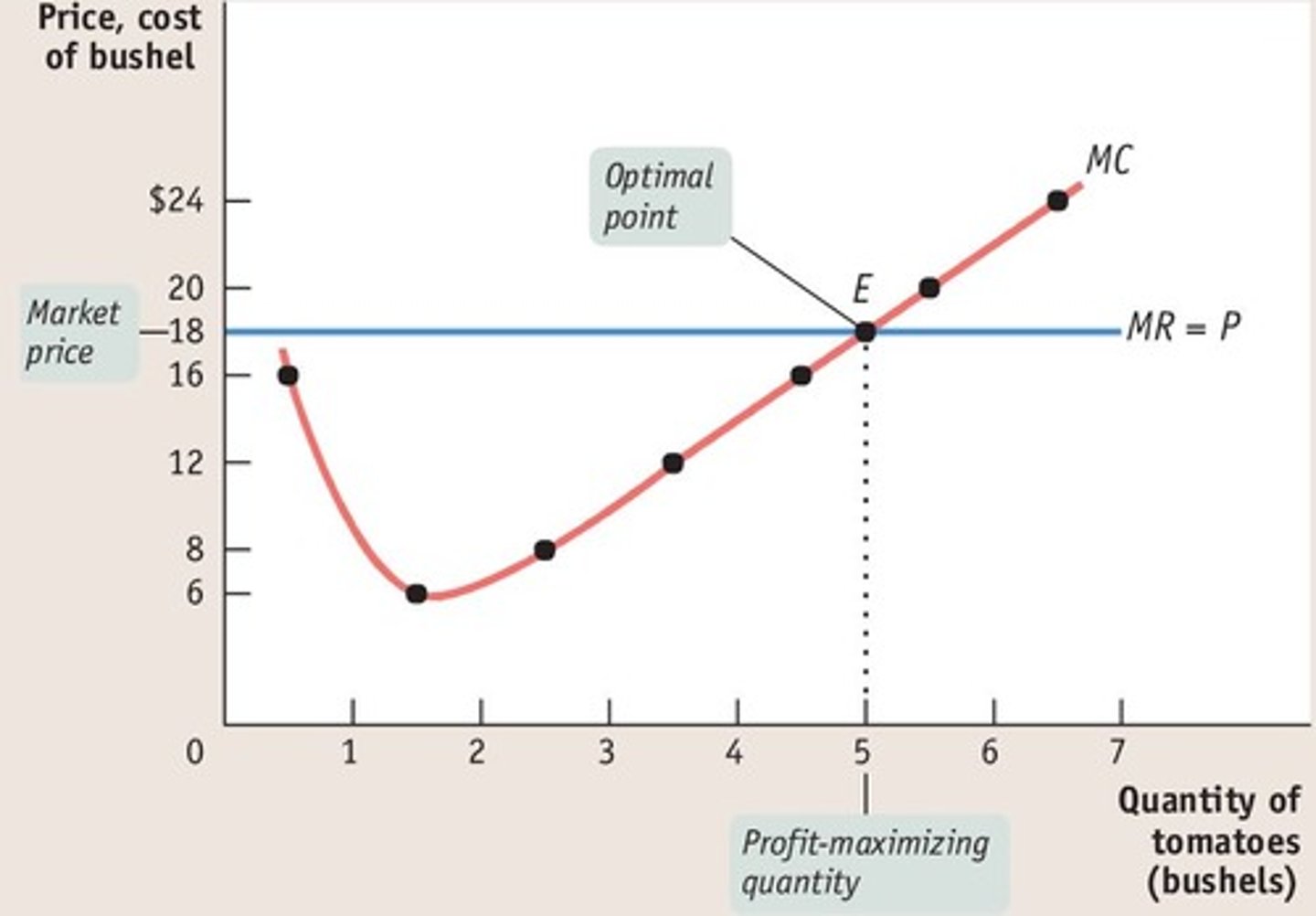
Marginal Revenue
the change in total revenue from selling an extra good or service
Marginal revenue is positive / negative depending on...
the price elasticity of demand
Marginal Cost
the extra cost of production that a firm incurs when producing one more good or service e.g. materials, labour
Marginal Utility
the extra benefit to an individual of consuming a good or service
(Law of) Diminishing Marginal Returns
the concept that the more of something you add, the lower the impact of each additional unit, ceteris paribus
Diminishing Marginal Product
the marginal product of an input declines as the quantity of the input increases e.g. farmers use the most fertile land to produce crops initially
(Law of) Diminishing Marginal Utility
decreasing satisfaction or usefulness as additional units of a product are used by consumers
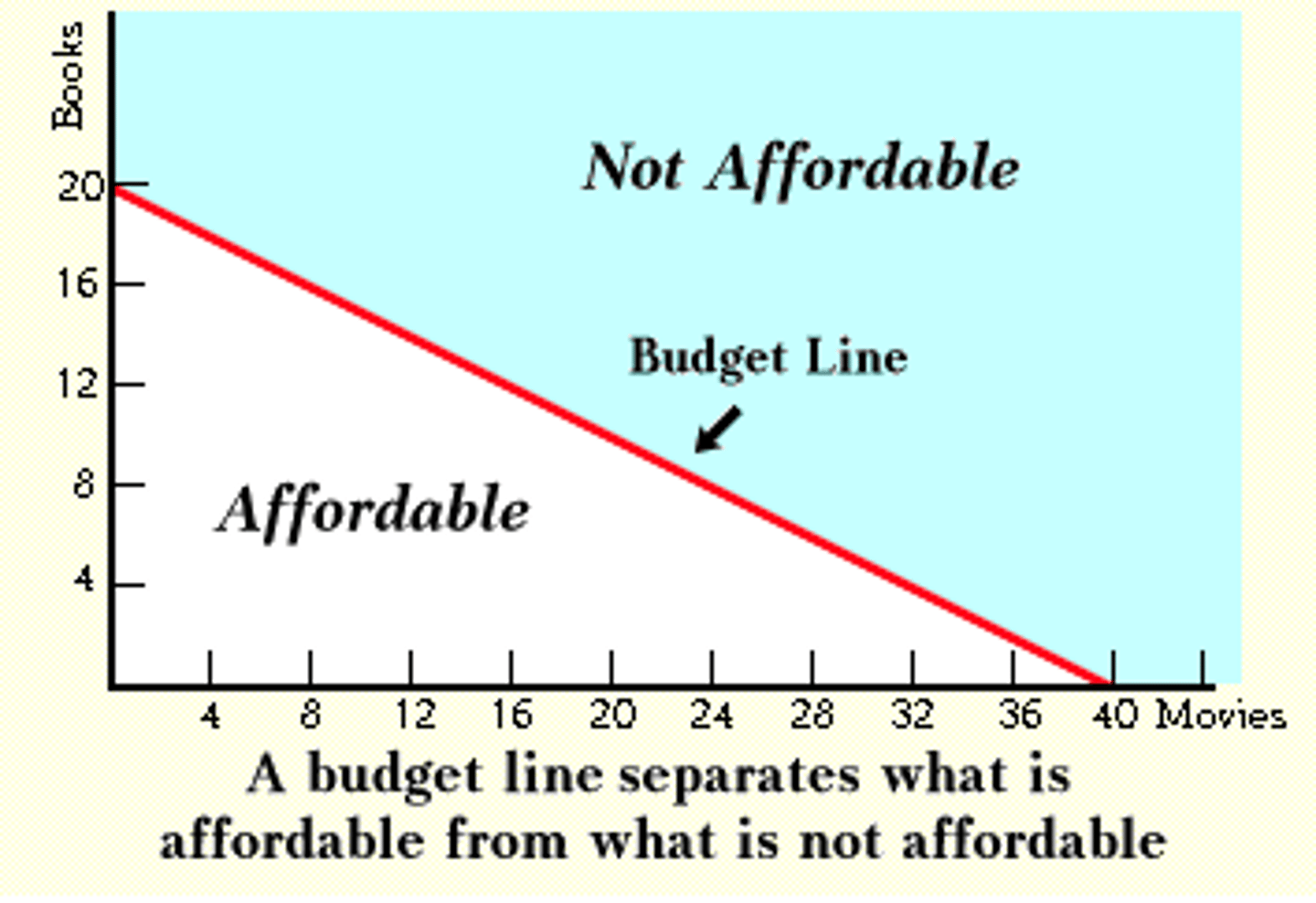
Budget Constraints
constraints that consumers face as a result of limited incomes
Total Utility
the total amount of satisfaction obtained from consumption of a product
Utility Maximization Formula
P1 / P2 = MŪ / MÚ
(these should be equal)
Rational Agents
agents (people, governments or producers) who use utility theory to guide their decision-making
Producers acting rationally will...
maximize their profit and attempt to increase their market share
Governments acting rationally will...
act in ways that maximise the welfare of their population e.g. reducing inflation
Consumers acting rationally will...
maximise their utility within the limits of their income and attempt to improve their work-life balance
Behavioral Economists
believe individuals will act irrationally as they lack perfect information and their decision making is restricted by time limits
Traditional Economists
assume that economic agents act rationally and want to maximise utility
Asymmetric Information
a situation in which one party to an economic transaction has less information than the other party
Anchoring
when an individual uses a reference point from a previous decision (which is usually irrelevant) to form the basis of a new decision
Availability Bias
the tendency for people to base their judgments on information that is readily available to them
Habitual Behaviour
where someone repeats their decision-making actions many times
Social Norms
generally accepted modes of behaviour
Nudging
a system of guiding people into making more rational decisions
Choice Architecture
presenting a decision in such a way as to influence an individuals decision
Default Bias
we are more likely to comply with a requirement than to make the effort not to comply
Mandated Choice
choices made in advance e.g. organ donor
Restricted Choice
offering people a limited number of options so that they are not overwhelmed by the complexity of the situation
Thin Market
a market with few buyers and few sellers
Thick Market
a market with many buyers and sellers
Price Signalling (Imperfect Information)
Buyers with imperfect information often believe a product's price represents its quality
Free Market
an economic system in which prices and wages are determined by unrestricted competition between businesses, without government regulation
Benefits of the Free Market (2)
- efficient as firms incentivised to produce more high demand goods
- rewards entrepreneurship
Drawbacks of the Free Market (2)
- missing markets for low demand products
- risk of monopolies
Benefits of Command Economy (2)
- corrects inequalities which exist in the free market
- prevent monopoly exploitation
Negatives of Command Economies (2)
- reduces incentive for entrepreneurship
- restricts consumer choice
Mixed Economy
an economy in which private enterprise exists in combination with the government controlled public sector
Bounded Rationality
a set of boundaries or constraints that tend to complicate the rational decision-making process
Price
the amount of money exchanged for a good or service
Quantity Demanded
the total number of units purchased at that price
Law of Demand
price and quantity demanded are inversely related as increased price will decrease demand, ceteris paribus
Willingness to Pay
the desire to pay based on individual preferences
Ability to Pay
whether an individual can afford product based on their income
Substitute Goods
an increase in the price of one good will increase the quantity demanded of the other e.g. Coca Cola and Pepsi
Complement Goods
an increase in the price of good will decrease the quantity demanded of the other e.g. flights to Spain and suncream
Income Effect
when prices fall, the consumer's purchasing power increases (assuming income is fixed), resulting in increased quantity demanded for the goods
Substitution Effect
when theorise of one good falls, the consumer will purchase the cheapest substitute, resulting in its quantity demanded increasing and demand for more expensive alternatives decreasing
Movements along the demand curve occur when...
price increases (demand contracts) or price decreases (demand extends)
Price Elasticity of Demand
measures the responsiveness of quantity demanded to a change in price
Price Elasticity of Demand Formula
PED = % change in quantity demanded / % change in price
Evaluating Price Elasticity of Demand
PED > 1 : Elastic Demand
PED < 1 : Elastic Demand
PED = 1 : Unitary Elasticity
Income Elasticity of Demand (YED)
measures the responsiveness of quantity demanded to a change in income
Income Elasticity of Demand Formula
YED = % change in quantity demanded / % change in income
Evaluating Income Elasticity of Demand
YED > 0 : Normal Goods
YED < 0 : Inferior Goods
YED > 1 : Luxury Goods
Cross Elasticity of Demand (XED)
measures the responsiveness of quantity demanded for product A in response to a change in price for product B
Cross Elasticity of Demand Formula
XED = % change in quantity demanded of product A / % change in price of product B
Evaluating Cross Elasticity of Demand
Positive XED : Substitute Goods
Negative XED : Complement Goods
XED Close to 0 : Unrelated Goods
Perfectly Elastic Demand
when quantity demanded is infinitely responsive to price and the price elasticity of demand equals infinity
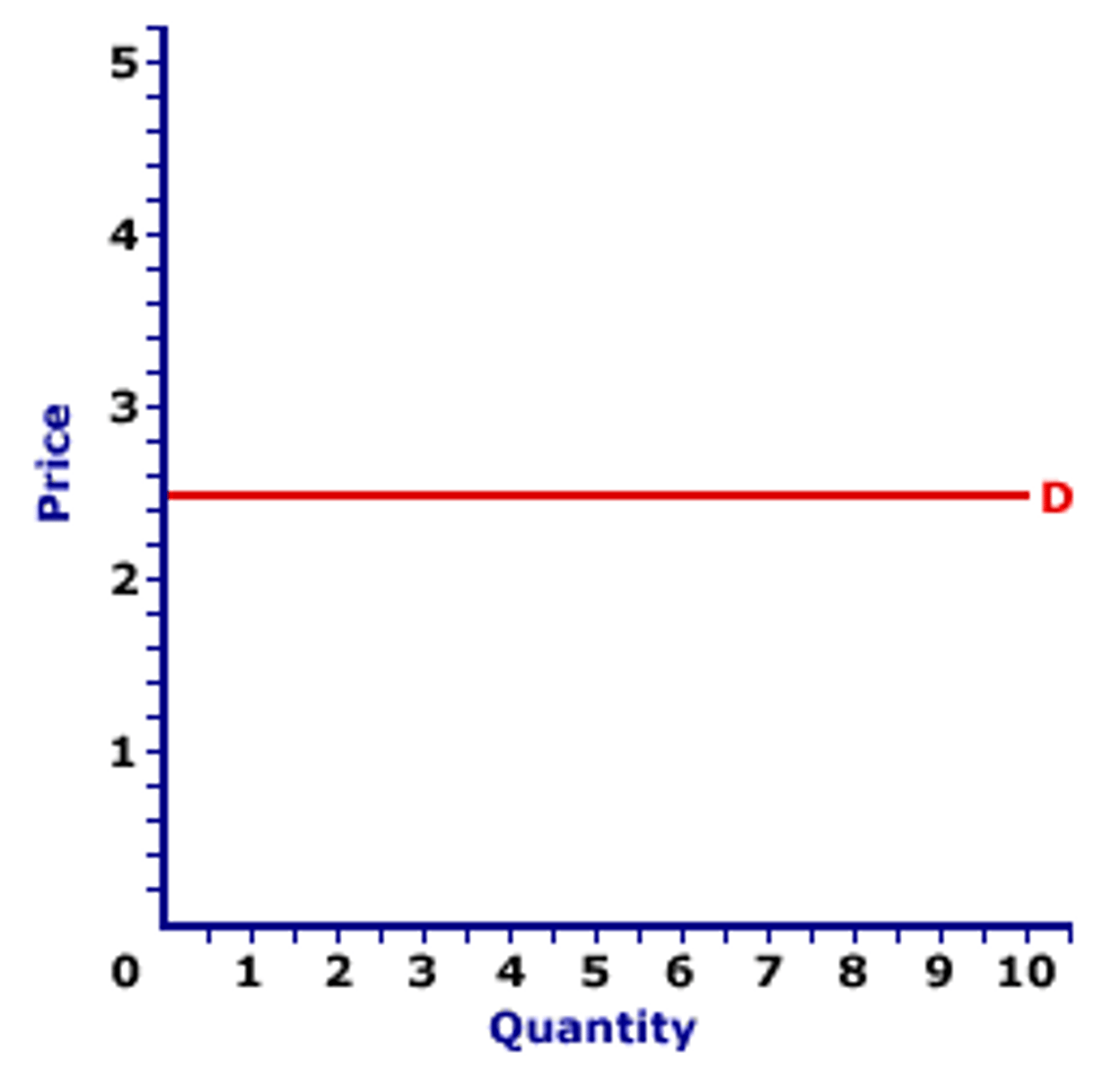
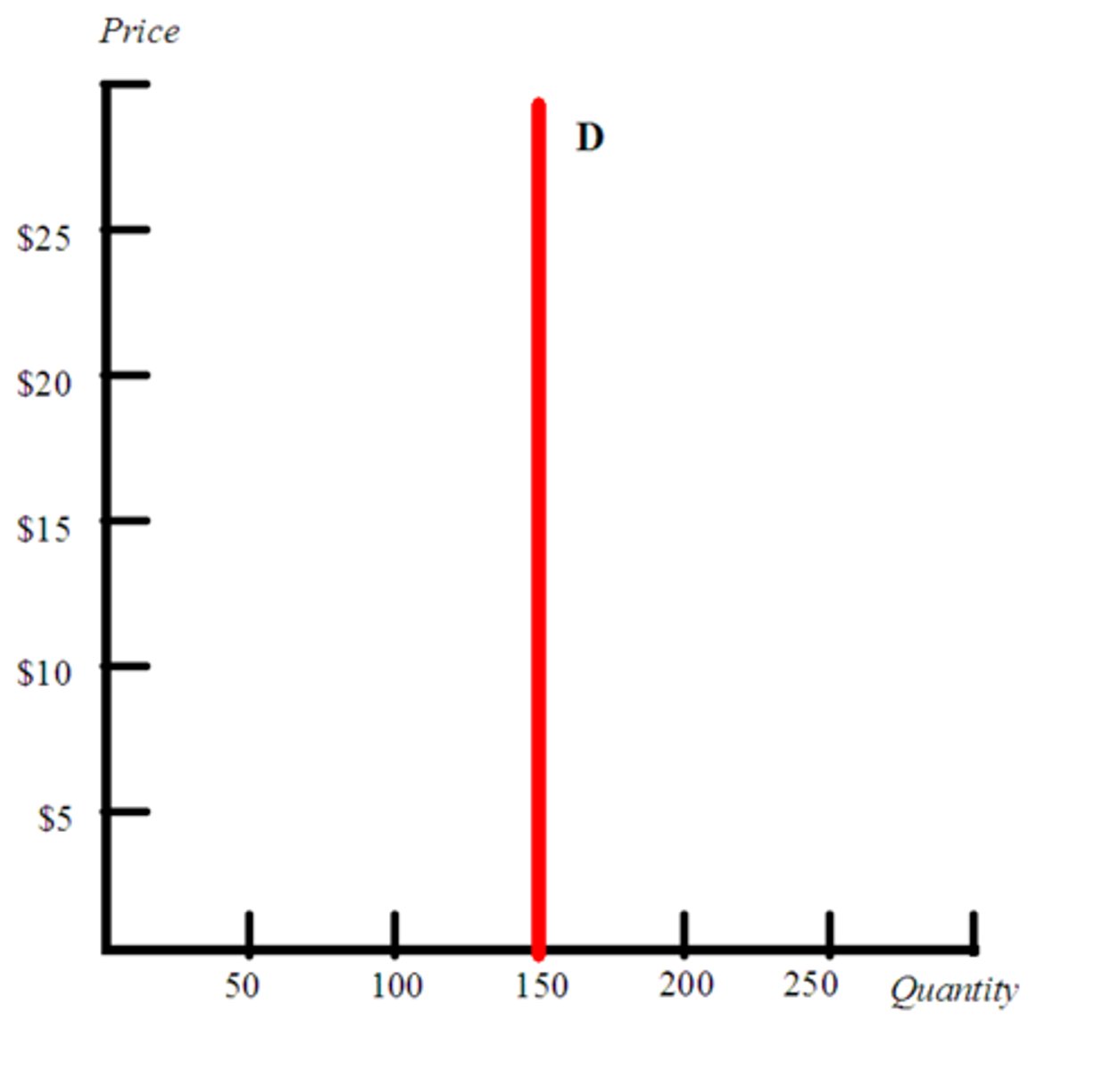
Perfectly Inelastic Demand
when quantity demanded is completely unresponsive to price and the price elasticity of demand equals zero
If demand is elastic, the firm should...
decrease prices as this will result in a proportionally larger increase in quantity demand
If demand is inelastic, the firm should...
increase prices as this will result in a proportionally lower decrease in quantity demand
Determinants of Price Elasticity (3)
- availability of substitutes
- proportion of income spent
- addictive goods
Total Revenue Formula
price per unit x quantity
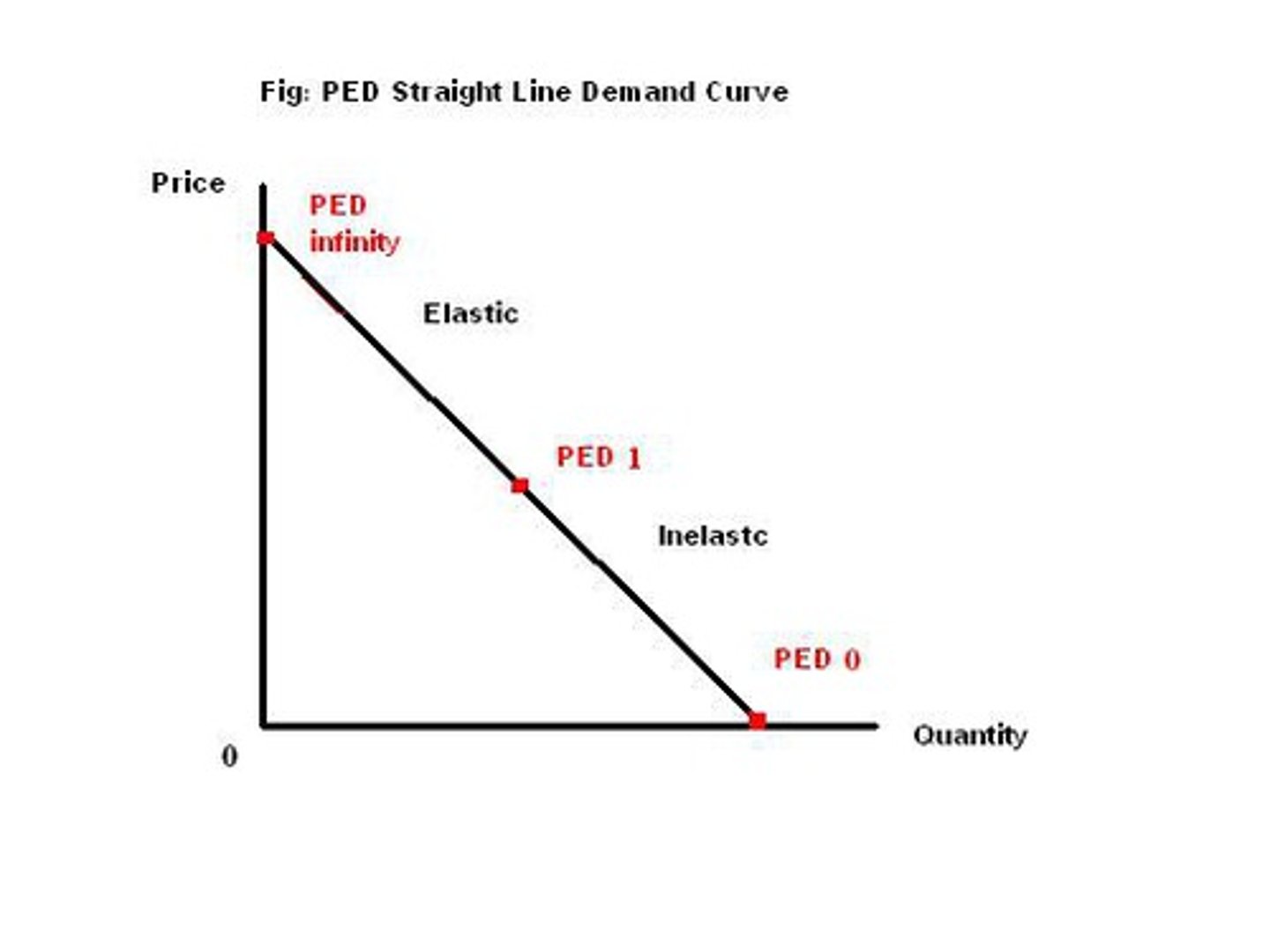
Straight-line Demand Curve
Demand becomes less elastic as we move down along the demand curve
Factors Which Increase Supply
- increase in price
- improved technology
- subsidies
Price Elasticity of Supply (PES)
measures the responsiveness of quantity supplied to a change in price
Price Elasticity of Supply Formula
PES = % change in quantity supplied / % change in price
Evaluating Price Elasticity of Supply
PES > 1 : Elastic Supply
PES < 1 : Elastic Supply
PES = 1 : Unitary Elasticity of Supply
In the short run, supply is...
inelastic as capacity is fixed and one or more factors of production (usually capital) are fixed
In the long run, supply is...
elastic as all factors of production are variable and capacity can be increased
Equilibrium Price
the price at which the quantity demanded equals the quantity supplied
Disequilibrium
when the market is not at a stable price or quantity, resulting in excess demand / supply
Excess supply will signal producers to...
cut prices as its better to sell at a lower price than not at all
Excess demand will signal producers to...
produce more to capitalize on higher sales revenue
Joint Demand
the demand for two or more complementary goods e.g. Iphone and Airpods
Composite Demand
demand for a good which has more than one use in the production process e.g. steel
 Note
Note  Flashcards (20)