Disease Prevention & Control
 Call Kai
 Learn
Learn Practice Test
 Spaced Repetition
 Match
Match Flashcards
 Knowt Play
1/98

There's no tags or description
Looks like no tags are added yet.
Name | Mastery | Learn | Test | Matching | Spaced | Call with Kai |
|---|
No analytics yet
Send a link to your students to track their progress
99 Terms
viruses…
are they small or large in size?
what shape are they?
what are they made of?
do they require a host to replicate? explain
VERY small (~0.025-0.35 um)
usually round
they’re just a genome surrounded by a protein capsule/capsid
YES, bc they’re not alive
viruses…
they can be enveloped or non-enveloped. → whats an envelope
are enveloped or non-env easier to disinfect? explain
what type of organisms do they infect (ani, human, etc.)
what do we use to tx them
envelope is a lipid membrane surrounding the virus’ capsid (it’s NOT part of the virus, it’s a PIECE OF THE HOST → when virus buds off host cell it takes a piece of PM w/ it)
env bc the detergent eats the envelope = virus is naked = becomes inactive (bc envelope contains receptors reqt to bind & enter host cell; e.g. flu virus)
almost all types (even bacteria!)
antivirals but there’s VERY few options
what does the “shedding time” of a virus mean
this is the period of time when its excreted from the ani & can be transmitted to another
do the pathogens below pose a high threat to biosecurity bc…
they’re very stable (& can survive a long time) in the environment
zoonotic
or both?
.
canine parvovirus type 2
cornebacterium pseudotuberculosis (causes caseous lymphadenitis)
ascaris suum
stable (survives in soil for 1 yr)
both (survives in soil for 8 m)
both (survives in soil for 10 yr)
do the pathogens below pose a high threat to biosecurity bc…
they’re very stable (& can survive a long time) in the environment
zoonotic
or both?
.
chronic wasting disease
bovine spongiform encephalopathy
zoonotic (human can get prion dis from eating infected meat)
both (incubation period is 2-8 yr)
bacteria…
are they small or large in size?
what shape are they?
what are they made of?
do they require a host to replicate? explain
name a feature some have that allows them to move
how long does it take them to replicate?
about 10-100x larger than viruses
sphere or rod shaped
single-cell organism
no, they can replicate on their own OR inside a host (but don’t RELY on host cell to rep)
flagella
some are super quick (within mins!) some take weeks or months
we can classify bacteria as gram-positive or gram-negative.
.
answer all for each:
what’s it made of
what color does it stain (pink or purple/blue)
is it easy or difficult to tx w/ abx
gram +:
only has 1 lipid membrane which is surrounded by a LARGE, THICK heavily crosslinked peptidoglycan layer
purple → bc the crystal violet dye binds to PPG during staining
relatively easy
.
gram -
has 2 lipid membranes (inner and outer) & a thin PPG layer in between them
pink → bc can’t retain crystal violet
difficult, resistant to many abx
parasites…
are they small or large in size?
what are they made of?
do they require a host to replicate? explain
some are as small as bac, most are larger
can be one cell (e.g. giardia) or more (e.g. nematodes), their cells have a nucleus (they’re eukaryocytes)
most do, some can freely rep in enviro
fungi…
are they small or large in size?
what shape are they?
what are they made of?
name some places they’re commonly found in the enviro
name 2 types of diseases they commonly cause
LARGEST (compared to bac, virus, parasite)
variety
cells have nuclei & vacuoles (they’re eukaryocytes)
resistant spores, mold, in rotting vegetation, in ani feces
skin infection & pneumonia
prions…
what are they made of?
describe what they do to their host
ONLY protein (no genetic material)
they’re a misfolded protein that triggers normal proteins (esp in brain) to misfold = chain rxn = get aggregates of misfolded proteins
define the following:
food safety
food defense
food security
food protection
preventing UNINTENTIONAL food contamination & foodborne illnesses
protecting food from INTENTIONAL contam thats meant to purposely cause harm or economic disruption (e.g. someone purposely contaminating a salad bar to make everyone sick)
having access to safe & nutritious food
the combo of 1 & 2 → taking all necessary steps to keep food safe, prevent contam, & ensure quality
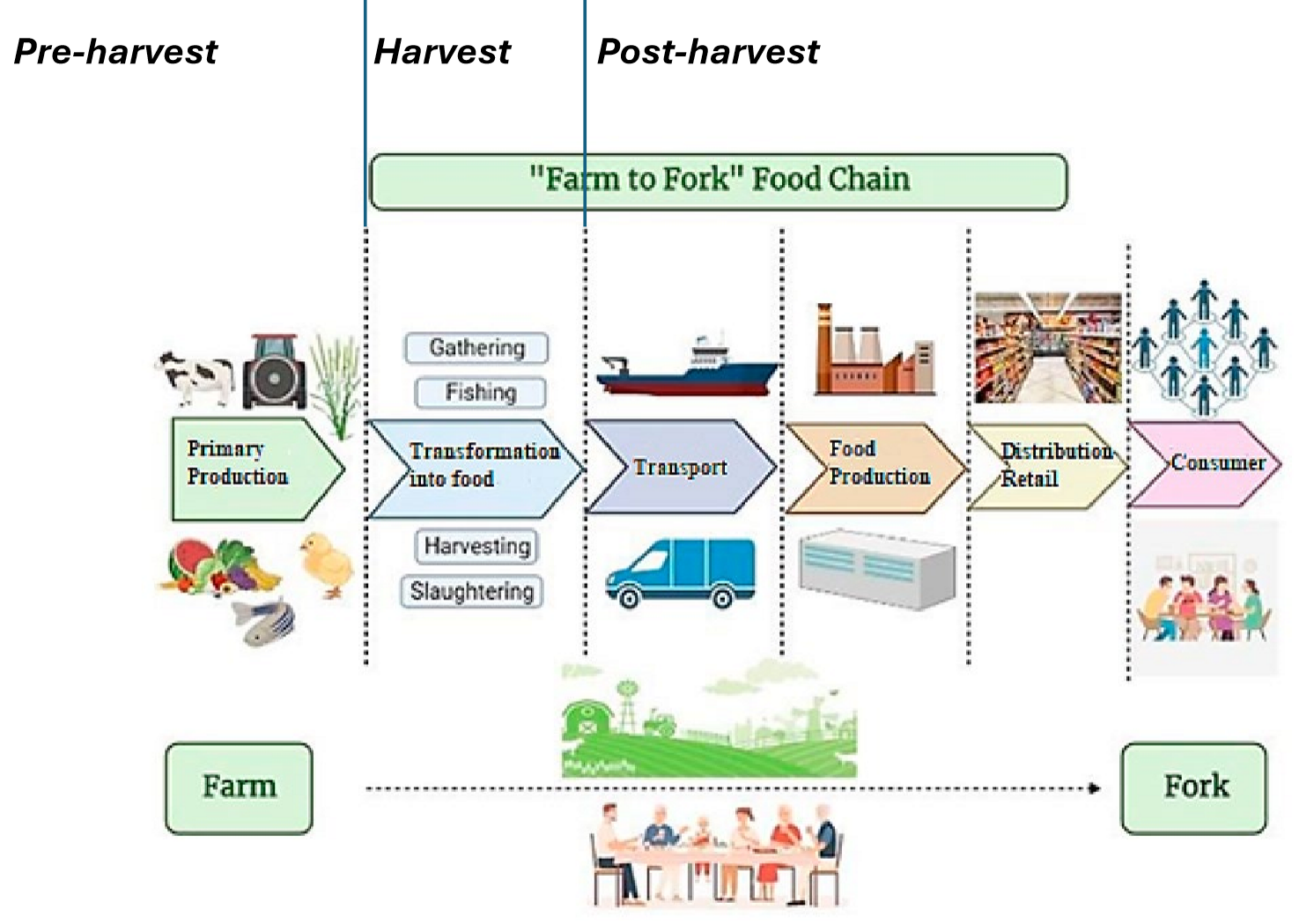
define “farm to fork”
.
describe the role of vets in this ^
.
whats AVMA’s stance on a vets role in food safety
the entire process of food prod → from growing food on a farm to it being on your dinner plate
.
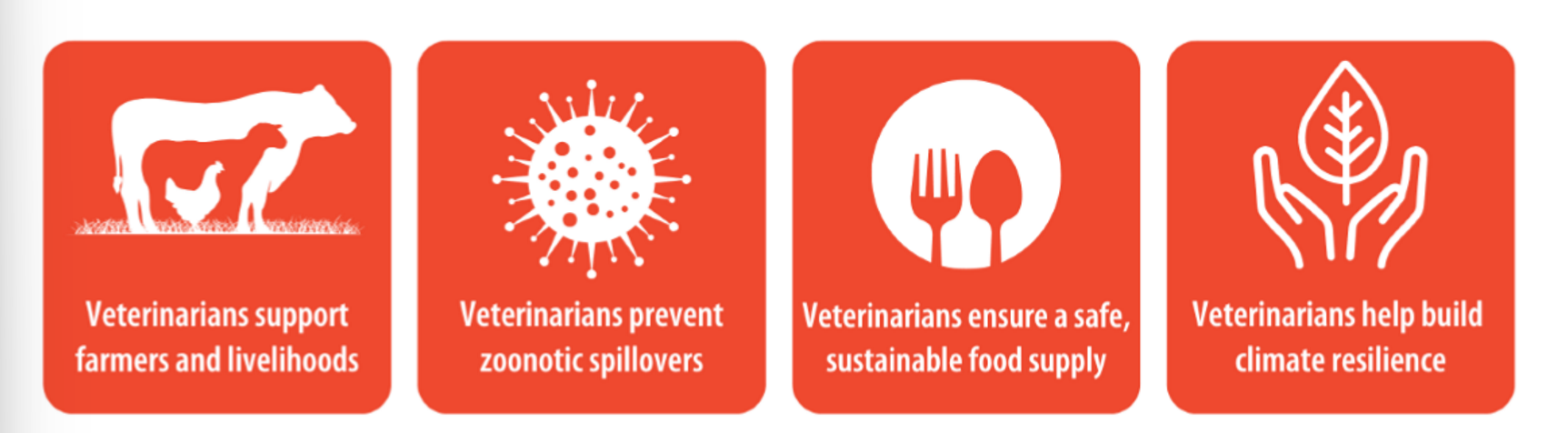
we’re involved in the entire process to ensure quality & safe food
.
they agree that we have a role in this
one way that vets are involved in food safety is by becoming a food supply vet
.
name some of their roles & responsibilites
monitor production
inspect ani products
educate on ani health, welfare, disease
preventative med
regulatory oversight
etc.
FSIS & FDA are the 2 federal departments/agencies that regulate food in the US.
.
describe the diff between what foods they each regulate
FSIS: meat from livestock, poultry, & processed egg products (liquid, frozen, etc.), catfish
.
FDA: everything else… pet food, produce, game meat (e.g. deer), seafood, shelled eggs
are the following things regulated by FSIS or FDA…
over 80% of the US food supply
enforces primarily thru physical inspections
grade A milk (AKA the milk we drink)
feed additives that we put in livestock feed
FDA
FSIS → they have an inspector in every single slaughter plant in US that looks at every indiv ani; FDA mainly does verficiation testing
FDA
FDA
there’s both federal & state meat inspection programs.
.
name 4 things the federal programs do to ensure meat safety
.
what about the state programs?
.
if meat was inspected by a federal inspector, can it be sold across state lines?
what about from a state inspector?
inspections both ante & post mortem
sanitation & standard operating procedures (SSOP)
a hazard analysis critical control point plan (HACCP)
testing for residues
.
MUST do everything federal does, can do more if they want
.
yes (& internationally)
NO, must be sold in the state its inspected in
there’s both federal & state meat inspection programs.
.
whats custom-exempt slaughter
.
what are talmadge-aiken plants
this is when the owner of the animal sends it to a plant to get slaughtered → then gets all the meat back
this meat ISN’T reqt to be inspected BUT it can only be consumed by the owner
.
these are plants in remote parts of the US where there aren’t any federal inspectors so we use state inspectors to do a federal inspection
are the following scenarios describing a:
A: FSIS veterinary medical officer
B: FDA veterinary medical officer
C: APHIS veterinary medical officer
D: food supply vet
.
I conduct antemortem inspections (done at the slaughter plant) of swine before they’re slaughtered
I educate producers about withdrawal times to prevent drug residue in milk
I visit dairy farms to discuss ^ when there’s a residue detected in their milk
i work with farmers to ensure cows are fit to be transported to slaughter plant
A: they work in the plants
D
B: FDA only comes to farm when there’s a residue
D: the’re the ones on the farm
are the following scenarios describing a:
A: FSIS veterinary medical officer
B: FDA veterinary medical officer
C: APHIS veterinary medical officer
D: food supply vet
.
I conduct TB testing in cows
i inspect meat, poultry, & eggs imported into the US
it depends… D if you’re just testing for surveillance, if you get a (+) test, C must come to do another test
A (C determines the qualifications for product before it even enters US)
whats a foodborne illness?
.
how quick does it take S&S of a FBI to occur
.
whos at greater risk of a FBI
illness someone gets from eating contaminated food
this is a PREVENTABLE public health challenge that causes thousands of deaths/year
.
can occur within minutes to weeks (usually presents as flu like symptoms)
.
young, old, pregnant, otherwise immunocompromised
camplyobacter is one of the most common bacterial causes of diarrheal illness in the US.
.
do cases of this occur as isolated sporadic events or large outbreaks
.
name some species that are assoc w/ getting this bac
.
describe how this bac leads to foodborne illnesses
almost all are sporadic, no outbreaks
.
kitten, puppy, poultry, livestock, unpast milk
.
many livestock carrying campy don’t show S&S and its carried in intestines & liver so it can easily transfer to edible parts of the ani when it gets slaughtered
ppl can get from touching infected dog/cat feces
produce can get infectd from water that has feces in it
cryptosporidium is a parasite that causes diarrheal illness & its the the most common causes of recreational water (e.g. pool) illness in the US.
.
name some species that are assoc w/ getting this parasite
.
describe how this parasite is transmitted
calves, goat kids, lambs
.
fecal oral → its in the stool of an infected person/ani
also it can sit in water for a longggg time
e.coli O157:H7 is a common bacterial causes of illness in the US.
.
which animal product has the most cases of this
.
besides ^, name some other species that are assoc w/ getting this bac
.
describe how this bac leads to foodborne illnesses
beef
.
goat, sheep, unpast milk
.
can get from eating undercooked contaminated ground beef
produce can be contaminated if contaminated cow feces is used as fertilizer in the field
can get from drinking contaminated raw milk
salmonlla is a common bacterial causes of illness in the US.
.
which animal product (2) has the most cases of this
.
besides ^, name some other species that are assoc w/ getting this bac
.
describe how this bac leads to foodborne illnesses
chicken & pork
.
reptiles, baby chicks & ducklings, poultry, livestock, dog, cat, unpast milk
.
it lives in GIT of animals so this is contaminated
ppl get from eating food & drinking water that was contamined w/ feces
.
e.g. outbreaks are common when ppl buy chicks from tractor supply… if these chicks have salmonella → kid plays w/ it → doesn’t wash hands → infected
listeria is the 3rd leading cause of death from FBI in the US.
.
which animal product has the most cases of this
.
besides ^, name some other species that are assoc w/ getting this bac
.
describe what makes this pathogen VERY hard to get rid of once a food processing facility has it
.
whats the easiest way to kill it?
dairy (ice cream, raw milk)
.
rodent, dog, cat, bird (also in water, silage, feces, etc.)
.
it easily spreads food to food just by touching the same contaminated surface, equipment, etc.
it continues to replicate when put in the fridge
.
heat the food
listeria is the 3rd leading cause of death from FBI in the US.
it comes in 2 versions: invasive illness & intestinal illness
.
describe the diff
invasive: can be tx w/ abx
intestinal: most recover w/o abx so only prescribe them if pt is YOPI
the first stage of preventing FBI is pre-harvest.
.
name some common sources of pathogens during this stage
.
describe these things we can do on the farm to prevent FBI pre-harvest:
environmental controls
e. coli 0157:H7 vaccine
competitive exclusion
ppl coming onto the farm, insects, rodents, bird, feed, water (manure runoff), compost
.
biosecurity, clean & disinfect, quarantine new ani, ventilation, avoid neighboring farms, etc.
this is given to reduce shedding by 65-85%
this is the idea of adding healthy bac to feed so they can out-compete bad bac in the gut = reduced shedding
whats the overall goal of a livestock quality assurance program (e.g. PQA)
.
describe the core components of a livestock quality assurance program (e.g. PQA):
animal welfare
food safety
traceability & record-keeping
biosecurity
.
do these programs require a VCPR
ensure safe, high quality, wholesome products are entering the food supply
.
QA programs train producers on…
proper handling, nutrition, enviro, etc. to minimize stress (this helps customers feel more confident in buying the product)
preventing chemical residues & contaminants in food
maintaining proper documentation of ani health & movement
implementing measures to improve herd health, prevent dis, etc.
.
yes
whats the focus of each of these livestock quality assurance programs:
beef quality assurance (BQA)
youth for the quality care of animals (YQCA)
pork quality assurance (PQA)
sheep safety & quality assurance (SSQA)
professional animal auditor certification organization (PAACO)
trains cattle producers on ani health, handling, etc.
same idea but trains kids & covers many species (swine, cow, rabbit, etc.)
same as 1 but for pigs
same for sheep
this is a 3rd party that goes to farms & slaughter plants to audit for ani welfare
critical control points (CCP) are a fundamental part of a HACCP plan (hazard analysis critical control point).
.
whats a HACCP plan
.
whats a CCP
a plan that all harvest facilities must have to address potential hazards in food prod
.
a step in the manufacturing process where food safety hazards can be prevented, eliminated, or reduced
describe the following CCP’s that are commonly emphasized during pre-harvest:
water quality monitoring
audits
pre-slaughter inspection
we want to test any water thats used for irrigation or mixed w/ pesticides to make sure its free from pathogens
want someone to come out to make sure we’re meeting pre-harvest standards
vets look at every ani for signs of disease before its transported
.
note: another common CCP is spreading manure on the field
residue avoidance is a major part of ensuring food safety pre-harvest.
.
describe what res avoidance is
.
name some things that are essential for a farm to do to practice res avoidance
.
whats FARAD (food ani residue avoidance database) role in this
this is preventing illegal drugs or abx residues from being in meat, milk, eggs
.
KEEP DETAILED RECORDS of all meds, date given, dosage, withdrawal time, etc.
ADHERE TO WITHDRAWAL TIMES (period from when you give the drug to when the ani can be slaughtered)
establish a VCPR to ensure proper drug use
be able to ID all of your animals
.
FARAD provides science based info on withdrawal times
antimicrobial stewardship is a big part of residue avoidance in food safety.
.
whats abx stewardship
.
we commonly give ani probiotics/bacteriophages pre-harvest (before slaughter).
why
this is using abx judiciously, don’t just use them to promote growth, etc.
.
it helps reduce any path they may have that can cause a FBI
the meat & poultry inspection act requires ani to be inspected before they’re shipped to the slaughterhouse.
.
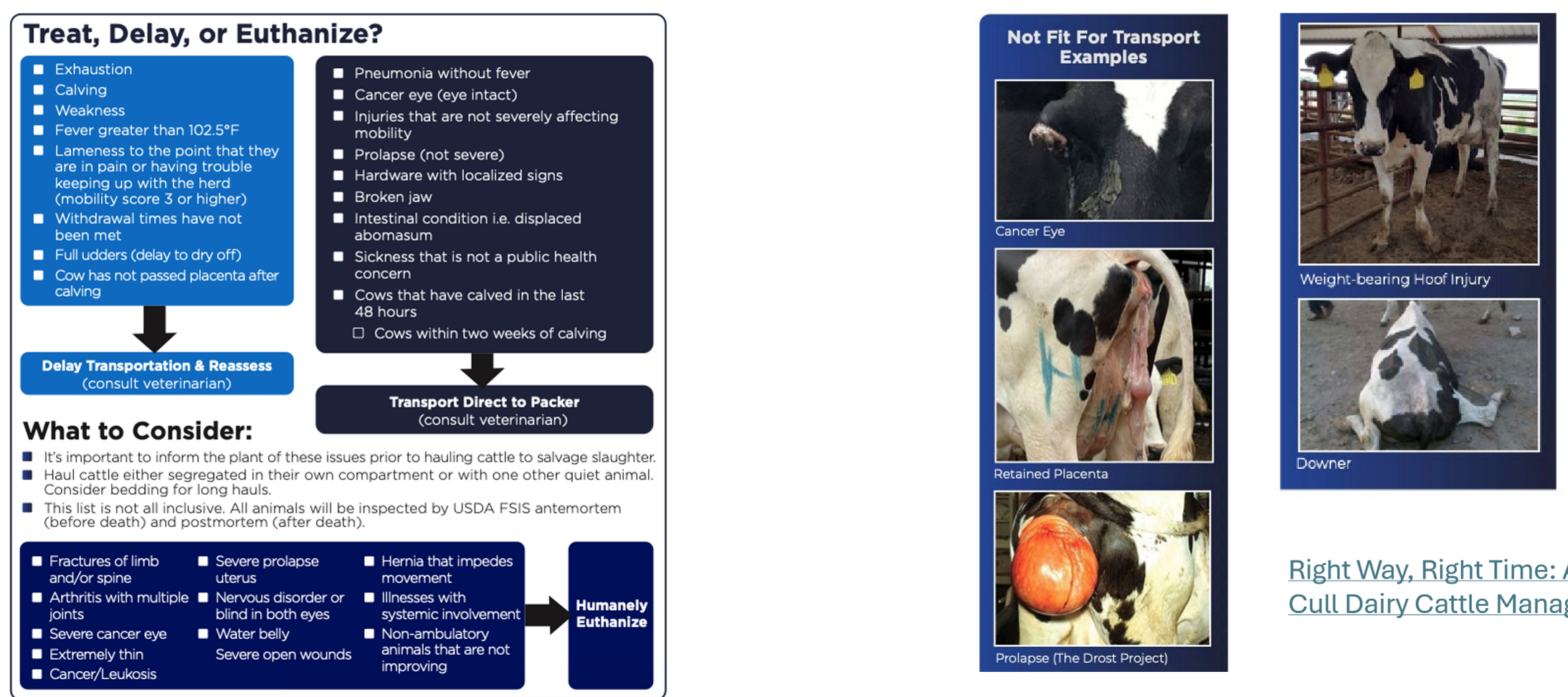
what are the reqt for an ani to be considered fit for transport
.
name 5 things that immeditely prohibit a cow from being transported & it should be euthanized instead
.
who determines if an ani is fit to transport
can bear weight on all 4 legs
fever free
don’t have BCS of 2 or less
past the withdrawal period of abx
not in the last 10% of gestation (bc may give birth during transit)
lactating cows must be milked right before transport
overall we want to make sure ani is in a condition to make it thru the entire trip (bc if ani gets to plant just to get condemmed = waste of time & not fair to ani)
.
cancer eye
retained placenta
prolapse
non-weight bearing
downer cow
.
vets!
name some things you should do to promote food safety if you’re slaughtering your own animal at your own home (not reqt by law to be inspected)
wash/sanitize your tools every 4 hours
use nonporous tables
prevent contact between carcass & fecess
for poultry, withhold feed 8-12 hr before slaughter (to avoid fecal contam)
cut away any parts of the carcass contam w/ feces, etc.
wear gloves
whats the basic idea of promoting food safety:
pre-harvest
harvest
post-harvest
preventing pathogens from getting into the ani on the farm
preventing contamination at the plant via strict hygiene, temp control, interventions, etc.
ensuring food is stored, transported, & handled safely
name some things the public health vet (PHV) is reponsible for doing at the slaughter house
testing for brucellosis, TB, or other surveillance pathogens
make sure there’s humane handling & stunning
conducts inspections, residue testing, & food safety assessments
steps of beef slaughter…
the first step is the ante-mortem inspection which is done at the plant.
.
do all plants do this
.
whats done during this inspection
.
name the 3 outcomes for an ani during this step
.
how does this step prevent pathogens from contaminating meat
YES, its reqt by law!!
.
each ani is observed at rest & in motion
.
ani is healthy, no concerns = it goes on to slaughter
we have some concerns = gets tagged as suspect so we slaughter it last & examine its carcass extra carefully
condemned/euthanized (e.g. down cows, swine & SR w/ super high temp, etc.)
.
it weeds out the sick ani
the humane methods of livestock slaughter act is required by law.
.
which gov agency enforces it
.
which domestic species does it NOT cover
.
name the 2 methods of slaughter it deems at humane
USDA FSIS
.
poultry
.
rendering the ani insensible to pain BEFORE its shackled, hoisted, thrown, cast, or cut
ritual slaughter (e.g. halal)
list each step of beef slaughter in order from beginning to end
ante-mortem inspection
stunning
exsanguination
remove the head
remove the hide
evisceration
split the carcass
wash the carcass
chiller
steps of beef slaughter…
.
define stunning
name the 4 approved ways to stun an ani
.
define exsanguination
what method do we use to do this
rendering an ani unconscious & insensible to pain in a single blow
CO2 (common in swine)
captive bolt
gunshot
electric current (common in swine)
.
the act of bleeding to death from severe blood loss (this is the step that kills the ani)
sever the jug veins & carotid arteries
steps of beef slaughter…
.
describe how we remove the hide
.
whats a bung tie
.
define evisceration
wash it to get dirt off → puller will pull it off → put knives in hot water wash to clean between each ani
.
using a bag or string to seal off the ani rectum (prevents feces contamination during evisceration)
.
removing the viscera
steps of beef slaughter…
the post-mortem inspection is conducted after the carcass is split in half.
.
do all plants do this
.
whats done during this inspection
.
whats done to the carcass if we find a localized (e.g. injection site lesion) vs generalized (e.g. enlagred LN’s) prob on it
.
name the 4 outcomes for a carcass during this step
.
who’s responsible for this part of the slaughter process
YES, its reqt by law that every indiv carcass is inspected
.
inspector looks at, palpates, & incises the head, viscera, & carcass
.
local = just trim off the affected area
general = carcass is retained for the PHV to inspect & maybe do additional tests on it
.
condemned/removed from food supply
partially condemned
pass
pass for cooking only (requires further processing)
.
plant inspector does inspection, PHV determines final outcome of carcass & is the only one that cna condem it
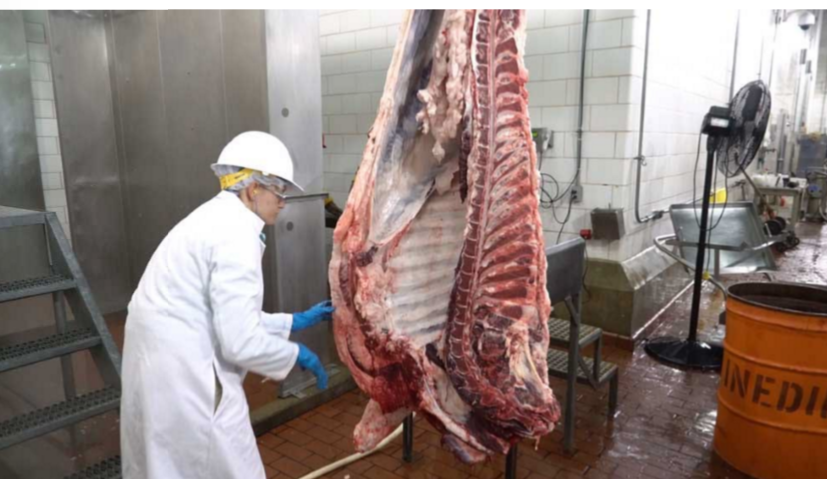
steps of beef slaughter…
what are the 2 ways a carcass can be washed (before its put in the chiller)
.
whats the purpose of this step
chemical wash or spray (e.g. acetic acid; evaporates off by the time meat is consumed)
thermal wash (e.g. hot water)
.
eliminates pathogens on the surf of the carcass
steps of beef slaughter…
.
residue & micrbiological testing are both verficiation tests.
what does this mean
.
residues & some pathogens are adulterants.
what does this mean
name some pathogens that are adulterants
.
what do each of these tests test for
they’re not done on every ani in the plant, we do randomly for surveillance & if we’re suspicious of a specific carcass
.
the carcass isn’t suitable to go into food supply
shiga-toxin producing e. coli in raw ground beef, salmonella in raw breaded stuffed chicken breast, listeria in ready to eat products
.
residue: any residue of drugs, pesticides, or chemicals in the carcass
micro: pathogens in the carcass (e.g. will do a bacteria culture)
the process of pork & poultry slaughter is very similar to beef.
.
how is their stunning diff
.
how is their chilling diff
.
how do we ID pigs vs cows
.
what are some things to consider when auditing a pork & poultry slaughter plant that we don’t consider in beef
pig: CO2 chamber or electrical stunning
poultry: CO2 (must raise levels slower than for pigs) or put on shackles then stun in electrical bath
cow: captive bolt
note: pig & cow aren’t put on shackles until post-stunning
.
pig & cow chilled in freezer
poultry in a cold water bath
.
pig: tattoo them as they walk off the trunk as the plant
cow: ear tag
.
pork: pigs vocalize a lot more than cows
poultry: check for bruising, broken wings, damaged legs
pasteurization is one thing we do post-slaughter to promote food safety.
.
whats the goal of it
.
give some benefits of past
.
name some foods that are commonly past
remove pathogens & make products more shelf stable
.
it eliminates 99.999% of pathogens
doesn’t significantly change the nutritional value & taste of a product
.
milk, ice cream, cheese, fruit juic, cider, liquid eggs, etc.
describe each type of pasteurization:
HTST (high temp, short time)
UHT (ultra high temp)
vat/batch
1:
most common method
heat to 165 F for 15 sec
.
2:
heat to 280 for 2 sec
makes unrefridgerated shelf life longer BUT can change flavor a bit
.
3:
heat to 145 for 30 min
usually used on small dairy farms before giving baby colostrum
high-pressure processing (HPP) is a type of cold pasteurization
.
how does it work
.
whats the benefit of using this method over UHT pasturization
.
what kind of products is this method commonly used for
put the food in its FINAL packaging (eliminates risk of re-contamination) → put in chamber that sprays water on it at a VERY high pressure → this kills salmonella, e. coli, etc. & extends shelf life
.
it doesn’t change taste of product (bc not adding heat or preservatives)
.
ready to eat things like guac dips, sauce, smoothies, etc.
post-harvest food safety is all about the consumer.
one component of this is cleaning.
.
list some times when its important to clean your hands, utensils, & surfaces
.
should consumers wash/rinse their produce & meat
before/during/after food prep, after handling raw meat or eggs, before eating, after touching an ani or its feed, etc.
.
yes for produce (run under water & dry)
NO for meat (just spreads more germs around the kitchen)
post-harvest food safety is all about the consumer.
one component of this is separating food to avoid cross contamination.
.
what should consumers do when using cutting boards & plates
.
what are some safe ways to handle raw meat at the grocery store and in the fridge at home
use separate boards & plates for cooked food/produce & raw food
.
put it in a separate section of your cart & bag it by itself
put in a sealed container or bag
post-harvest food safety is all about the consumer.
two components of this are cooking & chilling
.
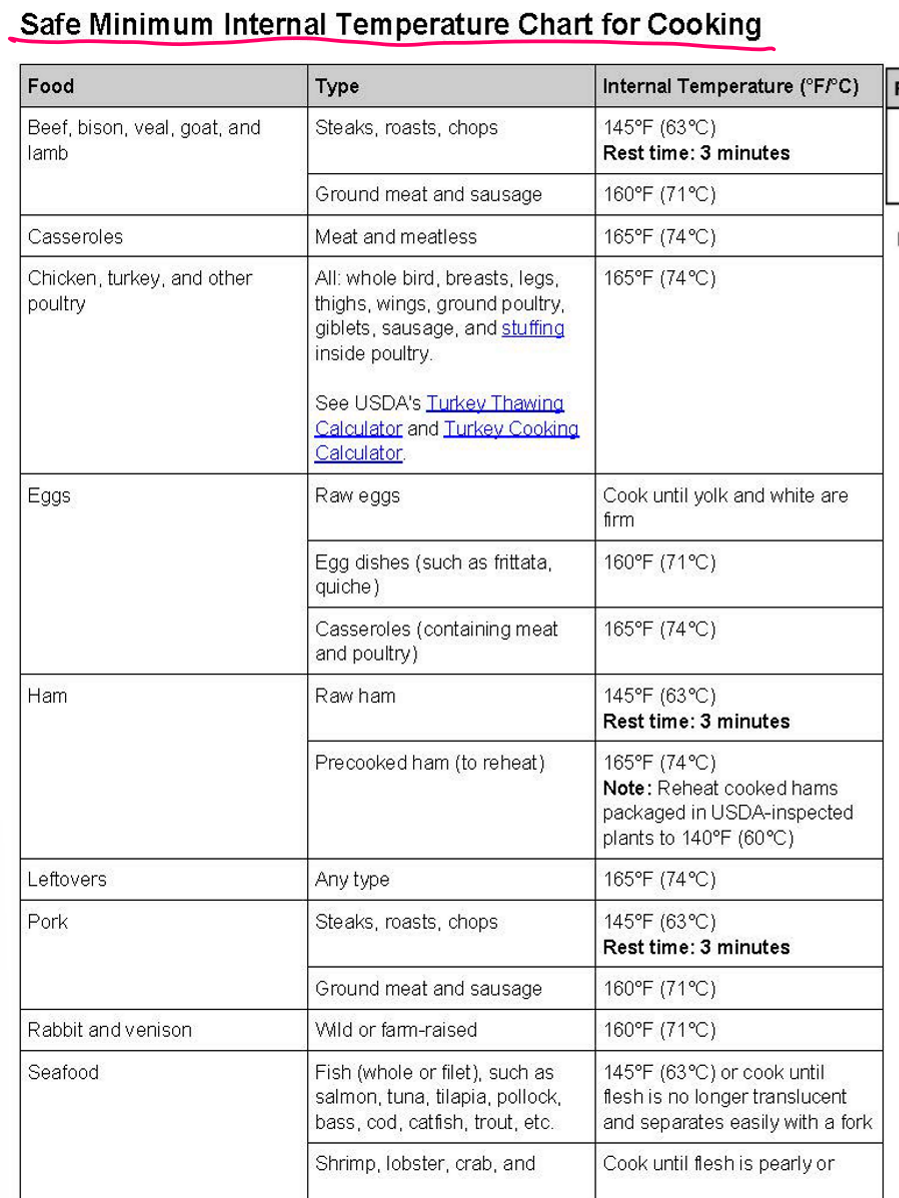
what should you do when cooking meat to promote food safety
.
describe how to safely chill your food after cooking
use a food thermometer to make sure its reached its safe minimum internal temp (put it in thickest part of food)
.
put food in fridge within 2 hr to keep it out of temp danger zone (bac multiply quickest within 40-140 F)
who do we call/report to if we want to report a food safety concern (e.g. food poisining) regarding…
meat, poultry, processed egg products
all other food
pet food
restarant food
USDA
FDA
FDA
local health department
the FDA is responsible for recalling pet food/treats when there’s food safety concerns.
.
whats the diff between a class I, II, and III recall
I: the product may cause serious health prob or death (worst type of recall!)
.
II: product may cause temporary health prob or pose a slightly serious threat
.
III: product is unlikely to cause health probs but it violates FDA labeling or manufacturing laws (e.g. label isn’t in english)
the FDA is responsible for pet food recalls which alert the public of a confirmed product.
.
who usually reports food concerns to them
.
why can pet food recalls also be a concern for human food
.
name the 3 most common type of contaminents found that lead to recalls
consumers or vets or manufacturers will notice it during one of their checks
.
sometimes these ingredients are made in the same processing plant
.
mycotoxins
chemical adulterants
bacteria
mycotoxins are a common thing that lead to pet food recalls.
what type of ingredients are they found in
.
why are they such a big public health concern
.
melamine is the largest chemical contamination of pet food in history.
why was it such a big public health concern
cereal grains, corn, nuts
.
can cause renal & hepatic damage in dogs
toxicosis in humans
and can be carcinogenic
.
led to renal failure & death in pets
led to infants dying
~8% of dog owners & 4% of cat owners feed their pets raw diets/treats even though they’re discouraged by the AVMA.
.
describe why this is a human health concern
.
whats the role of vets if we suspect our pt is sick from their pet food
studies show that many raw foods contain bacteria like salmonella, e. coli, etc. & the pet will shed this around the house
if owners touch the food, food bowels, feces, etc. w/o washing their hands after they’ll likely get the bac
YOPI have a much greater chance of getting sick
.
stay informed of new recalls (on FDA website), file a report to FDA, document well in med records, educate owners!!
what are some tips we can give owners to reduce the chance of them or their pet getting sick from pet food
wash hands after handling!!!
store their food away from human food
don’t prep their food in the kitchen
keep food in its original bag (so we have all the info if its recalled & if we dump contaminated food into a bin, bin will be contam & contam any fresh food that goes in it)
promptly discard any leftover food
don’t use their bowel to scoop their food, use a dedicated scoop
natural & man made disasters can have huge impacts on animals.
.
name some examples of ways natural disasters (e.g. earthquake, flood, tsunami) could negatively impact animals
.
is the number of natural disasters decreasing or increasing over time?
what about number of human fatalities from these disasters?
gas line break & leak, building fall releasing toxins/irritants, flood leaves ani stranded, bacteria starts growing in the water, etc.
these impact ALL animals (pets, livestock, zoo, wildlife, lab ani, etc.)
.
increasing A TON!
decreasing (better prepared, new technology, etc.)
in a disaster, animals can BE a disaster (e.g. foreign ani dis) or just be IN the disaster (e.g. flood).
.
one way an ani can be the disaster is if its a lab ani thats been exposed to a bioterrorist agent.
name 2 options you have for handling this ani if there’s a flood (for e.g.)
keep them at the facility & shelter in place
euthanize
hurricane katrina was the breaking point that led to HUGE developments in animal disaster response.
.
during katrina, what did people do with stranded animals
what was the result of this
.
describe each of these developments that came as a result of katrina:
FEMA
NRF (national response framework)
just grabbed them off the street & drove them out of the state bc there wasn’t ANY coordination between state, local, etc. organizations
thousands of ani were never reunited w/ their family
.
FEMA was made the official federal lead for coordinating disaster response
NRF was revised to focus on using the incident command system (ICS)
hurricane katrina was the breaking point that led to HUGE developments in animal disaster response.
.
describe each of these developments that came as a result of katrina:
PETS act
animal response teams
local animal shelters
this was passed & requires state/local gov to include pets & service ani in their emergency response plans if they want to recieve funding from FEMA (bc many ppl refused to evaucate katrina bc they couldn’t bring their pets)
requirements to be a member of the team were developed → must be registered, trained, wear identification on site, & can only deploy when FEMA asks you to (AKA you can’t be a random volunteer & do whatever you want)
started preparing better by asking community to foster dogs, etc. to clear out shelters before disaster strikes so they have room for animals
hierarchy of disaster response…
.
all disasters start locally.
name the local org thats in charge of responding to a disaster
name the state & federal org they can reach out to for help
what will these orgs ^ do
.
answer the same questions specifically for responding to ANIMALS in a disaster
county or city EMA
state & federal EMA
help w/ coordinating, training, & providing resources/funding (note: they aren’t the ones physically doing the rescuing)
.
local animal response team (most regions don’t have one)
state = varies (e.g. state dept of ag, state VMA, vet school, etc.); federal = US dept of HHS has a vet response team that pays vets to help, USDA NADPRP provides training & funding for FAD’s; also there’s non-gov orgs like ASPCA & AHA that deploy for LARGE disasters
.
EMA = emergency management agency
NADPRP = National Animal Disease Preparedness and Response Program
disaster response in Ohio…
Ohio doesn’t have a state agency in charge of companion ani disaster response.
what was the local response to this?
.
whats ODA’s role in ohio ani disaster response
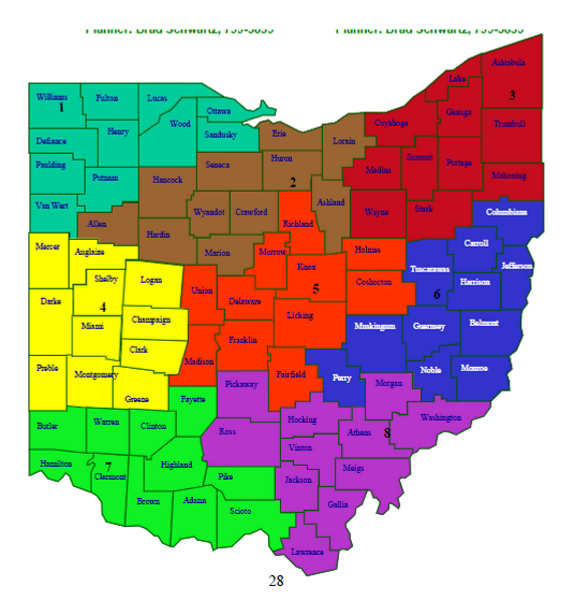
the state was broken up into regions & animal response teams were created in each region (but ohio doesn’t get many disasters so most aren’t active anymore)
.
if the disaster has a big impact on ag, they’ll coordinate some assistance & provide some funding
name, describe, & give an example of each of the 4 phases of disaster
1: mitigation
doing things to reduce the impact of a future disaster; usually its building smth structural that’ll always be present & have a long-term impact
e.g. make a vax reqt, build a dam to reduce risk of flooding
.
2: preparedness
creating a plan, training ppl & gathering resources to prep for a disaster
e.g. make an evacuation plan & go bag, microchip your pet
.
3: response
going out & implementing the plan we made when disaster strikes
e.g. search & rescue, triage
.
4: recovery
doing things to return to normal after a disaster
e.g. repair damage, adoption events, reflect on how to do better next time
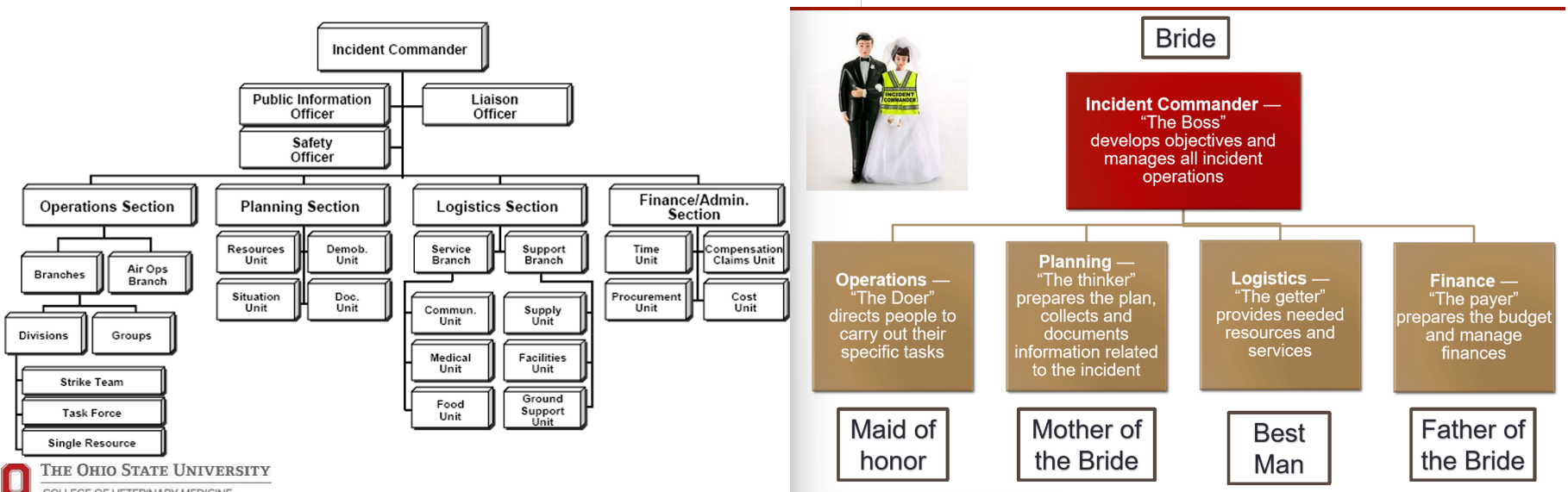
the incident command system (ICS) is a standardized system used to organize disaster response.
.
describe how an ICS works
.
name & describe the 5 main roles within an ICS
its organized into a VERY clear chain of command that tells everyone who’s in charge, what their role is, & how to communicate with each other
note: this allows ppl from all diff orgs (e.g. firefighter, medical team, etc.) to work together smoothly
.
incident commander: the leader
operations: ppl physically working in the field
planning: make the plan & document all info
logistics: provides resources that you need (e.g. will find you a building to house 200 dogs)
finance: preps the budget & manages money
name some activities vets can be involved in when it comes to animal disaster response
do surveillance for FAD’s
get deployed to be an emergency responder
help EMA’s create their emergency plans
educate owners to make an evacuation plan, make a go kit, microchip, etc.
provide medical care for ani working in a disaster (e.g. search animals)
during a disaster, it may be safest for animals to either shelter in place or be evacuated.
.
what does shelter in place mean
.
when is shelter in place the best option
.
name some pet supplies you should have prepared to shelter in place
you & your pet stay inside at home & don’t leave, someone may come by to make sure there’s food, water, etc.
.
when its safe to stay OR not safe to leave (e.g. active shooter, tornado)
.
1 week of food, water, meds, etc.; first aid kit; toys; crate; calming pheremones; etc.
during a disaster, it may be safest for animals to either shelter in place or be evacuated.
.
name 2 places pets can go when evacuation is needed
.
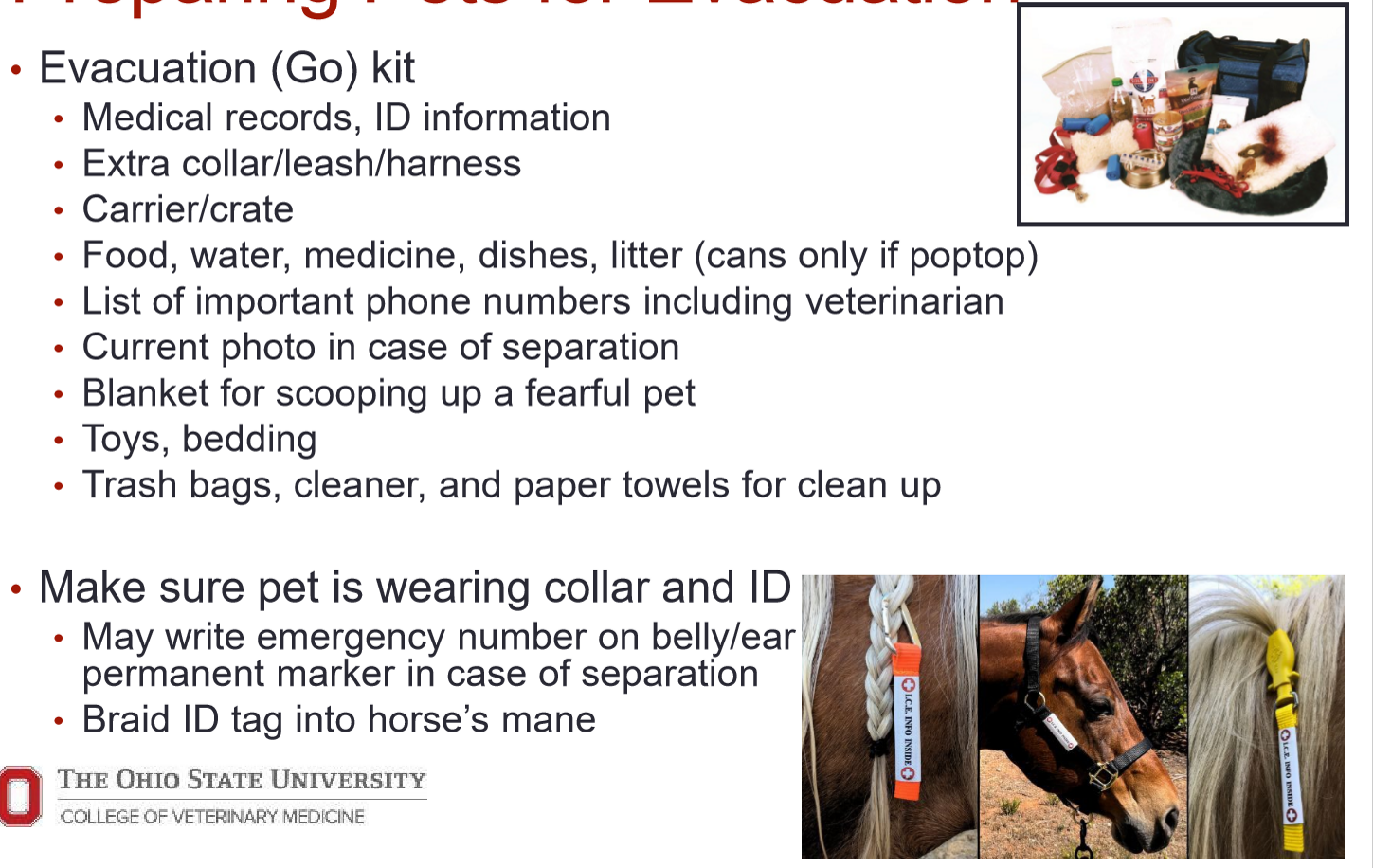
name some items owners should put in a pet go/evacuation kit
.
besides making a go kit, name some other ways owners can prep for pet evacuation
wherever their owner is going (e.g. hotel)
animal/temporary shelter
.
medical records, extra collar/leash, carrier, food, water, meds, litter, vet & owner contact info, current photo, blanket, etc.
.
make a list of places where you can drop your pet off, multiple routes to drive there, & who can get your pets if you’re not home
temporary shelters can be animals only, co-located, or co-habitated.
.
describe…
co-located
co-habitated
shelter is set up next to a human shelter, beneficial for all bc owners can help take care of their own (less stress on volunteers) & pets can see their owner (less stress on pets)
human shelter allows pets to stay w/ their owner
every vet clinic NEEDS a disaster response plan
.
walk thru the steps of how to establish this
buy insurance
identify any risks your clinic is susceptible to (e.g. power outage, tornado, fire)
identify the strengths & weaknesses of your clinic
implement as much prevention as possible (e.g. make an escape route, communication w/ team members, continuity of services, etc.)
in veterinary disaster field triage, all pets should recieve any needed first aid regardless of owners budget.
.
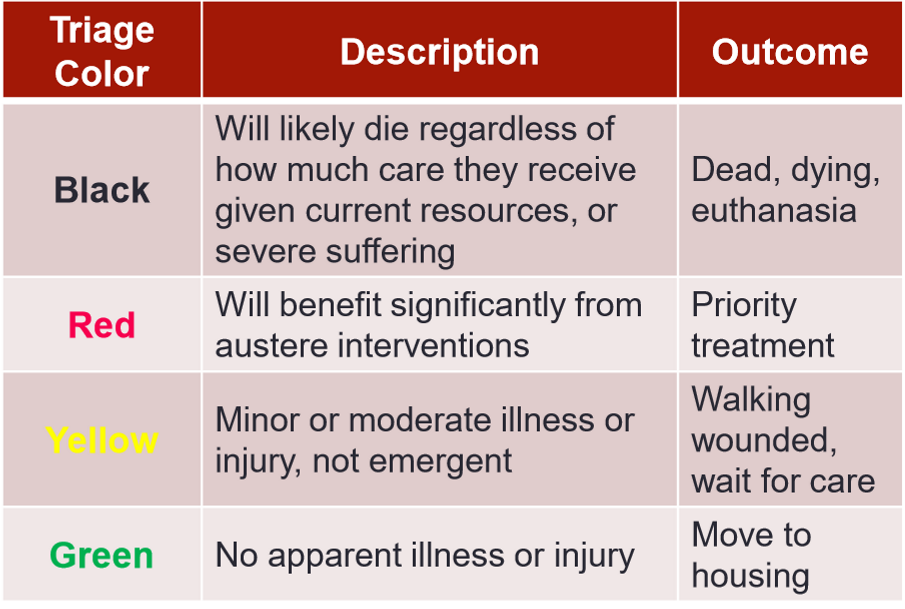
name the 3 questions we ask ourselves to determine if an ani is black, red, yellow, or green
.
describe what classifies a pt as ___ and describe what will vets do for this pt:
black
red
yellow
green
what medical needs does the pt have?
what resources do we have?
how many animals need care?
.
pt will prob die no matter how much care they get or they’re in SEVERE suffering → euth
pt will benefit A TON if given care → tx them first
pt can wait a couple hours to be tx (AKA walking wounded) → tx after red
pt doesn’t have any apparent injury → move into housing
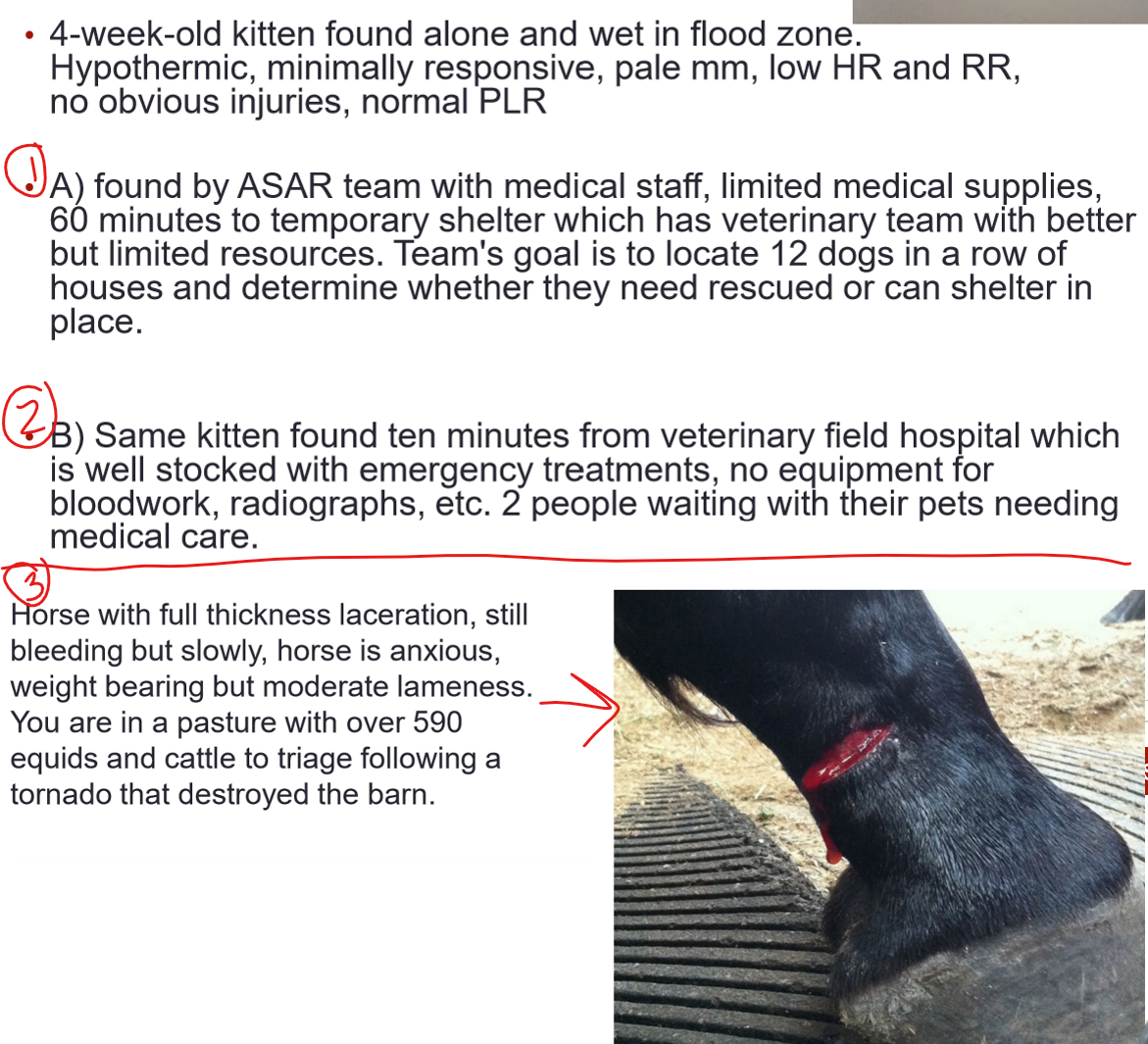
veterinary disaster field triage…
classify each patient as black, red, yellow, or green
black
red (let’s give it a try)
yellow (can throw a wrap on it or give a sedative to calm down for now)
list some examples of the NEEDS & WANTS of a temp shelter
needs: kennel/run to keep ani in, shelter from the elements, food, water & bowels, cleaning supplies, a way to ID each ani (e.g. kennel card), area to safely walk dogs
.
wants: vets, meds, group & individual housing, enrichment, outside access for walks, behavior team, bathrooms wifi & AC/heat for humans
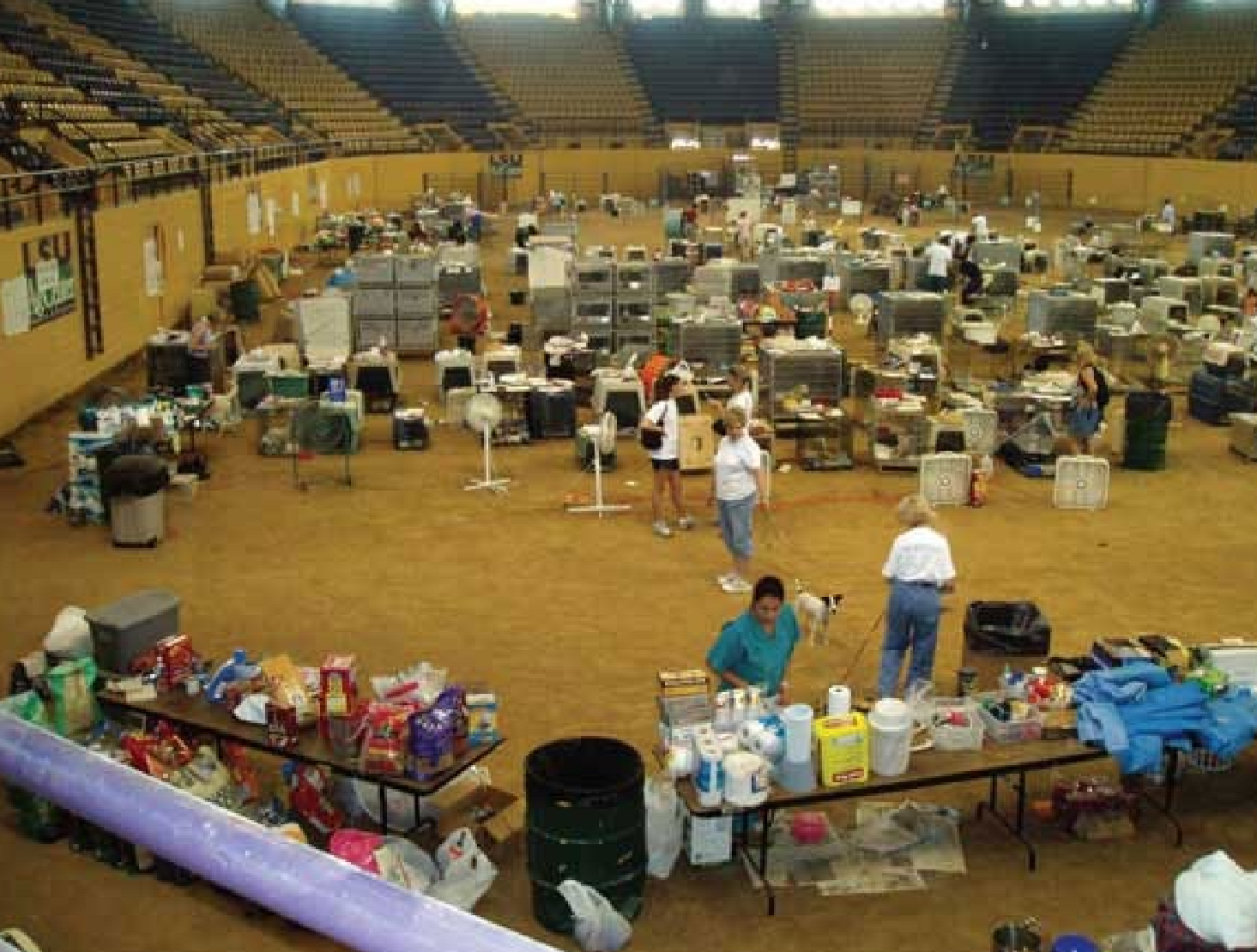
list some things to consider when deciding WHERE to set up a temp shelter
.
name the separate housing areas each temp shelter should have
is electricity & water available?
how close is it to a human shelter (co-location)?
how many ani & which species will we have?
parking?
note: county fairgrounds & empty warehouses are great for large shelters, tents for small shelters
.
general pop, ani w/ infectious dis, maternity, ani needing critical care, quiet area for anxious animals
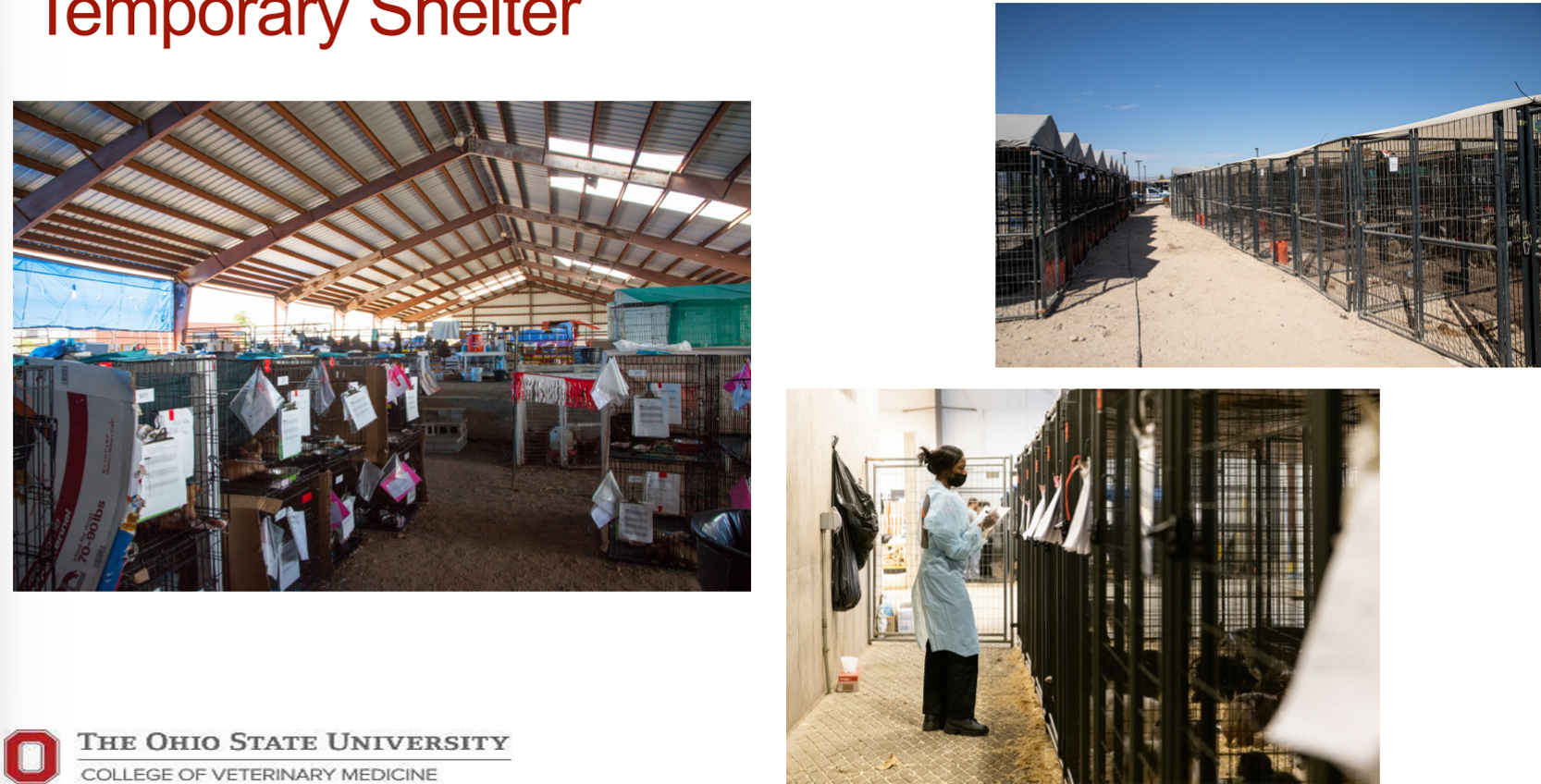
temporary shelters…
.
each ani should be ID’d at intake.
what should we do ASAP for stray animals that come in
.
why is maintaining records super important
.
are digital or paper records preffered?
post them online to hopefully find the owner
.
they’re legal docs & allows diff workers to all be on the same page
.
both is best
temporary shelters…
.
whats the primary & secondary goal when conducting medical intake of an ani once it arrives to the shelter
.
we can use intake forms & a critical care board to ensure adequate medical care in a temp shelter.
describe each
primary: determine if ani is vaxed, has parasites, & comfy
secondary: find any additional issues & schedule a time to address them
note: smtimes triage was done in the field before pt gets to shelter, smtimes not
.
form: use ASPCA’s standarized form when doing your intake exam to make sure all needed info is recorded
board: use a whiteboard to keep track of medical care for critical pt’s, this ensures they aren’t forgotten about
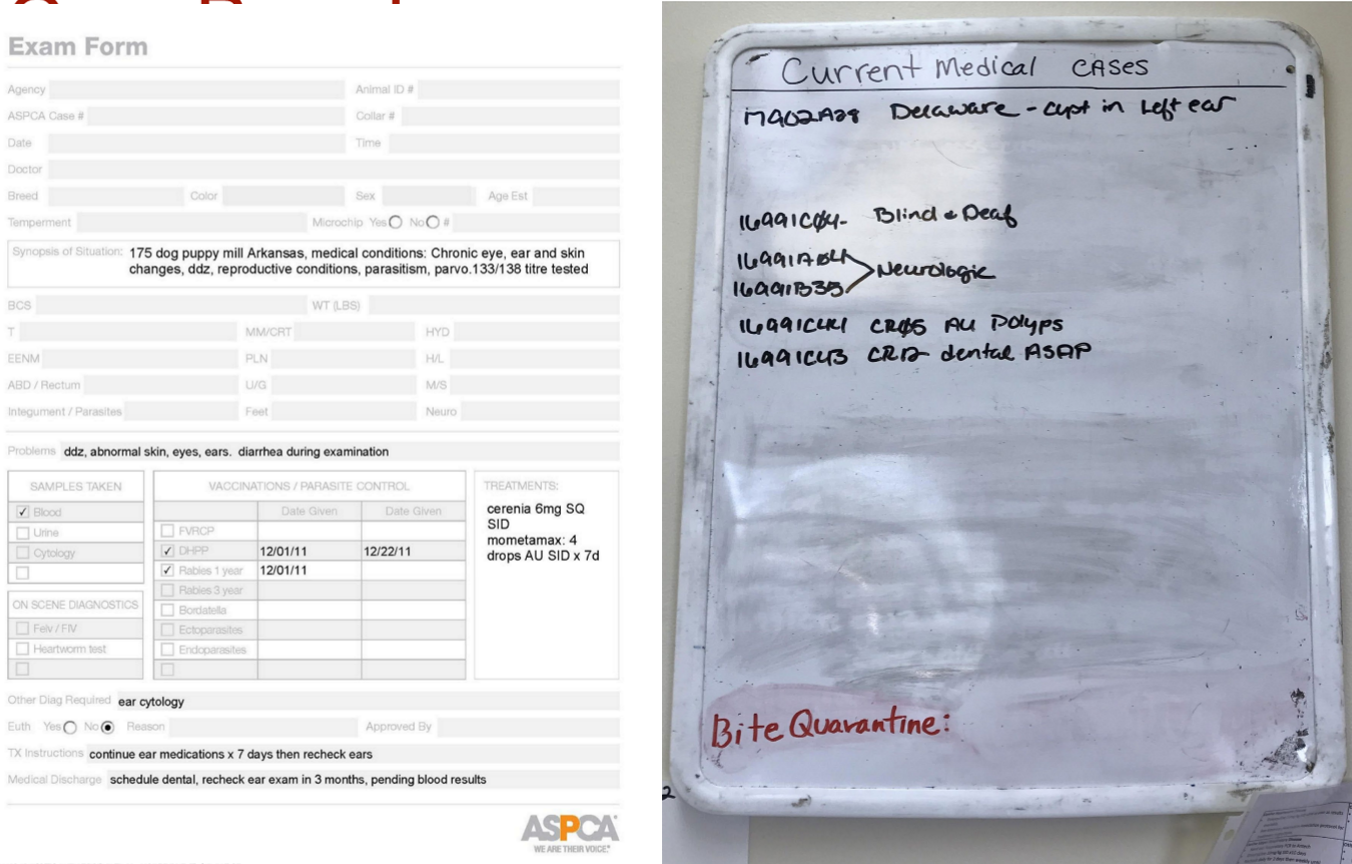
temporary shelters…
.
what are some things to consider when setting up the pharmacy?
.
give some tips for efficeicntly giving daily meds to animals
.
name some things to look for when doing your daily rounds/walkthrough
who’s DEA license will be used if using controlled substances?
how are we going to ensure each drug is properly stored?
.
set out trays → write ani name, med, & dose on it → fill trays & have another person double check them
.
illness, injury, behavior issues, missing cage ID, etc.
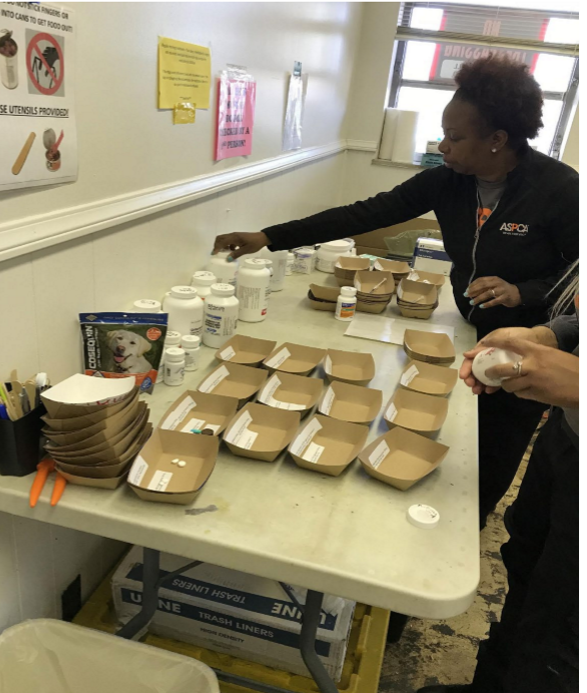
temporary shelters…
behavior issues are expected in shelters bc ani are stressed & anxious.
.
name some non-pharmaceutical ways we can address behavior issues
use experienced handlers only, move them to a diff area of the shelter, give them extra enrichment, add visual barriers to their run
define one health
.
identify the ___ of one health
who (who must work together)
how (how do we achieve it)
why (whats the end goal)
where (wheres it implemented)
an APPROACH that aims to balance & optimize the health of ppl, animals, & ecosystems
its SOLUTIONS focused
.
human, ani, environment
combo of comm, collab, coordination, & capacity building between all the sectors
to achieve healthy ppl, ani, & ecosystems
everywhere
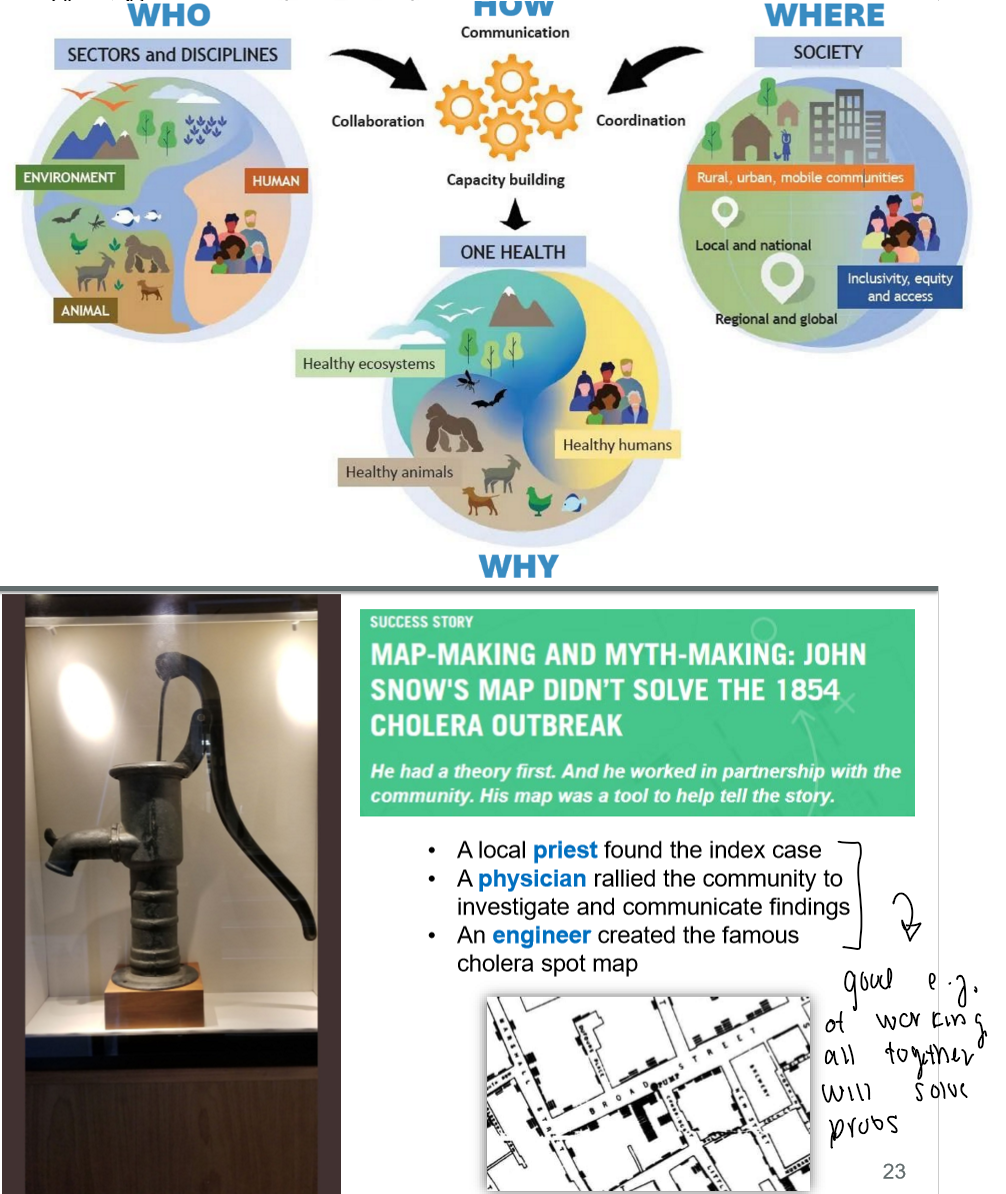
what did one health originate as?
.
what propelled the one health mvmt forward?
.
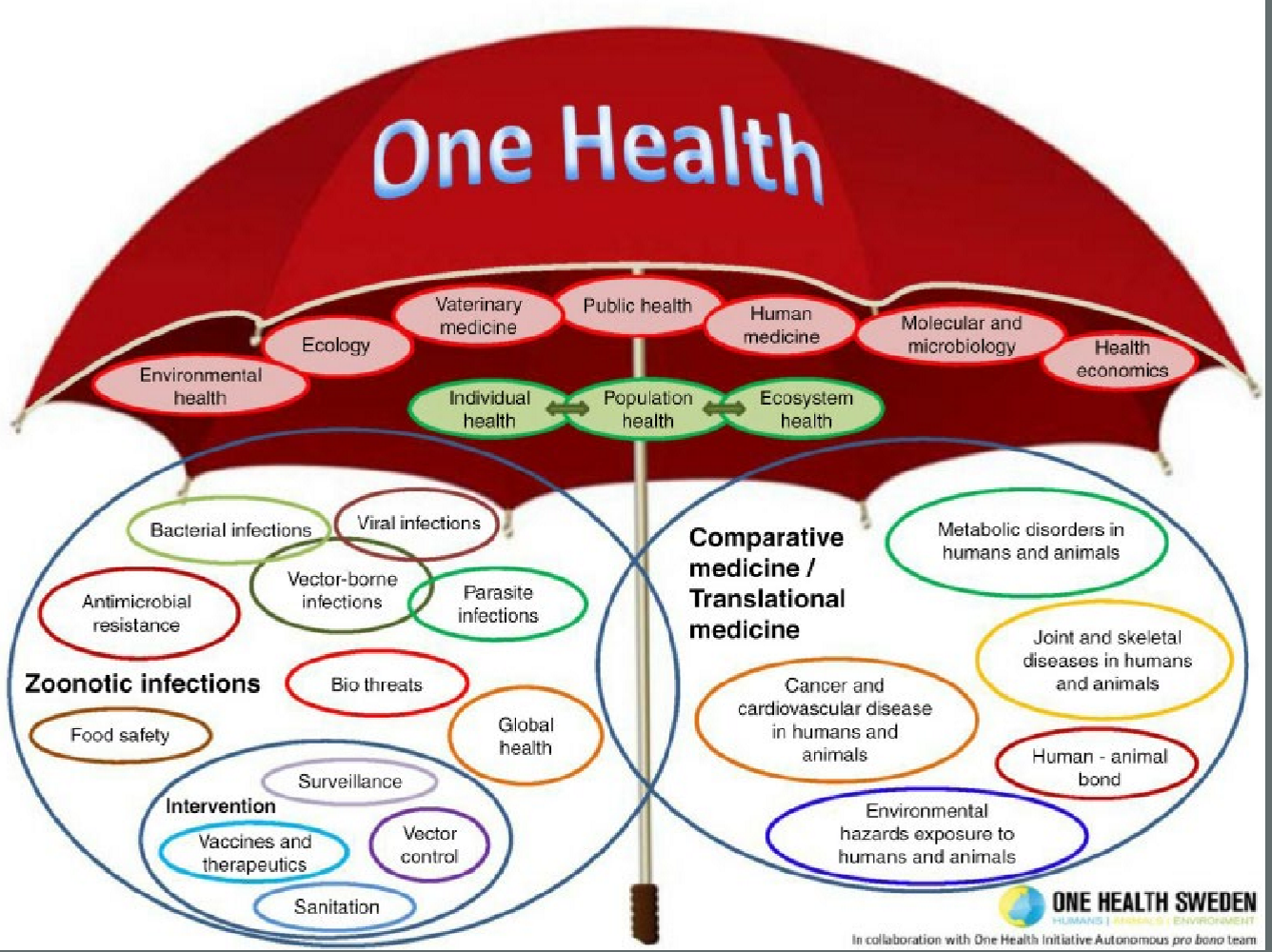
one health focuses on 2 big areas: zoonotic infections & comparative/translational medicine.
describe the latter
it was a medical & vet approach to control zoonotic diseases
.
a combo of HPAI outbreaks, globalization, & closer human-ani interactions
.
this is the idea of studying disease progression in animals (e.g. cancer) & applying it to human med
implementing one health…
.
give some big pros & cons of implementing a one health approach
.
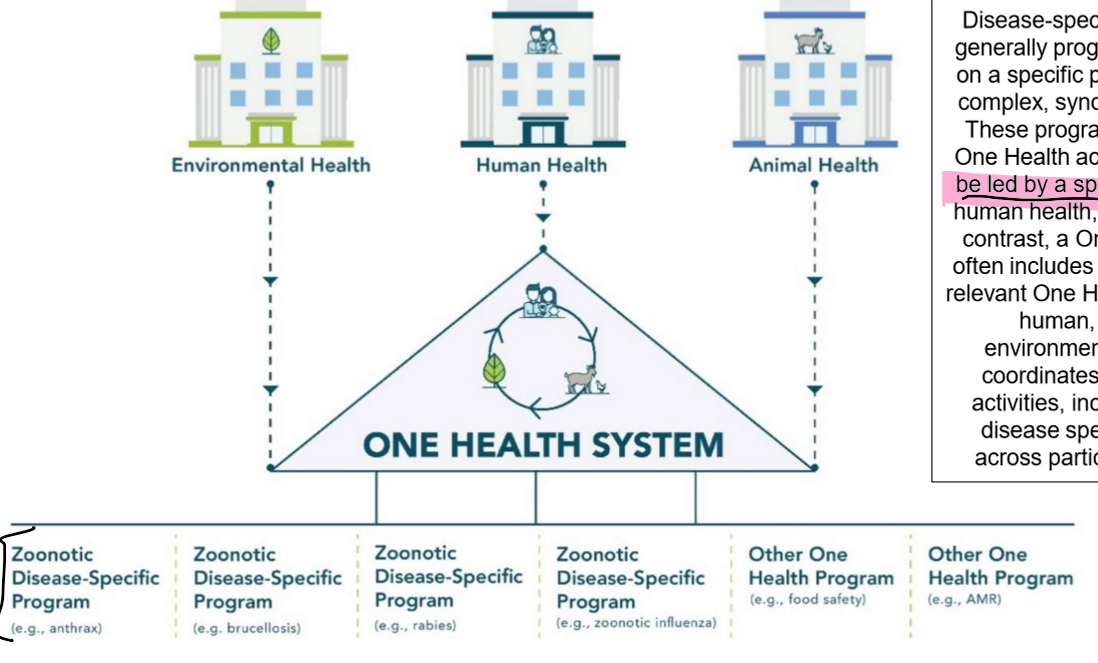
describe how implementing a one health approach can bring together disease-specific programs (e.g. anthrax program, rabies program, food safety program, etc.)
pros: allows us to better understand health & create more EFFECTIVE solutions when combating disease
cons: takes a lot more time, skill, commitment, & resources; hard to quantify & predict its benefits
.
these programs tend to be lead by one sector (e.g. animal health) → so OH includes delegates from all 3 sectors to better coordinate the programs activities & make sure each sector is represented
one health requires interprofessional collaboration at the national level.
.
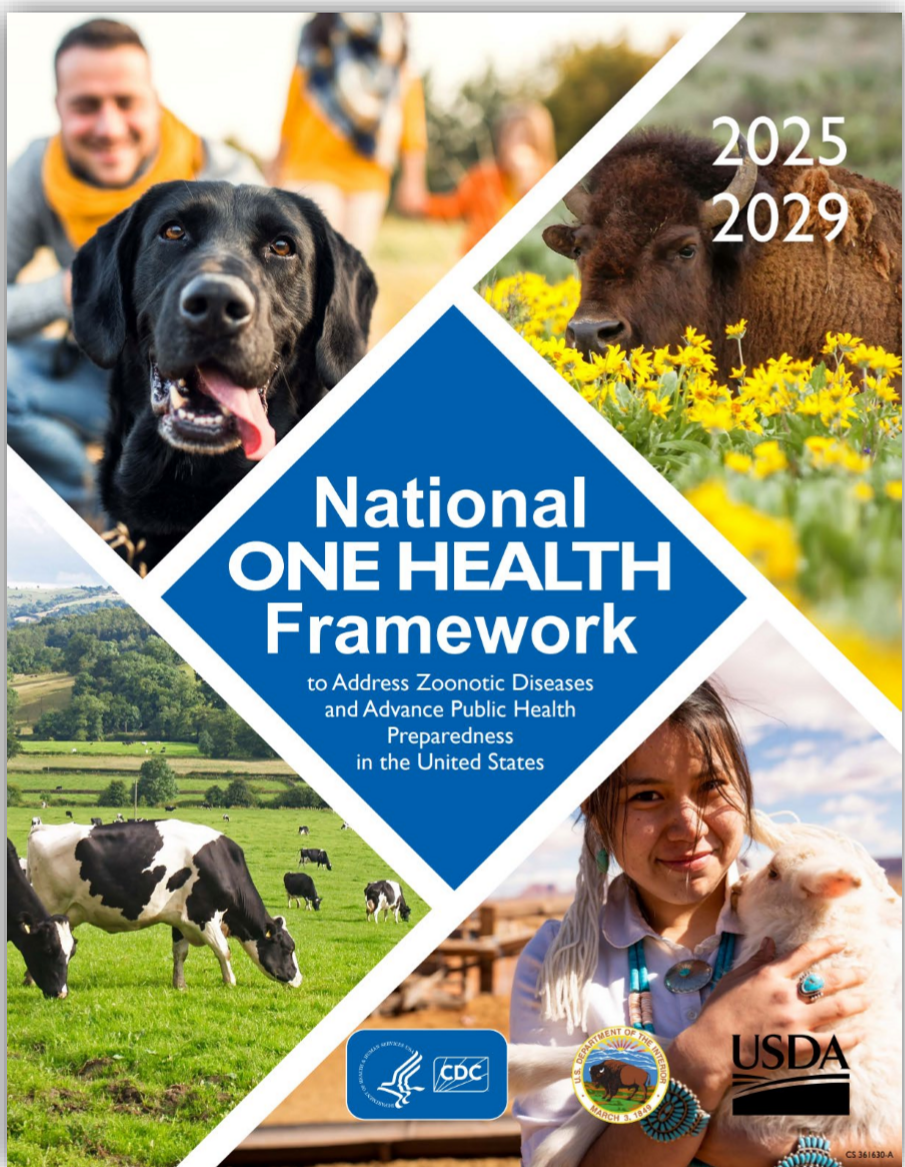
one way this was achieved is when congress mandated the CDC, DOI, & USDA to come together & create a national one health framework.
whats the basic purpose of this framework
.
another way this is achieved is thru the one health federal interagency coordination committee (OH-FICC).
describe who they are what they do
.
interprof collab is also required at the state level.
describe how ohio achieves this
establish formal coordination between all 3 sectors; better understand zoonotic disease; improve dis prevention, detection, response, & recovery at the federal level
.
a committee of 23 federal agencies (come from a mix of all 3 sectors) that have calls & webinars to share updates
.
there’s quarterly calls (anyone can join) to share resources, have conversation, & strengthen relationships
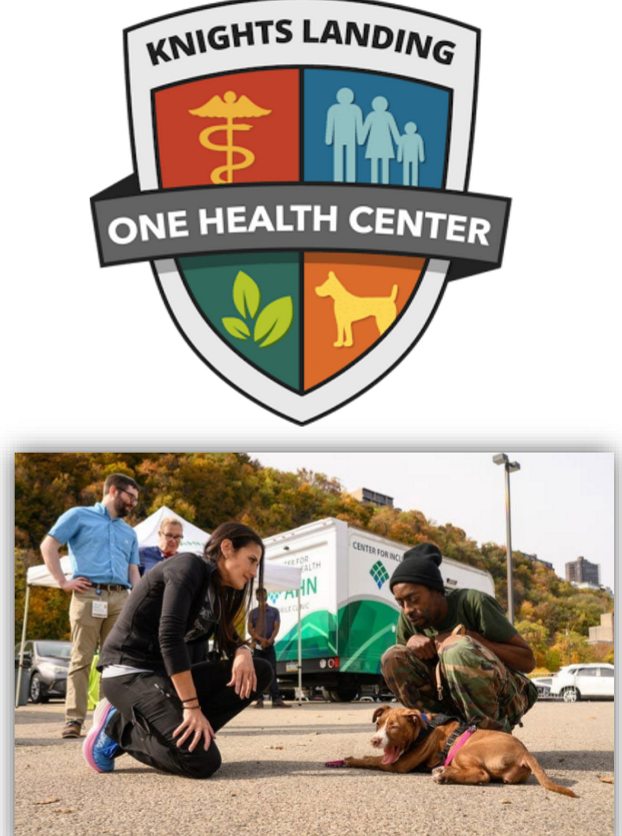
one health clinics are a national example of implementing one health.
.
describe what this is
.
name some benefits of it
health clinic that provides basic human & vet health to underserved communities
.
ppl have improved trust in health care providers & student trainees get more experience
the global health security agenda (GHSA) is an international example of implementing one health.
.
describe what this is
a group of over 70 countries that work together to promote one health on a global scale via surveillance, reporting, risk communication, etc.
.
note: their goal is to “advance a world safe & secure from infectious disease threats”
the FAO-OIE-WHO-UNEP (quadripartite) is an intergovernmental example of implementing one health.
.
describe what they do
they take joint responsibility for addressing zoonotice & high-impct diseases
so they collab to make early warning systems to warn member countries of major animla diseases
name some ways academic institutions contribute to one health
.
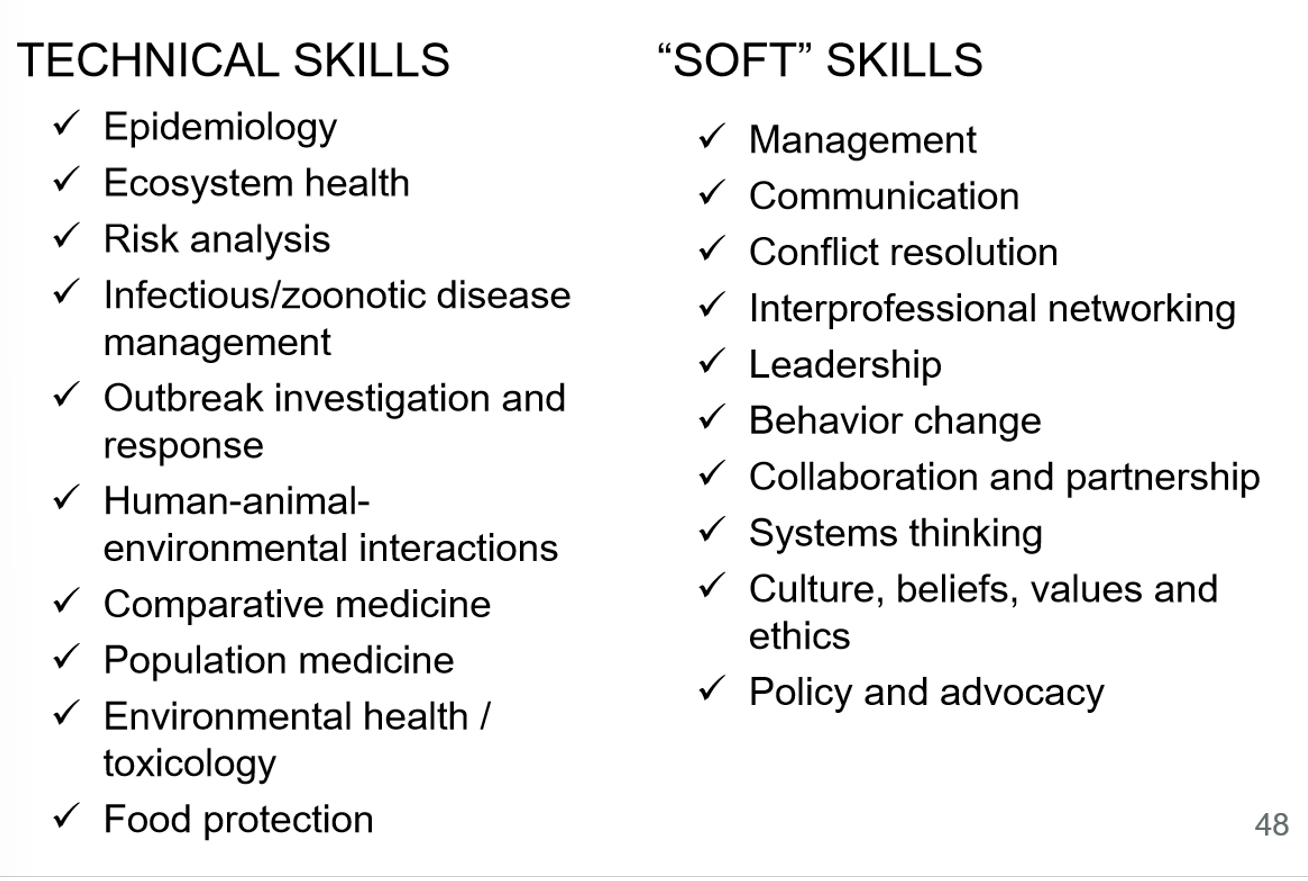
name some of the most desired ___ someone should have if they want to work in one health
skills
values/attitudes
knowledge
they do tons of research that can influence practice & policy regarding climate change, ani health, vax developmnt, etc.
they train the next generation of workers that’ll eventually implement one health
.
communication, collaboration, resilient
social/culture/gender equity & inclusiveness, reflection, collective learning
one health concepts (infectious disease mngmt, outbreak investigation, etc.)
name some things ___ can do if they want to get involved in one health:
students
workers
employers
build your leadership & mngmt skills, get involved in professional societies to build relationships & collab skills
work at a job that covers multiple disciplines, present your work to ppl outside your discipline
encourage employees to do one health CE, hire interns to increase their one health experience, hire ppl that value interdiscipline
name some ways vets can promote one health if they diagnose a pt with a zoonotic disease
report to local health dept (only human cases are reqt to be reported)
get thorough hx to try to find source of exposure
sanitize where pt walked in clinic
wear PPE
educate owner that they may be susceptible & give them your business card if their physician has questions
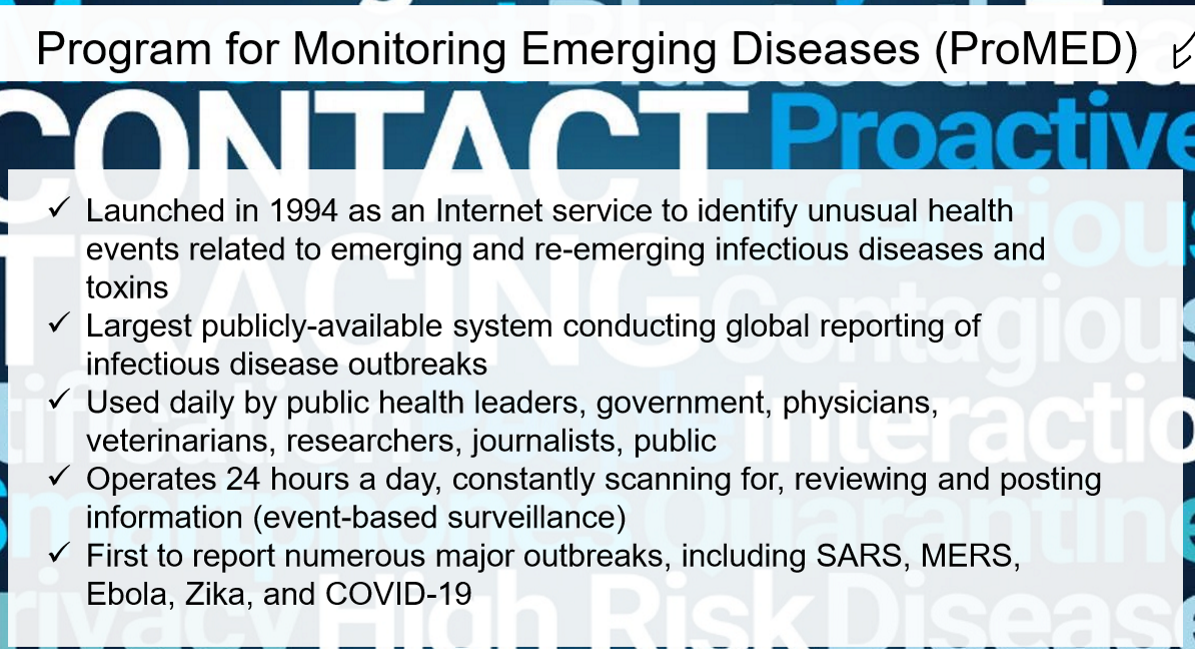
stay informed about whats currently going around (there’s tons of free sources like ZOHU call, ProMED, ArboNET, CAPC parasite maps, etc.)
name some trends in global development that impact the health risks ani, ppl, & the environment face
total population has increased a TON (8 bill ppl in 2022)
over half of the pop is living in cities (urbanization) = higher stocking density = higher risk of dis transmission
earth is getting hotter & more precipitation (climate change)
most ani that are traded are sourced from the wild, not captive
define global health
.
describe how global health was inspired by public health & international health
the idea of advancing health equity for ALL, including the impact our actions have on the environment
.
public focuses on mnging population health, inter focuses on health in tropical & developing countries
global has similar concepts but focuses on EVERYONE, not restricted to certain regions
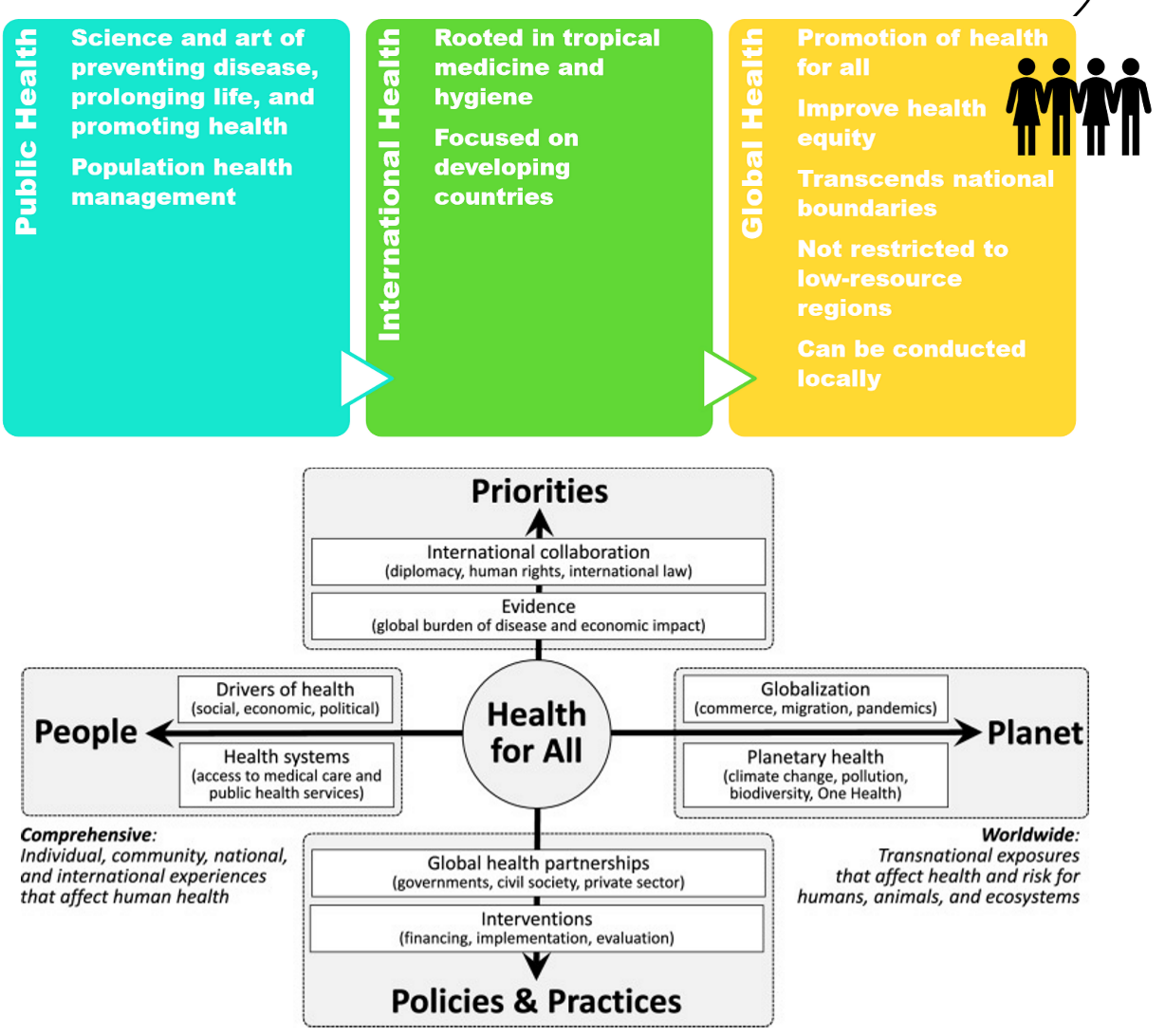
global health…
.
infectious disease, expanding travel/trade, abx resistance, & bioterrorism are all currenty risks to global health.
how is this relevant to vet med?
.
define global health security
most diseases that become public health emergencies are of animal origin and/or are zoonotic!! (e.g. zika virus, covid-19, plague)
.
taking action both proactive & reactively to minimize the danger/impact of acute public health events that endanger ppls health around the world
AKA having strong & resilient health systems that can prevent, detect, & respond to infectious dis threats all around the world
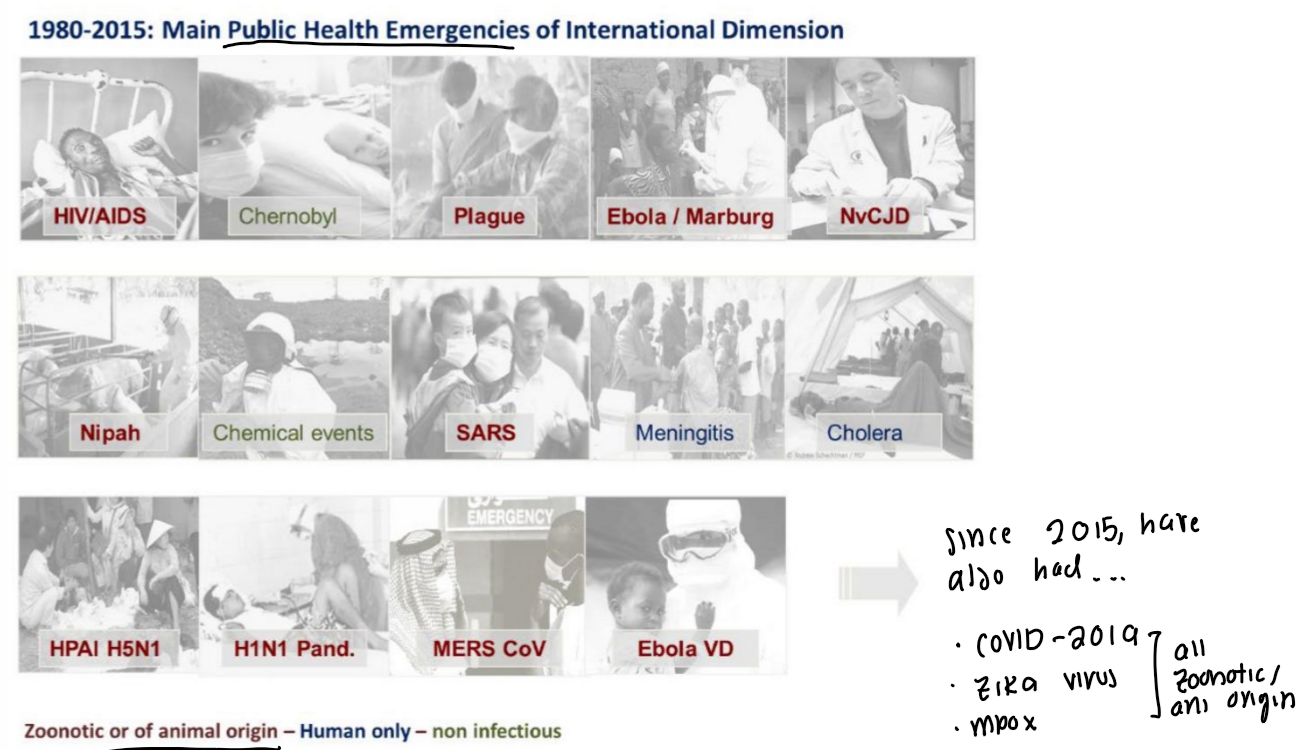
intergovernmental agencies that promote global one health…
.
the international health regulations (IHR) is a legally binding agreement across 196 countries that’s essential to achieving global health security.
.
name the 4 things it requires its member countries to do so they can assess, report, & respond to public health events
.
the goal is for all members to achieve the 7-1-7 rule.
whats this?
have surveillance systems/labs
collaborate when making decisions during an emergency
notify authorities of the event
respond effiiciently to the event
.
detect the emergency within 7 days of emergence
then notify authorities within 1 day
then respond within 7 days
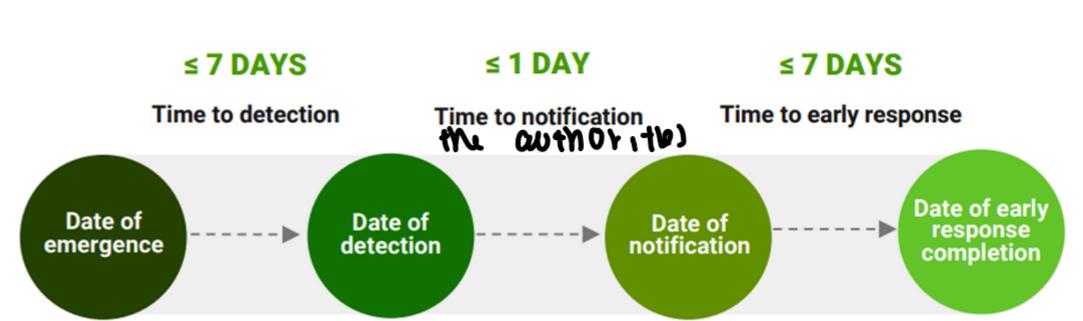
intergovernmental agencies that promote global one health…
.
IHR requires its member countries to detect & report any potential “public health emergency of international concern” (PHEIC)
.
a PHEIC is declared if the situation meets 2 out of 4 criteria.
name all 4 of the criteria
the event has a serious impact on public health
the event is unusual or unexpected
there’s a significant risk of it spreading internationally
there’s a significant risk of it causing international travel or trade restrictions
intergovernmental agencies that promote global one health…
.
the IHR conducts multiple activities to assess the strengths & weaknesses of a country’s health security.
.
one of these is the joint external evaluation.
describe what this is
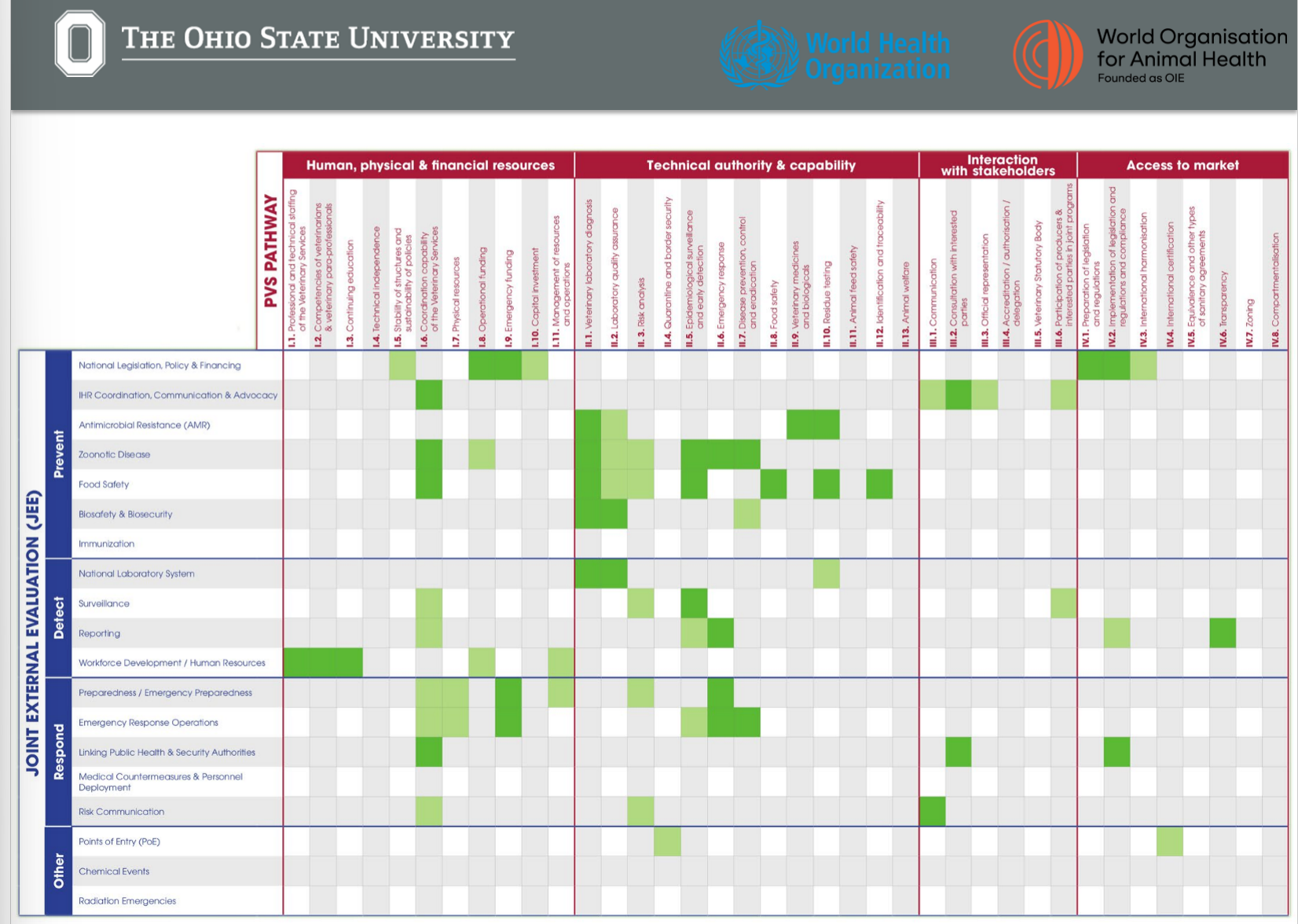
a voluntary process (should be done every 4-5 years) where health experts from diff sectors come together to assess the countrys pros/cons in 19 areas (e.g. zoonotic dis, abx resistance, food safety)
intergovernmental agencies that promote global one health…
WOAH (world organisation for ani health) has 183 member countries & they set international standards regarding ani health & zoonoses.
.
whats their primary goal
.
do they require member countries to report all cases of ani diseases?
.
whats their stance on countries providing adeqaute veterinary care
.
performance of veterinary services (PVS) is a voluntary assessment that WOAH offers.
what does it assess?
to protect the health & welfare of ani and to ensure ani are traded safe & fair
.
yes if its on their list of reportable diseases (can find updates on WAHIS website)
.
they believe its a global public good so all countries should have the capacity to provide vet care
.
uses a combo of documents, interviews, observation at farms, slaughterhouses, etc. to determine good the vet infrastructure is in the country
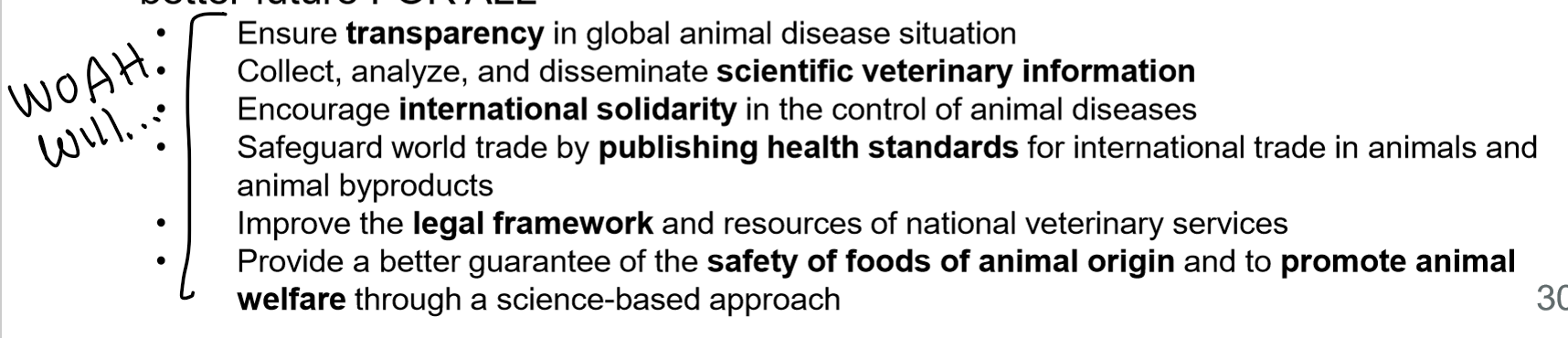

intergovernmental agencies that promote global one health…
the WHO & WOAH created the IHR-PVS national bridging workship to combine the human & ani piece of one health.
.
describe what this workshop is
its a voluntary 3-day event where countries collaborate to identify their strengths & weaknesses in 16 diff areas (e.g. field investigation, education, communication, etc.) that all focus on zoonoses & other human-animal events (food safety, etc.)
implementing one health…
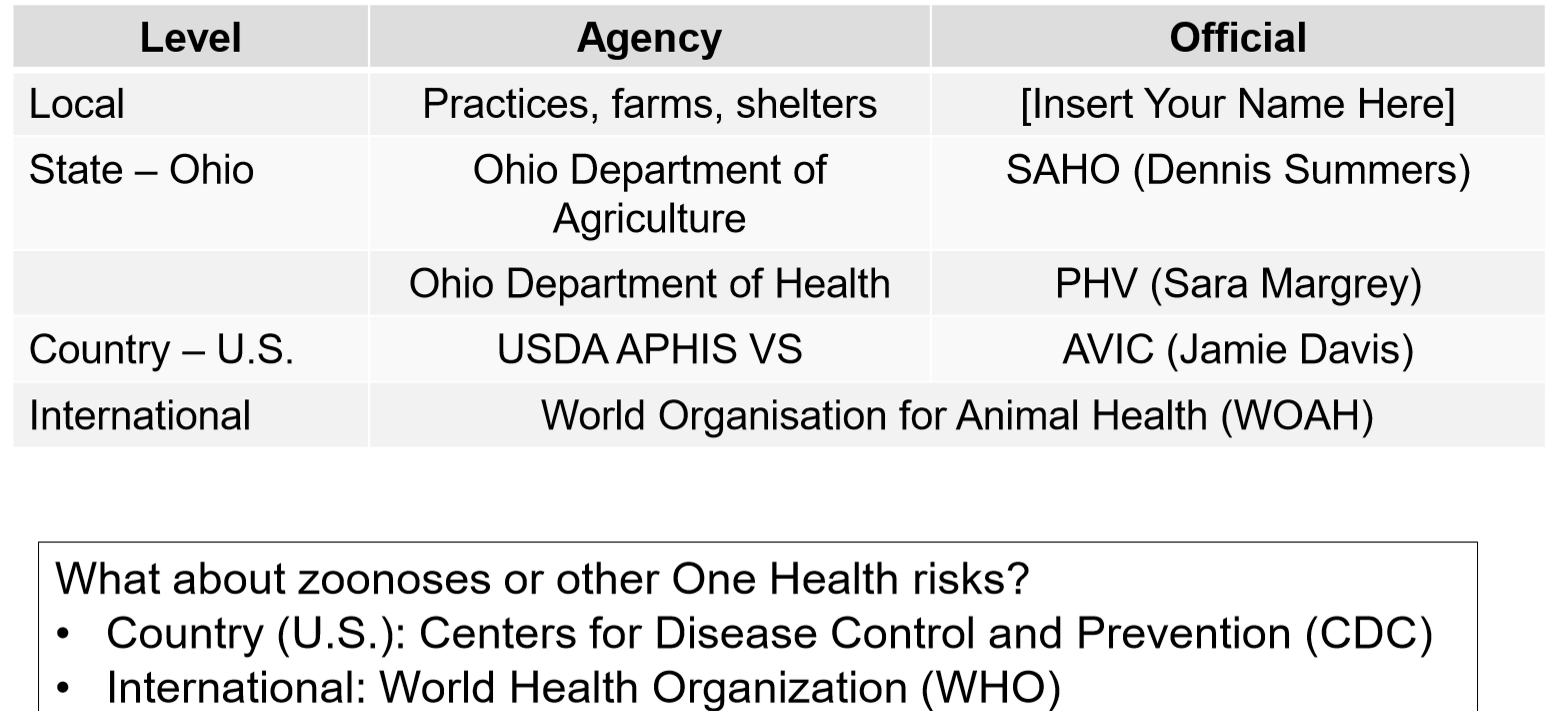
achieveing one health MUST begin at the local level & vets play a big role in this by reporting ani diseases.
.
who do we report to at the local level?
state level (ohio)?
country level?
international level?
.
besides looking at reports, what are some other ways we can monitor the mvmt of a disease?
vets
state ani health official that works for ODA or public health vet that works for ODH
aphis vet in charge that works for USDA APHIS
WOAH
.
track sales of drugs, health certificates, ani death reports, & do farm visits
implementing one health…
mitigation (the permanent reduction of risk) is one strategy to reduce the impact of public health events.
.
whats the diff between primary & secondary mitigation
.
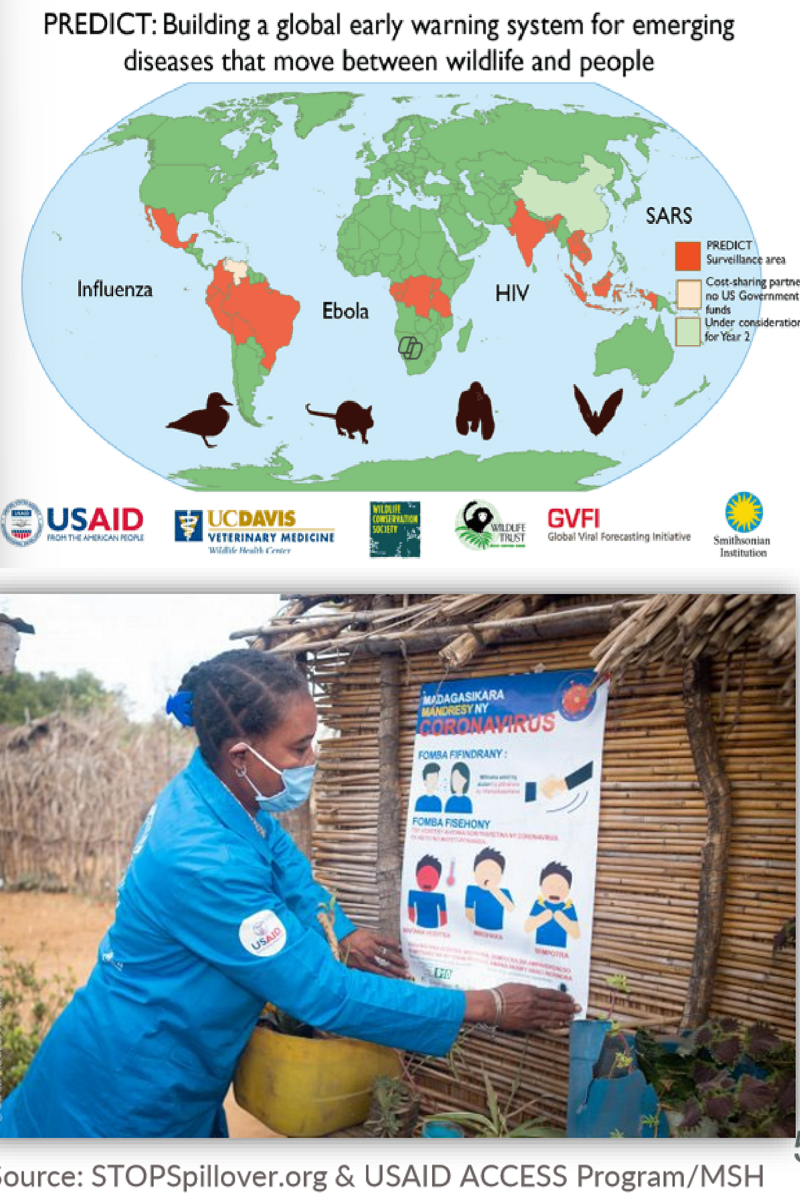
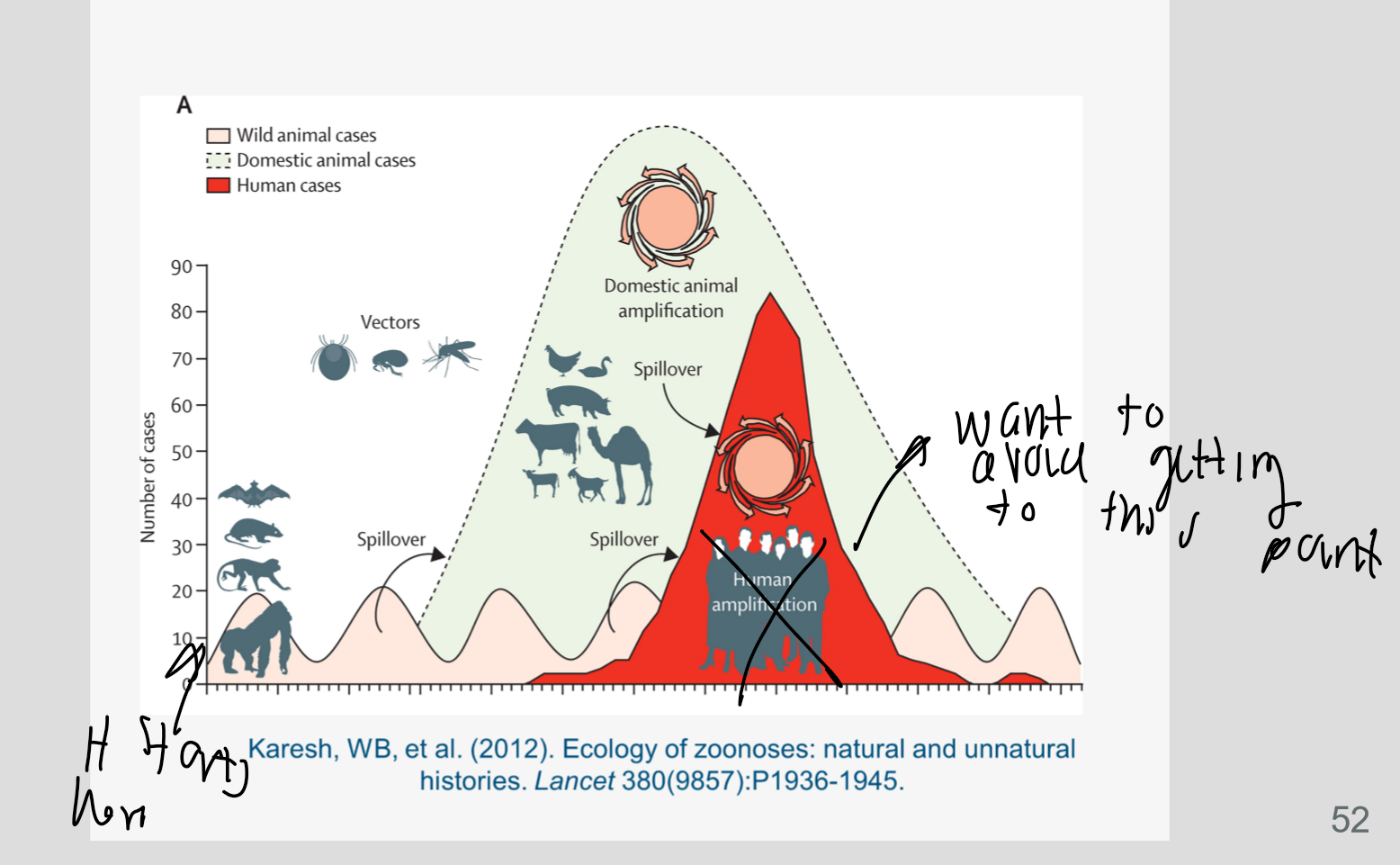
one way primary mitigation is being implemented is thru the emerging pandemic threats (EPT) program.
describe how its “PREDICT” & “STOP spillover” programs work to prevent zoonotic spillover events from occuring
prim: reducing how vulnerable we are to the hazard
sec: reducing the effects of the hazard
.
PREDICT: searches for new viruses that could become the next pandemic
STOP: researches risk factors that could lead to a spillover event, implement interventions for them, then assess how effective it is