week 1 pETBlue-1
 Call Kai
 Learn
Learn Practice Test
 Spaced Repetition
 Match
Match Flashcards
 Knowt Play
1/10

There's no tags or description
Looks like no tags are added yet.
Name | Mastery | Learn | Test | Matching | Spaced | Call with Kai |
|---|
No analytics yet
Send a link to your students to track their progress
11 Terms
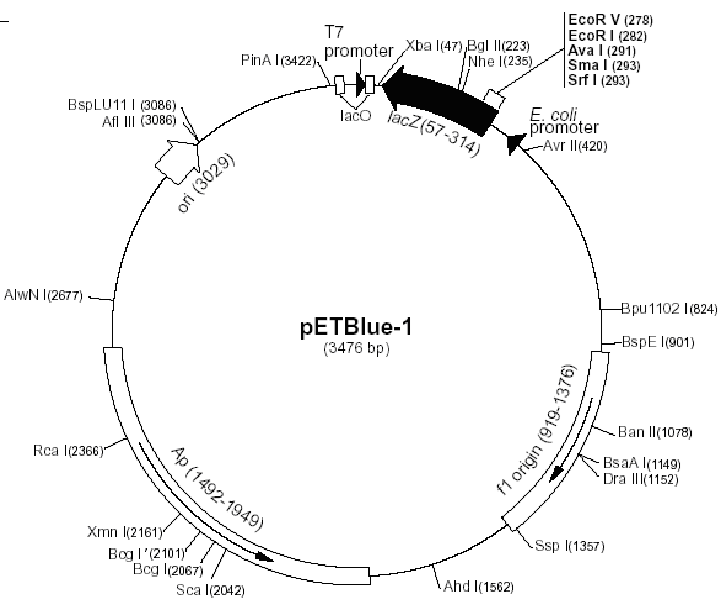
What is pETBlue-1 and what is it used for?
pETBlue-1 is an expression plasmid used for producing recombinant proteins in E. coli. It uses the T7 promoter for high-level, inducible expression and includes lacO sequences for IPTG regulation.
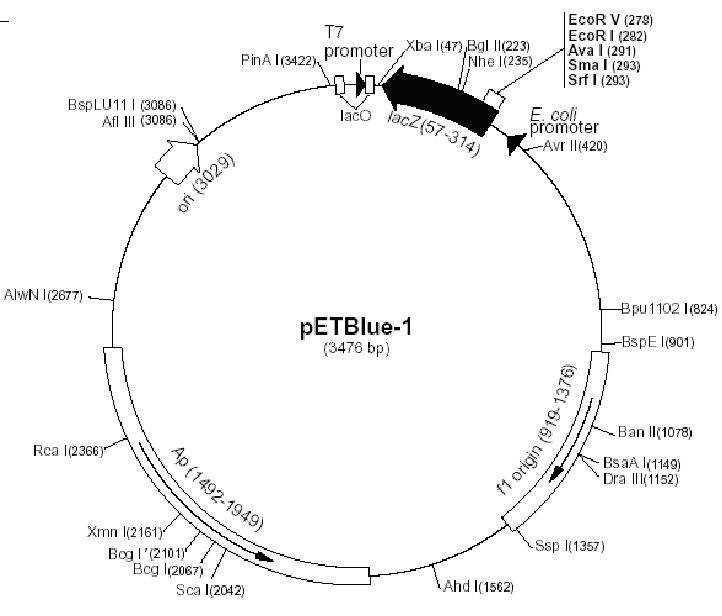
What regulatory elements control expression in pETBlue-1?
Expression is controlled by a T7 promoter flanked by lacO operator sites. This allows IPTG-inducible expression in host cells expressing T7 RNA polymerase.
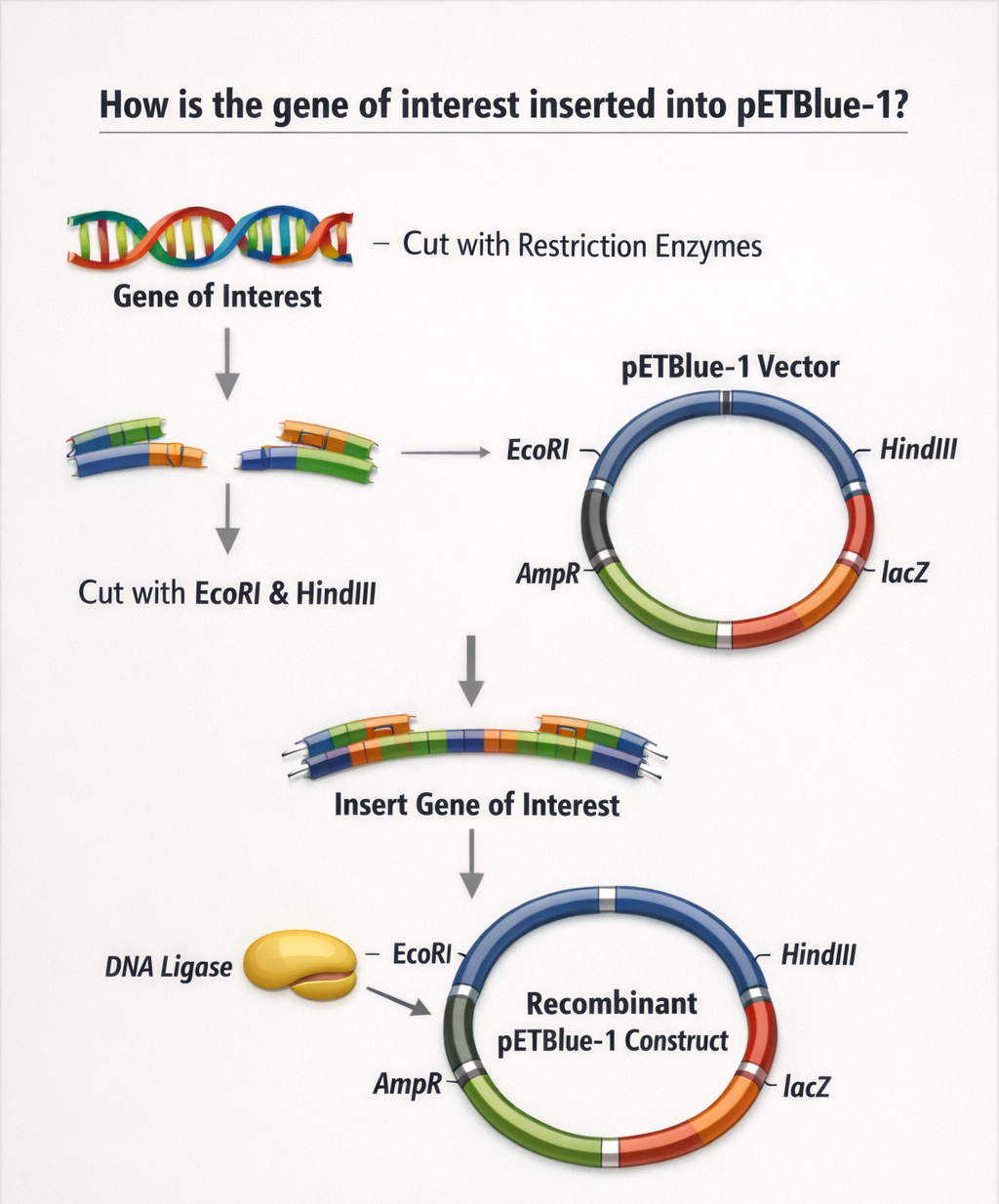
How is the gene of interest inserted into pETBlue-1?
The gene is inserted using compatible restriction sites and ligated into the vector. The plasmid includes a multiple cloning site (MCS) downstream of the T7 promoter.
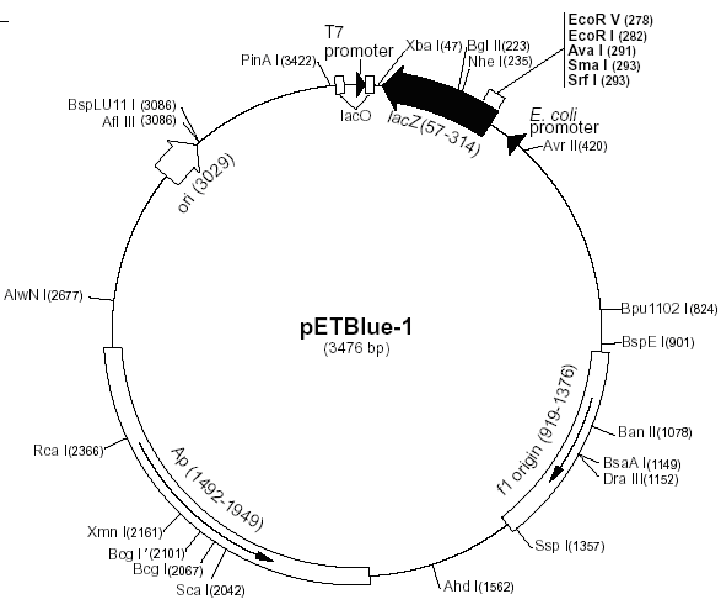
What enzyme joins the insert with the plasmid?
DNA ligase is used to covalently join the insert and plasmid via their compatible sticky or blunt ends.
How is the recombinant pETBlue-1 plasmid introduced into bacteria?
It is introduced by transformation, typically via heat shock or electroporation into competent E. coli cells (e.g., BL21(DE3)).
What is special about BL21(DE3) cells?
BL21(DE3) is a specialised E. coli strain engineered for high-yield protein production using the T7 expression system, featuring a built-in T7 RNA polymerase for rapid transcription and a deficiency in proteases to prevent the degradation of your target protein.
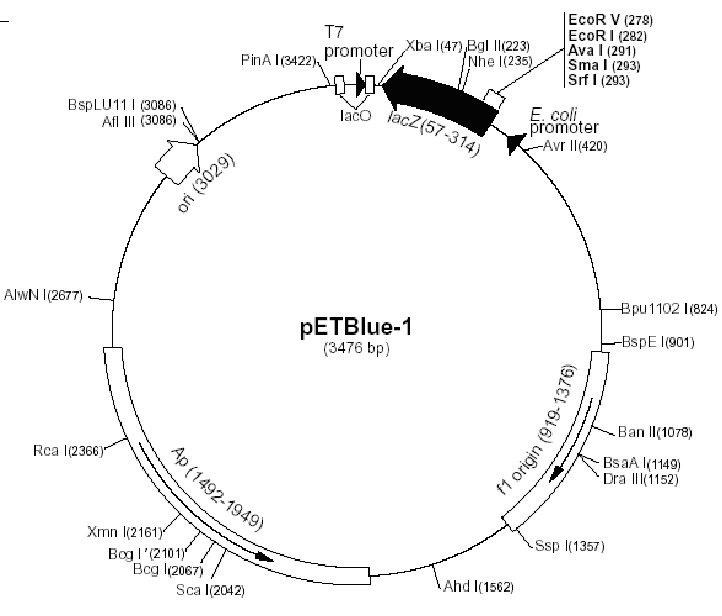
How is expression of the recombinant gene induced?
IPTG is added to the culture. It binds the lac repressor, lifting repression of T7 RNA polymerase expression. T7 polymerase then transcribes the gene from the T7 promoter.
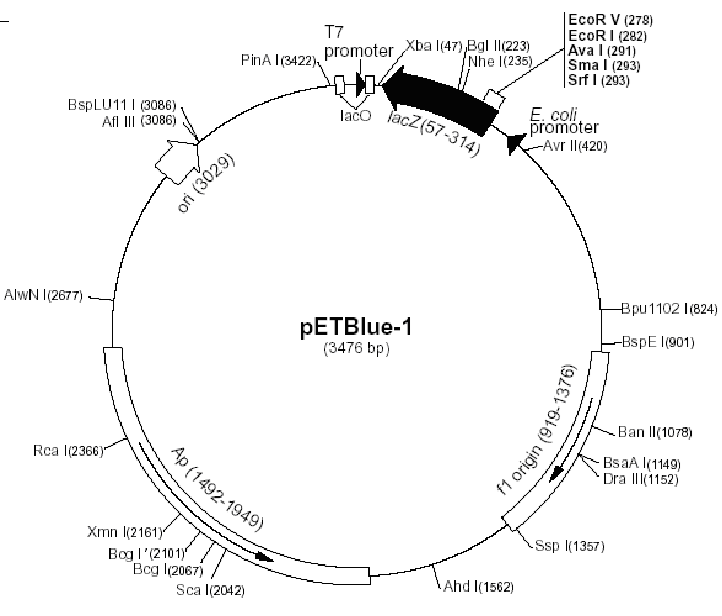
What role does lacO play in pETBlue-1?
lacO is the operator region bound by the lac repressor. It prevents transcription until IPTG is added.
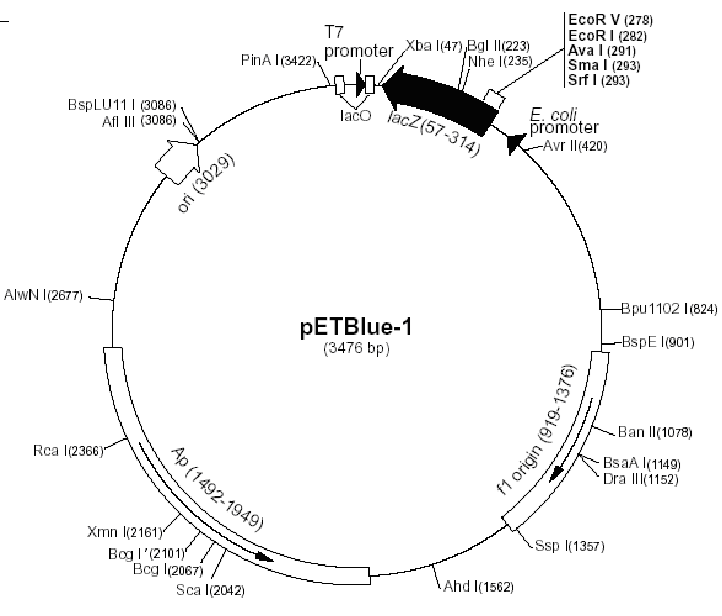
What is the purpose of the T7 promoter in pETBlue-1?
It is a strong promoter recognized specifically by T7 RNA polymerase, enabling high levels of target gene transcription upon induction.
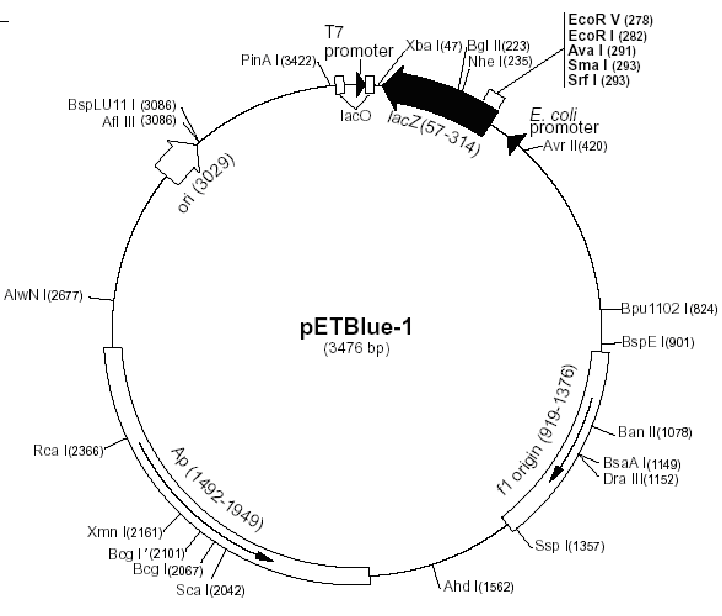
What selectable marker does pETBlue-1 contain?
The pETBlue-1 plasmid usually includes an ampicillin resistance gene (bla) to select for bacteria that carry it.
do thses after the revitrion agian.
Referencing the region labelled T7 promoter and lacO on the map:
A) Name the specific enzyme that binds to the T7 promoter to begin transcription. (1 mark) T7 RNA polymerases
B) Describe the role of the lacO sequence in controlling gene expression. (2 marks)The LacO is the operator region which binds the lac repressor, which enables high levels of target gene transcription upon induction.
C) What specific chemical must be added to the bacterial culture to "turn on" this system, and how does it work? (2 marks)
The chemical which is added to the bacteria is called IPTG, it binds the lac repressor, lifting repression of T7 RNA polymerase expression
Question 1: Induction and Regulation (5 Marks)
Referencing the T7 promoter and lacO labels on the map:
A) What is the specific purpose of the T7 promoter in the pETBlue-1 plasmid? (1 mark) T7 promoter used as a promoter for high-level inducible expression
B) Describe the role of the lacO operator region in controlling gene expression. (2 marks) Expression is controlled by the T7 promoter flanked by the LacO operator site. This allows ITCG-inducible expression in host cells expressing T7 RNA polymerase
C) According to your data, what chemical is added to the culture to bind the lac repressor and "lift" repression, and what enzyme does this then allow to be expressed? (2 marks)
IPTG is the chemical added to the culture that aids in receptor binding, and the enzyme expressed is T7 RNA polymerase.
Question 2: Host Strain Compatibility (5 Marks)
A researcher decides to transform this pETBlue-1 plasmid into BL21(DE3) E. coli cells.
A) Why is the DE3 designation critical for using this specific plasmid? (2 marks)
It is a specialised E. coli strain engineered for high-yielding protein production using the T7 expression system. It enables the synthesis of T& RNA polymerases.
B) BL21 cells are "protease-deficient." Explain how this characteristic benefits the production of recombinant proteins. (2 marks) Why is it good
Used for the expression of the T7 gene and built to withstand high-tide proteins.
C) Name one method used to introduce this plasmid into the competent E. coli cells. (1 mark) It is done via transformation, typically from heat shock
Question 3: The Cloning Process (5 Marks)
Looking at the lacZ (57-314) region and the restriction sites listed (e.g., EcoR I, Xba I):
A) What is the name of the region containing these multiple restriction sites where a gene of interest is inserted? (1 mark) multiple cloning sites
B) Which enzyme is required to covalently join the DNA insert into the pETBlue-1 backbone? (1 mark) DNA Ligase
C) If a gene is successfully inserted into the EcoR I site, explain why the resulting bacterial colonies would appear white rather than blue on selective media. (3 marks) ??
They appear white because the foreign gene disrupts the lac gene, preventing the production of beta-galactoside required to break down the X-gal into blue pigments.
11/15.

