Statistics 3 week 3
 Call Kai
 Learn
Learn Practice Test
 Spaced Repetition
 Match
Match Flashcards
 Knowt Play
1/23

There's no tags or description
Looks like no tags are added yet.
Name | Mastery | Learn | Test | Matching | Spaced | Call with Kai |
|---|
No analytics yet
Send a link to your students to track their progress
24 Terms
Factorial ANOVA
One quantitative Y and two (or more) qualitative X’s (say variable A and B):
Factor A has “a” different levels and factor B has “b” different levels.
Same assumptions as ANOVA + orthogonality of factors (no confounding effect)
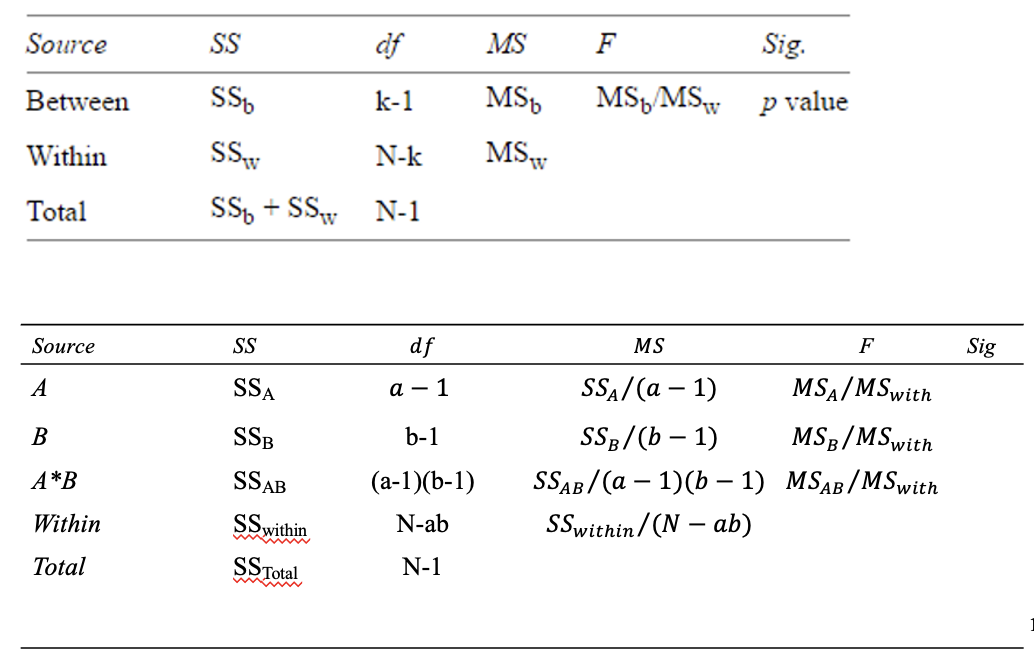
With two factors (e.g. A and B), a two-way ANOVA:
Test 2 separate main effects:
Null hypothesis 1: H0: μA1 = μA2 → FA = MSA/MSwithin, with df: (a − 1, N − ab)
Null hypothesis 2: H0: μB1 = μB2 →FB = MSB/MSwithin, with df: (b − 1, N − ab)
Test for the interaction effect between both factors:
Null hypothesis 3: H0: no AxB interaction → FAxB = MSAxB/MSwithin, with df: ( (a -1)(b-1), N − ab )
Degrees of freedom
In ANOVA
dfnumerator = dfbetween
dfdenominator = dfwithin
In regression
dfnumerator = dfregression
dfdenominator = dfresidual
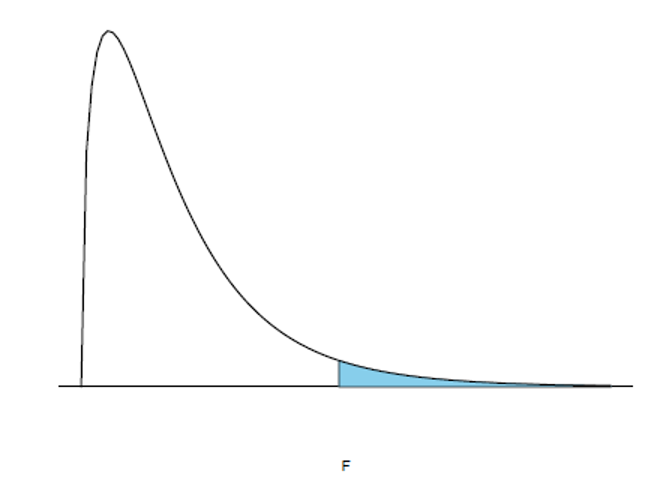
Factorial ANOVA-tests: F-distribution
In a factorial ANOVA, the null hypotheses are also tested based on an F-ratio, with the corresponding degrees of freedom
Factorial ANOVA: prediction
Observation from group with an expected value for the response variable
Within a group, there is random (unexplained) variation, or residual:
Observed response = expected response + error
The “k-th” observation from the “i-th” group A and the “j-th” group B
Yijk = μ + αi + βj + αβij + εijk
μ = overall mean,
αi = group effect factor A,
βj = group effect factor B,
αβij = interaction effect A and B, and
εijk ~N(0,σ^2 ) indicates the error variance (unexplained)
If there is no interaction effect between A and B, this simplifies to:
Yijk = μ + αi + βj + εijk
Relating Factorial ANOVA to One-way ANOVA
Intuitively: you can also execute two separate ANOVA-tests, but:
.. this does not allow you to (directly) estimate the interaction effect
.. less power if main effect other factor is statistically significant,
because the two factors are regarded separately
F-test for different hypotheses
Null hypothesis 1: If H0 holds, then σα^2 = 0 (and F=1)
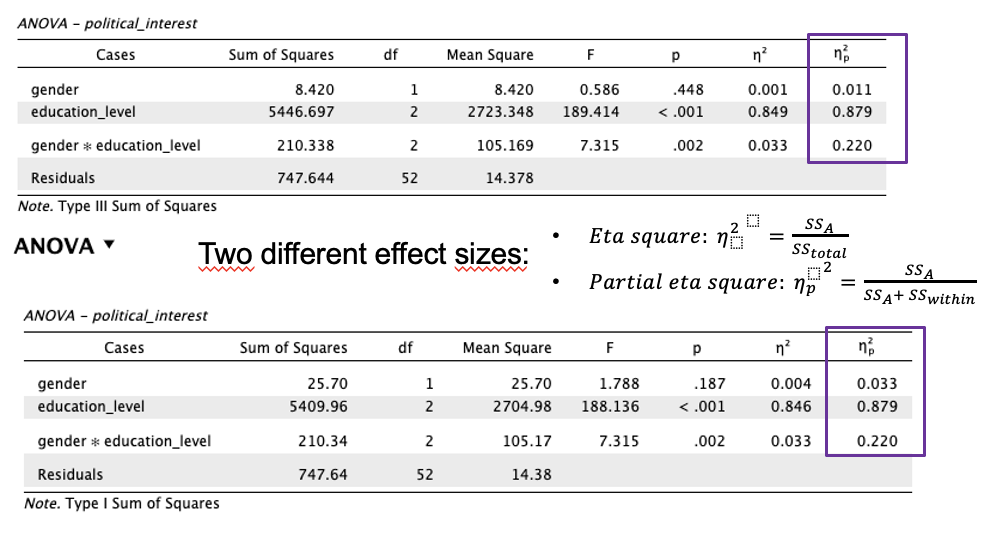
Effect size: ηA^2 = SSA / SStotal
Null hypothesis 2: If H0 holds, then σβ^2 = 0 (and F=1)
Effect size : ηB^2 = SSB / SStotal
Null hypothesis 3: If H0 holds, then σαβ^2 = 0 (and F=1)
Effect size : ηAxB^2 = SSAxB / SStotal
Venn-diagrams: orthogonality factor A and B
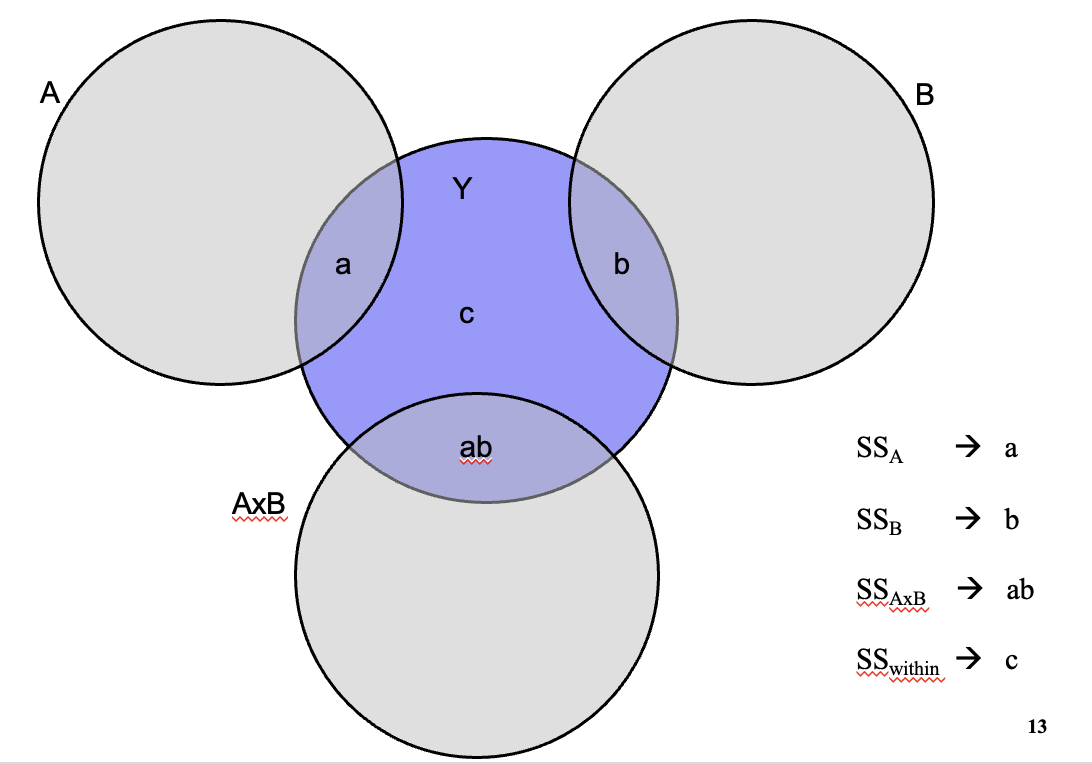
Venn-diagrams: non-orthogonality factor A and B
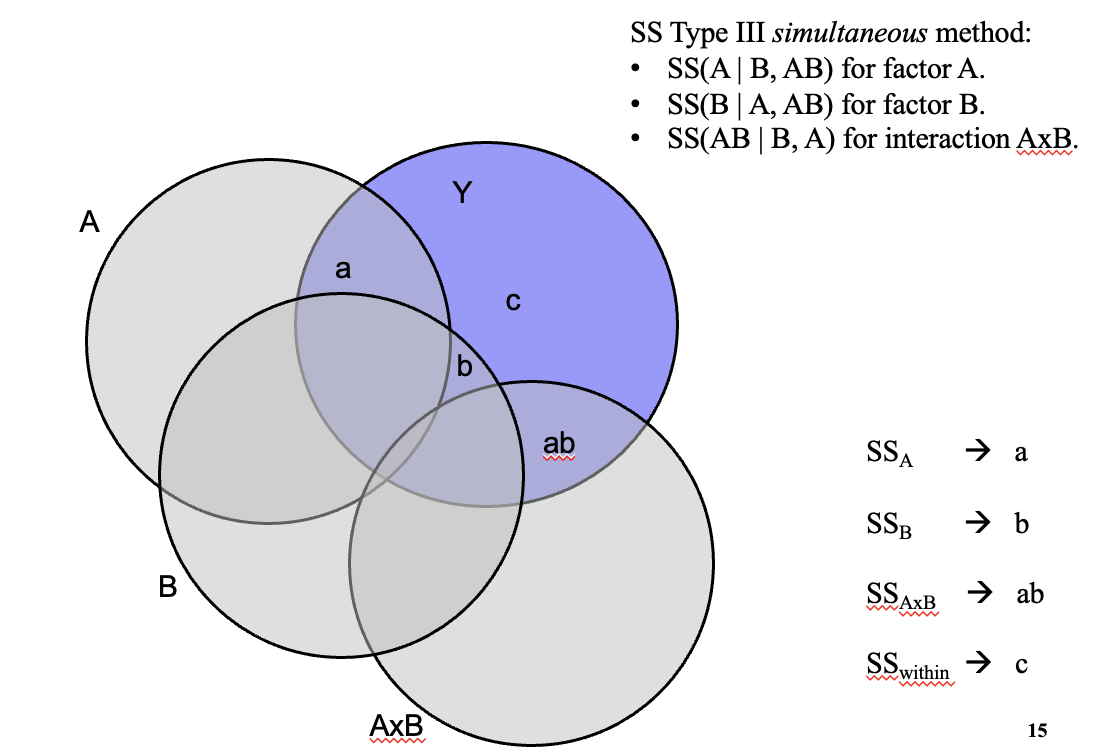
SS Type III simultaneous method:
SS(A | B, AB) for factor A.
SS(B | A, AB) for factor B.
SS(AB | B, A) for interaction
OR:
SS Type I stepwise method, first A:
SS(A) for factor A.
SS(B | A) for factor B.
SS(AB | B, A) for interaction AxB.
OR:
SS Type I stepwise method first B:
SS(B) for factor B.
SS(A | B) for factor A.
SS(AB | B, A) for interaction AxB.
Partial Eta Squared provided by JASP
Two different effect sizes for Type III Sum of Squares and Type I Sum of Squares
Intuitive interpretation of Partial Eta Squared: The proportion of error that a factor (A, B, or A*B) removes by including this factor into the model after the explained variance of the other factors already has been allocated.
When group sizes are unequal (unbalanced)
Calculate means in two ways:
Weighted means
Unweighted means
Weighted means
Groups with more people count more
Each cell mean is weighted by its sample size
Reflects real-world prevalence
The larger group has more influence
Use when unequal group sizes are meaningful (caused by confounding between factors A & B)
Unweighted means
All groups count equally
Each cell mean gets the same weight
Answers: “What would the mean be if all groups were the same size?”
Assumes unequal sizes happened by chance
Use when unequal group sizes are accidental
Which mean to choose?
No uniform answer. Warner (2013) provides the following suggestions:
Is the difference in numbers a consequence of a confounding effect between A & B? → weighted mean
Is the difference in numbers attributable to coincidence? → unweighted mean
Factorial ANOVA: Multiple testing and Type 1 error
When executing a factorial ANOVA, multiple (3) hypotheses are tested
→ The probability to incorrectly reject at least one of these hypotheses is larger than 5%, namely 14%:
1 - (1 – 0.05 )3 = 0.141 > 0.05
Solutions:
Omnibus F-test
Controlling family-wise Type I error rate
Controlling false discovery rate
Preregistration of hypotheses
Outliers, Laverage and Influential Points
An outlier is a data point whose response y does not follow the (general trend of the) rest of the data.
A data point has high leverage if it has "extreme" predictor x values.
A data point is influential if it strongly influences any part of a (regression) analysis, such as the predicted responses, the estimated slope coefficients, or the hypothesis test results.
Causes of outliers
Data entry errors
Measurement erros
Genuinely unusual values
How to identify outliers:
2 SD rule
Boxplot
Mahalanobis distance
Data entry error: Action
Replace: if it is clear what the correct entry would hae been
Remove: if this is not the case
Measurement error: Action
Replace: with maximum/minimum value if the direction of the deviation is “correct”
Remove: if entirely unclear what the “correct” value would have been
Genuinely unusual values: Action
Depends on objective
Keep: and if possible execute robust two-way ANOVA
Adjust: to less extreme value and compare outcomes
Transform: variable (e.g. log-transformation)
Remove: and compare outcomes
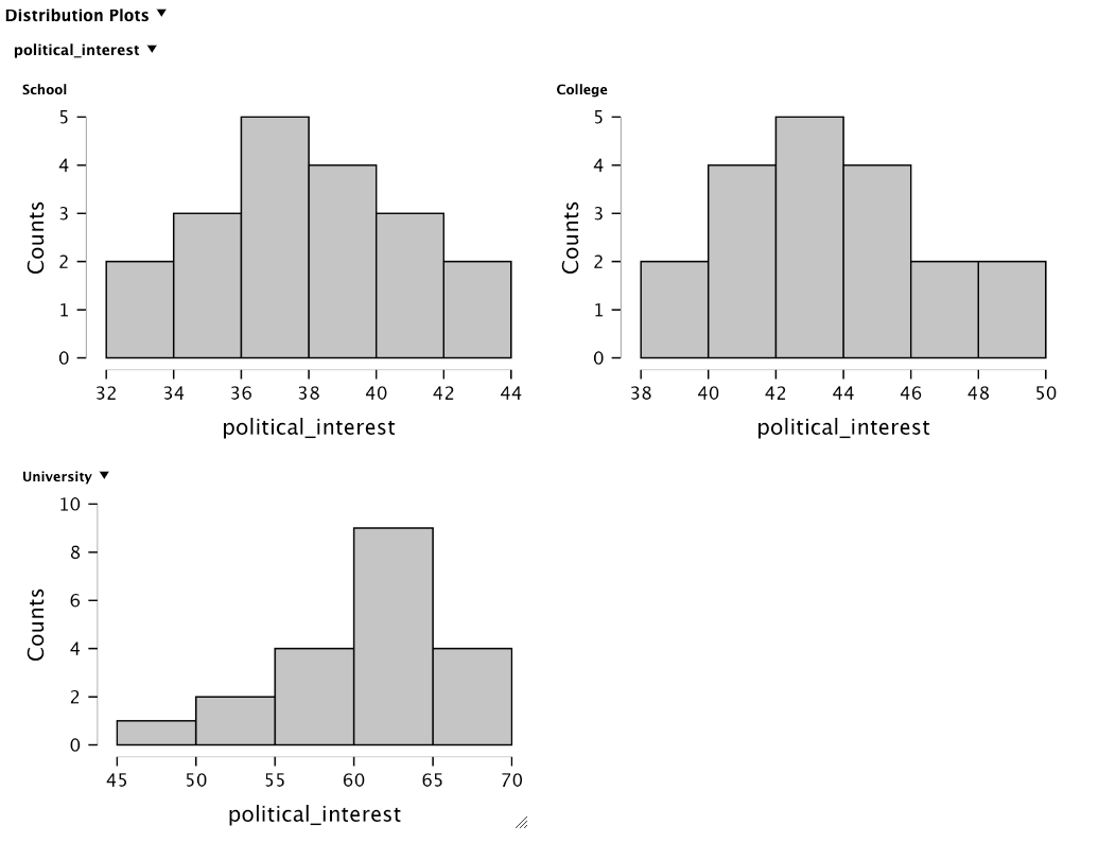
Check assumption: Normal distribution of Y (outcome variable)
Shapiro-Wilk test
Null hypothesis: data are normally distributed
If p > .05 → looks normal (OK)
If p < .05 → not normal (problem)
Visually
Check assumption: Eqal variances
Assumes all groups have the same variance/spread
Lavene’s test
Null hypothesis: variances are equal
If p > .05 → assumption is met
If p < .05 → assumption is violated
When assumption is violated/not met: Heteroscedasticity → larger Type I / Type II error due to under-/overestimating standard error (se)
What can we do if variances are unequal?
Transform the data (e.g., log transformation)
Continue anyway (ANOVA is often robust)
Use a robust version of ANOVA
Use weighted linear regression
Two-WayANOVA: results
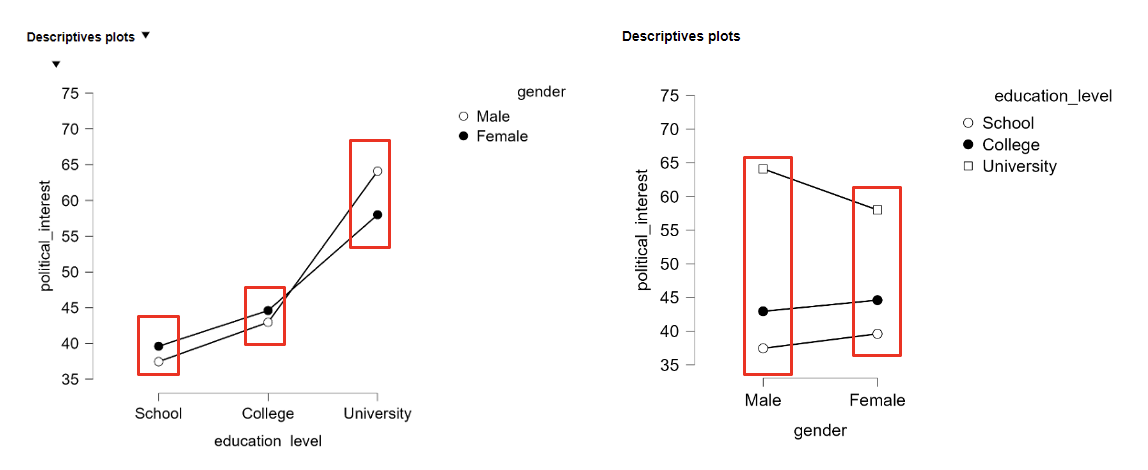
Firstly look at the coefficient of the interaction term. Why?
Significant? It is not possible to clearly interpret the coefficients for the main effects.
Not-significant? Interpret the main effects and e.g. post-hoc pair wise comparisons.
Comparing with multiple regression
The interaction effect can also be performed with a regression analysis:
Problem: 2 categorical independent variables → quantitative coding
Next: create interaction term → genxedu
Multiple regression equation: Yi = b0 + b1∗geni + b2∗edui + b3∗genxedui + εi
Is undesirable method here due to type of independent variable ”level of education” (qualitative)!
Regression assumes that independent variable is dichotomous or has interval/ratio scale
Extra: estimating “simple” effects
If there is a statistically significant interaction, you can decide to estimate simple effects: ”the effect of factor A per level of factor B” and “the effect of factor B per level of factor A”
Alternative: estimating simple effects via separate one-way ANOVAs. Disadvantage is lower power.
In JASP, these simple effects can be estimated directly (with Bonferroni-correction for multiple tests)