Lect 17. Integrative Bio
 Call Kai
 Learn
Learn Practice Test
 Spaced Repetition
 Match
Match Flashcards
 Knowt Play
1/42

There's no tags or description
Looks like no tags are added yet.
Name | Mastery | Learn | Test | Matching | Spaced | Call with Kai |
|---|
No analytics yet
Send a link to your students to track their progress
43 Terms
Q: What types of environmental changes can act as stressors for organisms?
Stressors are environmental factors that challenge homeostasis. Examples include:
Unpredictable stressors
Predators
Injury or infection
Habitat loss or fragmentation
Human disturbance
Pollution
Invasive species
Extreme weather
Global climate change
Predictable environmental changes
Day/night rhythms
Seasons
Tidal cycles
Lunar cycles
Rainy vs dry seasons
Predictable changes allow organisms to prepare in advance, while unpredictable changes trigger stress responses.
Q: What is the difference between regulated and facultative responses to environmental change?
Regulated changes
Occur in anticipation of predictable events
Include changes in morphology, physiology, or behavior
Examples:
Seasonal breeding
Migration
Molting
Rapid facultative changes
Occur during or after unexpected events
Often involve stress physiology
Examples:
Predator escape
Injury responses
Acute stress reactions
Q: What is the Principle of Allocation?
Organisms have limited energy, so they cannot maximize all life processes simultaneously.
Energy must be allocated among:
Growth
Reproduction
Immune function
Predator avoidance
Foraging
Maintenance/homeostasis
Trade-offs determine survival and reproductive success.
Q: What is the Barrel Model (Weiner 1992)?
The Barrel Model illustrates that organisms must balance competing physiological demands because energy is limited.
Life functions compete for the same energy resources, so increasing investment in one function reduces energy available for others.
Q: What is allostasis?
Allostasis is the process of achieving stability through physiological change.
Unlike homeostasis (maintaining constant internal conditions), allostasis allows set points to shift depending on environmental conditions.
Example:
Seasonal hormone changes
Stress hormone increases during emergencies
Q: What are the three energy components used in the allostasis framework?
EE (Existence Energy)
Energy required for basic homeostasis
Example: maintaining body temperature
EI (Energy Intake Cost)
Energy needed to find, process, and assimilate food
EG (Energy Gain)
Energy available in the environment
Stress occurs when:
Energy demand > energy available
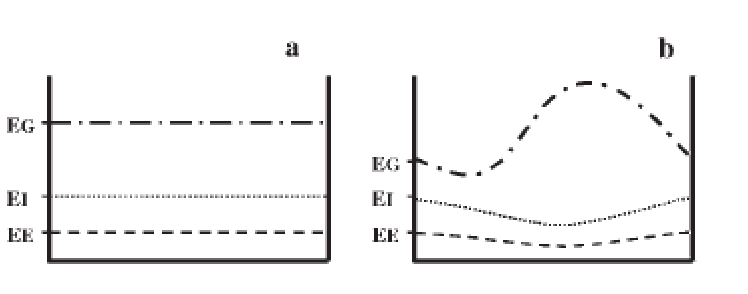
Q: What is Perturbation Resistance Potential (PRP)?
PRP is the capacity of an organism to cope with environmental disturbances.
It depends on:
Available energy reserves
Environmental conditions
Life-history stage
Higher PRP = greater ability to withstand stressors.
Q: What is the Emergency Life History Stage (ELHS)?
ELHS occurs when environmental conditions are severe and organisms temporarily abandon normal activities to survive.
Examples:
Stop reproduction
Stop territorial defense
Reduce activity
Focus on survival
Once conditions improve, organisms return to their normal life-history stage.
Q: What is a stressor?
A stressor is any stimulus that disrupts homeostasis and activates the stress response system.
Examples:
Predation threat
Food shortage
Disease
Temperature extremes
Social conflict
Q: What is the difference between acute and chronic stress?
Acute stress
Short-term
Adaptive
Helps survival
Examples:
Predator attack
Sudden injury
Chronic stress
Long-term exposure
Can be harmful
Causes physiological damage
Examples:
Persistent food shortage
Long-term habitat disturbance
Q: What system controls the first phase of the stress response?
The Autonomic Nervous System (ANS), specifically the sympathetic nervous system.
This activates the fight-or-flight response.
Q: Which hormones are released during Phase 1 of the stress response?
Catecholamines:
Epinephrine (adrenaline)
Norepinephrine (noradrenaline)
Dopamine
These hormones are released from the adrenal medulla.
Less than 1 min
Q: Why do catecholamines act very quickly?
Because they:
Are stored in vesicles
Are released by neurons
Use existing proteins and signaling pathways
Are linked to the sympathetic nervous system
Response time: seconds to <1 minute
Q: What physiological effects do catecholamines cause?
Catecholamines prepare the body for fight or flight:
Increased blood flow to muscles
Increased heart rate
Increased airflow to lungs
Suppressed digestion
Increased alertness
Release of glucose and fats
Inhibition of insulin
Increased glucagon
Release of β-endorphins (pain reduction)
Q: What does HPA axis stand for?
Hypothalamus
Pituitary
Adrenal axis
It regulates the endocrine stress response.
Q: What hormone cascade activates the HPA axis?
Hypothalamus
Releases CRH (Corticotropin Releasing Hormone)
Anterior Pituitary
Releases ACTH (Adrenocorticotropic Hormone)
Adrenal Cortex
Releases glucocorticoids → Cortisol, Corticosterone
Q: What are the main glucocorticoids?
Cortisol
Found in fish and mammals
Corticosterone
Found in birds, reptiles, amphibians, rodents
These hormones regulate metabolism during stress.
people think corticosterone and HPA is only funcctional for stres; NOT TRUE. Durng daily life without stressful events. hugher in morning
Q: Why can glucocorticoids cross cell membranes?
Because they are steroid hormones, which are lipid-soluble.
They diffuse across cell membranes to reach intracellular receptors. Mineralocorticoid receptor (MR)
Glucocorticoid receptor (GR)
Q: Why can glucocorticoids NOT be stored in cells?
Steroid hormones must be synthesized on demand, because:
They diffuse through membranes
They cannot be stored in vesicles
Q: What protein transports glucocorticoids in the blood?
Corticosteroid Binding Globulin (CBG)
Produced in the liver.
Functions:
Transport glucocorticoids
Extend hormone half-life
Q: What is the Free Hormone Hypothesis?
Only unbound (free) hormone can:
Enter tissues
Bind receptors
Produce biological effects
Bound hormone is inactive.
Q: What is the Reservoir Hypothesis?
Bound hormones act as a reserve pool.
When needed:
Binding proteins release hormone
Hormone becomes biologically active
Q: What are the two main glucocorticoid receptors?
MR (Mineralocorticoid Receptor)
GR (Glucocorticoid Receptor)
They differ in affinity and function.
Q: How do MR and GR receptors differ?
MR
High affinity
Activated at low hormone levels
Active during baseline conditions
GR
Lower affinity
Activated during high stress hormone levels
Controls stress responses
Q: What role do MR receptors play?
MR receptors regulate:
Circadian glucocorticoid rhythms
Baseline hormone regulation
Brain stress regulation
They are mostly active under normal conditions.
Q: What role do GR receptors play?
GR receptors regulate:
Stress response
Gene expression changes during stress
Metabolic adjustments
They are activated when glucocorticoids rise during stress.
Q: Why can't all glucocorticoid effects be genomic?
Some glucocorticoid effects occur within seconds to minutes, which is too fast for gene transcription.
Therefore, some effects occur through membrane receptors and non-genomic pathways.
Q: What do 11β-HSD enzymes do?
They activate or deactivate cortisol before receptor binding.
Two types:
11β-HSD1
Converts inactive cortisone → cortisol
11β-HSD2
Converts cortisol → cortisone (inactive)
Q: Why is cortisol deactivated in the kidney?
To allow aldosterone to bind mineralocorticoid receptors.
Otherwise cortisol would activate them.
Why can eating large amounts of licorice cause hypertension?
Licorice inhibits 11β-HSD2, preventing cortisol deactivation.
Result:
Cortisol activates mineralocorticoid receptors
Increased Na⁺ and water reabsorption
Increased blood volume
High blood pressure
Q: How do glucocorticoids affect metabolism?
They increase available energy by:
Protein breakdown (muscle catabolism)
Gluconeogenesis (glucose production)
Fat breakdown
This provides fuel during stress.
Q: How does stress affect reproduction?
Stress generally suppresses reproduction.
It can:
Delay breeding
Reduce reproductive hormones
Cause abandonment of breeding attempts
Q: How do stress hormones suppress reproduction?
They:
Inhibit GnRH release
Reduce gonadotropin secretion
Lower testosterone production
Reduce LH receptor activity
Q: How is the HPA axis regulated by negative feedback?
High glucocorticoid levels:
Inhibit CRH release from hypothalamus
Inhibit ACTH release from pituitary
Reduce pituitary sensitivity to CRH
This prevents excessive hormone production
Q: How can extreme climatic events affect organisms?
Direct effects:
Mortality (heat waves, cold snaps)
Nest flooding
Dehydration
Indirect effects:
Reduced feeding success
Lower chick provisioning
Changes in breeding timing
Fewer offspring
Q: How does the stress response change seasonally?
HPA axis sensitivity varies across the year.
Typically:
Peaks before breeding
Decreases during breeding
This prevents stress responses from interrupting reproduction.
Q: Why might the stress response be suppressed during molt?
High glucocorticoids damage feather quality.
Therefore, organisms reduce stress responses during molt to avoid feather defects (fault bars).
why is it that you’re able to run faster or something in a stressful situation
Adrenal Medulla-
Catecholamines
increase heart ratee → oxygen to muscles
increase ventilation
increase vasocotriction of specific region such as skin (bring more volume of air)
decrease digestion
increase glucagon
glucose released from muscle and liver
β-endorphin, an endogenous opiate and may
contribute to analgesia; that is, it may decrease the
perception of pain → allow you to escape
why do you remember traumatic events so easily
stimulus to amygdala: center of fear
stimulus to hippocampus: memory
useful for learning in evolutionary sense
Droughts &
Heat waves
Dehydration: Behavioral strategies
- Lower MR? (Tieleman et al. 2002)
- Lower LH
- Lower STI response
- Camels: adjustments in plasma renin-
angiostensin-aldosterone but not in CORT
- Spadefoot toad: facultative metamorphosis
environmentally induced, reversible, or selectable developmental pathway in amphibians—primarily salamanders and newts—where individuals can either transform into terrestrial adults or retain larval characteristics
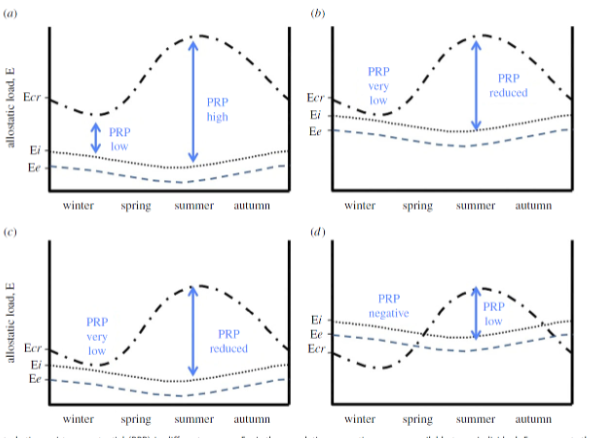
Perturbation Resistance Potential: draw graph and short explanation
difference between the amount of energy that an individual needs to perform all the normal activities and the amount of energy available in the environment
varitations related to life history stages and environemnt changes
Potential explanations for
Seasonal modulation of the adrenocortical stress
response
1. The Energy Mobilization Hypothesis: corticosteroid concentrations
will be highest during energetically costly times of the year metabolic
role of CORT
2. The Behavioral Hypothesis. Life-history stage expressing (or not)
CORT-mediated behaviors.
3. The preparative Hypothesis: Seasonal peaks in corticosteroid
concentrations provide better preparation for periods when adverse
conditions are more common.
4. The brood value Hp: Brood value is high greater resistance
potential to acute stressors and the adrenocortical response is mitigated
core/hub of HPA axis
perceive what is going on in the conditions outside of the body and those conditions could be individual stae, environmental, abiotic
inform hpa axis and respond by mobilizing energy
modulator of metabolism
what is “master of masters”????

