International Marketing Session 3
 Studied by 0 people
 Call Kai
 Learn
Learn Practice Test
 Spaced Repetition
 Match
Match Flashcards
 Knowt Play
1/26

There's no tags or description
Looks like no tags are added yet.
Name | Mastery | Learn | Test | Matching | Spaced |
|---|
No study sessions yet.
27 Terms
What Is Customer Value ?
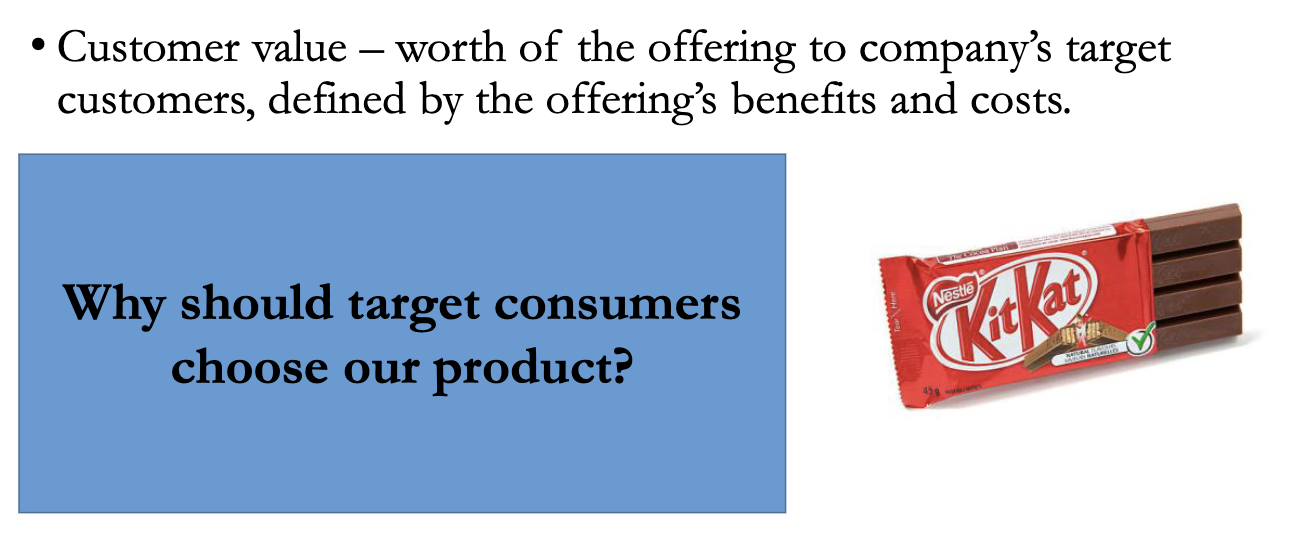
What Types of Value Do We Create?
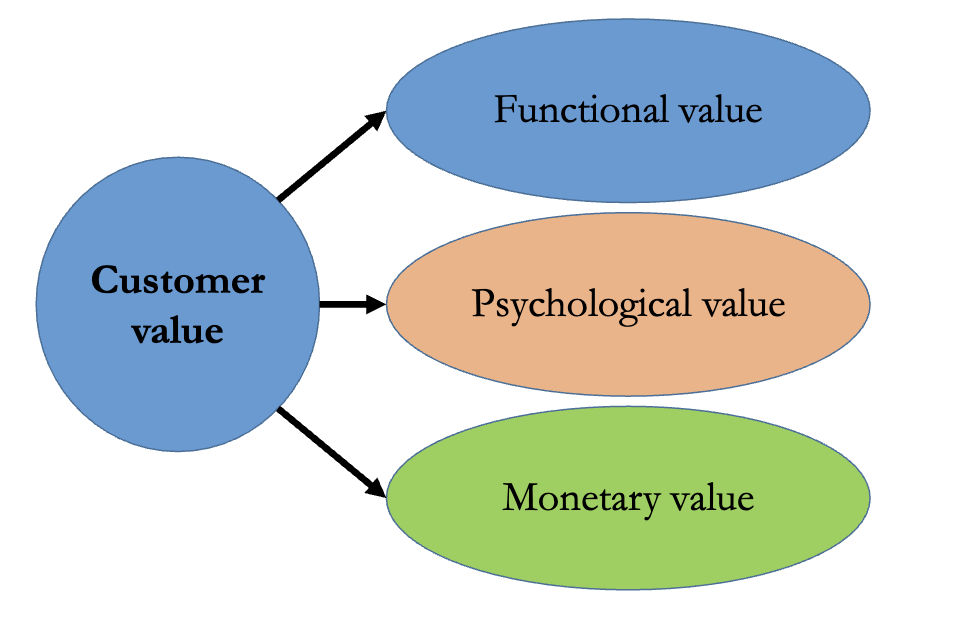
When a company creates a product, they aren't just selling a physical object. They are creating a "bundle" of value. The lecture divides this into three specific categories :
Functional Value: Does it work? (The performance).
Psychological Value: How does it make me feel? (The emotion).
Monetary Value: Is it worth the price? (The economics).
Business Application (The Kit Kat Example)
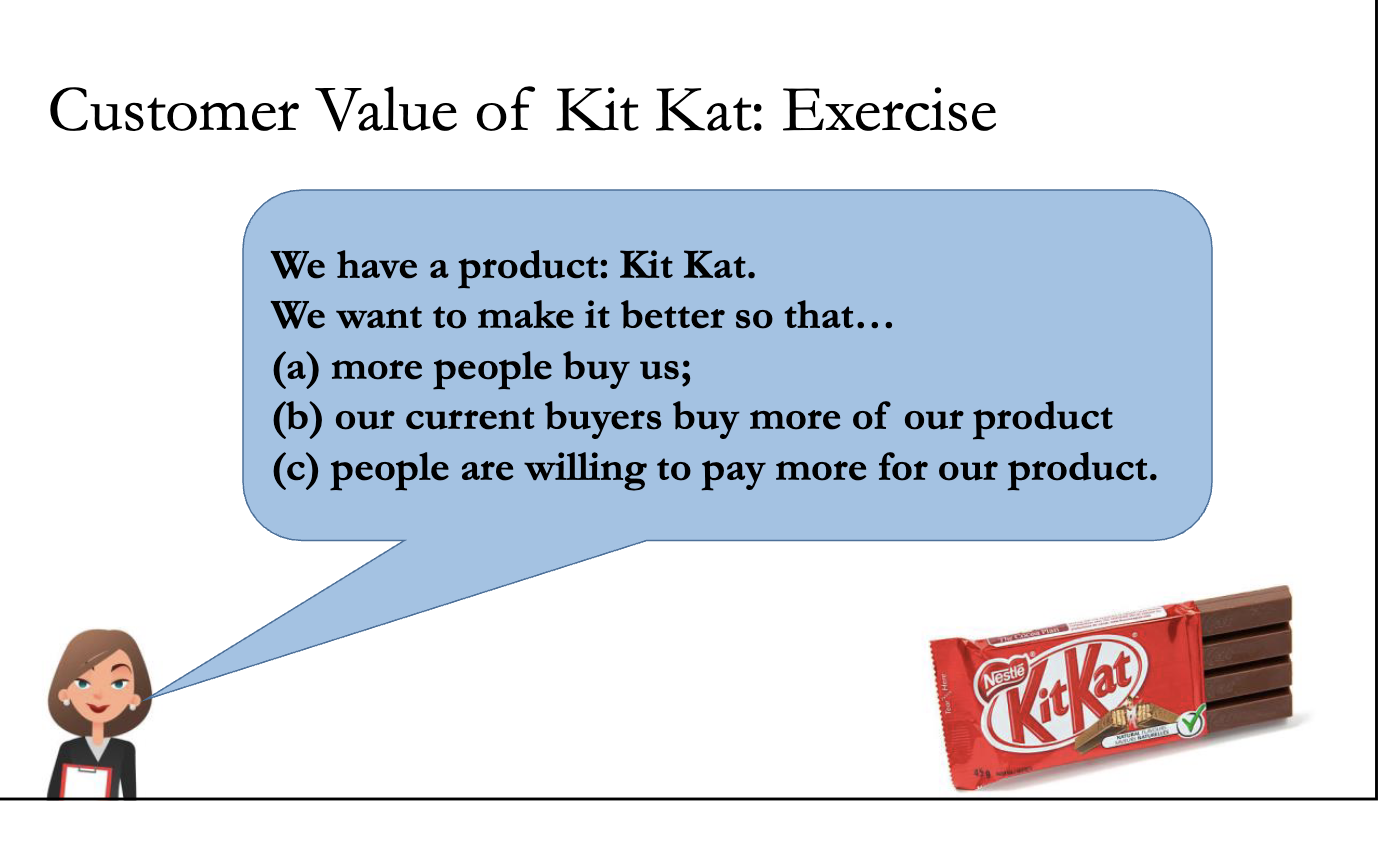
Before diving deeper into the definitions, the lecture asks you to think like a business manager for Kit Kat.
Companies usually want to increase value to achieve one of three specific business goals :
Acquisition: Get more people to buy the product (new customers).
Retention/Volume: Get current buyers to buy more of it (frequency).
Pricing Power: Get people to be willing to pay higher prices.
To achieve these, you have to tweak the three types:
i) Functional Value
ii) Psychological Value
iii) Monetary Value
What Types of Value Do We Create? : Functional Value
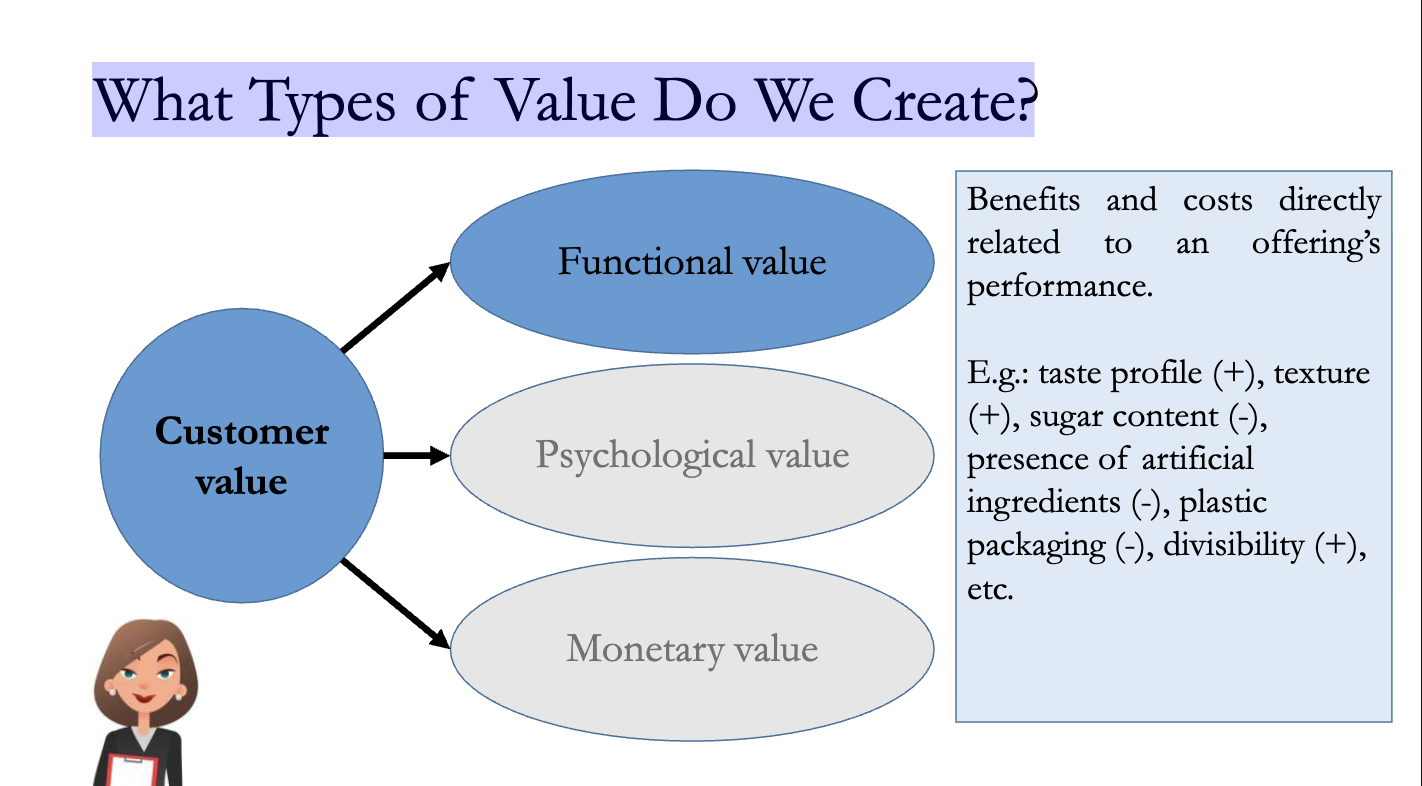
1. Functional Value (The "Brain" / Logic)
Definition: These are the benefits and costs directly related to how the product performs. It is about the physical reality of the product.
Examples (Kit Kat):
Positive (+): The taste profile, the texture (crunch), the "divisibility" (the ability to snap it in half).
Negative (-): High sugar content, artificial ingredients, or plastic packaging (which is bad for the environment).
What Types of Value Do We Create?:
Psychological value
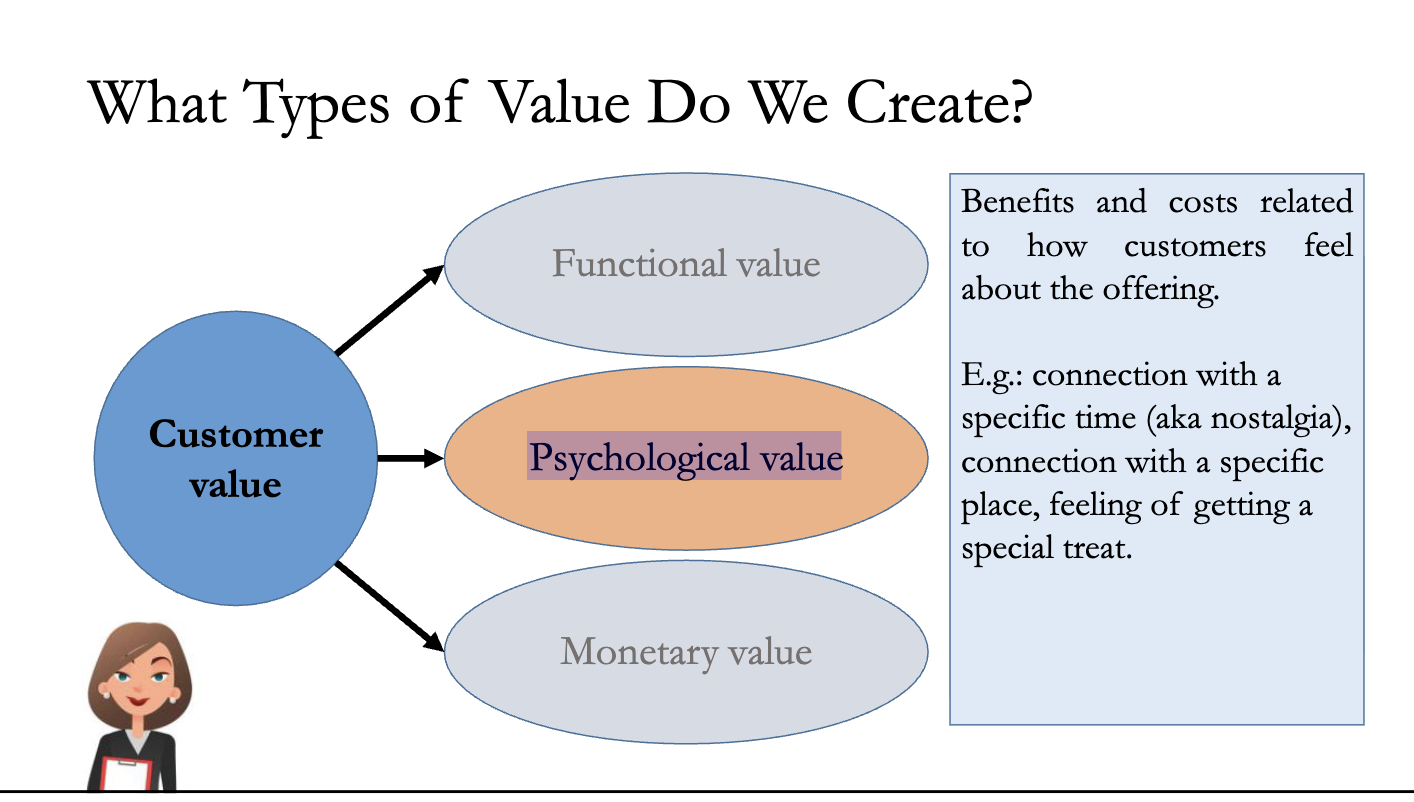
2. Psychological Value (The "Heart" / Emotion)
Definition: These are benefits and costs related to how the customer feels about the offering. This is intangible.
Examples (Kit Kat):
Nostalgia: Connection to a specific time (e.g., "I ate this as a kid").
Place: Connection to a specific location.
Self-Reward: The feeling of getting a "special treat" or taking a break
What Types of Value Do We Create?:
Psychological value
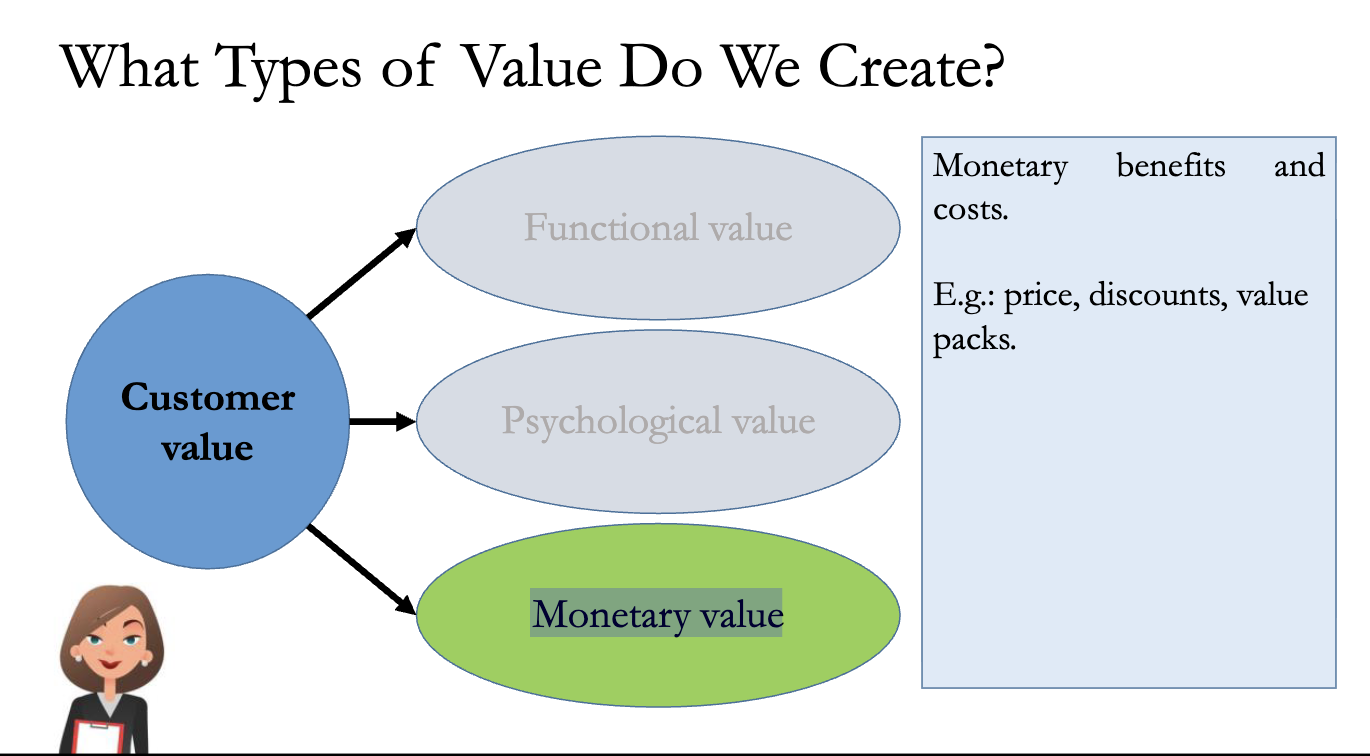
3. Monetary Value (The "Wallet" / Economics)
Definition: These are the financial benefits and costs. It is purely about the numbers.
Examples (Kit Kat):
The price tag itself.
Discounts (sales).
Value packs (getting more chocolate for less money per gram)
1. What is Positioning?
2. The Value Pyramid what is it?
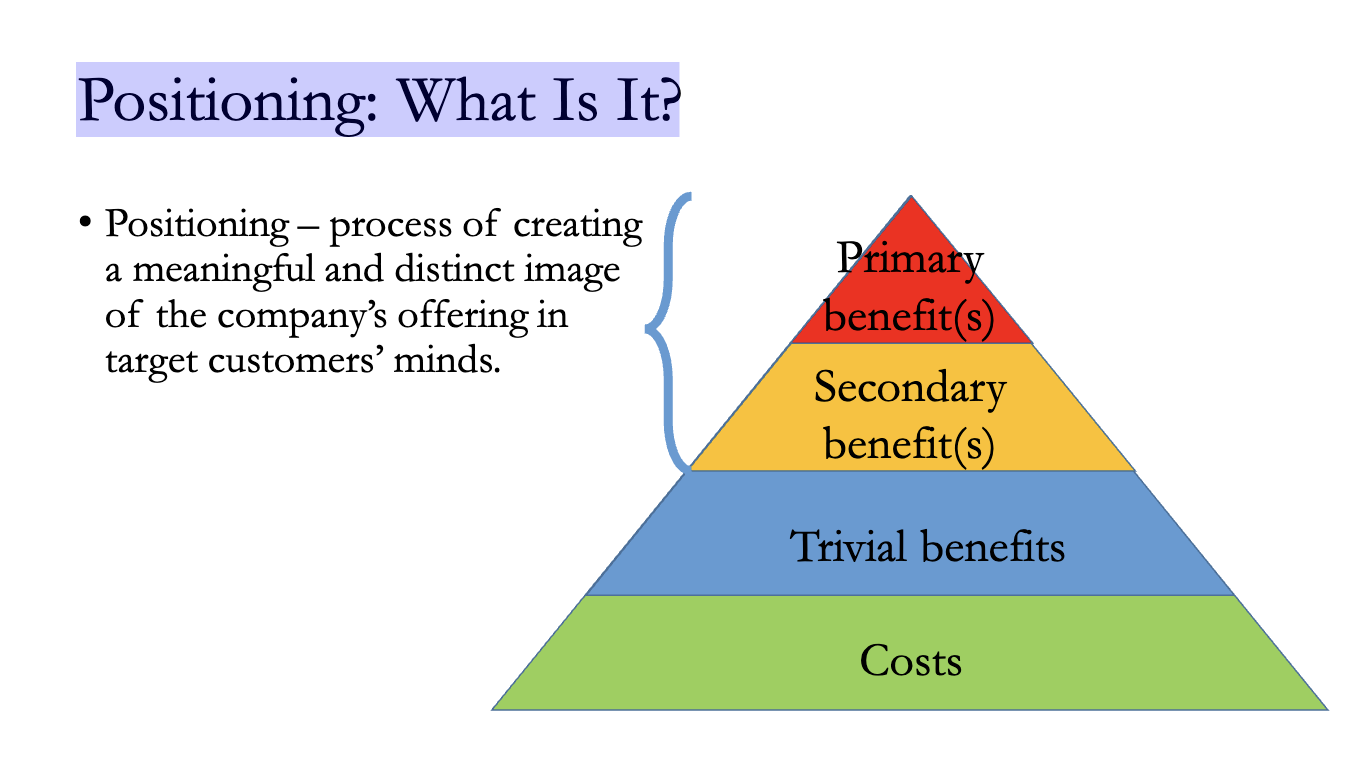
1. What is Positioning? Positioning is not just where you put the product on a shelf. It is a psychological concept.
Definition: It is the process of creating a meaningful and distinct image of your product in the target customer's mind.
The Goal: You want the customer to instantly understand what your product is and why it is better than the alternative.
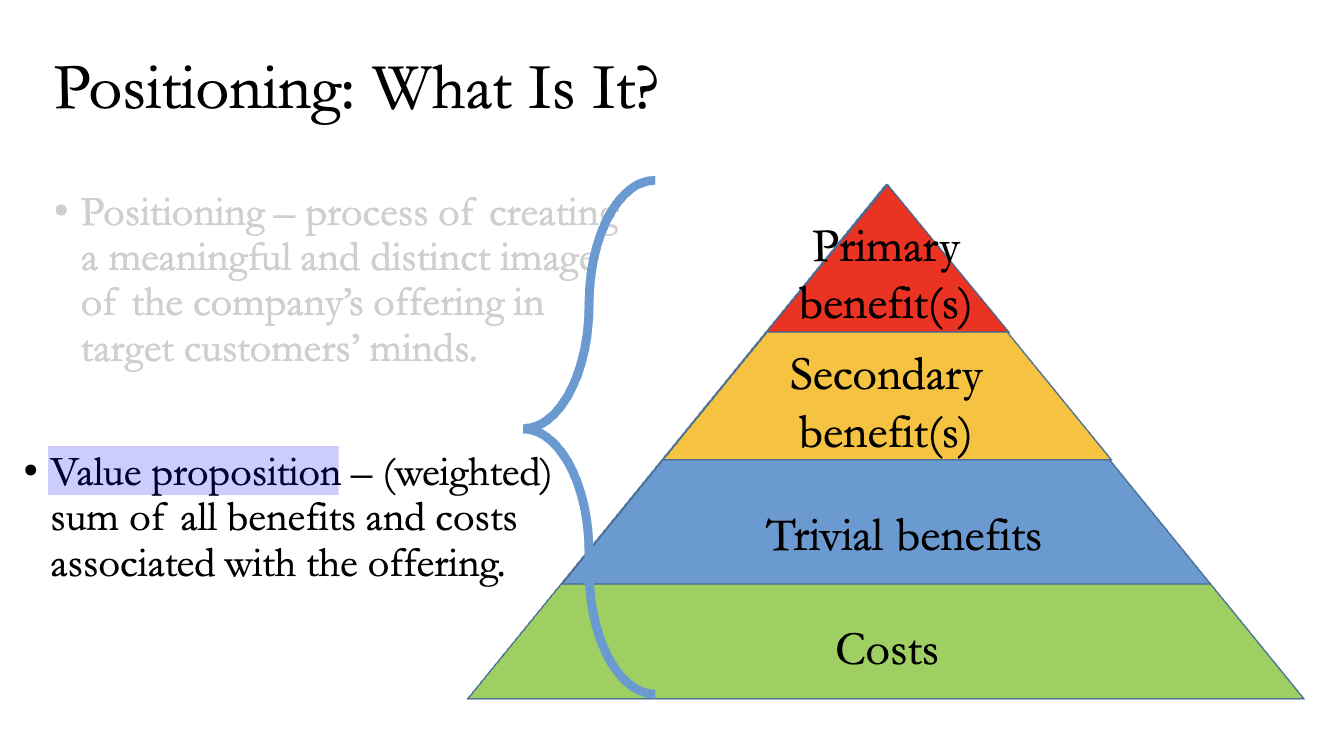
2. The Value Pyramid (Visual on Slide 12) To position a product, you must decide which benefits to highlight. The slide visualizes this as a pyramid :
Primary Benefit (Top): The main reason to buy (e.g., "The best taste").
Secondary Benefit: Nice to have, but not the main driver.
Trivial Benefits: Unimportant details.
Costs (Bottom): The price or effort required.
Value proposition
e.
Positioning in Action (The Kit Kat Case)
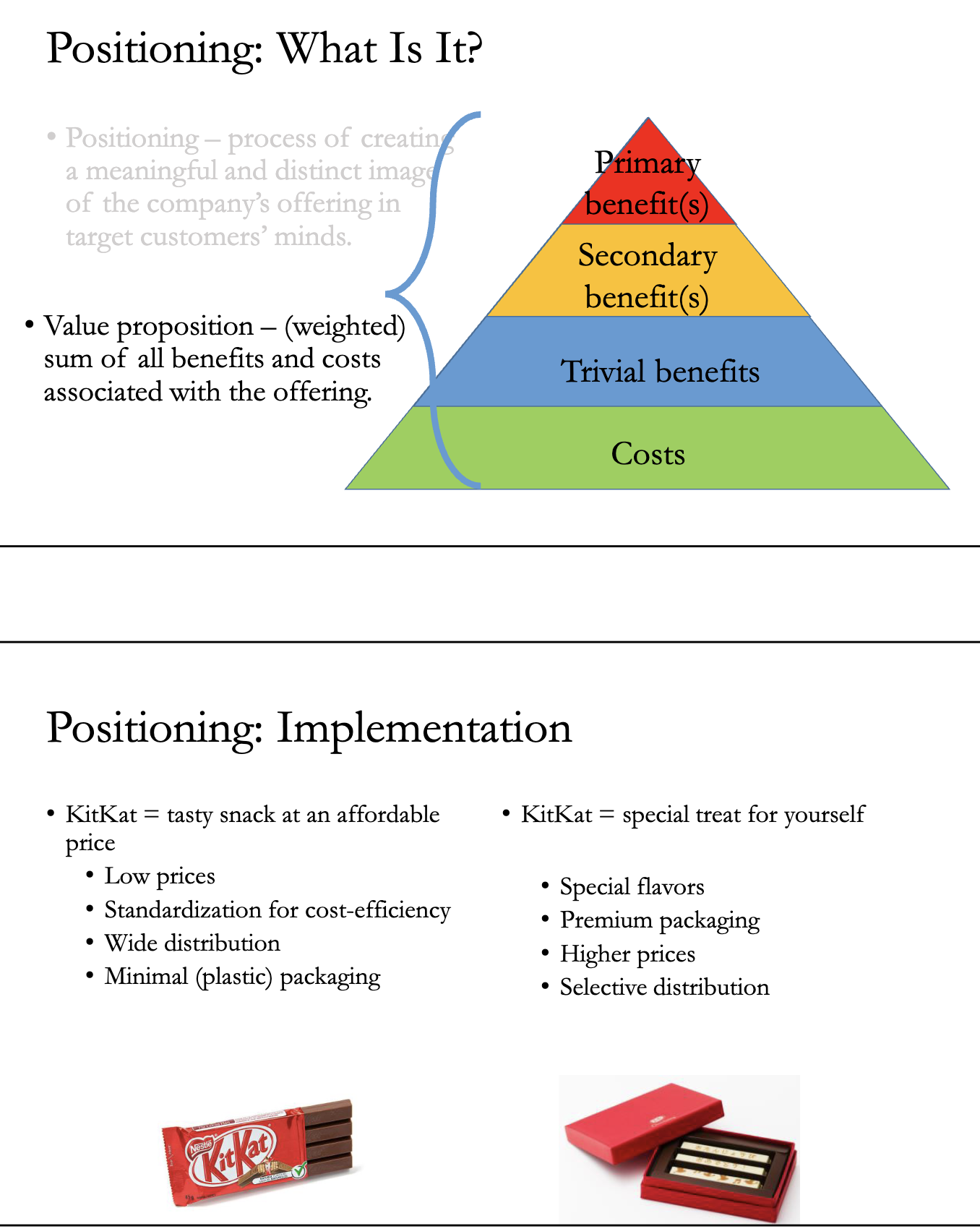
The lecture proves that the same product can be positioned in two completely different ways. It contrasts the Global/Standard positioning with the Japanese positioning of Kit Kat.
Scenario A: The "Tasty Snack" Positioning (Global)
The Image: A cheap, quick energy boost.
The Tactics:
Price: Low.
Product: Standardized recipe to keep costs down.
Packaging: Minimal plastic wrapper.
Distribution: Available everywhere (gas stations, supermarkets).
Scenario B: The "Special Treat" Positioning (Japan)
The Image: A premium gift or a luxury indulgence for yourself.
The Tactics:
Price: Higher.
Product: Special, unique flavors (e.g., Green Tea, Sake).
Packaging: Premium boxes (suitable for gifting).
Distribution: Selective (department stores, specialty shops).
Key Lesson: Positioning isn't just advertising; it changes the actual product (packaging, flavors) and price.
The Positioning Statement: What Is It?
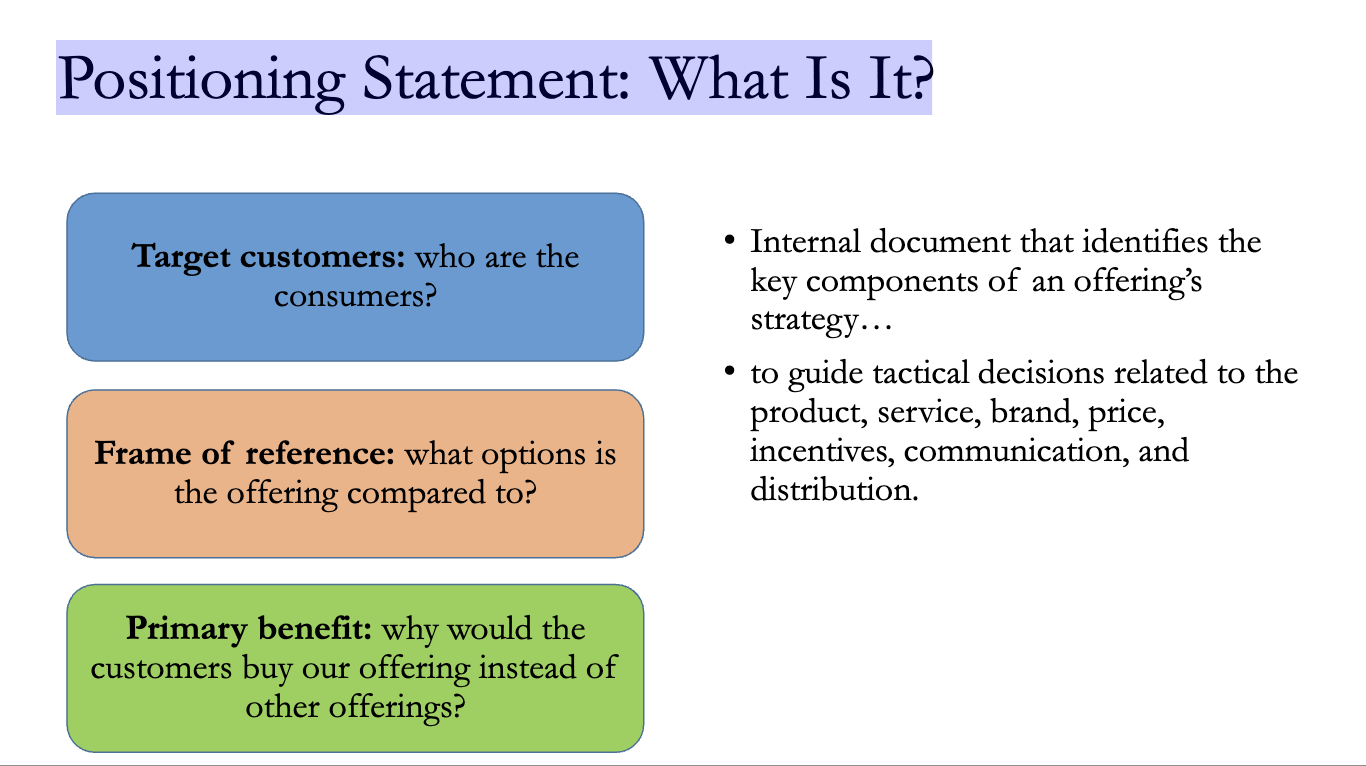
1. What is it?
→ It is an internal document. Customers never see this sentence; it is for the employees. It guides every decision the company makes (price, brand, ads) to ensure consistency.
2. The Formula A good positioning statement has three parts :
i) Target Customers: Who are we talking to?
ii) Frame of Reference: Who are we competing against?
iii) Primary Benefit: Why do we win?
3. The Example (Kit Kat)
"To consumers looking for a tasty snack [Target], KitKat is the confectionary brand [Frame of Reference] that can be found anywhere with the same quality and low prices [Primary Benefit]".
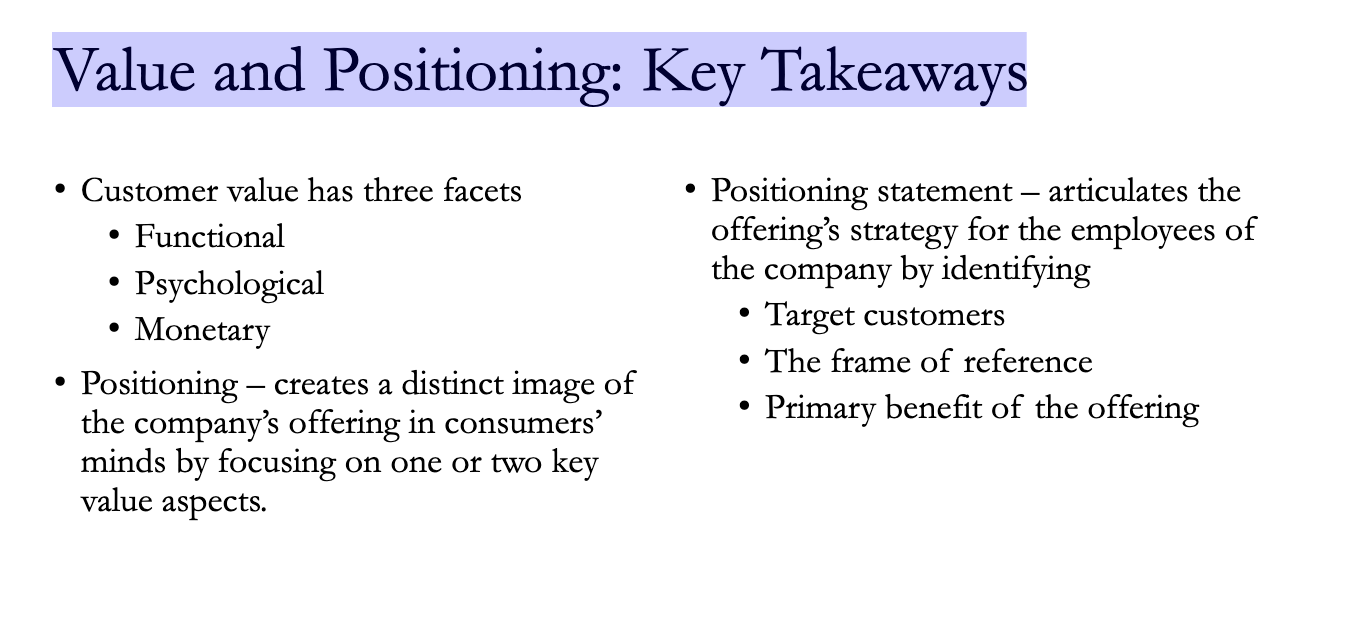
Value and Positioning: Key Takeaways
Consumer Culture Positioning (CCP)
Definition:
→ a marketing strategy where brands link themselves to meanings from a specific culture (global, foreign, or local) to influence consumer perception
Now the lecture shifts to International Marketing. How does culture affect positioning?
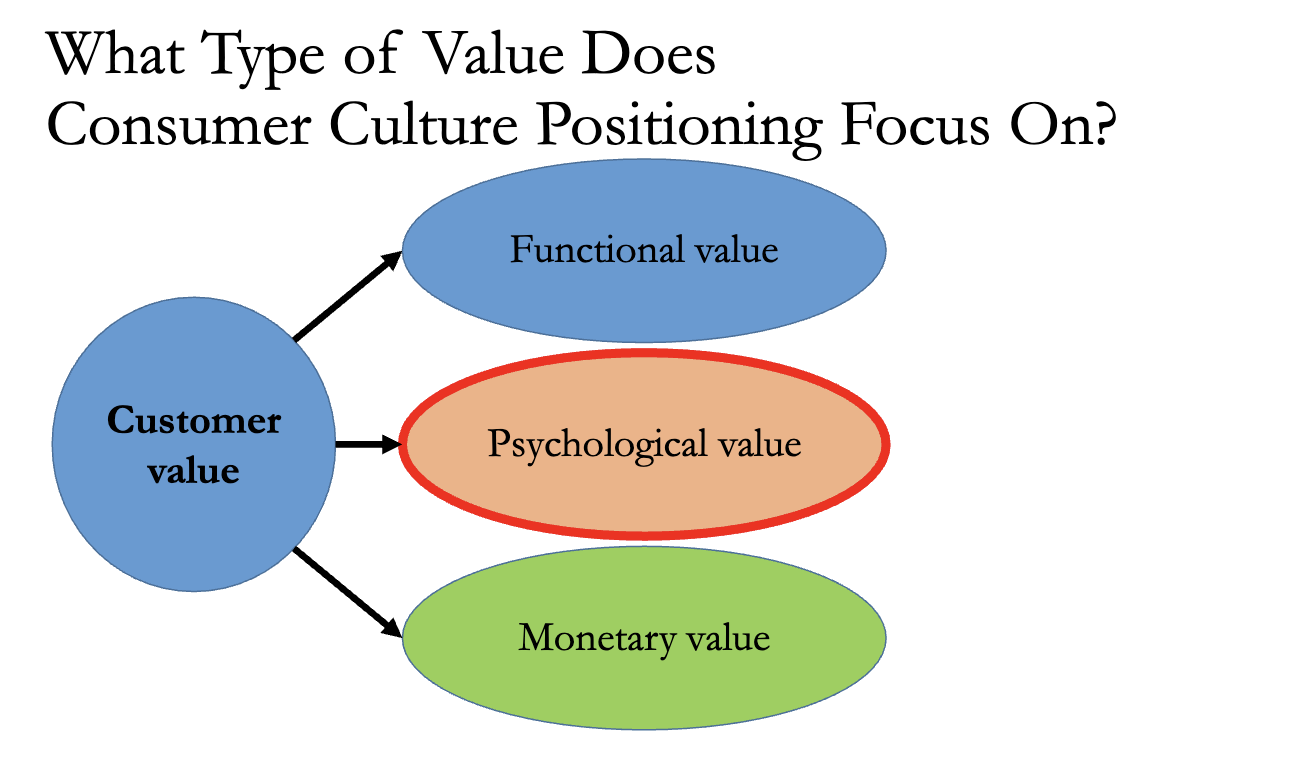
1. Which Value does this target? Slide 22 asks a critical question: What type of value does culture positioning focus on?
The Answer: Psychological Value (circled in red on the slide).
Why? It connects the brand to a consumer's identity, nostalgia, or sense of belonging, rather than just the product's function
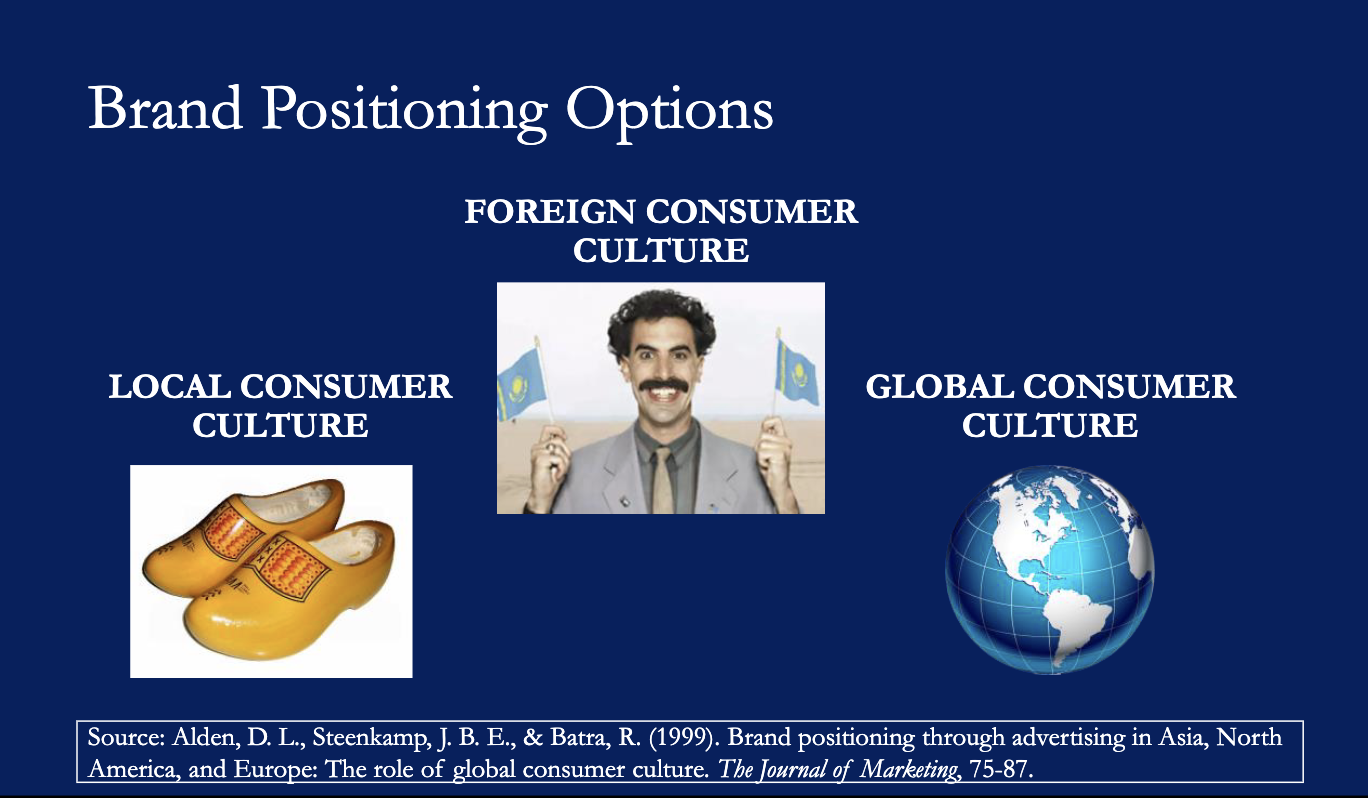
The Three Types of Cultural Positioning Brands usually choose one of three "personalities" based on geography:
Local Consumer Culture Positioning (LCC)
Foreign Consumer Culture Positioning (FCC)
Global Consumer Culture Positioning (GCC)
Local Consumer Culture Positioning (LCC)
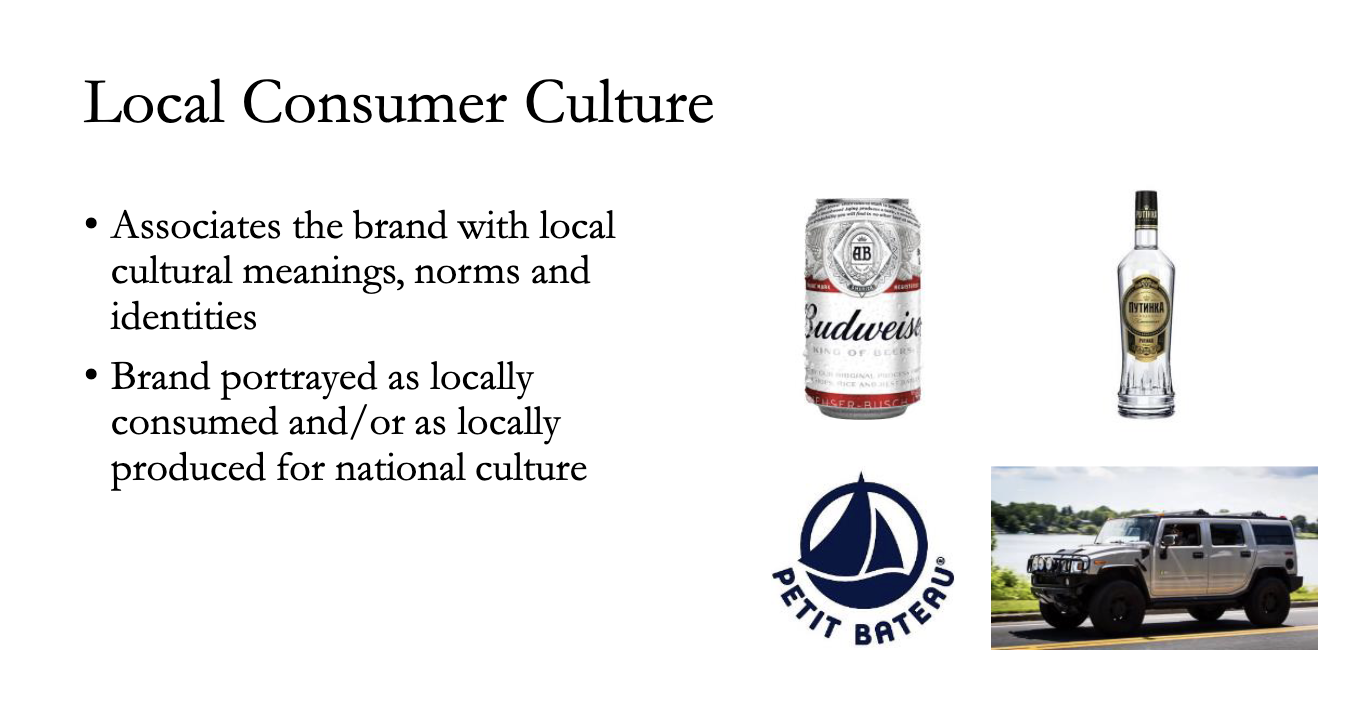
Strategy: The brand acts like a "local hero." It reflects native norms and identities.
Message: "This product is made for us, by us."
Examples:
Budweiser: Positioning itself as deeply American.
Petit Bateau: Positioning itself as deeply French
Foreign Consumer Culture Positioning (FCC)
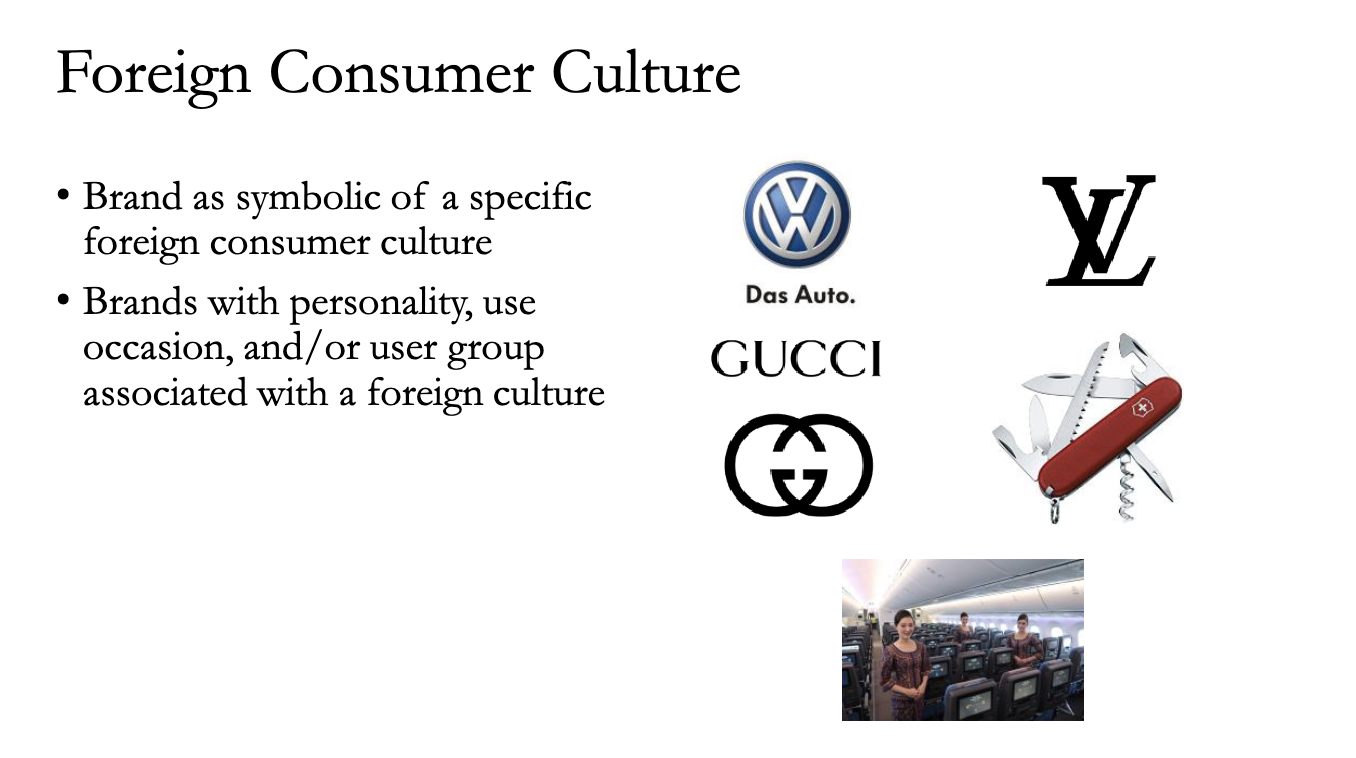
Strategy: The brand highlights a specific foreign culture to look cool or high-quality.
Message: "This product brings you the style/quality of [Country X]."
Examples:
Volkswagen: Uses the slogan "Das Auto" to highlight German engineering.
Gucci: Highlights Italian style.
Louis Vuitton: Highlights French luxury.
Global Consumer Culture Positioning (GCC)
Global Consumer Culture Positioning (GCC)
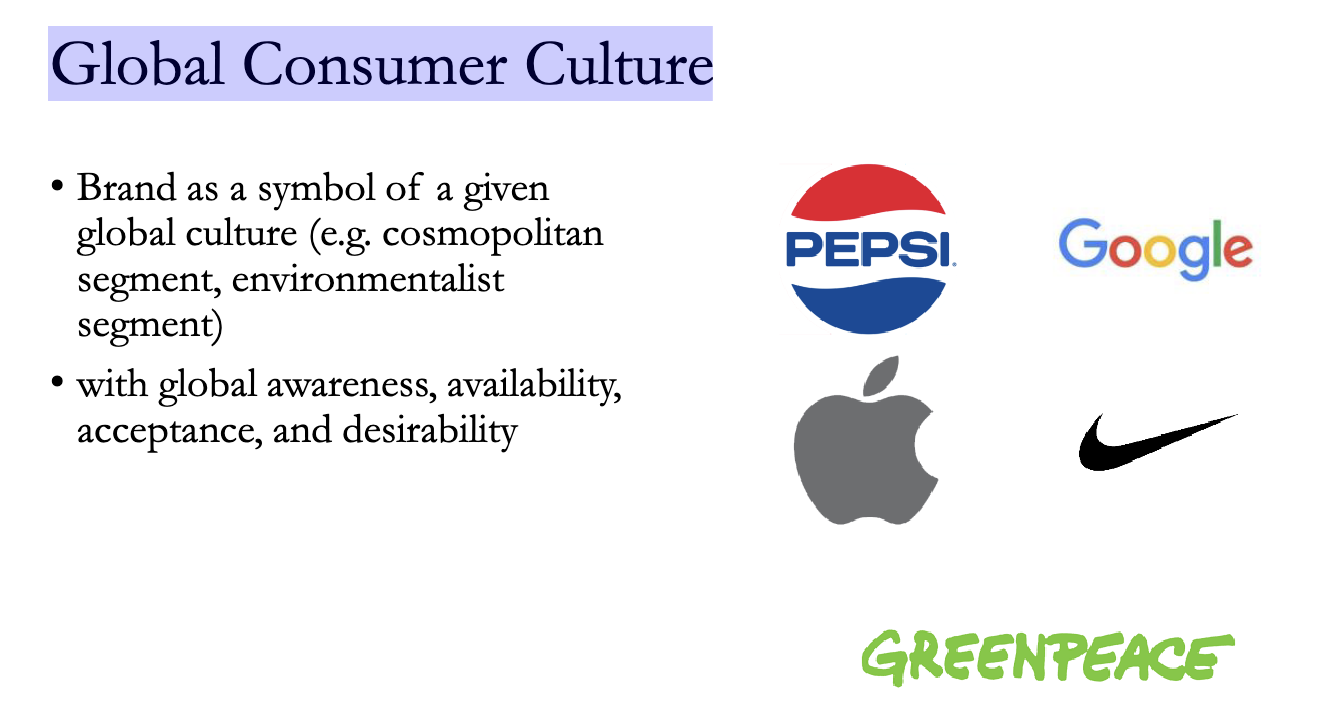
Strategy: The brand is not tied to any specific country. It represents a "global tribe" (e.g., modern business people, environmentalists).
Message: "We are citizens of the world."
Examples:
Google: A tool for everyone, everywhere.
Greenpeace: Saving the planet, not a country.
Pepsi: A universal drink for the youth.
How to Spot the Difference (Indicators)
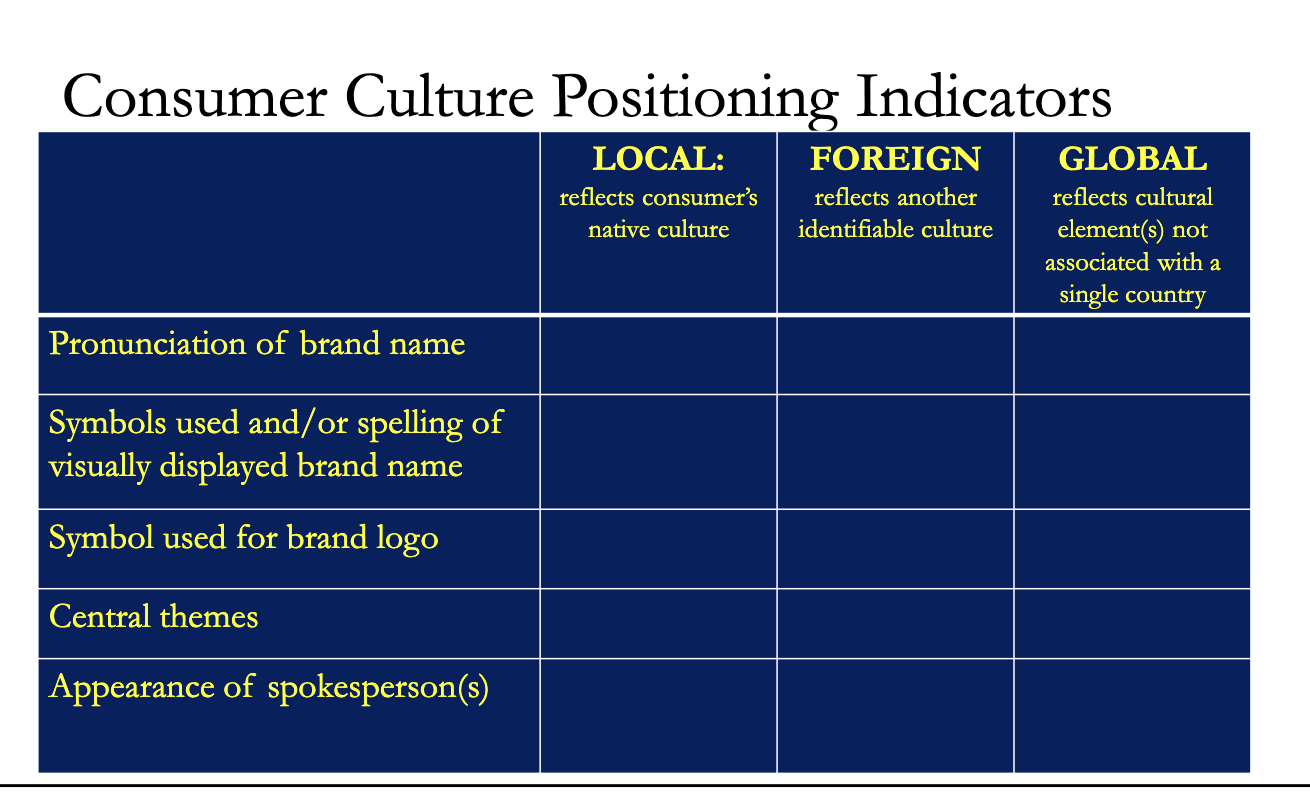
The final slide in this section provides a table to help you identify which strategy a brand is using based on clues:
Look at the Brand Name: Is it pronounced in a local way (Local) or kept foreign (Foreign)?
Look at the Spokesperson: Is it a local celebrity (Local) or a Hollywood star recognized everywhere (Global)?
Look at the Symbols: Does it use the Eiffel Tower (Foreign/French) or a globe (Global)?
Summary Checklist for Studying
Positioning is the mental image you create.
Positioning Statement is the internal rulebook.
Local Positioning (LCC): "I am one of you" (Budweiser).
Foreign Positioning (FCC): "I am exotic/classy" (Gucci).
Global Positioning (GCC): "I am modern/universal" (Google).
LOCAL VS. GLOBAL: WHEN TO?
Why go Global? (The Value) Why do companies try to look "Global"?
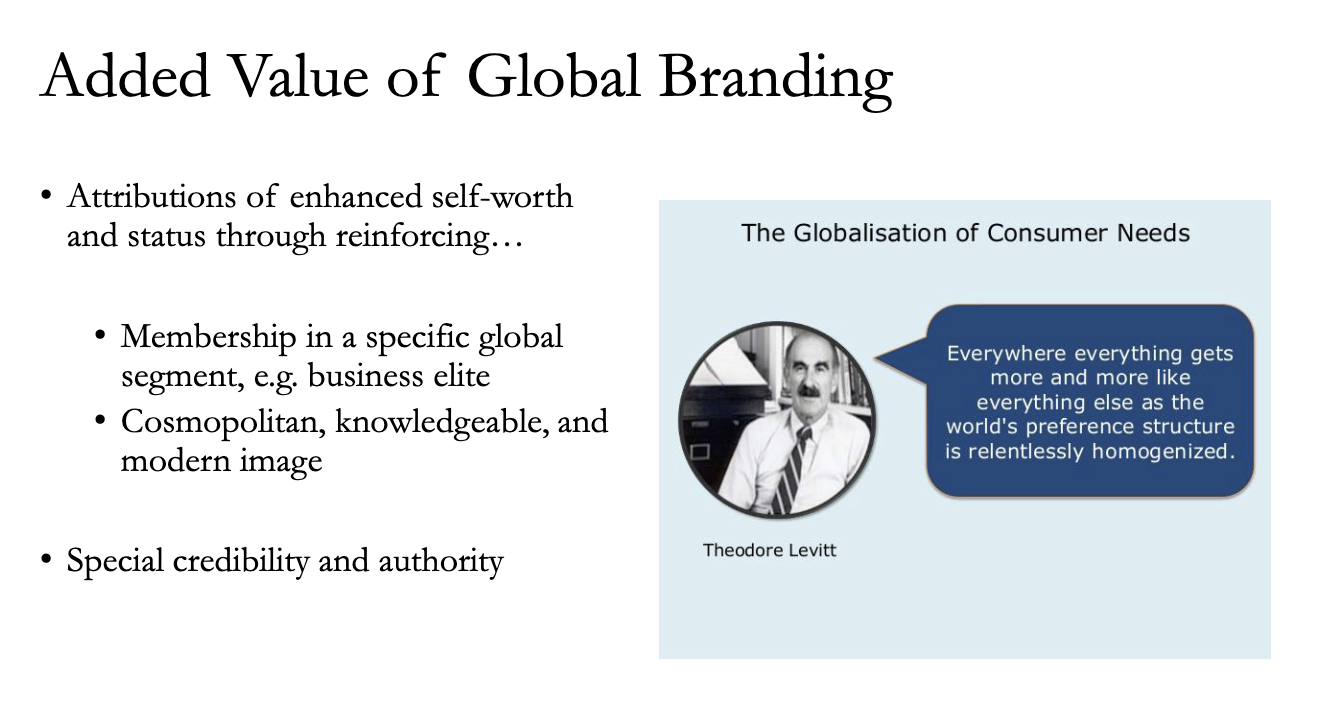
1. Why go Global? (The Value) Why do companies try to look "Global"?
Status & Self-Worth: Buying a global brand makes consumers feel modern, cosmopolitan, and part of an elite worldwide club (like the "business elite") .
Quality: People assume global brands are bigger, better, and more reliable.
The Reality Check (The Graph) Not every product works as a global brand. The graph on Slide 28 shows a clear trend
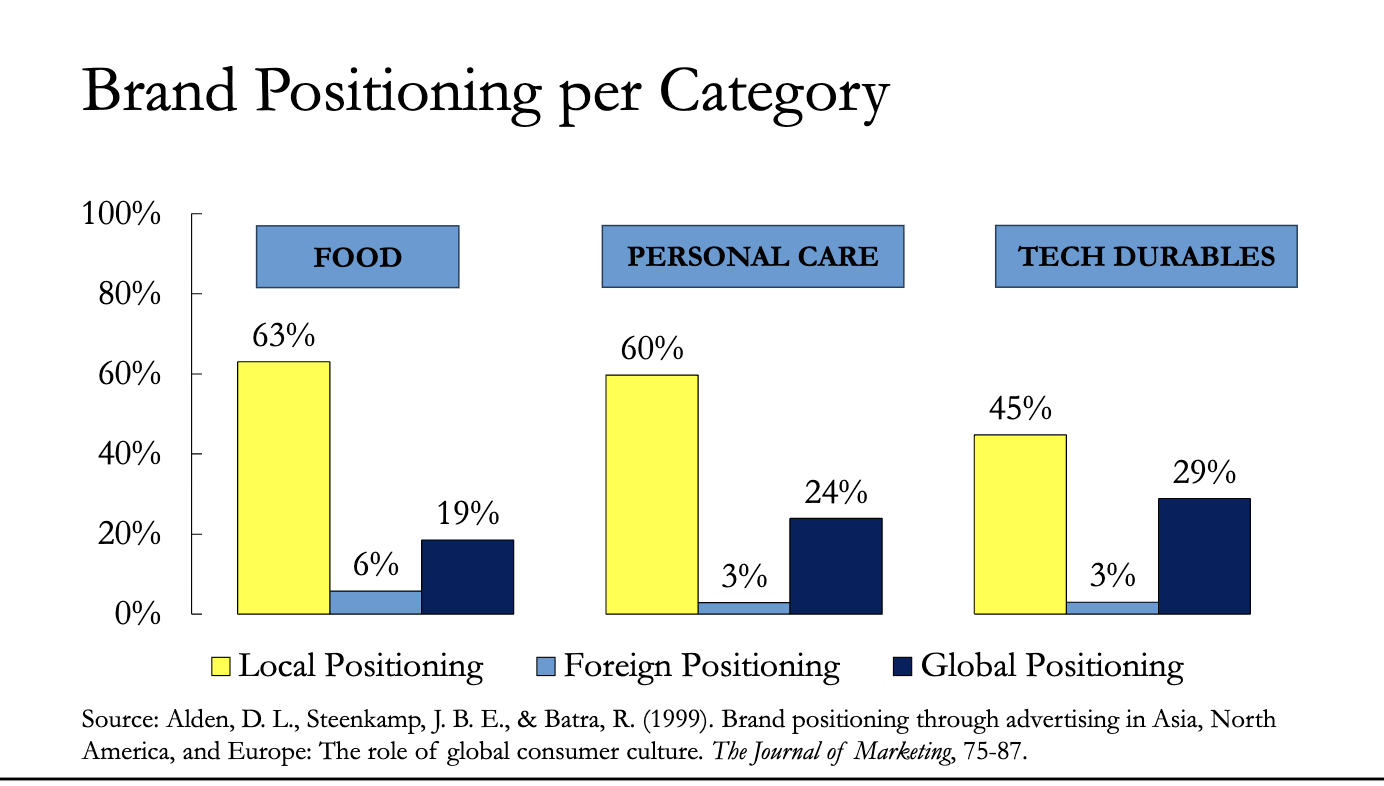
Tech Durables (TVs, Phones): Very easy to position globally. (It works the same everywhere).
Food: Very hard to position globally. Most food marketing is Local (63%) because taste is culture-specific.
Local vs. Global Dilemma: When To?
depends on the :
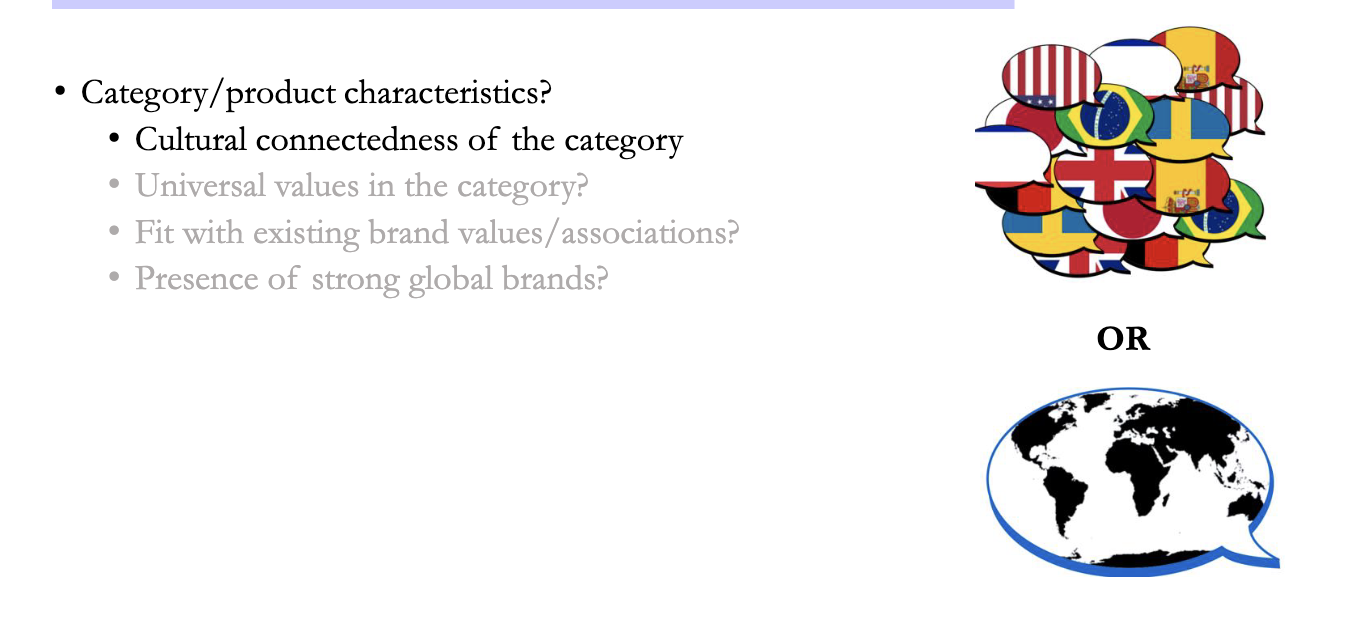
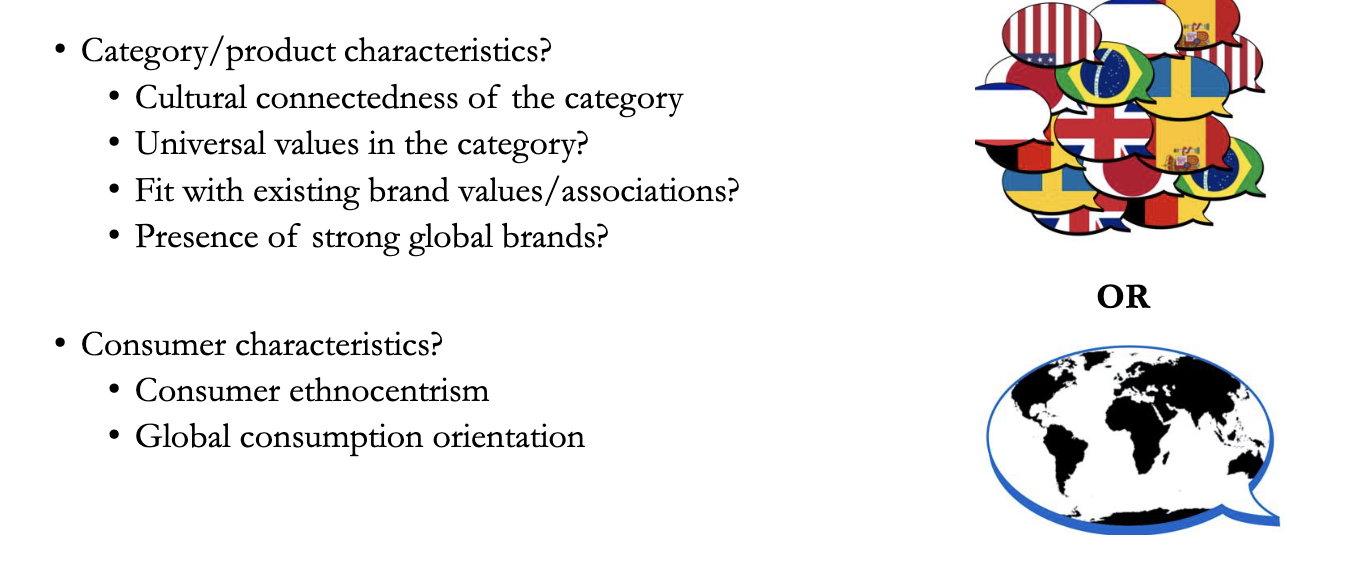
Category/product characteristics?
Cultural connectedness of the category
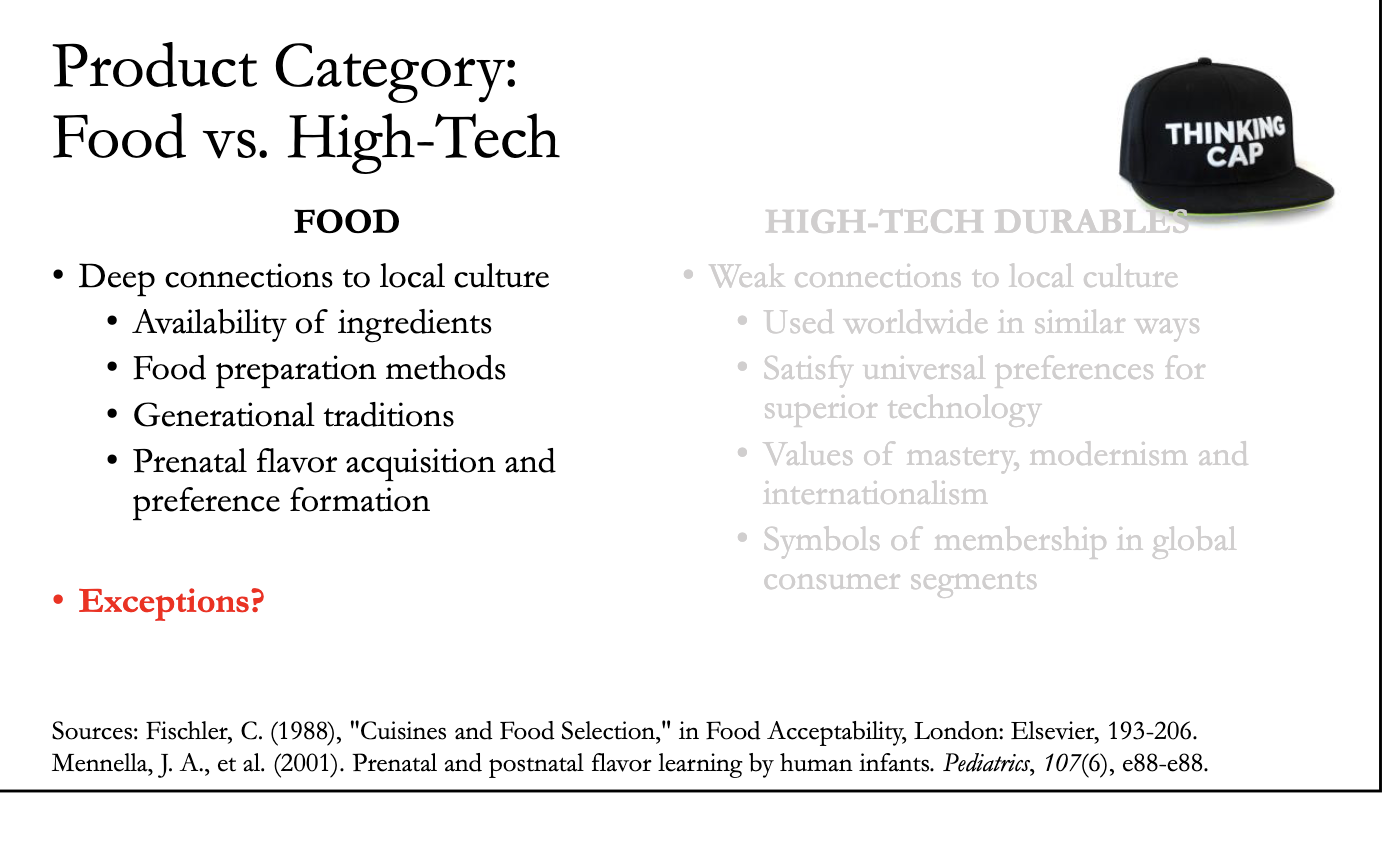
Example: Product Category: Food vs. High-Tech
1. Food = Culture (Local)
Food is deeply connected to history, family traditions, and even biology (flavors you learned to like as a baby) .
The Kit Kat Case Study:
In the West, Kit Kat is just a "snack" ("Have a break").
In Japan, Kit Kat became a cultural souvenir ("Omiyage"). Because the name sounds like "Kitto Katsu" (You will surely win), it became a good luck charm.
Nestlé created 300+ unique/local flavors (Wasabi, Sake, Matcha) to fit the Japanese gift-giving culture.
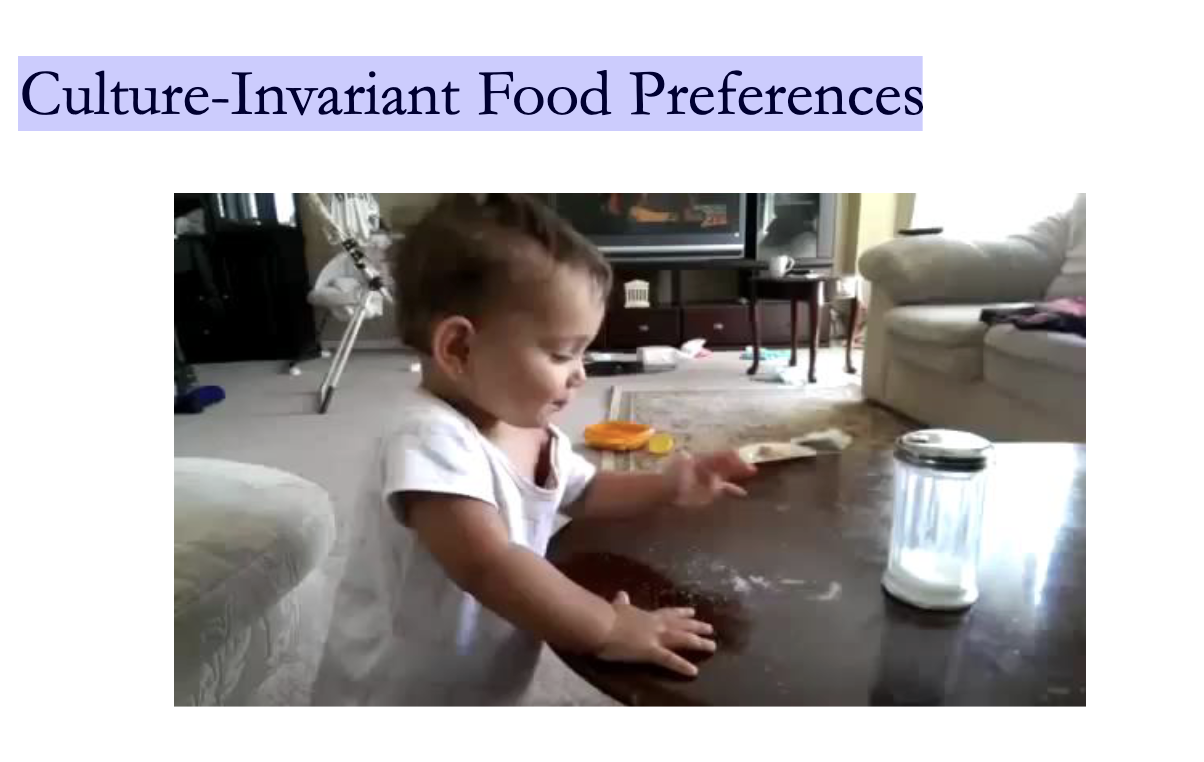
Exceptions?: Yes, Culture-Invariant Food Preferences" describes the shared, biological starting point of human taste.
eg: milk (including infant formula)
2. Tech = Function (Global)
Tech has "weak connections" to local culture. A laptop is a tool.
It satisfies universal needs (everyone wants a faster processor or clearer screen).
It represents "Mastery" and "Modernism," which are valued everywhere.
Local vs. Global Dilemma: When To?
Consumer Characteristics: Consumer Ethnocentrism
Consumer Psychology (Who buys what?)
(Pages 18–19 / Slides 35–38)
Even if your product is great, the consumer's attitude matters. The lecture highlights
→ Consumer Ethnocentrism (CET).
1. What is Consumer Ethnocentrism?
It is the belief that buying foreign products is wrong or unpatriotic.
The Mindset: "If I buy a foreign car, I am hurting my country's economy and causing unemployment".
2. The Research Findings Researchers tested this with products like Cola and TVs in the US and Korea.
The Result:
→ If a consumer has high ethnocentrism (they are very patriotic), they are much less likely to buy a brand that positions itself as "Global."
Global positioning only works well on people with low ethnocentrism
Consumer Characteristics: Global consumption orientation
This section introduces a more advanced way to group consumers based on how they view the world.
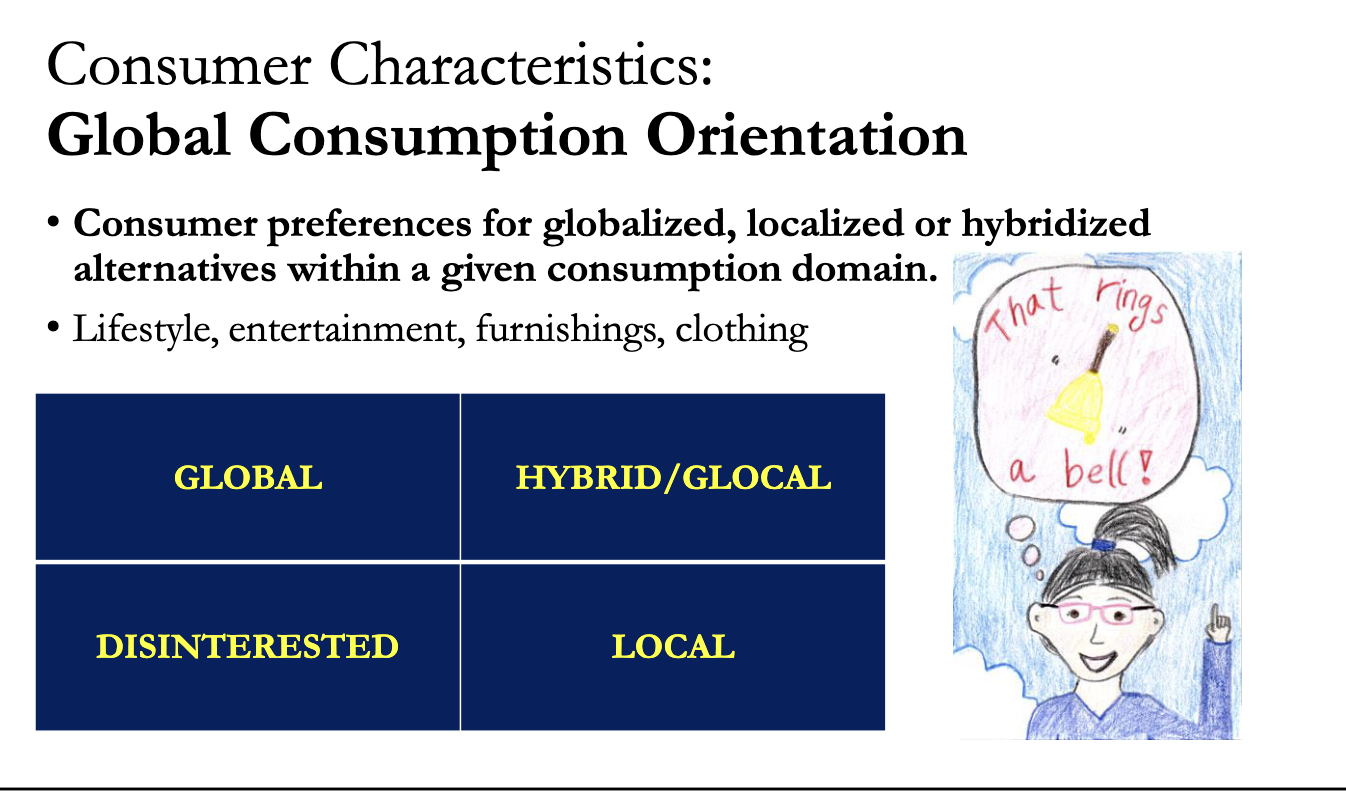
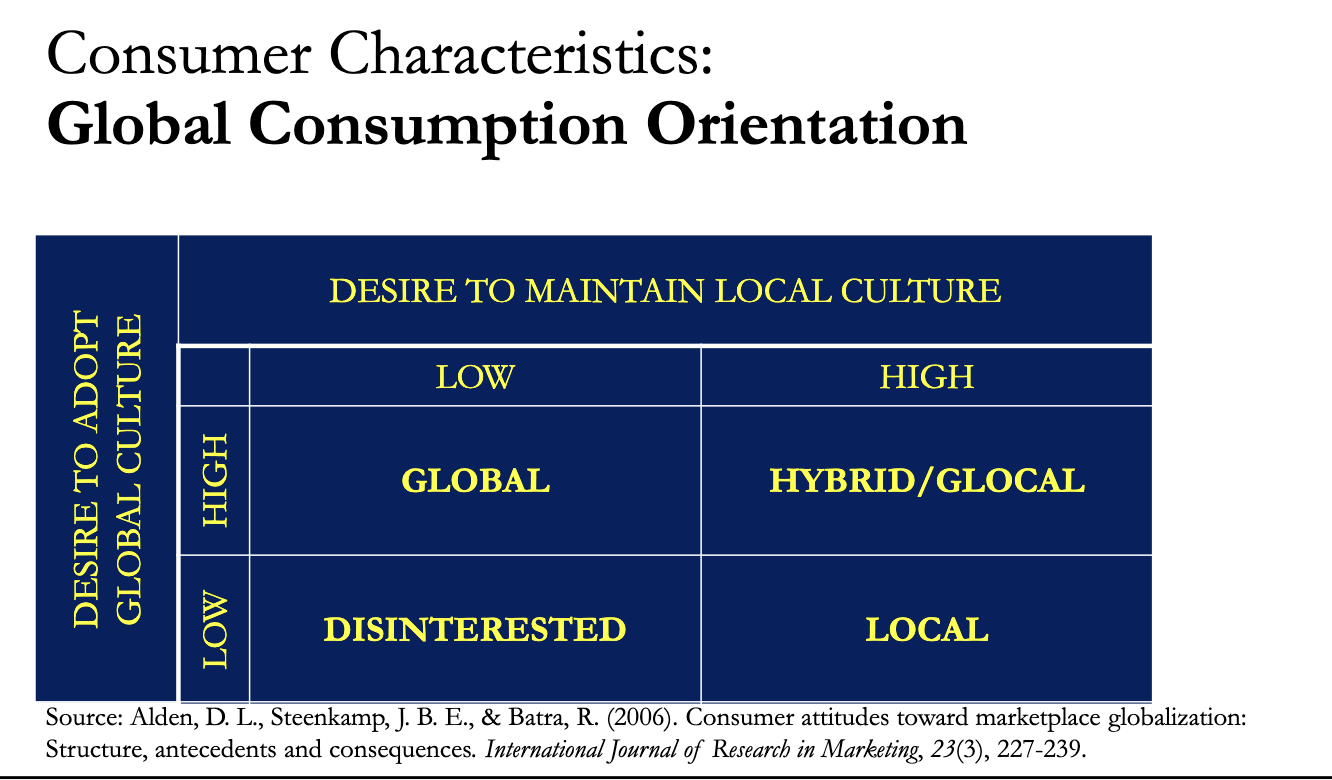
What country-level or individual-level traits could be associated with Global Consumption Orientation?
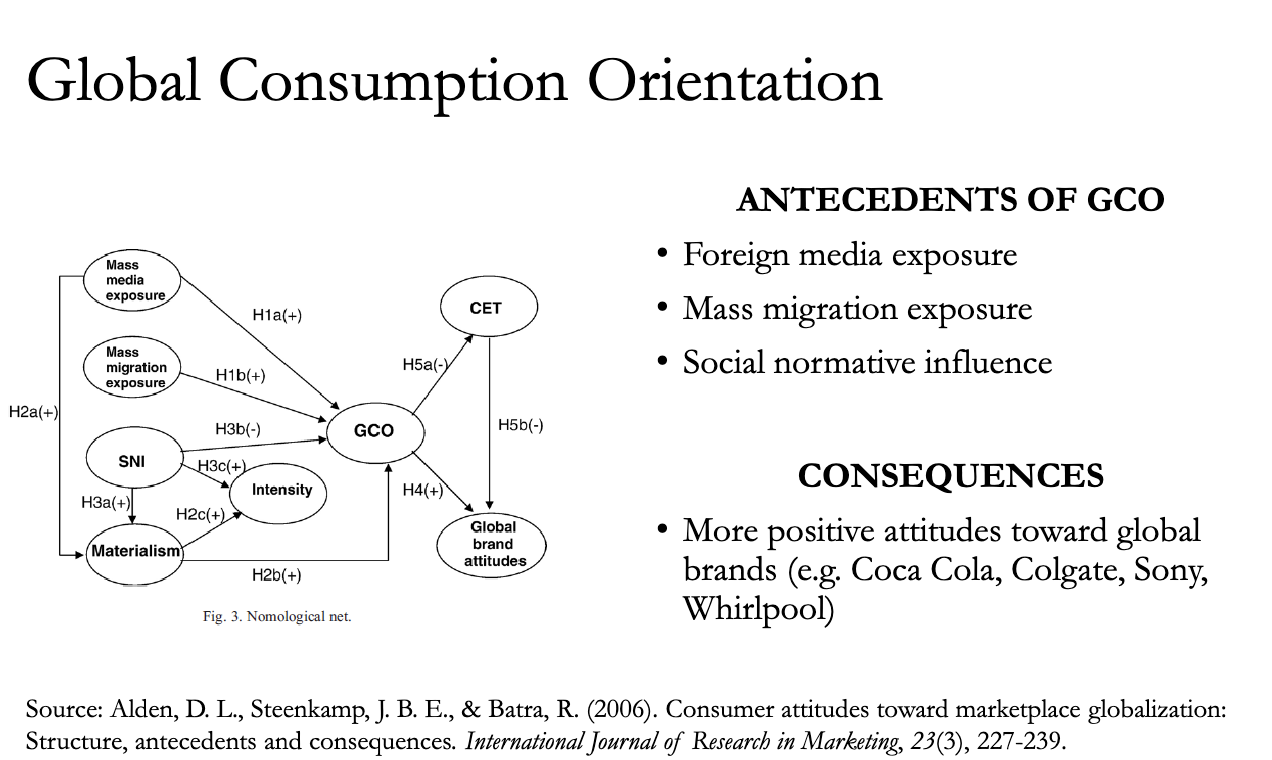
2. How do people become "Global"? (Antecedents) Slide 45 explains what causes a person to have a "Global" mindset :
Mass Media: Watching foreign movies/Netflix.
Migration/Travel: Meeting people from other countries.
Consequence: If you have these experiences, you have a higher "Global Consumption Orientation" (GCO) and you like brands like Coca-Cola and Sony more .
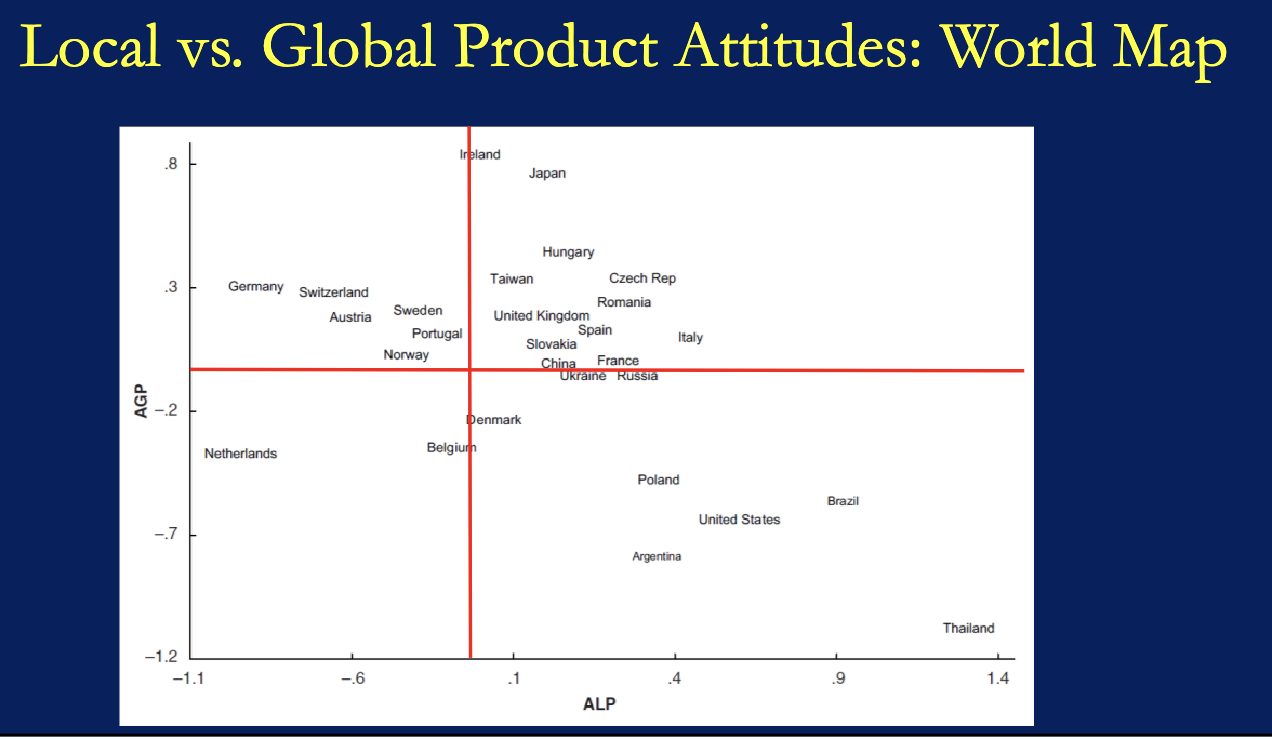
Demographics (Who is who?)
Consumer Characteristics: Demographic Correlates of LPA (Local Product Attitudes) and GPA (Global Product Attitudes)
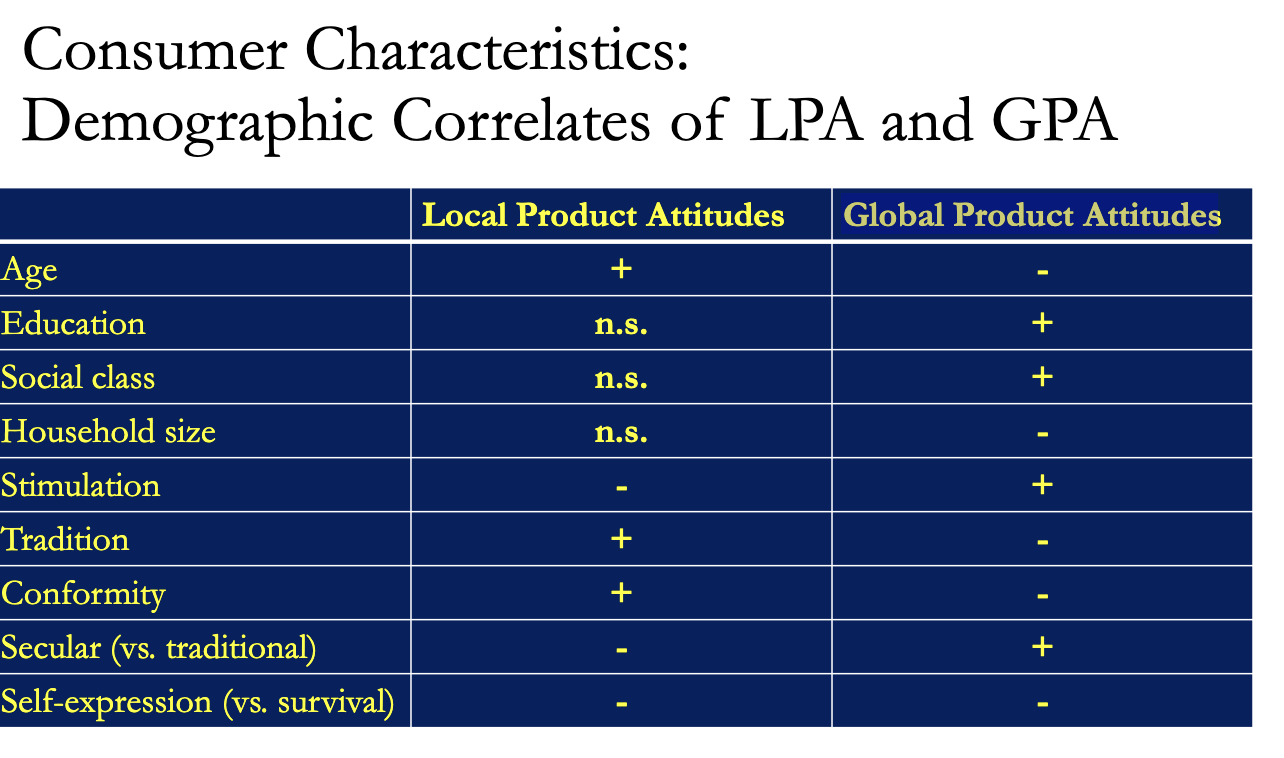
Finally, the lecture tells you exactly who fits into these categories based on data.
1. Who likes LOCAL products?
Older people (Age is positively correlated with Local attitudes).
People who value Tradition and Conformity.
2. Who likes GLOBAL products?
Younger people.
Higher Education and Higher Social Class.
People who value Stimulation (excitement) and are Secular (less traditional/religious).
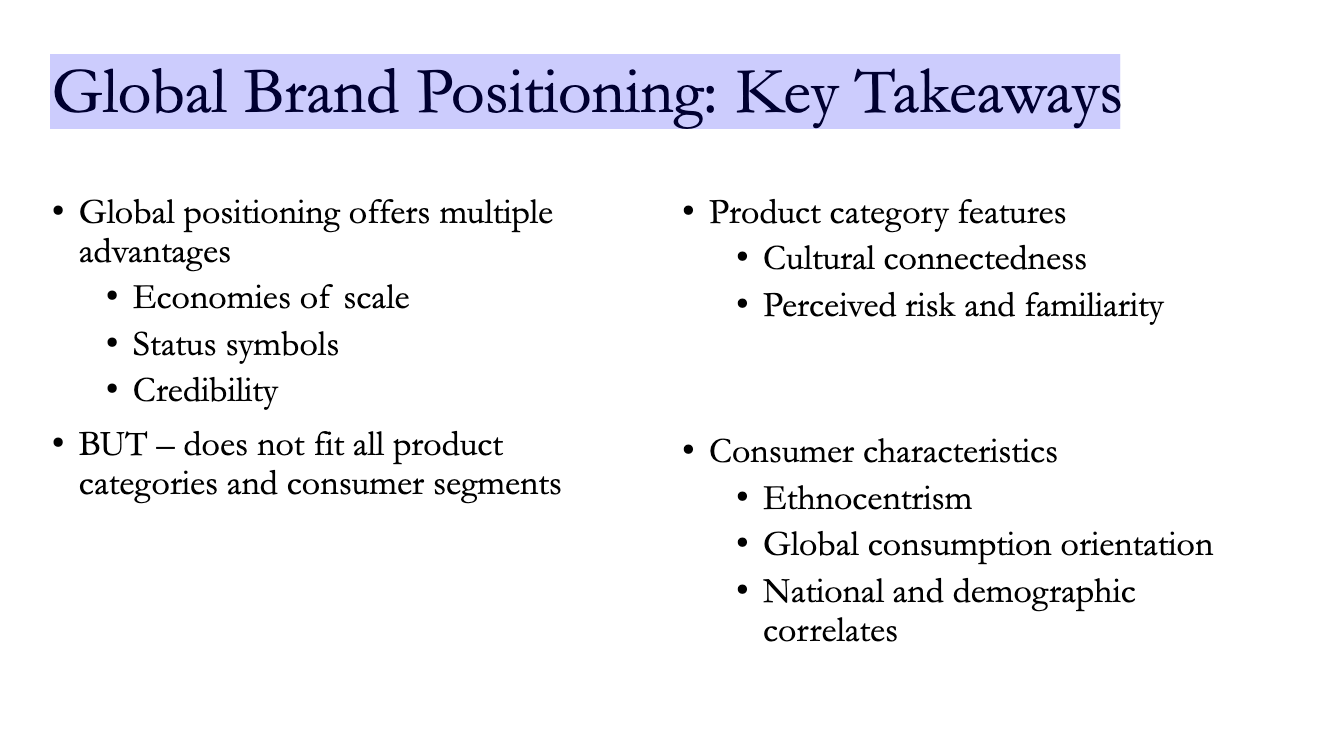
Global Brand Positioning: Key Takeaways
Lecture 3: Self-check Questions
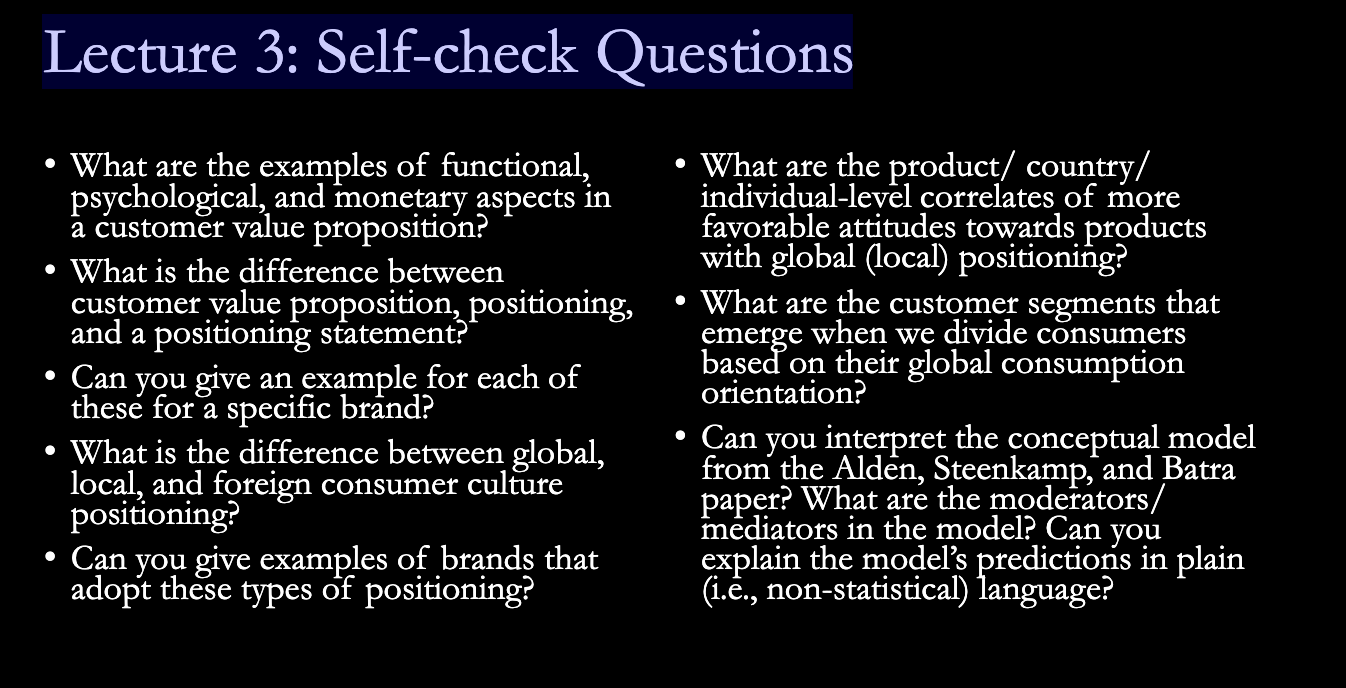
Here are concise, exam-style answers to the Lecture 3 Self-Check Questions, based on the provided lecture slides and supplementary readings.
1. Examples of Functional, Psychological, and Monetary Value
Functional Value: Benefits related to performance and physical attributes.
Examples: Taste profile, texture, divisibility (snapping a Kit Kat), or sugar content .
Psychological Value: Benefits related to feelings and emotions.
Examples: Nostalgia (connection to a specific time), sense of belonging, or the feeling of a "special treat" .
Monetary Value: Benefits related to economics and price.
Examples: Low price, discounts, or value packs .
2. Difference: Value Proposition vs. Positioning vs. Positioning Statement
Value Proposition: The (Weighted) sum of all benefits and costs (Primary, Secondary, and trivial costs) associated with the offering.
Positioning: The process of creating a distinct image of the offering in the target consumer's mind by focusing on specific key benefits.
Positioning Statement: An internal document used to guide company strategy. It articulates the target customer, the frame of reference (competition), and the primary benefit .
3. Example for a Specific Brand (Kit Kat)
Value Proposition: A tasty, chocolate-wafer snack that is affordable, divisible, and offers a mental break .
Positioning: "Have a break, have a Kit Kat" (Positioned as a tasty, affordable snack for a quick break).
Positioning Statement: "To consumers looking for a tasty snack, KitKat is the confectionery brand that can be found anywhere with the same quality and low prices".
4. Difference: Global, Local, and Foreign Consumer Culture Positioning
Local (LCCP): Associates the brand with local cultural norms, identities, and meanings (e.g., "made for us").
Foreign (FCCP): Associates the brand with a specific foreign culture to leverage that country's image (e.g., German engineering, French fashion).
Global (GCCP): Associates the brand with a universal "global" culture (e.g., cosmopolitanism, modernity) rather than any single country .
5. Brand Examples of Cultural Positioning
Local: Budweiser (USA), Petit Bateau (France).
Foreign: Gucci (Italy), Volkswagen "Das Auto" (Germany), Haagen-Dazs (invented Danish name).
Global: Google, Pepsi, Greenpeace.
6. Correlates of Favorable Attitudes Toward Global/Local Products
Product Level: High-tech durables (cameras, computers) are preferred as Global brands because they signal advanced technology. Food is preferred as Local because of deep cultural ties to taste and tradition.
Individual Level (Demographics):
Global Preference: Younger age, higher education, higher social class, cosmopolitanism.
Local Preference: Older age, values tradition and conformity.
Psychological Level: Consumer Ethnocentrism (CET) correlates with a preference for Local brands. High CET consumers believe buying foreign goods hurts the local economy .
7. Customer Segments Based on Global Consumption Orientation
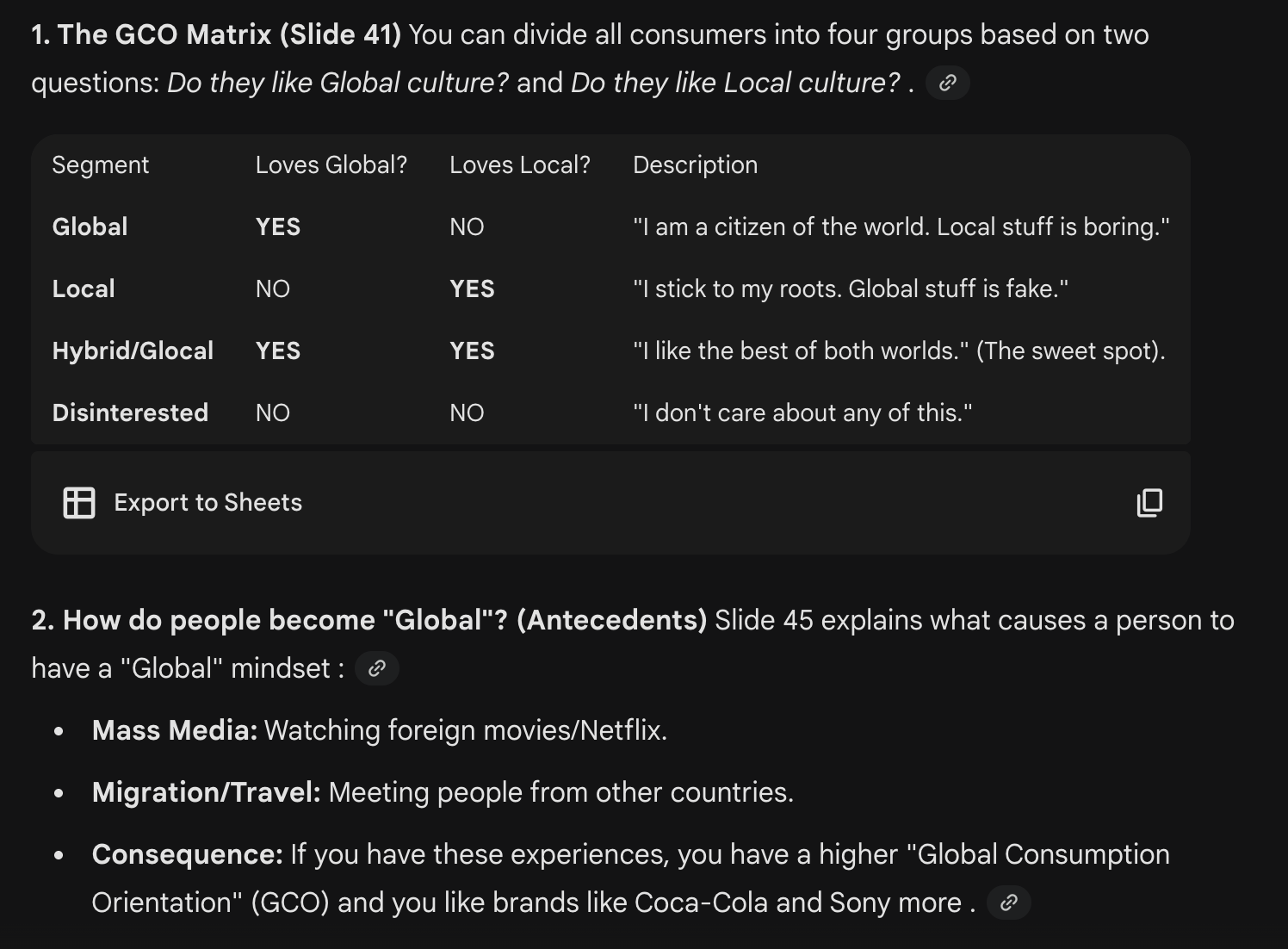
Consumers are divided into four segments based on their desire to adopt global culture vs. maintain local culture :
Global: High desire for global, low desire for local.
Local: High desire for local, low desire for global.
Hybrid/Glocal: High desire for both global and local cultures.
Disinterested: Low desire for both.
8. Interpreting the Model (Steenkamp, Batra, Alden, 2003)
The Model's Goal: To explain how "Perceived Brand Globalness" (PBG) leads to people wanting to buy a brand.
Mediators (The "Why"): PBG increases purchase likelihood because it increases Perceived Brand Quality and Brand Prestige. Consumers assume global brands are better quality and more prestigious
Moderator (The "It Depends"): Consumer Ethnocentrism (CET).
Plain Language
Explanation: Generally, people prefer global brands because they assume that if a brand is everywhere, it must be high quality and prestigious. However, this effect disappears for highly patriotic (ethnocentric) consumers. If a consumer feels strongly about protecting their home economy, the fact that a brand is "global" does not make them want to buy it, regardless of quality.
 Note
Note  Flashcards (53)