Lecture 8: Week 6: Sociological Theories of Juvenile Offending

0.0(0)
Studied by 0 people
call kaiCall Kai
learnLearn
examPractice Test
spaced repetitionSpaced Repetition
heart puzzleMatch
flashcardsFlashcards
GameKnowt Play
Card Sorting

1/36

encourage image

There's no tags or description

Looks like no tags are added yet.

Last updated 11:48 PM on 3/16/26
Name
Mastery
Learn
Test
Matching
Spaced
Call with Kai

No analytics yet

Send a link to your students to track their progress

37 Terms

1
New cards

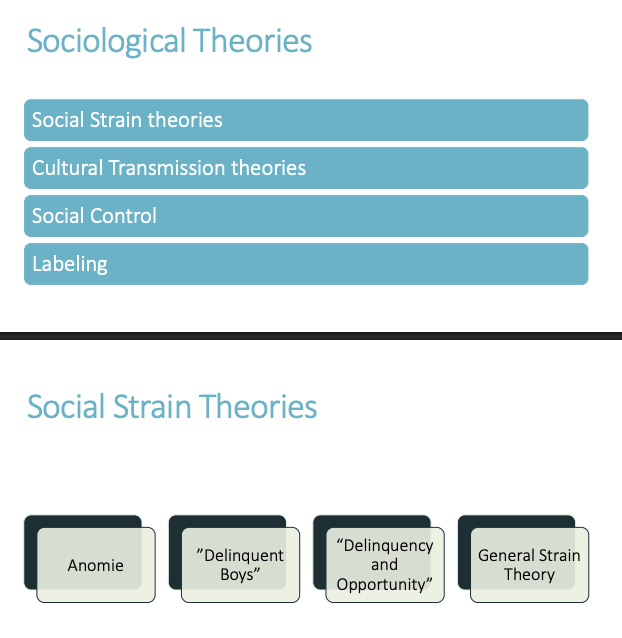
What are sociological theories of juvenile offending?

Theories that explain juvenile offending by focusing on society, groups, culture, and social structures (not just individual psychology/biology).

  • These theories explore how factors such as peer influence, family dynamics, socioeconomic status, and community environments contribute to juvenile delinquency.
<p>Theories that explain juvenile offending by focusing on <strong>society, groups, culture, and social structures</strong> (not just individual psychology/biology).</p><ul><li><p>These theories explore how factors such as peer influence, family dynamics, socioeconomic status, and community environments contribute to juvenile delinquency. </p></li></ul><p></p>
2
New cards

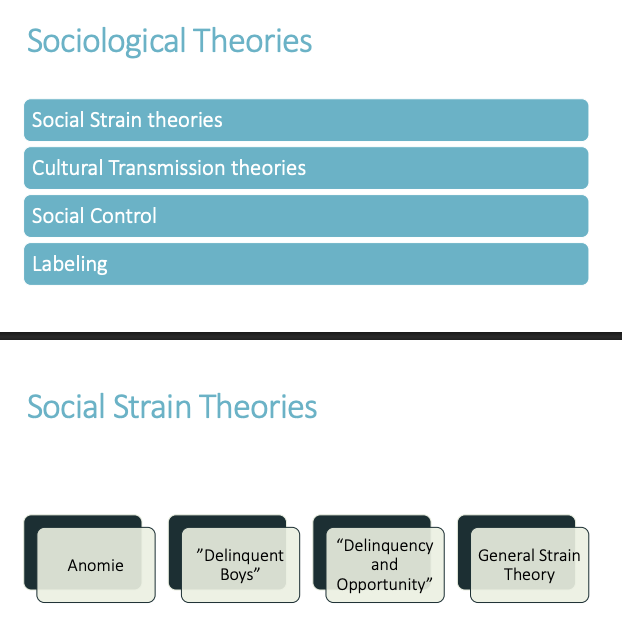
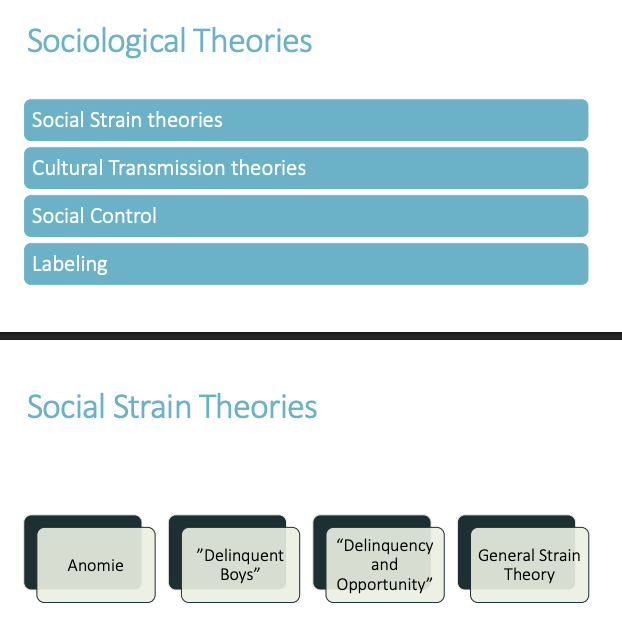
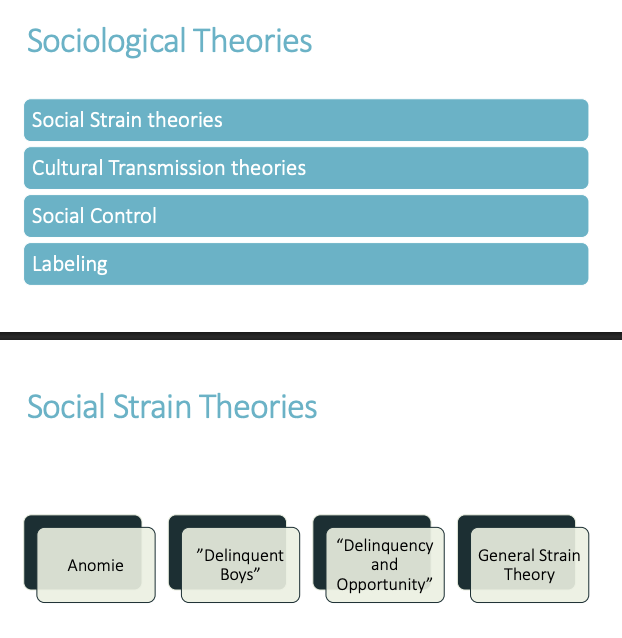
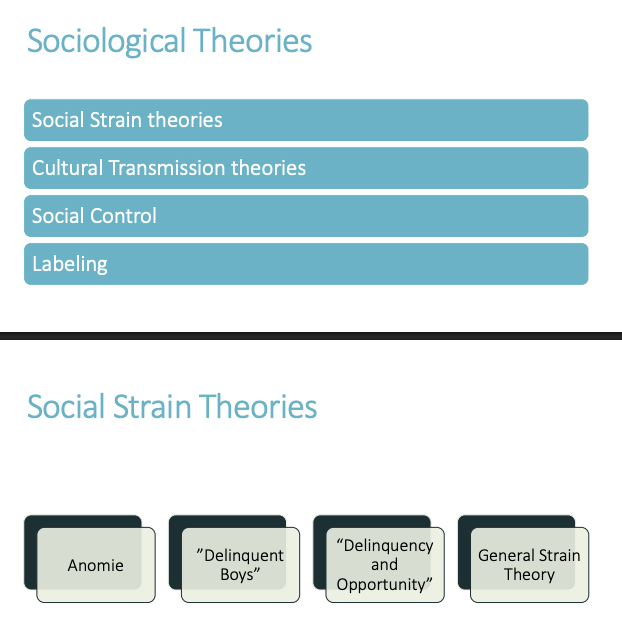
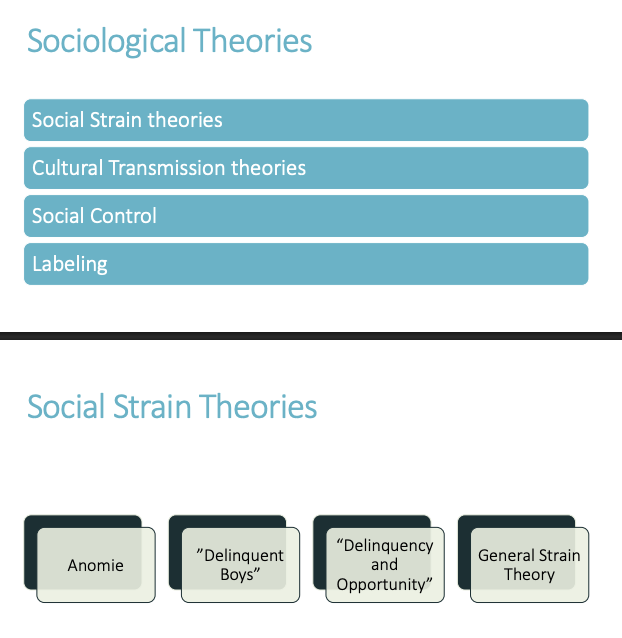
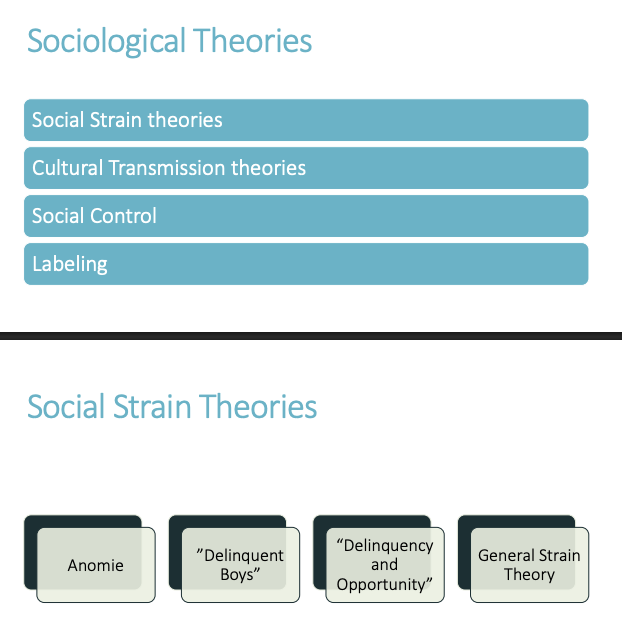
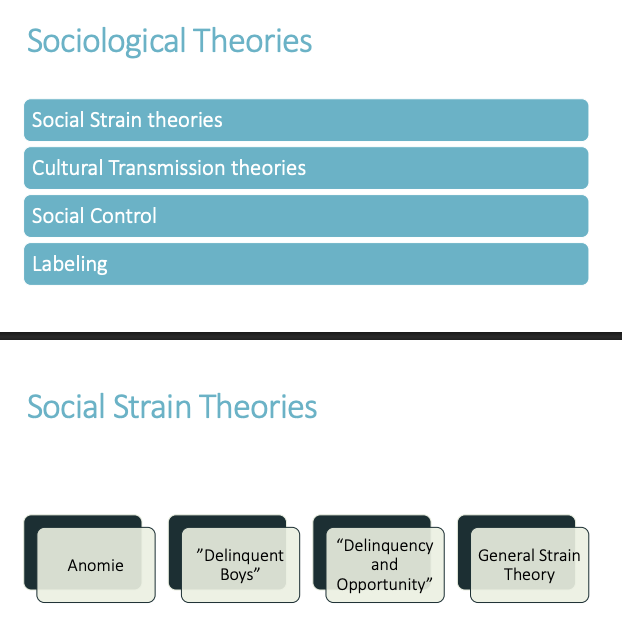
What are the four sociological theory types listed?

Social Strain theories, Cultural Transmission theories, Social Control, Labeling.
<p>Social Strain theories, Cultural Transmission theories, Social Control, Labeling.</p>
3
New cards

What are Social Strain theories (as a sociological theory type)?

Theories saying delinquency results when youth experience strain/frustration from blocked goals, unequal opportunities, or stressful conditions—delinquency becomes a response/adaptation.

  • They focus on how societal pressures can lead to deviant behavior among youth.
<p>Theories saying delinquency results when youth experience <strong>strain/frustration</strong> from blocked goals, unequal opportunities, or stressful conditions—delinquency becomes a response/adaptation.</p><ul><li><p>They focus on how societal pressures can lead to deviant behavior among youth. </p></li></ul><p></p>
4
New cards

What are Cultural Transmission theories?

Theories that explain delinquency as learned through culture/subculture and social environments—norms and behaviors get transmitted within groups/communities.

  • Cultural Transmission theories suggest that delinquency occurs when individuals internalize the values and norms of a subculture that supports criminal behavior, leading to the perpetuation of those behaviors across generations.
<p>Theories that explain delinquency as learned through <strong>culture/subculture</strong> and social environments—norms and behaviors get transmitted within groups/communities. </p><ul><li><p>Cultural Transmission theories suggest that delinquency occurs when individuals internalize the values and norms of a subculture that supports criminal behavior, leading to the perpetuation of those behaviors across generations. </p></li></ul><p></p>
5
New cards

What is Social Control theory (as a type)?

Theories focused on why most people don’t offend—delinquency happens when a youth’s bonds to society (family, school, rules) are weak.

  • It posits that strong social ties and community connections help to prevent delinquent behavior, while weak or broken bonds can lead to increased delinquency.
<p>Theories focused on why most people <em>don’t</em> offend—delinquency happens when a youth’s <strong>bonds to society</strong> (family, school, rules) are weak. </p><ul><li><p>It posits that strong social ties and community connections help to prevent delinquent behavior, while weak or broken bonds can lead to increased delinquency. </p></li></ul><p></p>
6
New cards

What is Labeling theory (as a type)?

Theories suggesting delinquency can be shaped by being labeled “delinquent/criminal,” which can change identity and opportunities and increase future offending.

  • Labeling theory posits that once an individual is labeled as a delinquent, they may internalize this identity, leading to further criminal behavior as a means of conforming to the expectations associated with that label.
<p>Theories suggesting delinquency can be shaped by being <strong>labeled</strong> “delinquent/criminal,” which can change identity and opportunities and increase future offending.</p><ul><li><p>Labeling theory posits that once an individual is labeled as a delinquent, they may internalize this identity, leading to further criminal behavior as a means of conforming to the expectations associated with that label. </p></li></ul><p></p>
7
New cards

Compare the four sociological theory types in one card.

  • Strain: offending = response to blocked goals/stress

  • Cultural transmission: offending = learned norms in groups/subcultures

  • Social control: offending = weak bonds/low constraint

  • Labeling: offending = effects of being tagged as “delinquent”

These theories provide different perspectives on juvenile offending, linking it to societal factors rather than individual pathology. Strain theory emphasizes the role of societal pressures, cultural transmission focuses on learned behaviors, social control highlights the importance of community ties, and labeling theory examines the impact of societal labels on identity and behavior.
<ul><li><p><strong>Strain:</strong> offending = response to blocked goals/stress</p></li><li><p><strong>Cultural transmission:</strong> offending = learned norms in groups/subcultures</p></li><li><p><strong>Social control:</strong> offending = weak bonds/low constraint</p></li><li><p><strong>Labeling:</strong> offending = effects of being tagged as “delinquent”</p></li></ul><p>These theories provide different perspectives on juvenile offending, linking it to societal factors rather than individual pathology. Strain theory emphasizes the role of societal pressures, cultural transmission focuses on learned behaviors, social control highlights the importance of community ties, and labeling theory examines the impact of societal labels on identity and behavior. </p><p></p>
8
New cards

What are social strain theories (definition)?

Theories that explain delinquency as the result of strain—when youth can’t reach socially approved goals through acceptable means, or experience stressful situations, they may turn to delinquency.

  • They highlight how societal expectations and pressures can create frustration, leading to criminal behavior as an alternative means to achieve success.
<p>Theories that explain delinquency as the result of <strong>strain</strong>—when youth can’t reach socially approved goals through acceptable means, or experience stressful situations, they may turn to delinquency.</p><ul><li><p>They highlight how societal expectations and pressures can create frustration, leading to criminal behavior as an alternative means to achieve success. </p></li></ul><p></p>
9
New cards

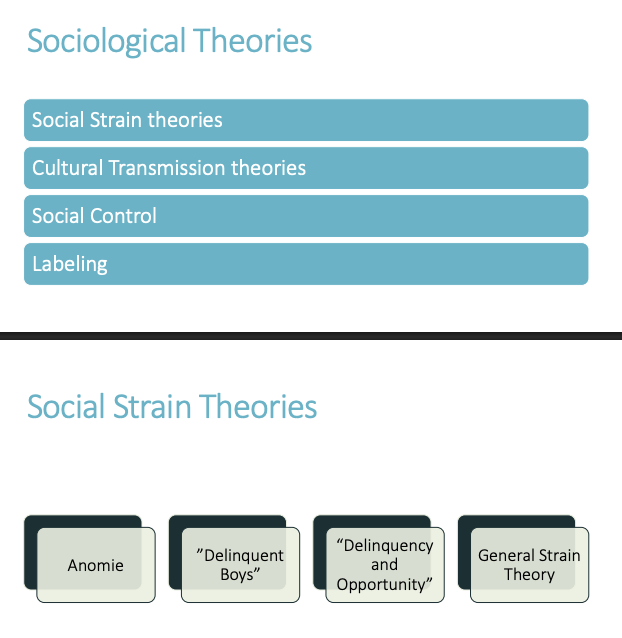
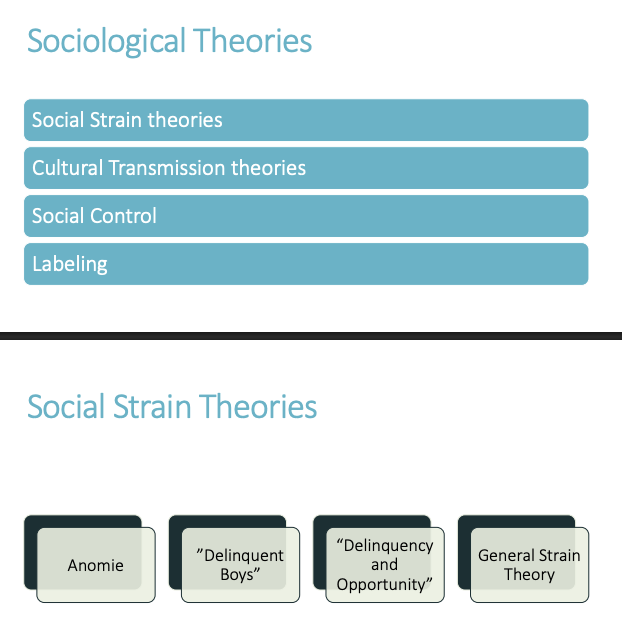
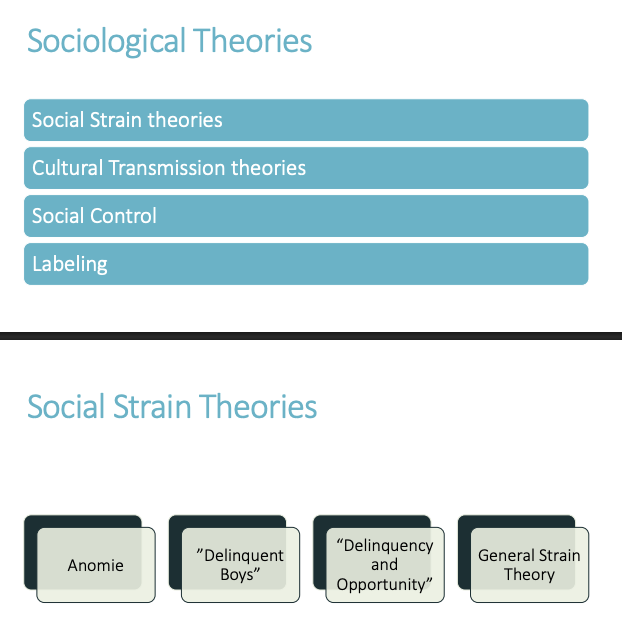
What are the four types of social strain theories listed?

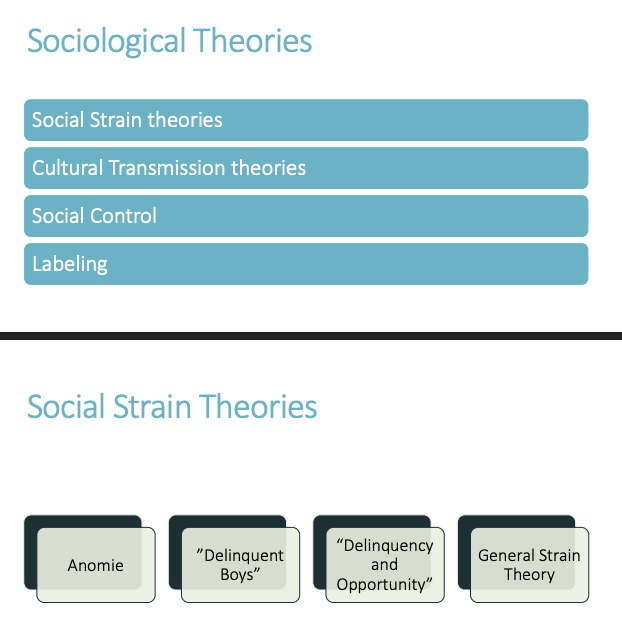
Anomie, “Delinquent Boys”, “Delinquency and Opportunity”, General Strain Theory.
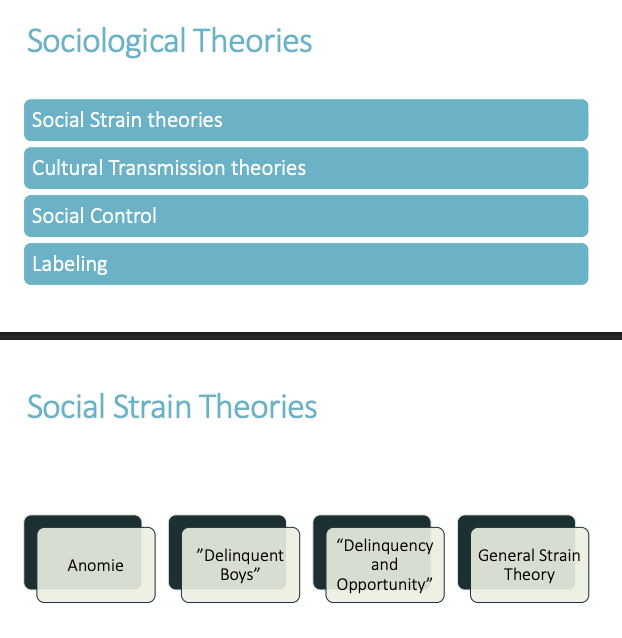
<p><strong>Anomie</strong>, <strong>“Delinquent Boys”</strong>, <strong>“Delinquency and Opportunity”</strong>, <strong>General Strain Theory</strong>.</p>
10
New cards

What is Anomie theory (as a social strain theory)?

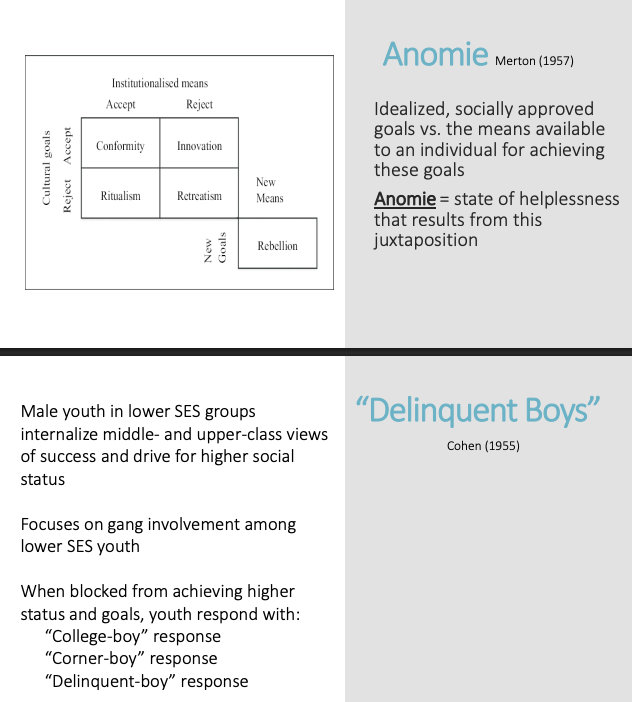
It focuses on the mismatch between idealized social goals and the means available to achieve them, creating strain that can lead to delinquency.

  • The theory suggests that when individuals are unable to achieve culturally approved goals due to structural barriers, it results in a sense of normlessness or anomie, which can prompt them to engage in delinquent behavior as an alternative.
<p>It focuses on the mismatch between <strong>idealized social goals</strong> and the <strong>means available</strong> to achieve them, creating strain that can lead to delinquency.</p><ul><li><p>The theory suggests that when individuals are unable to achieve culturally approved goals due to structural barriers, it results in a sense of normlessness or anomie, which can prompt them to engage in delinquent behavior as an alternative. </p></li></ul><p></p>
11
New cards

What is Cohen’s “Delinquent Boys” theory?

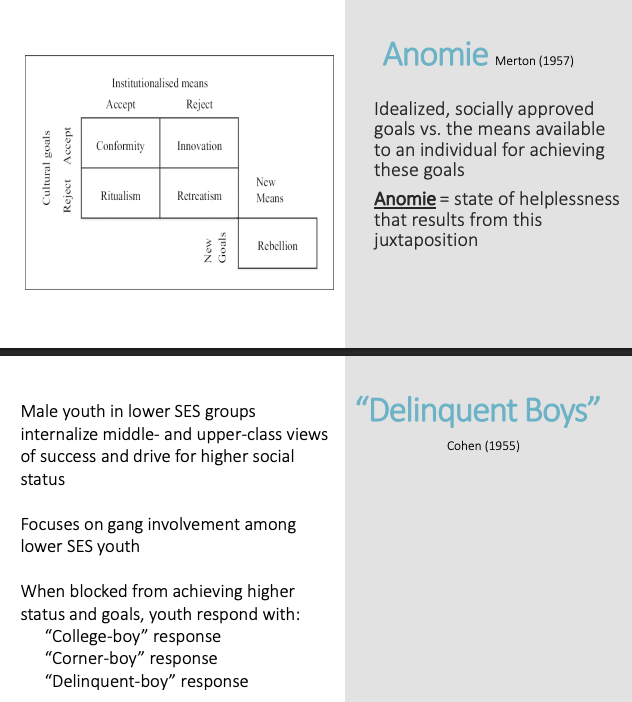
It says lower-SES male youth internalize middle/upper-class success standards and seek status. When blocked, they may join gangs and respond in different ways (college-boy, corner-boy, delinquent-boy).

  • This theory posits that lower-income boys experience status frustration when they cannot meet the expectations of middle-class society. In response, they may reject conventional values and form subcultures that create alternative forms of status and recognition.
<p>It says lower-SES male youth internalize middle/upper-class success standards and seek status. When blocked, they may join gangs and respond in different ways (college-boy, corner-boy, delinquent-boy).</p><ul><li><p>This theory posits that lower-income boys experience status frustration when they cannot meet the expectations of middle-class society. In response, they may reject conventional values and form subcultures that create alternative forms of status and recognition. </p></li></ul><p></p>
12
New cards

What is Cloward & Ohlin’s “Delinquency and Opportunity” theory?

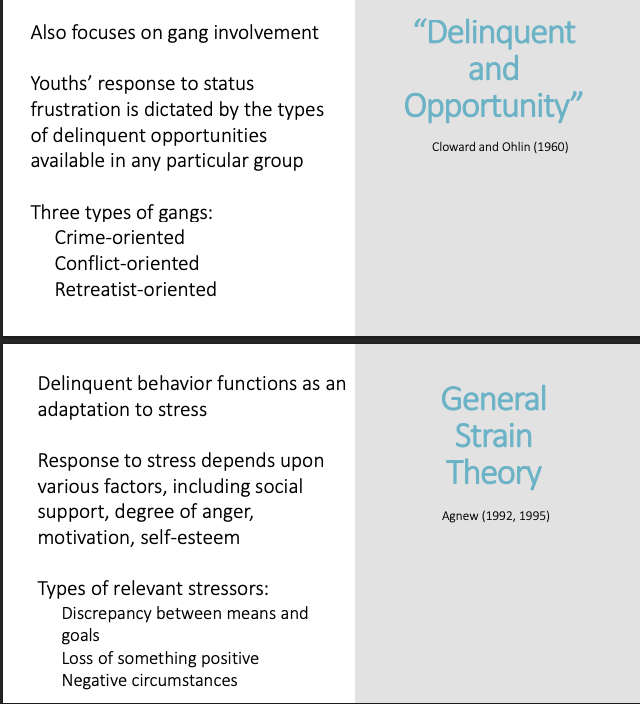
It says youth responses to status frustration depend on the types of delinquent opportunities available in their environment, leading to different gang types.

  • This theory asserts that not all youth can access the same avenues for achieving success; thus, they adapt based on the availability of opportunity structures, leading to the formation of different gangs such as conflict, retreatist, and criminal gangs.
<p>It says youth responses to status frustration depend on the <strong>types of delinquent opportunities</strong> available in their environment, leading to different gang types.</p><ul><li><p>This theory asserts that not all youth can access the same avenues for achieving success; thus, they adapt based on the availability of opportunity structures, leading to the formation of different gangs such as conflict, retreatist, and criminal gangs. </p></li></ul><p></p>
13
New cards

What is Agnew’s General Strain Theory?

It argues delinquent behavior functions as an adaptation to stress, and how youth respond depends on personal and social factors plus the types of stressors they face.

  • This theory expands on traditional strain theory by identifying multiple sources of strain, such as the loss of positive influences, the presentation of negative stimuli, and the failure to achieve valued goals, which collectively influence the likelihood of engaging in delinquent acts.
<p>It argues delinquent behavior functions as an <strong>adaptation to stress</strong>, and how youth respond depends on personal and social factors plus the types of stressors they face.</p><ul><li><p>This theory expands on traditional strain theory by identifying multiple sources of strain, such as the loss of positive influences, the presentation of negative stimuli, and the failure to achieve valued goals, which collectively influence the likelihood of engaging in delinquent acts. </p></li></ul><p></p>
14
New cards

What is anomie (explain it)?

Anomie is a state of helplessness that results when society promotes certain goals (like success) but an individual lacks realistic means to achieve them.

  • It reflects a breakdown of social norms and values, leading to feelings of disconnection and confusion within individuals. This can result in behaviors such as crime and deviance as people struggle to cope with the dissonance between societal expectations and their capabilities.
<p>Anomie is a <strong>state of helplessness</strong> that results when society promotes certain goals (like success) but an individual lacks realistic means to achieve them.</p><ul><li><p>It reflects a breakdown of social norms and values, leading to feelings of disconnection and confusion within individuals. This can result in behaviors such as crime and deviance as people struggle to cope with the dissonance between societal expectations and their capabilities. </p></li></ul><p></p>
15
New cards

What is Cohen’s “Delinquent Boys” theory (explain it)?

Lower-SES male youth internalize mainstream success/status values. When they can’t achieve that status through approved ways, they experience frustration and often turn to gang involvement and alternative status routes.

  • This theory posits that these youth create their own subculture—characterized by values that oppose mainstream society—where they seek respect and acceptance, ultimately leading to delinquent behavior as a form of rebellion against societal norms.
<p>Lower-SES male youth internalize mainstream success/status values. When they can’t achieve that status through approved ways, they experience frustration and often turn to <strong>gang involvement</strong> and alternative status routes.</p><ul><li><p>This theory posits that these youth create their own subculture—characterized by values that oppose mainstream society—where they seek respect and acceptance, ultimately leading to delinquent behavior as a form of rebellion against societal norms. </p></li></ul><p></p>
16
New cards

When blocked from achieving higher status/goals, what three responses do youth show in “Delinquent Boys,” and what do they mean?

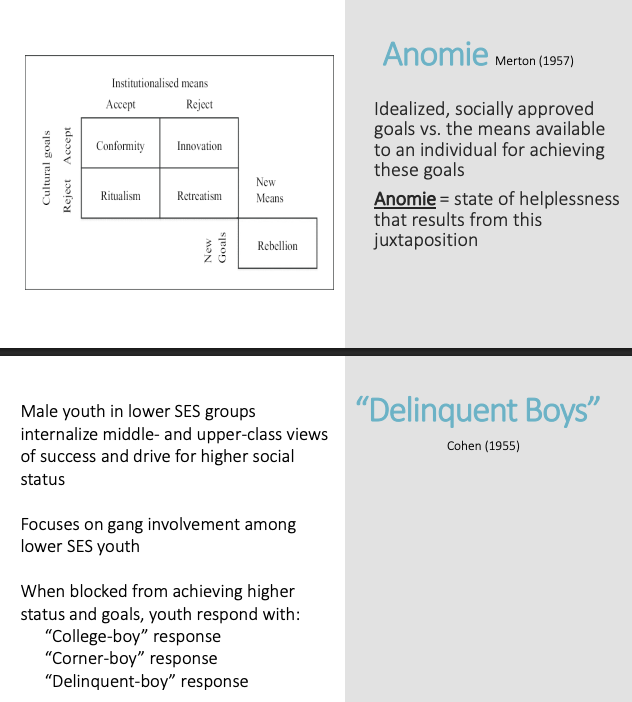
  • “College-boy” response: keep pursuing mainstream success routes (school/status the “approved” way).

  • “Corner-boy” response: accept local/lower-status roles and adapt without strong delinquent rebellion.

  • “Delinquent-boy” response: reject mainstream standards and seek status through delinquent/gang behavior.

These responses illustrate different adaptations to status frustration faced by lower-SES youth, highlighting how they navigate societal expectations when traditional paths to success are blocked.
<ul><li><p><strong>“College-boy” response:</strong> keep pursuing mainstream success routes (school/status the “approved” way).</p></li><li><p><strong>“Corner-boy” response:</strong> accept local/lower-status roles and adapt without strong delinquent rebellion.</p></li><li><p><strong>“Delinquent-boy” response:</strong> reject mainstream standards and seek status through delinquent/gang behavior.</p></li></ul><p>These responses illustrate different adaptations to status frustration faced by lower-SES youth, highlighting how they navigate societal expectations when traditional paths to success are blocked. </p><p></p>
17
New cards

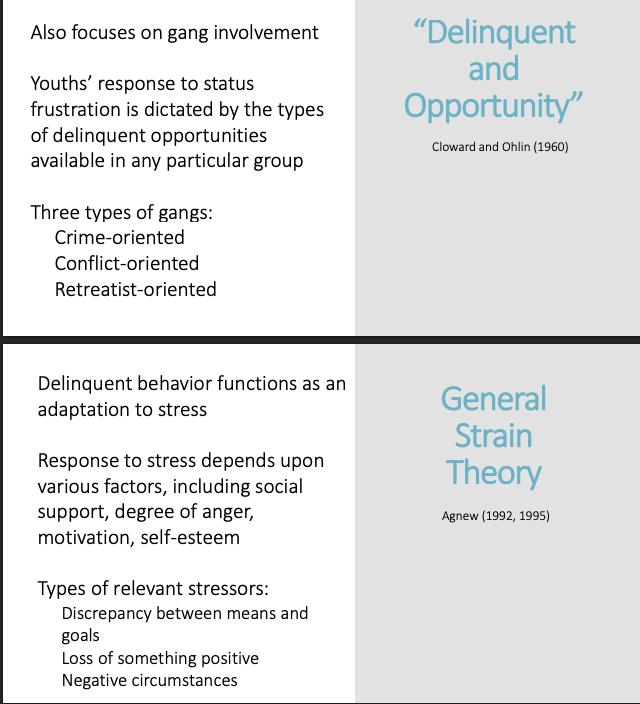
Explain “Delinquency and Opportunity” theory (types of opportunities, gangs, etc.).

Youth status frustration is shaped by what delinquent opportunities exist around them. Different environments offer different routes (crime, conflict, retreat), which results in distinct gang types.

  • This theory suggests that access to various forms of delinquent opportunities influences youth behavior and gang involvement. It categorizes gangs based on the types of opportunities available, such as criminal ventures, conflicts with rival groups, or withdrawal from mainstream society.
<p>Youth status frustration is shaped by what delinquent opportunities exist around them. Different environments offer different routes (crime, conflict, retreat), which results in distinct gang types.</p><ul><li><p>This theory suggests that access to various forms of delinquent opportunities influences youth behavior and gang involvement. It categorizes gangs based on the types of opportunities available, such as criminal ventures, conflicts with rival groups, or withdrawal from mainstream society. </p></li></ul><p></p>
18
New cards

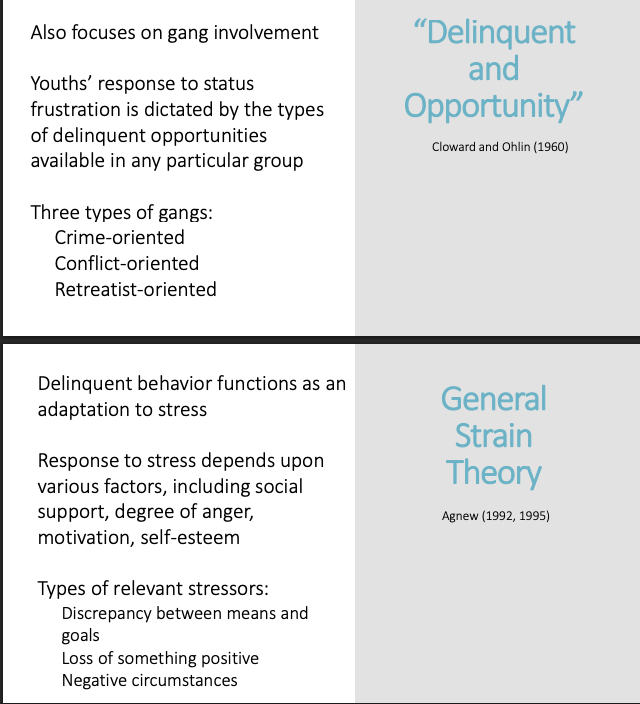
What are the three gang types in Cloward & Ohlin’s theory, and what does each mean?

  • Crime-oriented: delinquency organized around crime/illegal “business” opportunities.

  • Conflict-oriented: delinquency centered on violence/conflict when stable criminal opportunities aren’t available.

  • Retreatist-oriented: “retreat” into behaviors like substance use when other avenues fail (often seen as “double failures”).

In Cloward & Ohlin's theory, the three gang types are: 1) Crime-oriented: gangs that engage in organized crime or illegal business opportunities; 2) Conflict-oriented: gangs focused on violence and conflict when stable criminal opportunities are lacking; 3) Retreatist-oriented: gangs formed by individuals who retreat into substance use and other behaviors when they fail in both conventional and criminal pursuits.
<ul><li><p><strong>Crime-oriented:</strong> delinquency organized around crime/illegal “business” opportunities.</p></li><li><p><strong>Conflict-oriented:</strong> delinquency centered on violence/conflict when stable criminal opportunities aren’t available.</p></li><li><p><strong>Retreatist-oriented:</strong> “retreat” into behaviors like substance use when other avenues fail (often seen as “double failures”).</p></li></ul><p>In Cloward &amp; Ohlin's theory, the three gang types are: 1) <strong>Crime-oriented</strong>: gangs that engage in organized crime or illegal business opportunities; 2) <strong>Conflict-oriented</strong>: gangs focused on violence and conflict when stable criminal opportunities are lacking; 3) <strong>Retreatist-oriented</strong>: gangs formed by individuals who retreat into substance use and other behaviors when they fail in both conventional and criminal pursuits. </p><p></p>
19
New cards

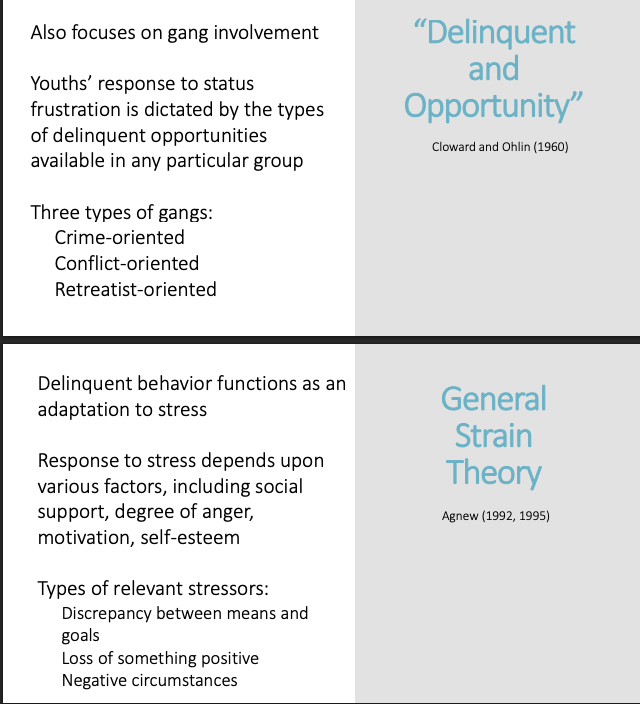
Explain Agnew’s General Strain Theory (delinquent behavior functions, stress response, stressors).

Delinquency is an adaptation to stress. Youth experience strains (goal blockage, losses, negative conditions) and may use delinquency as coping. Response depends on factors like supports and emotional/psychological resources.

  • Agnew's General Strain Theory posits that youth engage in delinquency as a means to cope with various stressors, including the blockage of goals, personal losses, and negative social conditions. The likelihood of delinquent behavior depends on individual factors such as available social support and emotional resilience.
<p>Delinquency is an <strong>adaptation to stress</strong>. Youth experience strains (goal blockage, losses, negative conditions) and may use delinquency as coping. Response depends on factors like supports and emotional/psychological resources.</p><ul><li><p>Agnew's General Strain Theory posits that youth engage in delinquency as a means to cope with various stressors, including the blockage of goals, personal losses, and negative social conditions. The likelihood of delinquent behavior depends on individual factors such as available social support and emotional resilience. </p></li></ul><p></p>
20
New cards

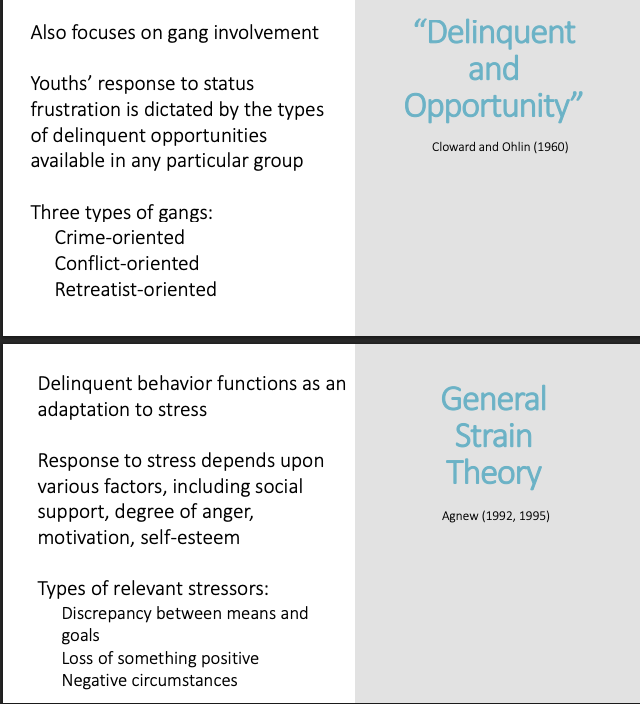
In General Strain Theory, delinquent behavior functions as what?

An adaptation to stress—a way to cope with, escape, reduce, or respond to strain.

  • An adaptation to stress, enabling individuals to cope with or respond to various strains in their lives.
<p>An <strong>adaptation to stress</strong>—a way to cope with, escape, reduce, or respond to strain.</p><ul><li><p>An adaptation to stress, enabling individuals to cope with or respond to various strains in their lives. </p></li></ul><p></p>
21
New cards

In General Strain Theory, what does a youth’s response to stress depend on?

Factors like social support, degree of anger, motivation, and self-esteem (these shape whether strain becomes delinquency).

  • These factors influence how youth cope with strains and whether they turn to delinquent behaviors.
<p>Factors like <strong>social support</strong>, <strong>degree of anger</strong>, <strong>motivation</strong>, and <strong>self-esteem</strong> (these shape whether strain becomes delinquency).</p><ul><li><p>These factors influence how youth cope with strains and whether they turn to delinquent behaviors. </p></li></ul><p></p>
22
New cards

What are the types of stressors in General Strain Theory?

  • Discrepancy between means and goals

  • Loss of something positive

  • Negative circumstances

These stressors can lead to feelings of frustration and anger, which may result in delinquent behavior as a coping mechanism.
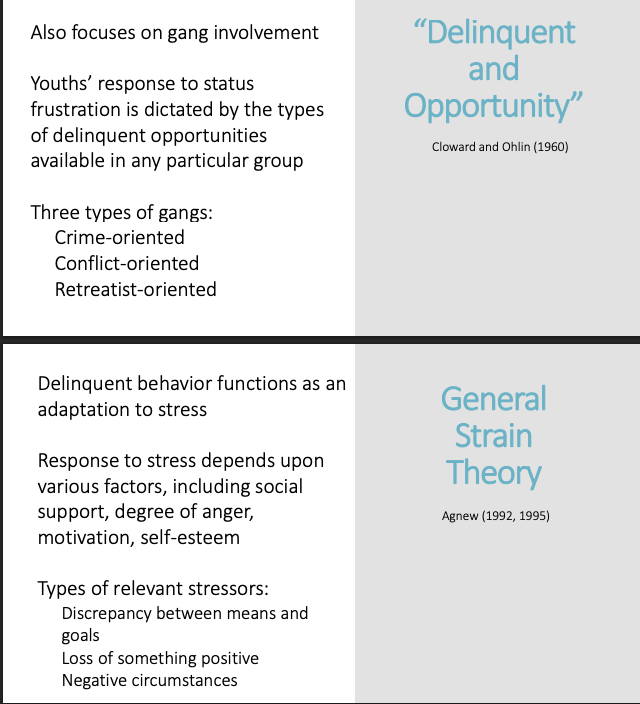
<ul><li><p><strong>Discrepancy between means and goals</strong></p></li><li><p><strong>Loss of something positive</strong></p></li><li><p><strong>Negative circumstances</strong></p></li></ul><p>These stressors can lead to feelings of frustration and anger, which may result in delinquent behavior as a coping mechanism. </p><p></p>
23
New cards

What are the limitations of strain theories (fully explain)?

  • Females excluded from most theories

  • Doesn’t explain middle/upper-class delinquency well

  • Bias/stereotypes: treats lower-class youth as all the same, ignoring community/cultural/individual differences

  • Doesn’t explain why only a small number of youth in lower-SES areas offend

  • Except for Agnew, many theories ignore background/family/circumstances

  • Doesn’t fully address normative adolescent development (normal risk-taking, development changes)

These limitations highlight the lack of comprehensive understanding of delinquency across gender, socioeconomic status, and diverse backgrounds, as well as the failure to consider normative developmental behavior in adolescents.
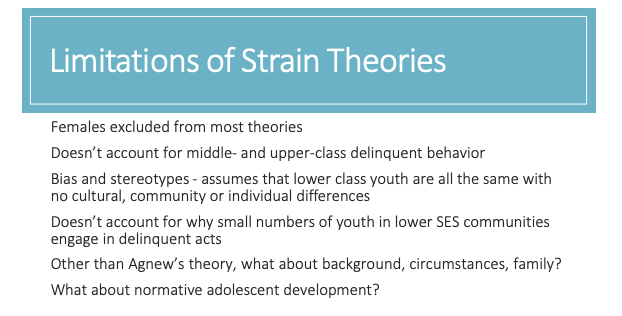
<ul><li><p><strong>Females excluded</strong> from most theories</p></li><li><p>Doesn’t explain <strong>middle/upper-class delinquency</strong> well</p></li><li><p><strong>Bias/stereotypes:</strong> treats lower-class youth as all the same, ignoring community/cultural/individual differences</p></li><li><p>Doesn’t explain why only a <strong>small number</strong> of youth in lower-SES areas offend</p></li><li><p>Except for Agnew, many theories ignore <strong>background/family/circumstances</strong></p></li><li><p>Doesn’t fully address <strong>normative adolescent development</strong> (normal risk-taking, development changes)</p></li></ul><p>These limitations highlight the lack of comprehensive understanding of delinquency across gender, socioeconomic status, and diverse backgrounds, as well as the failure to consider normative developmental behavior in adolescents. </p><p></p>
24
New cards

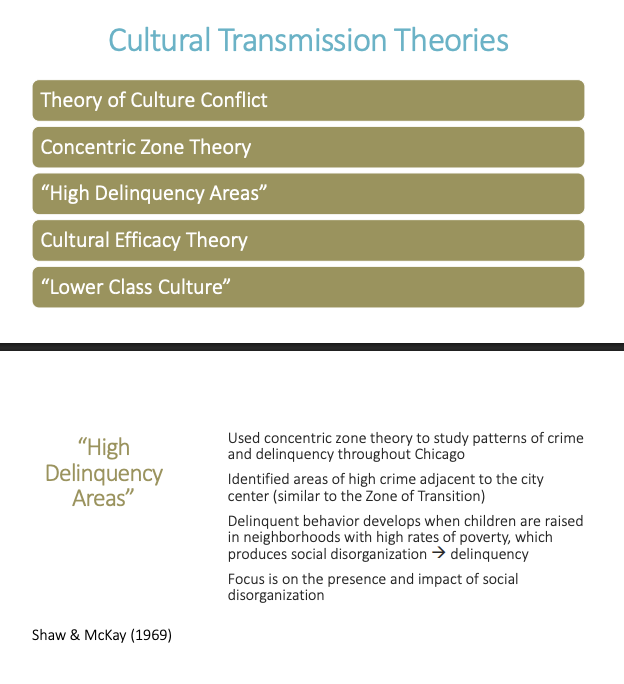
What are Cultural Transmission Theories (in juvenile offending)?

Theories that explain delinquency as shaped by community/neighborhood culture and social organization—youth learn norms and behaviors through their local environment, including disorganization, conflict, or community values.

  • These theories suggest that youth adopt the values and behaviors prevalent in their communities, influencing their likelihood of engaging in delinquent acts.
<p>Theories that explain delinquency as shaped by <strong>community/neighborhood culture and social organization</strong>—youth learn norms and behaviors through their local environment, including disorganization, conflict, or community values.</p><ul><li><p>These theories suggest that youth adopt the values and behaviors prevalent in their communities, influencing their likelihood of engaging in delinquent acts. </p></li></ul><p></p>
25
New cards

What are the five Cultural Transmission Theories listed?

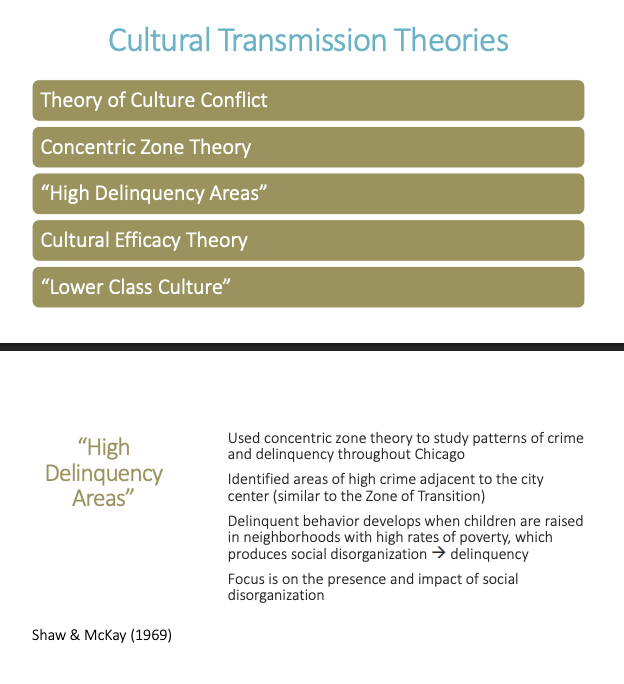
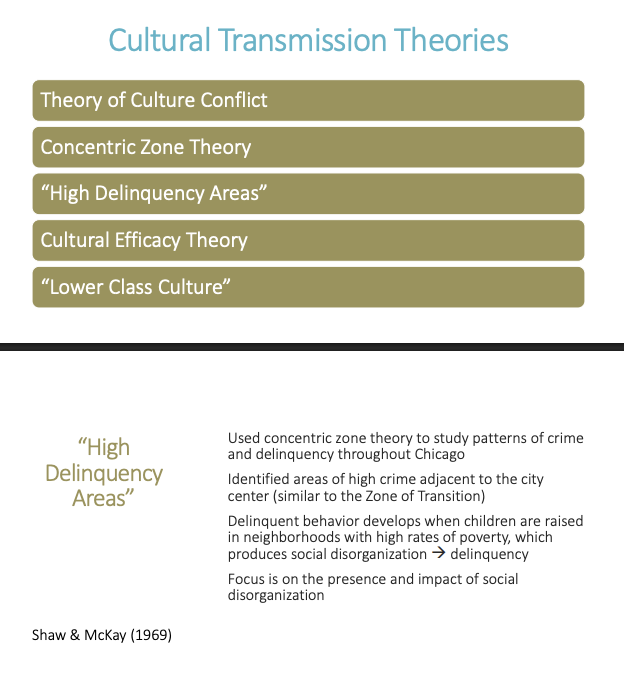
1) Theory of Culture Conflict
2) Concentric Zone Theory
3) “High Delinquency Areas”
4) Cultural (Collective) Efficacy Theory
5) “Lower Class Culture” (Miller)

These theories outline how cultural and social dynamics within neighborhoods lead to the development of delinquent behaviors among youth. They emphasize the role of community values and social organization in shaping individual norms.
<p>1) <strong>Theory of Culture Conflict</strong><br>2) <strong>Concentric Zone Theory</strong><br>3) <strong>“High Delinquency Areas”</strong><br>4) <strong>Cultural (Collective) Efficacy Theory</strong><br>5) <strong>“Lower Class Culture”</strong> (Miller)</p><p>These theories outline how cultural and social dynamics within neighborhoods lead to the development of delinquent behaviors among youth. They emphasize the role of community values and social organization in shaping individual norms. </p>
26
New cards

What is the Theory of Culture Conflict (cultural transmission)?

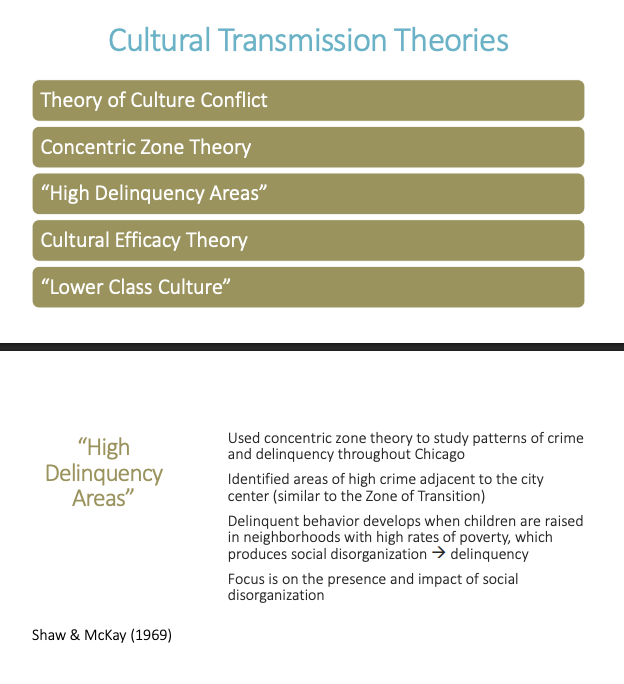
Delinquency can occur when youth experience conflicting cultural rules/norms—what’s acceptable in one group may be punished by another (especially mainstream/legal norms), creating conflict that can lead to delinquent behavior.

  • This theory suggests that youth may find themselves caught between competing cultural values, where adherence to one group's norms could result in punishment from another, ultimately increasing the likelihood of delinquent actions.
<p>Delinquency can occur when youth experience <strong>conflicting cultural rules/norms</strong>—what’s acceptable in one group may be punished by another (especially mainstream/legal norms), creating conflict that can lead to delinquent behavior.</p><ul><li><p>This theory suggests that youth may find themselves caught between competing cultural values, where adherence to one group's norms could result in punishment from another, ultimately increasing the likelihood of delinquent actions. </p></li></ul><p></p>
27
New cards

What is Concentric Zone Theory (cultural transmission)?

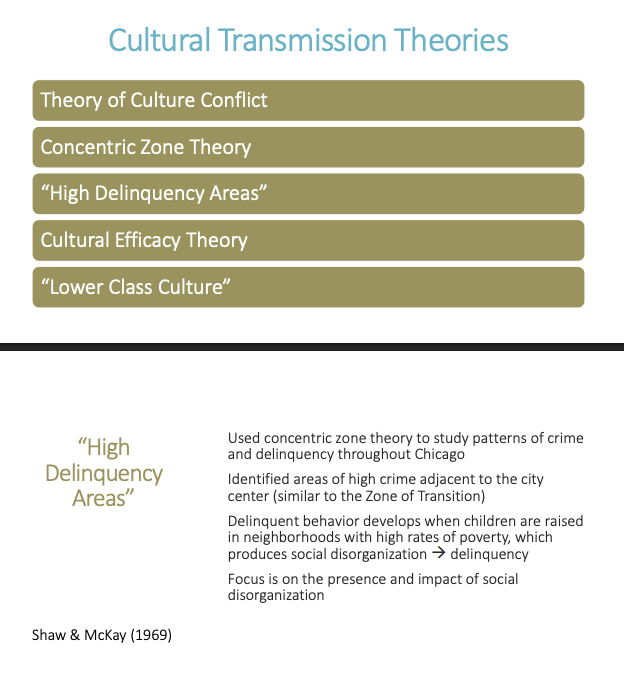
A theory about how cities are organized into zones and how crime/delinquency patterns vary by zone—often used to understand why areas near the city center may show higher disorganization and delinquency.

  • The Concentric Zone Theory posits that urban areas are structured in concentric rings, with each zone having distinct social characteristics that influence crime rates. It suggests that inner city zones often experience higher levels of social disorganization, which correlates with increased rates of delinquency.
<p>A theory about how cities are organized into zones and how crime/delinquency patterns vary by zone—often used to understand why areas near the city center may show higher disorganization and delinquency.</p><ul><li><p>The Concentric Zone Theory posits that urban areas are structured in concentric rings, with each zone having distinct social characteristics that influence crime rates. It suggests that inner city zones often experience higher levels of social disorganization, which correlates with increased rates of delinquency. </p></li></ul><p></p>
28
New cards

What is the “High Delinquency Areas” theory?

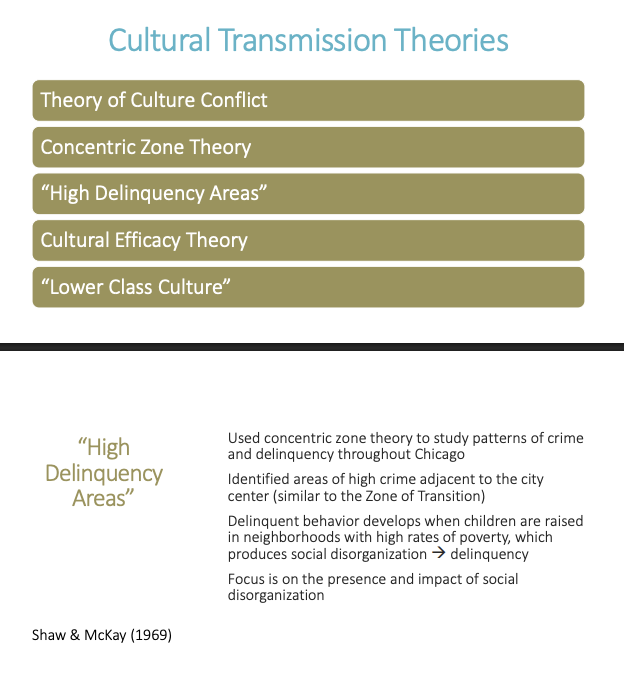
Shaw & McKay used concentric zone theory to study Chicago and found that delinquency clusters in high-poverty areas near the city center. These areas produce social disorganization, which increases delinquency.

  • This theory posits that neighborhoods characterized by high levels of poverty, residential instability, and ethnic diversity lead to social disorganization, creating an environment conducive to delinquent behaviors among youth. Shaw and McKay’s research highlighted how these high delinquency areas result from weakened community ties and diminished social control.
<p>Shaw &amp; McKay used concentric zone theory to study Chicago and found that delinquency clusters in <strong>high-poverty areas near the city center</strong>. These areas produce <strong>social disorganization</strong>, which increases delinquency.</p><ul><li><p>This theory posits that neighborhoods characterized by high levels of poverty, residential instability, and ethnic diversity lead to social disorganization, creating an environment conducive to delinquent behaviors among youth. Shaw and McKay’s research highlighted how these high delinquency areas result from weakened community ties and diminished social control. </p></li></ul><p></p>
29
New cards

What is Cultural (Collective) Efficacy Theory?

It focuses on social organization and collective efficacy in neighborhoods. Strong collective efficacy creates informal social control, cohesion, and support networks that reduce crime; disorganization/lack of efficacy increases crime.

  • This theory suggests that neighborhoods with strong social ties and shared expectations among residents can effectively control and prevent criminal behavior. When residents collaborate and support each other, they enhance community safety, thereby lowering crime rates.
<p>It focuses on <strong>social organization</strong> and <strong>collective efficacy</strong> in neighborhoods. Strong collective efficacy creates <strong>informal social control</strong>, cohesion, and support networks that reduce crime; disorganization/lack of efficacy increases crime.</p><ul><li><p>This theory suggests that neighborhoods with strong social ties and shared expectations among residents can effectively control and prevent criminal behavior. When residents collaborate and support each other, they enhance community safety, thereby lowering crime rates. </p></li></ul><p></p>
30
New cards

What is Miller’s “Lower Class Culture” theory?

It argues lower-SES communities may have distinct values/ideals/goals, and delinquency isn’t because youth fail to reach middle-class goals (not anomie frustration). Instead, delinquency reflects values specific to poorer communities, not internalized middle-class norms.

  • This theory posits that lower socioeconomic status (SES) communities have unique cultural norms that promote behaviors such as delinquency. Miller asserts that these values arise from the realities of life in lower-class neighborhoods, creating a subculture that encourages certain forms of deviance as a means of social adaptation.
<p>It argues lower-SES communities may have <strong>distinct values/ideals/goals</strong>, and delinquency isn’t because youth fail to reach middle-class goals (not anomie frustration). Instead, delinquency reflects <strong>values specific to poorer communities</strong>, not internalized middle-class norms.</p><ul><li><p>This theory posits that lower socioeconomic status (SES) communities have unique cultural norms that promote behaviors such as delinquency. Miller asserts that these values arise from the realities of life in lower-class neighborhoods, creating a subculture that encourages certain forms of deviance as a means of social adaptation. </p></li></ul><p></p>
31
New cards

Explain “High Delinquency Areas” specifically (what they found and why).

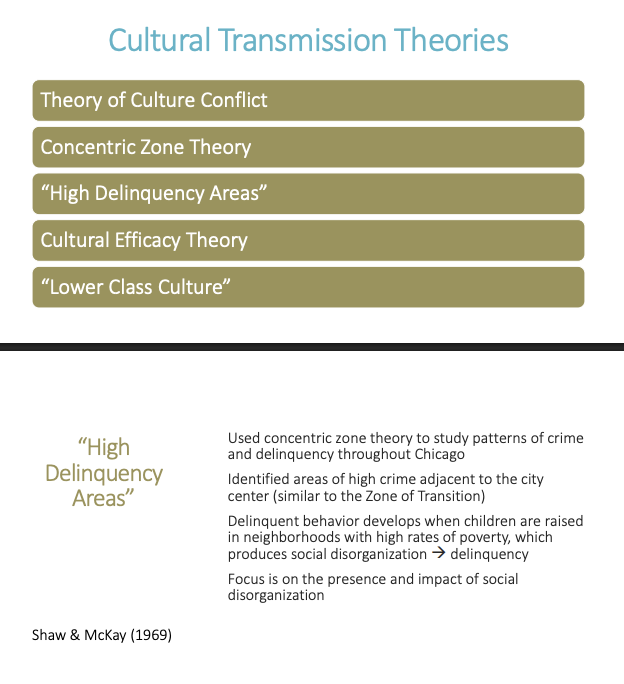
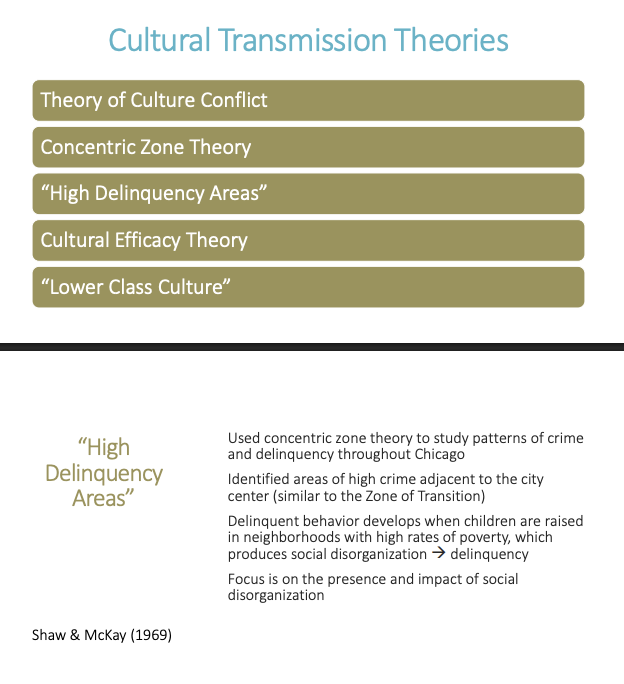
Shaw & McKay (1969) identified high-crime areas adjacent to the city center (like the “Zone of Transition”). They argued delinquency develops when children grow up in high-poverty neighborhoods, which produce social disorganization → delinquency. The focus is on how disorganization in the neighborhood drives delinquency.

  • This disorganization is attributed to factors like poverty, residential instability, and a lack of community cohesion, which hinder effective social control among residents.
<p>Shaw &amp; McKay (1969) identified high-crime areas <strong>adjacent to the city center</strong> (like the “Zone of Transition”). They argued delinquency develops when children grow up in <strong>high-poverty neighborhoods</strong>, which produce <strong>social disorganization → delinquency</strong>. The focus is on how disorganization in the neighborhood drives delinquency.</p><ul><li><p>This disorganization is attributed to factors like poverty, residential instability, and a lack of community cohesion, which hinder effective social control among residents. </p></li></ul><p></p>
32
New cards

Cultural/Collective Efficacy (Sampson): explain fully.

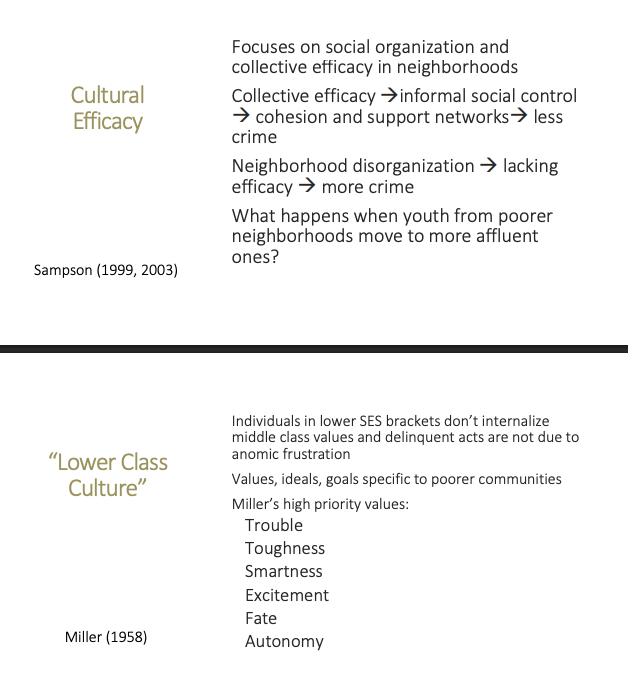
Sampson (1999, 2003) argued neighborhoods differ in collective efficacy—the ability of residents to work together, support each other, and create informal social control.

  • High collective efficacy → cohesion/support networks → less crime

  • Neighborhood disorganization → low efficacy → more crime
    It also raises questions like: what happens when youth move from poorer neighborhoods to more affluent ones?

Sampson’s Cultural (Collective) Efficacy Theory suggests that neighborhoods with strong social ties and collective efficacy help prevent crime through informal social control and community cohesion, while disorganized neighborhoods experience higher crime rates due to lack of efficacy.
<p>Sampson (1999, 2003) argued neighborhoods differ in <strong>collective efficacy</strong>—the ability of residents to work together, support each other, and create <strong>informal social control</strong>.</p><ul><li><p><strong>High collective efficacy → cohesion/support networks → less crime</strong></p></li><li><p><strong>Neighborhood disorganization → low efficacy → more crime</strong><br>It also raises questions like: what happens when youth move from poorer neighborhoods to more affluent ones?</p></li></ul><p>Sampson’s Cultural (Collective) Efficacy Theory suggests that neighborhoods with strong social ties and collective efficacy help prevent crime through informal social control and community cohesion, while disorganized neighborhoods experience higher crime rates due to lack of efficacy. </p><p></p>
33
New cards

Explain Miller’s “Lower Class Culture” theory fully.

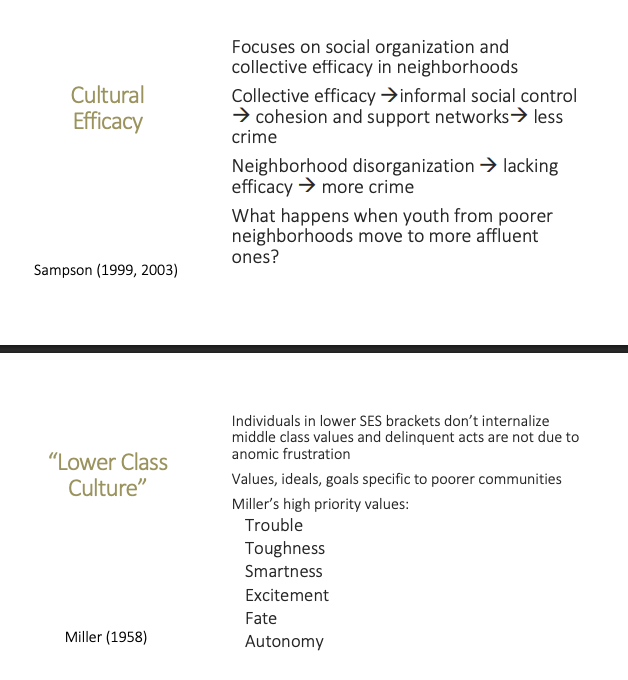
Miller (1958) argued delinquency among lower-SES youth isn’t mainly from failing to achieve middle-class goals (not anomie). Instead, lower-SES communities have their own values and priorities, and delinquency can reflect those culturally specific values.

  • This theory emphasizes that the distinct cultural norms in lower-class communities shape behaviors, leading youth to adopt delinquent actions as a response to their socio-economic realities, rather than a failure to adhere to middle-class standards.
<p>Miller (1958) argued delinquency among lower-SES youth isn’t mainly from failing to achieve middle-class goals (not anomie). Instead, lower-SES communities have their own <strong>values and priorities</strong>, and delinquency can reflect those culturally specific values.</p><ul><li><p>This theory emphasizes that the distinct cultural norms in lower-class communities shape behaviors, leading youth to adopt delinquent actions as a response to their socio-economic realities, rather than a failure to adhere to middle-class standards. </p></li></ul><p></p>
34
New cards

What are Miller’s high priority values, and what do they mean?

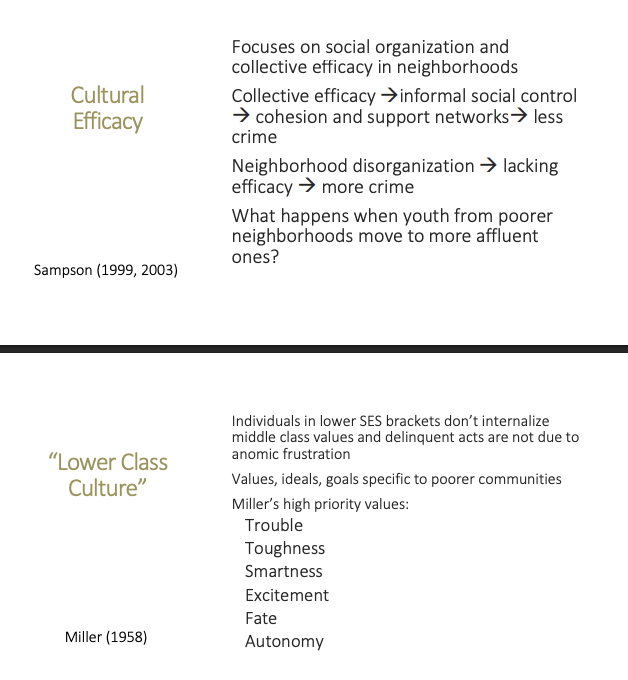
  • Trouble: gaining status by handling/causing trouble

  • Toughness: showing strength, masculinity, resilience

  • Smartness: being street-smart (outwitting others)

  • Excitement: seeking thrills and action

  • Fate: belief that life is shaped by luck/destiny more than control

  • Autonomy: resisting control; valuing independence

These values are central to the behavior and identity of lower-class youth, shaping their social interactions and norms in a way that often diverges from middle-class expectations.
<ul><li><p><strong>Trouble:</strong> gaining status by handling/causing trouble</p></li><li><p><strong>Toughness:</strong> showing strength, masculinity, resilience</p></li><li><p><strong>Smartness:</strong> being street-smart (outwitting others)</p></li><li><p><strong>Excitement:</strong> seeking thrills and action</p></li><li><p><strong>Fate:</strong> belief that life is shaped by luck/destiny more than control</p></li><li><p><strong>Autonomy:</strong> resisting control; valuing independence</p></li></ul><p>These values are central to the behavior and identity of lower-class youth, shaping their social interactions and norms in a way that often diverges from middle-class expectations. </p><p></p>
35
New cards

What are the limitations of Cultural Transmission Theories?

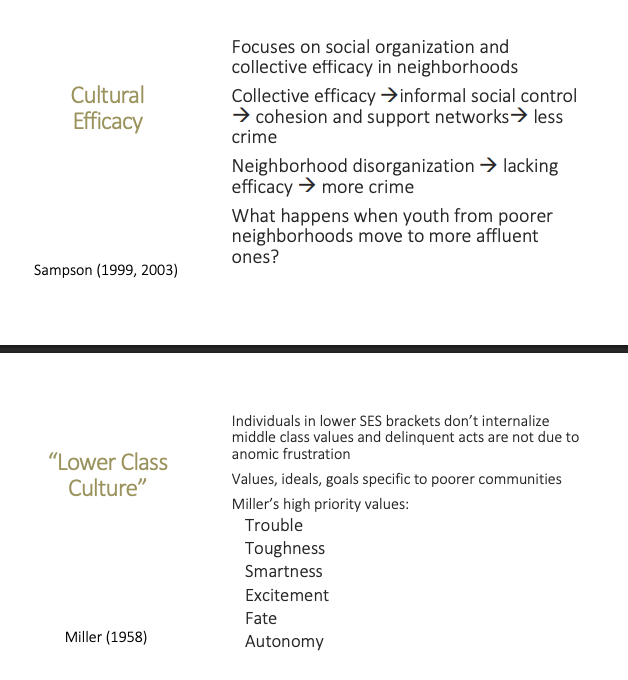
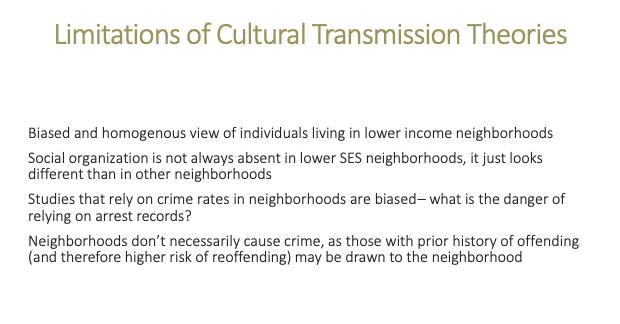
  • Can be biased and treat lower-income communities as homogenous

  • Assumes social organization is absent in lower-SES neighborhoods—when it may just look different

  • Neighborhood crime-rate studies can be biased if they rely on arrest records (danger: arrests reflect enforcement bias, not only true crime)

  • Neighborhoods may not “cause” crime—people with prior offending histories may be drawn to certain neighborhoods (selection effect)

Cultural Transmission Theories have limitations that include biases regarding lower-income communities, the assumption of absent social organization, reliance on potentially biased crime-rate studies, and the possibility of a selection effect where those with prior offending histories choose certain neighborhoods.
<ul><li><p>Can be <strong>biased</strong> and treat lower-income communities as <strong>homogenous</strong></p></li><li><p>Assumes social organization is absent in lower-SES neighborhoods—when it may just <strong>look different</strong></p></li><li><p>Neighborhood crime-rate studies can be biased if they rely on <strong>arrest records</strong> (danger: arrests reflect enforcement bias, not only true crime)</p></li><li><p>Neighborhoods may not “cause” crime—people with prior offending histories may be <strong>drawn to</strong> certain neighborhoods (selection effect)</p></li></ul><p>Cultural Transmission Theories have limitations that include biases regarding lower-income communities, the assumption of absent social organization, reliance on potentially biased crime-rate studies, and the possibility of a selection effect where those with prior offending histories choose certain neighborhoods. </p><p></p>
36
New cards

Compare the limitations of Cultural Transmission Theories vs Strain Theories.

  • Both can show bias/stereotypes about lower-SES youth and can ignore diversity within communities.

  • Strain limits (from earlier): often exclude females, don’t explain middle/upper-class delinquency, don’t explain why only some low-SES youth offend, and often ignore background/family/normal adolescent development.

  • Cultural transmission limits: risk over-blaming neighborhoods, relying on biased arrest data, assuming disorganization equals “no social organization,” and ignoring selection (offenders moving into areas).

Both theories can perpetuate biases and stereotypes about lower-SES youth while overlooking the diversity within communities. Strain theories often neglect female perspectives, fail to account for middle and upper-class delinquency, do not clarify why some low-SES youth offend, and might dismiss the impact of familial background and normal adolescent development. In contrast, Cultural Transmission Theories risk over-burdening neighborhoods with blame, rely on potentially biased arrest statistics, wrongly equate social disorganization with the absence of social organization, and overlook the selection effect where individuals with prior offending histories move into particular neighborhoods.
<ul><li><p><strong>Both</strong> can show <strong>bias/stereotypes</strong> about lower-SES youth and can ignore diversity within communities.</p></li><li><p><strong>Strain limits (from earlier):</strong> often exclude females, don’t explain middle/upper-class delinquency, don’t explain why only some low-SES youth offend, and often ignore background/family/normal adolescent development.</p></li><li><p><strong>Cultural transmission limits:</strong> risk over-blaming neighborhoods, relying on biased <strong>arrest data</strong>, assuming disorganization equals “no social organization,” and ignoring selection (offenders moving into areas).</p></li></ul><p>Both theories can perpetuate biases and stereotypes about lower-SES youth while overlooking the diversity within communities. Strain theories often neglect female perspectives, fail to account for middle and upper-class delinquency, do not clarify why some low-SES youth offend, and might dismiss the impact of familial background and normal adolescent development. In contrast, Cultural Transmission Theories risk over-burdening neighborhoods with blame, rely on potentially biased arrest statistics, wrongly equate social disorganization with the absence of social organization, and overlook the selection effect where individuals with prior offending histories move into particular neighborhoods. </p><p></p>
37
New cards

Compare Social Strain Theories to Cultural Transmission Theories.

  • Strain theories: delinquency comes from blocked goals or stress (frustration/strain → delinquency as response).

  • Cultural transmission theories: delinquency comes from neighborhood culture/social organization (disorganization, collective efficacy, local values, cultural conflict) shaping what youth learn and do.
<ul><li><p><strong>Strain theories:</strong> delinquency comes from <strong>blocked goals or stress</strong> (frustration/strain → delinquency as response).</p></li><li><p><strong>Cultural transmission theories:</strong> delinquency comes from <strong>neighborhood culture/social organization</strong> (disorganization, collective efficacy, local values, cultural conflict) shaping what youth learn and do.</p></li></ul><p></p>



