The violent universe
 Studied by 6 people
 Call with Kai
 Learn
Learn Practice Test
 Spaced Repetition
 Match
Match Flashcards
 Knowt Play
1/9

Earn XP
Description and Tags
For Midterm and Final
Name | Mastery | Learn | Test | Matching | Spaced | Call with Kai |
|---|
No study sessions yet.
10 Terms
An apple is released from a tree and begins to fall toward the ground. Is it accelerating while it falls? Explain what “acceleration” means in this situation.
Acceleration means a change in velocity over time. In this case, the apple’s speed increases as it moves downward due to the constant force of gravity pulling it toward the Earth.
Two objects in space attract each other by gravity. Describe how this gravitational attraction
changes if:
(a) one object becomes more massive, and
(b) the objects move farther apart.
(a) One object becomes more massive: The gravitational force between the two objects increases because gravitational force is directly proportional to the product of their masses.
(b) The objects move farther apart: The gravitational force decreases because it is inversely proportional to the square of the distance between the objects.
Astronauts on the Moon weigh less than they do on Earth, but their mass is the same.
Explain the difference between mass and weight, and say which one changes when someone
goes from Earth to the Moon.
Mass is the amount of matter in an object and does not change regardless of location.
Weight is the force exerted by gravity on that mass and depends on the gravitational field strength. When astronauts move from Earth to the Moon, their mass remains the same, but their weight decreases because the Moon’s gravity is weaker.
A small car and a large delivery van are traveling side by side at the same speed. Which one has the greater momentum?
Explain your reasoning using the definition of momentum.
The large delivery van has greater momentum because momentum is defined as the product of mass and velocity (p=m×vp=m×v). Although both travel at the same speed, the van’s larger mass results in greater momentum. Ex; a mother or father pulling a smaller child
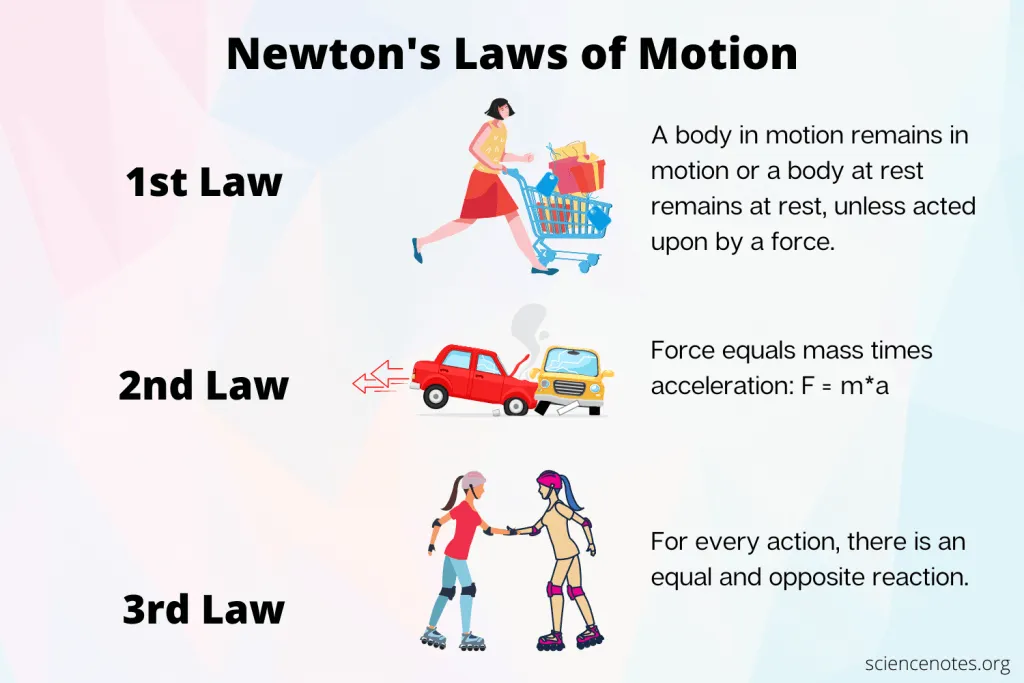
Newton’s three laws can all be described using the idea of momentum. For each law, briefly
explain what it says in terms of an object’s momentum.
First Law (Inertia): An object’s momentum remains constant unless acted upon by an external force.
Second Law: The rate of change of momentum of an object is proportional to the applied force (F=dpdtF=dtdp).
Third Law: For every action force, there is an equal and opposite reaction force, meaning momentum lost by one object is gained by another.
Choose one of Newton’s laws and describe a real-life situation where you can see it in action.
Explain how the law applies in that situation.
A book resting on a table remains at rest because no net external force acts on it. If you push the book gently, it will start moving, but if you stop pushing, friction will eventually bring it to rest again. Without friction, the book would continue moving indefinitely at constant velocity, demonstrating that an object maintains its state of motion unless acted upon by a net external force.
Give an example from everyday life or sports that shows conservation of angular momentum,
and explain what changes and what stays the same in your example.
A figure skater spinning with arms extended pulls them in to spin faster. The skater’s angular momentum stays constant, but by reducing the radius of rotation, the angular velocity increases. The product of moment of inertia and angular velocity remains the same.
Imagine that the Moon slowly moved closer to Earth over millions of years. How would this
affect the strength of the ocean tides on Earth? Explain your reasoning.
If the Moon moved closer, the gravitational pull on Earth’s oceans would increase, making the tides stronger. This is because tidal forces depend on the difference in gravitational attraction, which grows as the Moon’s distance decreases.
In astronomy, distances are often given in light-years. What does one light-year measure:
time or distance? Explain in your own words.
A light-year measures distance, specifically the distance light travels in one year. It is a unit of length used to express astronomical distances.
If a star exploded today at a distance of 20 lightyears away from Earth, when would we find out? Why?
We would find out about the star explosion 20 years after it happened because the light and other signals from the explosion take 20 years to travel to Earth at the speed of light.
 Note
Note  Flashcards (187)