Unit 2 TBT Terms

0.0(0)
studied byStudied by 90 people
call kaiCall Kai
learnLearn
examPractice Test
spaced repetitionSpaced Repetition
heart puzzleMatch
flashcardsFlashcards
Card Sorting

1/37

encourage image

There's no tags or description

Looks like no tags are added yet.

Last updated 6:00 PM on 2/6/26
Name
Mastery
Learn
Test
Matching
Spaced
Call with Kai

No analytics yet

Send a link to your students to track their progress

38 Terms

1
New cards

Nonpolar Covalent Bonds

formed between two nonmetals, electrons are shared evenly

2
New cards

Polar Covalent Bonds

formed between two nonmetals, electrons are shared unevenly

3
New cards

Ionic Bonds

formed between metal and nonmetal, electrons are transferred

4
New cards

δ-

on more electronegative atom

5
New cards

δ+

on less electronegative atom

6
New cards

bond energy/bond strength

the amount of energy required to break a bond

(high bond energy = strong covalent bonds)

7
New cards

triple bond

shortest and strongest

1 σ bond and 2 π bonds

8
New cards

double bond

1 σ bond and 1 π bond

9
New cards

single bond

longest and weakest

1 σ bond

10
New cards

lattice energy

the energy required to separate the ions in an ionic lattice

(high lattice energy = strong ionic bonds)

11
New cards

Ionic bonds are stronger when…

1)

2)

1) the magnitude of the charge is greater

2) the ion size is smaller

12
New cards

Properties of Ionic Solids

  • High Melting Points

  • Low Volatility (don’t evaporate easily)

  • Poor Conductors as Solids, Good Conductors when Molten/Aqueous

  • Soluble in Water

  • Brittle (shatter)

13
New cards

Properties of Metallic Solids

  • High Melting Points

  • Good Conductors of Electricity

  • Good Conductors of Heat

  • Malleable (hammered into sheets)

  • Ductile (pulled into wires)

14
New cards

Metallic Bonds

formed between metals, electrons are delocalized into a “sea of electrons”
15
New cards
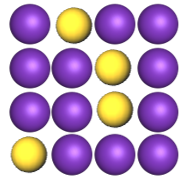
<p>Substitutional Alloys</p>

Substitutional Alloys

atoms of one metal are replaced by atoms of another

both metals have similar atomic radii
16
New cards
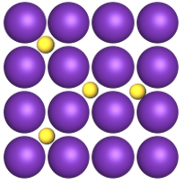
<p>Interstitial Alloys</p>

Interstitial Alloys

atoms of one element fill the gaps between atoms of a metal

one of the elements has a much smaller atomic radius

17
New cards

What is needed for a substance to conduct electricity?

charged particles (ions, delocalized electrons, etc.) that are able to move freely and carry charge

18
New cards

resonance structures

different valid drawings of the same molecule that differ only in electron (bond) placement, not atom positions
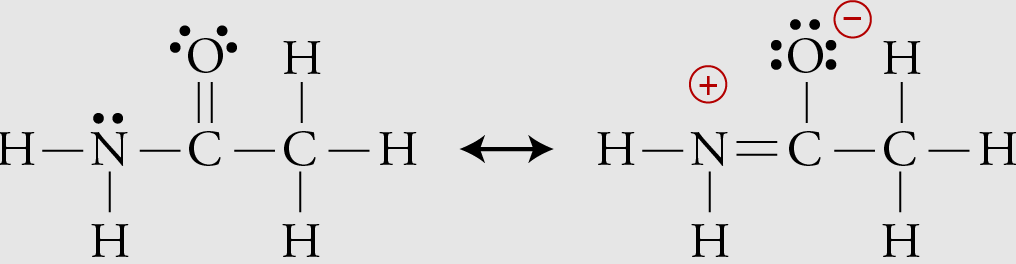
<p>different valid drawings of the same molecule that differ only in electron (bond) placement, not atom positions</p>
19
New cards

Formal Charge

# of Valence Electrons an Atom Starts With - # of Electrons Touching the Atom

20
New cards

The most valid resonance structure will…

1) minimize formal charge

2) put negative formal charge on the more electronegative atom

21
New cards
term image

Geometry: Linear

Bond Angle: 180o

Hybridization: sp

<p><strong>Geometry: </strong>Linear</p><p><strong>Bond Angle: </strong>180<sup>o</sup></p><p><strong>Hybridization: </strong>sp</p>
22
New cards
term image

Geometry: Trigonal Planar

Bond Angle: 120o

Hybridization: sp2

<p><strong>Geometry: </strong>Trigonal Planar</p><p><strong>Bond Angle: </strong>120<sup>o</sup></p><p><strong>Hybridization: </strong>sp<sup>2</sup></p>
23
New cards
term image

Geometry: Bent

Bond Angle: less than 120o

Hybridization: sp2

<p><strong>Geometry: </strong>Bent</p><p><strong>Bond Angle: </strong>less than 120<sup>o</sup></p><p><strong>Hybridization: </strong>sp<sup>2</sup></p>
24
New cards
term image

Geometry: Tetrahedral

Bond Angle: 109.5o

Hybridization: sp3

<p><strong>Geometry: </strong>Tetrahedral</p><p><strong>Bond Angle: </strong>109.5<sup>o</sup></p><p><strong>Hybridization: </strong>sp<sup>3</sup></p>
25
New cards
term image

Geometry: Trigonal Pyramidal

Bond Angle: less than 109.5o

Hybridization: sp3

<p><strong>Geometry: </strong>Trigonal Pyramidal</p><p><strong>Bond Angle: </strong>less than 109.5<sup>o</sup></p><p><strong>Hybridization: </strong>sp<sup>3</sup></p>
26
New cards
term image

Geometry: Bent

Bond Angle: less than 109.5o

Hybridization: sp3

<p><strong>Geometry: </strong>Bent</p><p><strong>Bond Angle: </strong>less than 109.5<sup>o</sup></p><p><strong>Hybridization: </strong>sp<sup>3</sup></p>
27
New cards
<p></p>

Geometry: Trigonal Bipyramidal

Bond Angle: 120o and 90o

<p><strong>Geometry: </strong>Trigonal Bipyramidal</p><p><strong>Bond Angle: </strong>120<sup>o</sup> and 90<sup>o</sup></p>
28
New cards
term image

Geometry: Seesaw

Bond Angle: less than 120o and 90o

<p><strong>Geometry: </strong>Seesaw</p><p><strong>Bond Angle: </strong>less than 120<sup>o</sup> and 90<sup>o</sup></p>
29
New cards
term image

Geometry: T-Shaped

Bond Angle: less than 90o

<p><strong>Geometry: </strong>T-Shaped</p><p><strong>Bond Angle: </strong>less than 90<sup>o</sup></p>
30
New cards
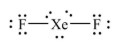
term image

Geometry: Linear

Bond Angle: 180o

<p><strong>Geometry: </strong>Linear</p><p><strong>Bond Angle: </strong>180<sup>o</sup></p>
31
New cards
term image

Geometry: Octahedral

Bond Angle: 90o

<p><strong>Geometry: </strong>Octahedral</p><p><strong>Bond Angle: </strong>90<sup>o</sup></p>
32
New cards
term image

Geometry: Square Pyramidal

Bond Angle: less than 90o

<p><strong>Geometry: </strong>Square Pyramidal</p><p><strong>Bond Angle: </strong>less than 90<sup>o</sup></p>
33
New cards
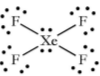
term image

Geometry: Square Planar

Bond Angle: 90o

<p><strong>Geometry: </strong>Square Planar</p><p><strong>Bond Angle: </strong>90<sup>o</sup></p>
34
New cards

Isomers

different substances with the same molecular formula but different arrangements of atoms
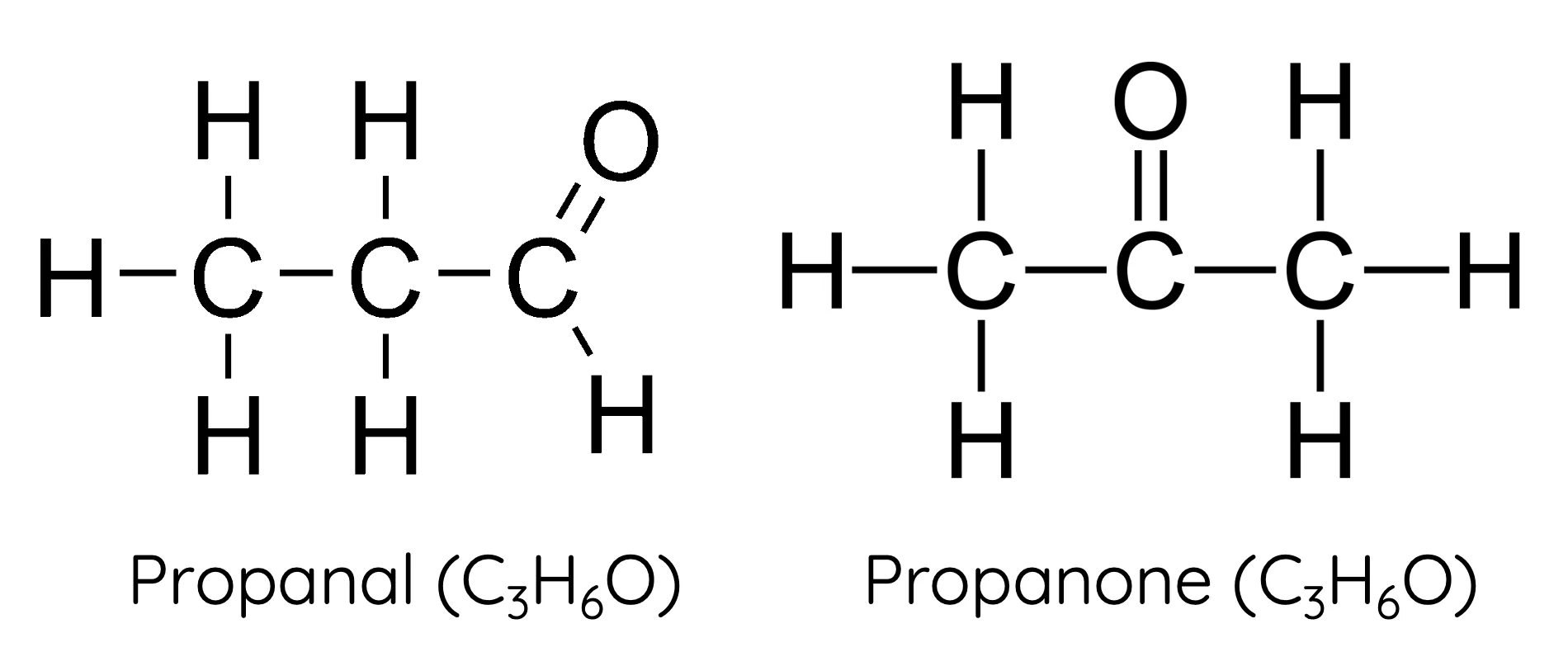
<p>different substances with the same molecular formula but different arrangements of atoms</p>
35
New cards

Sigma (σ) Bonds

head-on overlap of orbitals

stronger than pi (π) bonds

36
New cards

Pi (π) Bonds

side-by-side overlap of orbitals

weaker than sigma (σ) bonds

37
New cards

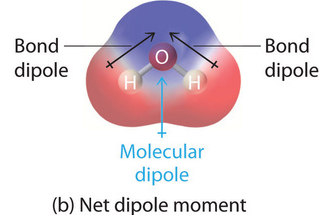
Polar Molecules

bond dipoles do not cancel out, resulting in a net dipole moment

usually have…

  • asymmetric geometry,

  • lone pairs on central atom, or

  • different terminal atoms

<p>bond dipoles <strong>do not</strong> cancel out, resulting in a net <strong>dipole moment</strong></p><p>usually have…</p><ul><li><p>asymmetric geometry,</p></li></ul><ul><li><p>lone pairs on central atom, or</p></li><li><p>different terminal atoms</p></li></ul><p></p>
38
New cards

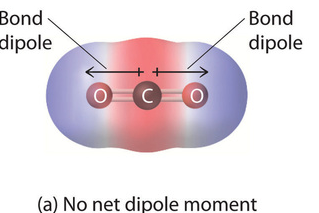
Nonpolar Molecules

bond dipoles cancel out

usually have…

  • symmetric geometry,

  • no lone pairs on central atom, and

  • identical terminal atoms

<p>bond dipoles <strong>cancel out</strong></p><p>usually have…</p><ul><li><p>symmetric geometry,</p></li><li><p>no lone pairs on central atom, and</p></li><li><p>identical terminal atoms</p></li></ul><p></p>

Explore top flashcards

WY 4 Unit 4
Updated 1063d ago
flashcards Flashcards (40)
Ordlista 1
Updated 498d ago
flashcards Flashcards (30)
Bio Cell Membrane
Updated 512d ago
flashcards Flashcards (22)
AP EURO unit 1
Updated 904d ago
flashcards Flashcards (34)
Vocab 6B
Updated 1148d ago
flashcards Flashcards (23)
german final vocab
Updated 1157d ago
flashcards Flashcards (78)
WY 4 Unit 4
Updated 1063d ago
flashcards Flashcards (40)
Ordlista 1
Updated 498d ago
flashcards Flashcards (30)
Bio Cell Membrane
Updated 512d ago
flashcards Flashcards (22)
AP EURO unit 1
Updated 904d ago
flashcards Flashcards (34)
Vocab 6B
Updated 1148d ago
flashcards Flashcards (23)
german final vocab
Updated 1157d ago
flashcards Flashcards (78)