APBio: Unit 7 Vocab’26
 Call Kai
 Learn
Learn Practice Test
 Spaced Repetition
 Match
Match Flashcards
 Knowt Play
1/80

There's no tags or description
Looks like no tags are added yet.
Name | Mastery | Learn | Test | Matching | Spaced | Call with Kai |
|---|
No analytics yet
Send a link to your students to track their progress
81 Terms
Evolution
Defined by Darwin’s phrase descent with modification: explain’s life’s unity and diversity
Natural Selection
individuals with advantageous heritable traits survive and reproduce more, cause of adaptive evolution
Adaptive Evolution
process where natural selection increases frequency of beneficial traits→ improves pop. fitness and survival in environment over generations
Artificial Selection
human-guided process of selecting plants or animals with desirable traits to breed the next generation
Do individuals evolve?
No, populations do
Adaptations
rely/depend on the environment
Homologous Structures
Structures in different species that are similar because of common ancestry
Vestigial Structures
remnants of features that served a function in the organism’s ancestors (but no longer useful)
Pseudogenes
segments of DNA that resemble functional genes, but are nonfunctional
Evolutionary Trees
a diagram that reflects evolutionary relationships among groups of organism
Analogous Structures/Convergent Evolution
distantly related organisms can resemble one another, similar features in different lineages (similar function, but no common ancestry)
Continental Drift
movements like this united all Earth’s landmasses into a single large continent called Pangaea (continents move apart later on, 200 mil yrs ago)
Vertebrates
organisms with backbones, excludes species like insects, mollusks, arthropods, etc.
Evidence to support Evolution
Direct observations, the fossil record, homology, biogeography
Microevolution
change in allele frequencies in a population over generations
Mutation and Sexual Reproduction
produces the variation in gene pools that contribute to differences among individuals
Mutations
changes in the nucleotide sequences of DNA, cause new genes and alleles to arise (rates are low in animals and plants)
Sexual Reproduction
can shuffle existing alleles into new combinations (crossing-over, independent assortment, fertilization), → recombinations of alleles more important than mutation in producing genetic differences
Heterozygote Protection
maintains a huge pool of alleles that may be harmful under present conditions, but be beneficial in environmental changes
Neutral Variation
genetic differences in DNA that do not give a selective advantage or disadvantage
Population
group of individuals of the same species that live in the same area and interbreed, producing fertile offspring
Gene Pool
consists of all copies of every type of allele at every locus in all members of pop.
Conditions for Hardy-Weinberg Equilibirum
no mutations, random mating, no natural selection, extremely large pop., no gene flow (not likely all 5 conditions will occur) → principle used to describe pop NOT evolving
Genetic drift (chance evolution)
describes how allele frequencies fluctuate unpredictably from one generation to the next→ tends to reduce genetic variation through losses of allele (smaller the sample, greater chance of deviation from predicted result)
The bottleneck effect
sudden reduction in pop. size due to a change in the environment
The founder effect
occurs when a few individuals become isolated from a larger population
Gene flow
consists of the movement of alleles among populations (ex. pollen) → tends to reduce differences between populations over time
Inbreeding
mating between closely related partners (causes frequencies of genotypes to deviate from what is expected)
Assortative mating
individuals select mates that are like themselves in certain phenotypic characters
Relative fitness
contribution an individual makes to the gene pool of the next gen, relative to the contributions of other individuals
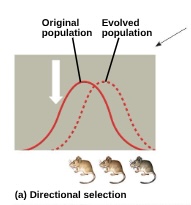
Directional selection
favors individuals at one end of the phenotypic range
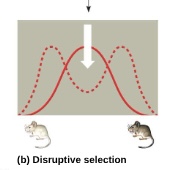
Disruptive selection
favors individuals at both extremes of the phenotypic range
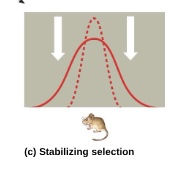
Stabilizing selection
favors intermediate variants and acts against extreme phenotypes
Sexual selection
natural selection for mating success, can result in sexual dimorphism
Intrasexual selection
competition among individuals of one sex (often males) for mates of the opposite sex
Speciation
the origin of new species, is at the focal point of evolutionary theory
Macroevolution
refers to evolutionary change above the species level
Reproductive isolation
existence of biological factors (barriers) that impede two species from producing viable, fertile offsprine
Hybrid
the offspring of crosses between different species
Habitat isolation
two species encounter each other rarely, or not at all, because they occupy different habitats, even though not isolated by physical barriers
Temporal isolation
species that breed at different times of the day, different seasons, or different years cannot mix their gametes
Behavioral isolation
courtship rituals and other behaviors unique to a species are effective barriers
Mechanical isolation
morphological differences can prevent sucessful mating
Gametic isolation
sperm of one species may not be able to fertilize eggs of another species
Reduced hybrid viabilty
genes of the different parent species may interact and impair the hybrid’s development
Reduced hybrid fertility
even if hybrids are vigorous, they may be sterile
Hybrid breakdown
some first-generation hybrids are fertile, but when they mate with another species or with either parent species, offspring of next generation are feeble or sterile
Allopatric speciation
geographically isolated, reduces gene flow
Sympatric speciation
not geographically isolated, speciation takes place in geographically overlapping populations
Habitat differentiation
appearance of new ecological niches
Sexual selection
females (typically) choose males based on appearance
Punctuated equilibrium
species often show long periods of little change (stasis) punctuated by rapid speciation; contrasts with gradual change
Stages of origin of life
abiotic synthesis
joining of these small molecules into macromolecules
packaging of molecules into “protobionts”
origin of self-replicating molecules (likely RNA)
protobionts
membranes, metabolism, simple reproduction
3 Eons
archean eon
proterozoic eon
phanerozoic eon
cyanobacteria
do oxygenic photosynthesis
Endosymbiotic theory
eukaryotes evolved from prokaryotes living inside host cells
Cambrian explosion
sudden appearance of modern body plants, predatory-prey interactions drive diversification
stromatolites
layered rocks that form when certain prokaryotes bind thin films of sediment together
mass extinctions
permian → volcanoes
cretaceous → asteroid impact
adaptive radiation
rapid evolution of many species from one ancestor → mass extinctions free up niches, survivors diversify, reduce predatory life
EVO-DEVO
study of evolution and development interact
heterochrony
evolutionary change in rate or timing of developmental events
Hox genes
a key class of homeotic genes, clusters that form along body axis→ control body layout (head, thorax, abdomen, limbs)
developmental gene regulation
can alter body form more than gene sequence changes
phylogeny
evolutionary history of a species or group of related species
systematics
systematists use fossil, molecular, and genetic data to infer evolutionary relationships
taxonomy
ordered division and naming of organisms
taxonomic groups
domain→kingdom→phylum→class→order→family→genus→and species
sister taxa
groups that share an immediate common ancestor
molecular systematics
uses DNA and other molecular data to determine evolutionary relationships
claditics
groups organisms by common descent
clade
a group of species that includes an ancestral species and all its descendants
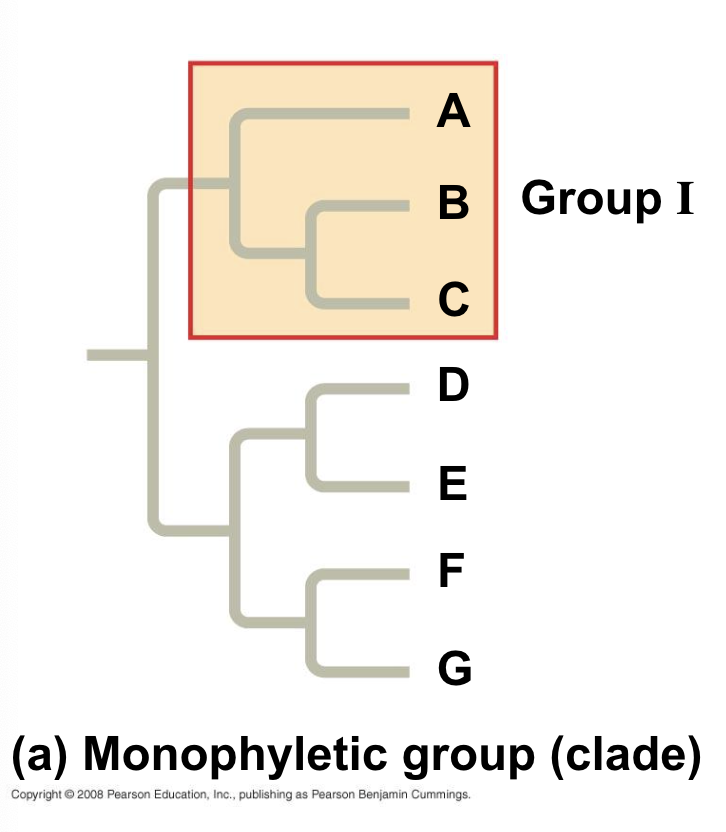
monophyletic grouping
consists of ancestor species and all its descendants
polyphyletic grouping
consists of various species that lack a common ancestor
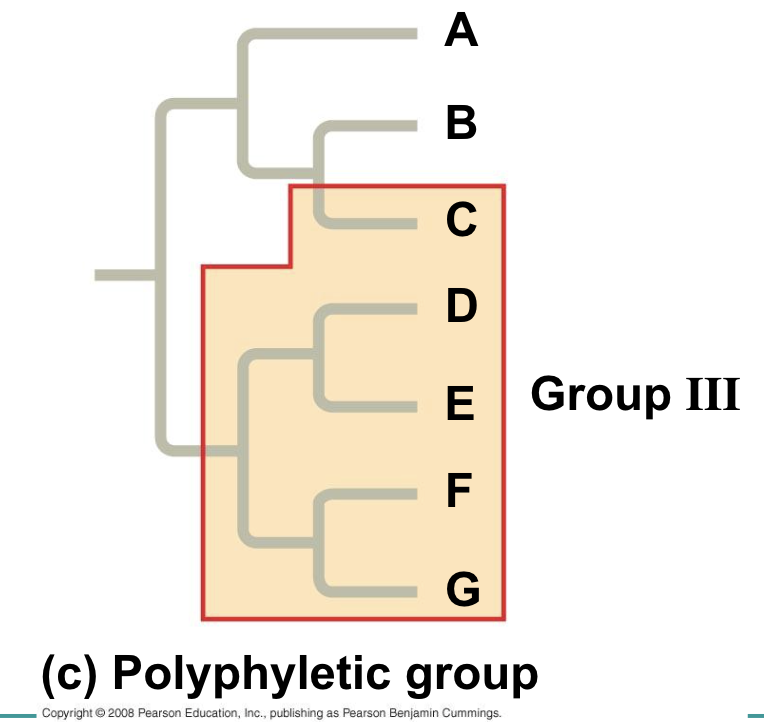
paraphyletic grouping
consists of an ancestral species and some, but not all, of the descendants
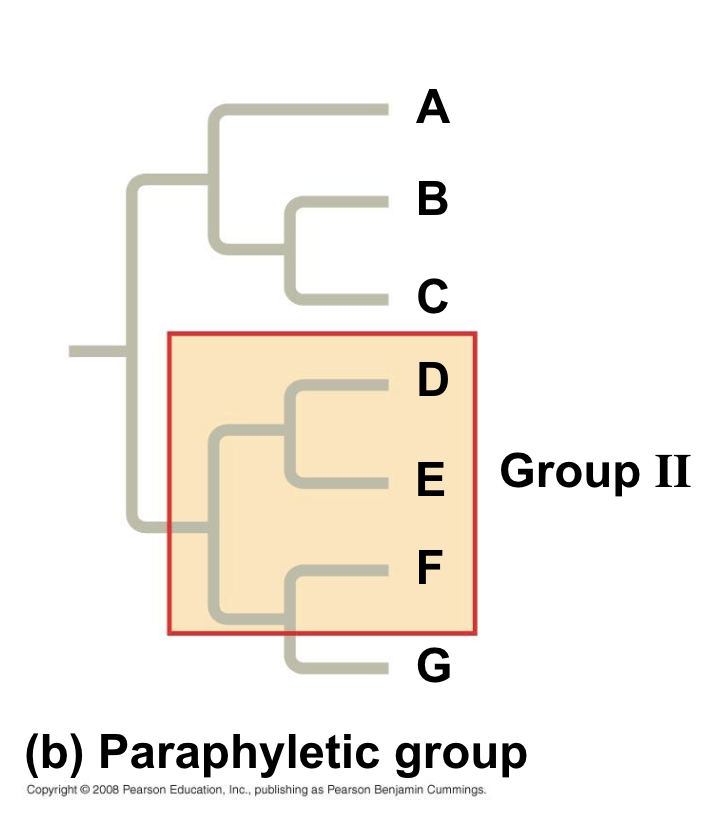
shared ancestral character
character that originated in an ancestor of the taxon
shared derived character
an evolutionary novelty unique to a particular clade
outgroup
species or group of species closely related to the species studied, but not entirely together
maximum parsimony
assumes that the tree requires the fewest evolutionary events, investigate the simplest explanation that is consistent with the facts
maximum likelihood
approach identifies the three most likely to have produced a given set of DNA based on certain probability rules about DNA sequences over time

