Bio exam 4
 Call Kai
 Learn
Learn Practice Test
 Spaced Repetition
 Match
Match Flashcards
 Knowt Play
1/147

There's no tags or description
Looks like no tags are added yet.
Name | Mastery | Learn | Test | Matching | Spaced | Call with Kai |
|---|
No analytics yet
Send a link to your students to track their progress
148 Terms
Most plants are autotrophs and so they make their own energetic compounds using light energy. They still need water and a number of essential elements. The get most of the Carbon, Oxygen and Hydrogen elements from either water (H2O) or from the air (CO2). The remaining essential elements (nutrients) are typically obtained from the soil solution through
through absorption by roots as either anions or cations.
The soil is actually quite complex and different parts of the soil____________ are important for supplying different elements.
mineral component, organic component, cation exchange
Also, plants have evolved elaborate structures to aid in obtaining these nutrients and plants have also evolved_____________ with bacteria and fungi help plants acquire other specific nutrients
complex mutualistic interactions
Deficiencies of particular elements result in
characteristic “nutrient” deficiency symptoms.
What is soil?
The upper layer of earths surface where plants grow. It supports life by providing plants with nutrients, water, and physical support.
What are various components within soil?
Mineral particles: sand, silt, clay (from weathered rock)
Organic matter (decomposed plants, animals, microorganisms)
Water
Air
Living organisms (bacteria, fungi, protozoa, insects, worms)
What are soil horizons?
Distinct layers of soil
O horizon: organic matter (humus) at the surface
A horizon: topsoil, rich in minerals and organic matter; most plants live there
E horizon: leached layer, lighter in color, minerals removed
B horizon: subsoil. Accumulation of minerals like iron, clay
C horizon: weathered parent material
R horizon: bedrock
What is the cation exchange of a soil (CEC for cation exchange capacity)
The soil’s ability to hold and exchange positively charged ions such as K, C, and Mg. Soils with high CEC can retain more nutrints for plant use. Largely influenced by clay and organic matter.
What elements do plants need to complete their lifecycle?
Macronutrients: nitrogen, phosphorous, potassium, calcium, magnesium, sulfur, hydrogen, carbon. oxygen
Micronutrients: iron, manganese, zinc, copper, boron, molybdenum, chlorine, nickel
How did scientists determine what elements were essential?
Through hydroponic experiments where plants were grown in solutions lacking a particular element. If a plant could not complete its lifecycle it was essential.
What is the difference between micronutrients and macronutrients?
Macronutrients are needed in large amounts, structural and metabolic roles
Micronutrients needed in tiny amounts, mostly enzyme cofactors or activators
What mineral nutrient deficiencies? What symptoms can they exhibit
N deficiency: yellowing of older leafs
P deficiency: stunted growth, dark green or purple leaves
K deficiency: leaf margin necrosis, leaf edges and tips turn brown (older leaves first)
Mg deficiency: interveinal chlorosis in older leaves, yellowing tissue between green tissue
Ca deficiency: deformed young leaves and growing tips
Fe deficiency: interveinal chlorosis in young leaves
What is the difference between a mobile nutrient deficiency vs an immobile deficiency? Which shows symptoms 1st in older leaves, which in younger leaves?
Mobile nutrient: N, P, K, Mg: Can move from older leaves to new leaves. Deficiency in older leaves first.
Immobile nutrients: Ca, Fe, B, Zn: cannot be moved; deficiency show first in younger leaves
Which essential elements are cations? Which are anions?
Cations: K, Ca, Mg, NH4
Anions: NO3-, PO43-, SO42-, Cl-
What are some of the major functions of macronutrients in plants? Do most macronutrients have functions that are the same for animals?
N: proteins, nucleic acids
P: ATP, nucleic acids
K: osmoregulation, enzyme activation
Mg: chlorophyll, enzyme cofactor
S: amino acids, coenzymes
Many functions are shared with animals, but some are plant specific like chlorophyll synthesis
How many of the micronutrients have functions as either enzyme activators or cofactors? What are cofactors (definition is in glossary). Since both enzyme activators and co-factors are typically reused, do you think that might be why they are only needed in “micro” quantities?
Most micronutrients are enzyme activators or cofactors (Fe, Mn, Zn., Cu, Mo, etc.)
Cofactors are non-protein molecules that help enzymes catalyze reactions. Needed in small qualities because they are reused and not consumed in reactions.
How do plants get mineral nutrients? Which plant organ is primarily responsible? Review material from Chap 35 p757-764 and p766 on plant organs, tissue types, cell types and meristems
Root system absorbs nutrients from the soil. They move via root hairs to cortex to xylem into shoots.
NOTE: Of the essential elements_______are derived primarily from the organic matter of the soil through decompositional processes. The rest are derived primarily from___________
N,P,S
from the mineral portion of the soil (broken down rock that forms the parent material of the soil).
What is a mutualistic relationship?
Close, long-term interaction where both species benefit. Example, fungi and root plants (mycorrhizae), rhizobacteria
What are rhizobacteria (rhizo refers to root)-
Bacteria that live near or on plant roots and enhance growth by producing nutrients, hormones, or fixing nitrogen.
Besides NH3→NH4 which is just the gas dissolving in water, what are the four main half reactions (ALL mediated by bacteria, ammonifying, fixing, nitrifying, denitrifying) within the Nitrogen cycle.
Nitrogen fixation: N₂ → NH3 (or NH4⁺)
Ammonification: Organic N → NH4⁺
Nitrification: NH4⁺ → NO2⁻ → NO3⁻
Denitrification: NO3⁻ → N2
Which of these reactions are oxidation reactions?
Nitrification (NH4⁺ → NO2⁻ → NO3⁻)
Which of these reactions is a reduction reaction?
Denitrification (NO3⁻ → N2)
What are the main forms of nitrogen in the cycle?
N₂, NH3, NH4⁺, NO2⁻, NO3⁻, organic N
What forms of nitrogen can the plant absorb?
NH4⁺ and NO3⁻
What is the overall nitrogen fixation reaction? What enzyme catalyzes it?
N₂ + 8 H⁺ + 8 e⁻ → 2 NH3 + H2, Catalyzed by nitrogenase enzyme.
What are nodules in nitrogen fixing plants?
Swelling on roots where symbiotic bacteria live and fix nitrogen.
What do we mean when we say that there is extensive communication between the bacteria and the plant in infection process?
Quorum sensing: bacteria coordinate an attack when their population is big enough
Plants evolve to listen to these signals and protecting themselves
Quorum quenching: plants have evolved to mimic bacteria signals to confuse them. Also, it can produce an enzyme that breaks down their signals. Bacteria can counteract this by evading the immune system.
Efferent secretion: bacteria inject proteins to suppress plant immunity
What are mychorrhizae?
Symbiotic relationship between fungi and plant roots. Fungi increase nutrient absorption of plants and plants provide carbohydrates.
What are differences between ecto and endomychorrhizae?
Ectomycorrhizae: fungi surround root but don’t penetrate cells
Endomyocorrizae: fungi penetrate root cells
What is the advantage for each party to enter into this mutualistic relationship? What does each get out of it?
Plant gets increased nutrient and water uptake and fungi/bacteria gets carbohydrates (energy) from plant
epiphytes, parasitic plants, and carnivorous plants
Epiphytes: grow on other plants but not parasitic
Parasitic plants: draw nutrients from host
Carnivorous plants: capture and digest insects for nutrients
three types of transport:
A. Diffusion (or osmosis if it is water) across cell membranes
B. Diffusion over short distances
C. Long distance pressure driven movement within the phloem and xylem
What exactly is diffusion?
The movement of molecules from high to low concentration. It is passive and happens naturally. No energy required
What does it mean when equilibrium is reached?
When molecule is evenly spread out, concentration is the same everywhere. No net movement (overall change=0)
Does it mean that the dye molecules no longer move across the membrane?
No, they still move randomly but equal movement in both directions.
What is osmosis? How does it differ from diffusion?
Diffusion of water across a selectively permeable membrane. Osmosis is only water and diffusion is any molecule.
Passive movement, just means that
that energy is not needed (at least directly) to make water move.
plant physiologists defined ______ to help with predicting the passive movement of water.
water potientals
Water potentials are related to ________. Free water (water that is free to move) moves from regions of high to low ______.
potiential energy
The potential energy of a sample of water is always compared with a theoretical sample of pure water at standard temperature and pressure conditions.
What are the typical units of water potential?
Megapascals (MPa)
What is the general water potential equation? What are the two components of the total water potential?
Ψ=Ψs+Ψp
Ws=solute potential (always negative)
Wp=pressure potential (can be positive or negative)
Based on the equation, in what direction does water potential always move?
Higher Ψ → lower Ψ (more free energy to less free energy)
What does it mean when we say there is a “selectively permeable” membrane? What does permeable mean?
Only some substances can pass, others a blocked
What can move across the semi-permeable membrane in Fig 7.11? What can’t?
Water, small molecules (sometimes) can cross. Large solutes and charged ions can’t without help
Note that the height of the water in upper right hand panel of Fig 7.11 is higher. You need to add a______ component to the water potential equation to explain this. Total water potential=________________________. In this example, the water is not under any pressure, so that component is zero.
gravity
osmotic component + pressure component + gravity component
Equilibrium occurs when the potential energy due to the greater height of the water column on the right hand side of the U-tube is equal to ____________________(more positive solute potential) on the left side of the U-tube.
the potential energy of the greater amount of free water
Aquaporins:
specialized channel proteins in the cell membrane that act as plumbing to allow water molecules to flow through quickly
Diffusion:
natural movement of particles from an area of high to low concentration
Concentration gradients:
: The difference in the density of a substance between 2 areas.
Passive transport:
Moving substances across a cell membrane without using any energy
Isotonic
a state where the concentration of solutes is the same inside and outside the cell. Water moves in and out at the same rate, keeping the cell stable.
Hypertonic
: A solution that has a higher concentration of solutes than the cell. Causes water to rush out and cell the shrivel.
Hypotonic
A solution with lower concentration of solutes than the cell. This causes water to rush in and could cause the cell to burst.
What does it mean for cells to be turgid?
Cell is full of water. Membrane pushes against the wall. (Heathy)
Which water potential component has to be positive for a cell to be turgid?
Requires positive pressure, Ψp
What does it mean for cells to be flaccid?
Limp, no pressure buildup
Referring to the water potential components, explain what it means for a cell to be turgid.
Pressure potential (wp) high enough to counteract negative solute potential (ws)
If you put a plant cell in a hypotonic solution. Does the solution have more solutes or less solutes compared to the cell?
Less solute outside
Why doesn’t the plant cell burst like the red blood cell?
Plant cells have cell walls that prevent overexpansion
Could a turgid plant cell have a total water potential of the cell equal to zero? Is that possible? Explain.
Yes, this is a fully turgid cell characteristic, when solute potential and pressure potential counteract each other perfectly.
In a hypertonic solution, does the solution have more or less solutes compared with the cell?
What does it mean when we say a plant cell has plasmolyzed?
More solute outside. When plant cells have plasmolyzed that means water leaves the cell, membrane pulls away from the wall.
For the top figures in all four panels (pure water at equilibrium at standard temperature and pressure), what is the water potential on both sides of the U-tube?
0 bars. No solute potential (pure), no pressure potential (STP)
What is the effect of adding solutes to one side of the U-tube (in the first panel)?
Does this increase or decrease the solute water potential?
In what direction does water move?
Adding solutes would lower Ψ (more negative). Water would move toward that side
decrease
Move toward the side with the solute
In the second panel, how does adding a positive pressure affect the water potential on the right side of the U-tube?
Why does water move to the left? In what direction does water always move (p787-788)?
This would increase Ψ
Water moves from higher to lower pressure.
What does it mean when the water in the U tubes comes into equilibrium? Does that mean there is no water movement?
This means the total water potential is equal on both sides. Water still diffuses but equally on both sides.
In Panel A above. Explain how do solutes affect water potential (Ψ) and how does that affect water movement?
Lowers water potential. Water moves toward the solutes.
In terms of potential energy, explain why the column of water is higher on the right side of the U tube compared to the left when it comes into equilibrium.
The right has lower potential energy and water moves from high to low energy
How do both a positive pressure or a negative pressure affect water potential (Ψ) and water movement?
Water flows from an area of high pressure to a area of low pressure. Positive increases water potential and negative decreases water potential.
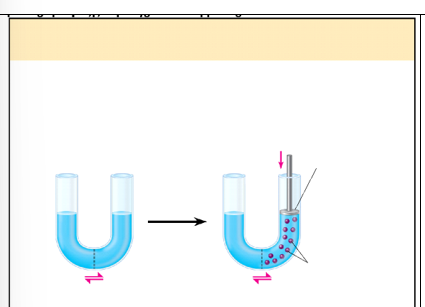
In the Panel C, what is the water potential on the left side of the U-tube?
It would be zero because there is no solute or pressure
In Panel C, why is there no net movement of water? What things equal out? Explain.
The solute and the water pressure,
Why do you have to know both the effect of both solutes (solute potential) and pressure (pressure potential) to understand the total water potential and water movement? Explain.
Because they are two opposing forces that dictate which direction water will move
For a U-tube set up similar to Panel C, let’s assume that adding the solutes to the right side of the U-tube results in a solute water potential of -0.5 MPa and that the pressure component being placed on the right side is +0.5 MPa. Now, let’s apply a positive pressure of 1.0 MPa to the left side. In which direction would water move?
To the right, water moves to lower pressure
Start in the middle with the initial flaccid cell? What does flaccid mean again?
Explain why the cell has a total water potential of -0.7 MPa.
Cell is not firm, low pressure. Because there is no pressure and only solute potential contributes.
How does the water potential of the cell change when you put the flaccid cell into a solution of 0.4 M sucrose? Note that the cell has no effect on the water potential of the solution, because it Ais assumed that the solution is much larger than the cell (even though the image doesn’t really look like it is much larger).
The outside water potential would be lower due to the solute so water would leave cell and become more flaccid
What happens when you put the flaccid cell into pure water? Explain the changes in water potential.
In pure water, water would enter the cell and it would become turgid.
Passive
no energy required. Movement is typically from high to low conc. (although charge
can affect this).
two types of passive movement
A. Simple diffusion
B. Facilitated diffusion-movement across membranes facilitated by transport proteins
Channel transport proteins
allow molecules of a certain charge and size to pass
2. Carrier transport proteins
specifically bind to molecules/ions
. Active transport
Is always from low to high Conc. A cell would never spend energy to move
solutes from a high to a low concentration as they will move passively.
two types of active transport.
A. Primary (1°) Active transport-A specific carrier transport protein binds directly to ATP and to the specific solute being transported. There is direct expenditure of ATP in this transport.
B. Secondary (2°) Active transport- Either a carrier transport protein (often a cotransport protein) or a channel transport protein allows a solute to be transported across a membrane against its concentration gradient using the potential energy from another source. Most commonly, the solute is transported using the potential energy from a proton gradient (chemiosmosis) to move a solute from a low concentration to a high concentration, but a charge gradient (electrochemical gradient or difference in charge across the membrane) can also be used.
This is primary active transport. In this example, primary active transport is setting up a proton gradient that is the first step in secondary active transport. Look at Fig. 36.6b and 36.6c-These examples of cotransport are also both examples of secondary active transport. There is a problem with Fig. 36.6d; Make sure you ask me to explain it in class. What is cotransport?
Moving 2 substances together. One moves against gradient and other moves down gradient
How do structural elements (like points of attachment and radially oriented microfibrils in guard cells) affect stomatal opening?
Radially oriented microfibrils are arranged like hoops around guard cells. When the cell swells, the radial orientation causes the stomata to open rather than expand equally in all directions.
Points of attachment in guard cells are anchored to surrounding epidermal cells, which helps convert cell swelling into pore opening
Remember-Organisms don’t expend energy (directly) to move water. By moving solutes, water will follow passively.
Mechanism of water movement
1. Pumping of K+ (using the potential energy of a proton gradient and charge differences
across the membrane) in or out of guard cell, This changes Ψs and ΨT
2. Water moves passively by osmosis due to ΨT differences
3. Guard cells either swell/go flaccid due to changes in water pressure. This opens/closes stomata
If water is moving into the guard cell, is the potassium concentration higher or lower in the guard cell? If water is moving out of the guard cell, is the potassium concentration higher or lower in the guard cell?
When water moves into the guard cell there is higher K+ inside, when water moves out of the guard cell there is higher K+ outside.
three tissue types (Fig 35.8, p761) and specifically vascular tissue. Review water conducting and sugar conducting specialize cell types
3 tissue types:
1. Dermal: protective outer layer (epidermis, cuticle)
2. Ground: storage, photosynthesis, support
3. Vascular tissue: transport of water, minerals, and sugar
a. Xylem: water conducting (tracheids, vessel elements, moves water up)
b. Pholem: sugar conducting (sieve tube elements, compainion cells). Moves sugars source to sink
Also look at the spatial arrangement of xylem and phloem within woody stems (Fig 35.19, 35.20, p770-771). Where is xylem produced in relation to phloem?
Xylem is produced inside the vascular cambium toward the center
Phloem is produced outside the vascular cambium
Which layer of xylem is the functional layer?
Older xylem layers are functional, older xylem may become heartwood
Which layer of phloem is functional?
Inner phloem layers are functional; outer phloem eventually dies
What is bulk flow? How does it differ from short distance flow?
Bulk flow: movement of water or sap under pressure over long distances (xylem or phloem)
Short distance flow: movement of water/solutes by diffusion or active transport over a few cells.
Define apoplastic and symplastic flow.
Apoplastic: water/solutes move through cells walls and intercellular spaces, no crossing membranes. Non living spaces
Symplastic: water/solutes move through the cytoplasm via plasmodesmata(channels), crossing at least one membrane initially. Living cytoplasm
Identify the epidermis, root hair, cortex, endodermis, casparian strip, and xylem.
Epidermis: outermost layer, includes root hairs for absorption
Cortex: storage and apoplastic movement
Endodermis: selectively controls solutes entering xylem; contains Casparian strip (waxy, blocks apoplastic flow, forcing symplastic entry.)
Xylem” transports water and mineral to shoots
Understand both apoplastic and symplastic movement of solutes in this short distance movement example within a root.
Caprasian strip forces symplastic movement. Cortex is apoplastic movement
What is the function of the endodermis and the casparian strip in the movement of solutes from the soil solution to the xylem of the root?
Prevent uncontrolled apoplastic flow, forces selective symplastic entry into xylem, ensuring only needed solutes enter the vascular system
Explain how the pattern (direction) of movement within the xylem differs from the movement in the phloem. Look out the window. In what direction is the majority of sugars moving within the phloem now. What would be the direction of movement of most of the sugars in mid to late summer?
Xylem moves water mostly up, unidirectional from roots to leaves
Pholem moves sugars from source to sink, can be either up or down. In spring sugar would move from leaves to growing tissues (buds, roots, fruit). In late summer sugars move from leaves to storage tissues (root, stem)
Define translocation.
Movement of sugars/solutes through phloem
What is phloem sap?
Sugar-rich fluid inside sieve-tube elements
What is a sugar source and a sugar sink?
Sugar source: tissue producing sugar (leaves)
Sugar sink: tissue consuming/storing sugar (roots, fruit, growing leaves)
Explain the movement of sugars from mesophyll cells to sieve-tube elements. Why do sugars move as described in Fig. 36.16a? What is driving the movement? Is it active, passive, relatively slow, fast?
1. Apoplastic pathway: sugars diffuse passively into cell wall space (apoplast).
2. Chemiomotic mechanism driving it: plant uses ATP to pump H+ out of compainion cells into apoplast creating a proton gradient. Sucrose uses this to diffuse into the companion cells vis sucrose H+ smporter protein. This lowers water potential in seieve tube elements causes water from xylem to enter by osmosis. This creates high tugor pressure that pushes sugar toward sink. Primarly active pathway in most species, it is also fast.

