Chapter 3 - ECOSYSTEM CLASSIFICATION AND RELATIONSHIPS
 Studied by 0 people
 Call Kai
 Learn
Learn Practice Test
 Spaced Repetition
 Match
Match Flashcards
 Knowt Play
1/34

There's no tags or description
Looks like no tags are added yet.
Name | Mastery | Learn | Test | Matching | Spaced | Call with Kai |
|---|
No analytics yet
Send a link to your students to track their progress
35 Terms
Ecology
the study of the interactions of organisms with their physical environment and with other organisms.
biosphere
Life on Earth is comprised of ecosystems. The sum of all ecosystems across the world is called the biosphere.
biomes
Biomes are regions of the world with similar climate, animals and plants. Biomes can then be further classified into ecosystems, smaller units where communities that are almost distinct interact.
An ecosystem is classified as a
community and its environment, and the interactions between them. Specifically, the community is the sum of all the living organisms in a habitat and the environment is the abiotic and biotic components of the ecosystem.
Abiotic factors
are physical and chemical factors such as temperature, light intensity, texture and pH of the soil, concentration of significant gases in water or air, nutrient availability and the availability of water.
Biotic factors
include the presence or absence of other living organisms that affect an organism, such as other members of their own species, competitors, collaborators, predators, disease-causing organisms, parasites and the availability of mates.
A population is a
group of individuals belonging to the same species, living in the same habitat at the same time.
Ecosystems are
composed of varied habitats, consisting of a range of biotic and abiotic factors, and can be described in terms of their component species, species interactions and the abiotic factors that make up the environment (an organism’s physical and biological surroundings) Therefore, instead of only classifying the biosphere into biomes, scientists find it helpful to classify them based on whether an organism lives on land (terrestrial) or water (aquatic).
grassland
is a type of biome because it occupies a major area of the biosphere and has a particular climate and a unique community of grass and animals. It can also be classified as terrestrial because the dominant organisms are living and growing on land. There are two main divisions of grasslands, both of which are terrestrial: savanna (with some individual trees scattered around; see Figure 3.2) and temperate grasslands (where trees are absent)
distribution of terrestrial environments
such as tundras, deserts, open forests and temperate grasslands is mainly the result of climatic variation.
Climate
is the atmospheric weather of an area, measured and averaged over a long period of time. emperature, water, light and wind are the four main elements of climate. Both water and temperature significantly affect the geographic range of organisms living in an environment. For example, the climate of the desert differs considerably from that of a tropical rainforest. Deserts are generally found at latitudes of approximately 30° north or south of the equator, where the climatic conditions are drier.
humus
Rainforest organisms are supplied with nutrients from the continual decomposition of plant and animal debris, known as humus
limiting factor to forest growth
The rate of this decomposition is a limiting factor to forest growth: the slower the humus is formed, the slower the nutrients become available to the rainforest organisms, and the slower their growth rate. The availability of substrates is another abiotic feature of an environment.
substrate
is a supporting surface on which an organism such as a plant grows. The substrate may simply provide structural support, or may provide water and nutrients. A substrate may be inorganic, such as rock or soil, or it may be organic, such as wood.
When classifying environments it is important to
identify the physical and chemical features of the soil. Understanding the features of the soil helps scientists determine which plants will grow best in a particular region. Soil type is determined based on a number of different properties. These include location, depth, texture, colour, porosity, pH, water-carrying capacity and nutrient status
Ecosystems are often named after the
dominant species
How can environments be classified
Environments can be classified based on their biotic and abiotic features. Ecosystems can also be classified by their biotic or abiotic components, but are often named after their dominant species.
Deserts
True deserts are areas with rainfall less than 100 mm a year on average; 18% of mainland Australia is desert. Many desert plants are ephemerals, short-lived species that appear following good rain. They rapidly germinate, grow, flower and set seed, while the desert soil is still moist. Deserts also feature xerophytes, plants that have physical adaptations suited to the dry environment, such as having fewer, smaller leaves to minimise water loss.
Grasslands
In arid regions, ground cover is typically hummocks and tussocks which vary in height from 2 cm to 2 m. Many species are adapted to fire and drought.
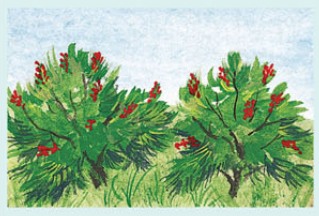
Scrublands
Foliage cover of 30–70%. Scrublands can also be called shrublands and heathlands, and they contain many different vegetation types. The typical vegetation is shrubs with a variable overstorey of small trees such as mulga (Acacia aneura) or eucalypts. Scrublands are adapted to drought, fire and low (but highly variable) rainfall.
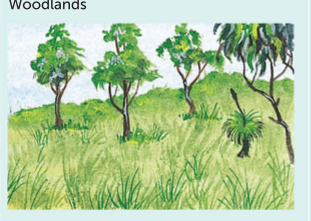
Woodlands
Widely spaced canopy cover of 10–30%; well-developed shrubs and grasses. The widely spaced trees are fewer and more scattered than in forests. Woodlands are mainly dominated by eucalypts and found mostly in southern, temperate Australia.
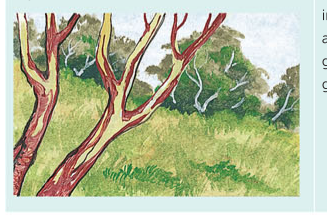
Alpine
Low, fairly continuous ground cover. Alpine ecosystems are found in cold mountain regions, including above the tree line (where altitude makes even summer temperatures too low for much tree growth). This ecosystem has rocky landscapes, and may contain glacial lakes and have seasonal snow coverage.
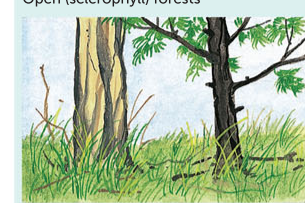
Open (sclerophyll) forests
Fairly open canopy cover of 30–70%; good understorey and ground cover. These forests are 25–35 m high, with fairly even height and moderately dense canopies that often join up. The forest floor can range from dry to damp and is covered with grasses and shrubs. These forests are dominated by eucalypts and are the most common forest type in Australia (the bush).
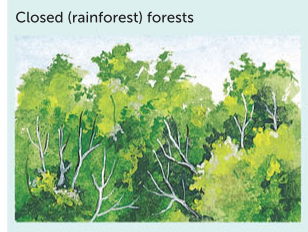
Dense canopy cover of 70–100%; distinct layers or storeys within forest. Rainforests are filled with mostly evergreen trees and typically receive high amounts of rainfall. Tropical rainforests are found near the equator, with high average temperatures and humidity, while temperate rainforests lie mostly in coastal, mountainous areas within the mid-latitudes.
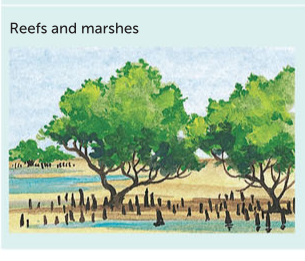
Dense growth. A reef is a ridge of material at or near the surface of the ocean. Reefs can occur naturally. Natural reefs are made of rocks or coral, which is the remains of skeletons of small animals. A marsh is a wetland, an area of land where water covers ground for long periods of time.
How do worms impact soil
Competition
occurs when individuals compete for a resource that limits their survival and reproduction
Collaboration
can occur when members of the same species work together to benefit all. These are examples of intraspecific interactions: relationships between members of the same species. On the other hand, the association that wolves or dolphins have with their respective prey is interspecific: it occurs between members of different species.
shape the biodiversity of an ecosystem.
The way in which one organism competes against or works with another organism to obtain their food helps shape the biodiversity of an ecosystem.
Seed predators
One example of herbivory influencing an ecosystem is seed predation. Seed predators can have a large effect on plant populations and their distribution throughout an ecosystem. These animals only feed on the seeds of plants, causing the seeds to become unviable as they pass through the predator’s digestive system. Another example of the effect of predation on the biodiversity of an ecosystem is the release of nutrients into the soil from decomposing animal carcasses left behind by predators, which provide nutrients for micro-organisms in the ecosystem
Symbiotic relationships
Symbiosis is the general term for a relationship between individuals of two or more species that benefits at least one of the species.
There are three main types:
1 parasitism: one species, the parasite, benefits at the expense of the other, the host
2 mutualism: both species in the relationship benefit and neither is harmed
3 commensalism: one species benefits and the other neither benefits nor is harmed. These relationships help shape the biodiversity of ecosystems.
Parasitism
The parasite derives its nutrients from the host organism, which is harmed during the process but not always killed. Ectoparasites, such as lice and ticks, live and feed on the external surface of their host organism. Endoparasites, such as tapeworms, live and feed within their host organism. Unlike in predation, the host is not immediately killed by the parasite, though it may sicken and die over time.
Mutualism
Pollinators are essential for many flowering plants to reproduce. Some plants, such as grasses, can be pollinated by wind. However, flowering plants generally rely on insects, birds, small mammals and even reptiles to transfer pollen from one plant to another. This is another example of mutualism; Seed dispersers are also intrinsic to ecosystem biodiversity. These include mammals and birds that eat fruits and seeds. When such an animal defecates, it deposits the seeds in a new location where they can germinate and grow. Seed dispersers are distinct from seed predators in that the seeds do not get damaged in the animal’s digestive system and therefore remain viable for germination.
Commensalism
Commensalism is a one-sided interaction between species. Only one of the two organisms involved, the commensal, benefits from the interaction; the other organism does not benefit, but it is not harmed. Some relationships are easy to identify as commensal, such as the relationship between the remora fish and the shark. The remora gets a free ride, and possibly free leftovers, by attaching to the shark using a suction pad on the back of its head. The shark is otherwise unaffected.
Epiphytes
Epiphytes are climbing plants, such as lianas, which use trees to support them as they reach for light. Their seeds germinate on the forest floor and the rapidly growing shoots spread out. If they reach a vertical surface, they take hold of it. Other seeds, such as those of orchids, are wafted high up to the branches and take hold there. In both of these instances, the tree offers support without apparently gaining anything in return and without being harmed in any way.
 Note
Note  Flashcards (124)