Assessment and intervention in Late language emergence
 Call Kai
 Learn
Learn Practice Test
 Spaced Repetition
 Match
Match Flashcards
 Knowt Play
1/31

There's no tags or description
Looks like no tags are added yet.
Name | Mastery | Learn | Test | Matching | Spaced | Call with Kai |
|---|
No analytics yet
Send a link to your students to track their progress
32 Terms
Late Language Emergence is also known as
Late talkers (LT)
Criteria of LLE:
Age, Semantics, and/or Syntax
Criteria of LLE - Age
24 months (2 years)
Criteria of LLE - Semantics
An expressive vocab of fewer than 50 words
Criteria of LLE - Syntax
No two-word combinations
Prevalence of LT (LLE) in 2 year-old (24 month)
about 10-20%
Prevalence of LT (LLE) in 30-36 month-old
about 16 to 17.5%
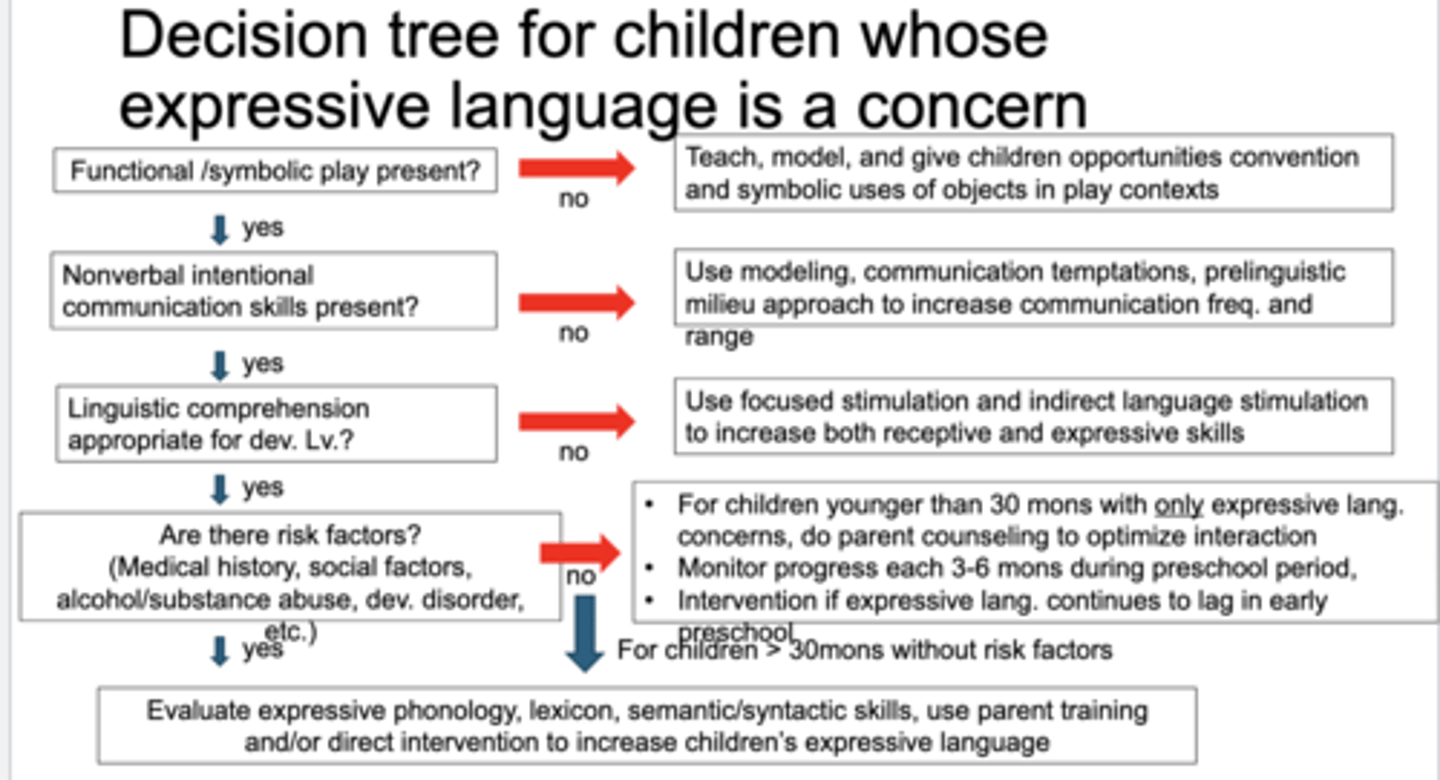
Decision tree for chilren whose expressive language is a concern
** make sure to look at play, comprehension, and risk factors before deciding intervention
Expressive Language is a concern follow these steps....
Goals of play assessment
- NOT used to decide if a child has prereq cognitive skills for learning language
- general development level = use of symbolic communication
- TO observe cognitive skills and conceptual imaginiatve abilities
-IDENTIFY toddlers' play level to design materials, play activities, and environmental contexts to encourage learning.
- Symbolic play may predict intervention outcomes!!!
Assessment on comprehension general guidelines
- Interview parents about childs known nouns/verbs/personal names
- vary contects bc comprehension is highly context dependent (ex. routines)
- Don't look at target, point towards, or request an item that child is approaching or touching during test.
- Make sure you measure consistancy. (test multiple times)
Assessment on comprehension targets at 12-18 months
Can the client understand 3-5 nouns and verbs without support? (single word comprehension)
12-18 months nouns example (comprehension assessment)
Target 6-8 objects that parents clain the child knows the names.
--- Say "give me...." (holding out you hand)
test body parts, location, persons names
--- Say "where's the ...?"
12-18 months verbs example (comprehnsion assessment)
Offer the child an object then say "Hit/throw/pat/kiss/hug/bite/put it"
Assessment on comprehension targets at 18-24 months
Can the client understand 2 word instructions? (2 word combination comprehnsion)
18-24 month comprehension example (comprehnsion assessment)
Use familiar words in unusual 2-word action/object combinations (as children may "do what you normally do)
--- Kiss the apple / push the baby / hug the car (to avoid context dependent knowledge)
If the client fails, fall back to commonly heard combos
--- Bite the apple / feed the baby / push the car
Assessment on comprehension targets at 24-36 months
Can the client understand 3-word agent-action object/agent instructions? (3 word sentence comprehension)
24-36 month comprehension example (comprehension assessment)
Use familiar words (greater freedom of choice) in probable combos
--- Act out "The baby feeds mommy" VS. Mommy feeds baby.
If the client feeds mommy then "child as agent"stratagy
If the client makes mommy feed the baby then probable event strategy
If child succeeds 3-word agent action-object/agent instruction then....
Move on to standardized comprehnsion assessments
Comprehension ability: 8-12 months
Ability: Understand a few single words in routine contexts
Comprehension ability: 12-18 months
Ability: Understand single words outside of routine but still require some contextual support.
Comprehension ability: 18-24 months
Abilitiy: Understands words for absent objects, some two-word combinations.
Comprehension ability: 24-36 months
Ability: Comprehends three-word sentences, but contexts or psat experience determines meaning ; little understanding of word order.
Other comprehension stratagies: Animate agent
The animate noun in the sentence is acted out as the agent in preference to the inanimate noun
"The dog pushes the block"
Other comprehension stratagies: Position bias
The picture or object in a preferred position (ex. preferred hand) is chosen
Other comprehension stratagies: Word order in a sentence
The first noun is mentioned in a sentence is preferred as the agent
Why is gesture assessment performed?
It is a prognostic indicator for children with language disorders!!!!
- Strong relationship between gesture and language in early development
- Young children often express meaning using gestures due to limitation in verbal abilities
- Parents who use word-gesture combination to infants may facilitate language development
- Word-gesture combination may lead to multiword speech
- For children with language disorders, their ability to use gesture goes beyond linguistic capacity
Gesture in developmental disorders: Frequency
- Toddlers with disabilities use fewer gestures than TD
Gesture in developmental disorders: Varient of communicative functions
- Ponting predicts first-word use
- ASD and others are associated with a limited variety of gestures at 18-24 months
- ASD and Down syndrome often acquire pointing late
Gesture in developmental disorders: Coordination of gestures with gaze and/or vocalizations
- TD uses gestures + gaze and/or vocalization by 15 months
- Lack of this coordination is associated with ASD and/or language delay
Gesture in developmental disorders: Transition from contact to distal gestures
- Failure to acquire gestures to indicate distant objects is associated with ASD and developmental disabilities
Gesture in developmental disorders: Transition to words
- TD name objects with words + gestures by 16 months, and uses words predominantly by 20 months
- Children who persist in using gestures to table objects after 20 months may have language delay.

