L2 - Philosophy of social science
 Studied by 0 people
 Call Kai
 Learn
Learn Practice Test
 Spaced Repetition
 Match
Match Flashcards
 Knowt Play
1/49

There's no tags or description
Looks like no tags are added yet.
Name | Mastery | Learn | Test | Matching | Spaced | Call with Kai |
|---|
No analytics yet
Send a link to your students to track their progress
50 Terms
Define:
Ontology
Epistemology
Methodology
Ontology = what is the nature of the social world - is there an objective reality or is it socially constructed?
Epistemology = what can we know about social phenomena (positivism, interpretivist, realist)
Methodology = how to we gain/obtain knowledge?
Define sociology
Sociology = scientific study of the social world
Define positivism
Positivism = Search for the truth through systematic collection of observable facts - knowledge about politics should be obtained objectively using the same methods as the natural sciences. (August Comte)
What are the 3 positions in positivism?
Classical positivism
Logical positivism
Falsification (Popper)
What is the main argument of classical positivism?
Science is objected to and value free. Not influenced by bias = neutral
e.g. Behaviouralism
What is naturalism in classical positivism?
social sciences should be studied in the same way as the natural sciences
What is empiricism in classical positivism?
knowledge is limited to what can be observed & measured (sensory experience). It must be empirically verified
What are Laws in classical positivism?
The social world is subject to regular systematic processes. Laws are explanatory & predictive
What is induction in classical positivism?
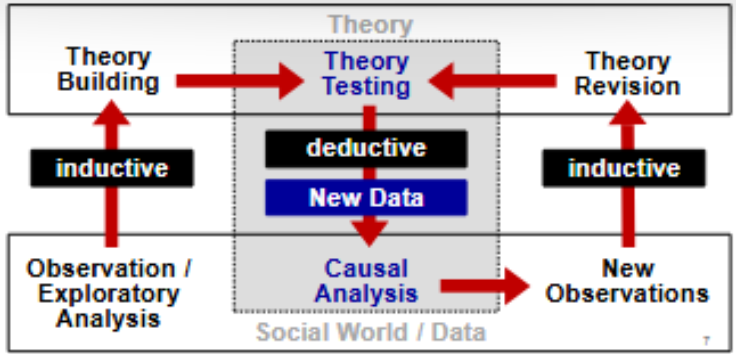
Specific observations → creation of general theory
What is cause-and-effect relationships?
Observable constant conjunction → A is constantly followed by B
Define logical positivism
Assumes that there is more than what can be directly observed (underlying explanations). Uses logic to find causal relationships and questions direct observations.
What does logical positivism involve?
Empiricism + logical reasoning = knowledge is limited to what can be observed & measured (empirically verified)
Verification - can be empirically verified & analytically true
What is deduction in logical positivism?
General theory → specific observation/conclusion
What is retroduction in logical positivism?
The back and fourth between induction and deduction (observation ←→ theory)
Why is induction, deduction & retroduction important?
You have to go back and fourth to constantly find new ways to test evidence and see if the theory is verifiable. Can lead to the dismissal of a theory or new findings.
Who criticises logical positivism?
Karl Popper - Falsification
Why does Popper reject induction?
States that a particular experience doesn’t always mean general knowledge - e.g. Back and white swans
It only takes one counter-observation and the law is falsified
Why does Popper reject verification?
Instead of verification of a theory, the goal should be falsification (replacing the theory with a better one)
Who created the Deductive-Nomological Model and the Hypothetico-Deductive Model
Carl Gustav Hempel
What is the Deductive-Nomological model?
Shows that an observed phenomenon is explained if it can be deduced from a universal law-like generalisation
e.g. glass window breaking if hit with enough force
Law = systematic processes, explanative & predictive → necessary connection NOT accidental generalisation
What is the Hypothetico-Deductive Model
Testing the ability of laws to predict events
Law → Hypothesis → Explicit Predictions
Prediction correct = hypothesis supported
Prediction incorrect = hypothesis falsified
What are 2 challenges to positivism?
Scientific realism and Interpretivism
What are 2 similarities between positivism and scientific realism?
Both believe social and natural worlds (sciences) are similar
Realism does also believe "objective" reality exists.
In what 4 ways does realism disagree with positivism?
Reality can consist of unobservable elements too e.g. structural relationships
Assessment by observable consequences
Uses causal mechanisms instead of law-like generalisations
“Best” theory is the one that explains phenomena the “best”
What are “environmental mechanisms” invented by Tilly in scientific realism
External conditions that change the situation of actors (e.g. economic crisis, state repression, new technologies…)
“Externally generated influences on conditions affecting social life”
What are “cognitive mechanisms” developed by Tilly in scientific realism?
How changes in actors perceptions, interpretations, or classifications of the world alter their behaviour or interactions.
They “operate through alternations of individual and collective perceptions”
Wat are “relational mechanisms” developed by Tilly in scientific realism?
Changes in social ties, interactions, or network structures between actors, thereby shaping collective action and outcomes.
These “alter connections among people, groups, and interpersonal networks”
What is Individualism's (micro level) ontological belief?
The basic unit of society are individuals, and social phenomena are the combined results of individual actions
What is Individualism's (micro level) methodology?
Explanations of social phenomena - classes, power, nations, or other social phenomena - must be reducible to the characteristics of individuals
What is Holism (macro level) ontological belief?
The whole of something is distinct from and not directly explicable in terms of its parts. Social facts have to have social causes that are irreducible to facts about individuals.
What is Holism (macro level) methodology?
The properties of a system as a whole cannot be deduced by the properties of its components alone. The system as a whole determines how the parts behave. Each social entity (group, institution, society) has a totality that is distinct.
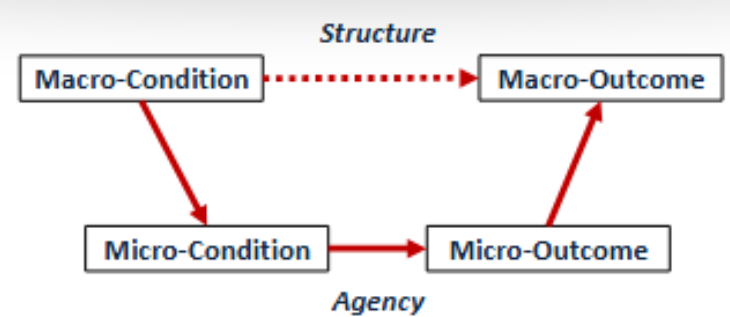
What is Coleman’s ‘Bathtub’
It argues that macro-level structures (such as laws, institutions, or economic conditions) do not directly cause macro-level outcomes; instead, they first shape micro-level structure (individuals’ incentives, opportunities, and constraints), which influence how people think and act. These individual actions then combine and interact, producing collective outcomes at the macro level.
Macro condition → micro condition → micro outcome → macro outcome
Why is interpretivism fundamentally different to positivism?
Interpretivism believes that the social world and the natural world are fundamentally different. Different methods are needed to take into account peoples interpretations.
But there are some similarities in collective evidence and establishing causal relations.
Name 2 ways interpretivism views the social world
Subjectively created
Understanding human behaviour by interpretation of meaning & social behaviour
What is Robert Jervis' famous quote about objectivity and values?
"“One can do a good job predicting what a study will find by knowing the preferences of the scholars who undertook it.”
What are 4 different perspectives regarding whether researchers' values are sources of bias in "objective" assessment?
Critical Theory (interpretivist): Yes, they can’t be separated
Positivism: Well, lets distinguish:
Normative theory (what ought or should be)
Empirical theory (what is)
Robert Cox: All theory is normative. Because they made assumptions about norms that are always implicit in every explanation we have.
Max Webber: Distinguish, yes, but values cannot be ignored (e.g. what is seen as relevant, point of view, (try to) strive for value-free social science
Why is being objective important?
Expectations shape perceptions.
E.g. do you see duck or rabbit first? Objective facts can be interpreted in different ways based on what you expect to see. Observations can change social phenomena
How can we be more objective?
Transparency - self discloser and critical examination by the larger scientific community
Who created the “normal science” and “structure of scientific revolutions”?
Thomas Kuhn
What did Kuhn argue?
Thomas Kuhn argued that to understand science, you must see it as a social activity carried out by a community that shares a common "way of seeing" the world, which he calls a paradigm.
What are the beliefs in the structure of scientific revolutions? 1962
Science is a social institution
Scientific community subscribes to a common view, paradigm, or conceptual scheme (=”normal science”)
Defines objects, norms & methods of investigation
‘Truth” is based on consensus in scientific community
What is meant by “normal science”?
Normal science is the routine research done but a paradigm: scientists solve problems whose solutions they assume exist if they use the accepted methods correctly
What is a paradigm?
A paradigm is a shared framework: exemplary theories, methods, instruments, and standards that a scientific community takes for granted.
What are paradigm shifts?
’Revolutionary’ change of paradigm
What are the different steps in in "scientific revolution"?
Pre-science →paradigm is established → normal science → anomalies build → crisis! → competition among candidates for a successor → revolution → one contender gains ascendancy over the others → new paradigm → generates new → normal science.
Who created Falsification and the Methodology of scientific research programs?
Irme Lakatos
What is scientific research programs?
Incremental, cumulative, progressive articulation of scientific research programmes lead to the growth of scientific knowledge.
What is Imre Lakatos' main argument?
Science advances not by instantly killing theories at the first failure, but by comparing whole research programs and favouring those that grow in a progressive way, producing new, confirmed knowledge.
What does the following mean "Hard core with a protective belt of auxiliary hypotheses"?
1. Hard core: The fundamental assumptions of a research program that scientists decide not to give up (at least for now), even in the face of anomalies.
2. Protective belt: hypotheses, models, initial conditions, measurement assumptions that surround the hard core and can be modified. When experiments conflict with predictions, scientists usually adjust the protective belt rather than abandon the hard core.
What are novel facts/anomolies?
Progressive (problem shifts) or degenerating research programs.
 Note
Note  Flashcards (491)