Code of Ethics
 Call Kai
 Learn
Learn Practice Test
 Spaced Repetition
 Match
Match Flashcards
 Knowt Play
1/19

Earn XP
Description and Tags
Topic 2
Name | Mastery | Learn | Test | Matching | Spaced | Call with Kai |
|---|
No analytics yet
Send a link to your students to track their progress
20 Terms
Code of Ethics
A basic set of values and behaviors that are intended to be embraced by users, so they conduct themselves responsibly, in an irreproachable manner, with honor and integrity.
Typically based on simple concepts that are of value to society, promote good behavior, foster trust, and result in respect of one another.
Should be easy to understand and written in general terms so it can be applied to every situation.
Why do you need code of Ethics?
Serves as a reference from moral guidelines
Used to inspire members to be ethical in their everyday pursuits
Define the moral aspects of being a professional and serves as a checklist of good behavior and desired attributes
Will raise consciousness and awareness of the moral obligations of a professional.
Can serve as the basis of discipline for undesirable behavior
Can be used as a resource when one is faced with a situation that involves moral perplexity or uncertainty
Sets a standard for professional behavior bound by the code that colleagues, the public, clients and employees can expect.
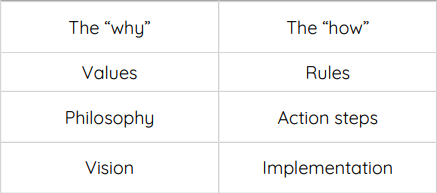
Principles
Broad philosophical commitments that express the core values of the civil engineering profession.
They describe why civil engineers must act ethically— the mindset, intent, and professional ideals behind ethical behavior.
Canon
Specific rules of conduct that civil engineers must follow in practice.
They describe how civil engineers must behave— the actions, duties, and professional obligations required in real situations.
Principles and Canons
FUNDAMENTAL PRINCIPLES
Civil Engineers uphold and advance the integrity, honor and dignity of the civil engineering profession by:
Using their knowledge and skill for the enhancement of human welfare and the environment.
Being honest and impartial and serving with fidelity the public, their employers/employees and clients.
Striving to increase the competence and prestige of the civil engineering profession
Supporting the professional and technical societies of their disciplines.
FUNDAMENTAL PRINCIPLES
Use knowledge and skill for human welfare & the environment
Engineering exist to protect life, property and nature
FUNDAMENTAL PRINCIPLES
Be honest, impartial, and serve with fidelity
Integrity is non-negotiable in all professional dealings
FUNDAMENTAL PRINCIPLES
Increase Competence, & prestige of the proffesion
Civil engineering must continuously evolve and uphold high standard
FUNDAMENTAL PRINCIPLES
Support professional & techincal societies
The profession grows through collective effort and collaboration
FUNDAMENTAL CANONS
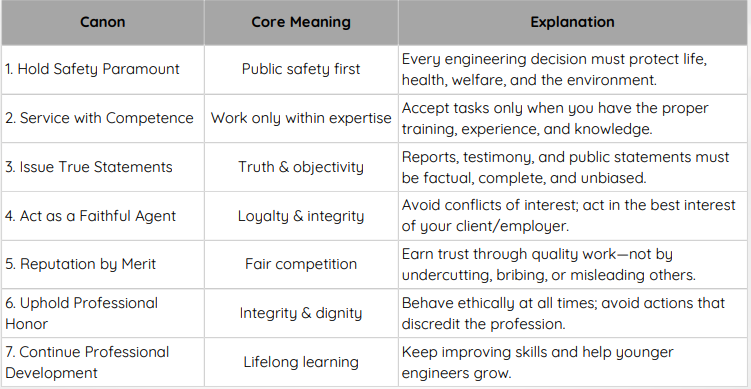
Hold Safety Paramount
Civil Engineers shall hold paramount the safety, health and welfare of the public and shall strive to comply with the principles of sustainable development in the performance of their duties.
FUNDAMENTAL CANONS
Service with Competence
Civil Engineers shall perform services only in areas of their competence.
FUNDAMENTAL CANONS
Issue True Statements
Civil Engineers shall issue public statements only in an objective and truthful manner.
FUNDAMENTAL CANONS
Act as Faithful Agent
Civil Engineers shall act in professional matters for each employer or client as faithful agents or trustees and shall avoid conflicts of interest.
FUNDAMENTAL CANONS
Reputation by Merit
Civil Engineers shall build their professional reputation on the merit of their services and shall not compete unfairly with othersF
FUNDAMENTAL CANONS
Uphold Professional Honor
Civil Engineers shall act in such a manner as to uphold and enhance the honor, integrity, and dignity of the civil engineering profession.
FUNDAMENTAL CANONS
Continue Professional Development
Civil Engineers shall continue their professional development throughout their careers and shall provide opportunities for the professional development of those civil engineers under their supervision.
FUNDAMENTAL CANONS
Summary
Civil engineering is more than calculations and structures—it is a commitment to protect lives, serve communities, and uphold the highest standards of integrity. The Code of Ethics reminds us that every decision we make carries real impact. By prioritizing safety, practicing within our competence, speaking truthfully, acting with loyalty, competing fairly, honoring our profession, and continuously improving ourselves, we strengthen not only our careers but the entire civil engineering community. Ethical practice is not an option—it is the foundation of public trust and the legacy we leave for future generations.

