Ch: regulating the internal enviornment
 Studied by 0 people
 Call Kai
 Learn
Learn Practice Test
 Spaced Repetition
 Match
Match Flashcards
 Knowt Play
1/134

There's no tags or description
Looks like no tags are added yet.
Name | Mastery | Learn | Test | Matching | Spaced | Call with Kai |
|---|
No analytics yet
Send a link to your students to track their progress
135 Terms
Animal life is challenged under changing environmental conditions-_________________compensate for changing conditions and maintain the internal environment within the relatively narrow limits that calls can tolerate
homeostatic control systems- glomeruli in a kidney
osmoregulation
the regulation of water and ion balance
Excretion
helps maintain the body’s water and ion balance while ridding the body of metabolic wastes
Thermoregulation
is the control of body temperature
Osmosis
water molecules diffuse across a selectively permeable membrane from a region of higher water concentration (low solute concentration) to a region of lower water concentration (higher solute concentration)
Osmolarity
total solute concentration of a solution is measured in osmoles- the number of solute molecules and ions (in moles) per liter of solution
What is the osmolarity of body fluids in humans and other mammals about
300 mOsm/L
Hyperosmotic
the solution with higher osmolarity is ____to the other solution
concentrated salt solution
water leaves the cell so the cell shrinks
Isotonic
if the solutions on either side of a membrane have the same osmolarity, they are_____
normal salt concentration
no net movement
Hypoosmotic
the solution with lower osmolarity is ______to the other solution
distilled water
water enters the cell so cell swells or bursts
For metabolic stability, animals must keep their cellular fluids and ECFs
isoosmotic
Osmoconformers
the osmolarity of cellular and extracellular solutions matches that of the environment
Osmoregulators
use control mechanisms to keep the osmolarity of cellular and extracellular fluid the same, but at levels that may differ from the osmolarity of the surroundings
What structures carry out osmoregulation and excretion in animals?
Microscopic tubules formed from a transport epithelium that regulate water, ions, and waste.
How are these tubules positioned in the body?
the tubules are immersed in body fluids at the proximal end and open to the body exterior at the distal end
How do the tubules move substances in and out?
transport proteins move specific molecules and ions into and out of the tubule by either active or passive transport, depending on the substance and its concentration gradient
Four steps in tubule function
Filtration
Tubular reabsorption
Tubular secretion
Excretion
Filtration
The process by which blood pressure forces water and small solutes (like ions, glucose, and urea) out of the glomerulus into Bowman’s capsule, forming filtrate.
Location: Glomerulus (renal corpuscle).
Purpose: To separate waste and small molecules from blood.
Tubular Reabsorption
Definition: The process of returning useful substances (like water, glucose, and ions) from the filtrate back into the blood.
Location: Along the renal tubule, mainly in the proximal convoluted tubule.
Purpose: To conserve valuable nutrients and maintain fluid balance.
Secretion
is a selective process in which specific small molecules and ions are transported from the ECF and blood into the tubules
Excretion
fluid (urine) containing waste materials is released into the environment from the distal end of the tubule- solid or semisolid form
: What is metabolic water, and how is it used in the body?
Metabolic water is the water produced during the metabolism of ingested food. It’s used in chemical reactions and physiological processes such as waste excretion.
: What happens to the nitrogenous products from the breakdown of proteins, amino acids, and nucleic acids?
They are excreted as ammonia, urea, uric acid, or a combination of these substances.
What determines which nitrogenous waste molecule an animal produces?
The type depends on a balance between toxicity, water conservation, and energy requirements.
Ammonia
NH3 results from biochemical reaction removing amino groups from amino acids during protein breakdown
soluble in water, but highly toxic- it must be either excreted or converted can be excreted only in dilute conditions
Examples: teleost, larval amphibians, aquatic invertebrates
excrete this straight into the surrounding water
This works because:
Ammonia is very soluble in water.
They can diffuse it easily across gills or body surfaces.
The constant water flow dilutes the ammonia quickly, preventing toxicity.
Urea
made by all mammals, mostly amphibians, some reptiles, some marine fishes, and some terrestrial invertebrates combine ammonia with HCO3 relatively nontoxic substance
requires more energy than forming ammonia, excreting urea instead of ammonia requires minimal water.
Uric acid
formed by terrestrial invertebrates, reptiles, and birds
nontoxic and insoluble - it participates in water and excreted as a paste
more energy than urea to generate but allows four times nitrogen
excretion conserves about 99% of the water required to excrete the same amount of nitrogen as ammonia
Most marine invertebrates are __________
osmoconformers – the osmolarity of their intracellular and extracellular fluids and the surrounding seawater is the same, about 1,000 mOsm/L
All freshwater invertebrates are _________
osmoregulators – they must expend energy to excrete excess water to keep their internal fluids hyperosmotic to their surroundings
Fresh water invertebrates also _______salt ions from the water, through skin or gills, into their bodies
actively transport
Invertebrate osmoregulators use three types of tubules for carrying out excretion:
Protonephridia, the simplest form of excretory tubule, found in flatworms and larval mollusks
Metanephridia, found in annelids and most adult mollusks
Malpighian tubules, found in insects and other arthropods
Protonephridia
the simplest form of excretory tubule, found in flatworms and larval mollusks
Metanephridia
found in annelids and most adult mollusks
Malpighian tubules
found in insects and other arthropods
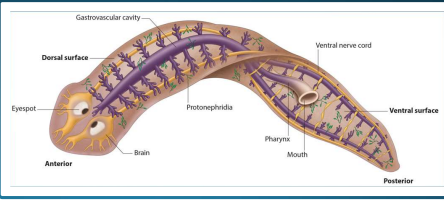
Protonephridia
found in flatworms
proximal branches of the tubule network and with a flame cell containing cilia that move fluid through the tubule
when hemolymph passes through ____, some molecules and ions are reabsorbed, and nitrogenous wastes are secreted into the tubules
urine is released through pores at the distal ends of the tubules where they reach the body surface
Metanephridia
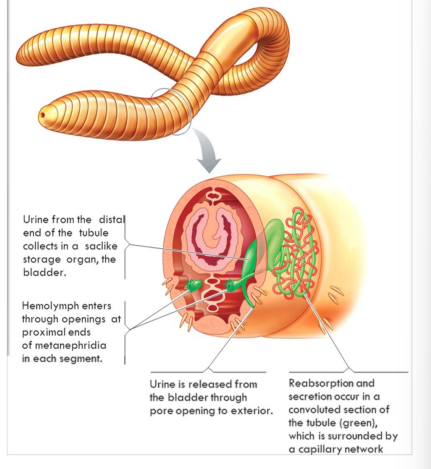
in the earthworm
urine from the distal end of the tubule collects in a saclike storage organ, the bladder
hemolymph enters through openings at proximal ends of metanephridia in each segment
urine is released from the bladder through pore opening to exterior
reabsorption and secretion occur in a convoluted section of the tubule (green) which is surrounded by a capillary network
Malpighian tubules
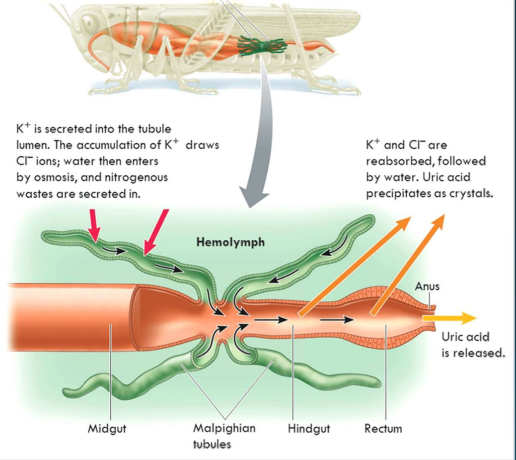
have a closed proximal end immersed in hemolymph
distal ends empty into the gut
tubules secrete K+ into the lumen of the proximal segment, which draws in Cl- from the hemolymph
water follows the KCl
uric acid is secreted into the tubule
when fluid reaches the hindgut K+ and Cl- are reabsorbed, followed by water
uric acid precipitates as crystals released with feces
Osmoregulation and excretion in mammals
specialized excretory tubules (nephrons) located in the kidney carry out excretion
The ________carries blood into the kidney
renal artery
The filtered blood leaves the kidney by the
renal vein
reabsorb important molecules and ions from the filtrate
peritubular capillaries
Urine is processed in
collecting ducts then drain through the
renal pelvis
ureter
urinary bladder
urethra
The mammalian kidney is divided into an outer ________and a central________
renal cortex; renal medulla
nephrons extend between the two regions
each kidney can obtain up to a million nephrons
Nephrons have ____major regions and are closely associated with a collecting duct
four
Renal corpuscle (Bowman’s capsule)
filters blood, forming a '“pre urine” or filtrate consisting of ions, nutrients, wastes, and water
ultrafiltration
Proximal convoluted tubule (PCT)
epithelial cells reabsorb nutrients, vitamins, valuable ions, and water
selective reabsorbtion
Loop of Henle
establishes a strong osmotic gradient in the tissues outside of the loop, and osmolarity increases as the loop descends
osmoregulation (salt gradient)
Distal convoluted tubule (DCT)
ions and water are reabsorbing
selective reabsorption
collecting duct
water retention
Renal corpuscle
composed of glomerulus and Bowman’s capsule
glomerular filtration occurs in the Bowman’s capsule which cups around a ball of arterial capillaries (the glomerulus)
Glomerular capillaries
have pores that make them more permeable to water and solutes than other capillaries
Blood pressure drives fluid containing solutes through the pores of the capillaries into _________blood cells and plasma proteins are retained in the capillaries
Bowman’s corpuscle
The diameter of the afferent arteriole -delivering blood to the glomerulus is _______than that of the efferent arteriole- maintaining a high level of glomerular capillary pressure
larger
Proximal tubule is for what region function
reabsorption
Things moving out of the tubule (→ back into the body / reabsorbed):
Substance | How it moves | Why it moves |
|---|---|---|
Na⁺ (sodium) | Active transport (Na⁺/K⁺ pumps) | Needed for fluid and ion balance; creates a gradient for other substances to follow |
Cl⁻ (chloride) | Follows Na⁺ passively (voltage gradient) | Balances charge |
Glucose, amino acids, nutrients | Active transport (specific proteins) | Body needs them for energy and growth |
Water (H₂O) | Osmosis through aquaporins | Follows solutes to balance concentration |
Movement of vessels
All of these go from the tubule → interstitial fluid → peritubular capillaries → back into the bloodstream.
Things moving into the tubule (→ to be excreted):
Substance | How it moves | Why it moves |
|---|---|---|
H⁺ (hydrogen ions) | Active transport | Helps control blood pH (removes excess acid) |
Detoxified waste products (from liver) | Passive diffusion | Gets rid of toxins or drugs |
Region 3
Descending loop of hele
Descending loop of henle
Filtrate leaving the proximal convoluted tubule enters the descending segment of the loop of Henle, where water is reabsorbed
This segment descends through regions of increasingly___________ in the interstitial fluid of the medulla – water moves out of the tubule through aquaporins
increasingly higher solute concentrations so water moves out of the tubule through aquaporins
What happens to the osmolarity of the filtrate as it moves down the descending loop of Henle?
The osmolarity of the filtrate gradually increases, reaching a peak of about 1,200 mOsm/L at the bottom of the loop because water leaves and solutes stay behind.
Difference between ascending and descending loop of henly
The descending loop of Henle is permeable to water but not to salts, so water leaves the filtrate, making it more concentrated as it moves down.
The ascending loop of Henle is impermeable to water but actively transports salts out, so salts leave and the filtrate becomes more dilute as it moves up.
👉 In short:
Descending = water out, Ascending = salts out
The scending segment
has membrane proteins that transport salt ions, but no aquaporins-water is trapped, while salt ions move out of the tubule
the reabsorption of salt ions helps establish the concentration gradient of the medulla – high near the renal pelvis and low near the renal cortex
At the top of the ascending loop, filtrate osmolarity has dropped to about 150 mOsm/L
Descending limb is highly
permeable to water but impermeable to solutes
Ascending limb is nearly
impermeable to water but highly permeable to Na+ and Cl-
Thin ascending limb
passive transport
Thick ascending limb
active transport
Distal convoluted tubule what it does
secretion and reabsorption
Substances moving out of the DCT (→ reabsorbed back into the body)
additional water is recovered by osmosis from the fluid in the distal convoluted tubule in response to hormones triggered by changes in the body’s salt concentrations
Na+ and Cl- ions are reabsorbed- urea and other nitrogenous wastes remain the same
Substances moving into the DCT (→ secreted into the filtrate)
varying amounts of K+ and H+ ions are secreted into the fluid,
Fluid urine entering the collecting ducts
by the time the fluid (urine) enters the collecting ducts, it is isosmotic with blood plasms ( about 300mOsm/L) but very different in composition
Collecting ducts
these are permeable to water but not salt ions
as they descend from the medulla of the kidney, they encounter an increasing solute concentration
water moves out osmotically
passive urea transporters near the bottom of the medulla contribute to the concentration gradient of the solutes in the medulla
Three features interact to conserve nutrients and water, balance salts, and concentrate wastes for excretion:
The loop of Henle, which descends through the medulla and returns again to the cortex
Differences in permeability along the nephron, established by specific membrane transport proteins in each region
A concentration gradient of molecules and ions in the interstitial fluid of the kidney, which increases from the renal cortex to the deepest levels of the renal medulla
What do the three kidney control systems monitor?
They link kidney function to blood pressure, osmolarity/pH of body fluids, and water balance, ensuring homeostasis.
How does the kidney maintain constant glomerular filtration despite small blood pressure changes?
Through autoregulation — an internal kidney system that adjusts arteriole diameter to keep filtration stable.
What role do hormonal controls play in kidney function?
Hormones compensate for salt or water loss and adjust water reabsorption in the kidneys to maintain proper fluid and electrolyte balance.
If blood pressure rises:
More blood enters the glomerulus → filtration rate would go up if unregulated.
Kidney sensors (receptors) detect this.
Response:
Afferent arteriole constricts → less blood flows into glomerulus.
Efferent arteriole dilates → blood leaves faster.
✅ Result: Filtration rate goes back down to normal.
If blood pressure drops:
Less blood enters glomerulus → filtration rate would fall.
Kidney sensors detect this.
Response:
Afferent arteriole dilates → more blood flows in.
Efferent arteriole constricts → blood stays longer.
✅ Result: Filtration rate rises back to normal.
Specialized tubule cells in the ___________monitor salt level of the fluid in the tubule
juxtaglomerular apparatus
If salt level rises
______________
The macula densa cells release paracrine signals (local hormones) that act on the afferent arteriole.
Response: afferent arteriole constricts → less blood enters the glomerulus.
✅ Result: filtration rate decreases, preventing too much salt from being lost in urine.
If salt it too low
____________
The opposite happens: afferent arteriole dilates, increasing filtration to allow more salt excretion.
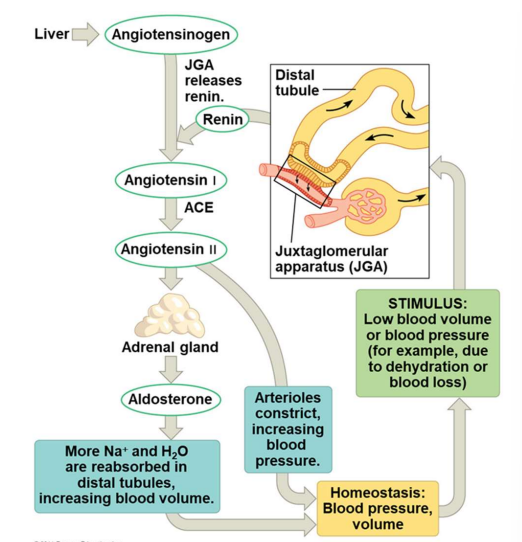
What RAAS Does
hormonal system involved in regulating Na+ balance
Analogy for RAAS
Blood pressure drops → renin calls the team → angiotensin II constricts roads (vessels) and tells the reservoirs (kidneys) to keep water and salt → system restores pressure.
The RAAS system responds when
reduced sodium delivery to the distal convoluted tubule detected by macula densa cell. (excessive sodium is excreted)
Reduced perfusion pressure in the kidney detected by baroreceptors in the afferent arteriole (BP drop and/or blood volume drop)
Sympathetic stimulation of the JGA via B1, adrenoreceptors
How does Angiotensin II affect water absorption and blood pressure?
Angiotensin II stimulates ADH secretion, which increases water reabsorption in the kidneys, helping to raise blood pressure.
elevated blood pressure has the opposite effect on the RAAS
Elevated blood pressure also stimulates cells in the heart to release _____________that inhibits renin release, dilatates afferent arterioles to the glomeruli, and inhibits aldosterone release
atrial natriuretic factor (ANF)
that inhibits renin release
dilates afferent arterioles to the glomeruli, and inhibits aldosterone release
inhibits aldosterone release
What does the ADH system regulate in the body?
ADH regulates osmolarity and water balance by increasing water reabsorption in the kidneys without changing salt excretion.
How do the hypothalamus and osmoreceptors control ADH?
: ADH-secreting neurons in the hypothalamus sense osmolarity; when osmolarity rises, they increase ADH secretion.
How does ADH increase water reabsorption in the kidneys?
ADH acts on distal convoluted tubules and collecting ducts by inserting more aquaporins into epithelial membranes, allowing more water to move back into the blood.
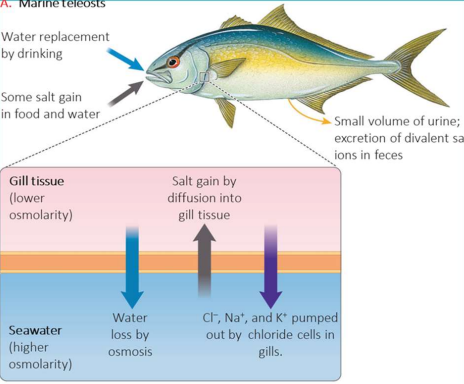
How do marine teleosts replace water lost by osmosis?
Marine teleosts continually lose water to their environment by osmosis and must replace it by continual drinking.
How are ions and nitrogenous wastes handled in marine teleosts?
Excess Cl– is eliminated by chloride cells in the gills, which actively transport it into the surrounding seawater – Na+ and K+ are actively transported to maintain electrical neutrality. Ca2+ and Mg2+ are removed in isoosmotic urine. Nitrogenous wastes are released from the gills as ammonia – kidneys play little role in nitrogenous waste removal.
Sharks and Rays
maintain osmolarity of their body fluids close to that of seawater by retaining high levels of urea and trimethylamine oxide (TMAO) in body fluids Sharks and rays maintain osmolarity of their body fluids close to that of seawater by retaining high levels of urea and trimethylamine oxide (TMAO) in body fluids
Isoosmolarity keeps them from losing water to the surrounding sea by osmosis, and they do not have to drink seawater continually to maintain their water balance
Excess salts ingested with food are excreted in the kidney and by a rectal salt gland located near the anal opening
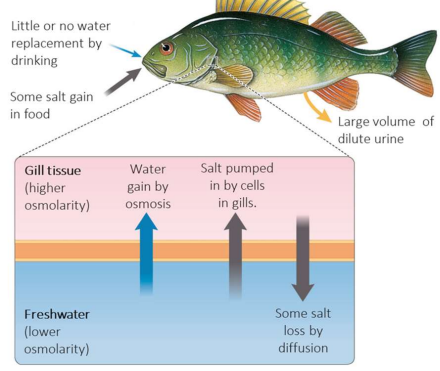
Freshwater fishes and amphibians
are hyperosmotic to the surrounding water (water moves osmotically into their tissues)
they rarely drink, and excrete large volumes of dilute urine to get rid of excess water
salt ions lost urine are replaced by salt in foods and by active transport of Na+ and K+ into the body by gills (in fishes) or across the skin (in amphibians)
Terrestrial amphibians
must conserve both water and salt, which is obtained primarily in foods
kidneys secrete slat into urine, causing water to enter urine by osmosis- salt is reclaimed in the bladder by active transport and returned to body fluids
also have behavioral adaptation that help minimize water loss, such as seeking shaded, moist environments and remaining inactive during the day.
Reptiles and birds
conserve water by secreting nitrogenous wastes in the form of uric acid crystals
epithelial cells of the cloaca absorb water from feces and urine before wastes are excreted
these that live in or around seawater take in large quantities of salt with their food and rarely drink fresh water
secrete excess salt through salt glands in the head, which remove salts from the blood by active transport
Adaptations that conserve water
Water-conserving activities of the kidneys, length of loop of Henle
Location of the lungs deep inside the body reduces water loss by evaporation during breathing
A body covering of keratinized skin almost eliminates water loss by evaporation
Water-conserving adaptations reach their greatest efficiency in _________ such as the kangaroo rat – 90% of its daily water supply is generated from oxidative reactions in its cells
desert rodents
Temperature regulation (thermoregulation)
is based on negative feedback pathways in which temperature receptors (thermoreceptors) detect changes from a set point
signals from receptors trigger phsiological and behavioral responses that return the temperature to the set point
All responses triggered by negative feedback mechanisms involve adjustments in rate of heat generating oxidative reactions within the body-couples with adjustments in rate of heat gain or loss at the body surface
Within a range of tolerable temperatures, an animal’s ____________varies greatly
organismal performance (biochemical, psychological, and whole body processes)
Heat exchange
All animals gain or lose heat by a combination of conduction, convection, radiation, and evaporation
To maintain constant body temperature, the heat gained and lost through these pathways must balance
 Note
Note  Flashcards (500)