Aquatic Botany Rhodophytes and Chlorophytes quiz
 Call Kai
 Learn
Learn Practice Test
 Spaced Repetition
 Match
Match Flashcards
 Knowt Play
1/75

There's no tags or description
Looks like no tags are added yet.
Name | Mastery | Learn | Test | Matching | Spaced | Call with Kai | Chat |
|---|
No analytics yet
Send a link to your students to track their progress
76 Terms
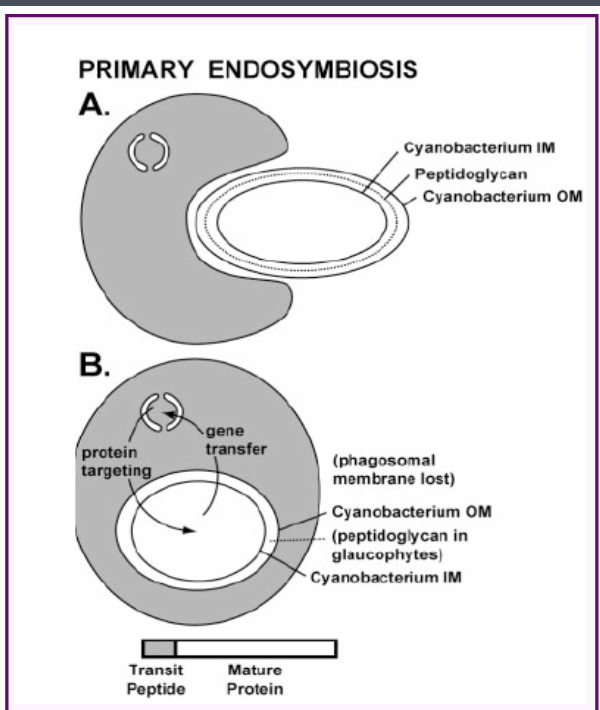
Explain the process of primary endosymbiosis
Host feeds on cyanobacteria
Instead of breaking down the chloroplast, there’s gene transfer (cyanobacteria genome reduced though)
Peptidylglycan layer lost
Phagosomal membrane lost
Cyanobacteria’s membranes are retained so it doesn’t die when the host does
Leads to evolution of chloroplast organelle
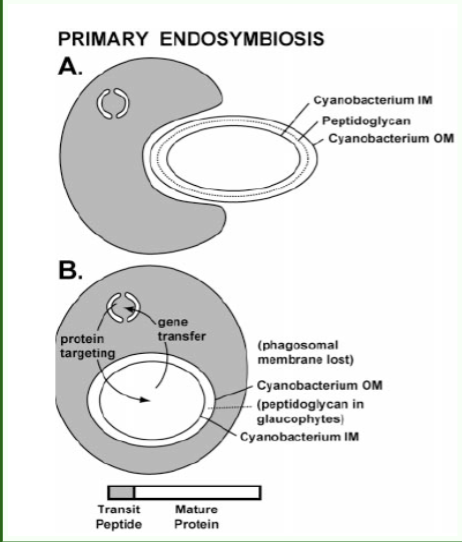
What cyanobacterial system is usually retained during primary endosymbiosis?
The electron transport system
What is a proplastid?
It is what exists before the chloroplast, and eventually becomes a chloroplast after being divided into gametes
What are the different indicators of chloroplast evolution stages?
Initial: proplastid
Develops into chloroplast envelope- double membrane in Chlorophyta and Rhodophyta
Endoplasmic reticulum
Some one membrane (Euglenophyta and Dinophyta)
Some two membrane (Cryptophyta, Prymnesiophyta, Heterokontophyta)
Those with two have 4 total??
List an important distinction between cyanobacteria and all other microalgae phytoplankton
Cyanobacteria lack chloroplasts
Cyanobacteria do have thylakoids
Describe the stroma
Matrix inside chloroplast envelope
Site of CO2 fixation
Use RuBisCO for the CO2 fixation
True or False: Most photosynthesizers have too much RuBisCO
True, so they store it in the crystalline pyrenoid
Describe thylakoids
Membranous vesicles or disks
Contain chlorophyll
May form bands or be free (phylum specific)
What do lipid droplets do?
They have light-absorbing pigments, which help with light sensing and directionality
How does the thylakoid generate ATP synthesis?
The membrane has a proton gradient which builds as shit moves across it, generating ATP
True or False: Rhotophytes and cyanobacteria have thylakoids that form bands.
False. Their thylakoids are free with phycobilisomes on the surface.
What do phycobilisomes do?
They capture light and transfer it to processing centers
What group has thylakoids that form 2 bands?
Cryptophyta
What groups have thylakoids that form bands of 3 with a girdle?
Euglenophyta and Heterokontophyta
What groups have thylakoids that form bands of 3 without a girdle?
Dinophyta, Prymnesiophyta, and Eustigmatophyceae
What group has thylakoids that form bands of 2-6
Chlorophyta
What are the two main lineages of primary endosymbiosis?
Red plastids (Rhodophytes)
Green plastids (Chlorophytes)
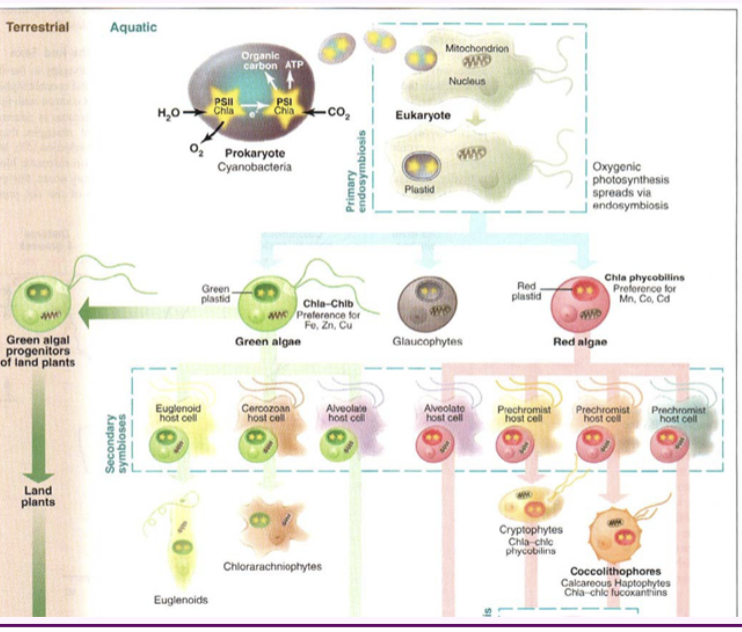
Primary endosymbiosis in Rhodophytes results in 2 membranes around the plastids. Where are they thought to come from?
One is thought to come from cyanobacteria
The other is thought to come from the food vacuole
Originated by primary
endosymbiosis of
cyanobacteria &
flagellated heterotroph
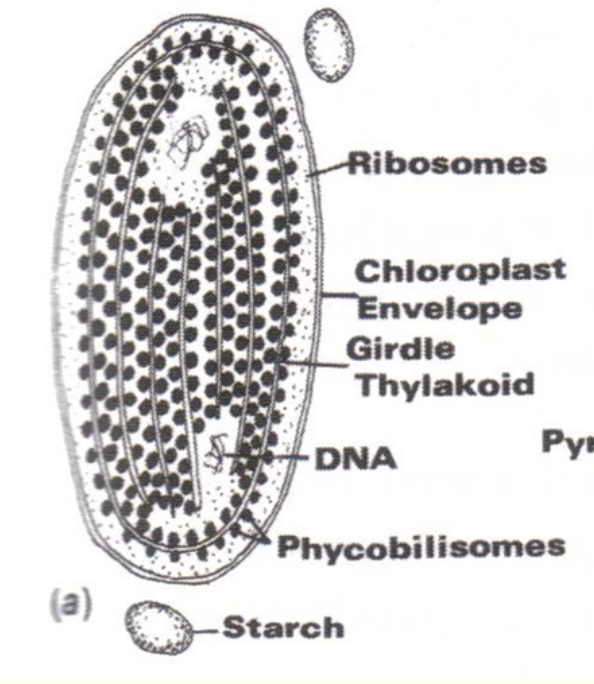
Where are phycobilisomes on rhodophytes? How many membranes does the chloroplast envelope have? How many thylakoids?
On thylakoid bands
2 membranes on envelope
Single thylakoids
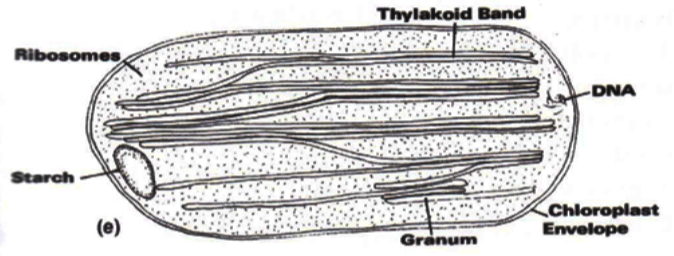
How many membranes are in the chloroplast envelope of chlorophytes? How many bands of thylakoids do chlorophytes have?
2 membranes in the envelope
2-6 bands of thylakoids
How many membranes does the chloroplast envelope have in Cryptophyta? How many bands of thylakoids? How many membranes of chloroplast endoplasmic reticulum?
3 membranes in chloroplast envelope
2 bands of thylakoids
2 membranes of chloroplast endoplasmic reticulum
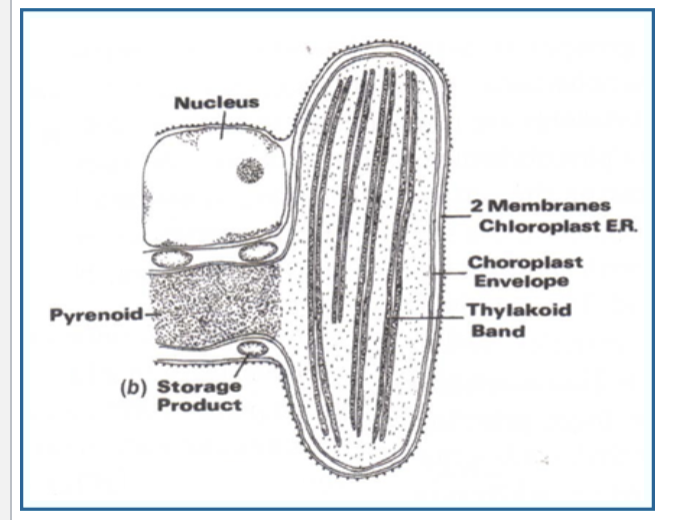
How many membranes do chloroplast envelopes have for heterokontophyta? What about bands of thylakoids? How many membranes of the endoplasmic reticulum?
3 chloroplast membranes
3 bands of thylakoids
2 membranes of chloroplast endoplasmic reticulum
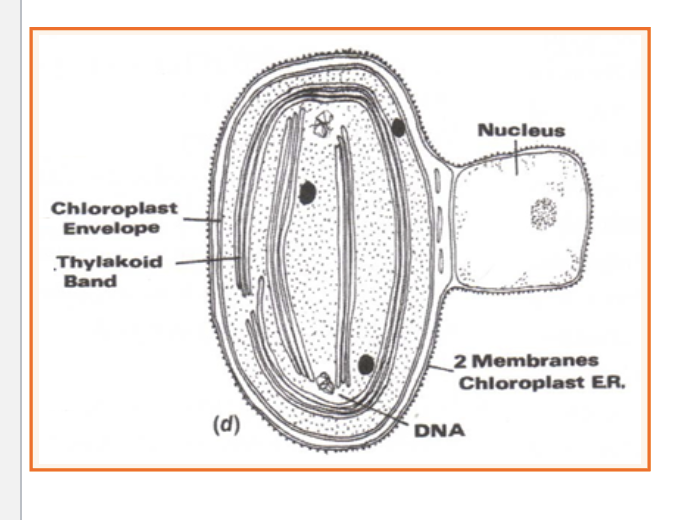
How many membranes do dinophyta/euglenophyta chloroplast envelopes have? How many bands of thylakoids? How many membranes of chloroplast ER?
3 membranes for chloroplast envelope
3 bands of thylakoids
1 ER membrane
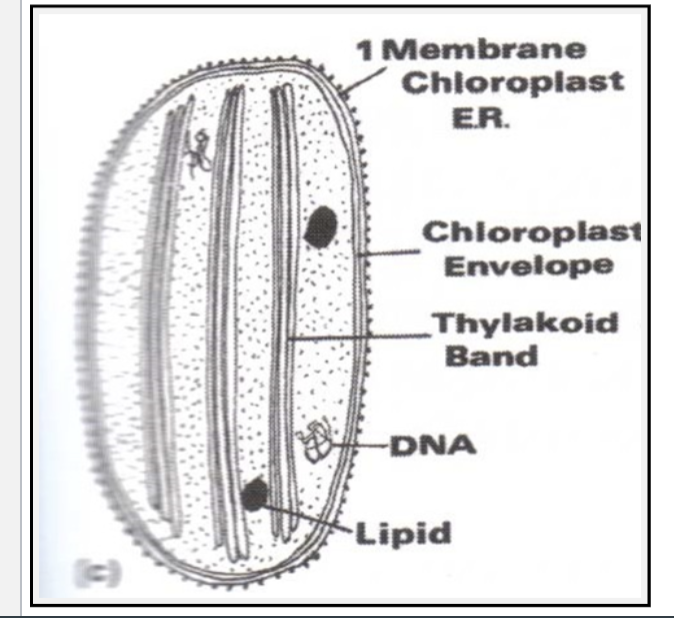
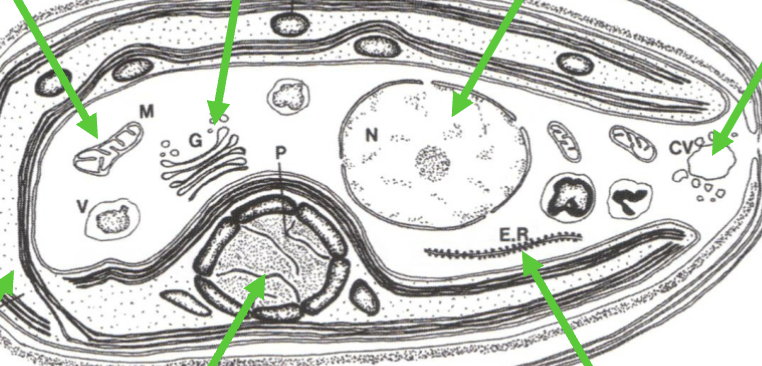
Which arrow is pointing to the pyrenoid?
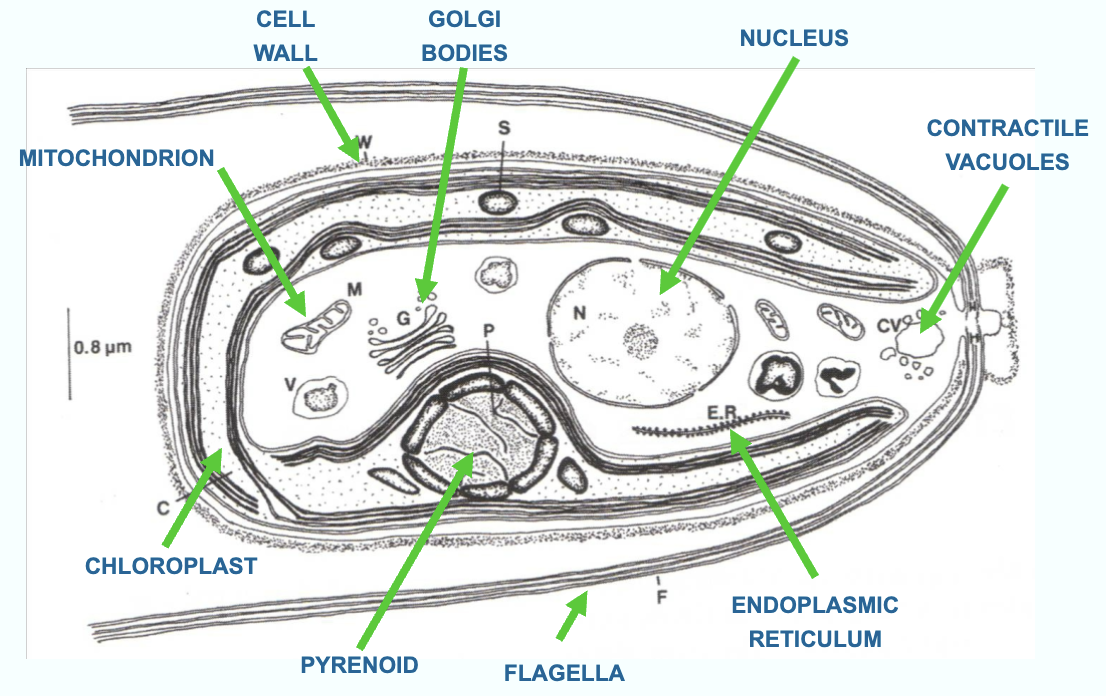
What is the main function of flagella?
Movement! For sessile organisms, they use flagella to move the surrounding water for things like feeding.
What is an axoneme?
9 doublet microtubules surrounding 2 central microtubules
What comprises 90% of the proteins that make microtubules?
α & β tubulin. Microtubules together form flagella
What is a flagellar collar?
Tunnel through cell wall
Where are radial spokes?
Project from A-microbutules of doublets on perimeter
Describe dynein arms
Connect outer microtubule doublets A—→B
ATP hydrolysis causes dynein to move
A = cargo
B = track
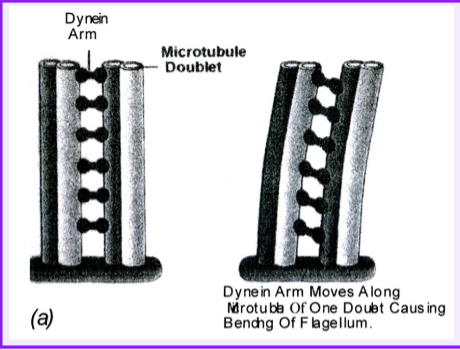
Describe kinesin
Protein involving the rotation of central microtubules
Interact with radial spokes causes sliding between adjacent outer microtubules
True or false: most algae have tubular flagellar hairs, while Heterokonts have non-tubular.
False. The opposite is true.
Describe rhodophyta
No flagella
One of oldest groups of eukaryotic algae
Acidic tolerance
Floridean starch food reserve (variation of land plant starch)
Cell wall: cellulose in agar and carragenean
What pigments do Rhodophyte chloroplasts have?
Chlorophylls a & c
Phycobilisomes
Phycocyanin
Allophycocyanin
Phycoerythricin
Chromatic adaptation
Describe group Cyanidales within Rhodophyta
UNICELLULAR
EVOLVED IN VOLCANIC AREAS
Acid hot springs- pH 0.5 ‒ 3
SMALLEST EUKARYOTIC GENOME
TEMPERATURES TO 56°C
BELIEVED TO BE MOST PRIMITIVE OF RED ALGAE
Describe group prophyridiales within rhodophyta
UNICELLULAR OR CELLS EMBEDDED IN MUCILAGE FILAMENT
Found in soil
Phototactic
Glides over surface with
release of muscilage
Releases polysaccharides
depending on environmental conditions
Describe the group bactrachospermales within rhodophyta.
Freshwater alga
GELATINOUS FILAMENTS
Whorled branches around cells
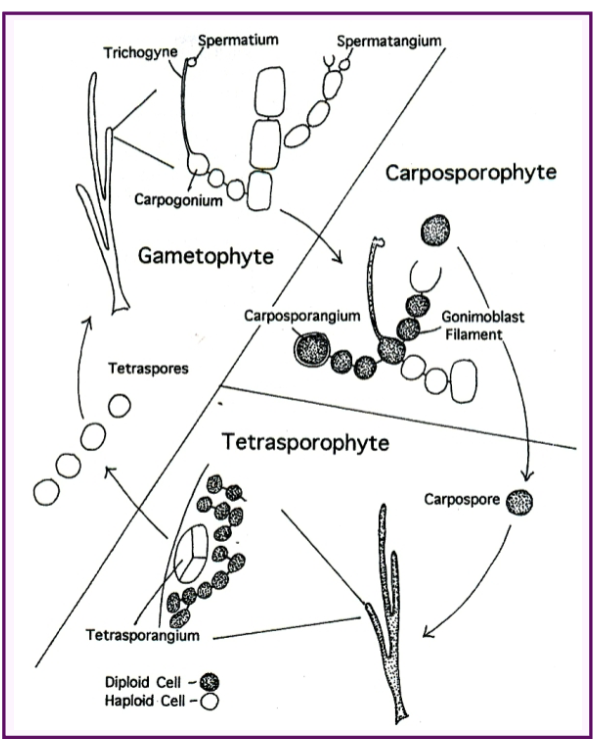
Describe rhotophyta reproduction
SPERMATIA = Male gametes
Released into water
CARPAGONIA = Female gametes
CARPOSPOROPHYTE
Formed from fertilized carpagonium
Produces spores from
gonimoblast filament
TETRASPOROPHYTE
Formed from spores released by carposporophyte
Produces haploid spores that form gametophyte
True or False: Chlorophyte plastids are surrounded by 2 membranes with 3-5 bands of thylakoids.
True, they are.
True or False: Rhodopsin is the photoreceptor for phototactic response in chlorophytes.
True, chlorophytes use chlamydomonas sensory rhodopsin A in high intensity/longer wavelength light, and B in low intensity/shorter wavelength light.
In chlorophytes, the phototactic response to changes in light intensity involves which of the following processes?
A. A change in membrane potential
B. A change in Ca2+ levels
C. A change in the beating of the flagella
D. All of the above
D. All of the above
Which of the following chlorophyte genus in order Volvocales are motile in flooded habitats but nonmotile in soil?
A. Chlamydomonas
B. Ulvophyceae
C. Volvox
D. Dunaliella
A. Chlamydomonas
True or False: The prasinophyte Tetraselmis forms symbiotic associations with segmented worm hosts in the group Annelida.
False, they have symbioses with the flatworm Convoluta roscoffrensis.
True or False: Eukaryotic algae originate via endosymbiosis.
True. A flagellated heterotroph engulfed a cyanobacteria, which evolved eukaryotic algae.
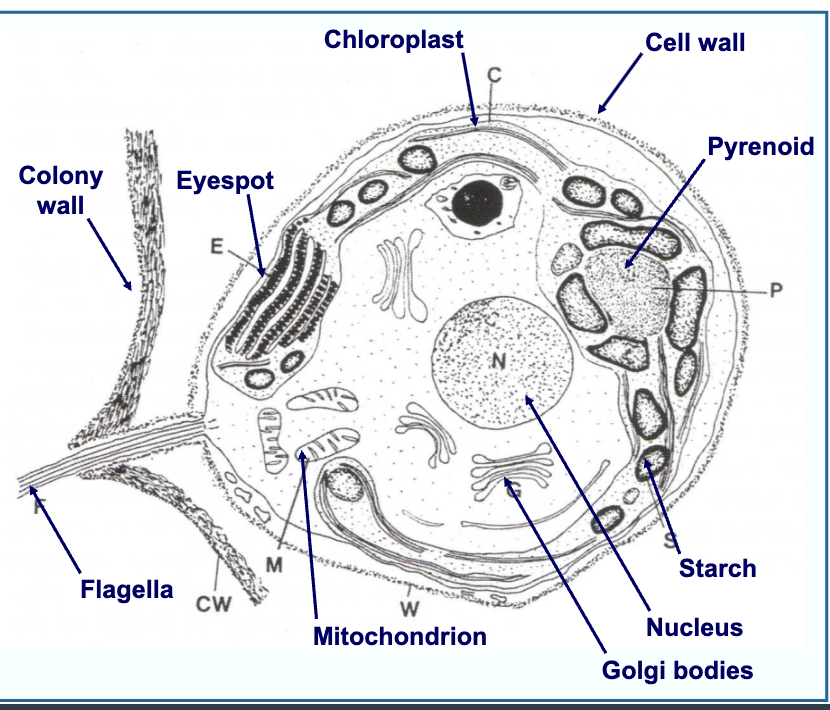
Know chlorophyte cell structure and where the following features are located:
Cell wall
Chloroplast
Eyespot
Pyrenoid
Starch
Nucleus
Golgi bodies
Mitochondrion
Flagella
Colony wall
Describe the scales of cyanobacteria
Acidic polysaccharides
Prasinophyceae
Theca
Glycoproteins & polysaccharides
Motile cells of Chlorphyceae
Where is starch formation in chlorophytes? What starches form? Why is this significant?
Often in pyrenoid
Made of Amylose (glucose joined by a14 links) and Amylopectin (addition of pectin polymer)
The starches present in chlorophytes show that they are a precursor to land plants
What pigments are used in chlorophyte chloroplasts?
Chlorophyll a & b
Carotenoids
Lutein (primarily)
Accumulate under stress (orangered)
Low N
High light
High salinity
Accumulates between thylakoids (β-carotene) or in lipid globules outside chloroplast
Orange ——> red passes up food chain (must supplement diet of farmed salmon)
Describe chlorophyte contractile vacuoles
Usually 2 (at base of flagella)
Alternately contract
Control H20 content of cell
What attachment points for flagella can chlorophytes have? Who has them?
Lateral position - Charophyceae
Anterior position - Ulvophyceae and Chlorophyceae
What are the two shapes for flagella/microtubule roots in chlorophyes? Who has them?
Broad-band with second smaller root - Charophyceae
Cruciate - Ulvophyceae and Chlorophyceae
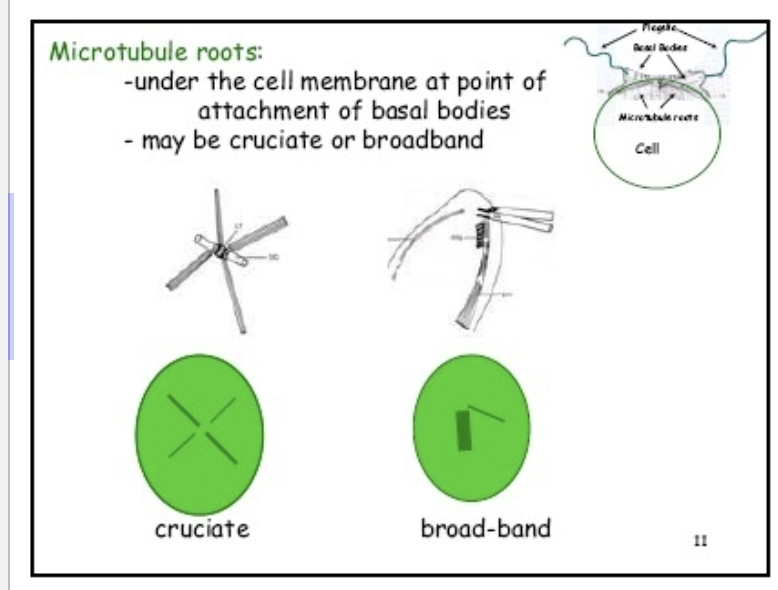
What is a rhizoplast?
An attachment point for flagella, or “flagellar root”
What is the difference between positive and negative phototaxis?
Positive is toward the light, negative is away from light.
What is phototaxis?
Locomotive response to direction & intensity of light
What is phototrophobia?
Response to rapid change in light intensity. The organism will swim backward, then in
new direction
True or False: Chlorophyte eyespots are located near the chloroplast at the base of the flagella
True. The eyespot is also called the stigma, and it contains carotenoids that reflect blue and green light
Where is the layer of lipid droplets in the stroma in chlorophytes?
It is between the chloroplast envelope and thylakoids
What wavelength of light do rhodopsin photoreceptors absorb?
Rhodopsin A: 510 nm (high light intensity)
Rhodopsin B: 470 nm (low light intensity)
Describe Prasinophyceae within Chlorophyta
PRIMARILY MARINE SPECIES, A FEW FRESHWATER SPECIES
MOST PRIMITIVE GREEN FLAGELLATES
MORPHOLOGICALLY VERY DIVERSE
VERY SMALL < 1 ‒ 30 μm
Reduced genome
MICROMONAS FROM PACIFIC OCEAN
1 ‒ 8 FLAGELLA MAY BE PRESENT\
SCALES CONTAIN 2-KETO-SUGAR ACIDS (Not found in other algal flagella)
1 GREEN OR YELLOW-GREEN CHLOROPLAST WITH 1 PYRENOID GENERALLY PRESENT (Rarely 2 chloroplasts or 2 pyrenoids)
EYESPOT USUALLY PRESENT (Occasionally 2 eyespots)
What chloroplast pigments do prasinophytes (chlorophyta) have?
Chl a & chl b
Prasinoxanthin
(some species)
Lutein
Carotenes
Zeaxanthin
Violaxanthin
Neoxanthin
Uriolide
Siphonaxanthin
What is unique about Nephroselmis olivacea (prasinophyceae, chlorophyta)
They have 2 unequal flagella
What is unique about tetraselmis (prasinophyceae, chlorophyta)
4 flagella covered with hairs & scales
Marine genus
What is unique about pyramimonas (prasinophyceae, chlorophyta)
Marine & freshwater
Common in tidepools
Move to surface at low tide & attach to sand at high tide
How does tetraselmis anatomy change when they become adults?
Loss of functional pharynx & mouth
Worms completely rely on symbionts
Photoautrophic organisms consuming sugars provided by symbiotic algae
Describe chlorophyceae (chlorophyta)
PREDOMINANTLY FRESHWATER
NINE ORDERS (Volvocales)
MOST HAVE THECA (Sheath surrounding alga)
MOTILE CELLS HAVE RADIAL SYMMETRY
FLAGELLA- Anterior or Cruciate
MANY HAVE RHIZOPLAST
COMMON HAVE EYESPOTS
MOTILE CELLS HAVE RADIAL SYMMETRY
Describe Chlamydomonnadaceae (Chlorophyta —> Chlorophyceae—> Volvocales)
FORM ZYGOSPORES
Germination depends on environmental conditions
Cells overwinter (cold, dark, dry)
Germinate during long day length
PHOTOPERIOD TIME MEASUREMENT
Sense duration of day length (or night length)
FOUND IN FRESHWATER, DAMP SOIL (HIGH N), & SNOW
Red snow ‒ grow on surface in spring/summer
Resting spores in winter ‒ migrate to surface
SINGLE NUCLEUS
2 FLAGELLA
Contractile vacuoles at base of flagella
CUP-SHAPED CHLOROPLAST & CENTRAL PYRENOID
May have anterior eye spot
What adaptations do dunaliella have to salt?
Ion pumps in plasma membrane expel sodium from protoplasm
Production of glycerol to balance intracellular concentration with external salinity
Describe volvocaceae (chlorophyta—>chlorophyceae—>volvocales)
COLONIAL
Cells number in multiples of 2
Up to 10,000 cells per colony
EYESPOTS MAY SHOW MORPHOLOGICAL
DIFFERENCES BASED ON LOCATION
Larger eyespots in anterior end
Genera specific
ASEXUAL & SEXUAL REPRODUCTION
CAN SWIM AT SPEEDS ≤5 m/h
Rotates as swims
Orients toward light
Volvox (within volvocaceae) have an extracellular matrix. What is it made of? What zones does it contain?
The matrix is a gelatinous sheath made of Hydroxyproline-rich glycoproteins
Zones:
Flagellar
Boundary
Cellular
Deep
Volvox undergo asexual and sexual reproduction. How does this work?
Sexual:
Separate male & female colonies
Males release sexual inducer (glycoprotein)
Occurs in summer
Asexual
Occurs in spring
How do groups within Charophyceae reproduce?
ZYGNEMATALES / ZYGNEMATACEAE
Sexually reproduce by conjugation
Spirogyra
CHARALES
aka: Stoneworts
Sexually reproduce by oogonia
& antheridia
Describe charophyceae (chlorophyta)
MOTILE CELLS
Asymmetrical
Scales often present
2 FLAGELLA INSERTED LATERALLY
Microtubular structure
(multilayer structure)
Broad root & second smaller root
No rhizoplasts
NO EYESPOTS
Describe Zygnematales (Chlorophyta—> Charophyceae)
FRESHWATER FILAMENTOUS ALGA
Unbranched filaments
Often twisted or spiral threads
GAMETES NON-FLAGELLATED
ZYGOTE/ZYGOSPORE RESTING STAGE
HAPLOID STAGE MOST OF LIFE CYCLE
SOME PREFER ACID CONDITIONS
Mougeotia spp
Describe Spirogyra (Chlorophyta—> Charophyceae—>Zygnematales)
RIBBON-SHAPED CHLOROPLAST
PYRENOIDS OCCUR ALONG LENGTH OF
CHLOROPLAST
NUCLEUS AT CENTER OF CELL
ASEXUAL REPRODUCTION
Fragmentation of filaments
SEXUAL REPRODUCTION
Zygote secretes 3 layered wall
(resting stage during winter)
PREFERS HIGH LIGHT & COOL TEMPERATURES
Spriogyra phototaxis:
ALIGNS TOWARD BLUE LIGHT
GLIDING MOVEMENT ALONG FILAMENTS
FILAMENTS FORM PARALLEL BUNDLES, CURVE, FORM LARGER MAT
Describe Charales (Chlorophyta—> Charophyceae)
COMPLEX PLANT BODY
Differentiated into nodes & internodes
RHIZOIDS ANCHOR PLANTS TO SEDIMENTS
APICAL GROWTH
FRESHWATER (SOME BRACKISH SPECIES)
Quiet water
Clear lakes
CALCIFICATION:
CaCO3 & MgCO3 deposits
Localized OH‒ efflux along internode
raises CO32‒ levels
CaCO3 super-saturated & precipitates
Calcite crystals deposited in bands
on cell wall
Describe Chara (Chlorophyta—> Charophyceae—> Charales)
WHORL OF BRANCHES AT NODES
BRANCHES GROW TO DEFINED LENGTH
INTERNODES
Single long cell
Multinucleate
Cytoplasmic streaming
GROWTH FROM APICAL CELLS
Transverse division of apical into
2 daughter cells
Lower cell
Internode initial
Becomes internode