Psych Exam 2
 Call Kai
 Learn
Learn Practice Test
 Spaced Repetition
 Match
Match Flashcards
 Knowt Play
1/56

There's no tags or description
Looks like no tags are added yet.
Name | Mastery | Learn | Test | Matching | Spaced | Call with Kai |
|---|
No analytics yet
Send a link to your students to track their progress
57 Terms
Modal Model of Memory
Includes sensory memory, STM/WM, and LTM
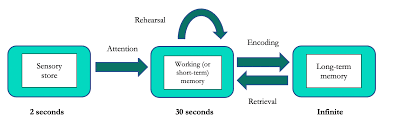
Sensory Memory (definition)
High capacity for very temporary storage of incoming sensory information
Pre-conscious/pre-categorical
Separate stores for each sense
Sensory info enters in parallel and decays rapidly
Visual (iconic) < 1s
Audio (echoic) < 4s
Short-Term Memory (basic definition)
Limited capacity short-duration store where we actively process and manipulate information
Capacity: 7 plus or minus 2 chunks
Duration (without rehearsal): < 20s
Long-Term Memory (basic definition)
Capacity and duration are unlimited
Encoding: information in STM/WM that we process/rehearse enough goes to LTM
Retrieval: information can be transferred back into STM/WM
Sperling Iconic Memory Experiment
Showed a grid of 12 characters very briefly and participants reported what they’d seen
Whole report (say all 12): mean 4.3 characters
Sensory memory fades fast
Partial report (say just one row)
Delay → mean 1.5 characters
Duration of sensory memory is short
No delay → mean 3.3 characters
Capacity is high
Report just letters of numbers → couldn’t do it
Sensory memory is pre-categorical
Capacity
Digit Span Task can measure capacity
Chunking: based on meaning/top-down processing
Peterson & Peterson Trigram Experiment
See a trigram, complete a filler task during an (IV) retention interval, recall trigram (DV)
Found that as retention interval increased, mean proportion recalled decreased similar to Ebbinghaus’ forgetting curve
Why do we forget from STM?
Decay: according to Peterson & Peterson, memories decrease in strength over time
Interference from other information
Proactive (old interferes with new) and retroactive (new interferes with old) interference
Keppel & Underwood took data from Peterson & Peterson
Only looking at the performance for the first trial, the difference in proportion recalled was much less and increased as more trials occurred
Perhaps information from earlier trials in LTM interfered with new trials, causing STM to appear to decay faster
Difference Between STM and WM
Working Memory (Baddeley and Hitch) takes into account that we are processing chunks of info in STM
Better explains complicated mental math and multi-tasking
Operation Span (OSPAN)
Tests the working part of WM
See an equation, decide whether it’s T/F, read a word → output: list words
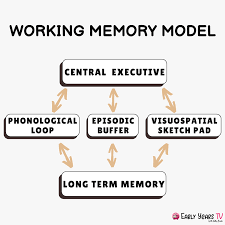
Baddeley’s Model of WM
Central Executive: modality independent director of operations
Modality dependent subsections
Visuo-spatial sketchpad (visual STM)
Phonological loop (auditory STM)
Episodic buffer
Visuospatial Sketchpad
The creation of visual images in the mind in the absence of a physical thing
Evidence: when mentally rotating an object, the more it must be rotated, the longer it takes for your brain to do it
Phonological Similarity Effect
Letters with similar sounds often get confused in memory
Word Length Effect
Memory for lists of words is better for short words than long words
Reading speed is long → takes longer to rehearse
Indicates people are reading words aloud in their head
The Serial Position Curve
Primacy effect: the first few words get more rehearsal time so go to LTM
Recency effect: the last few words are still in the WM loop
Double dissociation:
Increasing the retention interval (+ filler task) gets rid of recency effect, not primacy effect
Decreasing the speed of words spoken increases primacy effect, no impact on recency effect
Amnesia
Retrograde: can’t retrieve existing memories
Anterograde: can’t encode new memories
Temporal lobes + amnesia
Many surgeons treated neurological illness by taking out part of the brain → unintended cognitive impairments
HM
Surgery for epilepsy destroyed 2/3 of hippocampus and part of amygdala (bilateral temporal lobe resection)
Results
Seizures improved, normal IQ
STM/WM intact
LTM severe deficits: retrograde amnesia for 3 years before surgery, anterograde amnesia
Clive Wearing (conductor)
Hippocampus damaged by a virus
STM/WM intact
Anterograde amnesia, some retrograde amnesia but remembers his wife
Patient KF
TBI from a motorcycle accident
Impaired STM/WM
Digit span = 2
Couldn’t repeat words
Very limited recency effect
Intact LTM
Testing Memories
Explicit tests
Free recall
Recognition
Implicit tests
Word fragment completion (fill in blank w/ first word that comes to mind)
Lexical decision task (is this a real word?
Savings in relearning
Long-Term Memory
Explicit (declarative) memory: can be consciously retrieved
Episodic: specific experience
Semantic: generalized knowledge
Implicit (non-declarative) memory: a change in behavior as a result of experience
Procedural memory
Priming: when presentation of a stimulus influences later processing of the same or similar stimulus
Classical conditioning
Double Dissociation between Episodic and Semantic LTM
Yes semantic, no episodic
Clive Wearing
Kent Cochran
No semantic, yes episodic
Patient MN
Patient LP
Other fMRI evidence shows retrieving episodic and semantic memories activate different parts of the brain
Procedural Memory
LTM for skills involved in particular tasks
Procedural memory tasks: teach new procedural skills
Ex: HM got better at mirror tracing even though he never remembered having done the task
Ex: Clive Wearing improved piano, didn’t remember writing in his book but gravitated towards it
Generally: amnesia patients have intact priming/implicit/procedural memory
Claparede and Amnesiac Implicit Memory
Introduced himself every day
Shocked amnesiac patient one day, and she refused to shake his hand the next day
Future Memory
Ken Cochrane: couldn’t imagine the future
Some brain areas used for episodic recall and imagining future events
In both cases, your brain is performing a simulation
Constructive episodic simulation hypothesis: memory is constructive and used to simulate future events
Memory in the brain
WM: mostly pre-frontal cortex
LTM: likely distributed across whole cerebral cortex
Memory stored through LTP
Hippocampus: likely involved with both
Semantic vs. episodic
Double dissociations suggest separate locations
Interplay Between Episodic and Semantic Memories
Most things start as both episodic and semantic → lose episodic over time
Repisodes: repeated episodes get merged into a generalized representation over time
Semantic memory is enhanced when connected to an episodic memory
Semantic memory influences episodic memory through directing attention
Encoding: Level of Processing Theory
Retrieval is dependent on how well information is encoded
Shallow processing
Maintenance rehearsal
Little attention to meaning
Processing of physical features
Deep processing
Elaborative rehearsal
Focusing on meaning of words and relationships between concepts
Encoding Strategies
Grouping/organization
Structure of organization can cute memory
Words from structure can cue other words
Imagery (mental images)
Self-reference effect: memory is better if you relate a word to yourself
Generation effect: generating material yourself enhances learning and retention
Encoding specificity and TAP
Encoding specificity: retrieval cues are most effective to the extent that they are similar to conditions of encoding
Context dependence: overlap of external state
Ex: scuba diving study, uses spreading activation
State dependence: overlap of internal state
Ex: marijuana study
Transfer appropriate processing: memory performance is dependent on the amount of overlap of cognitive processes at encoding and retrieval
Ex: rhyme task vs. semantic task
Crossover interaction: performance best when type of processing is similar at encoding and retrieval
Illusions of Learning
Fluency of reading because of re-reading does not mean better memory
Familiarity effect
Highlighting: shallow processing
Mnemonics
Fancy encoding and retrieval strategies
Pegword method: prememorize a word with each number and associate with images
Method of loci/memory palace: imagine things you want to remember in different locations in a place you know well
Methods of enhancing retrieval
Testing Effect/Retrieval Practice: being tested on new material results in better memory
Demonstrated by Roediger and Karpicke: participants studied text passages, more retrieval led to more memory after a longer retention interval
Spacing Effect: distributed practice is better than massed practice
Retrieval Cues
Stimuli encoded along with internal and external aspects of experience
Retrieval is facilitated by extent to which encoding situation and retrieval situation are similar
Consolidation
Transforms new memories from fragile to more permanent state
Synapses and LTP: synaptic, faster
Systems: gradual reorg of connections, slower
Over time, hippocampus may not need to be involved bc cortical areas may form connections on their own
Sleep helps consolidation
Less retroactive interference?
Autobiographical Memory
Memory for your own life
Multidimensional (all 5 senses + spatial + thoughts/emotions)
Functions
Directive (to solve new problems)
Social (develop and maintain bonds)
Self-representative (maintain identity)
Adaptive (internal regulation of mood)
Memory and the Self
Experiencing self: WM (short, rich, most moments lost without a trace)
Remembering self: LTM, representative moments (beginning, peak, end)
Theory: Self-Memory System
Life story
Themes (education, work, relationship)
Lifetime periods
General events
Episodic memories
Emotion and Memory
Emotions: biologically-based responses to events/situations that are seen as personally relevant
Usually involve changes in physiology
Amygdala involved in encoding emotionally arousing events
Emotional arousal (increased cortisol) → better encoding
Emotional stimuli → better remembered and attracts more attention
Related to state-dependent memory (emotion can be a retrieval cue)
Emotional events may be rehearsed more frequently
Childhood Amnesia
As adults, we can’t retrieve anything from our first few years of life
Brain development?
Implicit memory: very early, some structures present at birth
Episodic memory: frontal lobes not functional until 1+ years, hippocampus developing into childhood
Sense of self?
Infants lack clear self-concept around which memories can be structured
Don’t yet understand they’re separate from their environment
Don’t pass Rouge test until 2
Language?
Helps organize memory
Pre-verbal infants encode things differently so we can’t access after we have language
Magic Shrinking Machine study
Social Cultural theory
“Maternal reminiscing”: parents differ in how much and how they talk about the past with their kids
More elaborative/detailed parental reminiscing: kid’s better self-concept and narrative about the past
Context changes a lot from infancy to adulthood (ex: size)
Dr. Carolyn Rovee-Collier
Infant memory works like adult memory but we’re not testing the right way
Used ribbon & mobile task (2-6 mos) and train task (to 2 yrs)
Retention increased
Reminiscence Bump (Why?)
Self-image
Identity formation occurs in young adulthood
Memory is better for crucial self-defining events
Cognitive
Encoding is best during periods of rapid change followed by stability
Evidence: people who emigrate to US later in life have a bump that occurs later
Cultural life script
Memory is better for events that fit into the expectations of a culture
Memory and Normal Aging
Crystallized intelligence increases
Word knowledge, LTM for existing knowledge
Fluid intelligence decreases
LTM for new materials, speed of processing, WM
Dementia and Alzheimer’s
Dementia: deterioration of memory and other cognitive functions bad enough to interfere with life
Alzheimer’s: progressive neurodegenerative disease
Pathology: neuron death starts in hippocampus, entorhinal cortex (interface btwn hippocampus and cortex) and spreads all over cortex
Amyloid plaques btwn neurons form
Tau protein tangles in neurons form
Symptoms:
Loss of memory, language
Disorientation
Impaired perception
Changes in personality/mood
Impaired decision making
Evaluating retrieval
Completeness: how much of what happened do you remember?
Forgetting: failure to access stored info
Accuracy: how much of what you remember actually happened that way?
Errors and distortion: reconstructive nature of LTM
Source monitoring, false fame, and illusory truth
Source monitoring failure: when something feels familiar, but we don’t remember the source
False fame effect:
Shown a list of fictitious names
Later shown a mix of same fictitious and real famous names
Rated fame of each name, and some fake names rated as famous
Failure of source monitoring, priming
Illusory truth: familiarity of statements increases their credibility
The “Room Study”
Procedure:
Encoding phase: experimenter has patient wait in office
Test phase: free recall of waiting room
Schema for typical academic office influenced results
DRM Procedure
Study a list of words highly related to a missing critical word
People often falsely remember the critical word
Hybrid lists (phonological and semantic associations) bring out error
Due to spreading activation
Misinformation/Suggestibility
Loftus: showed people film of a car accident, asked how fast they were going when they smashed/hit each other
Estimated speed went up with smashed
Loftus: people viewed slides showing a crossing (stop or yield sign)
Question asked using stop sign or yield sign influenced slide picked even though they knew question might be wrong
Hyman et at
Told students about false events they had no memory of
2 days later: remembered and made up details
Loftus: lost in shopping mall
Told participants 4 stories (one fake)
25% falsely remembered story
Associations
Spreading activation in an associative network can lead to correct retrieval, interference, or incorrect retrieval
Context Influences (Wade)
Viewed pictures of childhood events (1 doctored) over 2 weeks
50% of participants produced detailed descriptions of the false event by the end
Repressed/Recovered Memories
Freudian psychology: memories are repressed when associated with high levels of trauma
Therapists used Recovered-Memory-Therapy
Smell and Memory
Neural pathway bypasses thalamus, straight to the limbic system (amygdala and hippocampus(
LOVER: limbic system, old memories, vivid recall, strong emotions, rare
Odor stimuli usually close in space (fight/flight)
Music and Memory
Activates emotion which can enhance memory
Can take us back (especially to reminiscence bump)
Activates many brain regions (helpful when some areas are damaged)
Eyewitness Memory
Source-monitoring and familiarity-based errors
Unconscious transference to bystanders
Greater familiarity = greater confidence
Misinformation effect
Leading questions
Other-Race Effect
People are worse at making cross-racial identification
Improving Facial Recognition
Other race effect interventions: lineup construction (fillers similar to suspect, say perpetrator may not be present, sequential vs. simultaneous)
Recognition is more accurate if people can decide based on photos from different angles
Cognitive Interview
Geiselman
Reinstate environment mentally (eyes closed)
Described in various orders + viewpoints
Report all small details
Limitations:
More details: recall of more incorrect details
Doesn’t prevent misinfo effects
Less effective for stressful events

