Exam 2 Digital Media
 Call Kai
 Learn
Learn Practice Test
 Spaced Repetition
 Match
Match Flashcards
 Knowt Play
1/74

Earn XP
Description and Tags
COM3332
Name | Mastery | Learn | Test | Matching | Spaced | Call with Kai |
|---|
No analytics yet
Send a link to your students to track their progress
75 Terms
Characteristics of the interaction society
People do things in relation to each other (Mead), Behavior that is oriented toward the behavior of others (Weber), Participants can control the environment (Media Ecology)
Meaning of anonymity in 90s
lack of identity and freedom; dis-embodiment (ability not to be there as a person anymore); users can hide real identities, experiment with self expression, and speak openly without consequences (vs. current shift to now where you want to be visible, get followers & likes, etc.)
Interaction Society
Shift from information/content to social interaction
Meaning of the dog cartoon in 1993
The cartoon "On the Internet, nobody knows you're a dog," symbolized the internet's anonymity and freedom from identity; nobody knows who you are in an online environment; meaning in 1993 = anonymity + freedom, meaning (& how we use the internet) now = visibility + identity
Purpose of emojis (?)
Emojis restore emotional and nonverbal cues lost in digital text; help express tone, mood, and nuance, preventing misinterpretation and making communication more human-like
5 Advantages of asynchronous communication
Conversational relaxation, Sustained interaction, Feeling safer, Disinhibition, Democratic communication
Advantage of Asynchronous Communication: Conversational Relaxation
Communication isn’t happening at the same time, so you can think about what you want to say, how to say it, etc.
Advantage of Asynchronous Communication: Sustained Interaction
it’s not possible for a large group of 200 to all participate in a lecture, so you have the same 5-10 ppl answer; if its asynchronous 200 people can post messages and you can read all of them on your own time; you can back and read everything you want
Advantage of Asynchronous Communication: Disinhibited
We’re more loose with what we’re saying; we say things we might not say in real life (things that are too honest, mean things, etc.); relates to us being more anonymous; not necessarily an advantage, but it does help
Advantage of Asynchronous Communication: Democratic Communication
who you are (status, authority) doesn’t matter as much in an online environment; just because you’re a police officer and you get status IRL, in an online environment it doesn’t matter and people won’t listen to you more bcuz you’re a police officer
Which of the 5 advantages of Asynchronous Communication is the LEAST advantageous attribute (it’s not necessarily an advantage, but it does help)
Disinhibited
Deindividuation
the process by which individuals become immersed in a group dynamic (opposite of social identification); people lose their sense of personal identity and accountability in groups (develop group think), often leading to impulsive or aggressive behavior (Ex: Stanford Prison Experiment)
Why we feel “safe” online (Deindividuation can be seen when we feel safe/anonymous)
we can control how we present ourselves, remain unseen, and maintain distance; “invisibility” lowers fear of judgement
we think our voice will be drowned out by all the other messages
our response to a post is just 1/10,000 and nobody will bother to track us down if we do/say something bad
Behavior in the Hyperpersonal Model
People form deeper, more idealized connections online due to selective self-presentation (show best version of themselves) and overreliance on limited cues; Communication becomes more intense and emotionally charged than face-to-face interaction
Hyperpersonal
Suggests online relationships can become more personal than in-person ones because users idealize each other, carefully curate what they share, and take time to compose responses; we idealize people bcuz we focus too much on the limited info that’s presented
Hyperpersonal Model
Idealization based on over-reliance on limited info; identification/intensification loop
3 current trends with regard to anonymity
True anonymity is rare - most platforms require identifiable profiles
Social Media encourage visibility - users are encouraged to show their real identities, have to create a pseudonym/user (that must stay consistent to establish who you are, you’re expected to have stable identities/profiles)
Data tracking - online behavior is constantly monitored and recorded, datamining
Value of targeted advertising
allows companies to reach specific audiences based on demographics and psychographics, making ads more efficient but reducing user privacy and reinforcing the visibility economy; we’re in an age of data-tracking/datafication
What did Facebook require in the early days that it no longer requires now?
required a valid school or university email (.edu) to register + now, anyone can create an account without institutional verification (relates to current trend for anonymity = true anonymity is rare)
(Txtbk) Major shift of Online Landscape in the early 2000s
“the online landscape shifted from being topically organized to being organized around social connections between people”; internet evolved from an anonymous, text-based space to a social, identity-driven one. Online platforms became centered on real profiles, visibility, and interaction — marking a move from anonymity to post-anonymity.
(Txtbk) TikTok is an example of a platform whose specific features allow for different kinds of user interactions or responses (passively watching, leaving a comment, or creating one’s own video and posting it). Passive watching is compared to TV watching. Creating a video is referred to as being an active participant.
What does this show about interactivity?
The important point here is that interactivity depends on both the user’s choices and the features of the platform
(/) There are several definitions and descriptions of “community” provided in this section. What are the concepts/criteria that these definitions have in common, and therefore, the elements that are needed to form a community?
share emotional connections, mutual support, shared identity, and a sense of belonging; They depend on trust, shared values, and social interaction; Online, this translates into meaningful engagement and sustained participation
(/) What reasons do people have for joining communities?
connection, support, shared interest, identity formation, and participation in something larger than themselves
(/) What is the definition for “third places,” and what examples are provided in the book?
informal, social environments beyond home (first place) and work (second place), such as coffee houses/cafes, barber shops, gyms, libraries, parks, or online forums, where people gather and build social bonds.
(/) The book discusses a research study on gamers. What did the study investigate and what were the results of this research study?
explored how gamers use online games as third places; results showed that players formed friendships, social networks, developed their identities, and had communities similar to offline relationships, showing that digital interaction can build genuine social bonds; + hardcore gamers who reached stage where longterm/largescale activities were main activity showed gaming was work-like
(/) According to the book, what is “the key to understanding the societal effect of digital media”?
an understanding of the wider context of their use; how it reshapes interaction and connection between people, not just how it transmits information
(/) This brief section presents several comparisons, pointing out that even though this type of community has this advantage, we must also consider that other type of component. Make sure you can recognize these comparisons when presented with them.
Online communities lack physical proximity but offer flexibility, accessibility, and diversity; can bring ppl together who share common interests, but don’t make it easier to get to know others & all of their diff identities
Offline communities provide richer nonverbal cues and stronger embodied ties
Both forms balance advantages and limitations, with online spaces often extending rather than replacing offline relationships
(/) Does today’s society fit more of a community or more of a network perspective?
network perspective; relationships are looser, flexible, and based on individual connections rather than tightly-knit group
(/) In Chapter 1, the author says that media are environments. What about networks?
Networks are also environments: social and technological ecosystems where interactions occur and relationships are maintained
(/) The “social network revolution” is and is not a result of what?
is a result of technological innovation and digital communication, but not solely caused by it; it also stems from broader social and cultural shifts toward individualization
(/) What was Simmel’s main theoretical contribution, according to the book?
emphasized that society is formed through patterns of interaction ("sociation"), showing how networks of relations create social life
(/) What three forces or changes resulted in the network society?
Technological advances in communication and computing (informationalism)
Globalization and flexible labor structures
Cultural shifts toward individualization and digital connectivity
(/) What is “informationalism”?
new form of social organization where all human activity, economy, politics, warfare, social movements, etc. follow a networked logic; an economy and society based on information processing, digital communication, and networked production rather than physical goods
(/) What is a “network” versus “networking”? Which one is required in order for the other to be possible?
A "network" is the structure of existing relationships + "networking" is the active process of building and maintaining those connections; Networking is required to form networks.
(/) Based on the results of the research study on online role-playing games/gaming, how does the level of intensity with which people use social networking sites relate to their social connections offline?
Moderate users ("Socializers") have the best balance, maintaining strong offline relationships and feeling less lonely; Very high ("Debaters," "Advanced") or very low ("Lurkers," "Sporadics") usage correlates with weaker offline ties and greater loneliness.
(/) What does “networked individualism” mean? If you had to draw a picture of the concept, how would you describe it?
describes how people are now the centers of their own networks, connected to multiple overlapping groups instead of one home community; A diagram would show one person in the middle, with various smaller circles (family, friends, coworkers) radiating outward and partly overlapping
(/) What new skills do we need in the new operating system that a networked society represents?
must be adaptable, comfortable with constant change, able to manage multiple connections, maintain online relationships, and navigate shifting social and technological environments
(/) How do the concepts of “egocentric” and “egoistic” relate to networked individualism?
Networks are egocentric (centered on the individual's position) but not necessarily egoistic, since individuals still rely on and engage with diverse social ties
(/) At the end of this section, what is the textbook author’s main conclusion about choosing the correct terminology?
concludes that we shouldn't be confined by strict terms like "community" or "network” as Digital society includes a continuum of ways people connect, so concepts like "fields of togetherness" better capture how interaction, emotion, and technology overlap; The key is to empirically study how people actually interact, rather than arguing over labels
The Visual Turn
An increased interest in how images, photos, and videos, affect how we experience culture, and how we interact with each other
When does The Visual Turn begin?
began within last few decades of 20th century, as a result of mass media & technological development including TV, film, color TV, computer, etc. (internet came along later)
What is so tricky about one’s own taken-for-granted’s?
you cannot truly understand what you take for granted in your current environment unless you take a step out of it
(/) Causes or reasons leading to postmodernity
technological advancements (especially digital media), mass communication, globalization, and the rise of consumer culture and visual saturation; post-modernism is about simulation
Approximate date of the first self-photograph
2002
5 Characteristics of selfies
Shared on social media (conscious social action with intention); we want someone to see our selfie
Fulfill need for affirmation (want ppl to not only see it, but react)
More spontaneous & casual than traditional self portraits
Typically not produced by traditional artists (instead by everyday person)
Social by definition (cuz of this sharing on social media & the need for others to see it)
3 social purposes of selfies
Explore a variety of identities (identity as a child of your parents vs as a friend)
Experience self-empowerment by taking control (we can choose how we want to show ourselves, someone else isn’t taking this pic)
Both enforce social powers and norms, as well as resist them (you do something others wouldn’t expect, against stereotypes for example; like a male doing a selfie doing football reinforces stereotypes)
What 3 reasons contributed to the popularity of selfies?
General tendency toward visual fascination (a visual turn)
Individualistic culture; focused on identity/ourselves (selfie is focused on an individual person)
Availability of phones with cameras
When does media panic happen?
extremist ideas (world going to end vs. save/change the world) tend to exist whenever a dramatically new technology comes out
When talking about performing identity, one of the negative and one of the positive examples both had to do with which aspect?
negative (body dysmorphic disorder) + positive (balancing beauty ideals/self exploration) = exploring/performing your identity
What is a “selfie death”?
people die because they’re trying to take selfies because they get themselves into dangerous situations (ex: try to take selfie and fall off cliff)
What does it mean to say that social media are ecosystems?
you can present improved/changes versions of yourself constantly in diff environments; different filters, images, etc.
4 components of an assemblage/selfie;
The Self
Physical space/place
The Device
The Network/Platform
What are some old-fashioned examples comparable to videos of affinity (aka online videos generated to create “communicative connection”)?
old-fashioned home movies/videos (ex: birthday, graduation videos filmed by family)
(?) Are videos of affinity restricted to being on social media?
No
What role does the body play in videos of affinity?
body is often at center of video
In what way are emojis a universal language, but still don’t always have universal meaning?
one individual emoji can sometimes have more than one meaning (Ex: thumbs up can mean agreement or a sarcastic gesture)
What did the research study conclude about the use of emojis and power?
those using emojis are perceived as less powerful
What is blended writing?
typical of the digital age, combining visuals, audio, alphabetic, and non- alphabetic units of meaning
(MH) Approximately what percent of US adult social media users live with mental health concerns, according to course materials?
43 million; one in five adults
(MH) What city has classified social networking sites as a public health threat?
NYC
(MH) (?) Which negative social media use result was found among FSU students?
lower feelings of well-being; depression
(MH) Who experiences higher levels of depression?
women and adolescents
(MH) (?) On the “Blame-Game” slide, what short-term effects for aggression versus long-term effects for tolerance were found by researchers?
short term exposure to violence causes feelings of aggression and acts of violence; increased exposure to virtual violence or harassment lowers people's tolerance level long term
(MH) What are examples of social media “currency” and in what economy are they used?
likes, shares, follows, comments; attention economy (everything is trying to vie for our attention)
(MH) What is the relationship between cognitive capacity and multitasking?
as more social medias are developed, your attention is getting more and more captured, so your cognitive capacity gets bigger; a larger portion of your cognitive capacity is drawn in by social media/multi-tasking; multitasking overloads cognitive capacity
(MH) What is the relationship between multitasking and attention shifting?
our brain cannot pay equal attention to two things at the same time, we don’t actually multitask we just shift our attention from one thing to another (and later get bored when they have to look at something for a while in depth)
(MH) How do digital media help older adults?
maintain cognitive skills; when gaming they can retain/train their cognitive health, maintain brain smartness, and agility
reduces loneliness; they get something to talk about and people to game with (maintain and/or make social connections)
can help with recuperation for physical ailments, rehabilitation, etc.
provide space for for identity/self-expression
(MH) Which statistical analysis can explain predictions?
regression analysis (NOT correlation analysis)
(MH) What does the suction cup on the “Media Portrayal” PPT slide signify?
amount of depression that is explained by your social media use (only a little bit of your depression is actually explained by your social media use)
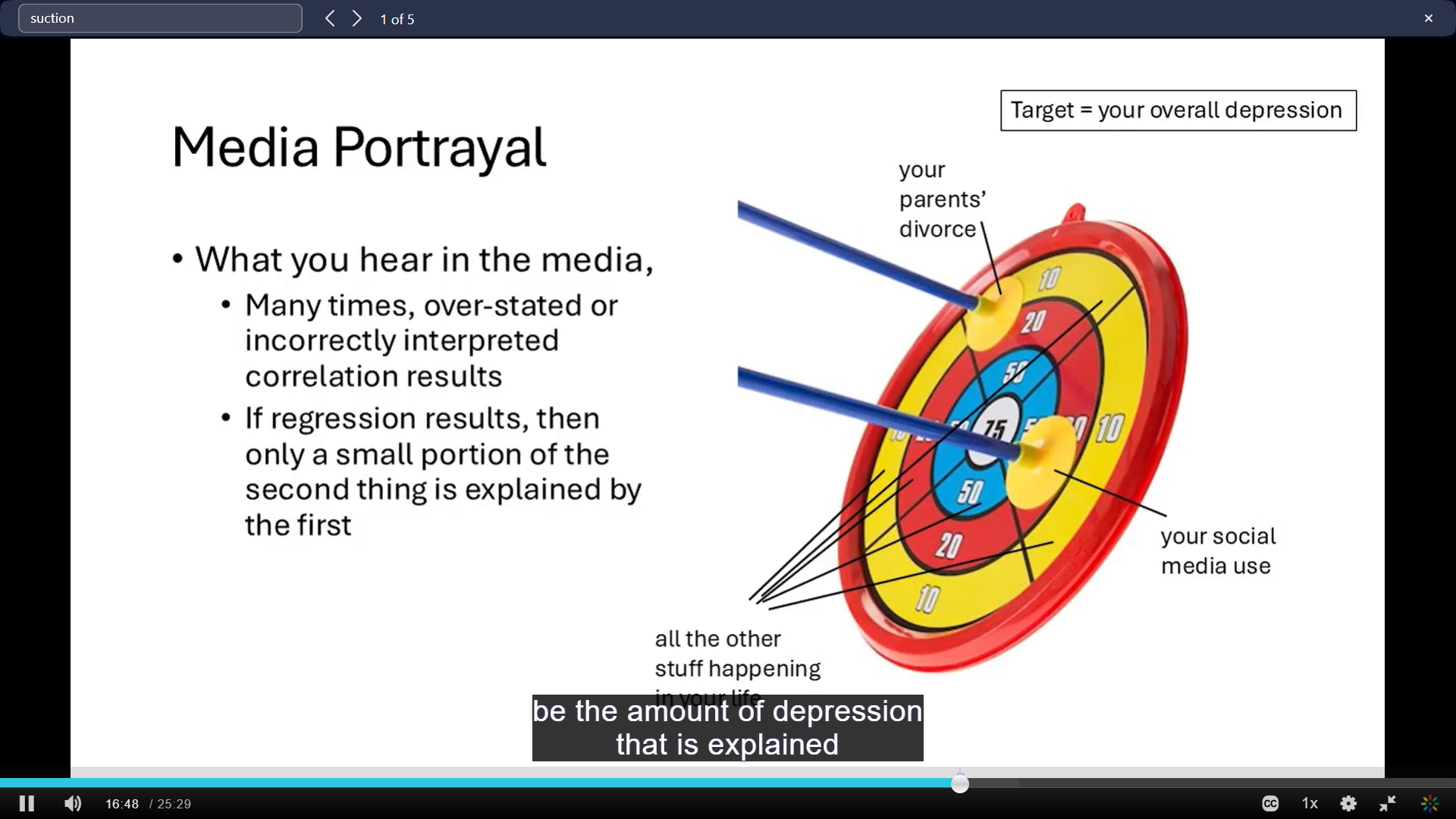
(MH) What was the overall point of the explanation of correlation, regression, and the children’s target with suction cups?
we have to have literacy in listening to what the media are saying about social media use/mental health/other connections, because the media are not always accurately recording or representing what research results are showing; be careful what you believe (media makes it sound like social media suction cup covers entire target, when that’s not the case)
(MH) What is brain rot?
AI trained on low-quality content produces low-quality information, including for AI therapy
(MH) Recognize an example of upward comparison (when you compare yourself to someone who is better than you or higher than you)
look on social media at perfect people and perfect profiles where everybody is happy and you feel worse about yourself
(MH) Recognize an example of downward comparison (where you're comparing yourself to someone who is lower or less worthy than you)
you’re exposed to somebody on social media and their circumstances that are worse than yours and feel better about yourself
(MH) According to the displacement hypothesis, what is displaced and what does that lead to?
online time replaces meaningful offline activities (displacing offline interactions); leads to mood disorders, lack of sleep (spending more time online + blue light), etc.
(MH) What is the main assumption of Stimulation Hypothesis?
digital media use and going online enhances your life/social well-being by allowing deeper relationships and expanding/reinforcing them (ppl you know offline you can become more connected to online), and stimulating frequent interaction online; more social engagement and positive affect

