ASU ARS 475 Exam One
 Studied by 0 people
 Call Kai
 Learn
Learn Practice Test
 Spaced Repetition
 Match
Match Flashcards
 Knowt Play
1/61

There's no tags or description
Looks like no tags are added yet.
Name | Mastery | Learn | Test | Matching | Spaced | Call with Kai |
|---|
No analytics yet
Send a link to your students to track their progress
62 Terms
Zhou Dynasty
1100 to 256 BC
Eastern Zhou / Late Zhou
770 to 476 BC, a period within the Zhou Dynasty.
The Warring States Period
475 to 221 BC, a time of intense warfare and political turmoil following the fragmentation of the Eastern Zhou Dynasty, leading to the Qin Dynasty.
State of Chu
One of the most powerful states during the Warring States Period (Circa 5th century).
Qin Dynasty
221 – 206 BC
Han Dynasty
206 BC – AD 220
Changsha, Hunan province
A major historical city in that served as a core cultural hub for the State of Chu and later as the capital of the Changsha Kingdom during the Han Dynasty. It is a critical archaeological site, most famous for the Mawangdui tombs.
Mawangdui 馬王堆, Hunan province
An archaeological site in Changsha containing three tombs from the Western Han Dynasty (206 BC – 99 AD). It is world-renowned for the well-preserved body of Lady Dai (Xin Zhui), silk funeral banners, and a treasury of manuscripts known as the Mawangdui Silk Texts.
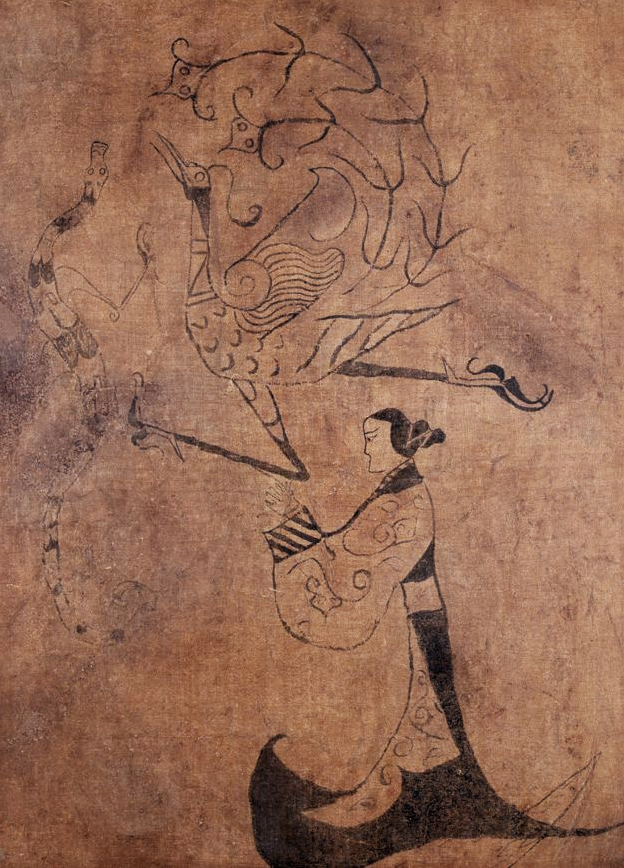
Woman, Phoenix and Dragon, ink on silk, from Changsha, Eastern Zhou period, 3rd century BC
Woman, Phoenix and Dragon
It depicts a woman accompanied by a phoenix and a dragon, representing the soul's journey to the afterlife and portrays the deceased. Figure in profile and outlined in jagged ink.
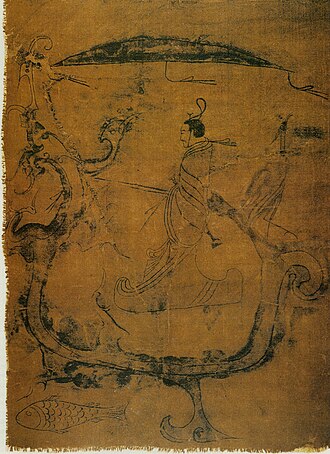
Man Riding a Dragon, ink on silk, from Changsha, Eastern Zhou period, 3rd century BC.
Man Riding a Dragon
Depicts a man steering a dragon, often interpreted as a soul being guided to the celestial realm. Another portrait of the deceased which was looted from a tomb. Line work more steady and calligraphic.
The “Chu Silk Manuscript”
An important ancient Chinese text providing insights into the philosophical and literary culture of the Chu state during the Warring States period.
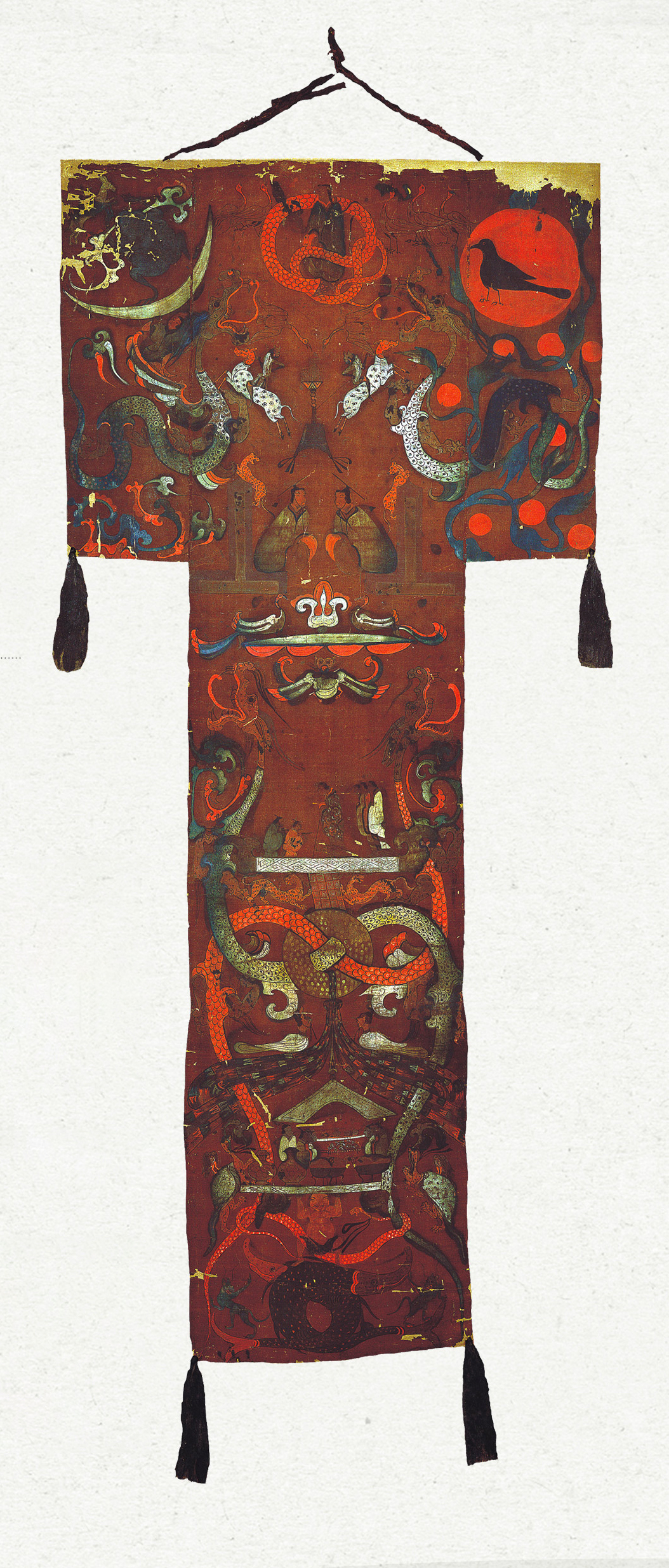
Funerary banner with portrait of Lady Dai, ink and color on silk banner, from Mawangdui, tomb #1, Han period, early 2nd century BC. Looted from a tomb.
Funerary banner with portrait of Lady Dai
Depicts Lady Dai and is divided into four sections, reflecting her layered existence in the afterlife. Showcases the evolving artistry and funerary practices of the Han dynasty. Suggests beliefs of Daoism. Stylistically makes use of three dimensional space.
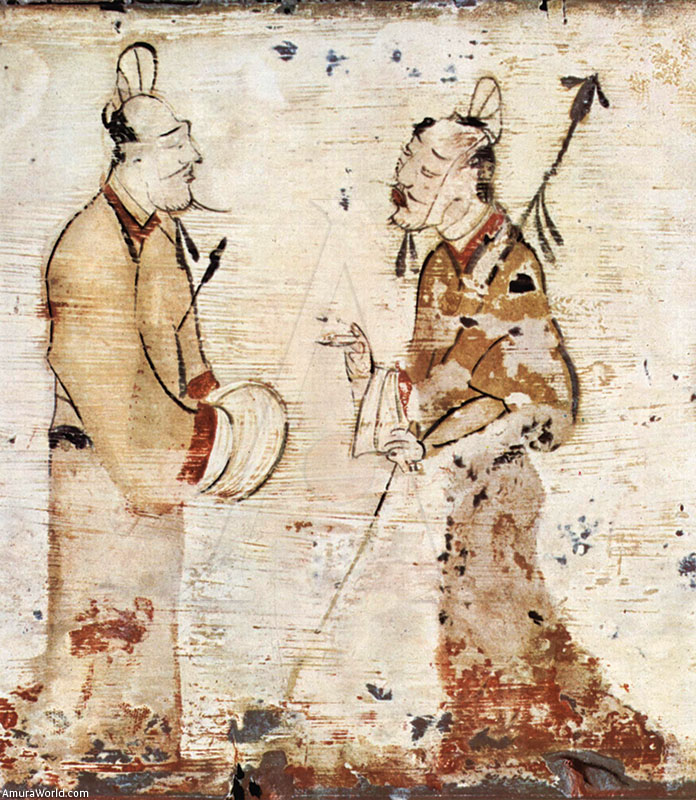
Painting on the lintel of a tomb, 1st century BC (or BCE). Han dynasty.
Painting on the lintel of a tomb,
Painted lacquer screen. that adorned the entrance of a burial site, often illustrating themes related to the afterlife, status, and beliefs of the deceased during the Han dynasty. Likely a Confucian subject. Depiction of Confucian filial piety.
Western (former) Han
The first half of the Han dynasty, from 206 BC to 9 AD, characterized by strong central government and expansion of territory.
Xin dynasty (Wang Mang Interregnum)
A short-lived dynasty that interrupted the Han rule from 9 AD to 23 AD, established by Wang Mang, known for its attempts at reform and failed policies that led to social unrest.
Eastern (Later) Han
The second half of the Han dynasty, lasting from 25 AD to 220 AD, marked by internal strife, the rise of powerful eunuchs, and eventual fragmentation leading to the Three Kingdoms period.
Eastern Jin (Chin) dynasty
A short-lived dynasty that ruled China from 317 to 406 AD, following the fall of the Western Jin, known for its cultural developments and challenges from northern tribes.
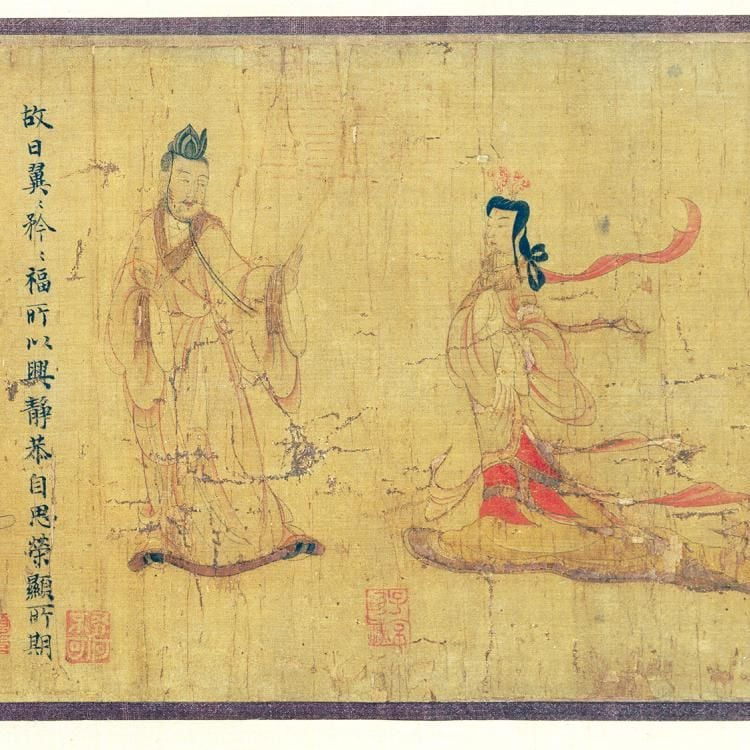
Admonitions of the Court Instructress to Palace Ladies, handscroll, ink and color on silk. Later copy of a 4th or 5th century painting. Six Dynasties Period (or Eastern Jin Dynasty, attributed to Gu Kaizhi.
Admonitions of the Court Instructress to Palace Ladies
is a renowned Chinese painting that illustrates moral teachings and the roles of women in court life, celebrated for its artistic style and historical significance. Confucian ideals of proper behavior of court ladies.
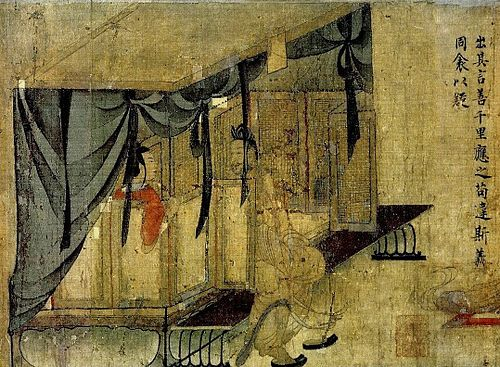
Admonitions of the Court Instructress to Palace Ladies, handscroll, ink and color on silk. Later copy of a 4th or 5th century painting. Six Dynasties Period (or Eastern Jin Dynasty, attributed to Gu Kaizhi. About lying, if you are dishonest your lover won't trust you either.
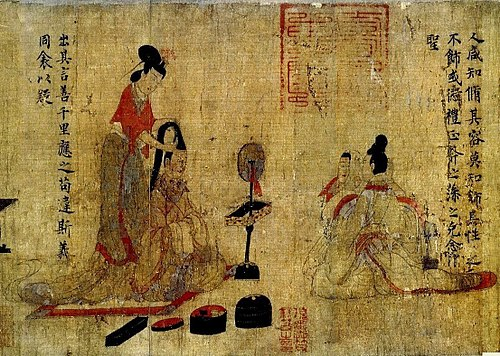
Admonitions of the Court Instructress to Palace Ladies, handscroll, ink and color on silk. Later copy of a 4th or 5th century painting. Six Dynasties Period (or Eastern Jin Dynasty, attributed to Gu Kaizhi. Reflects vanity. Focus on beautifying your inside rather than the outside.
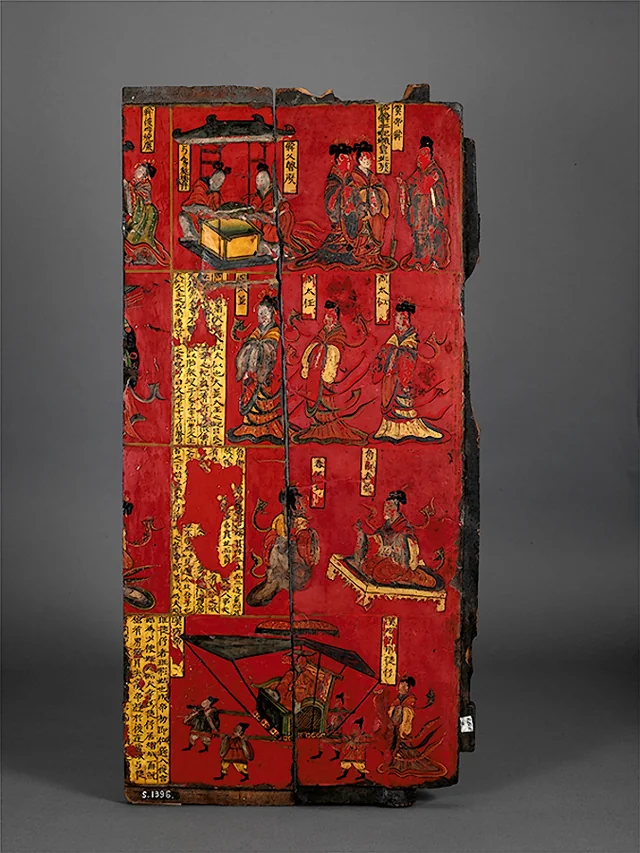
Scenes of Feminine Virtues (including the story of Ban Zhao), lacquer screen excavated from the tomb of Sima Jinlong (in Datong). Dated 484 (5th century), Six Dynasties Period (Northern Wei Dynasty).
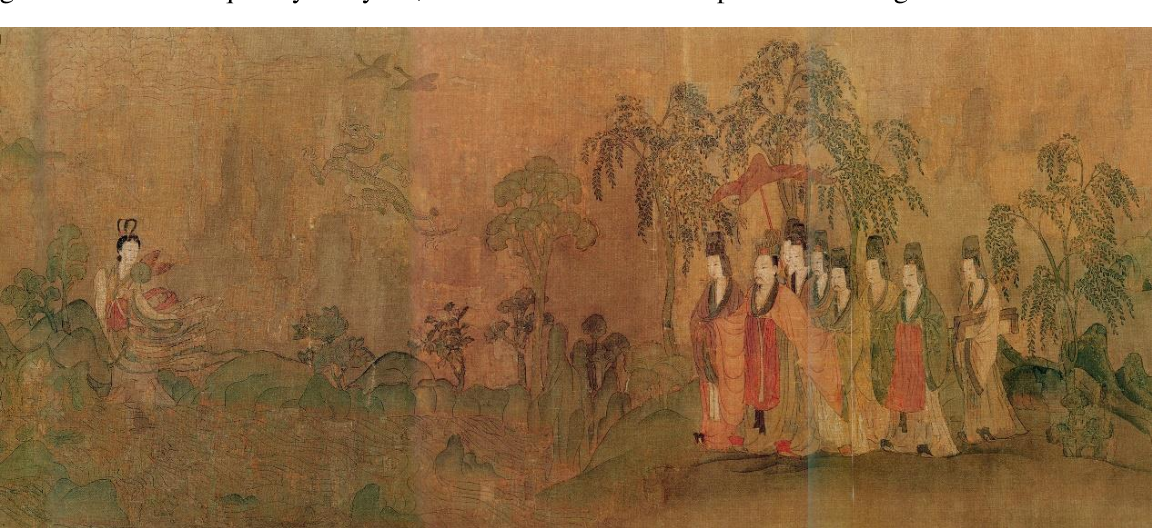
Sections of The Nymph of the Luo River, handscroll, ink and colors on silk. Copy of a 6th century work. Original of the Eastern Jin Dynasty (Six Dynasties Period), attributed to Gu Kaizhi.
The Nymph of the Luo River
is a famous work of Chinese art that portrays a mythical figure associated with beauty and longing, reflecting themes of nature and emotion, based off a poem. Suggestive of beliefs relating to Daosim. Example of a continuative narrative.
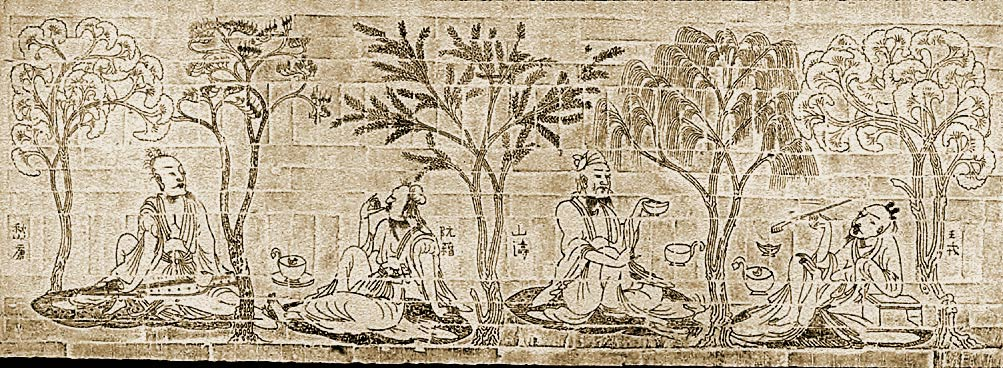
The Seven Worthies of the Bamboo Grove, 4th-5th century. Eastern Jin Dynasty (Six Dynasties Period).
The Seven Worthies of the Bamboo Grove
A group of 33rd century Daoist scholars and poets who retreated to a bamboo grove to escape political corruption. They became a popular subject in 44th-55th century Eastern Jin art, symbolizing spiritual freedom and intellectual nonconformity. Molded brick tomb relief from Nanjing.
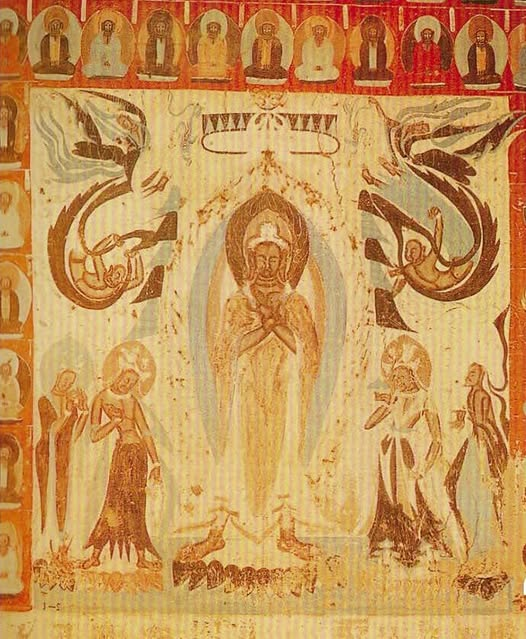
The Buddha, Dunhuang caves, early 6th century. Northern Wei dynasty (Six Dynasties Period).
The Buddha, Dunhuang caves.
A revered figure in Buddhism, highly stylized by thick lines and winged shapes. Artworks from this period reflect the profound influence of Buddhism on Chinese culture.
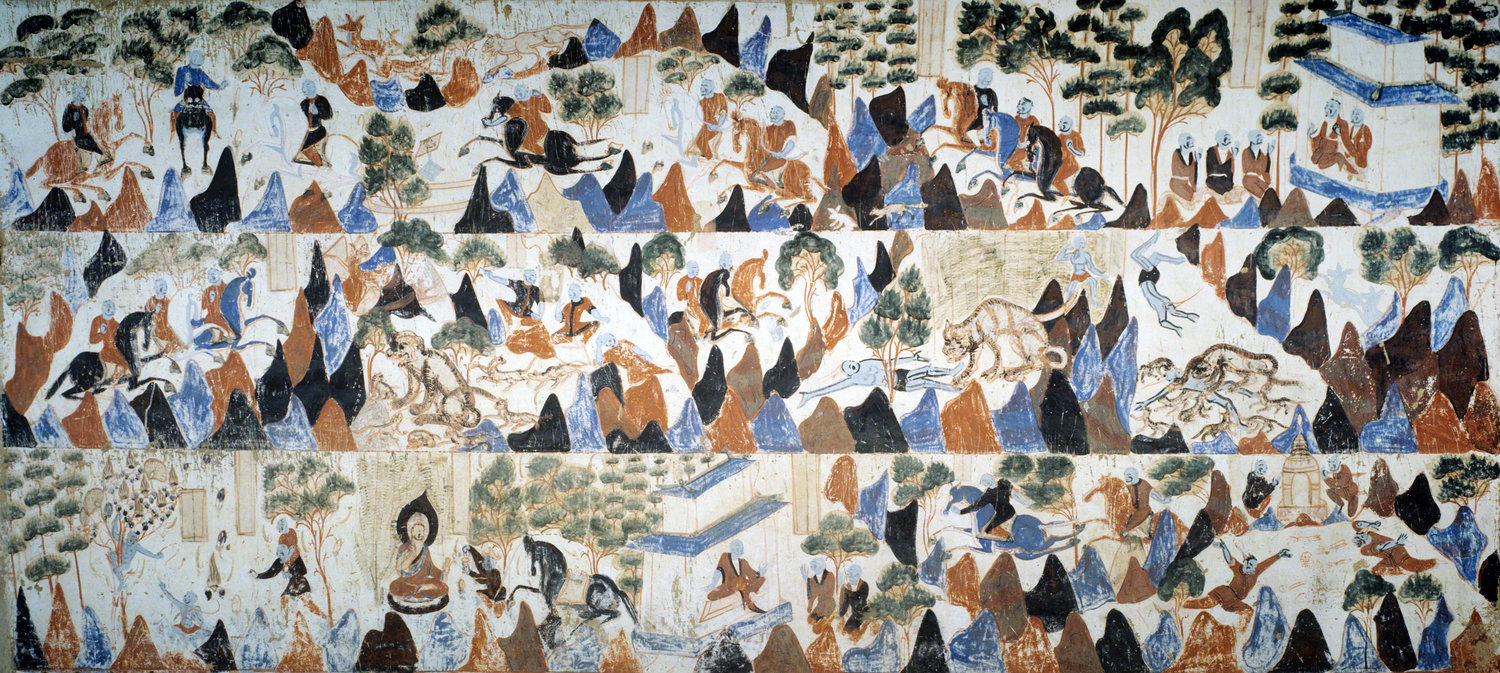
Jataka of the Hungry Tigress (Mahasattva Jataka), Dunhuang caves, early 6th century. Northern Wei dynasty (Six Dynasties Period).
Jataka of the Hungry Tigress (Mahasattva Jataka)
A famous narrative depicting the Bodhisattva's self-sacrifice to save his mother, showcasing themes of compassion and altruism, illustrated in the Dunhuang caves during the early 6th century.
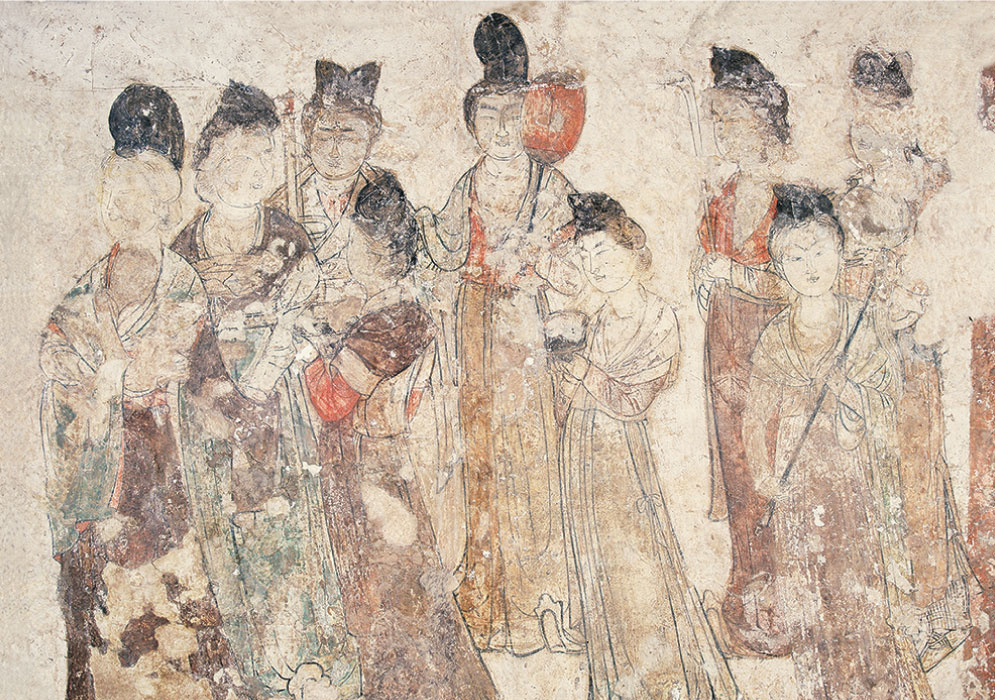
Court Ladies, Princess Yongtai’s tomb, dated 706 (8th century). Tang dynasty.
Court Ladies, Princess Yongtai’s tomb.
A prominent depiction of court women characterized by elegance, fashion, and ritual significance, often associated with the lavish lifestyle of the Tang dynasty elite.
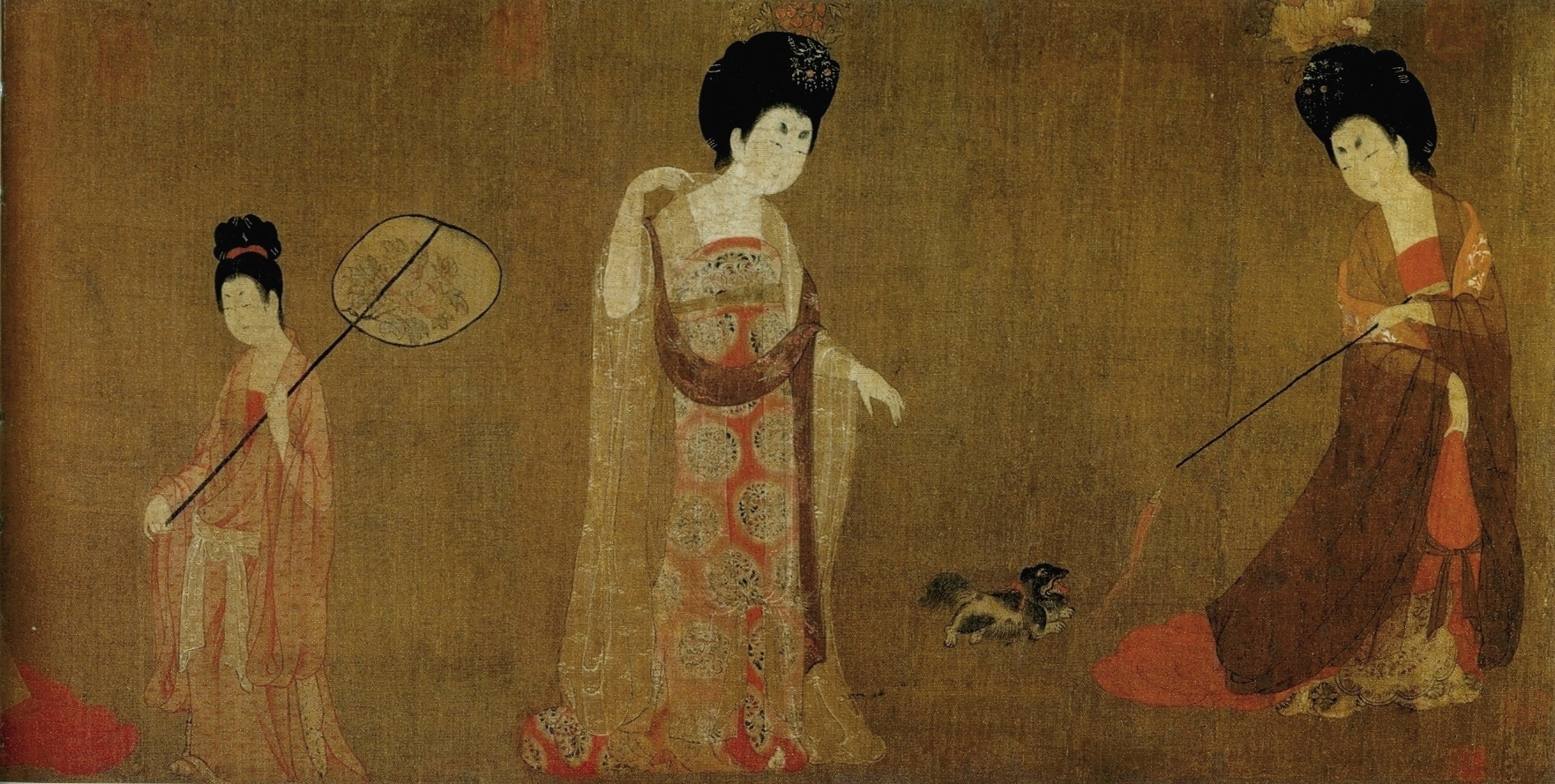
Section of Court Ladies Wearing Flowered Headdresses, attributed to Zhou Fang. 8th century, Tang dynasty.
Section of Court Ladies Wearing Flowered Headdresses.
A famous artwork from the Tang dynasty that showcases court women adorned with elaborate flowered headdresses, reflecting their status and beauty in 8th century China. Survived above ground.
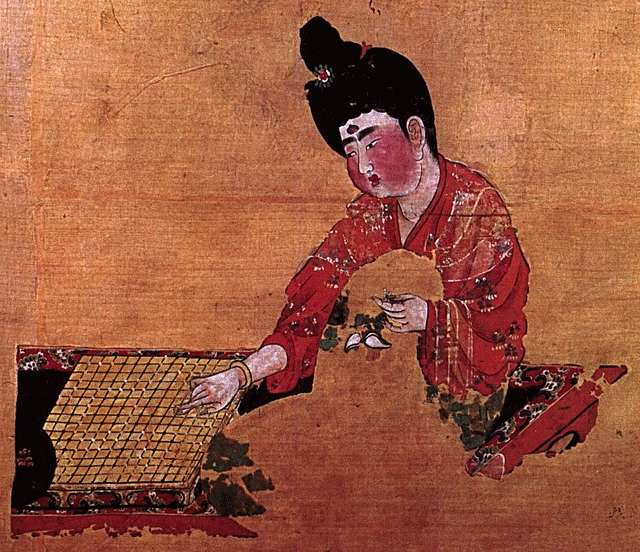
A Woman Playing a Game of Chess, section of a fragmentary painted screen from Turpan (Turfan), 8th century Tang dynasty.
A Woman Playing a Game of Chess.
A significant Tang dynasty artwork depicting a woman engaged in a game of chess, illustrating leisure and social interaction in 8th century China.
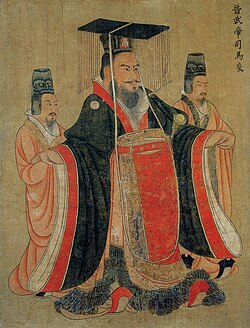
Section of Emperors of the Successive Dynasties, attributed to Yan Liben. 7th-8th century (at least in part?), Tang dynasty.
Section of Emperors of the Successive Dynasties.
A historical painting depicting the emperors of various Chinese dynasties, significant for its representation of political legitimacy and cultural heritage during the Tang dynasty. The Emperor is passing on knowledge from previous mistakes.
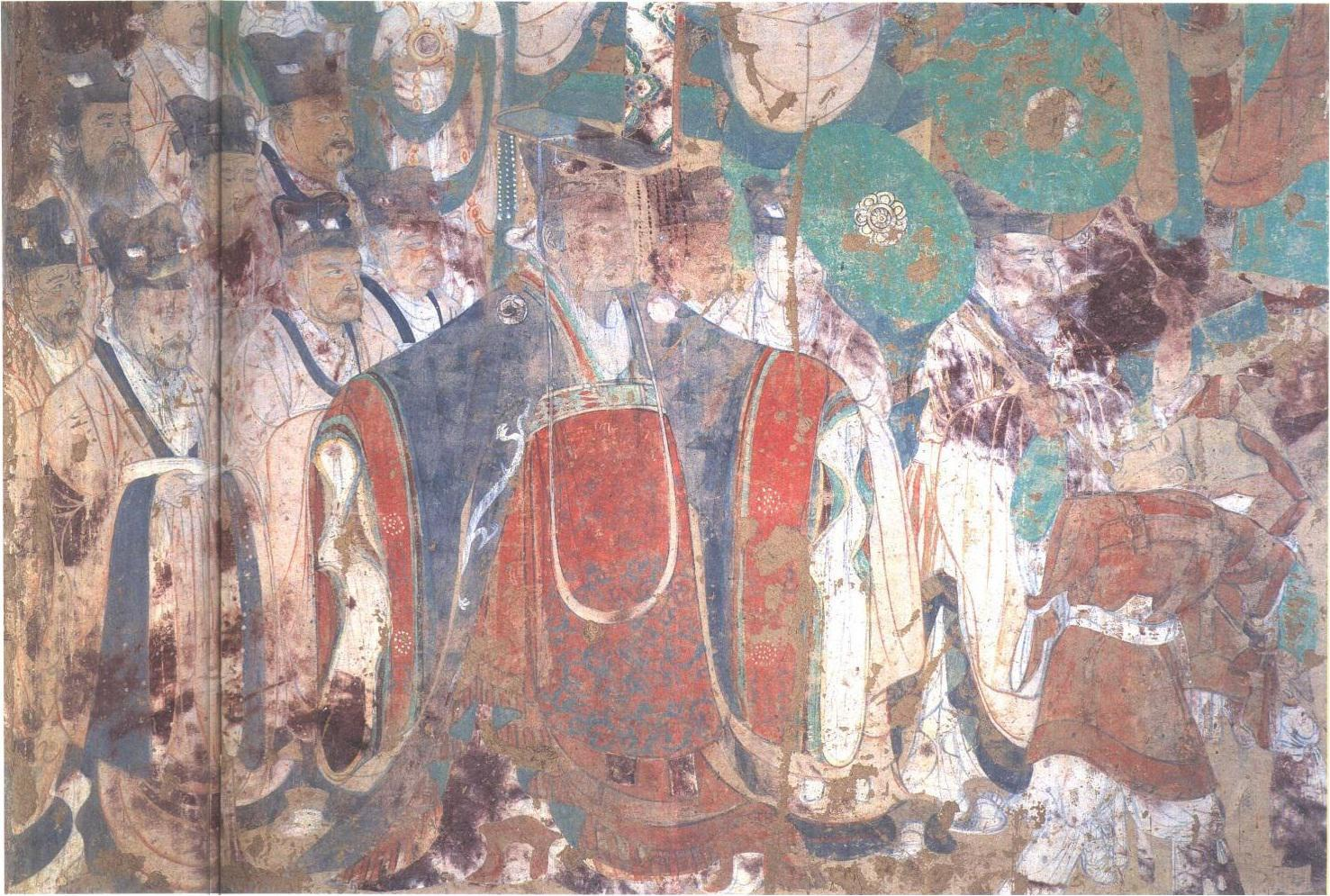
Emperor and Attendants. Dunhuang, dated 642 (7th century), Tang Dynasty.
Emperor and Attendants.
A mural from Dunhuang illustrating the emperor surrounded by attendants, showcasing the importance of imperial authority and the cultural context of the Tang dynasty.
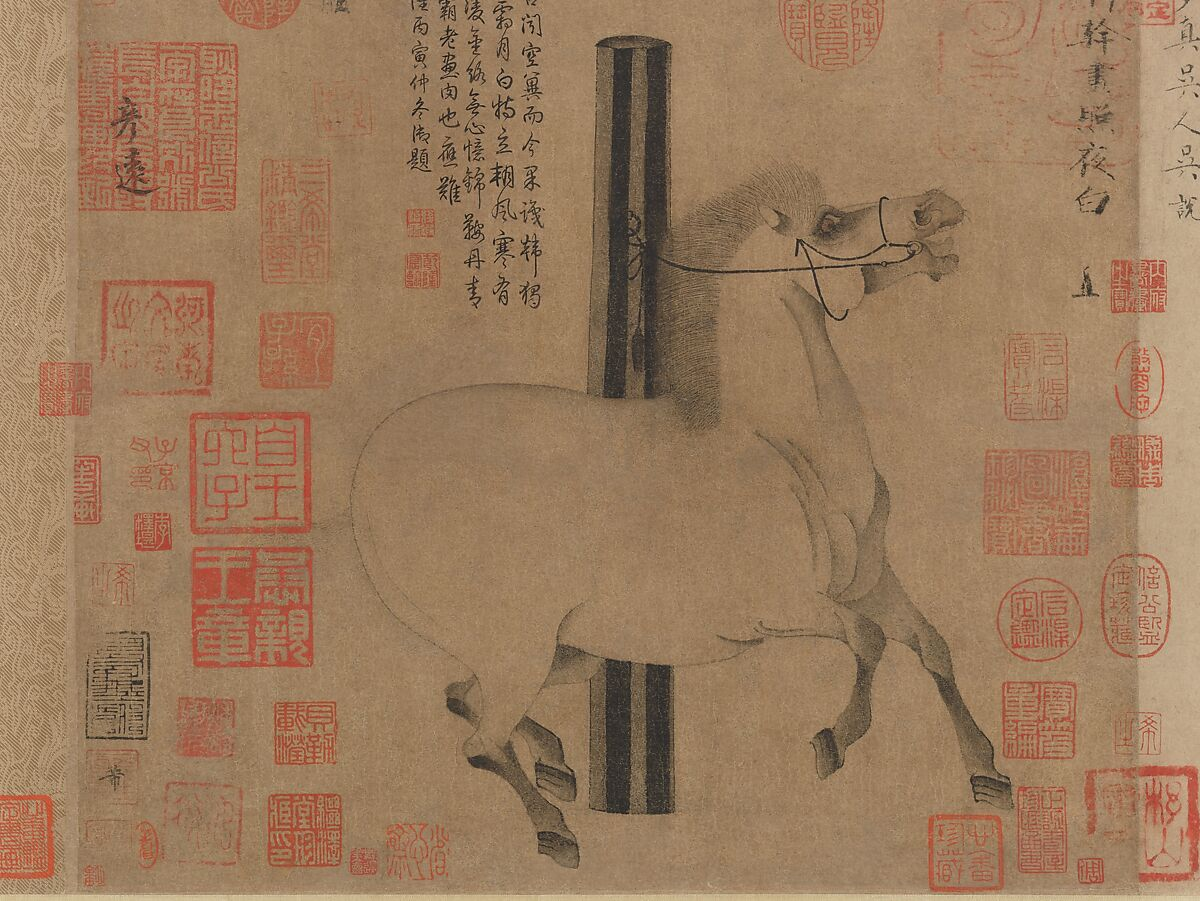
Shining Light of the Night, attributed to Han Gan. 8th century Tang dynasty
Shining Light of the Night.
A renowned painting from the 8th century Tang dynasty that depicts a luminous horse, emphasizing the skill of the artist Han Gan and the significance of horses in Tang society. Han Gan specialized in horses (of imperial stables).
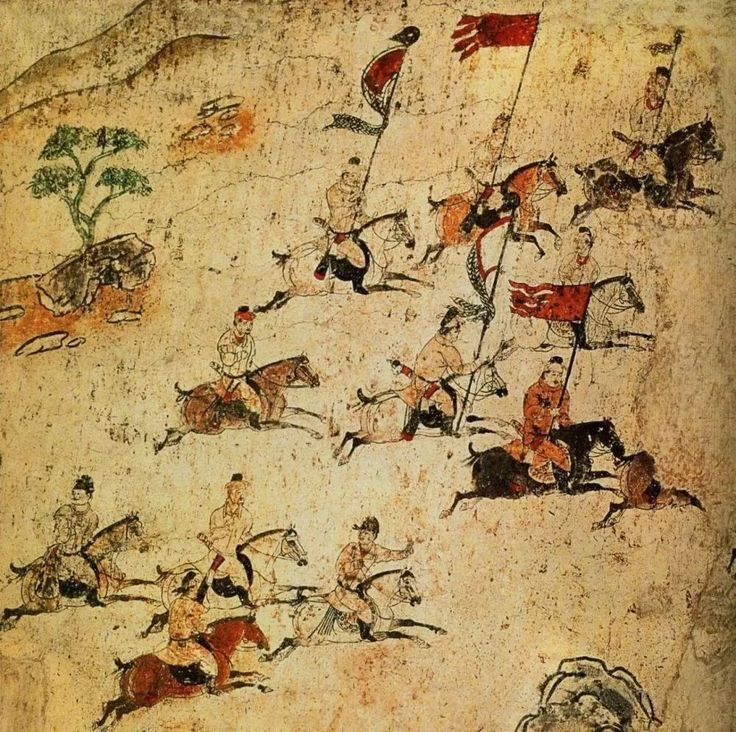
Playing Polo—Landscape mural in Prince Zhanghuai’s tomb, Qianxian, dated 706 (8th century) Tang dynasty.
Playing Polo—Landscape mural in Prince Zhanghuai’s tomb.
A significant 8th century Tang dynasty mural that showcases scenes of polo, highlighting the sport's popularity among the aristocracy and its cultural importance.
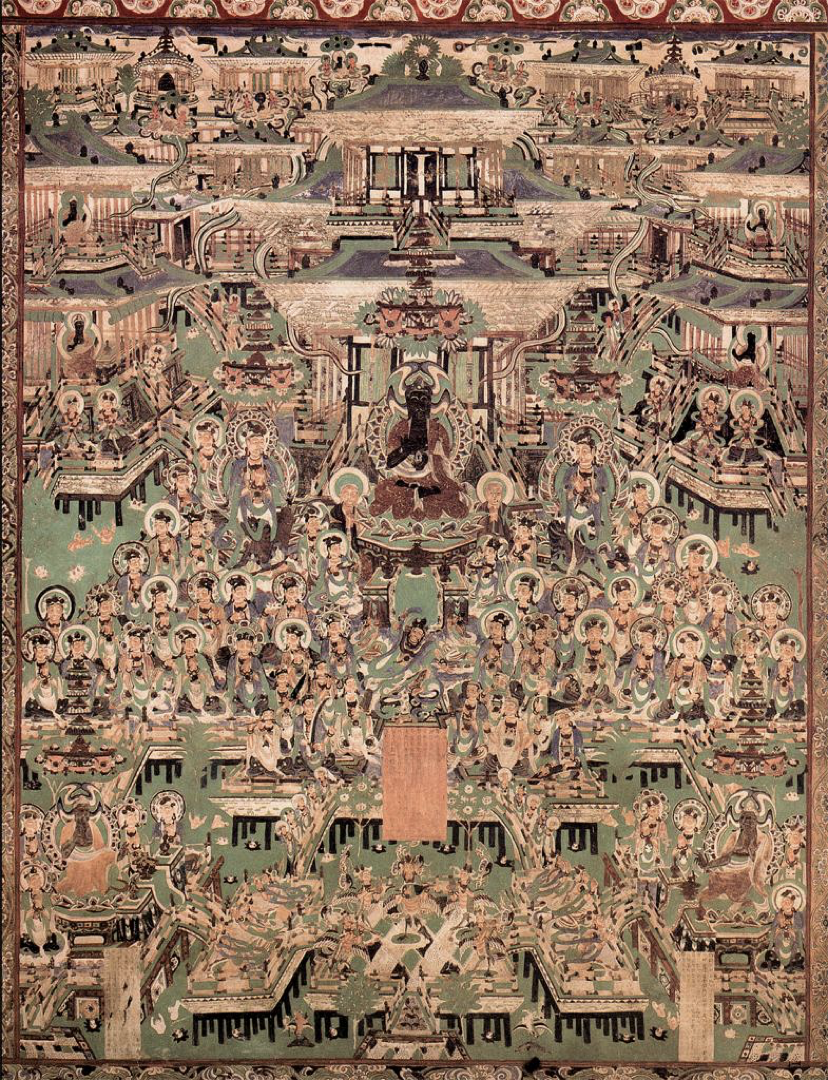
Buddhist Paradise scene, Dunhuang, 8th century Tang dynasty.
Buddhist Paradise scene, Dunhuang.
A prominent mural depicting a heavenly realm in Buddhism, illustrating the ideals of paradise and the spiritual aspirations of followers during the Tang dynasty.
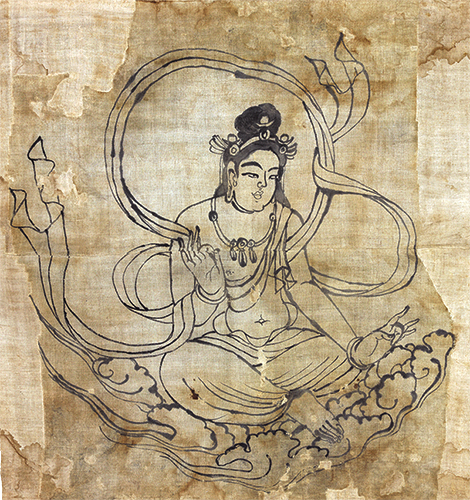
Bodhisattva Shoso-in repository, Nara, Japan, datable to before 756, from Tang dynasty China.
Bodhisattva Shoso-in repository.
A collection of treasures and artworks housed in the Shoso-in, reflecting the cultural exchanges between Japan and Tang dynasty China, significant for understanding Buddhist art.
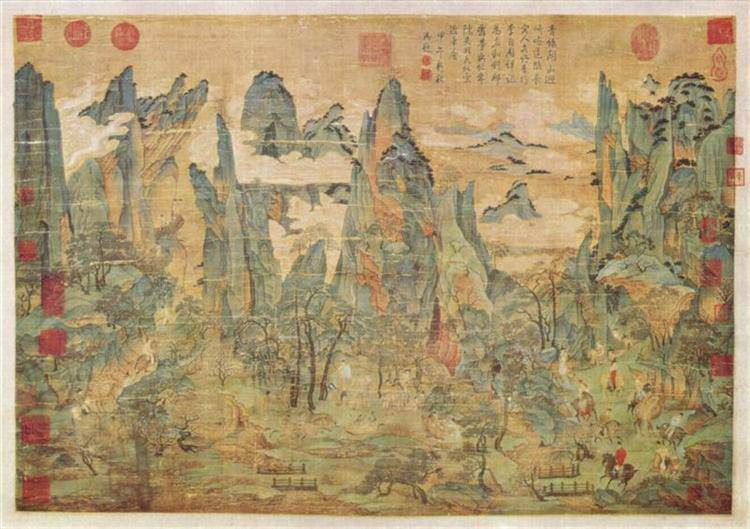
Emperor Minghuang’s Journey into Shu, attributed to Li Zhaodao. Likely a Song dynasty copy of a Tang original created ca. 800.
Emperor Minghuang’s Journey into Shu.
A famous painting depicting the legendary journey of Emperor Minghuang of the Tang dynasty to Shu. The Emperor was exiled because he was neglecting his duties and focusing on his concubine (who he took with him). An example of Blue and Green style assc. with Tan Dynasty
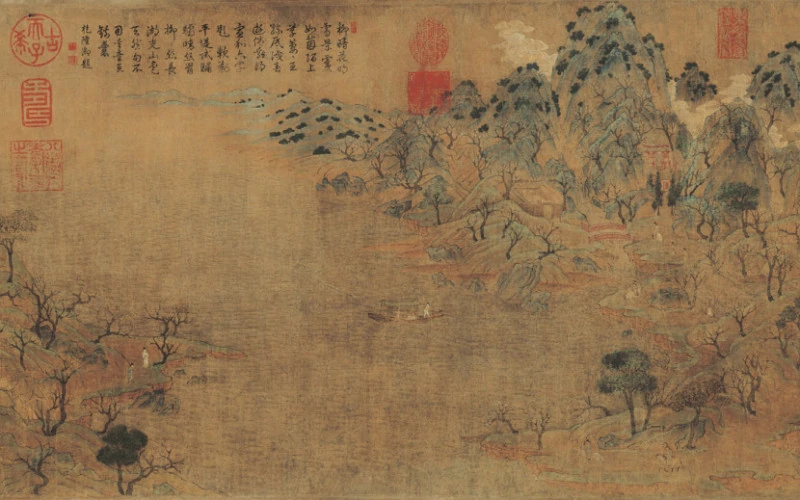
Spring Outing, attributed to Zhan Ziqian. Likely a Song dynasty copy of an early Tang dynasty work (7th century).
Spring Outing.
A well-known landscape painting representing the joys of spring, featuring elegant figures and natural beauty typical of early Tang aesthetics. Handscroll, ink and color on silk, Palace Museum. Colophon by Qianlong Emperor. "Blue-green landscape (shanshui)." Azurite mineral used for blue color. Malachite used for green and cinnabar used for red.
Hanging Scroll.
A traditional format for a Chinese painting or calligraphy that is designed to be hung on a wall, typically rolled up for storage. These scrolls can feature intricate artworks often associated with historical, cultural, or philosophical themes.
Handscroll.
A traditional Chinese painting format, which is designed to be viewed horizontally and often requires unrolling to see the entire composition. Handscrolls typically feature scenes unfolding in a narrative style, combining artistic expression with storytelling.
Yan Liben
High ranking court official and finest artist at the courts of the Emperors Taizong (T’ai-tsung) and Gaozong (Kao-tsung). He is renowned for his historical narratives and portraits, representing the essence of Tang dynasty art.
Gu Kaizhi
A prominent Chinese painter of the sixth century known for his figure painting and narrative style, especially in the depiction of historical and literary themes. His works greatly influenced the development of Chinese art. He is most famous for his painting "Nymph of the Luo River" and is regarded as a master of traditional Chinese painting techniques.
Zhou Fang
(active late 8th century). His paintings from Princess Yongtai’s tomb have been associated with this Tang court artist and may reflect his style.
Xie He's Six Principles of Painting
Spirit Resonance (氣韻生動) – conveying vitality and inner life
Bone Method (骨法用筆) – expressive use of the brush
Correspondence to the Object – correct depiction of form
Suitability to Type – appropriate application of color
Division and Planning – proper composition
Transmission by Copying – learning through imitation
 Note
Note  Flashcards (63)