Module 10 - Correlation and regression
 Studied by 0 people
 Call Kai
 Learn
Learn Practice Test
 Spaced Repetition
 Match
Match Flashcards
 Knowt Play
1/42

There's no tags or description
Looks like no tags are added yet.
Name | Mastery | Learn | Test | Matching | Spaced | Call with Kai |
|---|
No analytics yet
Send a link to your students to track their progress
43 Terms
Correlation test
Goal is to evaluate if there is an association between two numerical variables (whether one variable trends up/down as the other changes)
Key notes about correlation tests
No implied causation
Both variables are assumed to have variation
Not used for prediction, only to evaluate association
Correlation strength
Measured by Pearson’s correlation coefficient (r), the population parameter is given the Greek letter ⍴ (rho). Can take any value from ⍴=-1 to ⍴=1. ⍴=-1 indicates a perfect negative correlation. ⍴=0 indicates no association. ⍴=1 indicates perfect positive correlation
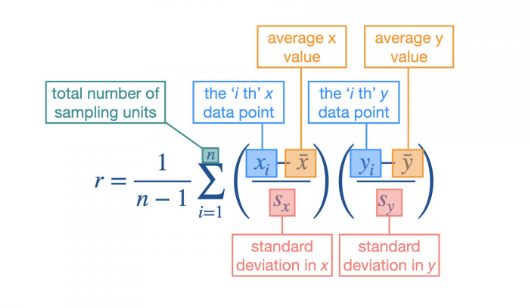
The expression for calculating the correlation coefficient from a sample. Covariation (how much one goes up when the other changes) is found within the brackets, then sum over all sampling units and divide by degrees of freedom (take the average covariation among sampling units)
Assumptions behind a correlation test
Each pair of numerical values is measured on the same ampling unit
Numerical values come from continuous numerical distributions with non-zero variation
If there is an association between the variables, it is a straight line
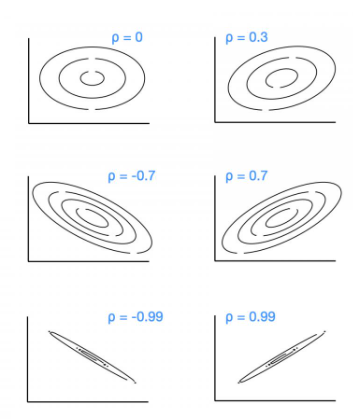
Bivariate normal distribution
An extension of the normal distribution for two numerical variables that allows for an association between them. Shows contour lines that represent variation. The tighter the lines are, the closer to perfect correlation
Null and alternative hypotheses for the correlation test
Null hypothesis: correlation coefficient is zero ⍴=0, OR can be directional, ⍴≤0 (or ⍴≥0)
Alternative hypothesis: correlation coefficient is not zero ⍴≠0, OR directional, ⍴>0 (or ⍴<0)
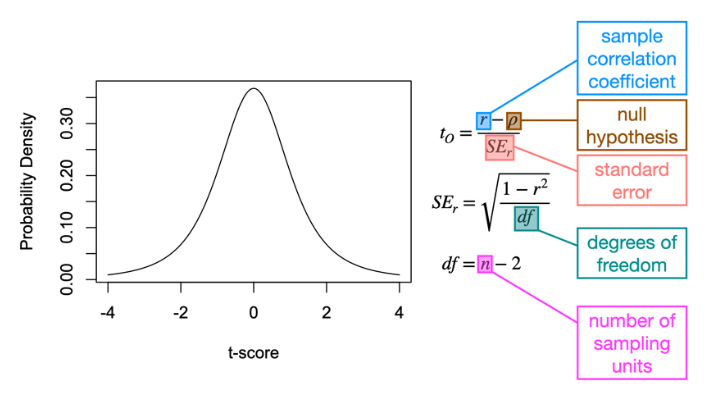
Null distribution for a correlation coefficient
T-distribution. Correlation tests are a special case of a single-sample t-test. Use the same machinery as a single-sample t-test. Reject the null hypothesis if tO>tC or p<⍺. Fail to reject if tO≤tC or p≥⍺
Scientific conclusions for a correlation test
Non directional:
Reject the null hypothesis and conclude that there is evidence of an association between the two numerical variables.
Fail to reject the null hypothesis and conclude that there is no evidence of an association between the two numerical variables.
Directional:
Reject the null hypothesis and conclude that there is evidence of a positive (or negative) association between the two numerical variables.
Fail to reject the null hypothesis and conclude that there is no evidence of a positive (or negative) association between the two numerical variables.
Linear regression test
Is the statistical test used to evaluate whether changes in one numerical variable can predict changes in a second numerical variable
Key points about linear regression tests
focus is on prediction (one variable is predictor variable, other is response variable)
sampling error occurs only in the response variable
in experimental studies: reflects a causal relationship, predictor variable/independent variable is manipulated, response/dependent variable is measured
in observational studies: predictor and response variables depend on the research question — want to make predictions about the response variable
Linear equation
yi= a + bxi
Shows that the response variable is equal to the intercept parameter plus the slope parameter * the predictor variable
Slope (b)
Describes the relationship between numerical variables. It is the amount that the response variable increases or decreases for every unit change in the predictor variable. Positive values describe an increasing relationship, zero value indicates no relationship, negative describes a decreasing relationship
Intercept (a)
The value of the response variable when the predictor variable (x) is at zero. Changing the intercept raises/lowers the line, but does not change the relationship between the variables
Three components to the statistical model
Systematic component, random component, link function
Systematic component
Describes the mathematical function used for predictions. For linear regression is the linear equation. Parameters are the intercept (a) and slope (b)
Random component
Describes the probability distribution for sampling error, as well as where it emerges in the model. For linear regression, is the normal distribution for the response variable. Illustrated as “coming out the screen towards you” for each data point. The mean value can change across x, but the standard deviation does not change
Link function
Connects the systematic component to the random component. States that the mean of the normal distribution is the same as the predicted value from the linear equation
Fitting the statistical model
Estimation of the intercept and slope that best explains the data — done by minimizing residual variance
Residual variance — sum of squares
The average squared residual value across all data points — the difference between the observed data point and the predicted value
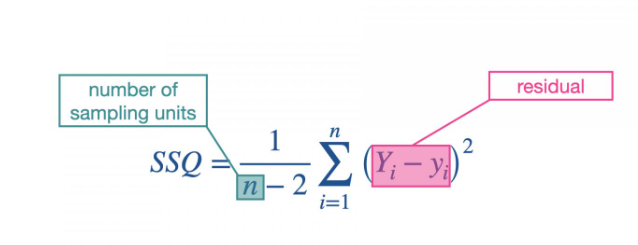
Calculation for sum of squares
Calculate the residual for each data point
take the square of each residual
Sum the squared residuals across all data points
Divide the degrees of freedom, which are df=n-2
Minimizing the sum of squares
The process for fitting the statistical model to data — varying the slope and intercept parameters until you find values that minimize the residual variance
Hypothesis testing for linear regression
Done on the parameters of the systematic component. Test hypotheses for the intercept and slope.
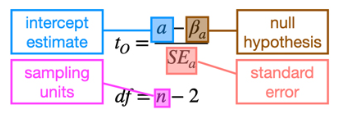
Intercept null and alternative hypotheses
Null: Intercept is not different from a reference value, or a=βa in symbols, HO: a≤βa
Alternative: Intercept is different from a reference value, or a≠βa in symbols, HA: a>βa
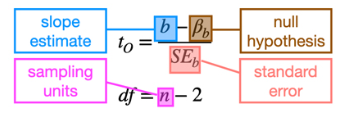
Slope null and alternative hypotheses
More common than for an intercept — usually whether it is different from zero.
Null: Slope is not different from a reference value, or b=βb in symbols, HO: b≤βb
Alternative: Slope is different from a reference value, or b≠βb in symbols, HA: b>βb
Linear regression test
Works by locating critical t-score and comparing to observed t-score. Statistical decision is:
Reject the null hypothesis if the observed score is greater than the critical score (i.e., tO>tC) or if the p-value is smaller than the Type I error rate (i.e., p<⍺).
Fail to reject the null hypothesis if the observed score is less than or equal to the critical score (i.e., tO≤tC) or if the p-value is larger or equal to the Type I error rate (i.e., p≥⍺).
Scientific conclusions for a linear regression test
Depends on parameter under consideration. Could be non-directional or directional. Below are non-directional:
Intercept:
Reject the null hypothesis and conclude there is evidence that the predicted response variable is different from the reference (βa) at x=0.
Fail to reject the null hypothesis and conclude there is no evidence that the predicted response variable is different from the reference (βa) at x=0.
Slope:
reject the null, there is evidence that changes in the predictor variable can be used to predict changes in the response variable
fail to reject the null, there is evidence that changes in the predictor variable can predict changes in the response variable
Four main assumptions for a linear regression
Linearity
Independence
Normality
Homoscedasticity
Linearity
Response variable can be described as a linear combination of the predictor variable. Assume the systematic component is y= a+bx, means relationship is assumed to be a straight line. Evaluated qualitatively
Assumptions of linearity met
The data shows a straight line relationship between the predictor variable and the residuals. If the relationship is described by a straight line, then the residuals will not have a trend
Assumptions of linearity violated
The residuals may have a trend to them, may often look like a smiling or frowning face (curved relationship to them)
Independence
Assumption that residuals are independent of each other across the predictor variable. Violations may occur when there is repeated sampling of the same sample units or there is a spatial/temporal relationship among sampling units. Can guard against it be ensuring units are selected at random. Evaluated qualitatively
Assumptions of independence met
Look at the pattern among adjacent residuals, there is a switch between positive and negative residuals.
Assumptions of independence violated
Residuals are not independent, may have runs of positive and then negative
Normality
Assumption that residuals are normally distributed (not the data itself). Evaluated qualitatively by looking at a histogram of the residuals as densities with a normal distribution overlaid on top with a mean of zero and a standard deviation matching that of the residuals. Can also be evaluated quantitatively with a Shapiro-Wilks test
Assumptions of normality met
The histogram of residuals will look similar to the reference normal distribution. Residuals are normally distributed.
Assumptions of normality violated
Statistical population may have a skewed or unusual distribution. May also violate assumptions of linearity. residuals are not normally distributed, may have more density in the middle and less in the tails than expected for a normal distribution, or may be skinnier.
Shapiro-Wilks test
Statistical test used to quantitatively evaluate the assumption that the residuals are normally distributed.
HO: The residuals are normally distributed, HA: The residuals are not normally distributed
If p≥α then we fail to reject the null hypothesis, no evidence to suggest that the residuals are not normally distributed
Homoscedasticity
Assumption that the residuals have the same variance across the predictor variable. Can be evaluated qualitatively by looking at a plot of residuals against the predictor variable
Heteroscedasticity
If the residuals have little variation along some parts of the predictor variable and large amounts at others. Can be caused if residuals are not well described by a normal variation.
Assumption of homoscedasticity met
Straight line relationship between predictor variable and residuals. There is roughly equal variance across the predictor variable (on positive and negative sides of the predictor variable).
Assumptions of homoscedasticity violated
Residuals have small variance at low values of the predictor variable and increased variance at high values, for example.
If assumptions are violated
No simple 1:1 map between violations of assumptions and trustworthiness of statistical results. Sometimes violation has little impact on robustness of the statistical conclusions, sometimes minor violations can alter the statistical conclusions.
 Note
Note  Flashcards (50)