Surface Patterning & Biotextiles
 Call Kai
 Learn
Learn Practice Test
 Spaced Repetition
 Match
Match Flashcards
 Knowt Play
1/36

There's no tags or description
Looks like no tags are added yet.
Name | Mastery | Learn | Test | Matching | Spaced | Call with Kai |
|---|
No analytics yet
Send a link to your students to track their progress
37 Terms
What is surface patterning and why is it important?
What: Creating chemically or physically distinct regions on a surface to control biological interactions (cells, proteins).
Why: Because cell behavior is strongly influenced by surface chemistry and structure.
What is resolution in surface patterning?
The smallest feature size that can be created.
High resolution is not always applicable (cell patterning)
What is throughput?
The area patterned per unit time (important for manufacturing).
Drives cost
What is contrast?
How well patterned regions are distinguished from background
→ often depends on biomolecule density and non-fouling background.
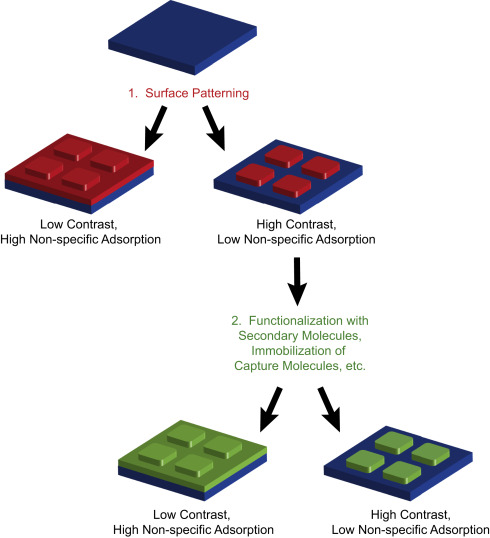
What is bioactivity (in patterning)?
Ability of patterned biomolecules to retain function after processing.
What is direct-write patterning?
Using a tool to “write” patterns directly onto a surface.
High res, Low throughput (limitation)
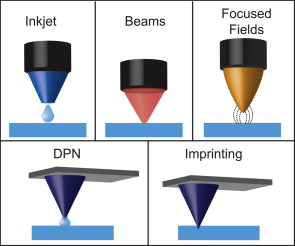
What is DPN?
AFM (atomic force microscope) based technique that deposits molecules with very high resolution (<100 nm).
(nano-imprinting and nano-engraving)
How does inkjet patterning work?
Deposits droplets (10–20 pL) of bio-inks (proteins, DNA, cells) onto surfaces in defined patterns.
high throughput
contact-free
works in ambient conditions
What is the focused fields direct-write technique?
Scanning electric and magnetic fields, has lower spatial resolution and use to elicit local electrochemical reactions.
What is electron beam lithography and its limitations?
Uses electrons to create patterns with ~10 nm resolution.
requires vacuum
low throughput
not ideal for direct biological patterning
expensive
What is focused ion beam lithography?
uses high mass ions as energetic particles that bombard and ablate surface molecules
engraves sub-mircon features
What is lithography and therefore photolithography?
Use of etched stones coated with ink to create pictures in the stone age
Uses light and a mask to pattern surfaces via photoresist reactions.
200nm resolution (i.e. diffraction limit of visible light)
Difference between positive and negative photoresist.
Positive → exposed regions dissolve
Negative → exposed regions harden
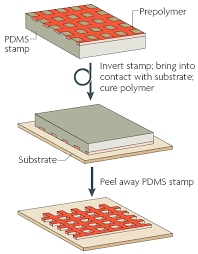
What is soft lithography and advantages?
Uses PDMS (elastomeric molds) to transfer patterns onto surfaces.
Cured as a relief pattern from silicone master.
“stamp”
inexpensive
scalable (over large areas)
works for biological materials
What is self-assembly patterning?
Pattern formation driven by thermodynamics (minimizing free energy).
self-assembly patterning example: block copolymer self-assembly.
Phase separation of polymer blocks → nanoscale patterns.
High throughput
self-assembly patterning example: nanosphere lithography
Nanoparticles self-organize into ordered arrays for patterning.
High throughput
self-assembly patterning example: magnetic self-assembly
Particles align using magnetic fields → can guide cell positioning.
Why are textured implants better than smooth ones?
promote tissue integration
reduce fibrous capsule formation
improve implant stability
How does surface texturing reduce inflammation?
Reduces micromotion and alters collagen organization → less fibrosis
Examples of surface texturing methods.
acid etching
sandblasting or grit
anodization
micro-machining
Ideal pore size for tissue ingrowth.
>100 um —> allow cell filtrations
<1000 µm → avoid fibrous tissue ingrowth
Goals of manufacturing porous materials
stimulate tissue ingrowth
disrupt fibrosis
promote angiogenesis
Optimal pore size for bone ingrowth.
100–400 µm
Minimum pore size for vascularization
50–100 µm
(100 min. for continuous growth)
Tradeoff of porous materials
Increased porosity → decreased mechanical strength
What is osteointegration?
Direct bone bonding to implant surface.
How do porous implants improve osteointegration?
Allow bone ingrowth → reduces stress shielding and implant loosening.
What are biotextiles?
Fibrous materials used in medical applications (e.g., grafts, sutures, implants).
vascular grafts
hernia repair
heart valves
wound dressings
Key properties of biotextiles.
flexible
strong
porous
high surface area
What polymer properties are needed for fibers (to facilitate crystallization)?
high molecular weight
linear chains (no bulk)
ability to crystallize
strong intermolecular interactions for chain alignment
What does a decitex metrify?
yarn linear density (mass per 10 or 9000 meters of fiber)
Textile processing: What is melt spinning?
Polymer resin is melted and extruded into fibers (used for thermoplastics).
Textile processing: What is wet/gel spinning and when is it used?
Polymer solution dissolved and extruded into a bath → precipitates into solid fibers.
For polymers that degrade at high temperatures (natural materials).
10um for multifilament yarns (weak but ductile)
500um for monofilament yarns (strong but large)
Textile processing: What is electrospinning?
Uses electric field to overcome surface tension and accelerate jets to a target form nano-scale fibers (100 nm–µm). very small
Creates structures that mimic ECM architecture.***
What factors affect electrospinning?
polymer type
solution concentration
voltage
system geometry
Why align fibers?
Improves:
mechanical properties
cell alignment and phenotype

