AP Art History - Northern Renaissance Multiple Choice Test
 Studied by 2 people
 Call Kai
 Learn
Learn Practice Test
 Spaced Repetition
 Match
Match Flashcards
 Knowt Play
1/81

There's no tags or description
Looks like no tags are added yet.
Name | Mastery | Learn | Test | Matching | Spaced | Call with Kai |
|---|
No analytics yet
Send a link to your students to track their progress
82 Terms
(Unit 3 Chapter 14 - Northern Renaissance (c. 1400 - 1600 CE)) Introduction to the Northern Renaissance
Historical Background: Various Artistic Developments
Modern European art emerges from global interactions with other cultures. Western Europe & the American colonies are at the center of Renaissance studies. Europeans began to collect & organize knowledge from their various expansions around the globe.
There’s an interest in returning to _________ ______ in the 15th century
Greater emphasis on ______ _________ & ________ ________
Exploration of ________, ___________, & _____
Artistic training is enhanced by the birth of academies and art becomes a way to glorify patrons
classical ideals (Ancient Greece & Rome)
formal education
artistic training
painting
composition
color
(Unit 3 Chapter 14 - Northern Renaissance (c. 1400 - 1600 CE)) Introduction to the Northern Renaissance
Religion: Reformation and Counter-Reformation caused a rift in Christian art of Western Europe
________ Europe = emphasis on ____________ subjects (portraits, genre paintings, still lives)
Northern
non-religious
(Unit 3 Chapter 14 - Northern Renaissance (c. 1400 - 1600 CE)) Introduction to the Northern Renaissance
Religion: Reformation and Counter-Reformation caused a rift in Christian art of Western Europe
________ Europe = emphasis on _________ subjects with more action & dynamism
Southern
religious
(Unit 3 Chapter 14 - Northern Renaissance (c. 1400 - 1600 CE)) Introduction to the Northern Renaissance
Religion: Reformation and Counter-Reformation caused a rift in Christian art of Western Europe
__________ ___________ → one of the greatest upheavals in religious/political European history
Protestant Reformation
(Unit 3 Chapter 14 - Northern Renaissance (c. 1400 - 1600 CE)) Introduction to the Northern Renaissance
Religion: Reformation and Counter-Reformation caused a rift in Christian art of Western Europe
______ ______ → German monk/Catholic scholar/founder of Lutherans (Protestant)
Found issues within the Catholic church and wrote his __ ______ detailing its abuses (specifically, indulgences…. Indulgences → Money paid by Catholics for the repentance of sins)
Martin Luther
95 Theses
(Unit 3 Chapter 14 - Northern Renaissance (c. 1400 - 1600 CE)) Introduction to the Northern Renaissance
Religion: Reformation and Counter-Reformation caused a rift in Christian art of Western Europe
Reformation → Martin Luther called for reform in the Catholic church— instead, he caused a schism where Martin Luther began a new branch of Christianity called the Lutherans
What are the Catholic Countries and Protestant Countries?
Catholic Countries: Spain, Italy, Portugal, Poland
Protestant Countries: Germany, Scandinavia, and the Netherlands
(Unit 3 Chapter 14 - Northern Renaissance (c. 1400 - 1600 CE)) Introduction to the Northern Renaissance
Developments in Art Forms: Oil Paint
Produces ____ ___ _______ colors & imitate _______ hues & tones
Takes a while to dry, so artists can change & update their work
Becomes the medium of choice
rich and vibrant
natural
(Unit 3 Chapter 14 - Northern Renaissance (c. 1400 - 1600 CE)) Introduction to the Northern Renaissance
Developments in Art Forms: Woodcut VS Engraving VS Etching
___________ → Development of ____________ _________ _ ___________ _____
________ _____: developed by ______ _________
Printmaking
mechanically producing & reproducing books
Printing Press
Johann Gutenberg
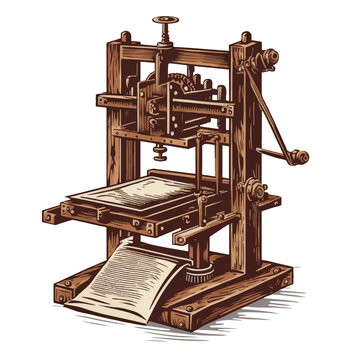
(Unit 3 Chapter 14 - Northern Renaissance (c. 1400 - 1600 CE)) Introduction to the Northern Renaissance
Developments in Art Forms: Woodcut VS Engraving VS Etching
Describe the features of Woodcut (carved, inked, pressed).
Sharp Lines
Stiff Figures
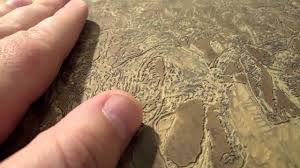
(Unit 3 Chapter 14 - Northern Renaissance (c. 1400 - 1600 CE)) Introduction to the Northern Renaissance
Developments in Art Forms: Woodcut VS Engraving VS Etching
Describe the features of Engraving (incised, inked, printed).
Amazing Details
Fine Contour Lines
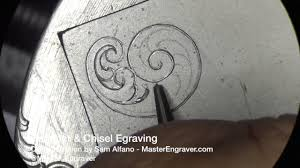
(Unit 3 Chapter 14 - Northern Renaissance (c. 1400 - 1600 CE)) Introduction to the Northern Renaissance
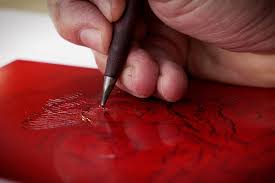
Developments in Art Forms: Woodcut VS Engraving VS Etching
Describe the features of Etching (resist, acid, print).
Even BETTER Details
Even More Fine Lines
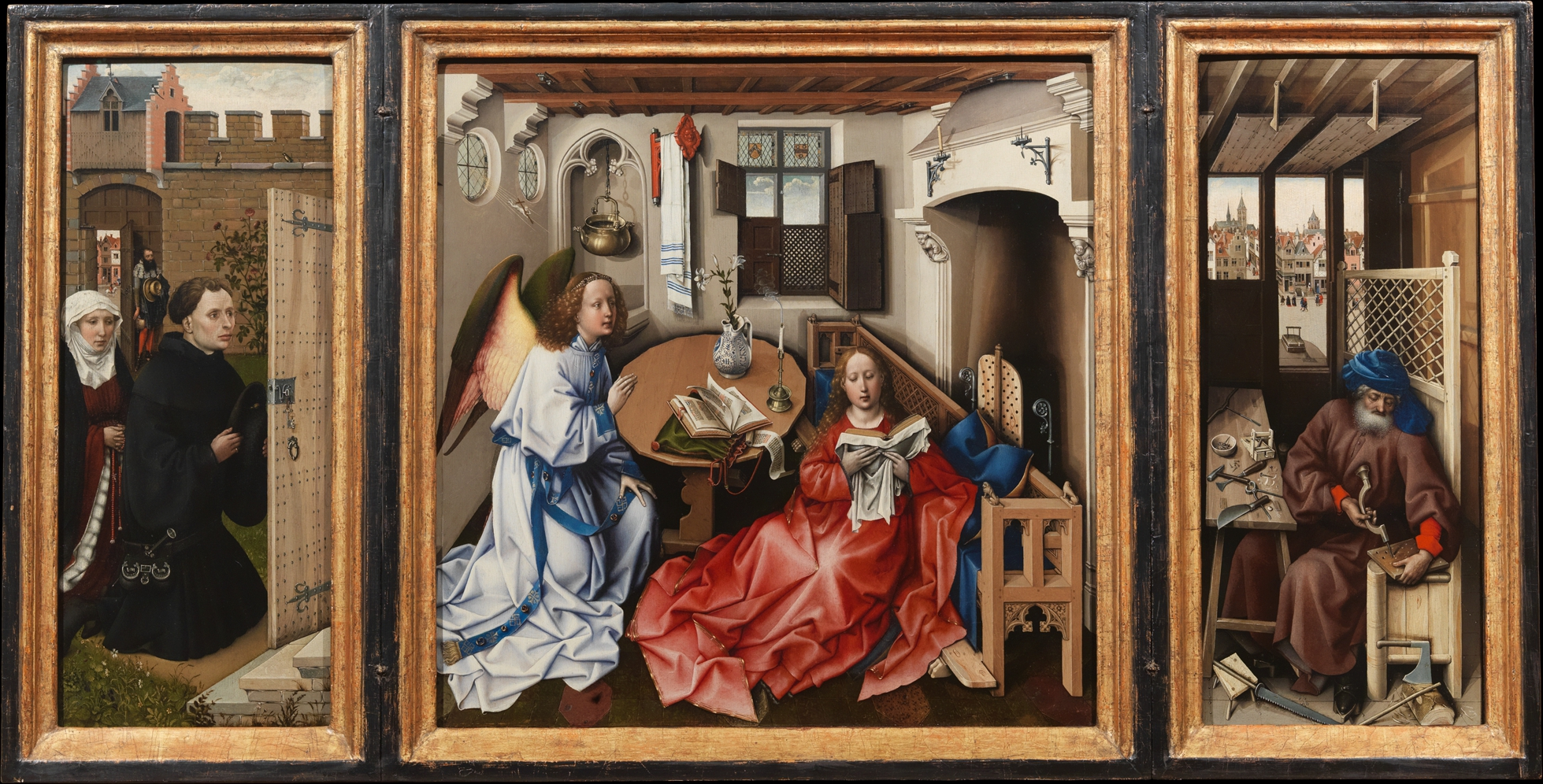
(Unit 3 Chapter 14 - Northern Renaissance (c. 1400 - 1600 CE)) Name this piece!
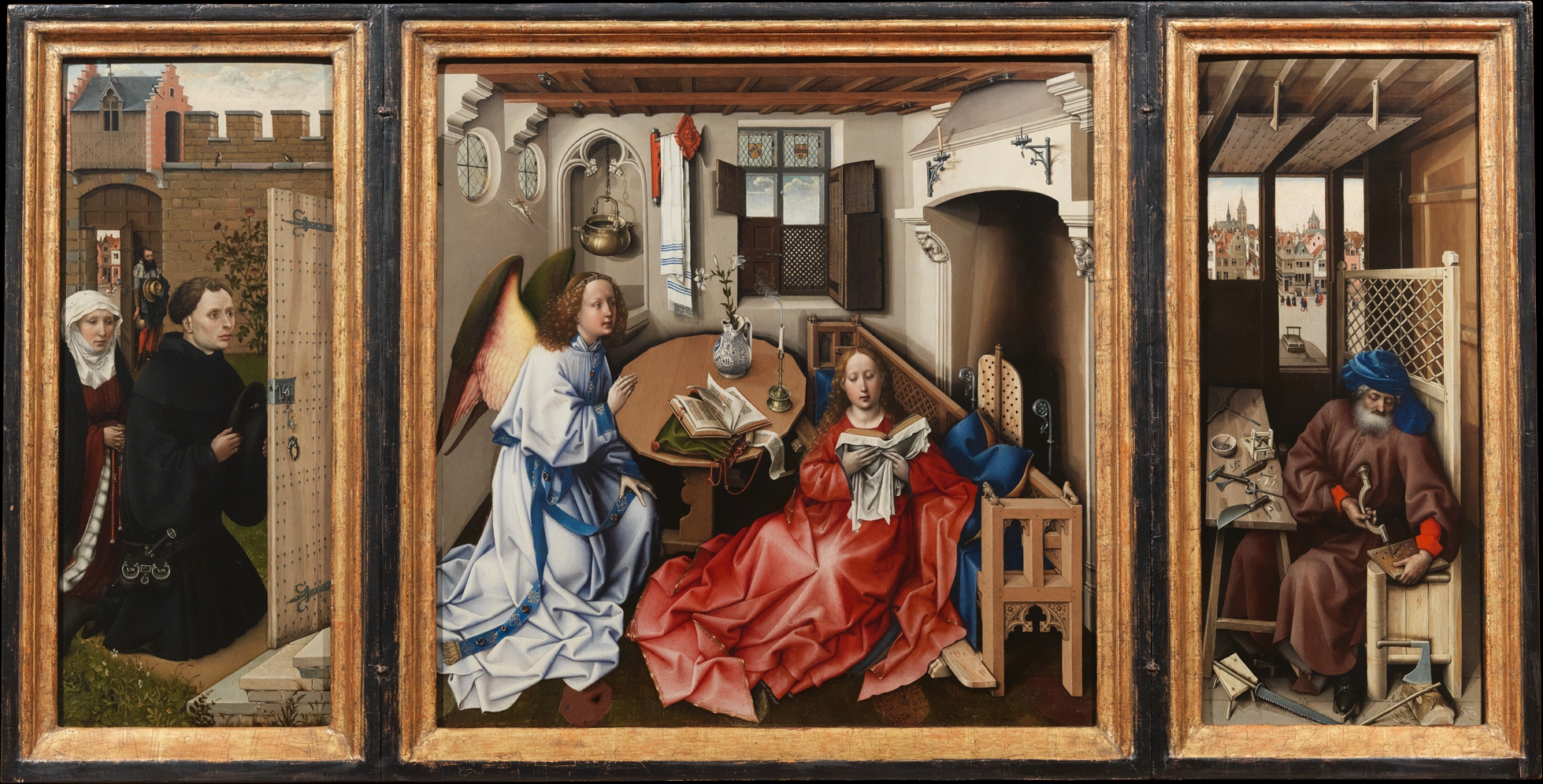
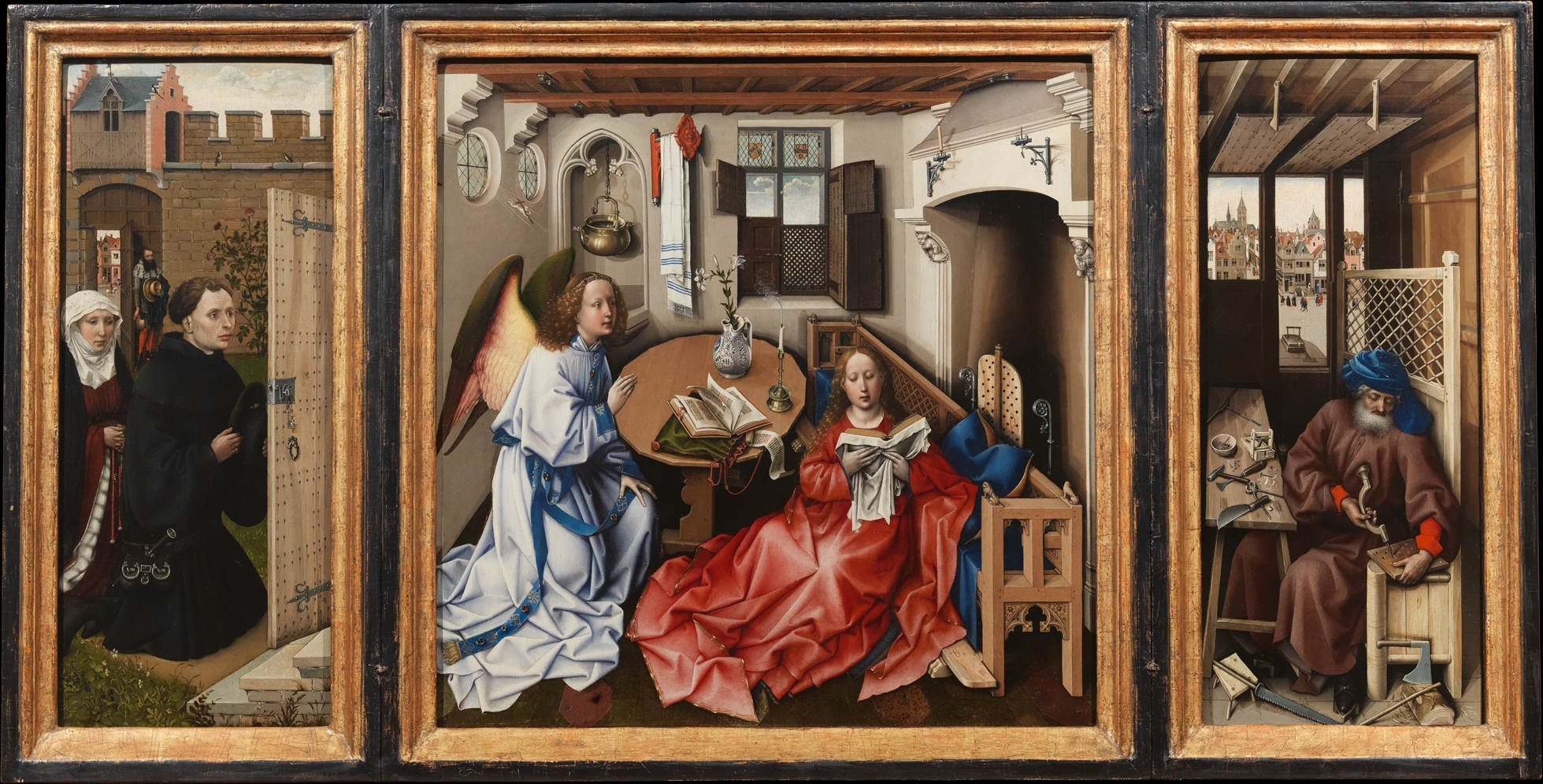
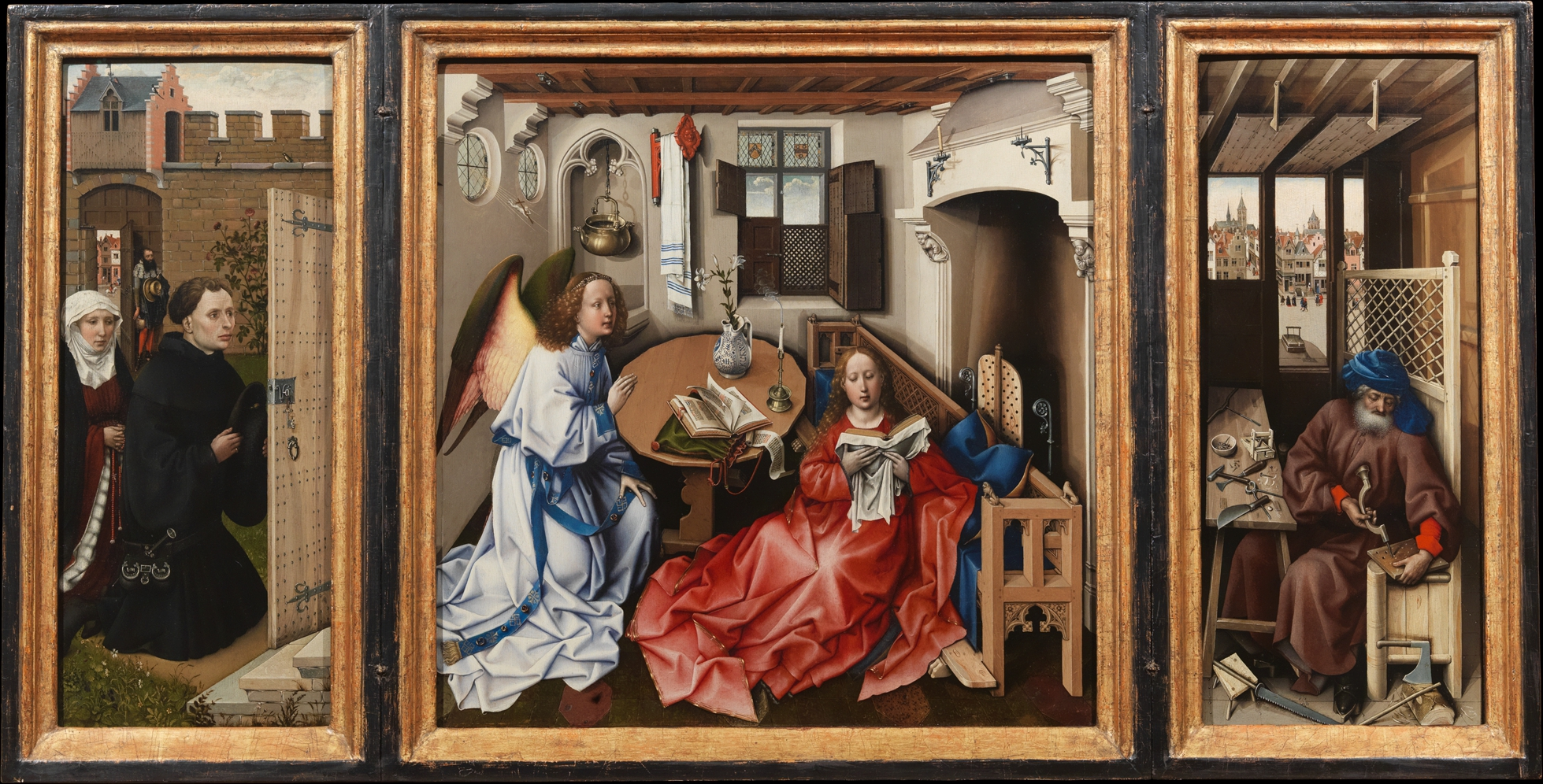
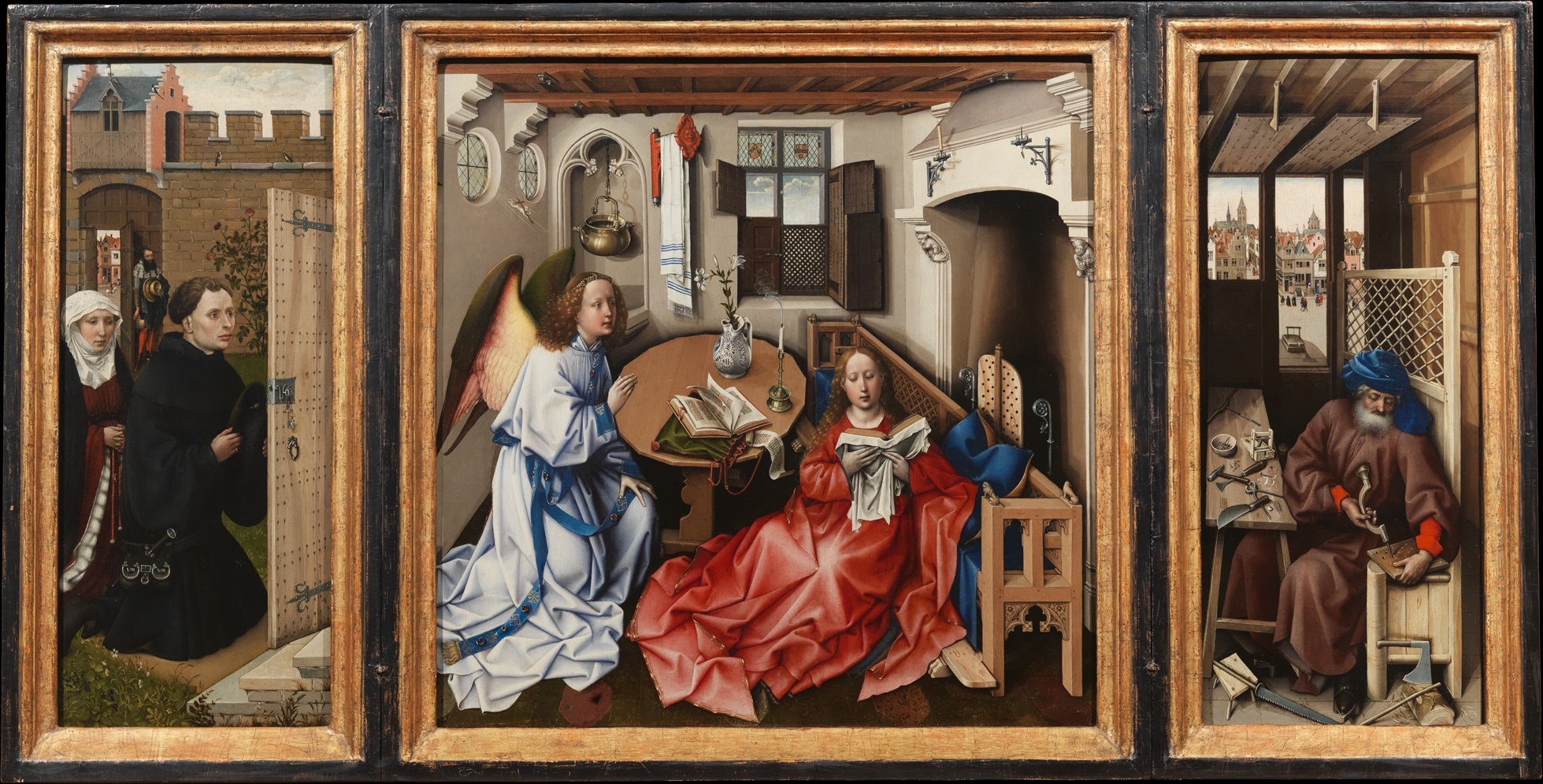
Merode Altarpiece (Annunciation Triptych)
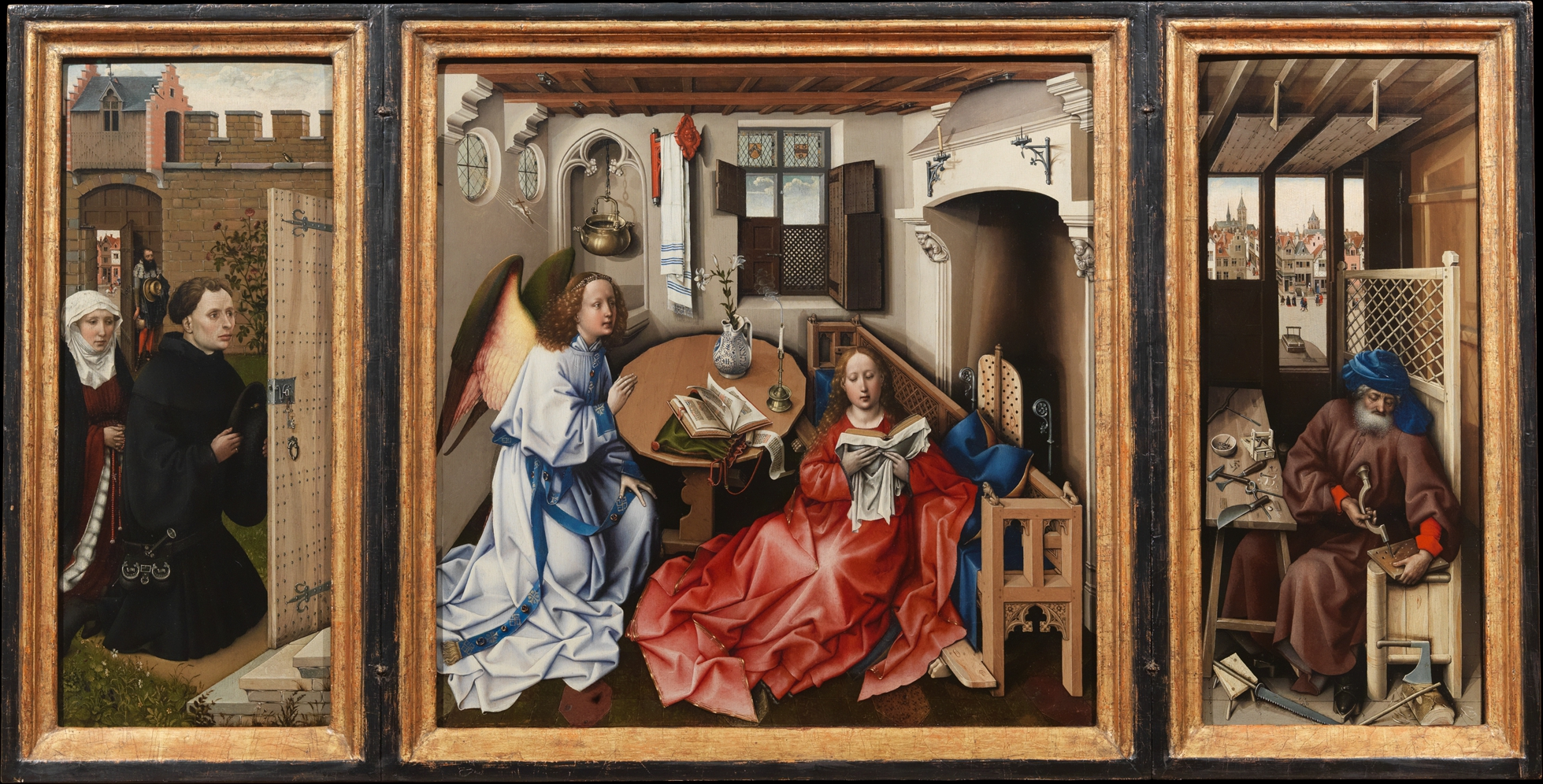
(Unit 3 Chapter 14 - Northern Renaissance (c. 1400 - 1600 CE)) #66: Merode Altarpiece (Annunciation Triptych)
LOCATION
Tournai, Belgium
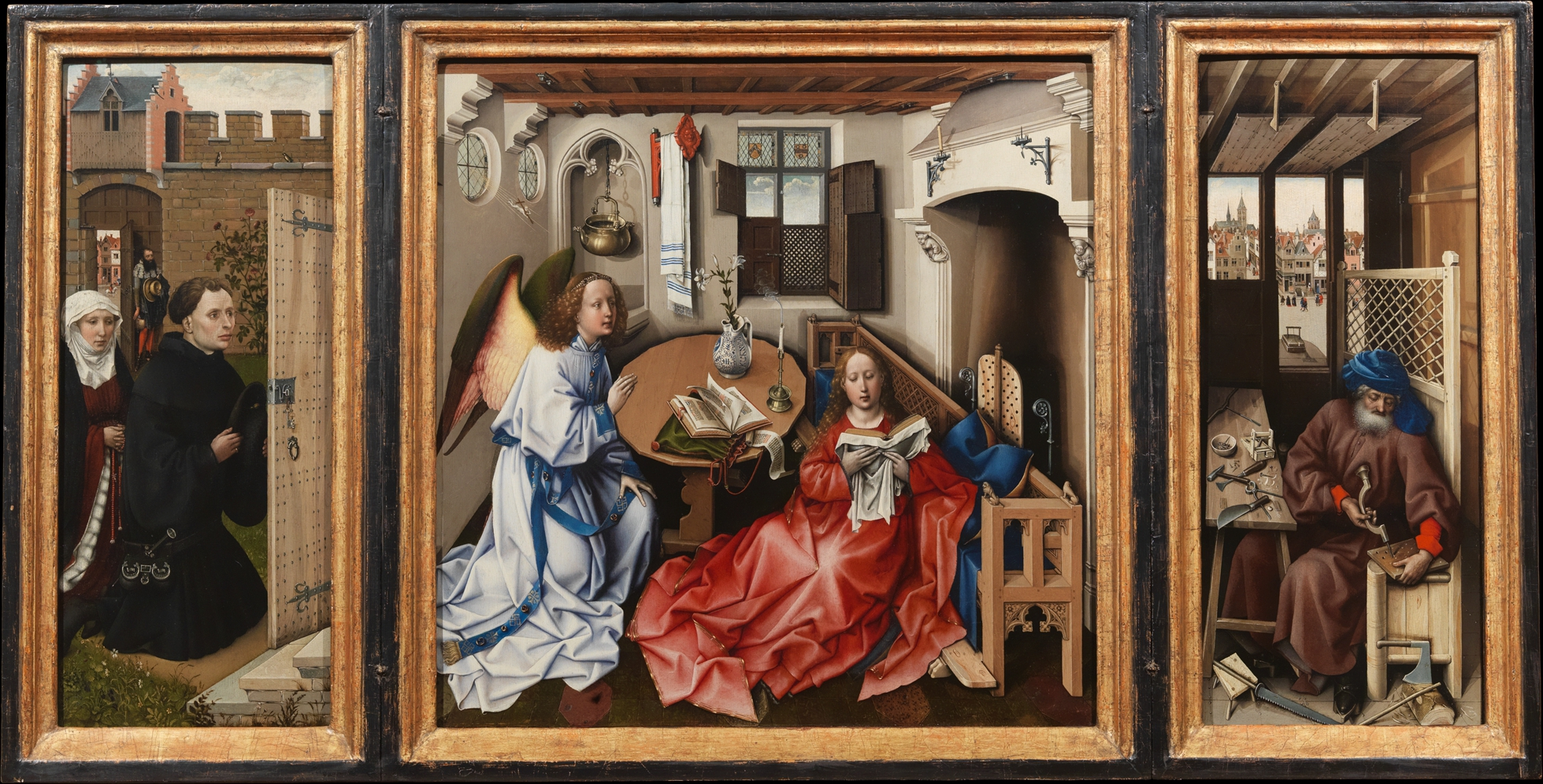
(Unit 3 Chapter 14 - Northern Renaissance (c. 1400 - 1600 CE)) #66: Merode Altarpiece (Annunciation Triptych)
ERA
Northern European Renaissance
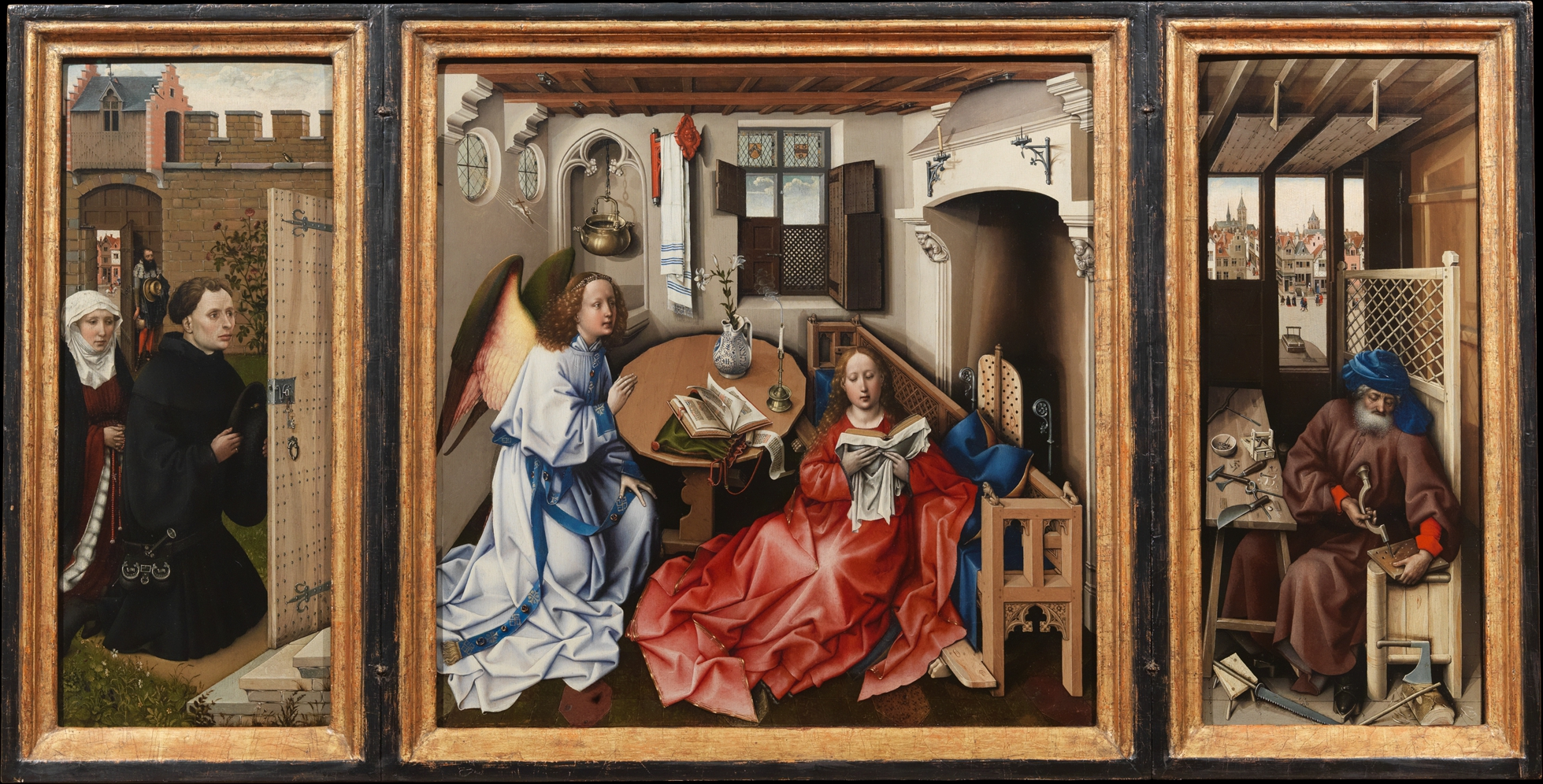
(Unit 3 Chapter 14 - Northern Renaissance (c. 1400 - 1600 CE)) #66: Merode Altarpiece (Annunciation Triptych)
ARTIST
Robert Campin
(Unit 3 Chapter 14 - Northern Renaissance (c. 1400 - 1600 CE)) #66: Merode Altarpiece (Annunciation Triptych)
FORM
Oil Paint on Wood
(Unit 3 Chapter 14 - Northern Renaissance (c. 1400 - 1600 CE)) #66: Merode Altarpiece (Annunciation Triptych)
PATRON
Unknown
(Unit 3 Chapter 14 - Northern Renaissance (c. 1400 - 1600 CE)) #66: Merode Altarpiece (Annunciation Triptych)
FUNCTION
Triptych Altarpiece depicting the Annunciation
(Unit 3 Chapter 14 - Northern Renaissance (c. 1400 - 1600 CE)) #66: Merode Altarpiece (Annunciation Triptych)
VOCABULARY: Triptych
a picture expanding across 3 panels, typically hinged, usually used as an altarpiece
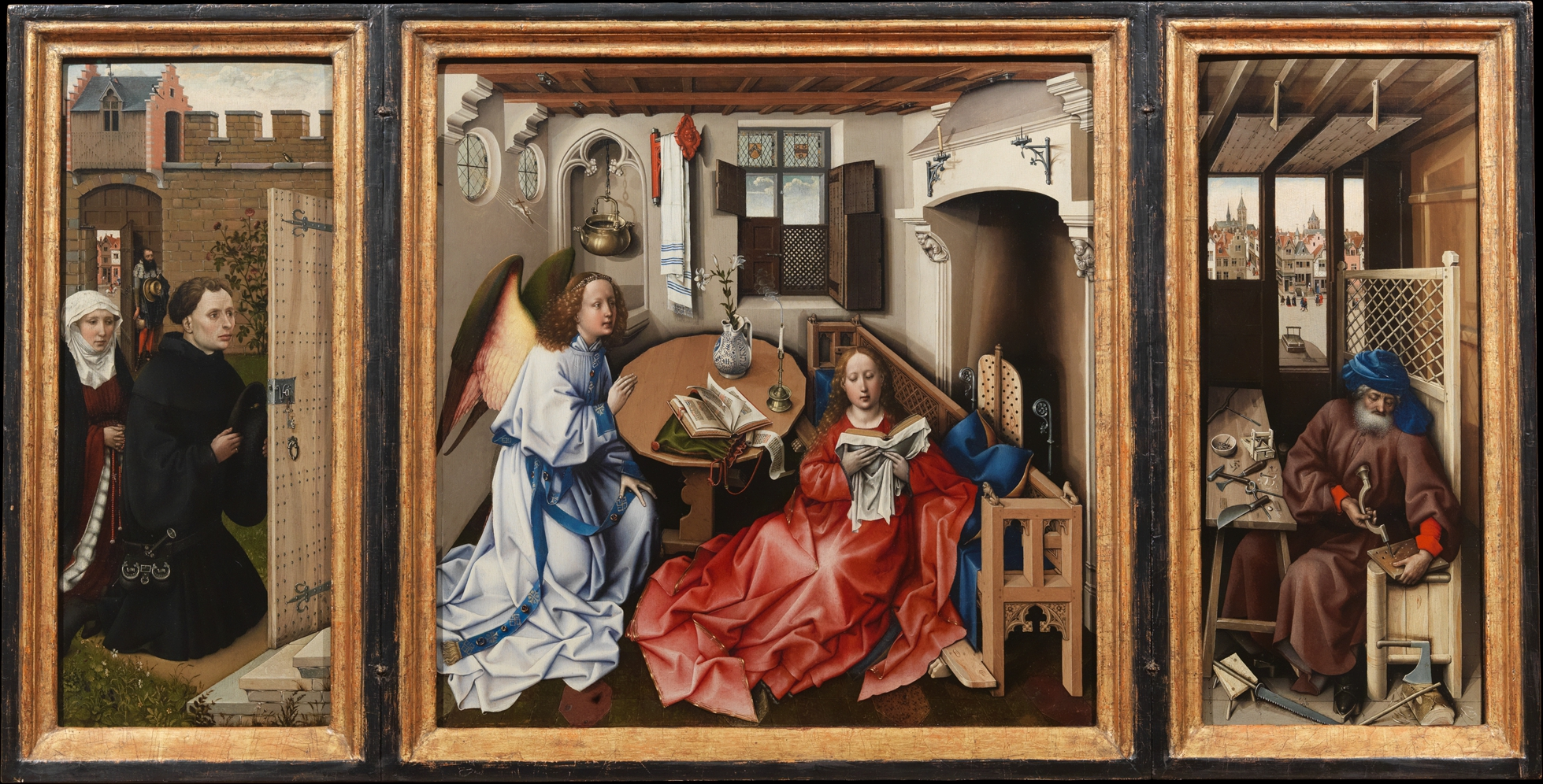
(Unit 3 Chapter 14 - Northern Renaissance (c. 1400 - 1600 CE)) #66: Merode Altarpiece (Annunciation Triptych)
VOCABULARY: Annunciation
Angel Gabriel comes down from heaven to tell Mary she is with child
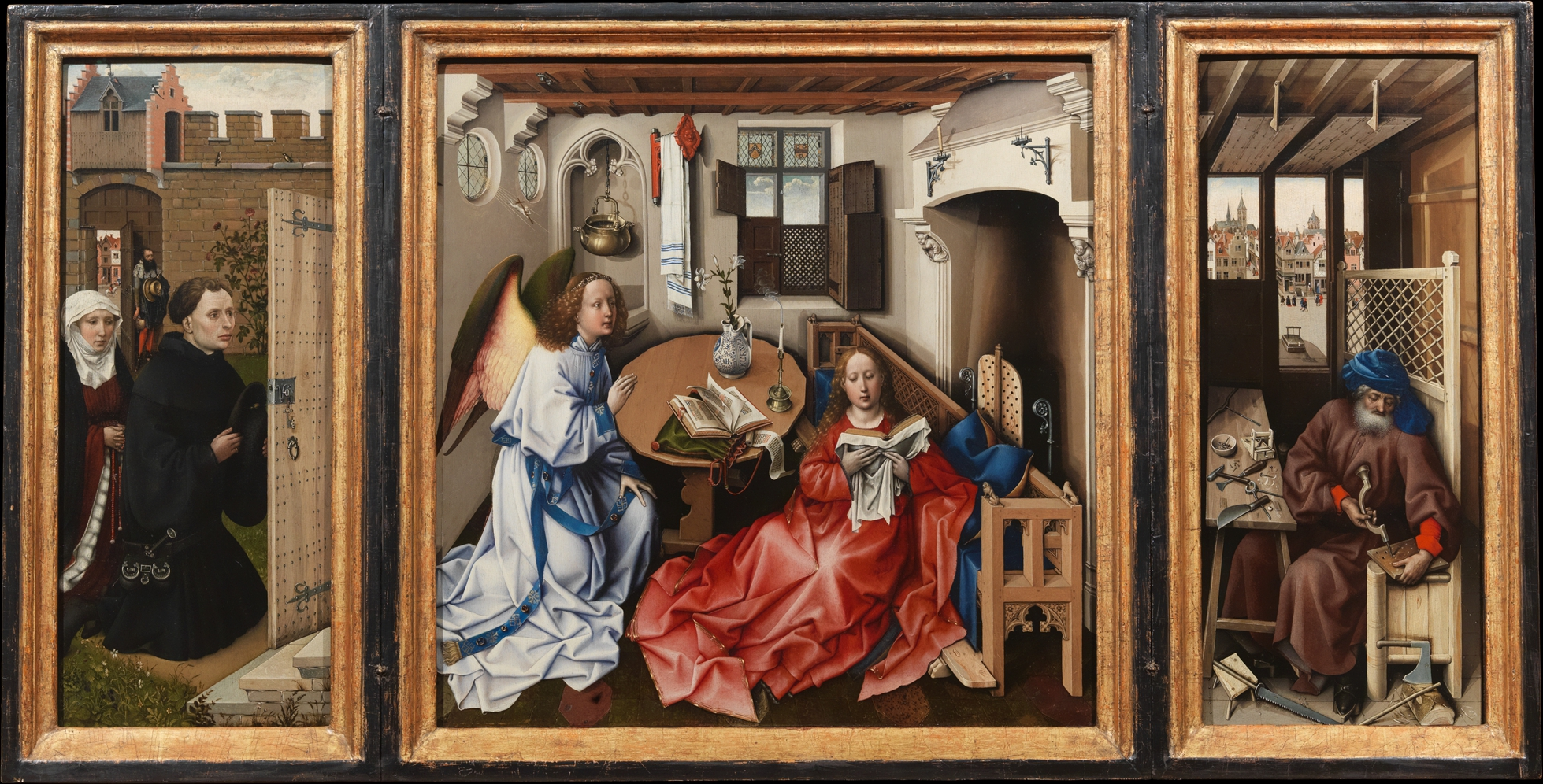
(Unit 3 Chapter 14 - Northern Renaissance (c. 1400 - 1600 CE)) #66: Merode Altarpiece (Annunciation Triptych)
VOCABULARY: One-Point Perspective
drawing method that shows how things appear to get smaller as they get further away, converging towards a single “vanishing point” on the horizon line
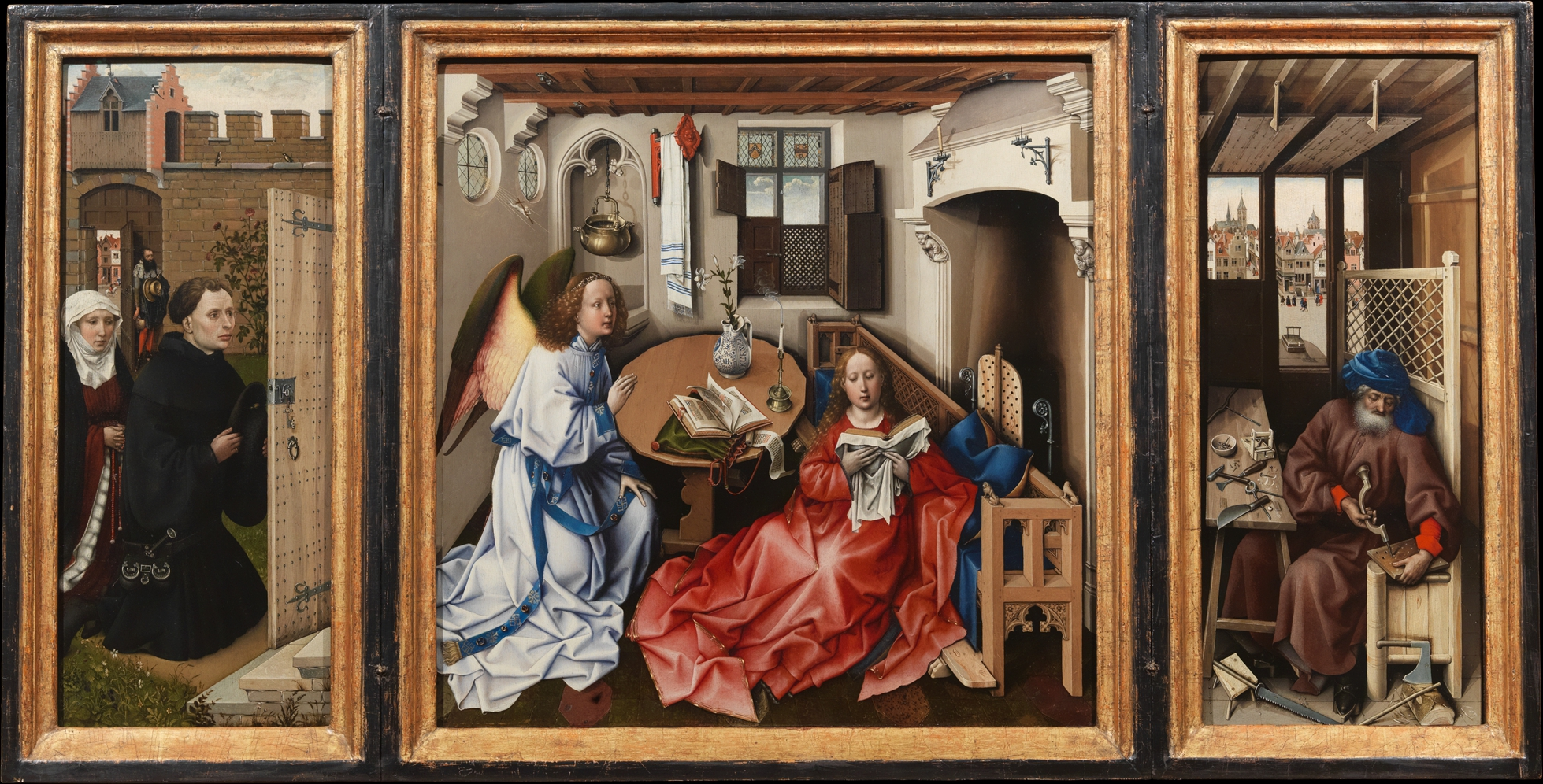
(Unit 3 Chapter 14 - Northern Renaissance (c. 1400 - 1600 CE)) #66: Merode Altarpiece (Annunciation Triptych)
VOCABULARY: Humanizing
to create something that appeals to the lives of average human beings
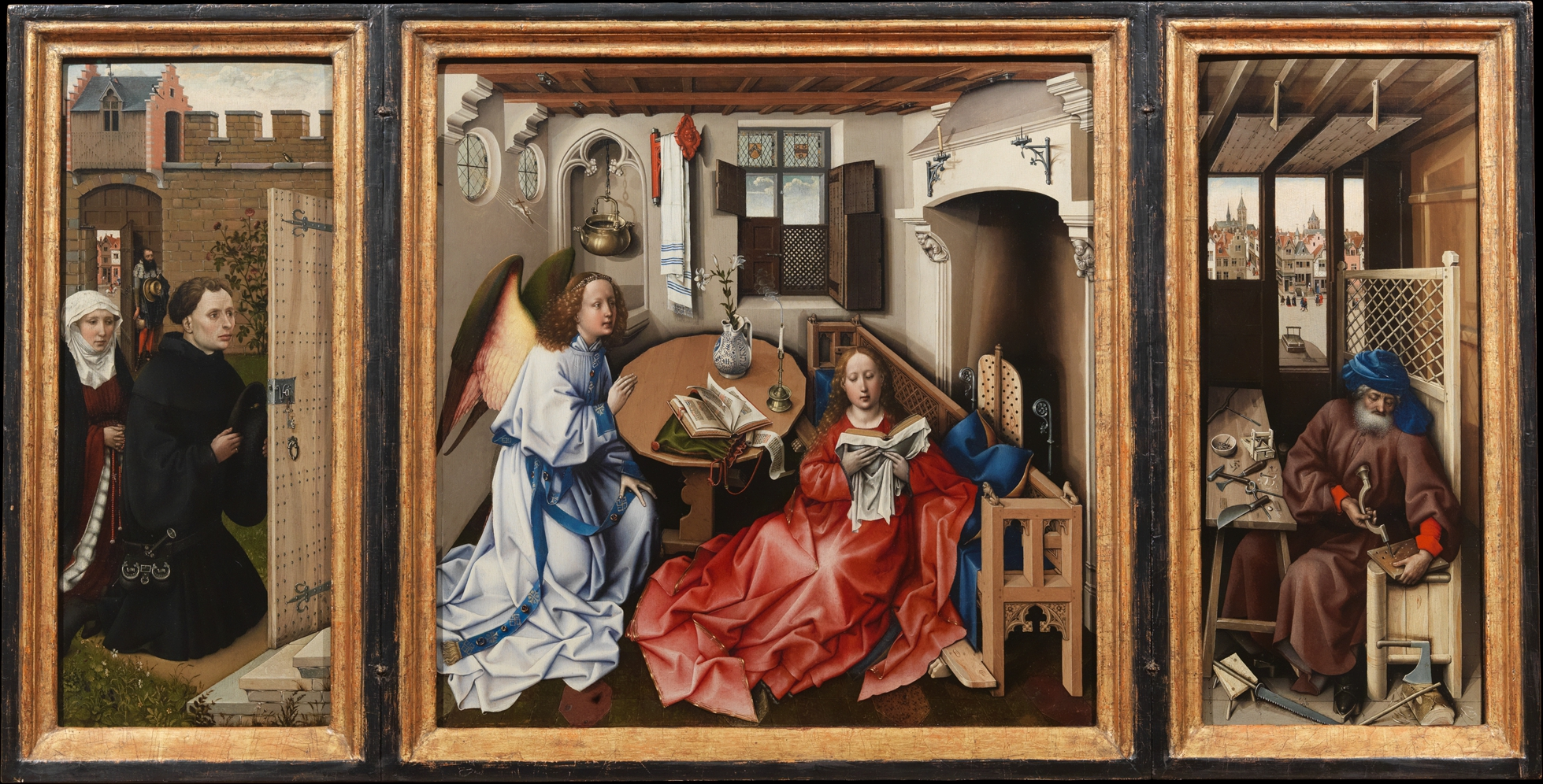
(Unit 3 Chapter 14 - Northern Renaissance (c. 1400 - 1600 CE)) #66: Merode Altarpiece (Annunciation Triptych)
CONTENT (visual evidence): Label the artwork.
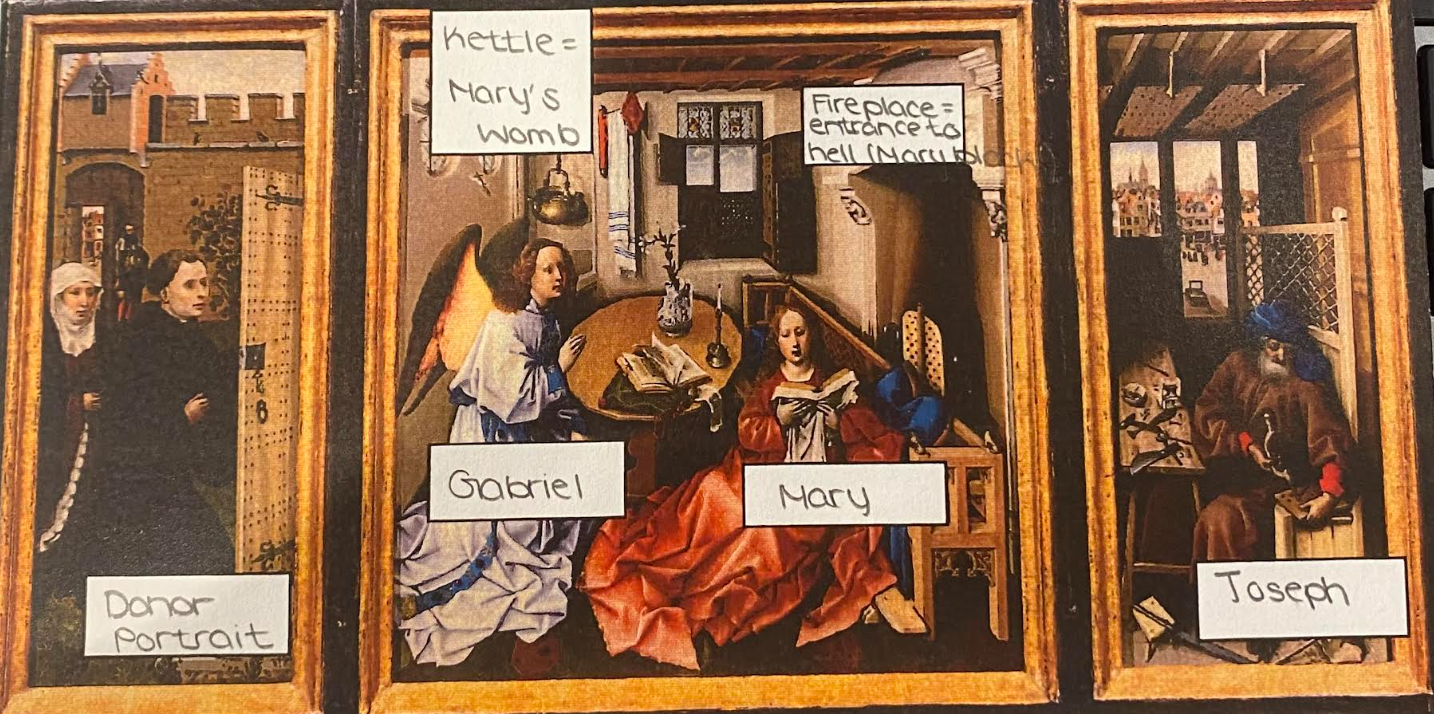
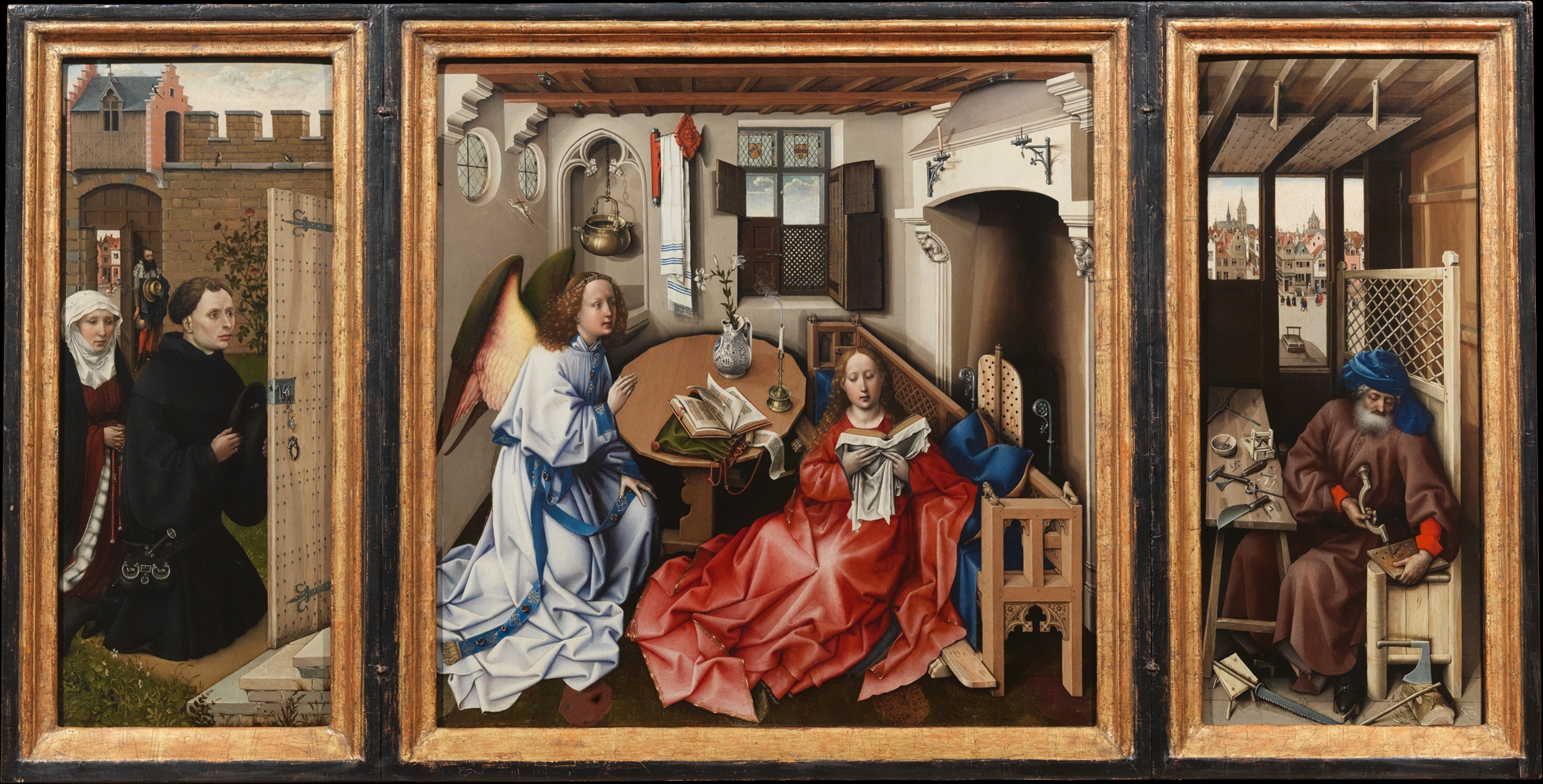
(Unit 3 Chapter 14 - Northern Renaissance (c. 1400 - 1600 CE)) #66: Merode Altarpiece (Annunciation Triptych)
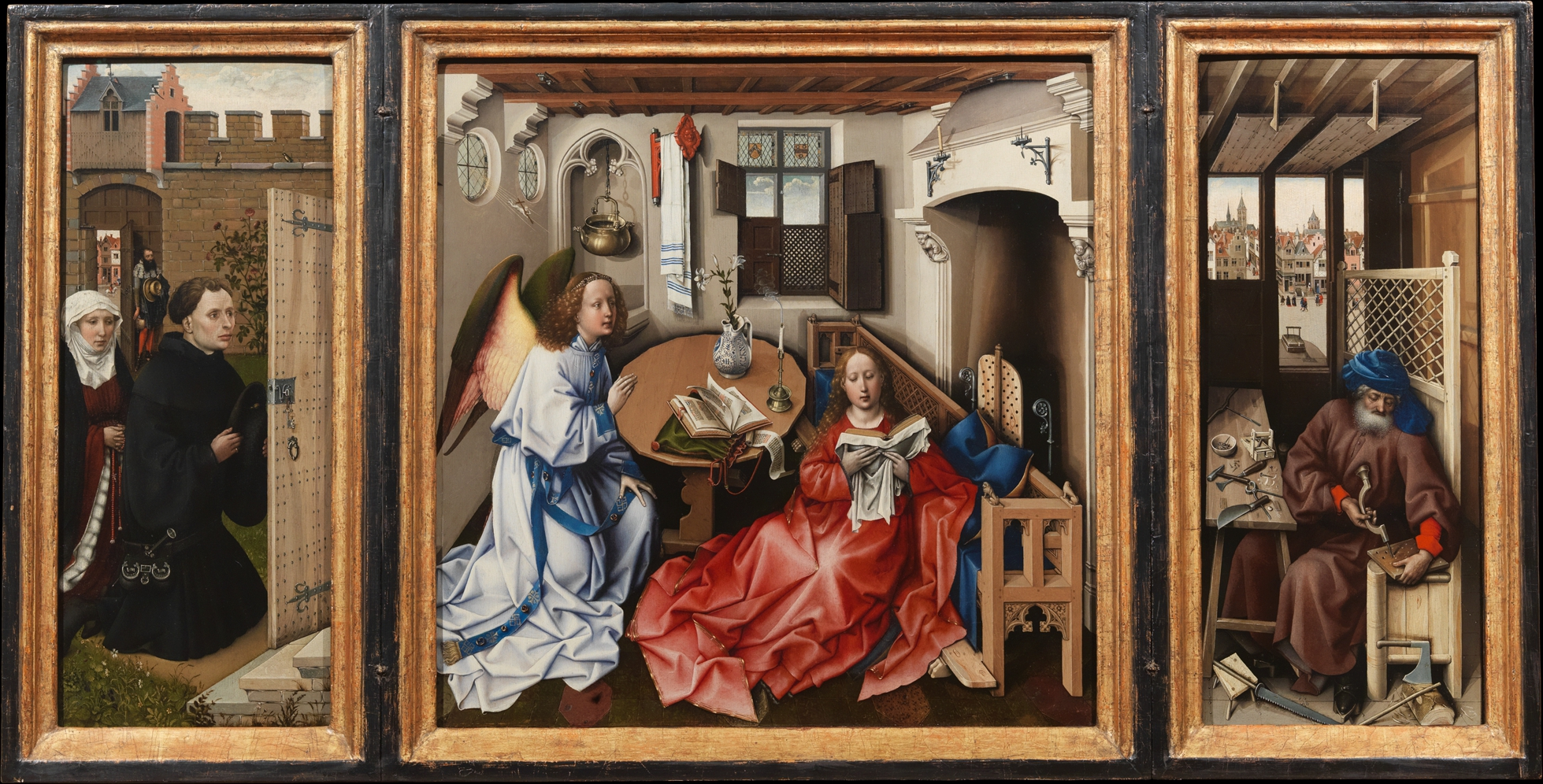
CONTENT (visual evidence)
Left Panel:
Donor Portrait: a portrait of the patron
middle class
small details
wife added later
Middle:
LOTS of Christian symbolism/iconography…
White Towel = Mary’s purity
Lillies w/ 3 Buds = Holy Trinity
everyday Flemish interior
thick folded fabric
VERY forced one point perspective (orthogonal lines)
Right:
Joseph in carpentry workshop making mousetrap = JC traps the devil
more small details
(Unit 3 Chapter 14 - Northern Renaissance (c. 1400 - 1600 CE)) #66: Merode Altarpiece (Annunciation Triptych)
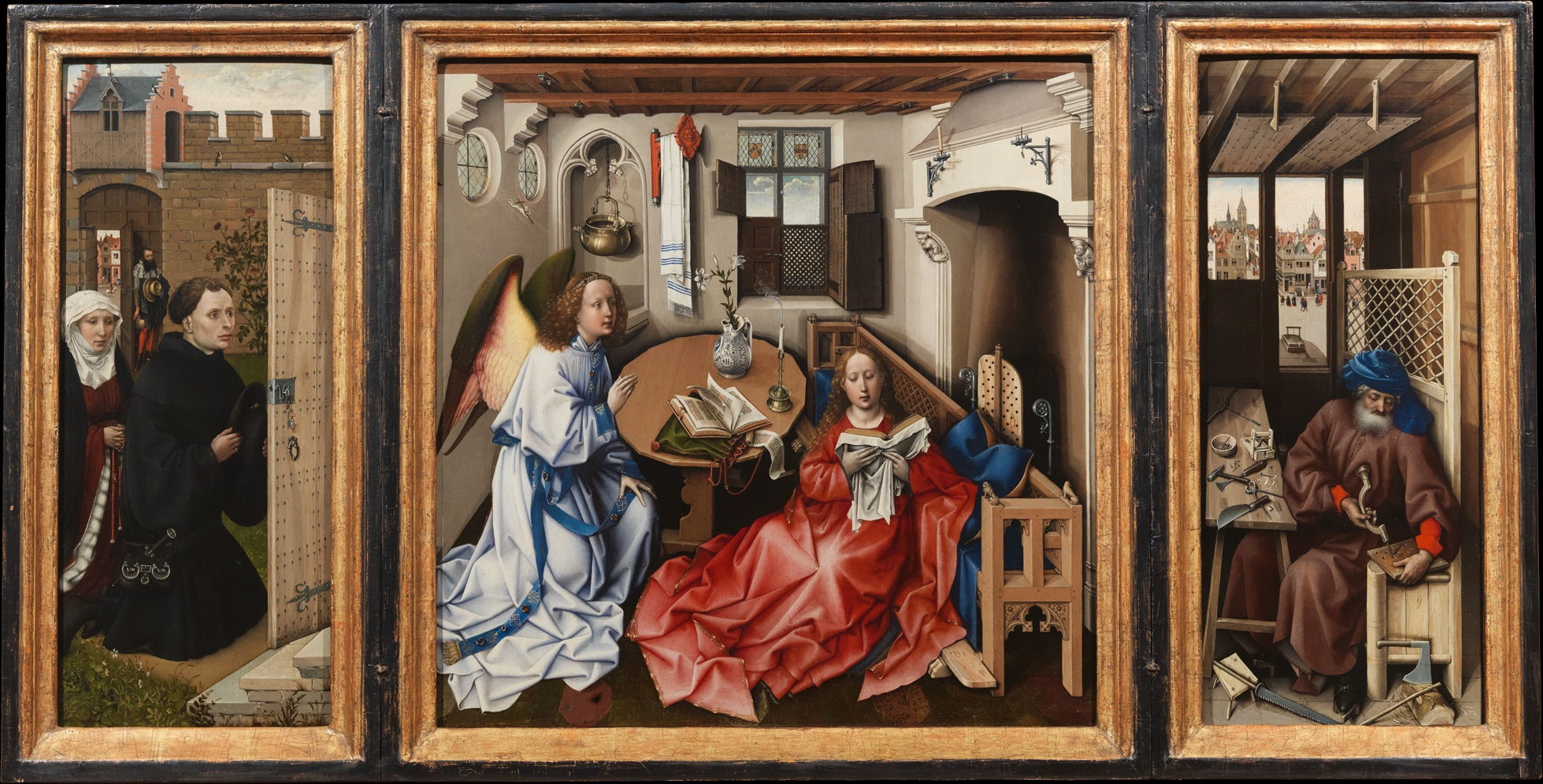
CONTEXT (what is happening historically)
Culture = Flemish (Dutch): people from Flanders (Belgium)
(Unit 3 Chapter 14 - Northern Renaissance (c. 1400 - 1600 CE)) #66: Merode Altarpiece (Annunciation Triptych)
OTHER ART CONNECTIONS
Rottgen Pieta → humanizing
(Unit 3 Chapter 14 - Northern Renaissance (c. 1400 - 1600 CE)) Name this piece!
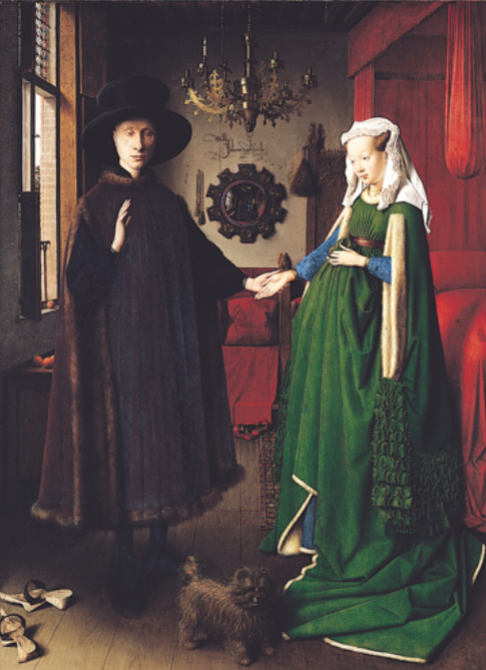
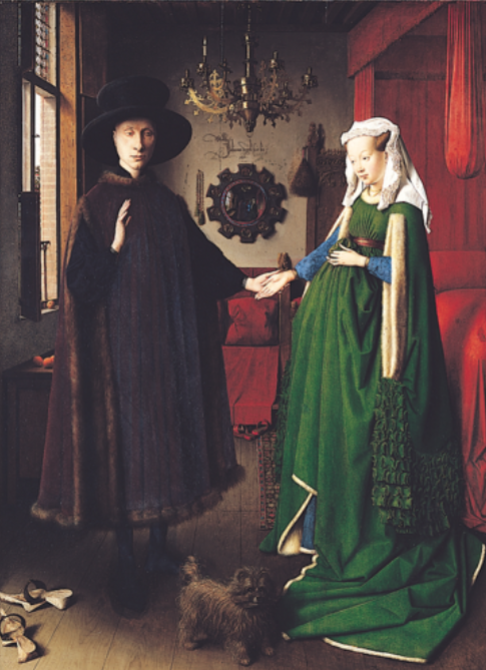
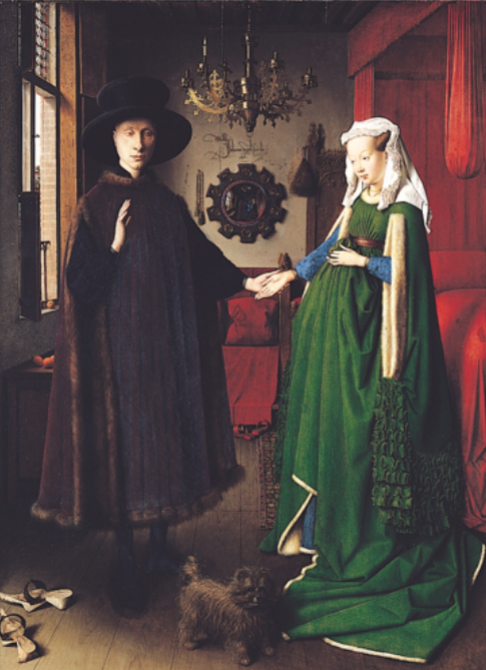
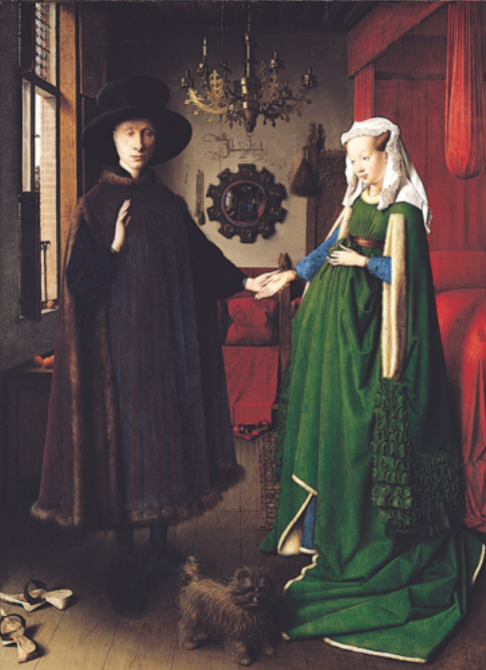
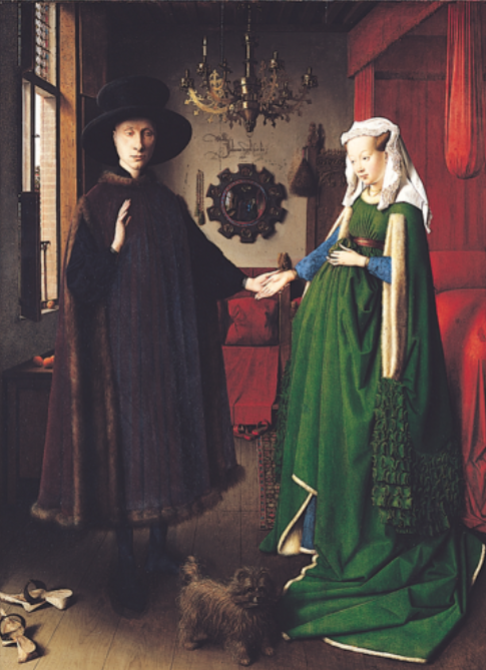
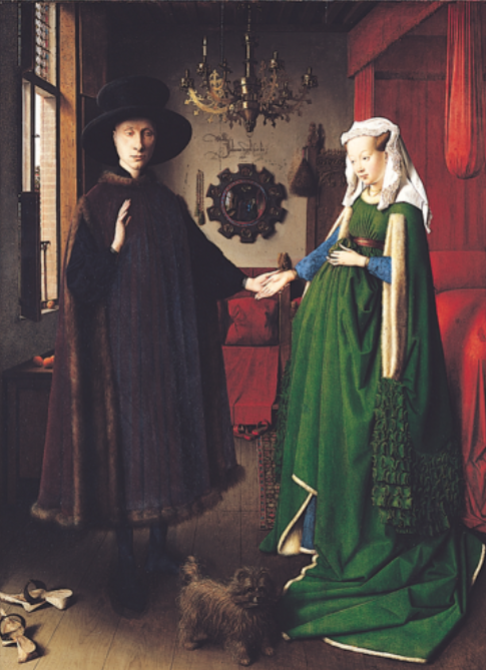
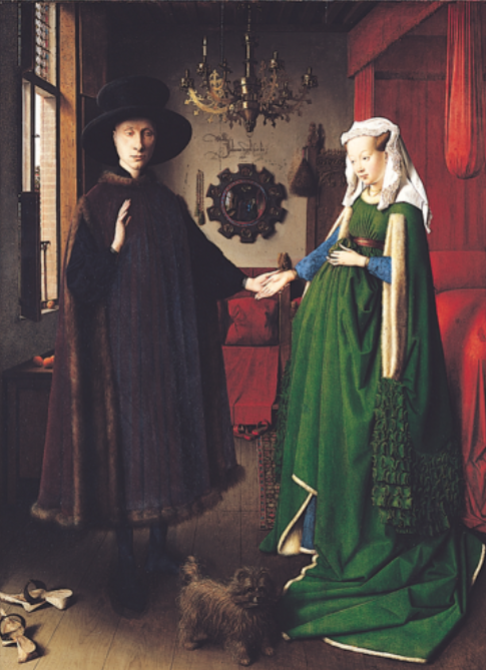
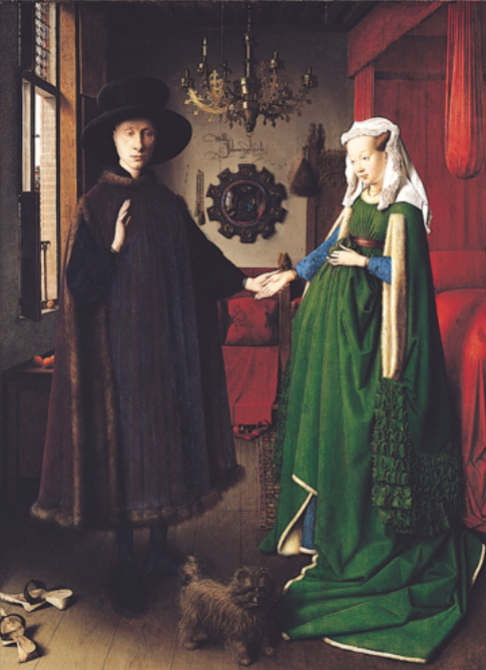
Arnolfini Portrait
(Unit 3 Chapter 14 - Northern Renaissance (c. 1400 - 1600 CE)) #68: Arnolfini Portrait
LOCATION
Berlin, Germany
(Unit 3 Chapter 14 - Northern Renaissance (c. 1400 - 1600 CE)) #68: Arnolfini Portrait
ERA
Northern European Renaissance
(Unit 3 Chapter 14 - Northern Renaissance (c. 1400 - 1600 CE)) #68: Arnolfini Portrait
ARTIST
Jan Van Eyck
(Unit 3 Chapter 14 - Northern Renaissance (c. 1400 - 1600 CE)) #68: Arnolfini Portrait
FORM
Oil Paint on Wood
(Unit 3 Chapter 14 - Northern Renaissance (c. 1400 - 1600 CE)) #68: Arnolfini Portrait
PATRON
Giovanni Arnolfini
(Unit 3 Chapter 14 - Northern Renaissance (c. 1400 - 1600 CE)) #68: Arnolfini Portrait
FUNCTION
Wedding portrait of Giovanni Arnolfini & his wife
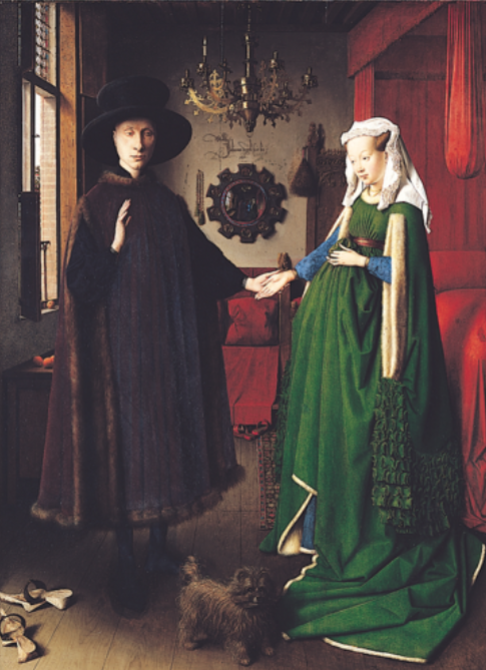
(Unit 3 Chapter 14 - Northern Renaissance (c. 1400 - 1600 CE)) #68: Arnolfini Portrait
VOCABULARY: St. Margaret
Patron saint of childbirth
(Unit 3 Chapter 14 - Northern Renaissance (c. 1400 - 1600 CE)) #68: Arnolfini Portrait
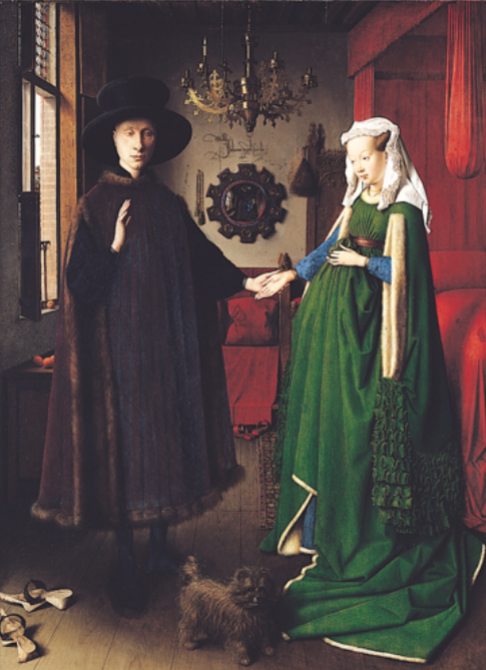
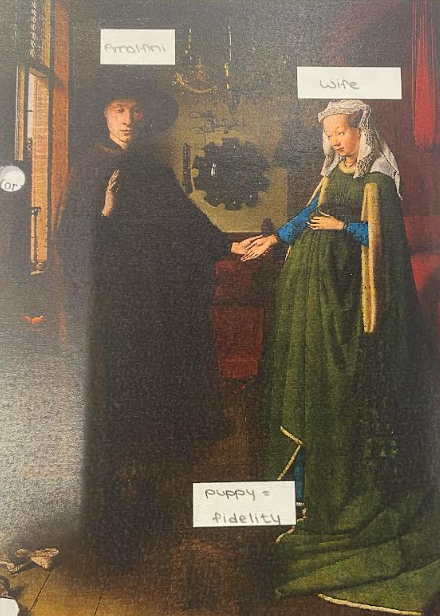
CONTENT (visual evidence): Label the artwork.
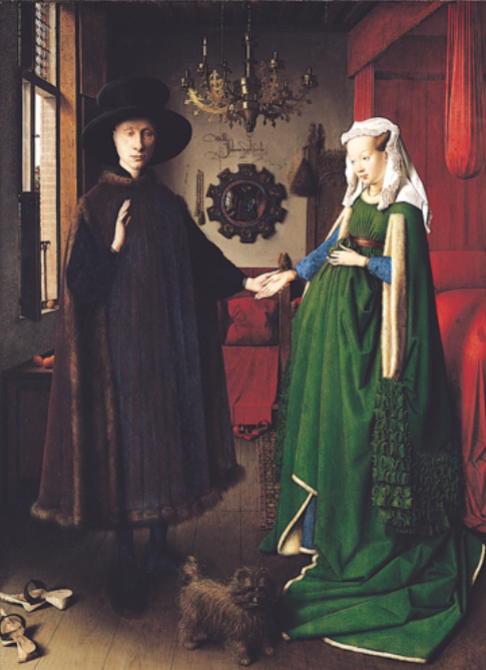
(Unit 3 Chapter 14 - Northern Renaissance (c. 1400 - 1600 CE)) #68: Arnolfini Portrait
CONTENT (visual evidence)
LOTS of symbolism/iconography…
Puppy = fidelity / loyalty
Not wearing shoes = standing on holy ground
Man, Near Window = role in outside world
Woman, Near interior of home = role as homemaker
St. Margaret on bedpost = hope for a family!
Convex Mirror → back of Arnolfini + wife, Jan Van Eyck in back (wrote was here on wall), exact measurement in scale, space, proportions to the actual staged scene, passion of Christ in roundels on mirror frame
glass beads
(Unit 3 Chapter 14 - Northern Renaissance (c. 1400 - 1600 CE)) #68: Arnolfini Portrait
CONTEXT (what is happening historically)
OTHER FUNCTIONS…
betrothal scene
memorial portrait
husband passing legal and business privileges to wife in prep for upcoming absence
(Unit 3 Chapter 14 - Northern Renaissance (c. 1400 - 1600 CE)) Name this piece!
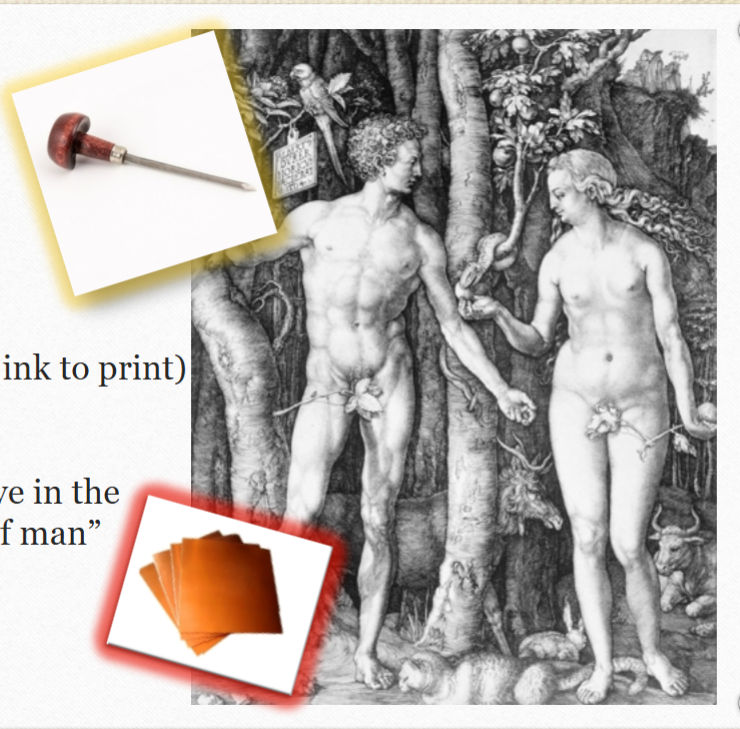
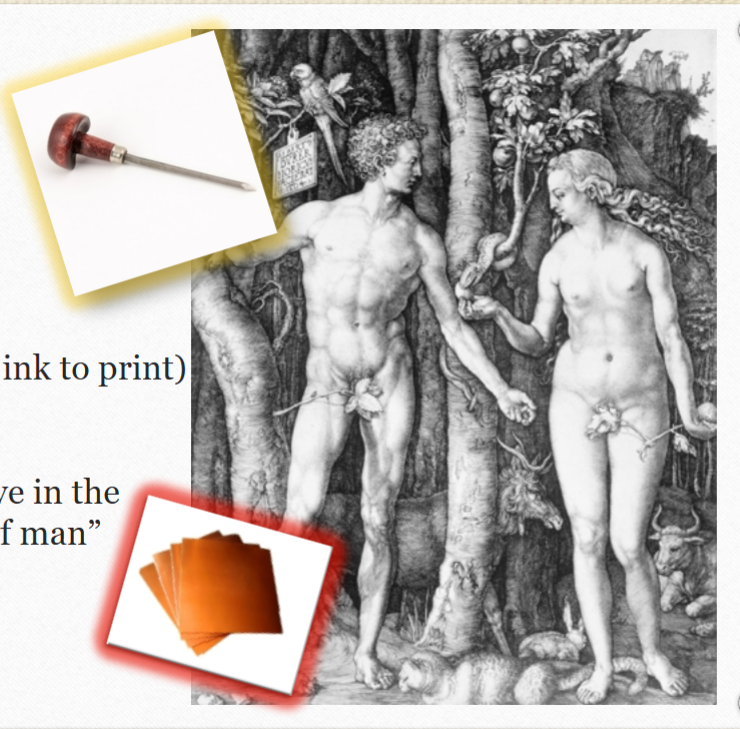
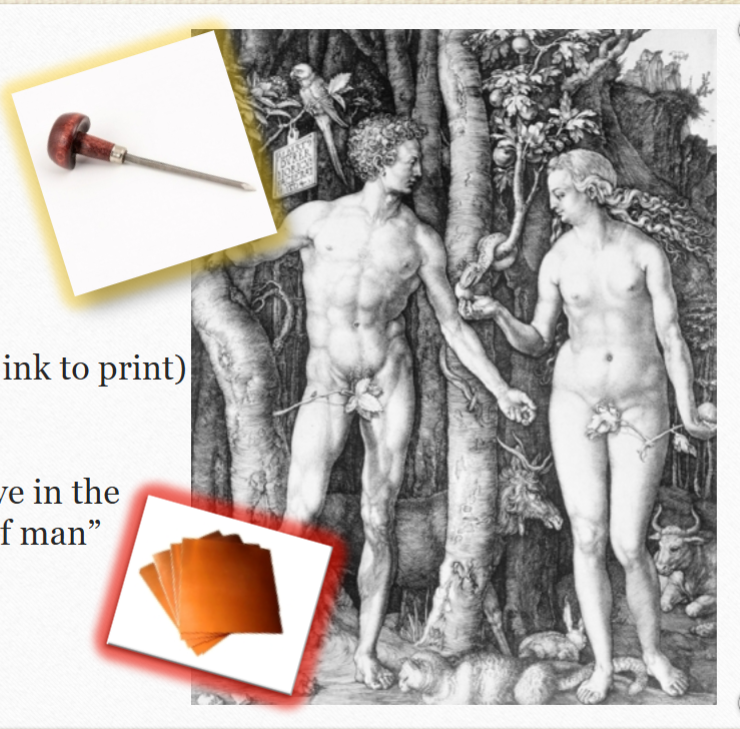
Adam and Eve (The Fall of Man)
(Unit 3 Chapter 14 - Northern Renaissance (c. 1400 - 1600 CE)) #74: Adam and Eve (The Fall of Man)
LOCATION
Nuremberg, Germany
(Unit 3 Chapter 14 - Northern Renaissance (c. 1400 - 1600 CE)) #74: Adam and Eve (The Fall of Man)
ERA
Northern European Renaissance
(Unit 3 Chapter 14 - Northern Renaissance (c. 1400 - 1600 CE)) #74: Adam and Eve (The Fall of Man)
ARTIST
Albrecht Dürer
(Unit 3 Chapter 14 - Northern Renaissance (c. 1400 - 1600 CE)) #74: Adam and Eve (The Fall of Man)
FORM
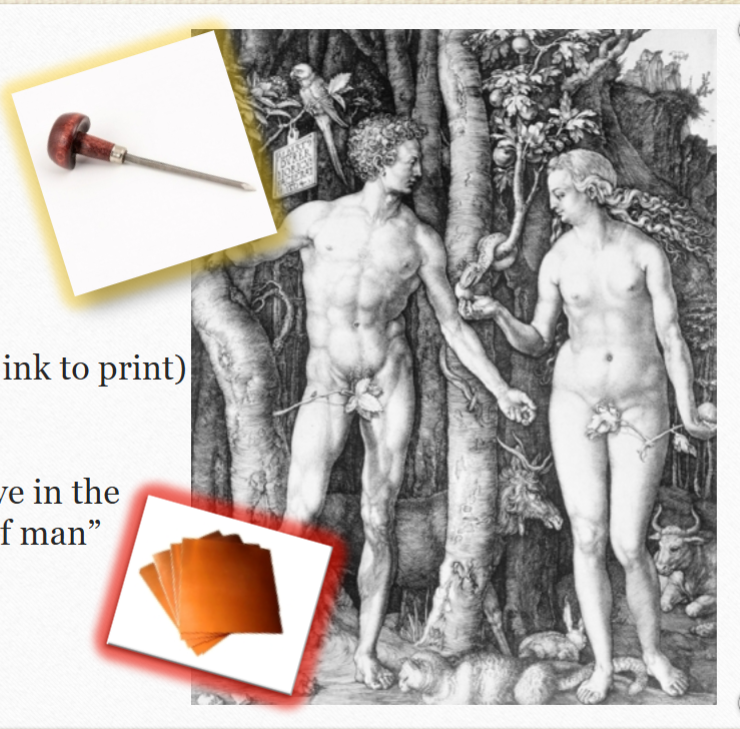
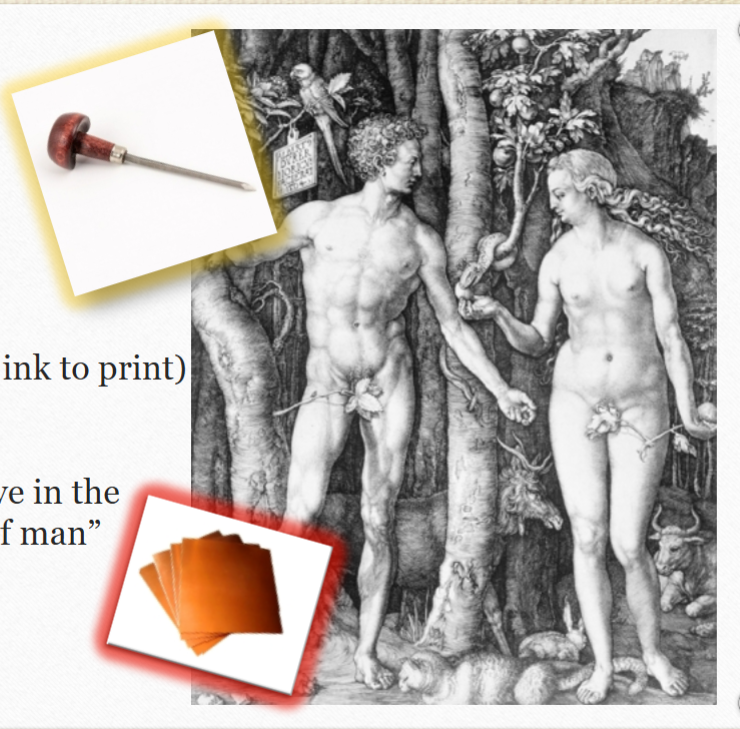
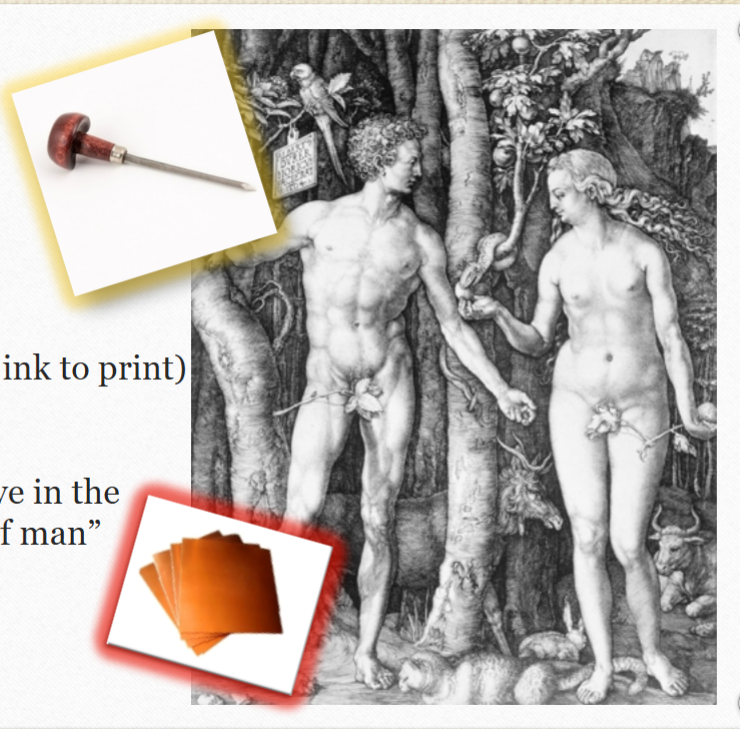
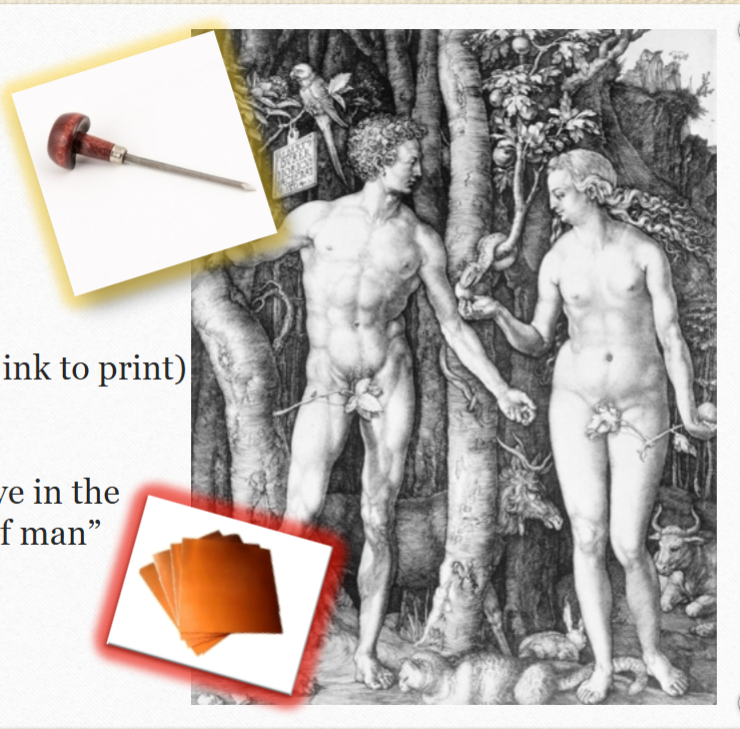
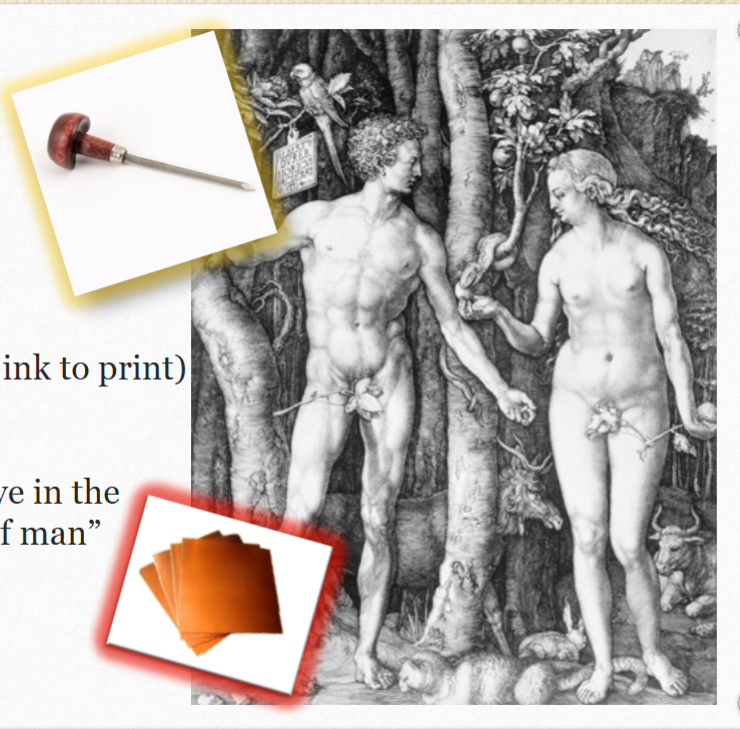
Engraving (burin on a copper plate, ink to print)
(Unit 3 Chapter 14 - Northern Renaissance (c. 1400 - 1600 CE)) #74: Adam and Eve (The Fall of Man)
PATRON
Unknown
(Unit 3 Chapter 14 - Northern Renaissance (c. 1400 - 1600 CE)) #74: Adam and Eve (The Fall of Man)
FUNCTION
Shows the figures of Adam and Eve in the Garden of Paradise before the “fall of man”
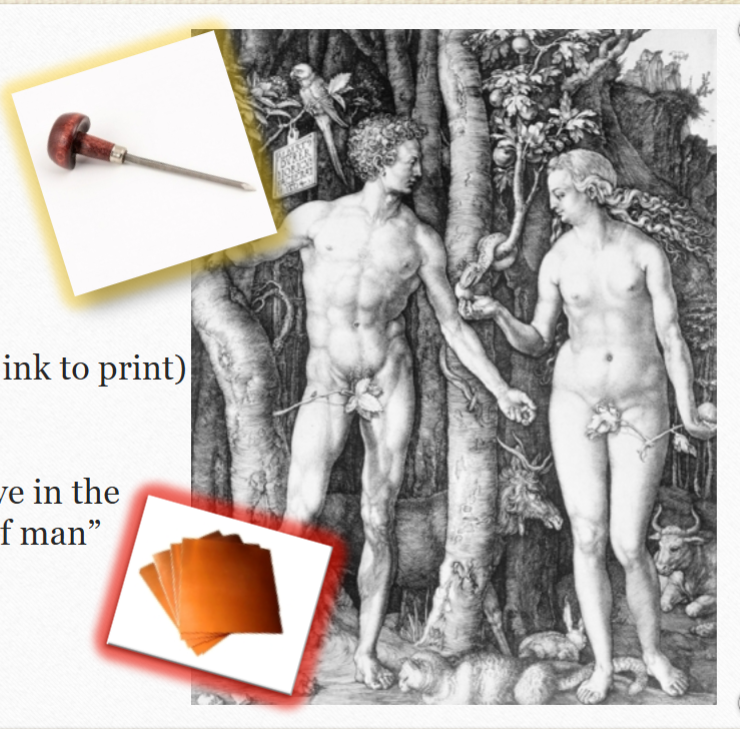
(Unit 3 Chapter 14 - Northern Renaissance (c. 1400 - 1600 CE)) #74: Adam and Eve (The Fall of Man)
CONTENT (visual evidence): Label the artwork.
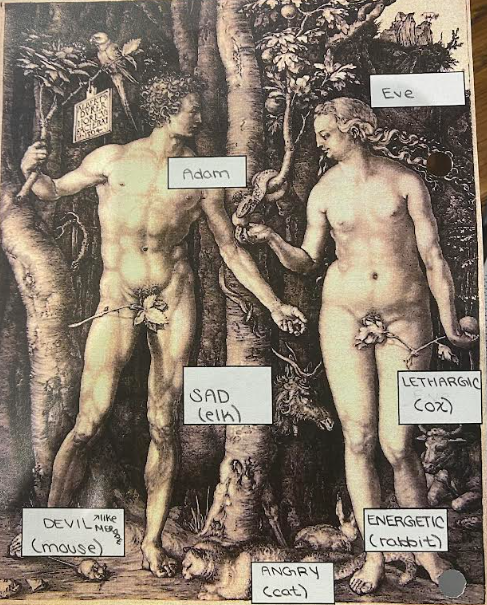
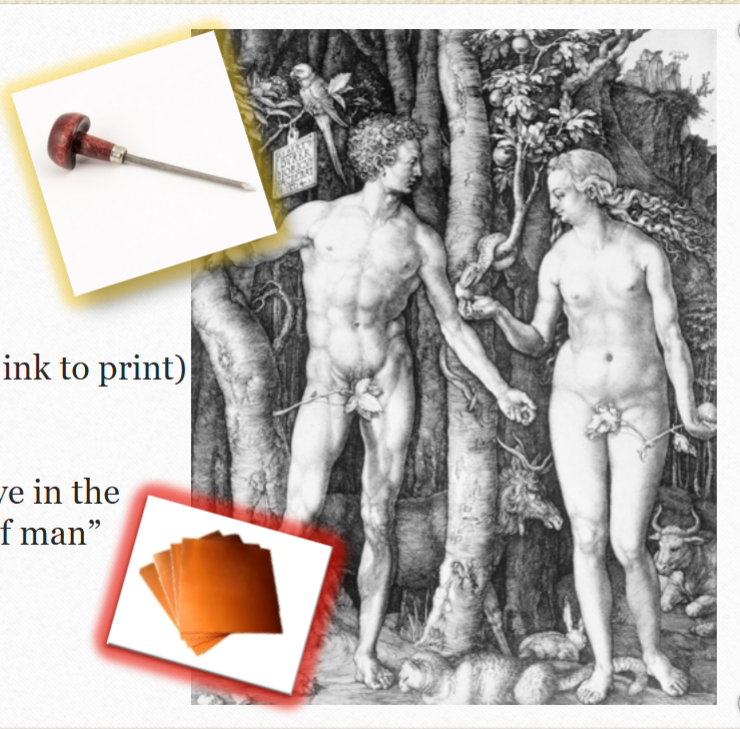
(Unit 3 Chapter 14 - Northern Renaissance (c. 1400 - 1600 CE)) #74: Adam and Eve (The Fall of Man)
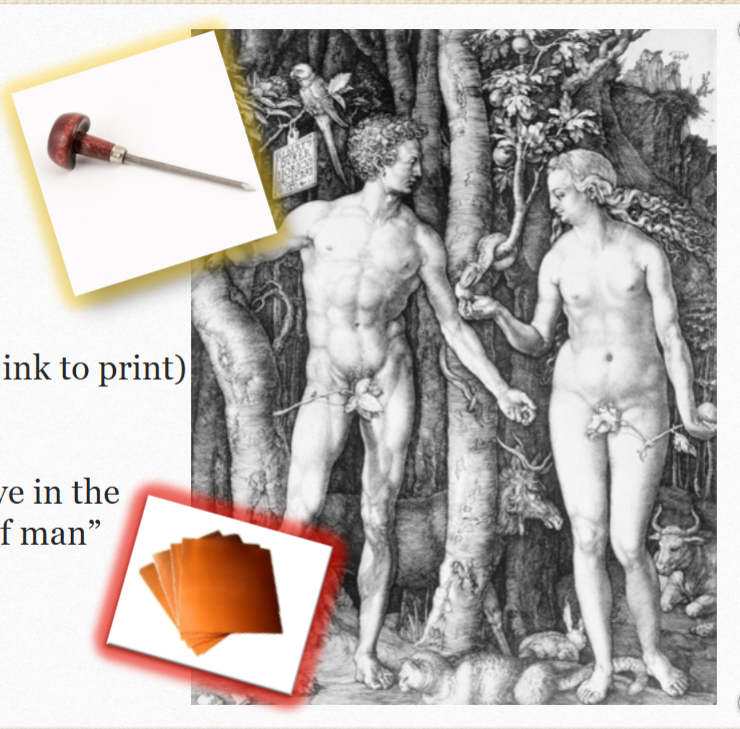
CONTENT (visual evidence)
Other symbolism/iconography…
parrot = cleverness
Mountain Ash Branch = Tree of Life (branch in Adam’s right hand)
Snake’s Branch Perch = Tree of Knowledge
(Unit 3 Chapter 14 - Northern Renaissance (c. 1400 - 1600 CE)) #74: Adam and Eve (The Fall of Man)
CONTEXT (what is happening historically)
Classical Sculpture Influence:
Apollo Belvedere → Adam
Medici Venus → Eve
The 4 Fundamental Personality Types
AKA
The 4 Temperaments
AKAKA
The 4 Humors
established by AN Ancient Greek Physician
Represented by animals…
Durer is THE guy for detailed artwork… and he made printmaking an elevated art form!
(Unit 3 Chapter 14 - Northern Renaissance (c. 1400 - 1600 CE)) #74: Adam and Eve (The Fall of Man)
OTHER ART CONNECTIONS
Merode Altarpiece → mouse
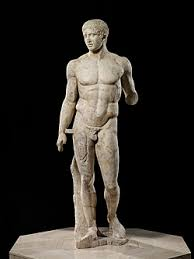
Doryphoros (Classical Greece) → contrapposto (pose with weight on one leg, creating a natural S-curve)
(Unit 3 Chapter 14 - Northern Renaissance (c. 1400 - 1600 CE)) Name this piece!
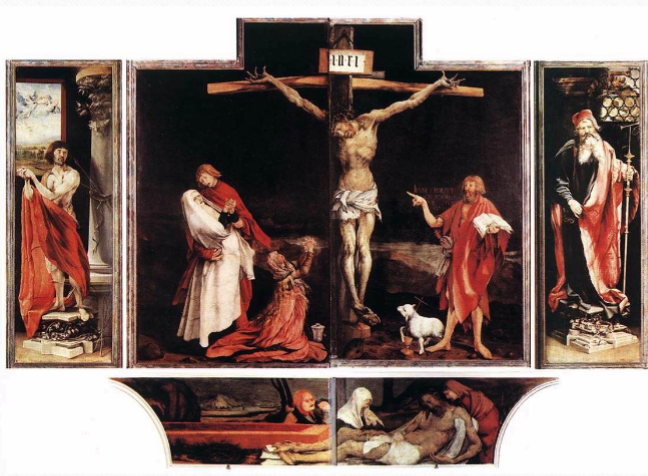
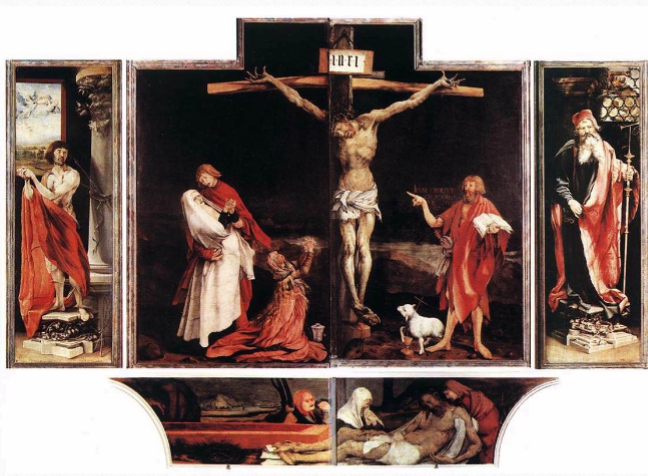
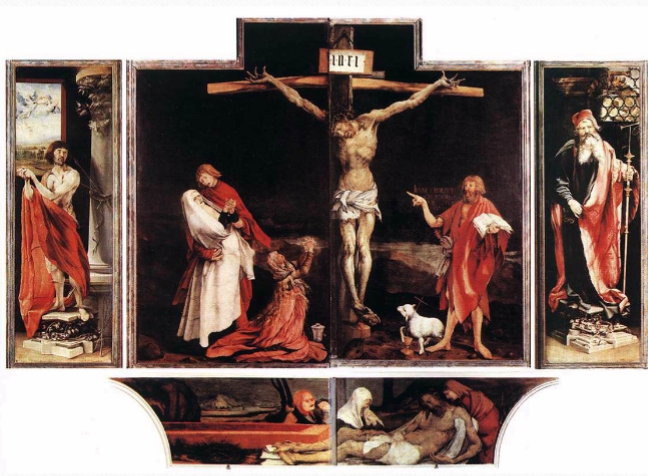
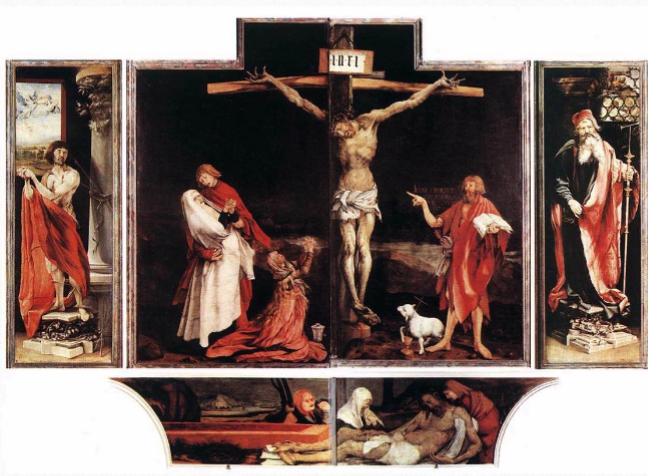
Isenheim Altarpiece
(Unit 3 Chapter 14 - Northern Renaissance (c. 1400 - 1600 CE)) #77: Isenheim Altarpiece
LOCATION
Chapel of St. Anthony (Isenheim, Germany)
(Unit 3 Chapter 14 - Northern Renaissance (c. 1400 - 1600 CE)) #77: Isenheim Altarpiece
ERA
Northern European Renaissance
(Unit 3 Chapter 14 - Northern Renaissance (c. 1400 - 1600 CE)) #77: Isenheim Altarpiece
ARTIST
Matthias Grünewald
(Unit 3 Chapter 14 - Northern Renaissance (c. 1400 - 1600 CE)) #77: Isenheim Altarpiece
FORM
Oil on wood
(Unit 3 Chapter 14 - Northern Renaissance (c. 1400 - 1600 CE)) #77: Isenheim Altarpiece
PATRON
Guy Guers (hospital preceptor (instructor))
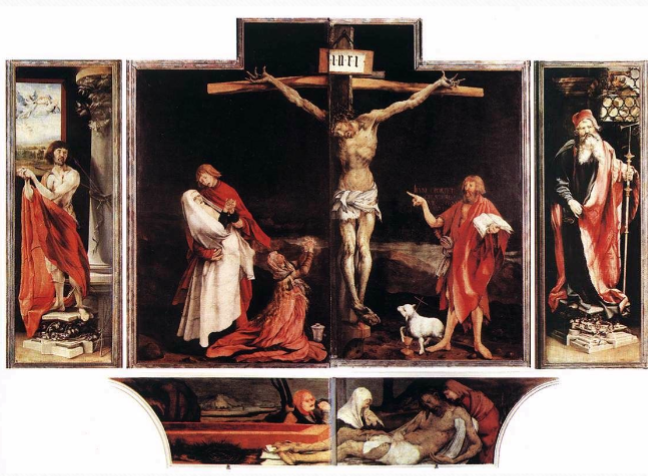
(Unit 3 Chapter 14 - Northern Renaissance (c. 1400 - 1600 CE)) #77: Isenheim Altarpiece
FUNCTION
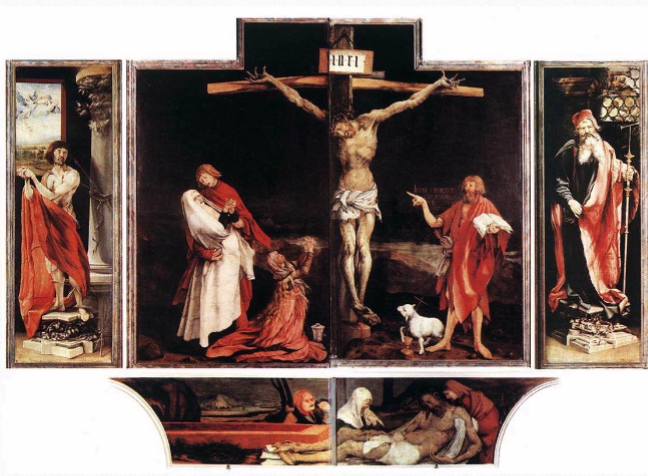
Triptych, multi-layered (polyptych) altarpiece placed in a monastery hospital (where people were treated for ergotism (St. Anthony’s Fire) caused by fungus in rye bread)
(Unit 3 Chapter 14 - Northern Renaissance (c. 1400 - 1600 CE)) #77: Isenheim Altarpiece
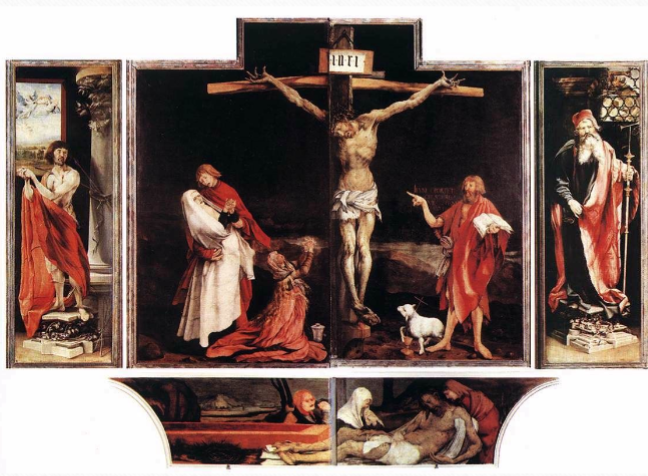
CONTENT (visual evidence): Label the artwork.
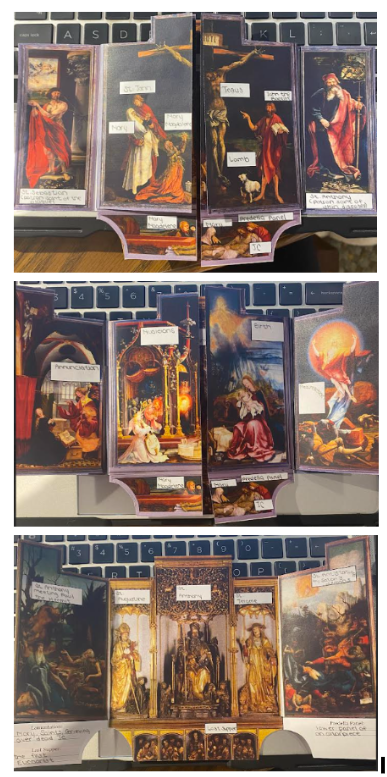
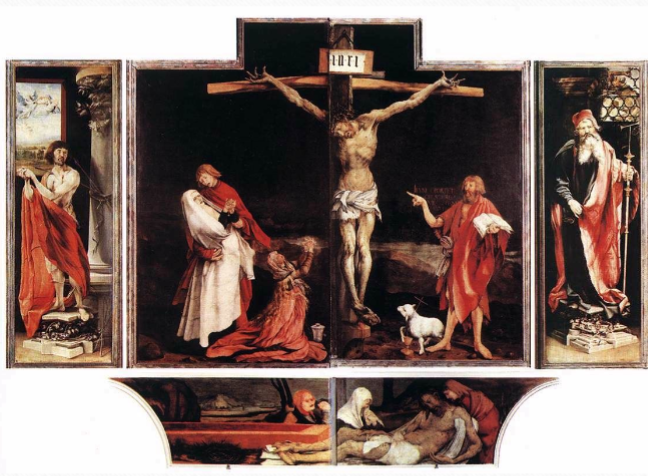
(Unit 3 Chapter 14 - Northern Renaissance (c. 1400 - 1600 CE)) #77: Isenheim Altarpiece
CONTENT (visual evidence)
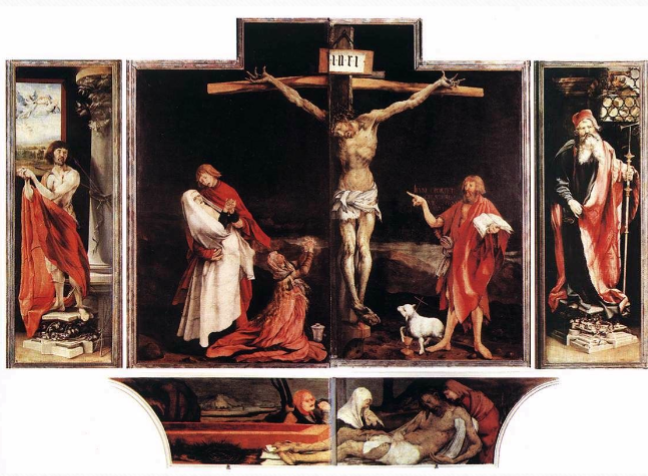
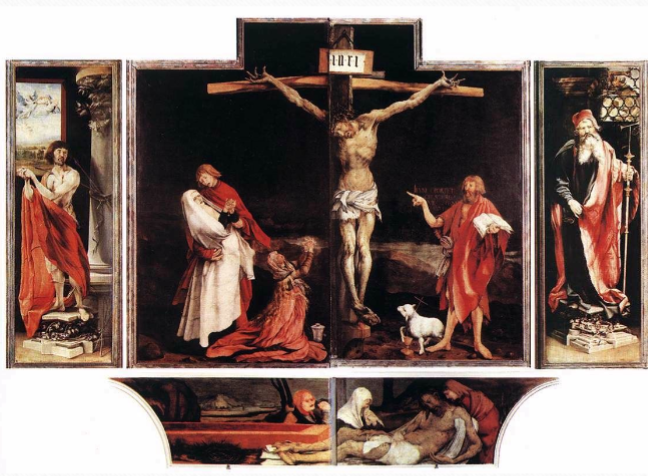
Level 1:
Predella Panel below (Lamentation)
Crucifixion
Mary swoons in arms of St. John (gospel writer)
Mary Magdalene in knees, hands clasped in prayer
JC on the cross
Lamb → JC = good shepherd
Level 2:
Musicians → music therapy used at this time
(Unit 3 Chapter 14 - Northern Renaissance (c. 1400 - 1600 CE)) #77: Isenheim Altarpiece
CONTEXT (what is happening historically)
Ergotism Symptoms: Gangrene of limbs, convulsions, tummy problems
Consider the Audience & Function
To die from Ergotism RLLY RLLY sucks… how are sick Christians supposed to have hope???
(Unit 3 Chapter 14 - Northern Renaissance (c. 1400 - 1600 CE)) Name this piece!
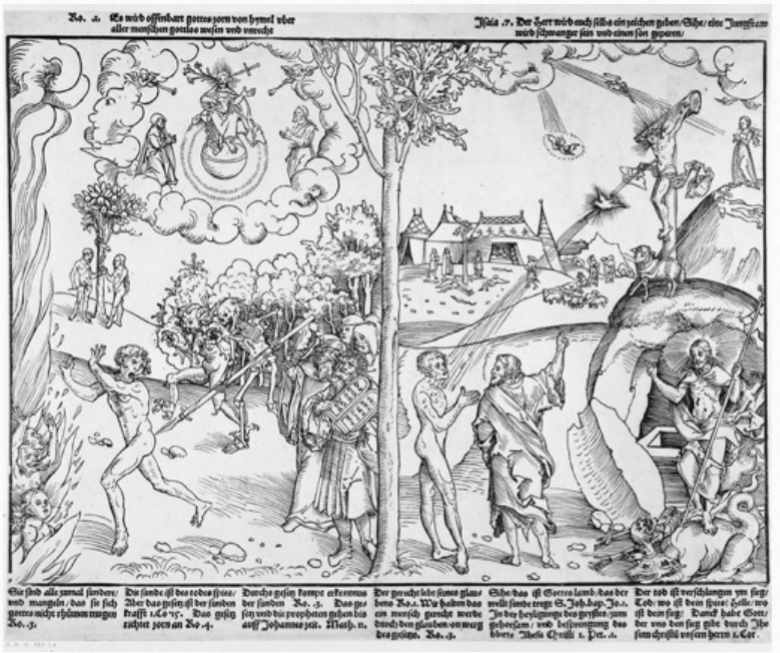
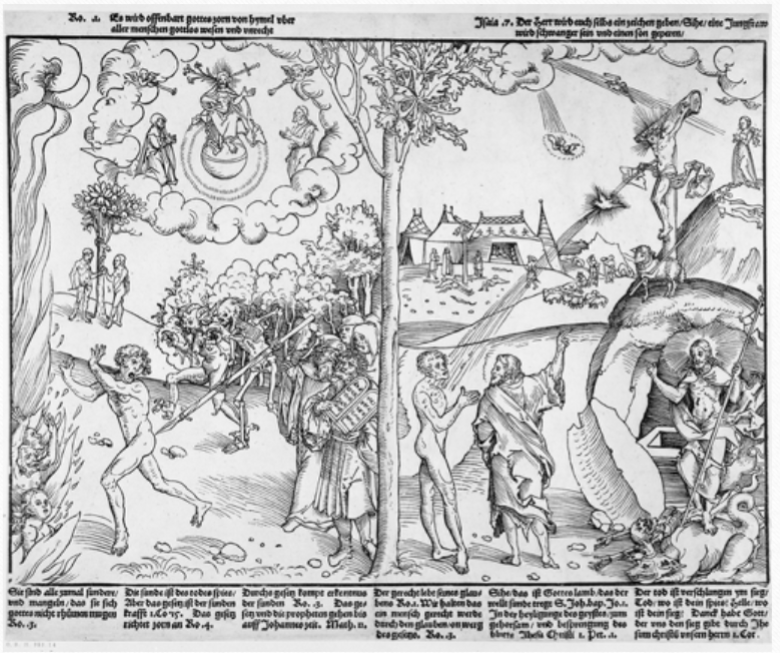
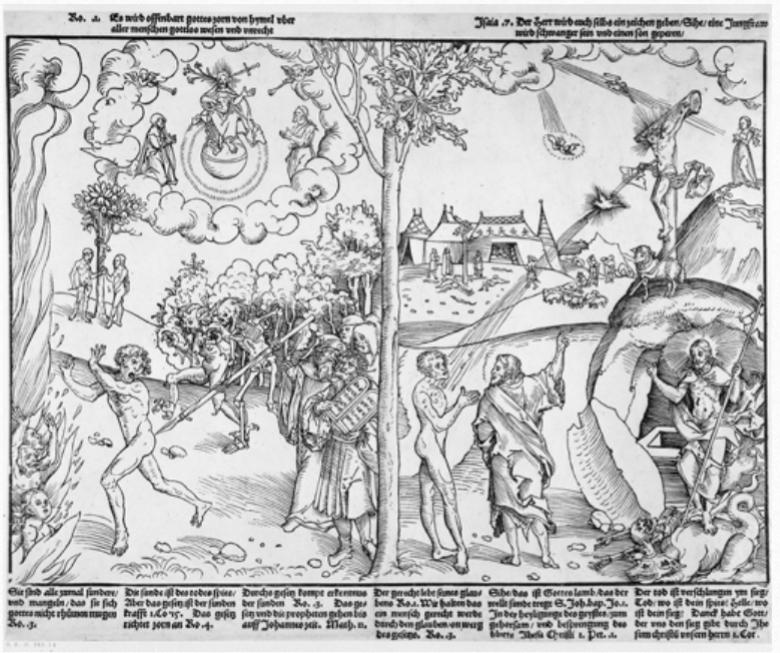
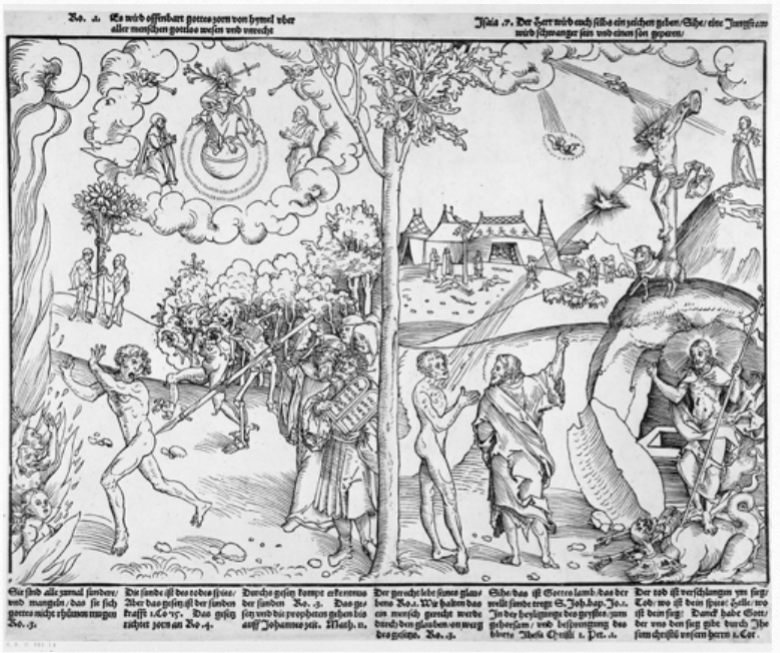
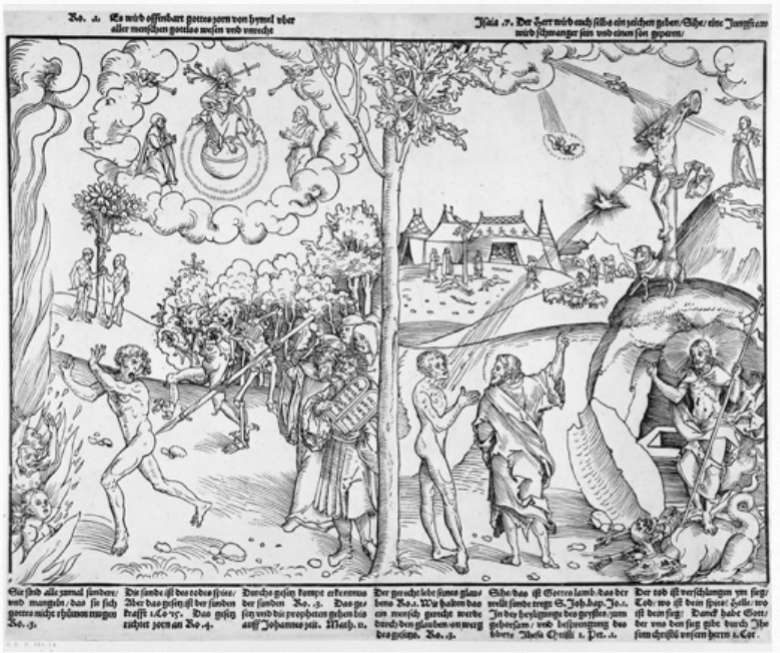
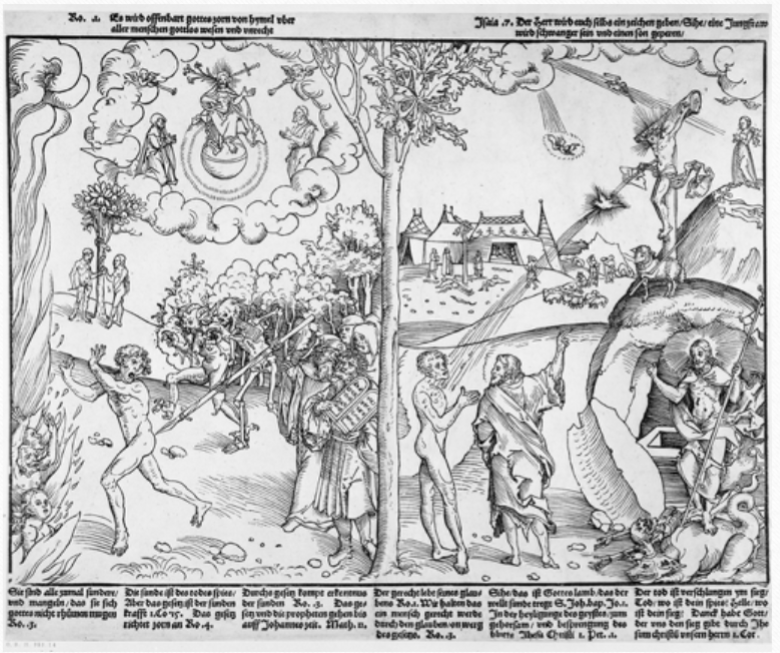
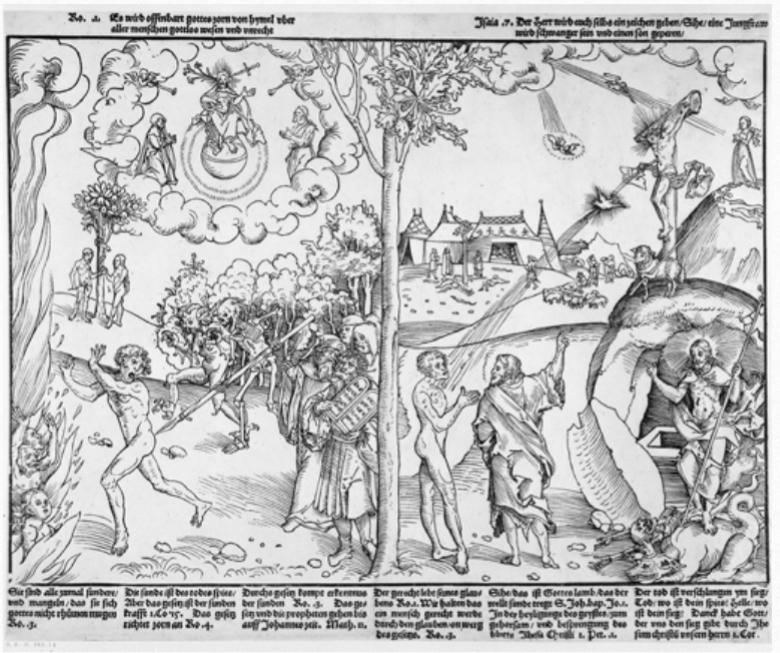
Allegory of Law and Grace
(Unit 3 Chapter 14 - Northern Renaissance (c. 1400 - 1600 CE)) #79: Allegory of Law and Grace
LOCATION
Wittenberg, Germany
(Unit 3 Chapter 14 - Northern Renaissance (c. 1400 - 1600 CE)) #79: Allegory of Law and Grace
ERA
Northern European Renaissance
(Unit 3 Chapter 14 - Northern Renaissance (c. 1400 - 1600 CE)) #79: Allegory of Law and Grace
ARTIST
Lucas Cranach the Elder (court painter, chief, artist of the Reformation)
(Unit 3 Chapter 14 - Northern Renaissance (c. 1400 - 1600 CE)) #79: Allegory of Law and Grace
FORM
Woodcut
(Unit 3 Chapter 14 - Northern Renaissance (c. 1400 - 1600 CE)) #79: Allegory of Law and Grace
PATRON
Followers of the Reformation
(Unit 3 Chapter 14 - Northern Renaissance (c. 1400 - 1600 CE)) #79: Allegory of Law and Grace
FUNCTION
Diptych illustrating Lutheran beliefs, guidelines, rewards, and punishments
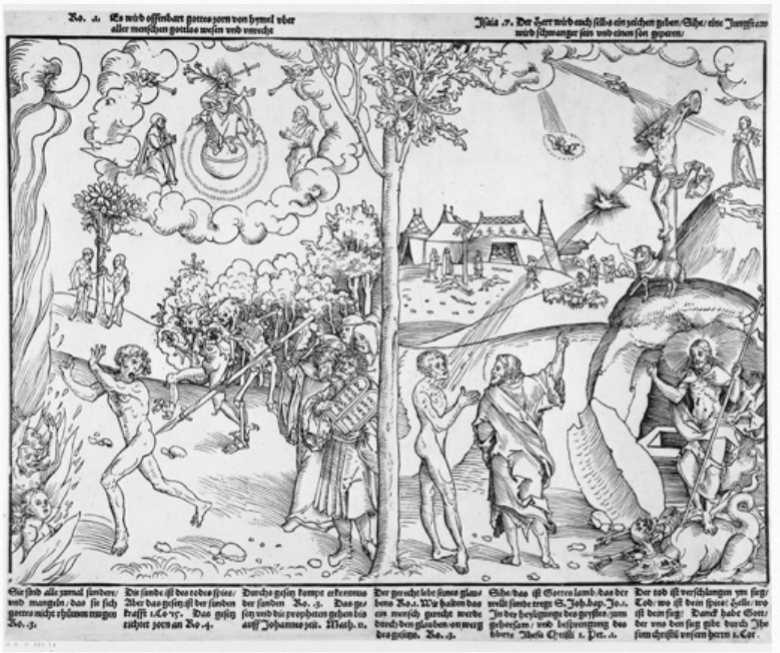
(Unit 3 Chapter 14 - Northern Renaissance (c. 1400 - 1600 CE)) #79: Allegory of Law and Grace
VOCABULARY: Martin Luther
German priest whose theological beliefs spurred the Protestant Reformation
(Unit 3 Chapter 14 - Northern Renaissance (c. 1400 - 1600 CE)) #79: Allegory of Law and Grace
VOCABULARY: Protestant Reformation
Catholic Church was becoming OVERLY rich in money, power, and art… not all agreed w/ religious rules and needed a new version of Christian faith
(Unit 3 Chapter 14 - Northern Renaissance (c. 1400 - 1600 CE)) #79: Allegory of Law and Grace
VOCABULARY: Lutheranism
is the largest of the Protestant denominations
(Unit 3 Chapter 14 - Northern Renaissance (c. 1400 - 1600 CE)) #79: Allegory of Law and Grace
VOCABULARY: Allegory
a picture that can be interpreted to reveal a hidden meaning, usually moral or political
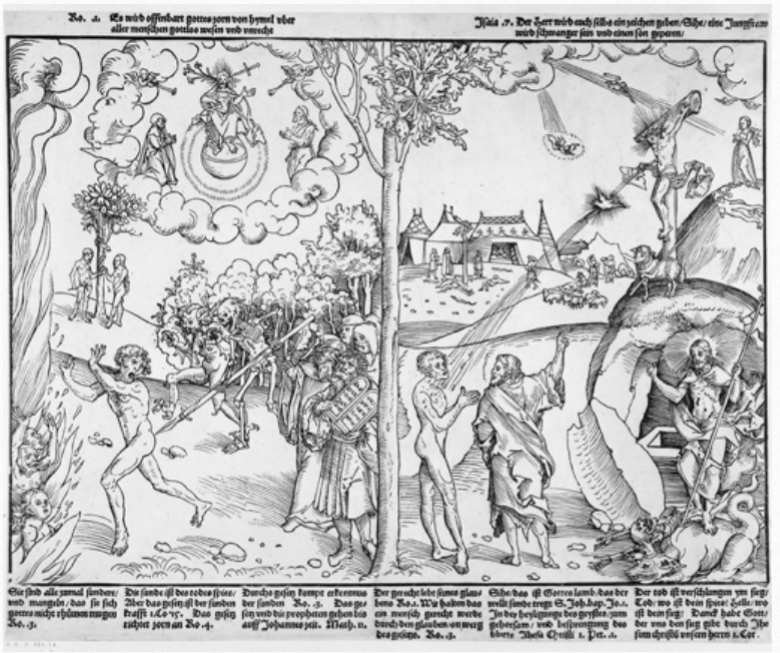
(Unit 3 Chapter 14 - Northern Renaissance (c. 1400 - 1600 CE)) #79: Allegory of Law and Grace
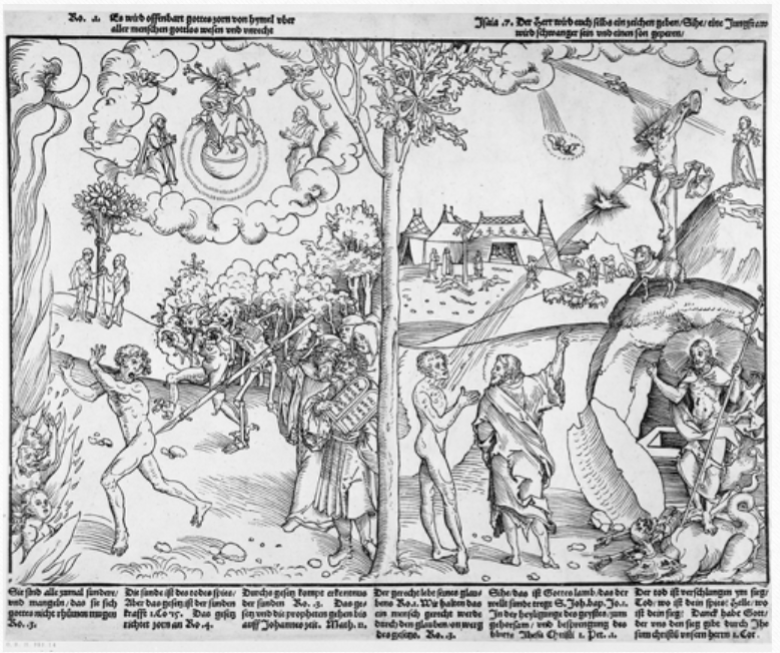
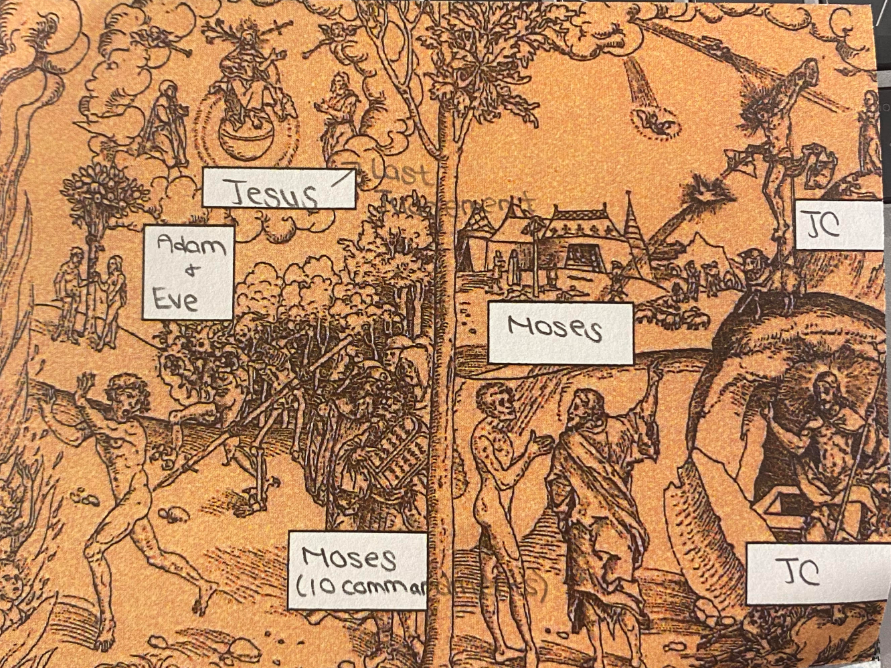
CONTENT (visual evidence): Label the artwork.
(Unit 3 Chapter 14 - Northern Renaissance (c. 1400 - 1600 CE)) #79: Allegory of Law and Grace
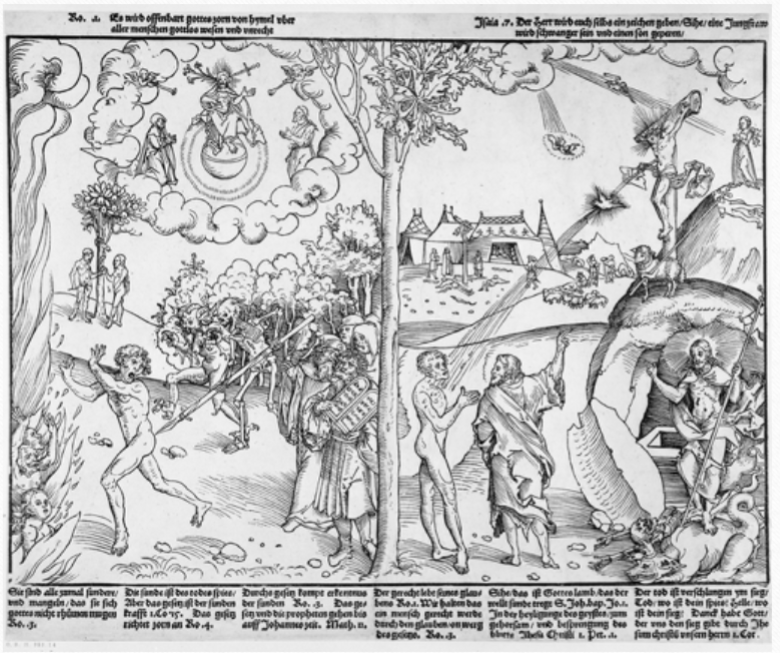
CONTENT (visual evidence)
Left:
Last Judgement Scene
Moses holds 10 commandments (which represents old law & Catholicism)
Not enough to live a good life
Right:
Figure is now bathed in the blood of JC
FAITH is needed for true salvation
(Unit 3 Chapter 14 - Northern Renaissance (c. 1400 - 1600 CE)) #79: Allegory of Law and Grace
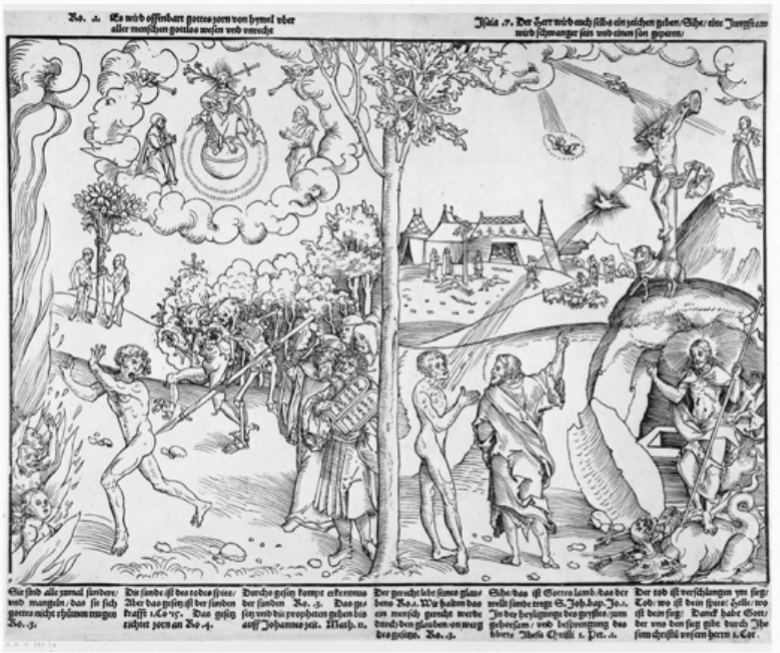
CONTEXT (what is happening historically)
Lucas Cranach the Elder created a painting first in 1529 before he switched to printmaking techniques…why?
THE PRINTING PRESS IS HERE → things can be mechanically produced quicker and cheaper (better for lower class)
Not enough to live a good life, FAITH is needed for true salvation
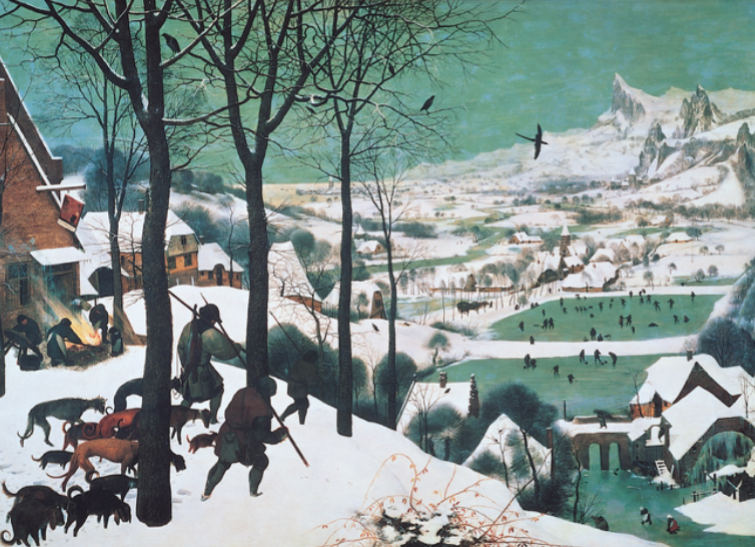
(Unit 3 Chapter 14 - Northern Renaissance (c. 1400 - 1600 CE)) Name this piece!
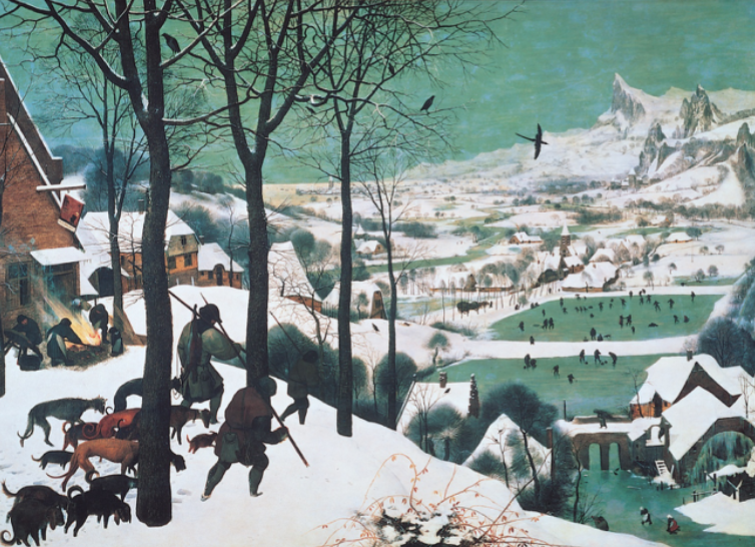
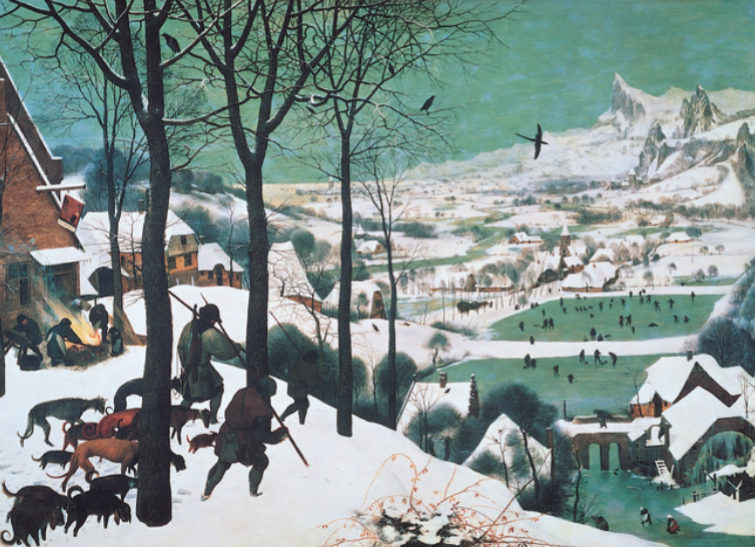
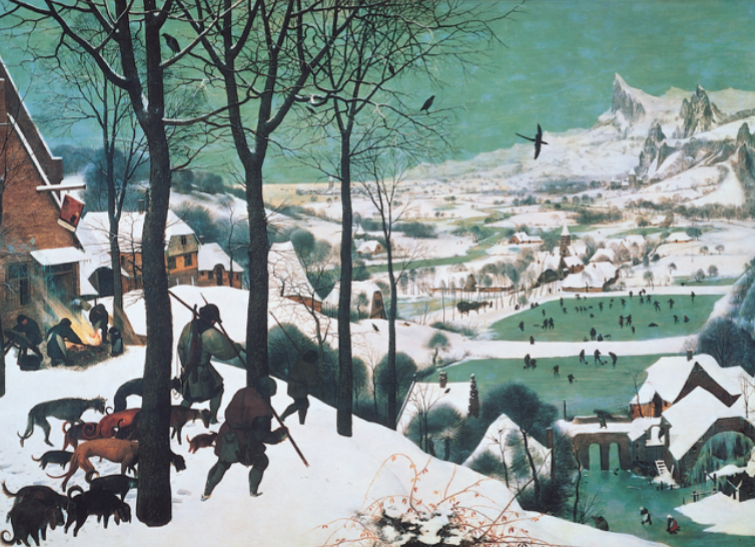
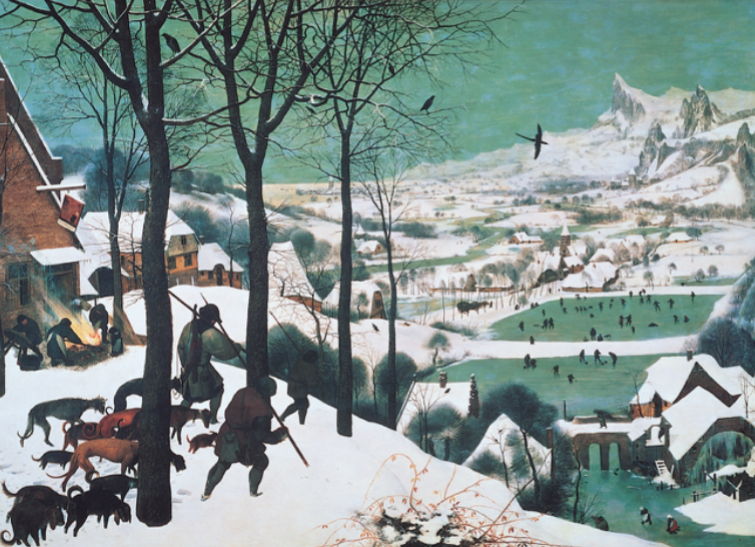
Hunters in the Snow
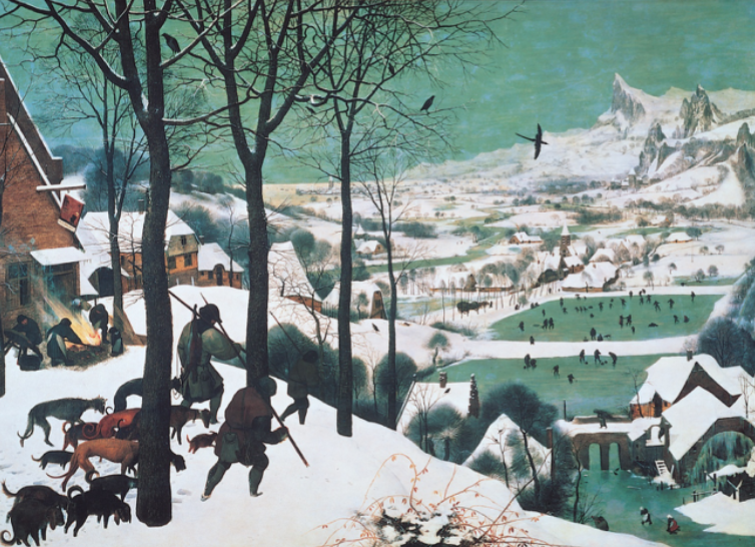
(Unit 3 Chapter 14 - Northern Renaissance (c. 1400 - 1600 CE)) #83: Hunters in the Snow
LOCATION
Antwerp, Belgium
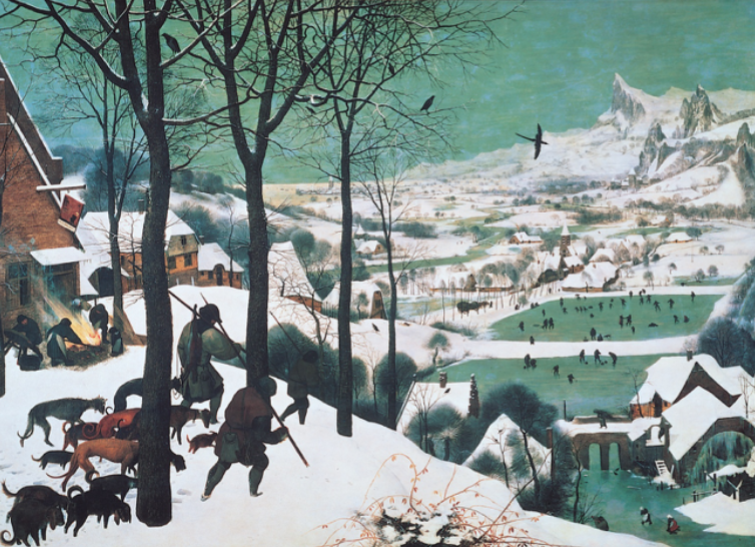
(Unit 3 Chapter 14 - Northern Renaissance (c. 1400 - 1600 CE)) #83: Hunters in the Snow
ERA
Northern European Renaissance
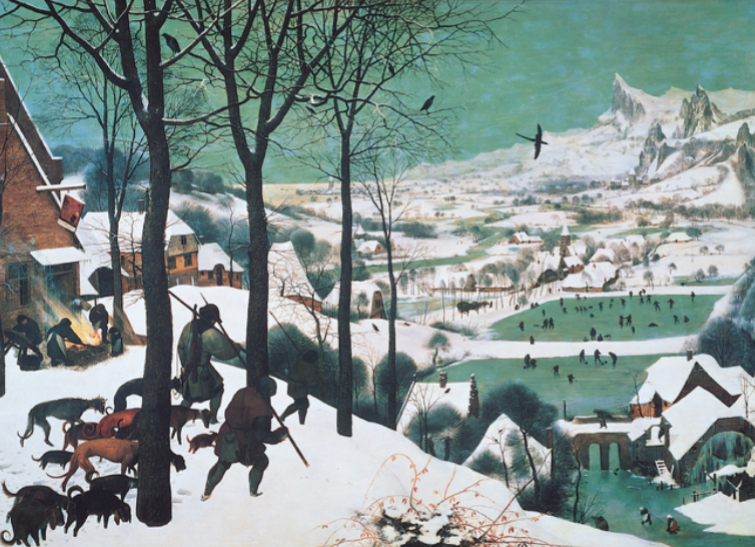
(Unit 3 Chapter 14 - Northern Renaissance (c. 1400 - 1600 CE)) #83: Hunters in the Snow
ARTIST
Pieter Bruegel the Elder
(Unit 3 Chapter 14 - Northern Renaissance (c. 1400 - 1600 CE)) #83: Hunters in the Snow
FORM
Oil on wood
(Unit 3 Chapter 14 - Northern Renaissance (c. 1400 - 1600 CE)) #83: Hunters in the Snow
PATRON
Nicolaes Jonghelinck (merchant who wanted the images to hang in the dining room of his suburban Antwerp home)
(Unit 3 Chapter 14 - Northern Renaissance (c. 1400 - 1600 CE)) #83: Hunters in the Snow
FUNCTION
1 of 6 secular paintings that depict the different seasons, this on being Nov. and Dec,
(Unit 3 Chapter 14 - Northern Renaissance (c. 1400 - 1600 CE)) #83: Hunters in the Snow
VOCABULARY: Alpine
adjective for the Alps mountain range
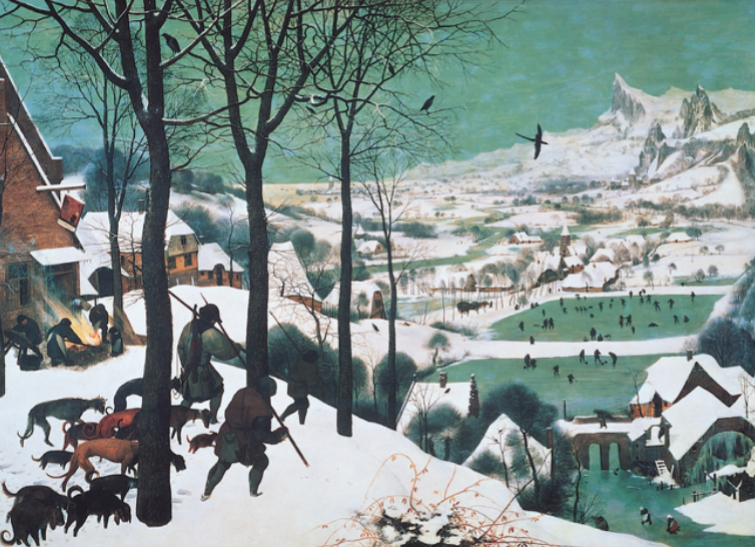
(Unit 3 Chapter 14 - Northern Renaissance (c. 1400 - 1600 CE)) #83: Hunters in the Snow
VOCABULARY: Secular
non-religious
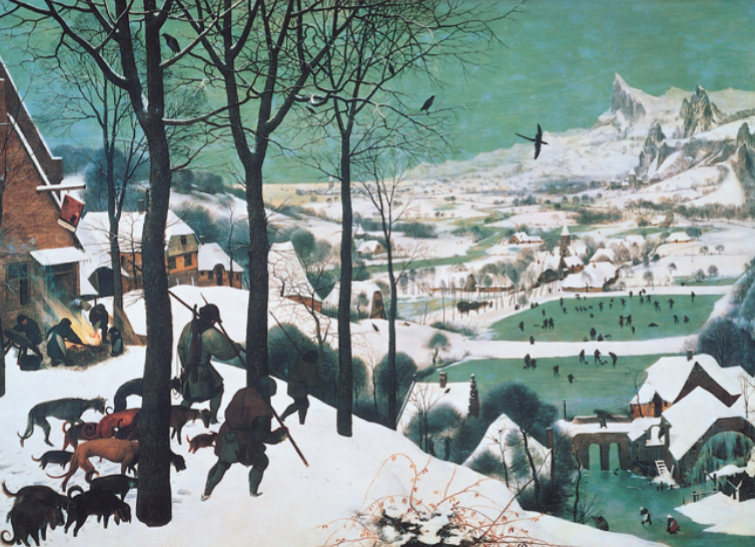
(Unit 3 Chapter 14 - Northern Renaissance (c. 1400 - 1600 CE)) #83: Hunters in the Snow
CONTENT (visual evidence)
Foreground → hunters returning from unsuccessful hunt (only 1 rabbit)
use faith through harsh winter
Middleground → winter activities
Background → Alpine landscape, sad expression of dog, reflection of skaters on ice
 Note
Note  Flashcards (23)